Monastery of the Holy Forty Martyrs

Today, June 4, is the celebration of Pentecost, an important holiday in the Christian religion and a great feast in the Orthodox Church. It is celebrated fifty days after Easter and gets its name from that number (pente / πέντε). It commemorates the day the Holy Spirit descended on the apostles in Jerusalem, after which they were able to speak in tongues.

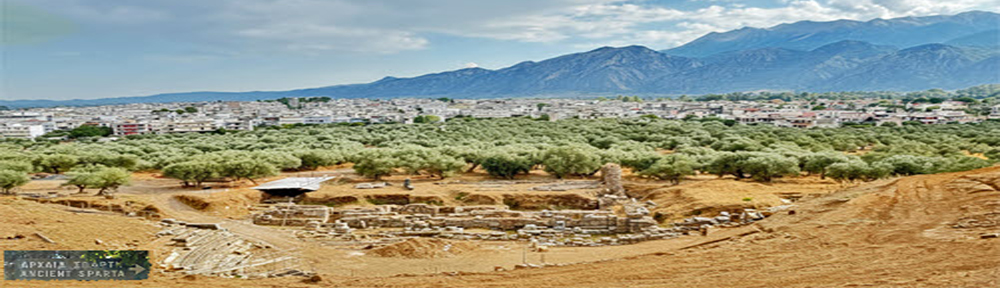
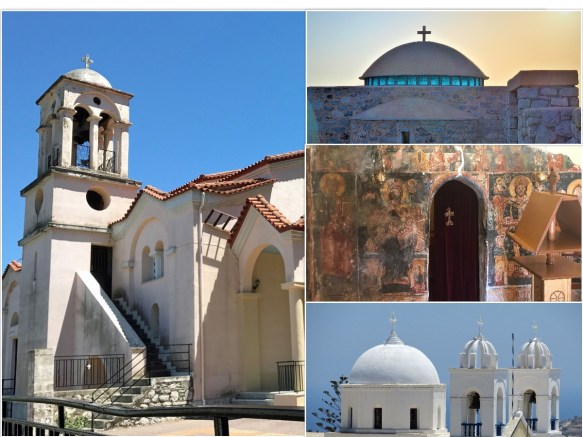
This morning my cousins took me to church services to one of the most important Byzantine monasteries in Lakonia, the Monastery of the Holy 40 Martyrs (Ιερα Μονη Αγιων Τεσσαρακοντα Μαρτυρων). The monastery takes its name from The Forty Martyrs of Sebaste. They were Roman soldiers who, in the year 320, were killed for not renouncing their Christian faith.1 Located by the village of Chrysafa, about 5 miles from Sparta, the Monastery is near the top of a mountain, surrounded by fields and olive trees. The original monastery was in a natural cave, initially founded in 1305 and situated northeast of its present location. It was moved to its present location in the 17th century.

Over time, stone buildings were constructed and the complex grew to meet the needs of an increasing number of monks and priests.

The Metropolis of Sparta designates the interior frescoes as “a miracle of Byzantine painting reaching the limits of high art.1” Painted against stone, their colors have remained vibrant throughout the centuries. Tiny windows filter the light to make the interior ethereal.

During the Ottoman dominion of Greece, the sultan issued a decree which granted the Monastery special privileges and kept it from Muslim desecration. Also, the Monastery possessed a document, Achtanames (testament) of Mohammed, which granted the clergy freedom to practice the Orthodox religion, exempted them from taxes and military duty, and ordered the Muslims to shield them from those who would do harm.2 It was an extraordinary document which ensured the preservation of the Monastery and the protection of its monks and priests.

The importance of the Orthodox Church in Greece cannot be understated. It is not simply a religion, but is a significant source of Greek identity–especially during periods of foreign occupation. Through thousands of years, it has been a driving force in preserving Greek culture, language and history. Its libraries hold manuscript codices and documents of historical value. It operates schools and seminaries, and provides social services such as hospitals, orphanages, and charitable organizations.

The Church played a pivotal role in the Greek Revolution of 1821. It fostered patriotism and unity among the citizens, as well as providing them moral support and spiritual guidance. Priests not only encouraged the fight for liberation, but also fought side-by-side with revolutionaries. Monasteries and churches became hospitals or military headquarters, and sources of income to meet the needs of the armies.

To understand Greeks, we must understand their country’s ties to the Church, its significance in the history of the country, and its role in the everyday lives of its people.


1Orthodox Wiki
2Source of historical information: Metropolis of Sparta and Momenvasia

1874, Villagers of Agios Ioannis Request a New Priest

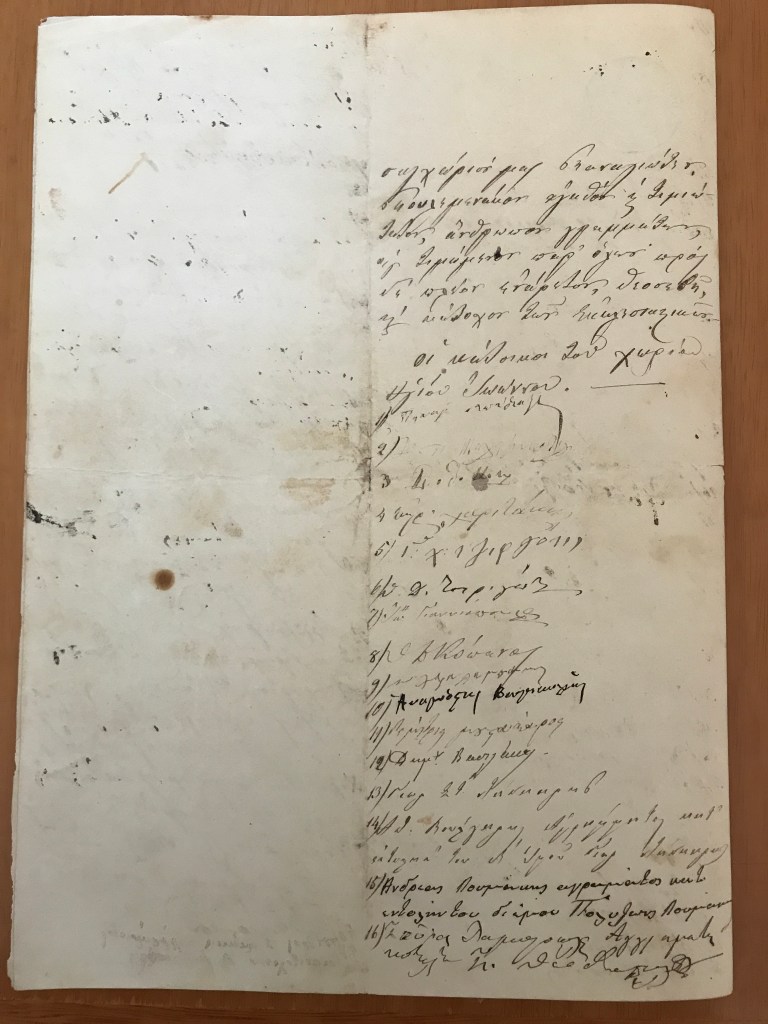
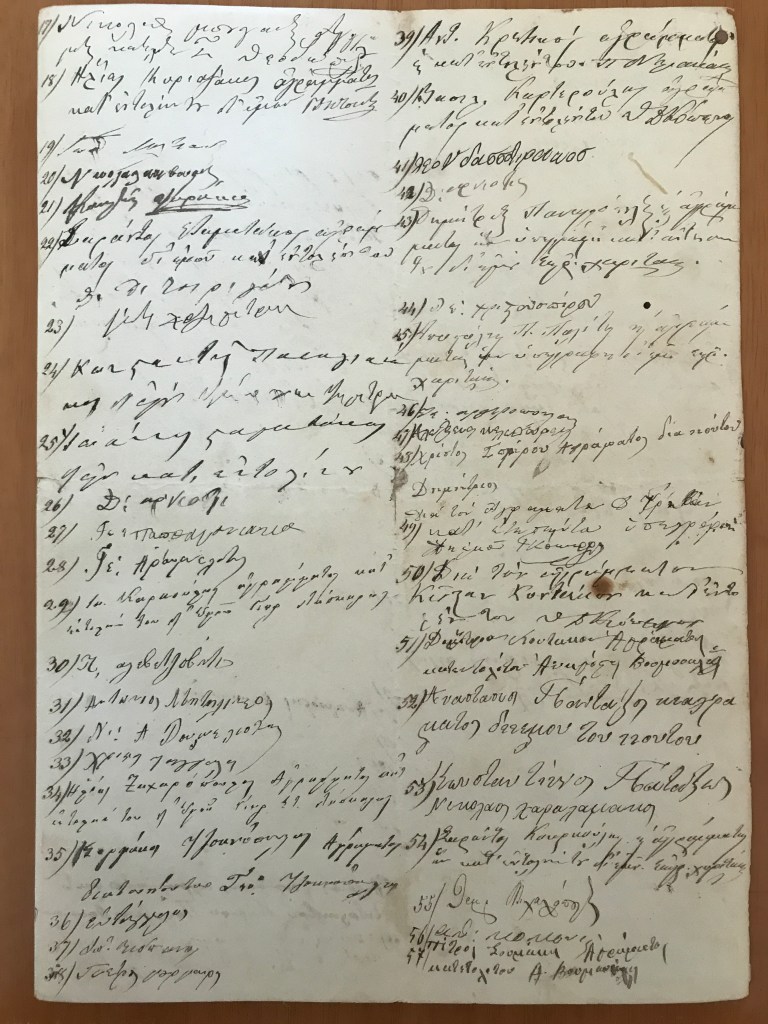
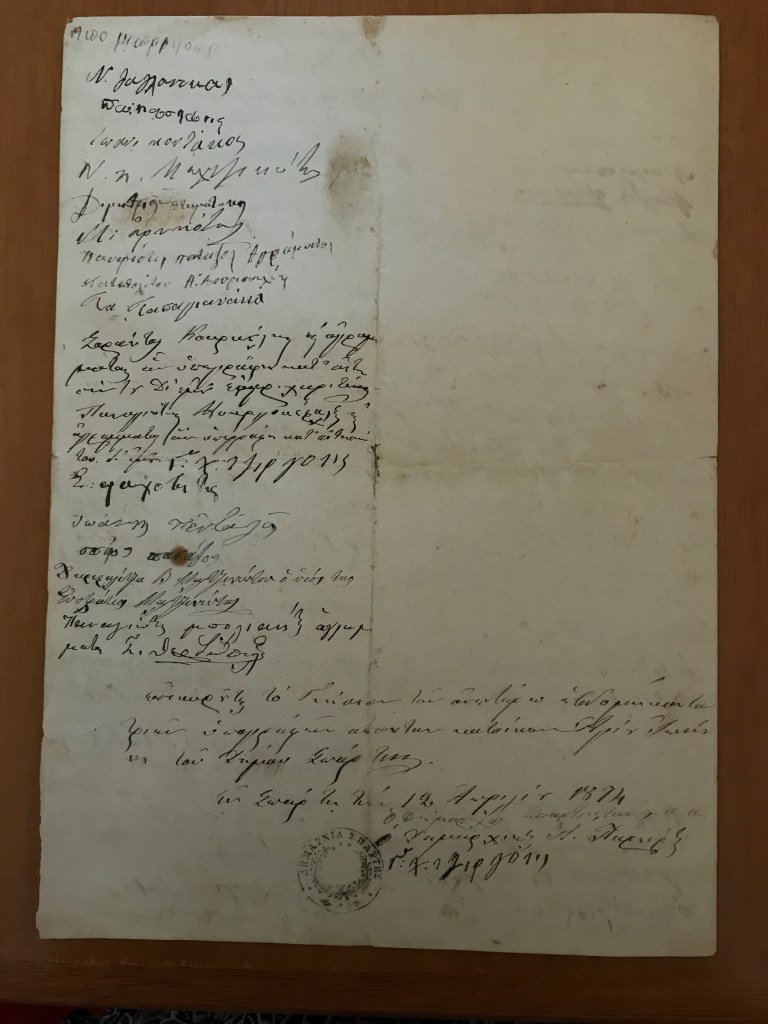
When I was digitizing the records of marriages from 1835-1935 at the Metropolis of Sparta in 2018, I came across an unusual document. It caught my attention because it was from my ancestral village of Agios Ioannis and there were many signatures. It is a formal request to the Bishop of Sparta for a new priest to be sent to Agios Ioannis. I asked Gregory Kontos of GreekAncestry for a translation.

This was published on my website, Agios Ioannis, Sparta which is dedicated specifically to the families and stories of that village. I am cross-posting here as it is a historic document signed by the majority of the families.

To the Honorable Bishop of Monemvasia and Sparti

Received on April 27th, 1874

No. 221

April 20th, 1874

Agios Ioannis

It is known to you, your Eminence, that Agios Ioannis has over two hundred families, which, as follows, cannot be ministered by the current one priest with all the willingness he has, especially as the families are not concentrated, but are dispersed in neighborhoods, which are quite far from each other, about half an hour from where the priest is based. For this reason, we believe that one more priest has to be appointed and that the priest needs to be from this village and of general renown, so that through his position and his estimation from his co-villagers he will command respect and resolve many little disputes.

If you approve, we ask you to ordain our co-villager, Panagiotis Poulimenakos, a good and honest man of letters, valued by everyone, and also virtuous, pious and with ecclesiastical knowledge.

The residents of the village of Agios Ioannis,

  1. Panagiotis Papa[…]
    2. D. P. Maltziniotis
    3. P. Th. Ko[…]
    4. Efstr. Charitakos
    5. I. Ch. Tzirgotis
    6. Th. D. Tsirigotis
    7. Ioannis Gianniopoulos
    8. Th.  D. Kopanos
    9. K [?] Haralambakos
    10. Anagnostis V[…]lias
    11. Dimitrios Moustakaros
    12. Dimitrios Vasilakos
    13. Georgios St. Laskaris
    14. Ath. Voulgaris, illiterate. On his order and behalf, Geor. Laskaris.
    15. Andreas Loumakis, illiterate. On his order and behalf, Polyzois Loumakis.
    16. Spyros Lampropoulos, illiterate. On his order and behalf, K. Theodosopoulos.
    17. Nikolaos Bougadis, illiterate. On his order and behalf, Theodopoulos.
    18. Ilias Kyriazakis, illiterate. On his order and behalf, G. D. […].
    19. Ioan. M[.]ltiad[.]
    20. Nikolaos […]
    21. Konstantis Psyrakis
    22. Sarantos Stamatakos, illiterate. On his order and behalf, D. [?] P. Tsirigotis.
    23. Zois [?] […]
    24. Konstantis Panagianakos. On his behalf, Chatzipetros.
    25. Ioannis Stamatakos, on his order and behalf.
    26. D. Arniotis
    27. Io. Papagiannakos
    28. Ge. Aramel[…]
    29. Io. Karkoulis, illiterate. On his order and behalf, Geor. Laskaris.
    30. P. Alevetzovitis
    31. Antonios Mitilinaios
    32. N. A. Roumeliotis
    33. Christos Tagkalos
    34. Ilias Zacharopoulos, illiterate. On his order and behalf, Geor. St. Laskaris.
    35. Kargakos Tzounopoulos, illiterate. On his behalf, Geo. Tzounopoulos.
    36. Efta[…]
    37. Ioannis Kopanos
    38. Petros Gourgouris
    39. Ant. Kritikos, illiterate.On his order, P. N. Liakakos.
    40. Vasileios Karteroulis, illiterate. On his order, D. Kopanos.
    41. Leonidas Sotirakos
    42. D. Arniotis
    43. Dimitrios Panagopoulos, illiterate On his order and behalf, Efstr. Charitakos.
    44. Le. Christou Spirou
    45. Apostolis P. Politis, illiterate. On his order and behalf, Efstr. Charitakos.
    46. K. Argyropoulos
    47. Alexandros Kelepouris
    48. Christos Spyrou, illiterate. On his behalf, Dimitrios.
    49. On behalf of D. Gravas [?], G. Kokoris.
    50. On behalf of illiterate Konstas Kontakos, Th. D. Kopanos.
    51. Dimitrios Kontakos, illiterate. On his order and behalf, Anagnostis Vougiouklas.
    52. Anastatios Pantazos, illiterate. On his behalf, his son.
    53. Konstantinos Pantazos, Nikolaos Charalampakos
    54. Sarantos Kourkoulis, illiterate. On his order and behalf, Efstr. Charitakos.
    55. Them. Michalopoulos
    56. An. Kokonis
    57. Petros Soumakis, illiterate. On his order, A. Vougiouklis [?]
    [58.] N. Lagchanikas [?]
    [59.] Papasionis [?]
    [60.] Ioannis Kontakos
    [61.] N. N. Maltziniotis
    [62.] Dimitrios Stamatakos
    [63.] M. Arniotis
    [64.] Panagiotis Pantazos, illiterate. On his order, A. Vougiouklis.
    [65.] Pa. Papagiannakos
    [66.] Sarantos Kourkoulis, illiterate. On his order and behalf, Efstr. Charitakos.

[67.] Panagiotis Mourgokefalos, illiterate. On his order and behalf, G. Ch. Tzirgotis.

[68.] S. […]
[69.] Ioannis Pantazos
[70.] Spyros Pantazos
Charifalitza V. Maltziniotou, her son, Efstratios Maltziniotis

Panagiotis Mpolianitis, illiterate. On his behalf, S. Theodopoulos.

The authenticity of the above 70 signatures of all the residents of Agios Ioannis of the Municipality of Sparta is verified.

Sparta, April 12th, 1874

The Mayor of Sparta,

The Representative of Parori,

G. Ch. Tzirgotis

1874 Letter, page 1
1874 Letter, page 2
1874 Letter, page 3
1874 Letter, page 4

Heart of the Village

The heart of every Greek village is its church. Seared into each Greek psyche is reverence, respect and reliance on religion. Their Orthodox faith has buoyed Hellenes through wars, occupations, personal and natural disasters. Its traditions and holidays anchor life in a rythmn of peaceful repetition and steadfastness.
The soul of the village is its priest–the father (παπάς) of the congregation who ministers, counsels and guides his people. Together, the villagers and their beloved πάπα navigate mortality and attend to its holy sacraments.
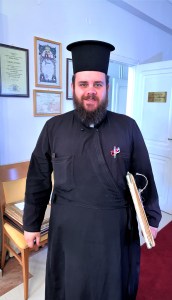
Papa Panagiotis, priest of Theologos, Lakonia, whom I met at the Metropolis of Sparta last summer

I continue to be awed by the number of churches dotting the Greek landscape. Even the smallest villages may have several. Some are erected by families to commemorate a loved one; some are older and no longer attended except on its patron saint holiday; some are tiny holy places excavated within rock caves, and others are simple, small buildings. My village of Agios Ioannis has eight churches!

Tiny church excavated within a cave, Faneromeni Monastery, Mani

Small church in Vordonia, Lakonia

Not all churches have a priest serving every Sunday, but at some point in the year, most host at least one divine liturgy.

Today, priests are appointed and remunerated by the state. But this was not always so–before 1967, priests were commissioned and compensated by each village. Candidates were identified and elections were held with voters (e.g., heads of household) casting their ballots and choosing their new ecclesiastical leader. This  practice resulted in a rare and exciting collection recently made available on GreekAncestry–Parish Voter Lists, which I wrote about here.

When I was digitizing marriage documents at the Metropolis of Sparta, I came across one that caught my attention because it did not appear to be wedding-related. It was a letter with three pages of signatures. I was able to read the words Αγιός Ιωάννης (St. Johns) which caused me to stop work immediately. This is my village and my curiosity was raised–what is this document? My colleague, Gregory Kontos, explained that it was a petition from the residents of Agios Ioannis to the Bishop, requesting that a second priest be appointed. There were over 200 families in the village and the villagers felt that having just one priest was not sufficient to meet the needs of the people. They proposed that a local man, Panagiotis Poulimenakos, be ordained.

This document, created in 1894*, was signed by 70 men and one woman. It is a historical and genealogical treasure. It supplements the 1872 Election Lists and fills gaps in the Male Registers of Agios Ioannis. Now preserved are the handwritten signatures of the parishioners–most of whom would have signed few, if any, documents during their lifetime. The document shows us who is literate, and who is not. The signature of Charifalitza V. Maltziniotou denotes that her husband, Vasileios, was deceased, and that the prominence of the Maltziniotis family in the village lended credence and weight to the parishioners’ petition.

Below is the document and its translation, for which I am forever indebted to Gregory Kontos. We now have a glimpse into the dealings of these humble people who are seeking a second priest to tend to the spiritual and temporal needs of their families.
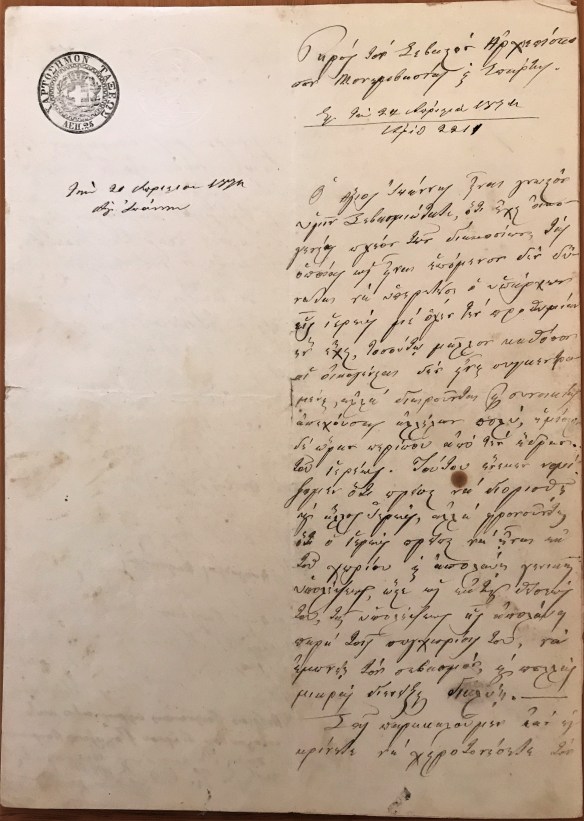
Agios Ioannis, Petition, 1894, p.1

Agios Ioannis, Petition, 1894, p.2
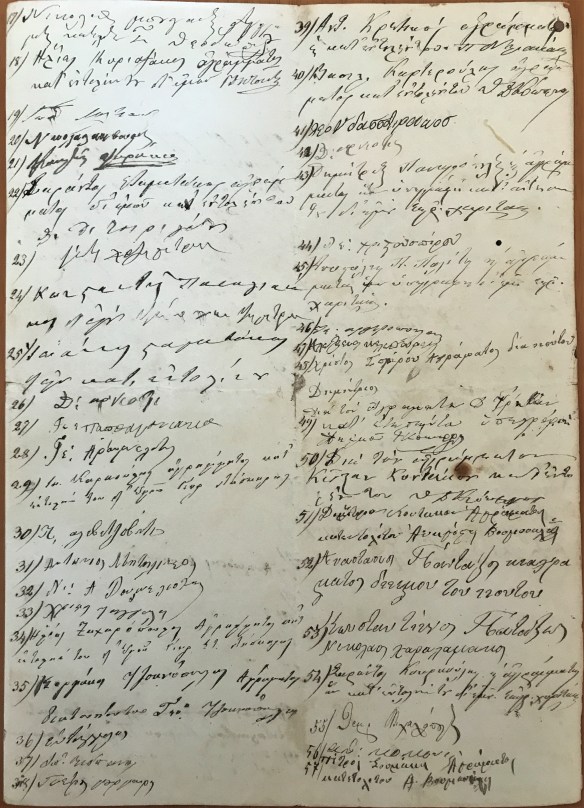
Agios Ioannis, Petition, 1894, p.3
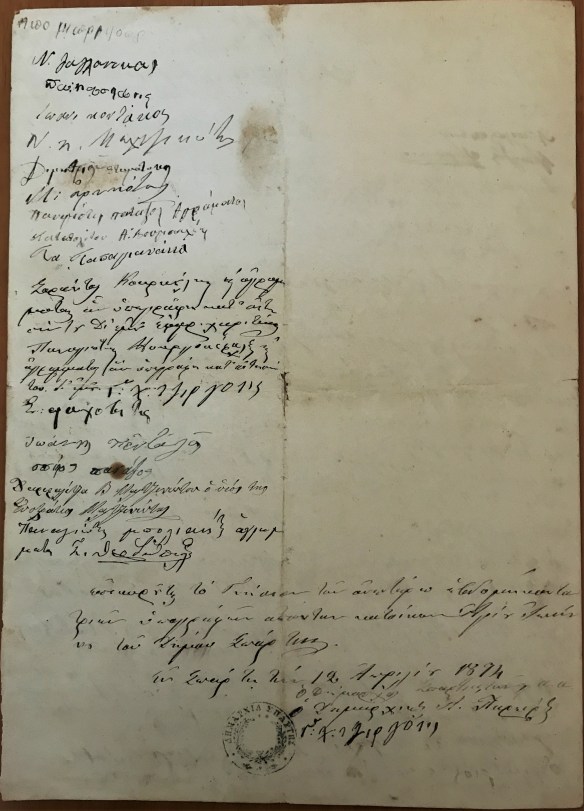
Agios Ioannis, Petition, 1894, p.4

To the Honorable Bishop of Monemvasia and Sparti
Received on April 27th, 1894
No. 221
April 20th, 1894
Agios Ioannis

It is known to you, your Eminence, that Agios Ioannis has over two hundred families, which, as follows, cannot be ministered by the current one priest with all the willingness he has, especially as the families are not concentrated, but are dispersed in neighborhoods, which are quite far from each other, about half an hour from where the priest is based. For this reason, we believe that one more priest has to be appointed and that the priest needs to be from this village and of general renown, so that through his position and his estimation from his co-villagers he will command respect and resolve many little disputes.

If you approve, we ask you to ordain our co-villager, Panagiotis Poulimenakos, a good and honest man of letters, valued by everyone, and also virtuous, pious and with ecclesiastical knowledge.

The residents of the village of Agios Ioannis

1. Panagiotis Papa[…]
2. D. P. Maltziniotis
3. P. Th. Ko[…]
4. Efstr. Charitakos
5. I. Ch. Tzirgotis
6. Th. D. Tsirigotis
7. Ioannis Gianniopoulos
8. Th.  D. Kopanos
9. K [?] Haralambakos
10. Anagnostis V[…]lias
11. Dimitrios Moustakaros
12. Dimitrios Vasilakos
13. Georgios St. Laskaris
14. Ath. Voulgaris, illiterate. On his order and behalf, Geor. Laskaris.
15. Andreas Loumakis, illiterate. On his order and behalf, Polyzois Loumakis.
16. Spyros Lampropoulos, illiterate. On his order and behalf, K. Theodoropoulos.
17. Nikolaos Bougadis, illiterate. On his order and behalf, Theodopoulos.
18. Ilias Kyriazakis, illiterate. On his order and behalf, G. D. […].
19. Ioan. M[.]ltiad[.] [possibly Miltiades]
20. Nikolaos […]
21. Konstantis Psyrakis
22. Sarantos Stamatakos, illiterate. On his order and behalf, D. [?] P. Tsirigotis.
23. Zois [?] […]
24. Konstantis Panagianakos. On his behalf, Chatzipetros.
25. Ioannis Stamatakos, on his order and behalf.
26. D. Arniotis
27. Io. Papagiannakos
28. Ge. Aramel[…]
29. Io. Karkoulis, illiterate. On his order and behalf, Geor. Laskaris.
30. P. Alevetzovitis
31. Antonios Mitilinaios
32. N. A. Roumeliotis
33. Christos Tagkalos
34. Ilias Zacharopoulos, illiterate. On his order and behalf, Geor. St. Laskaris.
35. Kargakos Tzounopoulos, illiterate. On his behalf, Geo. Tzounopoulos.
36. Efta[…]
37. Ioannis Kopanos
38. Petros Gourgouris
39. Ant. Kritikos, illiterate.On his order, P. N. Liakakos.
40. Vasileios Karteroulis, illiterate. On his order, D. Kopanos.
41. Leonidas Sotirakos
42. D. Arniotis
43. Dimitrios Panagopoulos, illiterate. On his order and behalf, Efstr. Charitakos.
44. Le. Christou Spirou
45. Apostolis P. Politis, illiterate. On his order and behalf, Efstr. Charitakos.
46. K. Argyropoulos
47. Alexandros Kelepouris
48. Christos Spyrou, illiterate. On his behalf, Dimitrios.
49. On behalf of D. Gravas [?, possibly Grivas], G. Kokoris.
50. On behalf of illiterate Konstas Kontakos, Th. D. Kopanos.
51. Dimitrios Kontakos, illiterate. On his order and behalf, Anagnostis Vougiouklas.
52. Anastatios Pantazos, illiterate. On his behalf, his son.
53. Konstantinos Pantazos, Nikolaos Charalampakos
54. Sarantos Kourkoulis, illiterate. On his order and behalf, Efstr. Charitakos.
55. Them. Michalopoulos
56. An. Kokonis
57. Petros Soumakis, illiterate. On his order, A. Vougiouklis [?]
[58.] N. Lagchanikas [?]
[59.] Papasionis [?]
[60.] Ioannis Kontakos
[61.] N. N. Maltziniotis
[62.] Dimitrios Stamatakos
[63.] M. Arniotis
[64.] Panagiotis Pantazos, illiterate. On his order, A. Vougiouklis.
[65.] Pa. Papagiannakos
[66.] Sarantos Kourkoulis, illiterate. On his order and behalf, Efstr. Charitakos.[67.] Panagiotis Mourgokefalos, illiterate. On his order and behalf, G. Ch. Tzirgotis.
[68.] S. […]
[69.] Ioannis Pantazos
[70.] Spyros Pantazos
[71.] Charifalitza V. Maltziniotou, her son, Efstratios Maltziniotis
[72.] Panagiotis Mpolianitis, illiterate. On his behalf, S. Theodopoulos.

The authenticity of the above 70 signatures of all the residents of Agios Ioannis of the Municipality of Sparta is verified.

Sparta, April 12th, 1894
The Mayor of Sparta,
The Representative of Parori,
Ch. Tzirgotis

________

*The year appears on both the first and last pages. It is not clearly written and could be either 1874 or 1894; we are assuming it is 1894 as there is no line through the stem of the 7, which is how that number is always written in Greek.