Reading a Town Register and a Male Register

My friend and Greek genealogist, Gregory Kontos, prepared some excellent handouts for the Hellenic Genealogy Conference in Salt Lake City on September 26, 2015.

This is a sample of a Dimotologion Koinothtos, or Town Register. It is similar to a U.S. census record as it lists the families in the villages, with parents and children’s names, birthdates, birth places, and other relevant information. These records were created in the 1900’s. The oldest families will have parents born in the late 1800’s, with their children born in the early-mid 1900’s. To my knowledge, there is no such record collection dated earlier than this timeframe, which is unfortunate as we cannot go back to find a father or a mother in this record, when he/she is listed as a child in their parents’ family.

This is page 1 of 2.

Dimotologion 1st page description

Here is an example of the 1st page of the Dimotologion, with an entry translated into English.
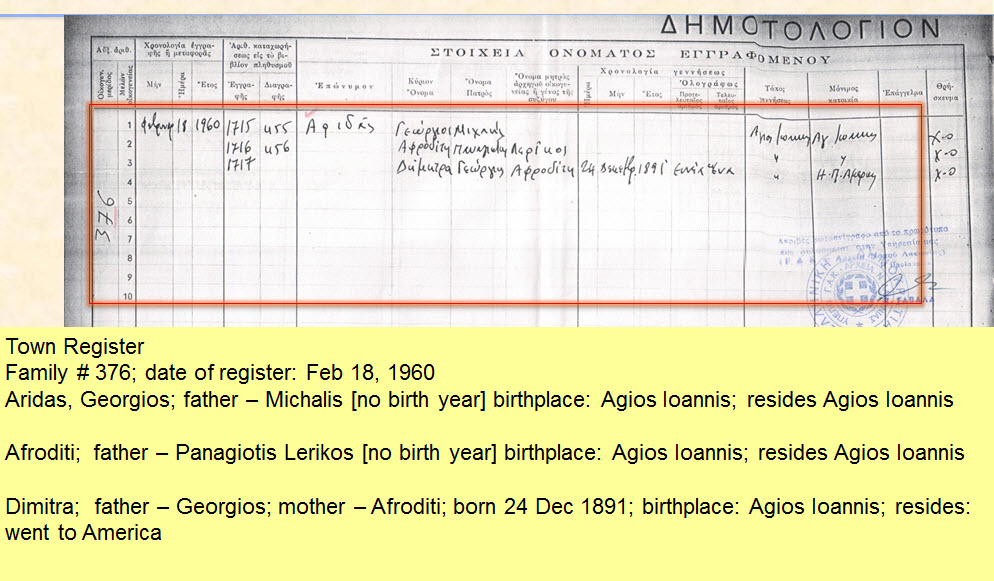
Dimotologion extracted 1st page

This is page 2 of a Dimotologion. It gives additional information about each person in the family.

Dimotologion 2nd page description

This is a Mitroon Arrenon, or Male Register. It is a record of every male born in a village. It was kept by the government for military draft purposes, and is considered an official register of birth.

Mitroon Arrenon 1st page description

These two record sets are the backbone of genealogy research in Greece. The regional offices of the General State Archives of Greece (GAK) have books with these record collections for the villages over which they have jurisdiction.

A list of the Regional  GAK offices can be found here: http://www.gak.gr/Cont/cont-py-00.html. The page can be translated into English using Google translate. If you write for information, include whatever you know about the family you are searching. It is especially important to know the spelling of the original surname in Greek (e.g., Papagiannakos, not just Pappas). You must also know the exact village and its location because there are many villages with the same name (e.g., not just Agios Ioannis, but Agios Ioannis Sparta).

Greek Microfilms at the FamilySearch Library

Various record collections from areas in Greece have been microfilmed and are available to the public through the FamilySearch Library and its more than 4,700 Family History Centers throughout the world. To locate the one closest to you, click here.

To find a Greek microfilm,  you will need to know the village, district, and county of your ancestor. The following explains the geographic divisions in Greece:

Greece is divided geographically into 9 main regions:
1.  Central Greece and Euvoia
2.  Peloponnese
3.  Ionian islands
4.  Thessaly
5.  Epirus
6.  Macedonia
7.  Thrace
8.  Aegean Islands
9.  Crete

Each of these 9 main regions is divided into “Counties” called Nomos.

Each of the nomos is divided into “Districts” called Eparhia.

Each Eparhia is divided into “Municipalities” called Dimos. A Dimos may include surrounding villages.

Prior to 1999, there was a division called “Community” or Koinotis. In 1999, all “communities” were dissolved and incorporated into the larger “Municipalities” or Dimos.

In order to determine if the FamilySearch Library has a Greek film of interest to you, you will need to identify the following information:

1.  The village
2.  The Dimos (municipality) to which the village belonged when the record was created
3.  The Eparhia (district) to which the Dimos belonged when the record was created.
4.  The Nomos (county) to which the Eparhia (municipality) belonged when the record was created.

You must also know the full, original Greek surname; for example: not Pappas, but Papadopoulos.

Records That May Give You Name & Village

  • Census (1900, 1910, 1920, 1930 ask specific immigration & naturalization questions)
  • Marriage (U.S. and Greek Church)
  • Baptismal Records (Greek Church)
  • Immigration (Passenger Ship)
  • Naturalization (Declaration of Intention & Petition for Naturalization)
  • Social Security Application (original and computerized)
  • World War I & II registration cards
  • Death Certificate (beware of informant’s possible misinformation)
  • Obituary
  • Tombstones
  • Photographs

After you have determined the original Greek surname and village, check to see if FamilySearch has a digitized microfilm for your location. Check the FamilySearch catalog for Greece.

Digital images can be viewed at any FamilySearch Center. Find the one closest to you at this link.

Surnames from Agios Ioannis (St. Johns), Sparta

During my visit to the Archives in Sparta last summer, I obtained pages of the Mitroon Arrenon (Male Registers) for the village of Agios Ioannis, Sparta. The records begin in 1844. This village is the birthplace of three of my four grandparents (Papagiannakos, Kostakos, Aridas/Michalakakos). Almost every page had surnames of my grandparents’ families, or those who married into my family. I was thrilled to have copies of these records!

I am ever-grateful to the staff at the GAK in Sparta: Pepi Gavala (Archivist), Maria Stellakou, and Michalis Sovolos. They are kind, gracious and most helpful!

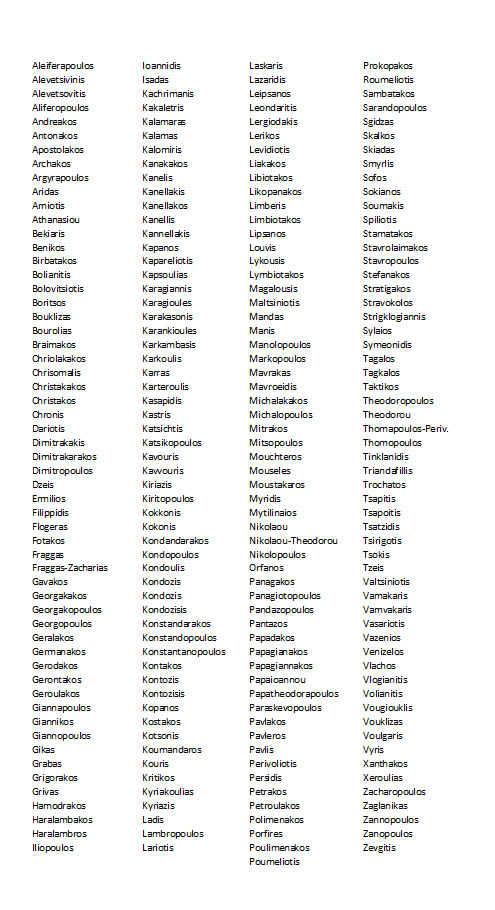
Below is an index of the surnames in the pages that I obtained (this list may not be complete.

Surnames - Agios Ioannis