Virtual Trip through Agios Ioannis (Sparta)

My friend, Georgia Stryker Keilman, found a Google car trip through our ancestral village of Agios Ioannis. Her post on her blog, HellenicGenealogyGeek, reads as follows:

Follow this link to view the TRIP THROUGH AGIOS IOANNIS.  This is a car driving through the village’s main road with a 360 degree camera mounted on the top of the car.  You can view this in several different ways: 1) the bottom strip of photographs are highlights from the video;  2)  on the lower right side of the main picture you will see “backward and forward” symbols < > which will allow you to move forward on the road incrementally;  3) you can place your cursor on the road and drag your way forward;  4) on the bottom right side of the main picture is a red and white pointer surrounded by circular arrows which will allow you to look at a 360 degree view from any point on the road.

Georgia’s connection to Agios Ioannis is her ancestor, George Stratigakos (1859-1921). I just love to think that our families must have known each other as this is not a big village, and that our grandfathers must have passed many hours in the local kafenio talking politics and other topics. Here we are, 100 years later, reconnected in a new land. It’s all so exciting!

Georgia’s HellenicGenealogyGeek Facebook page is the go-to place for online Greek genealogy collaboration with over 6,500 members.

Thank you, Georgia, for finding and posting this virtual tour and for all you do to connect Greek researchers online!

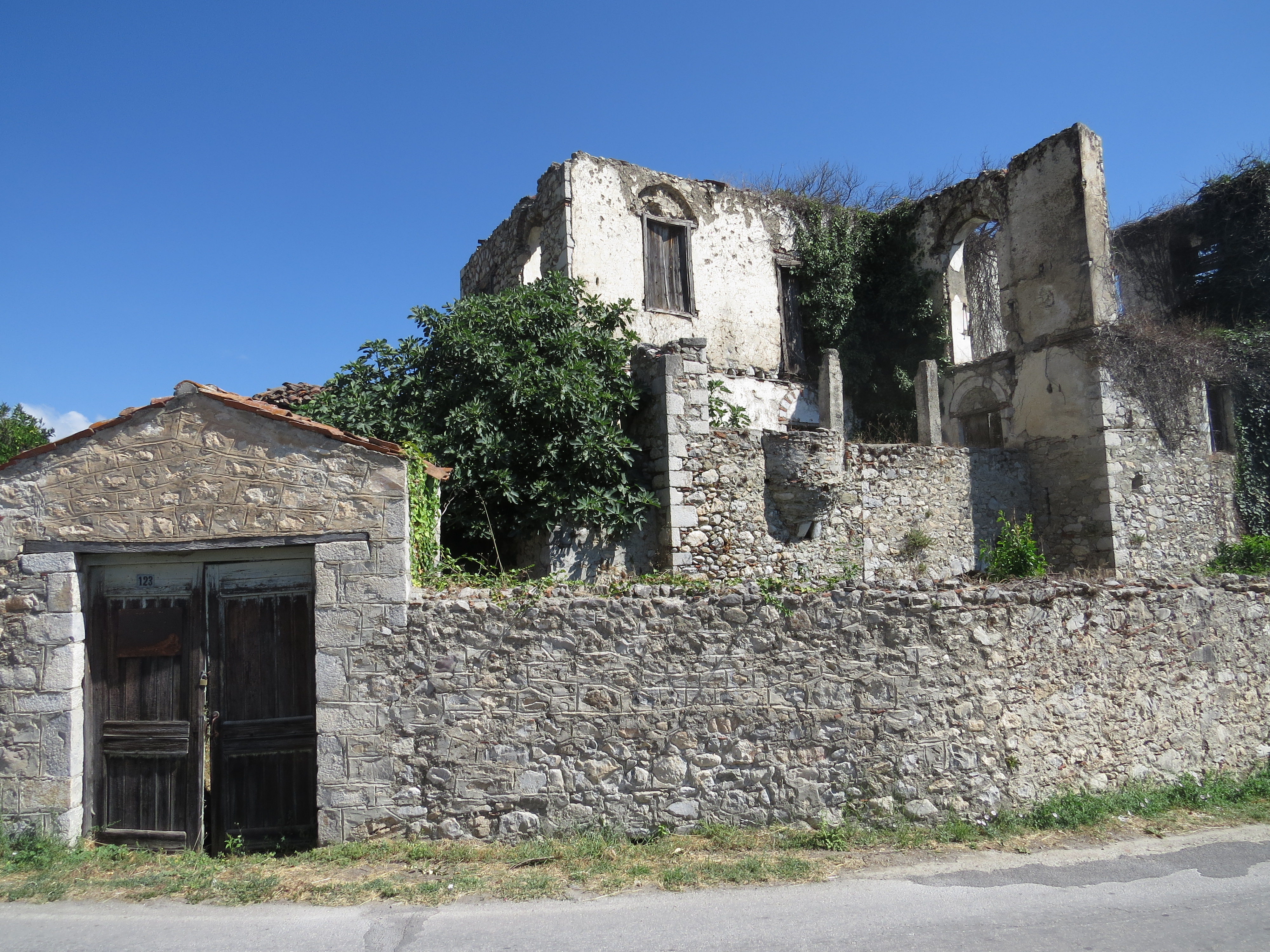
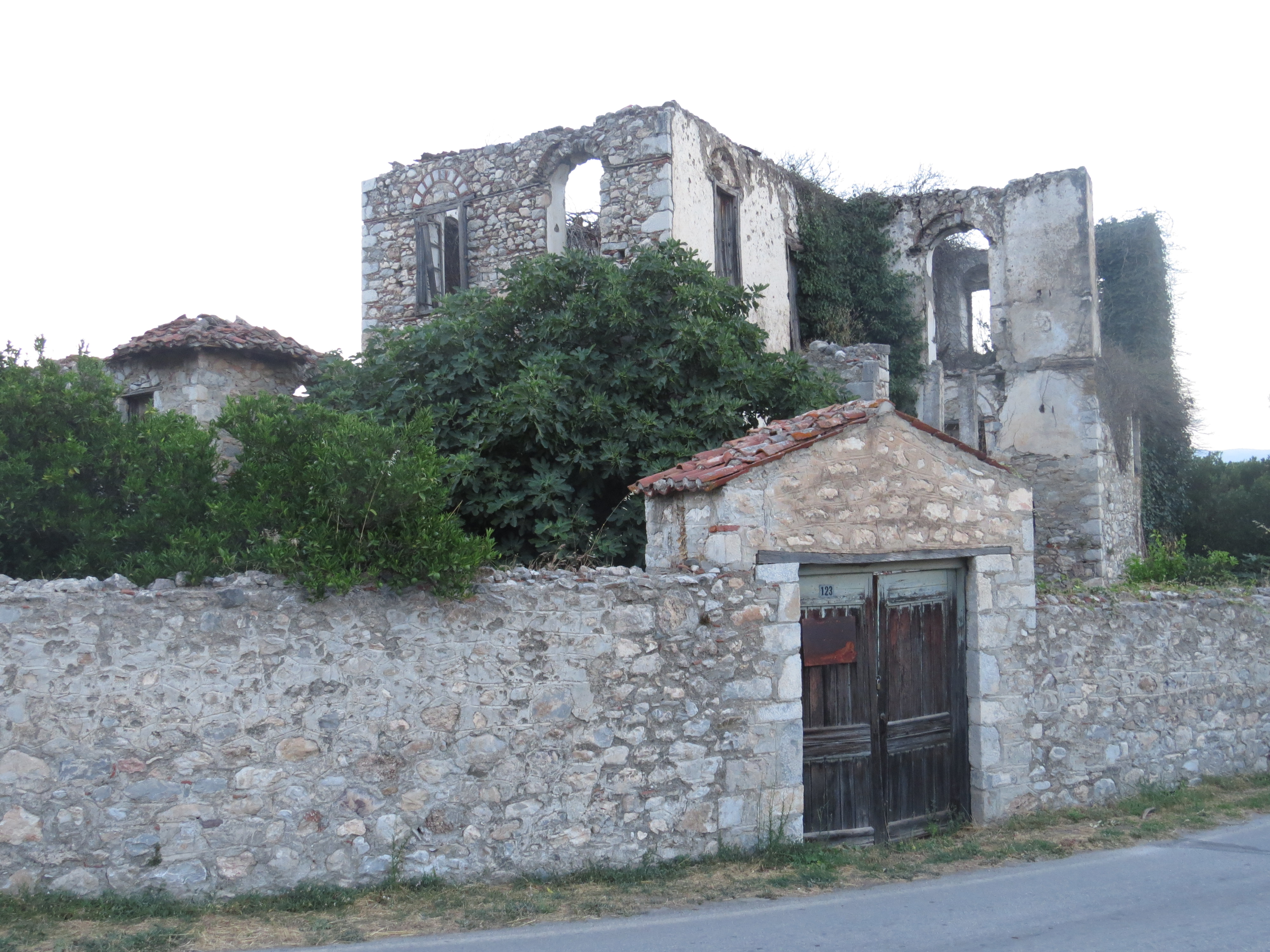
Maltsiniotis House in Agios Ioannis, Sparta

This is the Maltsiniotis house located in Agios Ioannis. My cousin, Father Eugene Pappas, was told by Demetrios Papagiannakos (“Jimmy” Pappas 1875-1948) that there is a blood connection between the Maltsiniotis and the Papagiannakos families. Possibly, the Maltsiniotis name was the precursor to the Papagiannakos name because a member of the Maltsiniotis family became a priest whose name became “Father John”. I haven’t found anything that can prove this interesting story, except that the Maltsiniotis house and the Papagiannakos School (built by this same Jimmy Pappas) share the same property. So, whether the connection is blood or business remains unclear.

The house is a replica of the amazing stone towers found in Mani, which is another clue that the family/families traveled north towards Sparta from the southern Peloponnese, most likely after the Revolution of 1821. It surely was a grand structure in its day! Wouldn’t it be amazing to restore it?

Maltsiniotis Tower Home, Agios Ioannis, Sparta. July 2014

Maltsiniotis Tower Home, Agios Ioannis, Sparta. July 2014

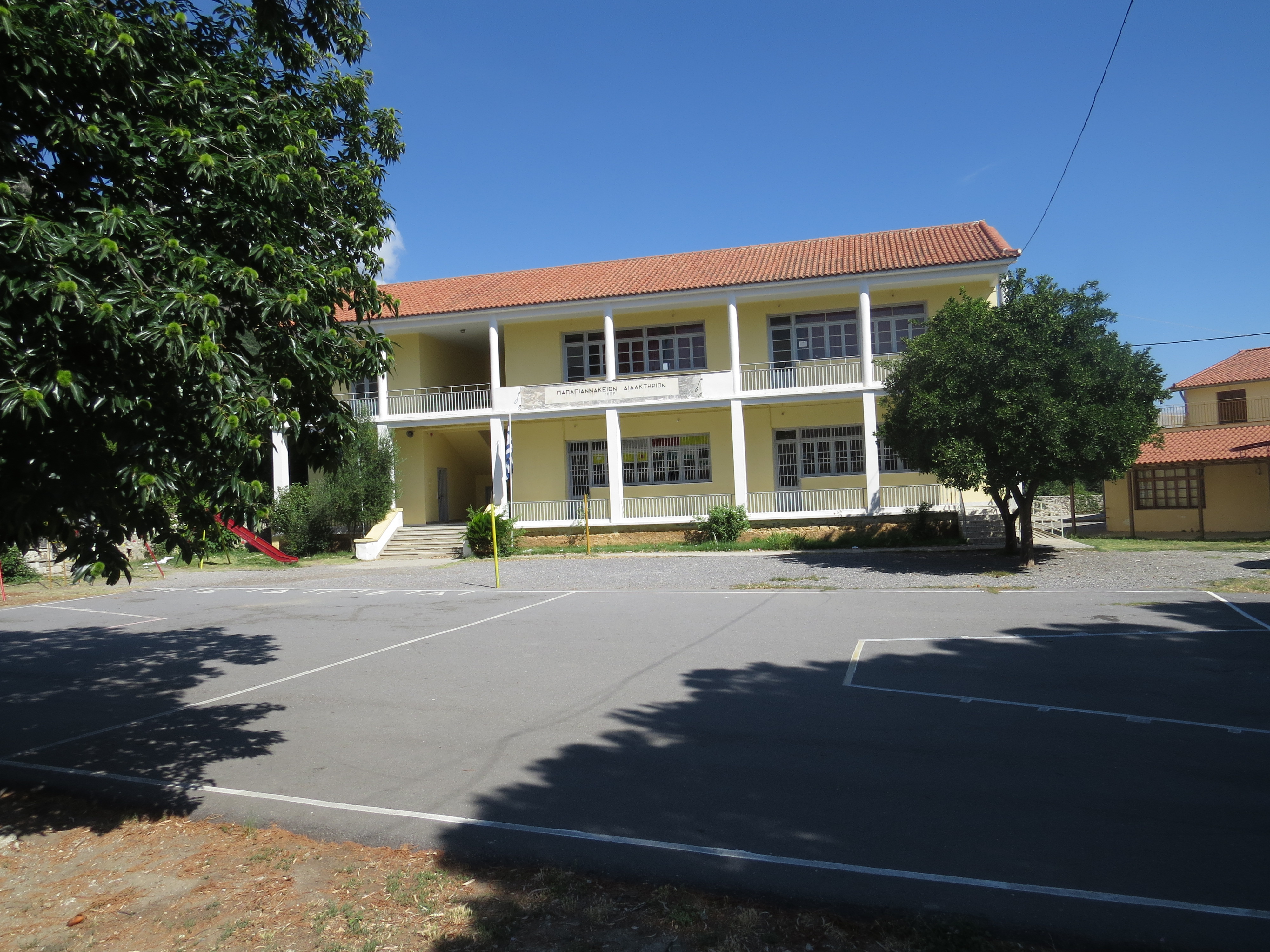
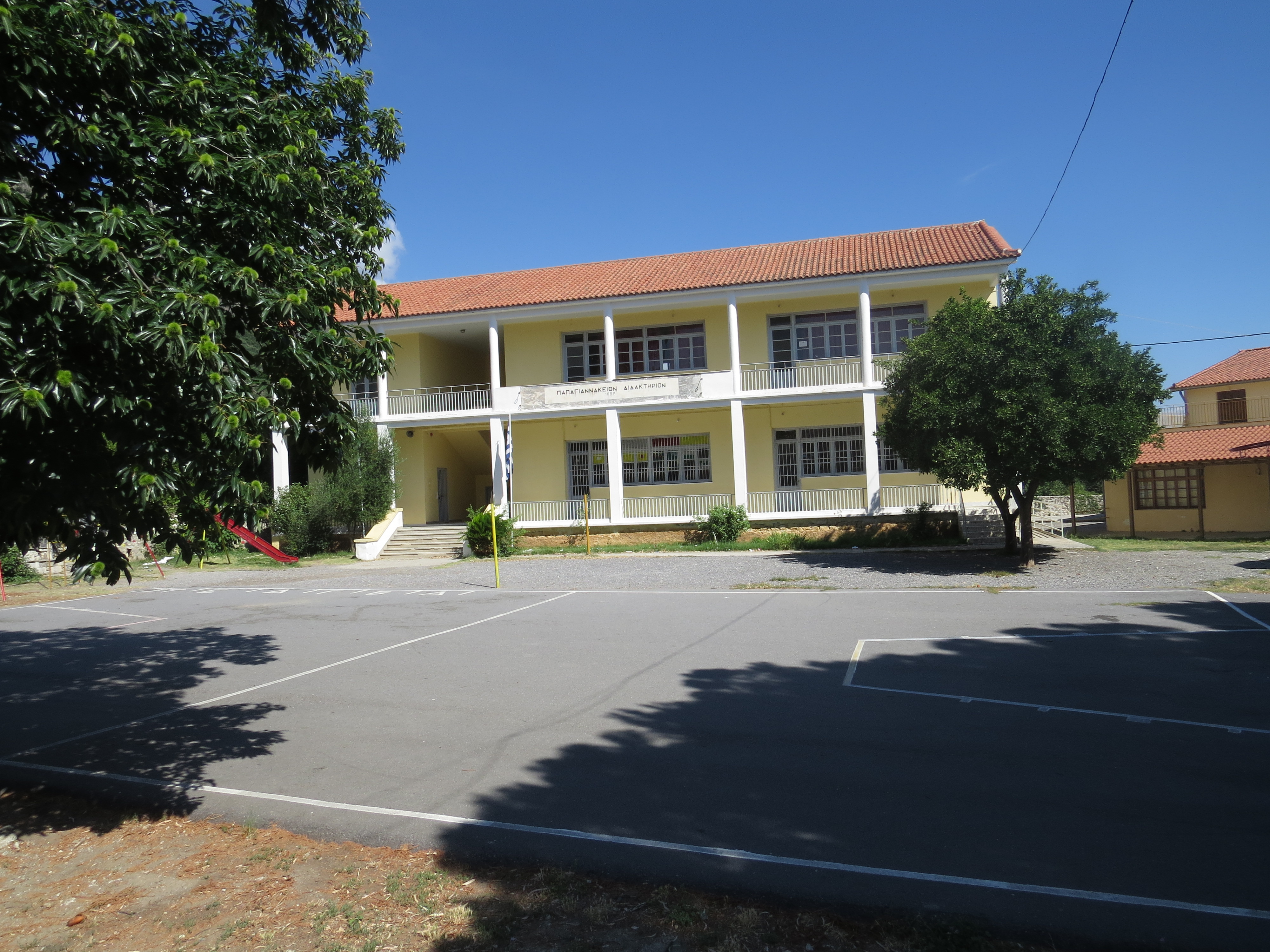
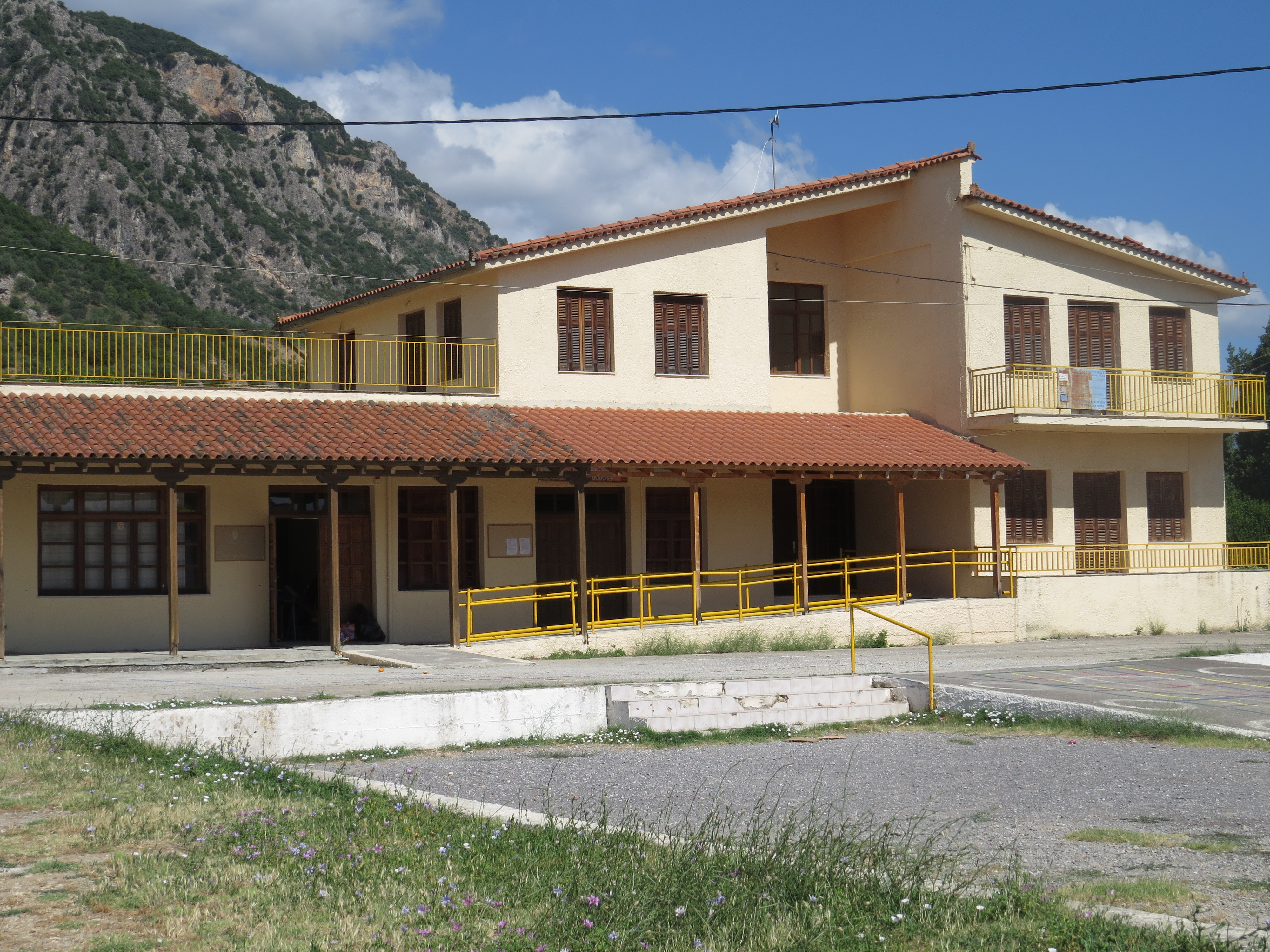
Papagiannakos School, built by Demetrios Papagiannakos (Jimmy Pappas)

Papagiannakos School, built by Demetrios Papagiannakos (Jimmy Pappas). Agios Ioannis, Sparta, July 2014

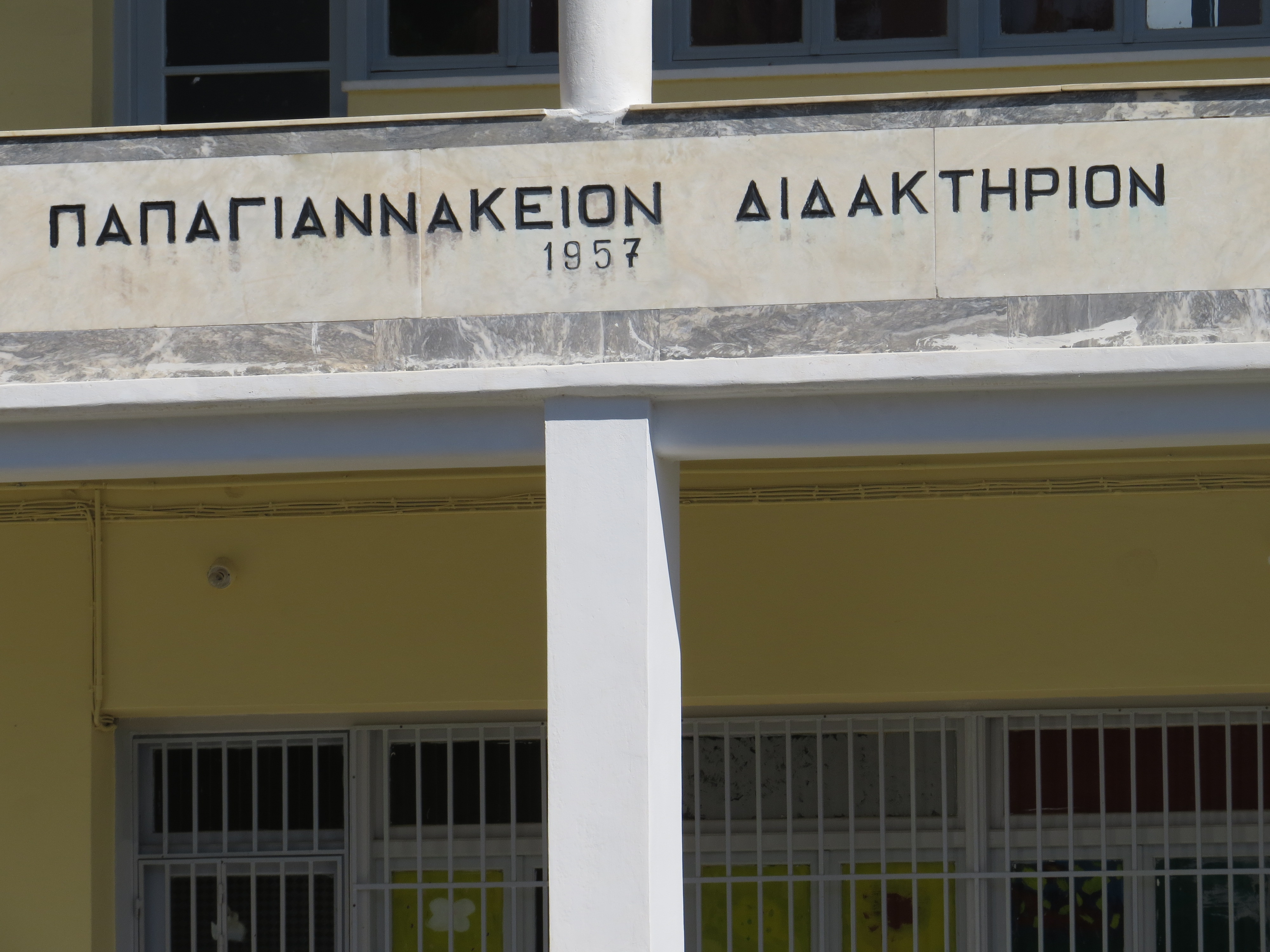
Sign on Papagiannakos School. Agios Ioannis, Sparta. July 2014

Sign on Papagiannakos School. Agios Ioannis, Sparta. July 2014

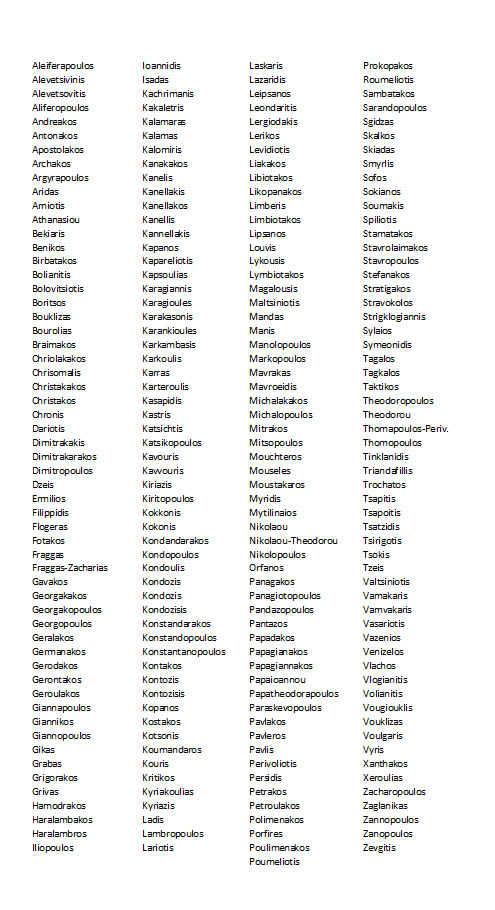
Surnames from Agios Ioannis (St. Johns), Sparta

During my visit to the Archives in Sparta last summer, I obtained pages of the Mitroon Arrenon (Male Registers) for the village of Agios Ioannis, Sparta. The records begin in 1844. This village is the birthplace of three of my four grandparents (Papagiannakos, Kostakos, Aridas/Michalakakos). Almost every page had surnames of my grandparents’ families, or those who married into my family. I was thrilled to have copies of these records!

I am ever-grateful to the staff at the GAK in Sparta: Pepi Gavala (Archivist), Maria Stellakou, and Michalis Sovolos. They are kind, gracious and most helpful!

Below is an index of the surnames in the pages that I obtained (this list may not be complete.

Surnames - Agios Ioannis

Research and Remembrances, Part 5

Ancestral Villages 

A new highway from Corinth south to Sparta bypasses the villages, making the journey speedy and smooth. Except for the road signs in Greek, I could have been in almost any mountainous country. The highway stopped in Tripolis and the last section into Sparta was closed until officials decided how the tolls would be divided among neighboring jurisdictions (I understand it did open shortly after my visit). But I didn’t mind — I was happy to detour onto the winding roads that immersed me into the Grecian countryside. Each village, surrounded by towering mountains, was unique:  the town squares, the narrow streets lined with houses and shops, the churches and fields, reflected the hard work and the independent spirit of its inhabitants.

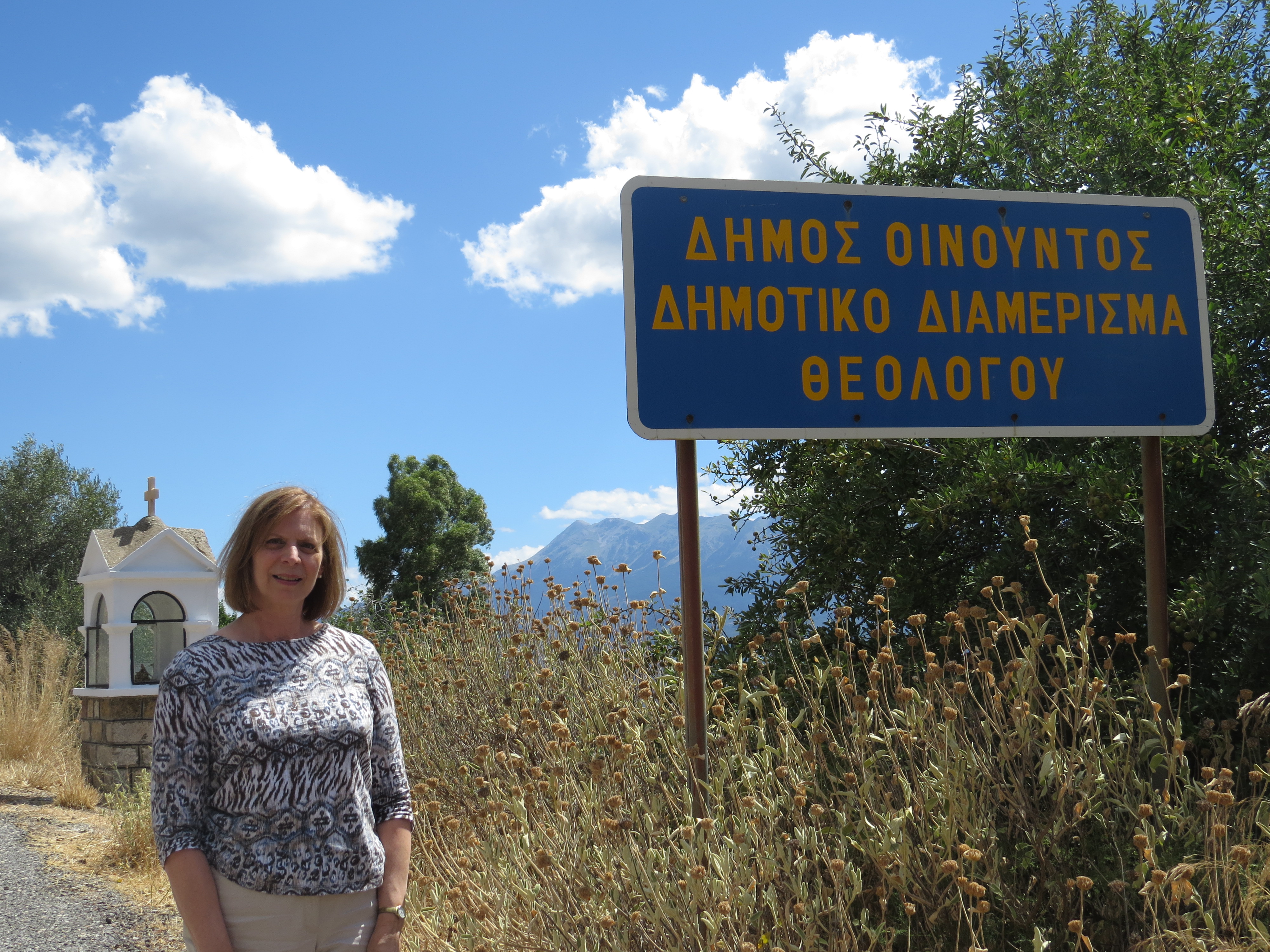
Theologos, Oinountos  
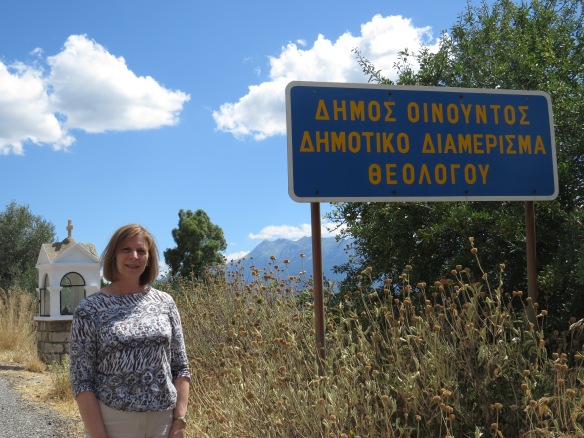
Theologos (19)

I entered Theologos, the village of my maternal great-grandmother, Stathoula Zaharakis, on a quiet afternoon.

Theologos (3)

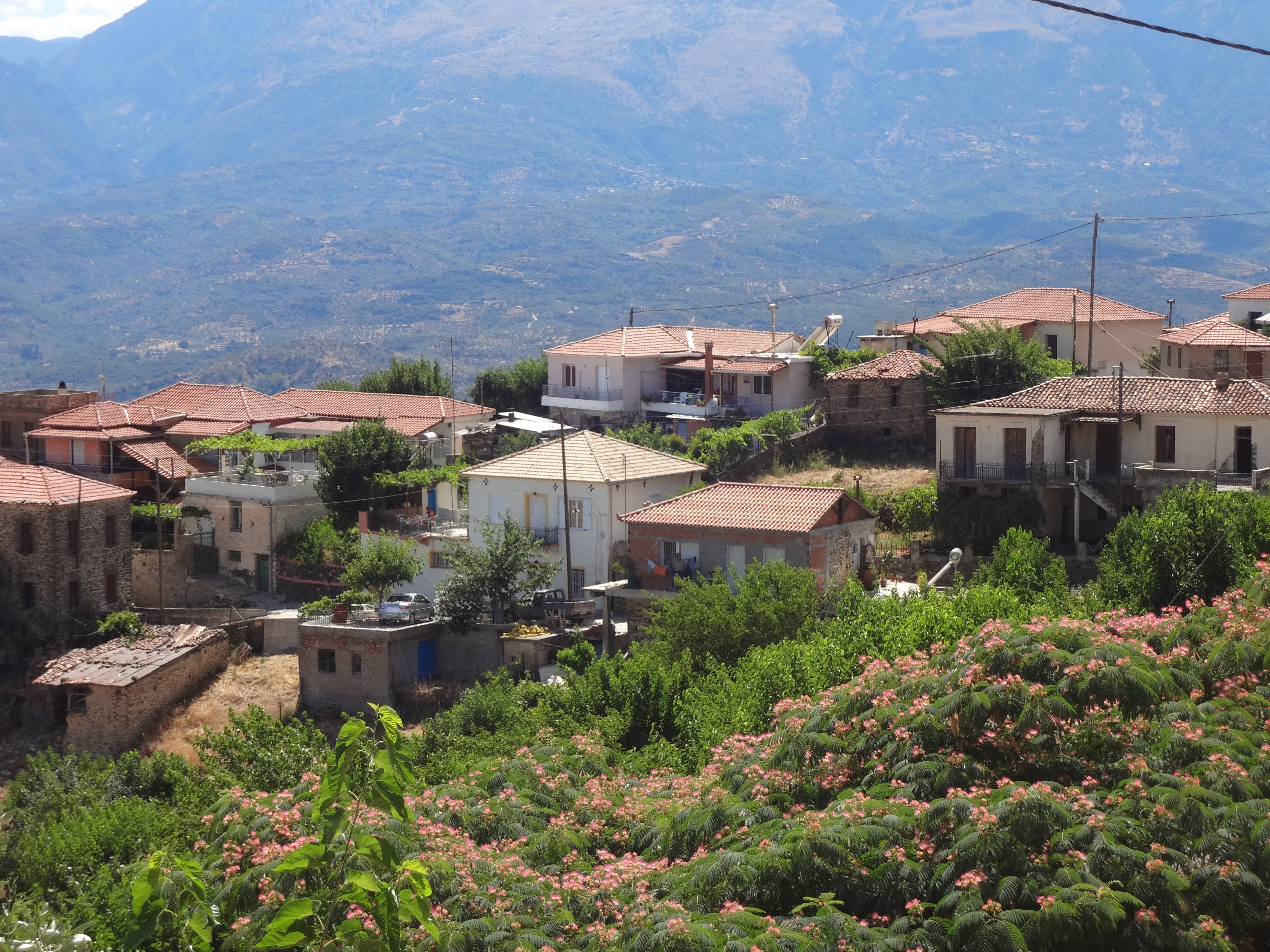
We had traveled a narrow, steep road into this lovely town. Nestled below the towering Parnon mountains, it looked both cozy and inviting.
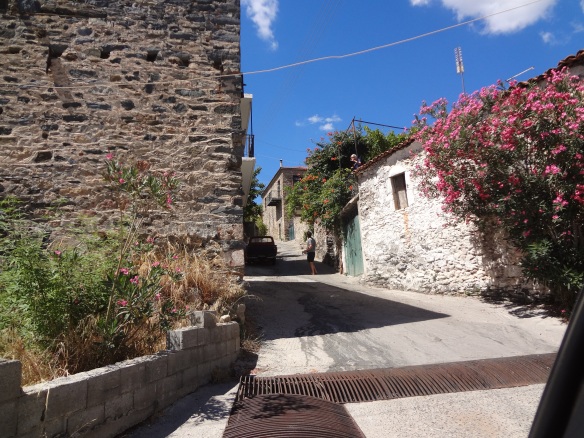
Theologos (2)

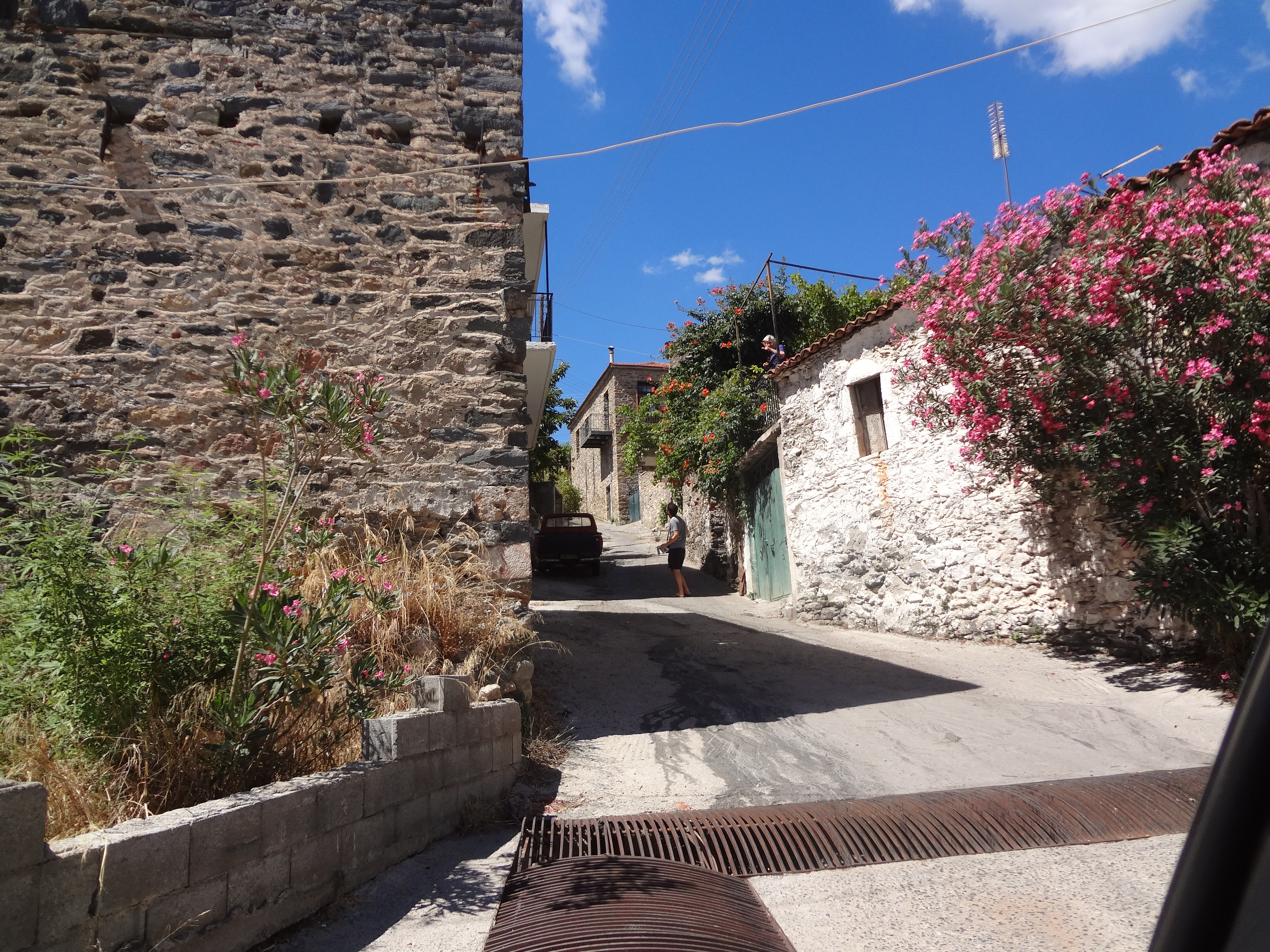
It was siesta time, and the streets were deserted. The peace and tranquility of a beautiful day filled my soul and helped me imagine my ancestors walking the streets.

Theologos (4)

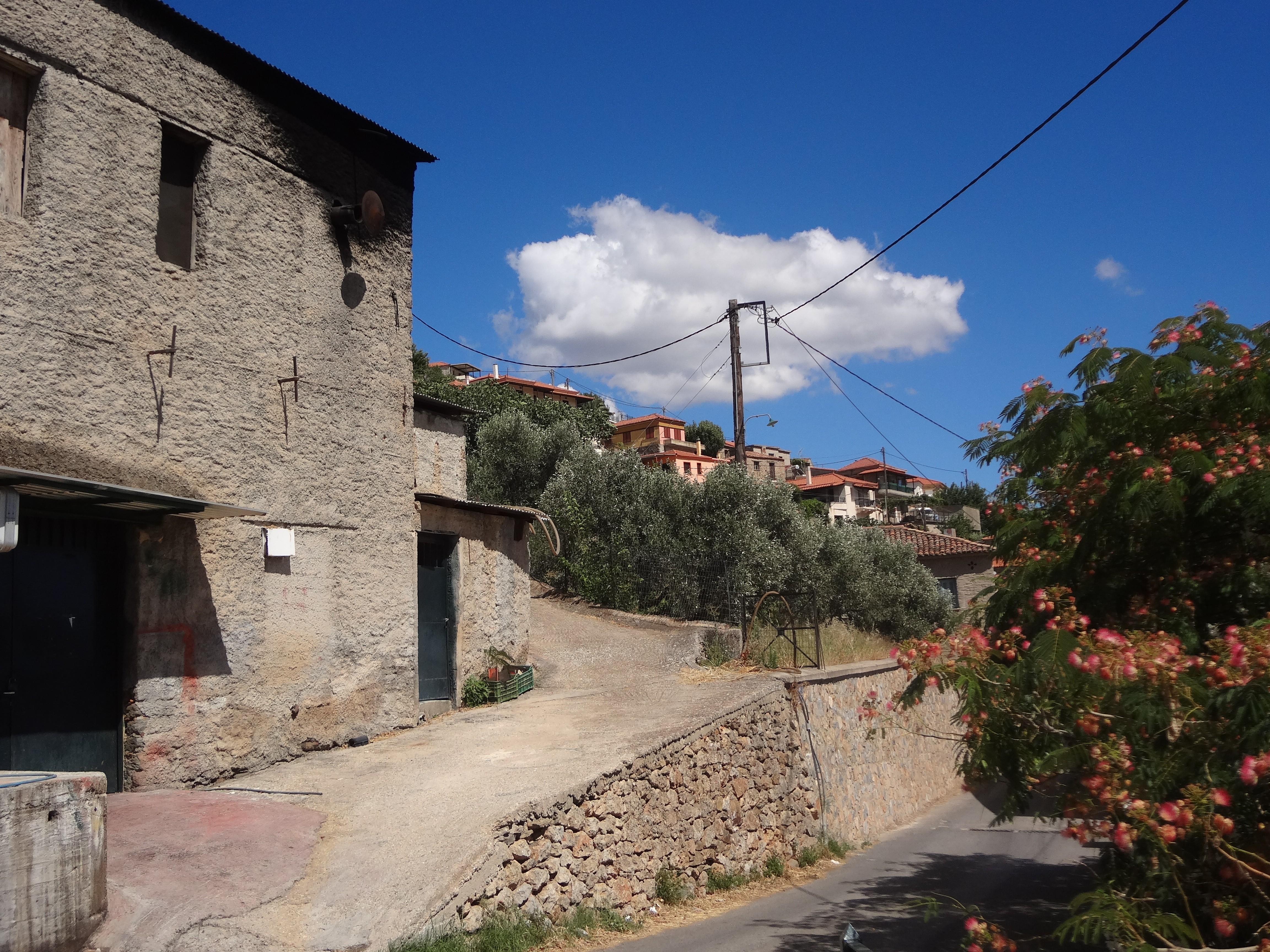
Homes in mountain villages are built on terraces, which enable you to see each one. The flowering bushes and trees provided a beautiful contrast to the stark stone buildings.
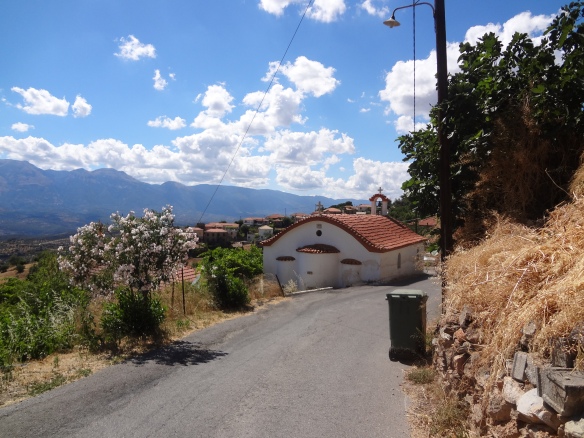
Theologos (7)

It is not unusual for even the smallest village to have more than one church. I love the way this small church was built to conform to its surroundings.
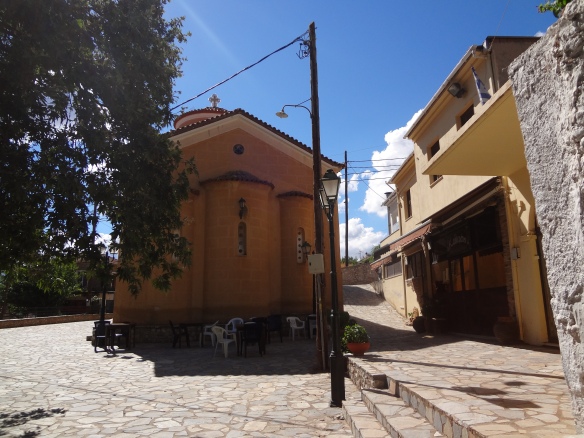
Theologos (12)

The larger church was built on the west end of the town square.

Theologos (8a)


The original plaque on the front corner of this church reads that it was built in 1879-1880 by the families of Theologos. With my gr-grandmother Stathoula’s birth being in 1870, this means that her parents would have helped build this church and worshiped in it!
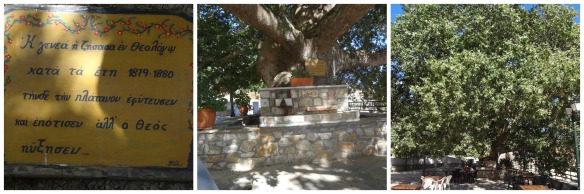


Theologos town square  Collage

The town square has an enormous tree that provides both a focal point and much-needed shade on a hot day. The plaque reads: “The generation that lived in Theologos during the years 1879-1880 planted this sycamore tree and watered it but God made it grow.” I closed my eyes and imagined by Zaharakis gr-gr grandparents at the tree-planting ceremony – surely they were there! I felt very, very close to them as I stood on the ground where they had lived.

Theologos (21a)

It is heartwarming to see that every village has a monument honoring those who died in the service of their country. This one in the Theologos town square bears the names of:  Dim. H. Mouses, Pan. N. Kefalas, Andr. N. Synolinos, Nikol. K. Kefalas, Bas. P. Sarantopoulos, Dim. N. Manousos, Anar. K. Galatas.

Agios Ioannis

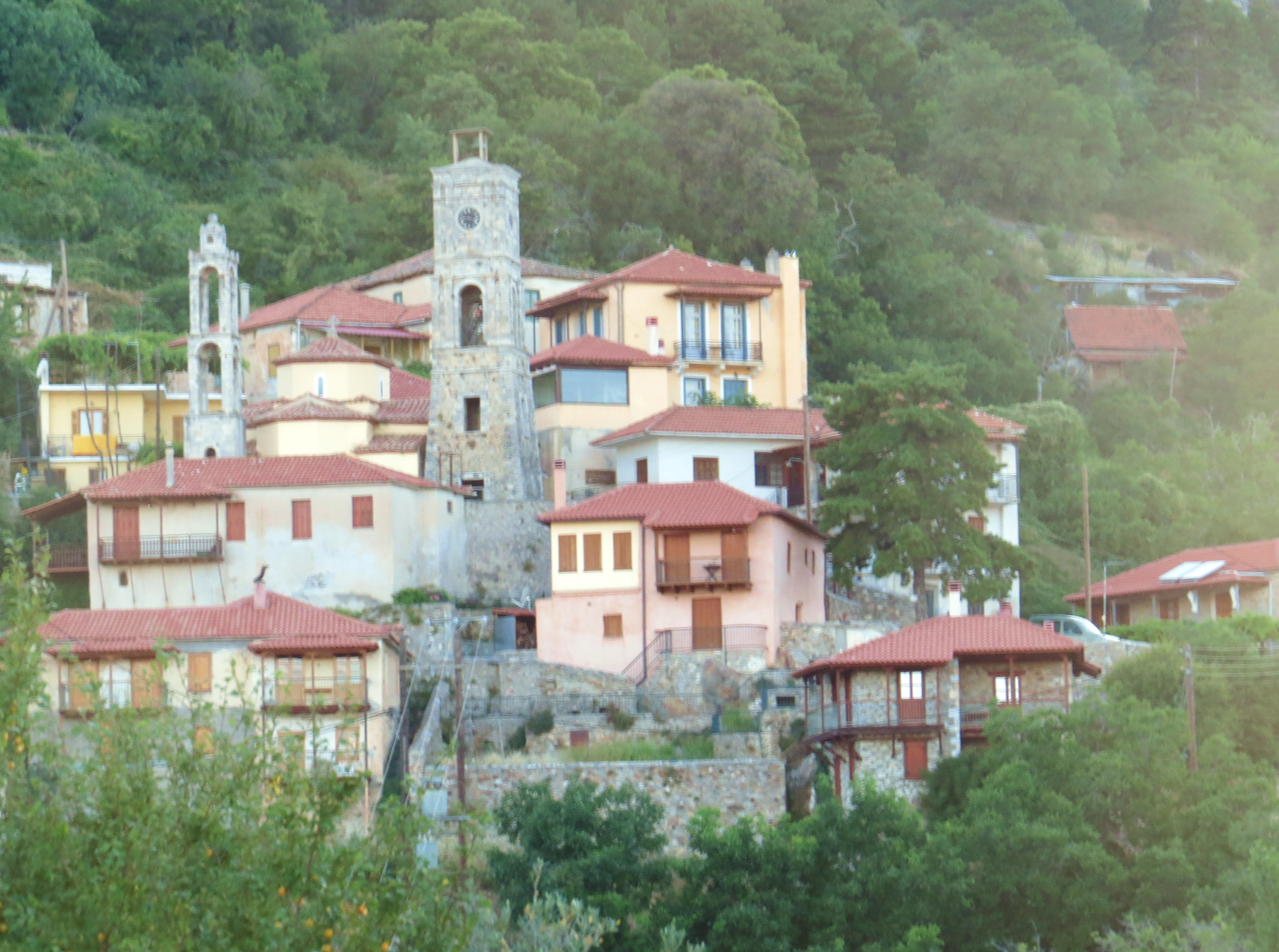
Three of my four grandparents were born in Agios Ioannis (Sparta): Papagiannakos, Kostakos, Aridas/Mihalakakos. This village lies in the fertile valley of the plains of Sparta, overshadowed by the rugged and forbidding Taygetos mountains. My family history continues in this village, as I wrote in an earlier post about visiting my relatives here.
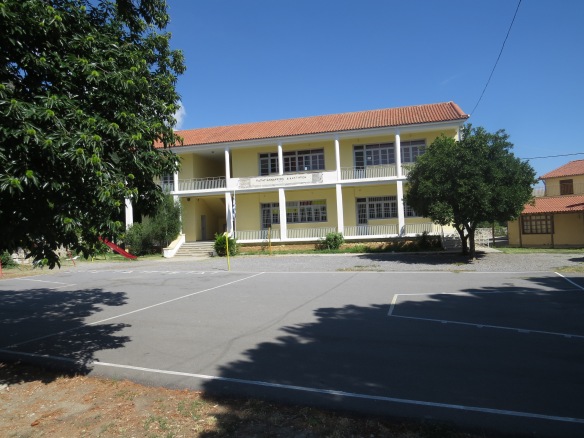
Agios Ioannis (1 Papagiannakos school) (7)

Demetrios Nikolaos Papagiannakos (1897-1945), who emigrated to America and became a most successful restaurateur, built this school in Agios Ioannis which bears his name.

Agios Ioannis (2 building built by Kostakos)

My second cousin, Grigorios Georgios Kostakos (1927-2001) was mayor and provided the means and the incentive to build this structure which is used for town meetings and other events.

Agios Ioannis - Maltsiniotis tower-home (6)

This house, which is adjacent to the Papagiannakos School, was built by the Maltsiniotis family. Its structure is evocative of the towers found in Mani, which is where the family originated. There is speculation that the Papagiannakos family may have been a branch of the Maltsiniotis family, but that has yet to be proven.
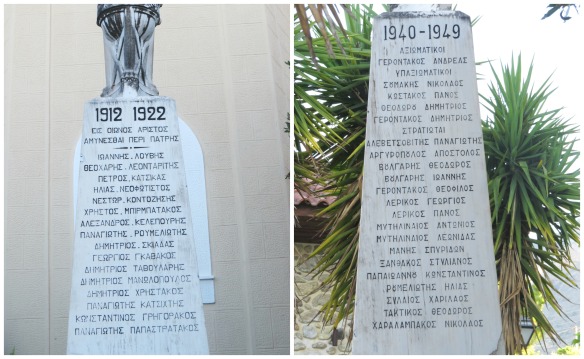
Agios Ioannis monument Collage

The memorial tower for Agios Ioannis lists several surnames in my family.

Mystras  

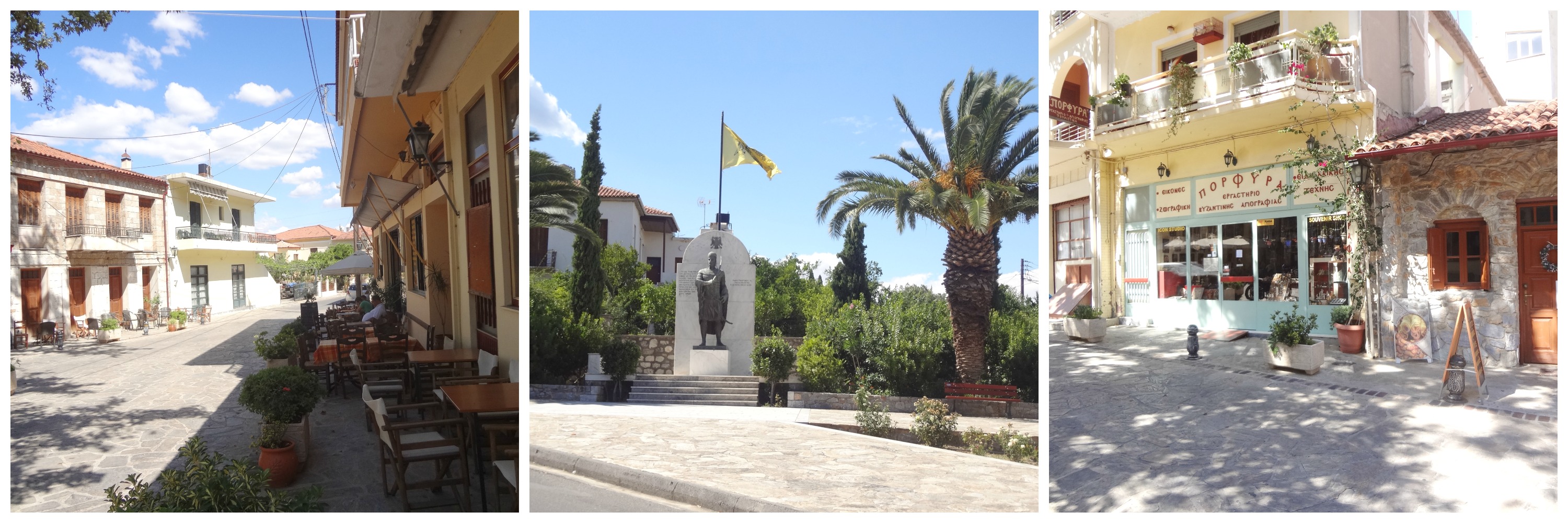
The ancient city of Mystras, which was the seat of the Byzantine Empire in the Peloponnese, is the ancestral village of my grandmother, Aggeliki Eftaxias. It is built on a side of the Taygetus mountain overlooking Sparta. Mystras (10)
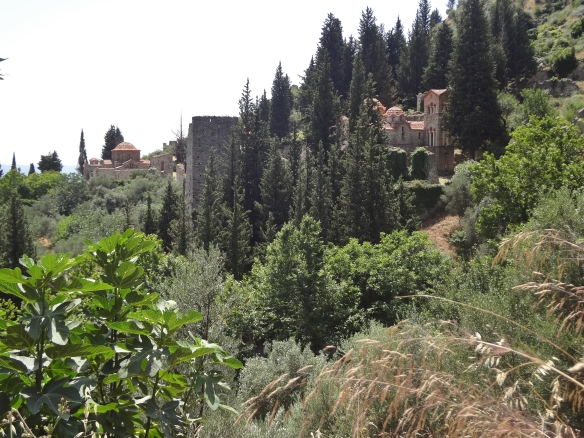
The majestic castle buildings and churches, built in 1249, dominate the landscape and and give the  visitor a glimpse into the world of its founder, the prince of Achaia, William of Villehardouin. Mystras was occupied by the Byzantines, the Turks and the Venetians, and was eventually abandoned in 1832.
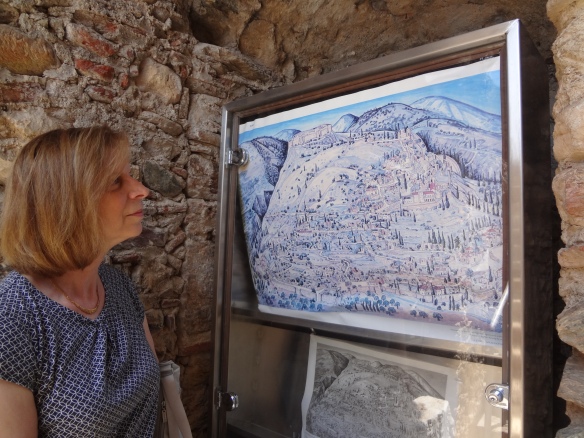
Mystras (22)

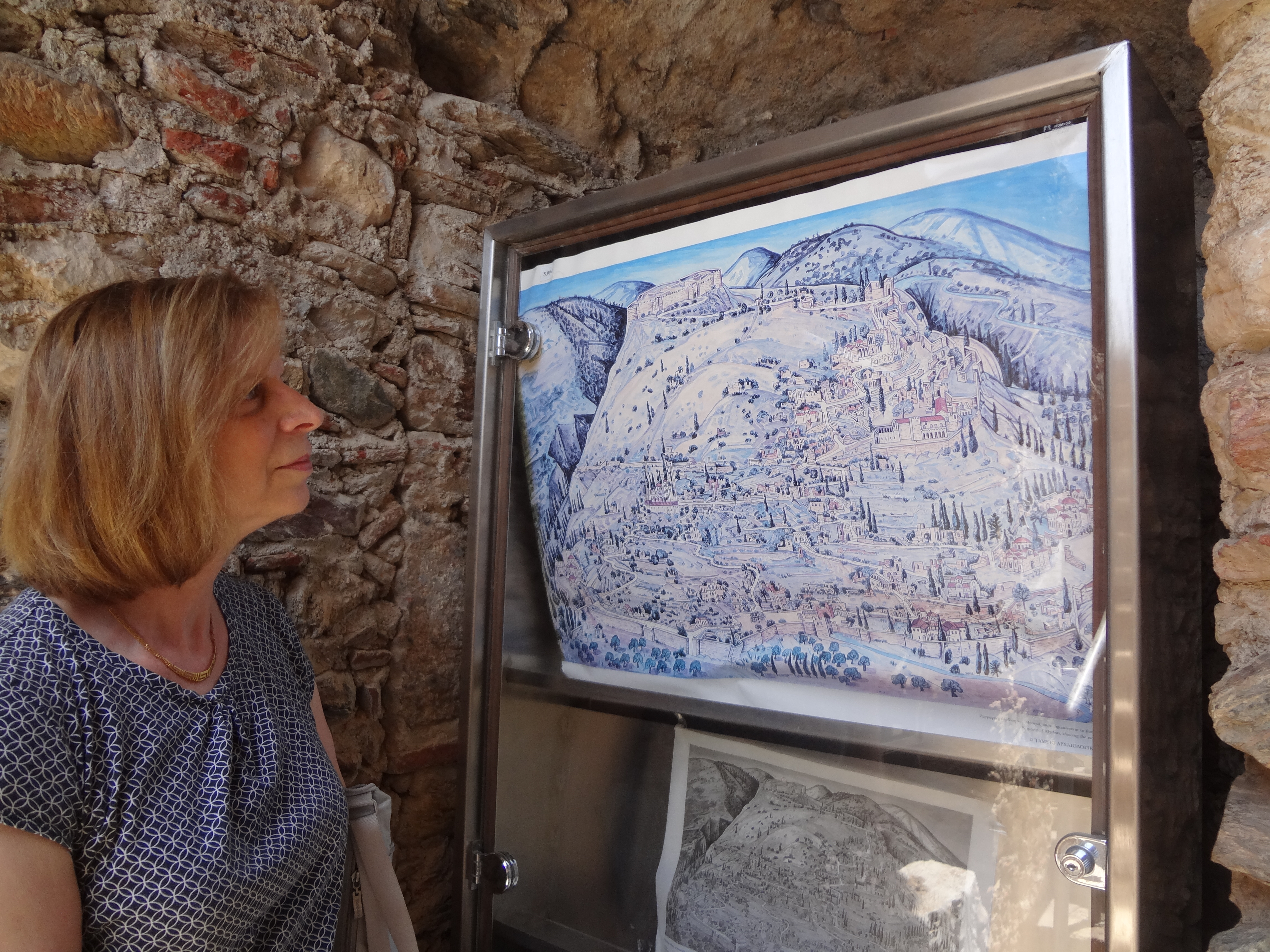
This map, on the wall by the ticket office, shows the layout of the city during its prime years.
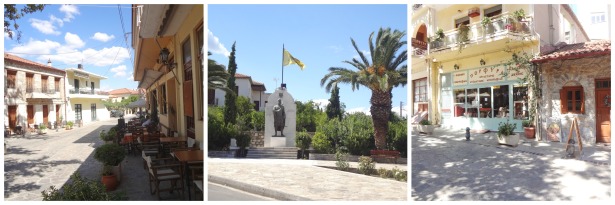
Mystras Collage

The village of Mystras is charming, with small shops and a mixture of architectural designs. I delighted in spending the night in this wonderful place where my Eftaxias family still lives.

Anavriti 

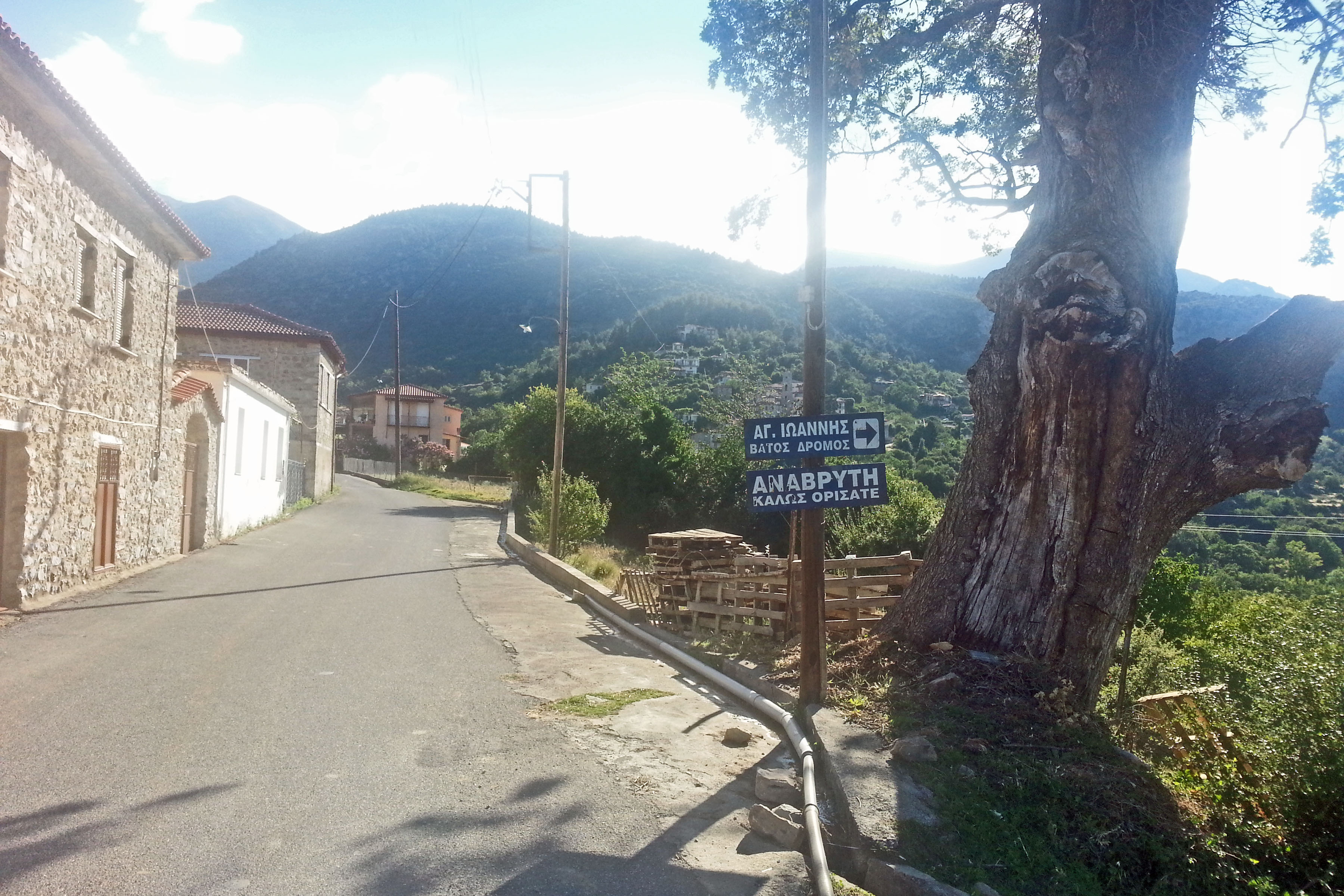
At the peak of a mountain in the Taygetus range, overlooking Sparta, is the village of Anavriti. The “old road,” a narrow, hairpin-turn switchback road, has thankfully been replaced by one that is newly paved and slightly wider. Even so, it was frightening to wind across the face of the mountain at an almost vertical climb.

Anavriti CollageIt is easy to see why there are so many “icon boxes” on these twisting roads, which are erected by families to memorialize the spot where a loved one died.

Anavriti (11)

The village is literally perched at the very top of the mountain! How did people ever build on this terrain?

Anavriti (20a)-path to AgIoannis

This photo shows the way to a trail leading down the mountain from Anavriti to Agios Ioannis, making it very convenient for the two populations to mingle! I am attempting to tie Kostakos families from Anavriti into my bloodline; also, there are several Anavriti families that married into mine which give me a link to this village.

Vordonia  

Slightly north of my villages is the town of Vordonia, home to the Linardakis family.

Vordonia (1)

My daughter, Kathy, was thrilled to visit the ancestral home of her paternal grandfather, George Lynard/Linardakis, who immigrated to Washington D.C. when he was a teenager.
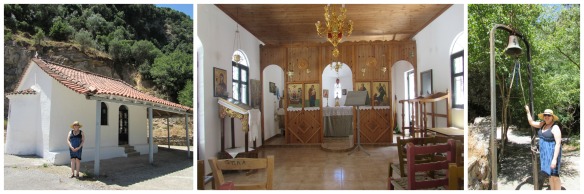
Vordonia Church Collage

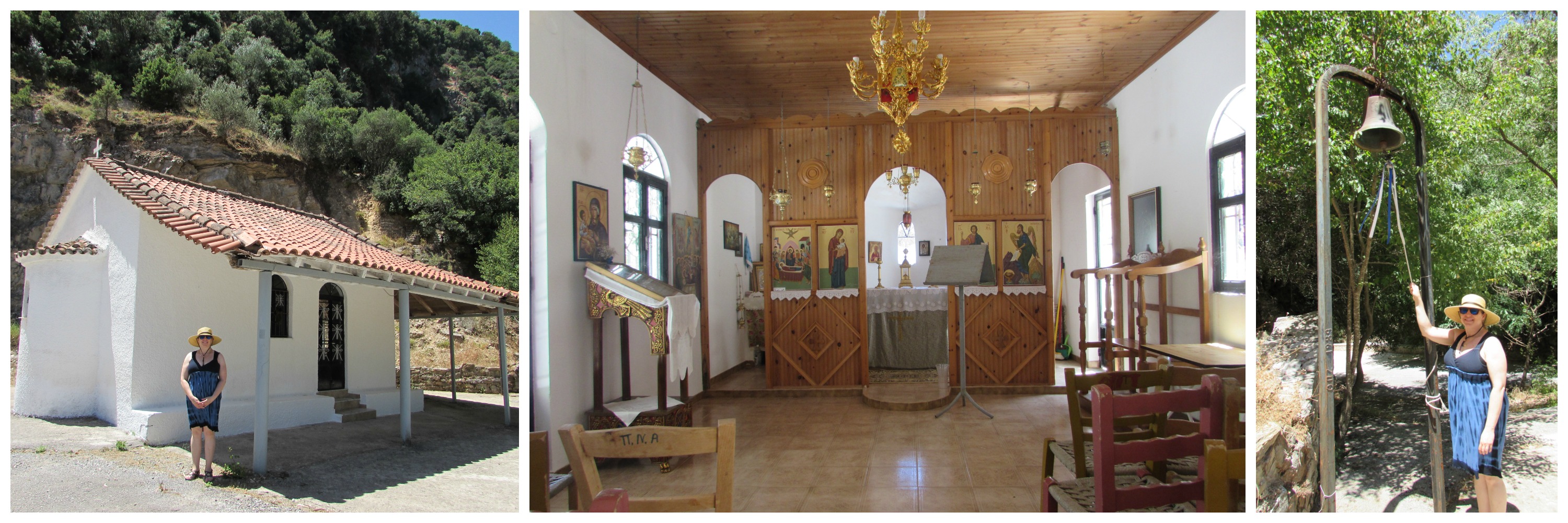
We found a tiny but charming church and imagined that the Linardakis family may have met in a building such as this.

Vordonia Monument Collage

The ornate memorial touched our hearts and reminded us that every life is precious.
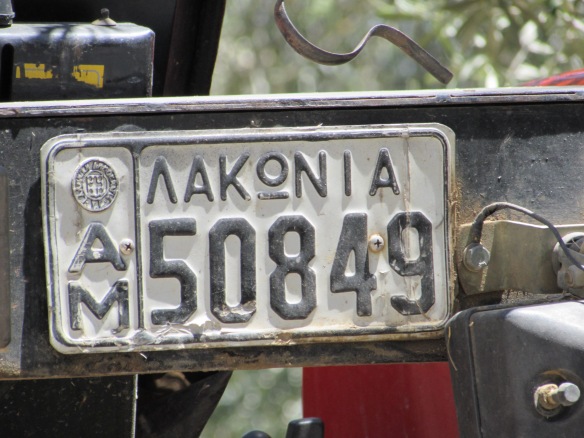
Vordonia (51)As we drove many miles through many villages, we more clearly understood the difficulties of travel in the days before automobiles. People walked or rode donkeys up and down steep and rugged goat trails, and a simple visit to a neighboring village could have been an all-day trek! As I study the records of villages, I now realize why almost all people married within a local geographic boundary — and, why some never left their village.
 

Research & Remembrances, Part 4

Research in the General Archives of Greece, Sparta office

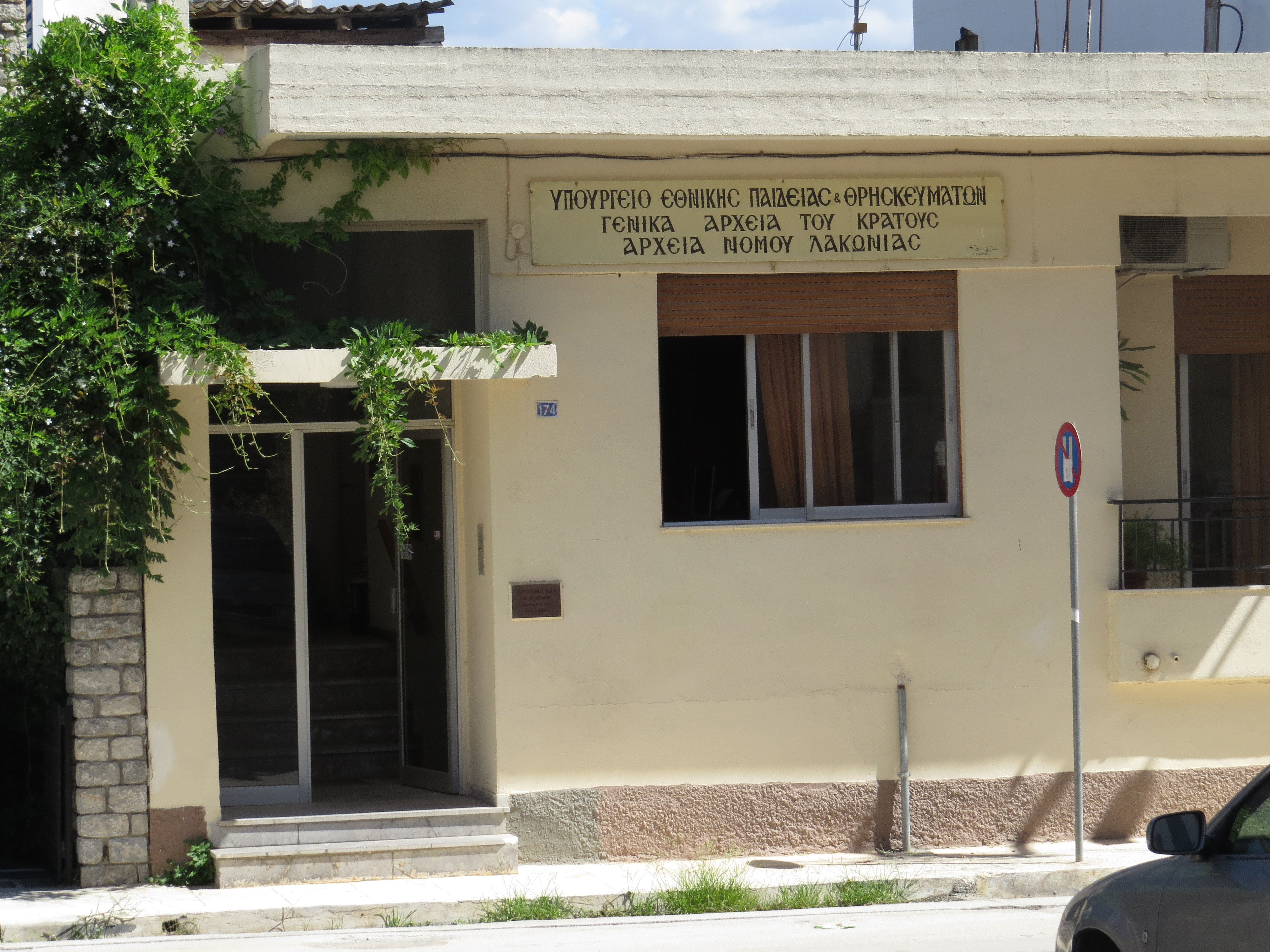
After months of preparation, I was so very excited to go in person to the General Archives of Greece office in Sparta! It located in a building on Vrasidou Street in the center of Sparta.

http://gkfamilytrees.wordpress.com/

General Archives of Greece, Sparta office

The Archives has offices for staff and a spacious research room. It also has off-site storage areas where most of the books and records are kept. Some records for Sparta which are listed at the GAK website may also be available. The research room has a large table, perfect for reviewing the oversized books and taking notes.
Research room, Archives office, Sparta

Research room, Archives office, Sparta

In the lobby, there are several  display cases featuring historic photos and documents.

Display case, Archives office, Sparta

Precious documents and photos are on display at the Archives

Gregory Kontos and I were finally able to meet our new archivist friends with whom we had connected through Greek genealogy Facebook groups — Maria Stellakou and Mihalis Sovolis. I had sent Maria an email in advance, letting her know exactly when we would be arriving. These dear people had offered to assist us in every possible way, and that is exactly what they did. They asked us which locations we were researching and what types of records we were seeking. They told us that they would have the appropriate books ready for us when we arrived the following morning.

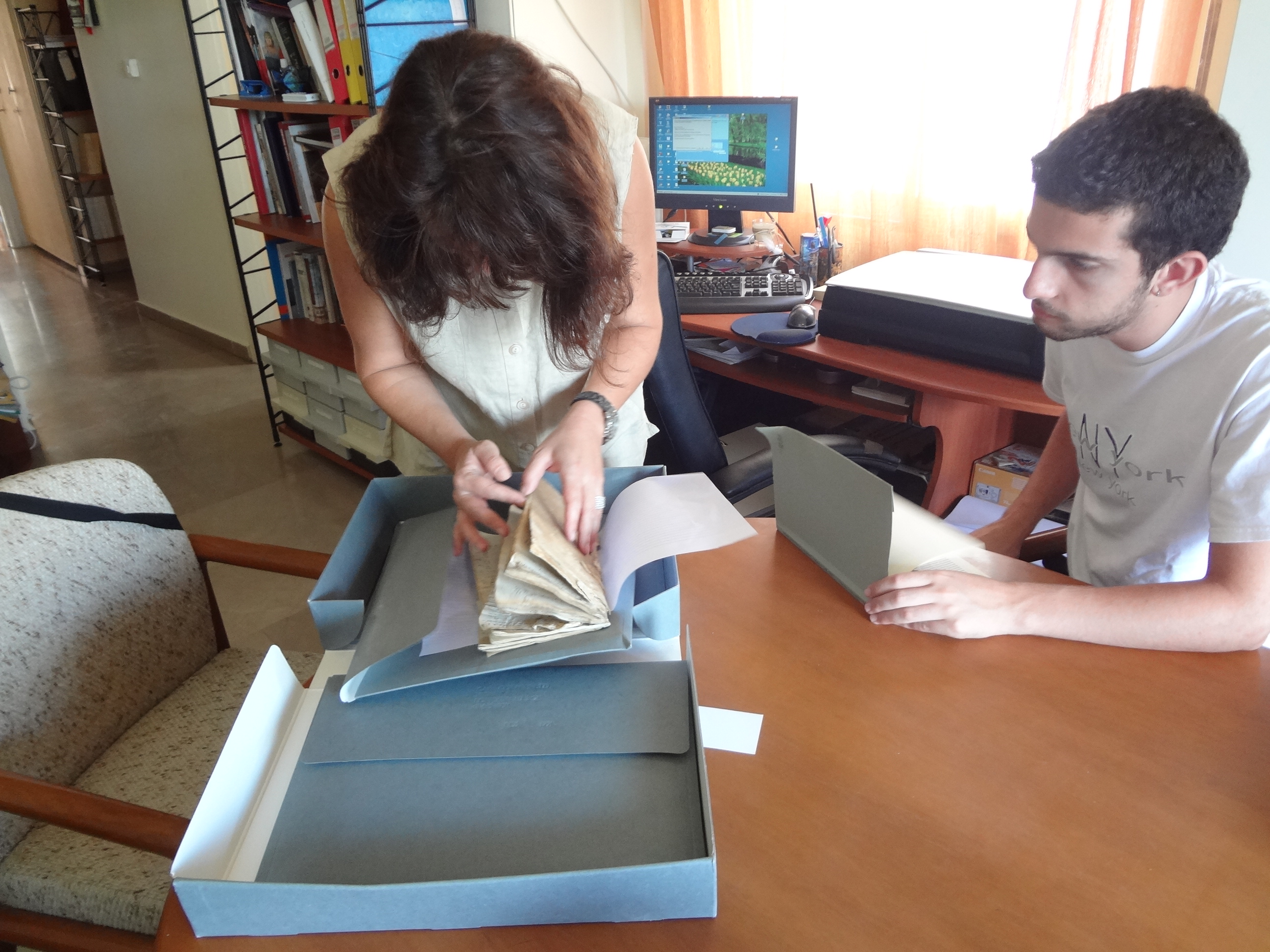
Maria Stellakou looks for a record.

Maria Stellakou looks for a record.

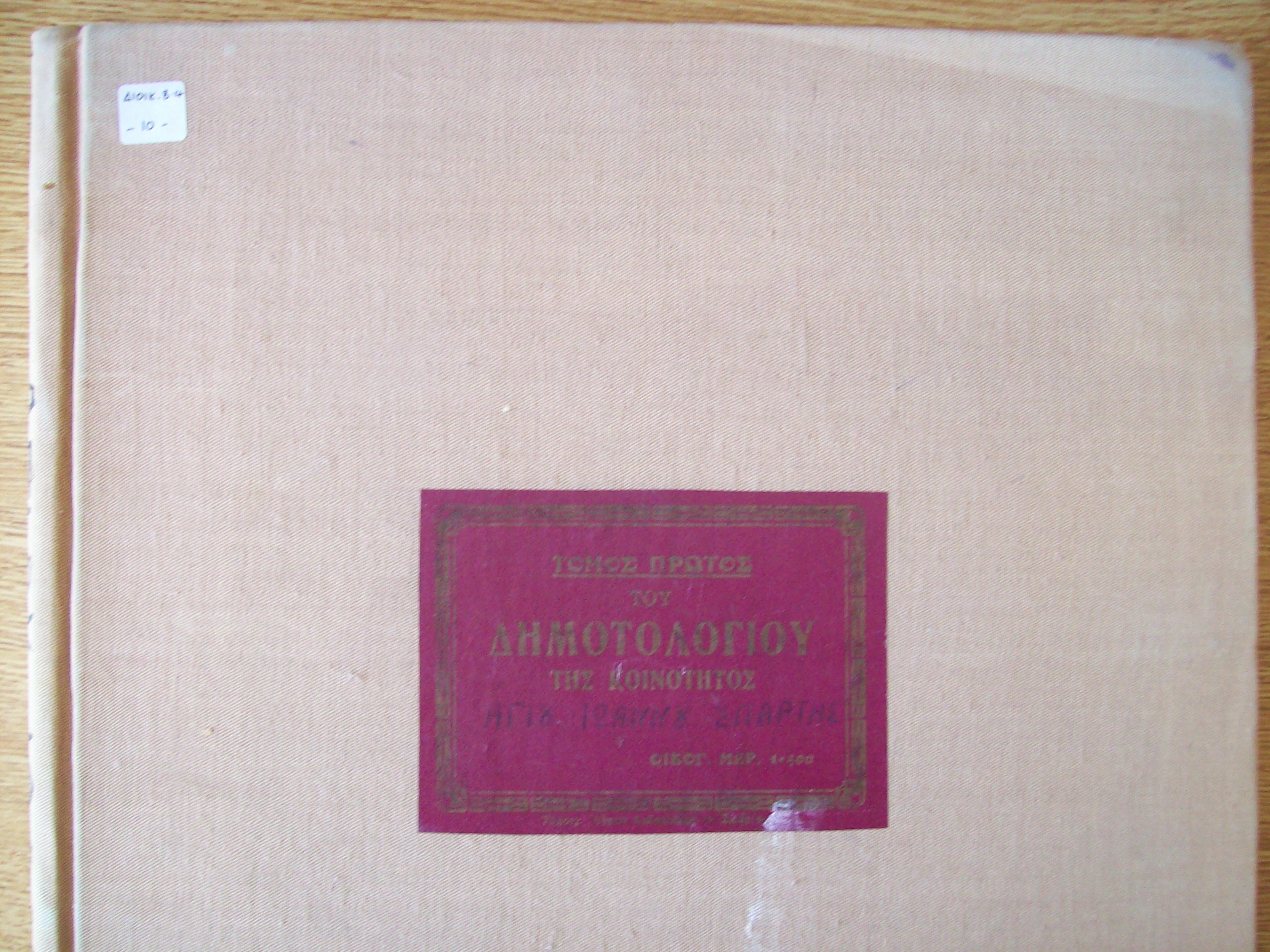
Can you imagine how thrilled I was to see the Dimotologion book for Agios Ioannis, the ancestral home of three of my grandparents? The Dimotologion is a register of families, listing husband, wife and children with their birth dates and other information. It is comparable to a U.S. census record.

Dimotologion for Agios Ioannis, Sparta

Dimotologion for Agios Ioannis, Sparta

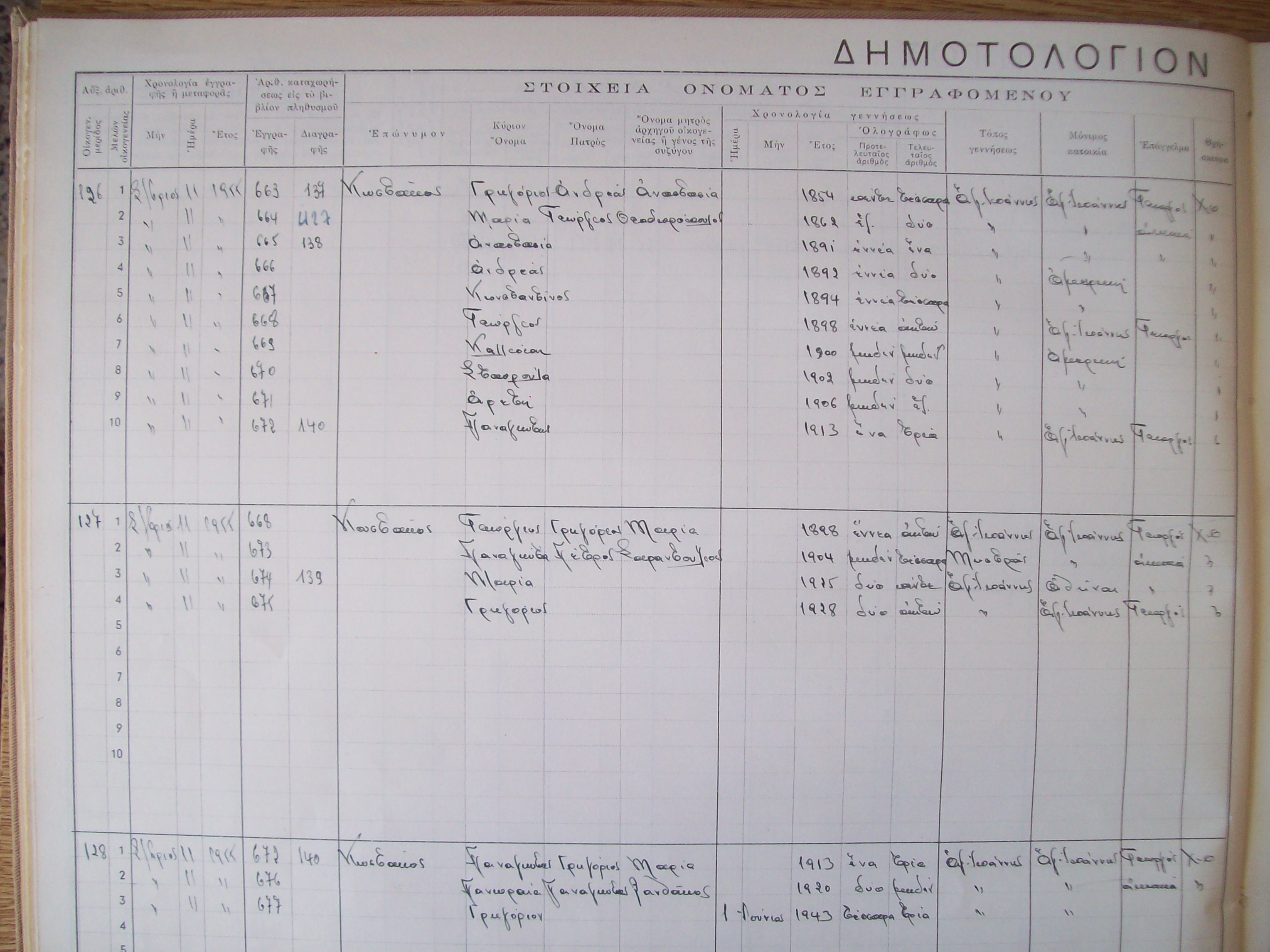
When I opened that book and turn the pages, I found three Kostakos families. These records appear to have been created in the 1900’s, as that is when most of the children were born. Unfortunately, there are no similar family records for the 1800s.

Kostakos families, Dimotologion

Kostakos families, Dimotologion

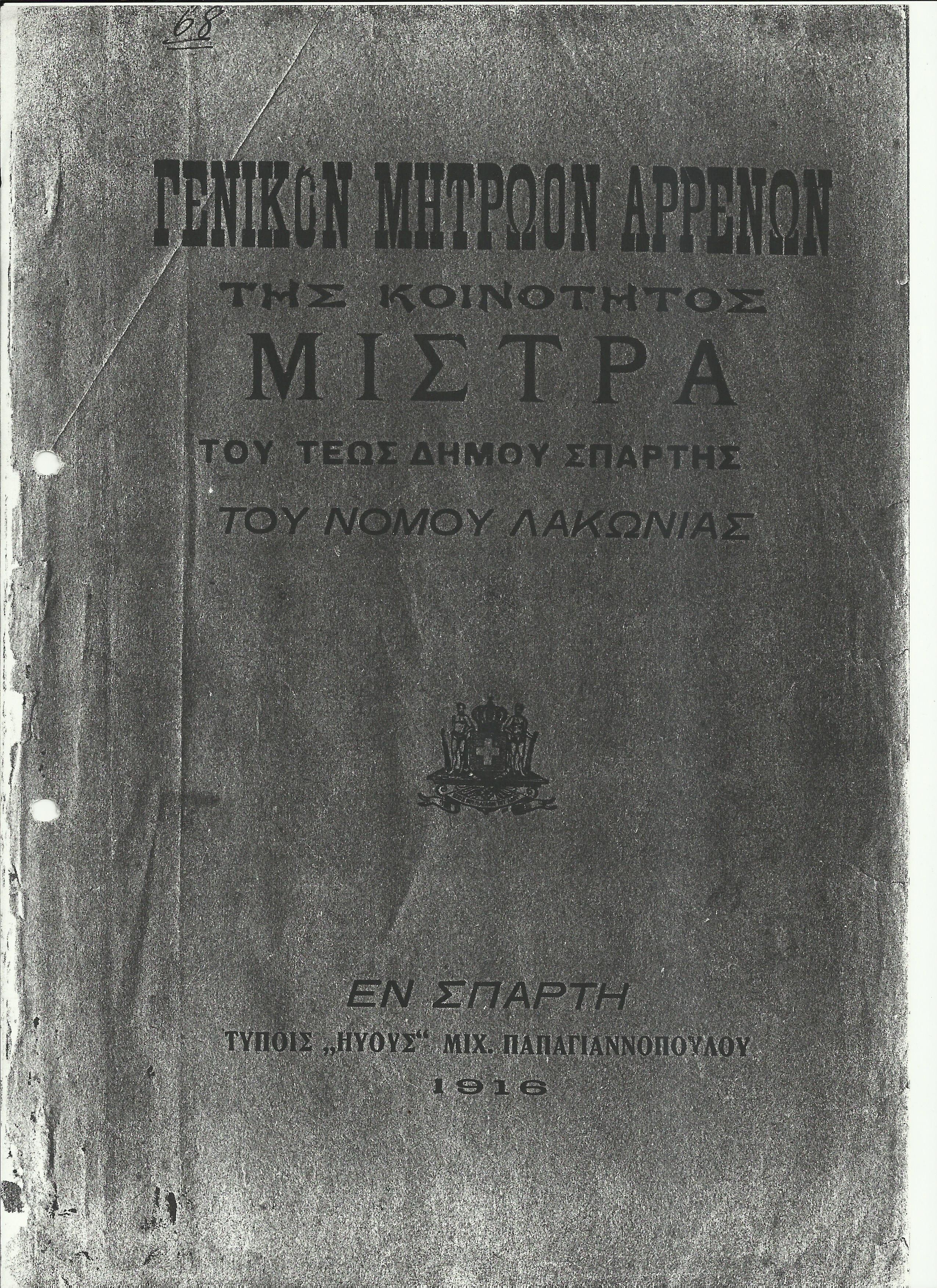
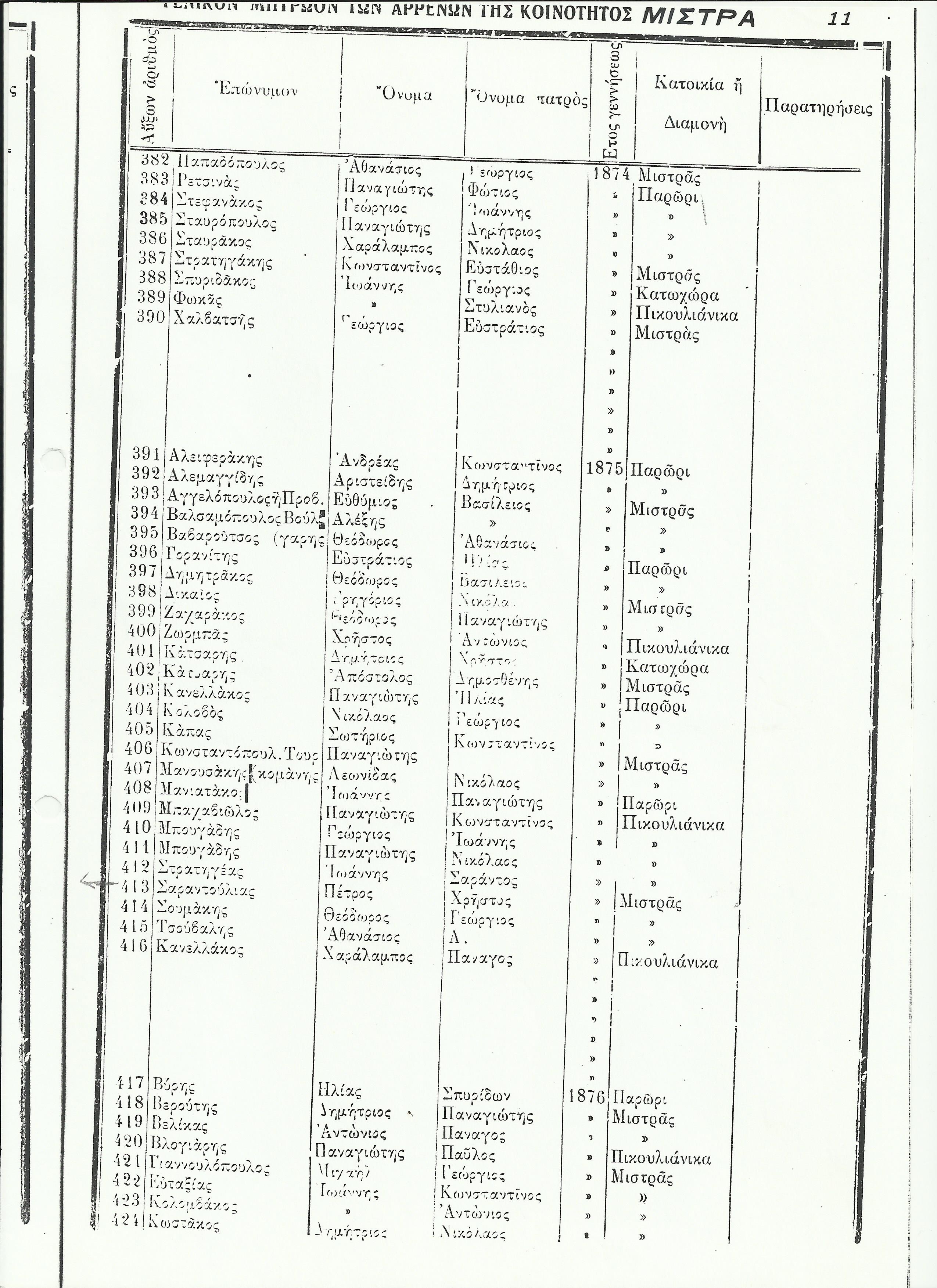
I looked at Mitroon Arrenon, Male Registers, for Agios Ioannis, Mystras, and other nearby villages.

Mitroon Arrenon (Male Register) for Mystras, Sparta

Mitroon Arrenon (Male Register) for Mystras, Sparta

In the book for Mystras, I found an entry for my granduncle, Ioannis Eftaxias born in 1876. Konstandinos, my great-grandfather, is named as Ioannis’ father. Gregory and I were given permission to use our cameras to take photographs of any pages containing my family names.

Line 122: Eftaxias, Ioannis; father Konstandinos; born 1876 in Mystras.

Line 422: Eftaxias, Ioannis; father Konstandinos; born 1876 in Mystras.

Maria has begun to digitize some of these books herself. That is quite an ambitious project! She uses a scanner and then uploads the images to the office computers. With digitization, the old books can be preserved. They can also be easily accessed by computer.

Gregory and I spent all day on Tuesday (July 15) and Wednesday morning at the Archives. We were delighted to meet Pepi Gavala, the archivist, on Wednesday. Over the years, I have come to know Ms. Gavala by name, as she signs letters that I have written to the Archives when I was requesting information. She is a delightful woman, dedicated to her job and sincerely wanting to assist researchers in every possible way.

Here is an example: when we arrived on Wednesday morning, I asked if the books for Vordonia and Kastania were available. These are the ancestral villages of my first husband, Peter Lynard (Linardakis). Although I had not planned to research those areas, I had a strong impression that I should do so. Mihalis was at one of the offsite storage areas, and Maria called to ask him if he would go to the building where the Vordonia and Kastania books were kept. He stopped what he was doing, found the books, and brought them to us as quickly as he could.

I left the Archives, thrilled to have digital copies of civil records that are helping me piece together the various branches of my family. I also left behind new friends: Maria, Mihalis and Ms. Gavala. They made this visit both pleasant and productive. I am ever grateful for their cheerful help and their sincere desire for my success in finding the records I was seeking. I hope that someday I will be able to return their kindness and be of help to them.