A Signature, An Ancestor

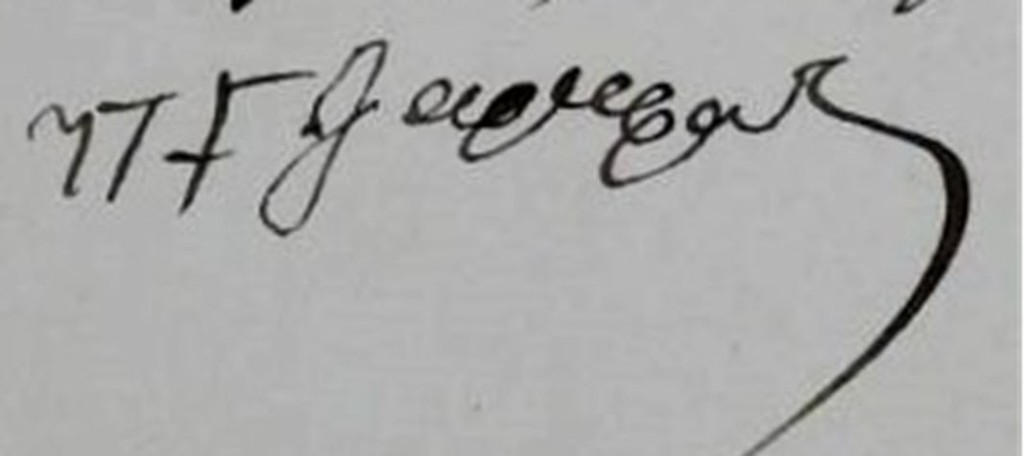
Letter of Consent to Marriage of Giannoula P. Zarafonitis and Dimitrios Nikolaos Zacharakis, April 18, 1869 in Sklavochori (now Amykles), Lakonia, Greece

This letter granting permission for the marriage of my second great-grandparents, Giannoula Zarafonitis and Dimitrios N. Zacharakis, was signed by Giannoula’s father, Panagiotis G. Zarafonitis. By adding the “G” in his signature, Panagiotis (my third great-grandfather born 1821) provided the first initial of his father which took my lineage back one more generation to my fourth great-grandfather! In this area of Sparta and for my family, the initial “G” would most likely indicate the name of Georgios.

P. G. Zarafonitis

I am thrilled that this document –so meaningful to me–is one that I digitized with my own hands. During the summers of 2019, 2018 and 2017, I volunteered to work with Gregory Kontos of GreekAncestry.net to preserve, through the digitization process, marriage books and documents at the Metropolis of Sparta for the years 1835-1935.

It is incredibly emotional for me to see the signature of my third great-grandfather, Panagiotis, and to know that through my work, his handwriting and mark of mortality has been saved and is now viewable by his descendants. And I am especially grateful to him for choosing to include that most important initial of G.

Translation of marriage letter*:

Metropolis of Sparta and Monemvasia
Marrriage #89
The consent of the parents and other relatives of the future groom and bride, Dimitriou Zacharakis of the village, Theologos of Dimos Sellasias, and Giannoula daughter of Panagiotou Zarafonitou of the Dimos Sparta and village of Sklavochori, affirming that there is no kinship between the future couple nor any other impediment for them to join in matrimony, both for the first time, with the signature of two guarantors and two witnesses.

In Sklavochori on 18 April 1869

Signatures, left side:
Relatives of the groom:
N. Papastratis
Priest, S. Dimitropoulos
For the bride:
P. G. Zarafonitis

Signatures, right side:
Guarantors:
P. Anagnostakos
P. Iliopoulos
Witnesses:
M. Michalalopoulos
Ioannis Chatzikos

________
*Translation by Gregory Kontos, GreekAncestry.net

Beyond the Basics: City Directories

Do you know if your ancestor owned a business or was considered a “professional” in his village? Now there is a way to find out. The new City Directories series on Greek Ancestry is the very first digitized and name-searchable collection available for over 5,000 towns and cities in Greece.

The City Directory of 1934-1935 is a historical portrayal of Greece’s cities and communities immediately preceeding World War II. It is organized as follows: the first section lists businesses in the cities of Athens, Piraeus, Thessaloniki and Patras.  The second section lists select people in Athens and Piraeus. The third section lists, in alphabetical order, each prefecture with its capital and general information, then its primary towns and communities.  Unlike other Greek records, directories provide a snapshot of an entire town–not just an individual or a family. They also include business ads, which are so very interesting!

Ad for the Grand Bretagne Hotel in Athens, 1934

These City Directories are not the same as telephone books. They do not list every household found in the village; but they do list every business and professional enterprise and include the name of its owner.

The page below gives information for the Prefecture of Lakonia. Its number of residents is 144,336 and its capital is Sparta. The first paragraph is a brief historical background which reads: The present-day prefecture of Laconia occupies the ancient country of Laconia, inhabited by the Doric people of the Lacedaemonians, who were distinguished for their heroism and fighting ability and which they succeeded for many years in Greece. The most important center of this people was the city of Sparta. Following is a geographic description of the prefecture and the names of its four districts (Gytheio, Epidavrou Limiras, Lakedaimonos, Oitylo).

Below Lakonia is the entry for Sparta. It also provides a brief history and synopsis of the city, and lists its officials, municipal offices (post office, tax office, etc.), churches and monasteries, schools, charitable institutions and cultural associations. A list of the professionals and businesses is then presented.

This is page 2, Επαγγελματίαι (Professionals) for Sparta. It documents the professionals and business owners in these industries: midwifery, silk manufacturing, machinery, hotels for sleep, timber warehouse, carpentry, wine tavern, oxygen welding, gun shop, green grocer, ice shop, inn, grocery store, farrier, hat repair, bicycle repair, sewing machines, tailor, blacksmith, typography, bank, shoemaking, hydraulic (water) works, shoe sales, fabrics, pharmacy, drug warehouse, photography, stationery, dance school, sundries. Doesn’t this provide a fascinating insight into city life in 1934?

Business information for the various Communities of Lakonia follows. Highlighted in red is my community of Agios Ioannis.

The entry reads:

  • Capital of the community: Agios Ioannis, number of residents 914
  • Villages in the community: Agia Kyriaki (Tsaousi), Varika (Chaloulou), Kozi, Tseramio and Sinampei
  • Municipal offices:  post office, elementary school, farmers’ association, syllogos (cultural association)
  • Professionals and Businesses:
    • Colonial Products (items imported from European colonies such as coffee, tea, cocoa); proprietors: Kalama, K., Tsirigioti, Ilias.
    • Bakery: Papaioannou, K.
    • Lawyer: Kyriazis, Kon.
    • Doctors: Geroulakos, Dimit., Mitrakos, Dim.
    • Cafes:  Gianopoulou, Ad., Sampatakou, Dim.
    • Hotel: Christakakou, V.
    • Grocery: Vougioukli, El., Papaioannou, Kal.
    • Pharmacy: Theodorou, Dim.

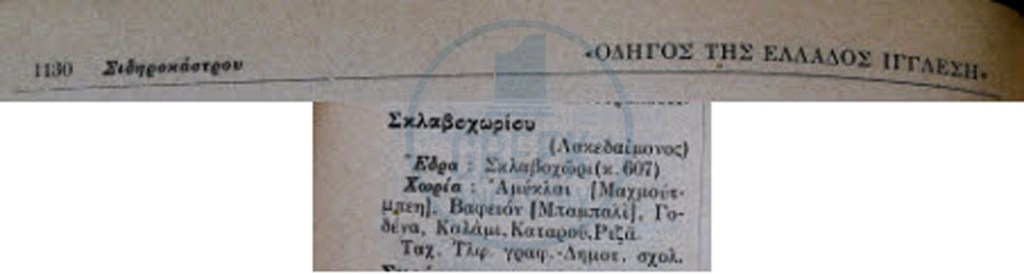
Some villages may not have resident professionals or businesses, but they are still listed in the directory with statistical data and other important information.  For example, this is the only information provided for the community of Sklavochori in 1934-35:

  • Capital of the community: Sklavochori, number of residents 607
  • Villages in the community: Amykles (Machmoutbei), Vafeion (Mpampali), Godena, Kalami, Katarou, Riza.
  • Municipal offices: post office, elementary school.

Although the information is scant, it reveals important historical data: 

  • As part of the Government reform to abolish names of Turkish, Slav or Albanian origin, thousands of Greek villages underwent name changes. In this 1934-35 directory, the community name is “Sklavochori.” Today, Sklavochori no longer exists. In 1940, that name was eliminated and the area was integrated into Amykles. Consequently, Amykles was then elevated from a village to a community (see this page and this issue of the ΦΕΚ / Government Gazette.)
  • Of significant importance, this City Directory reveals the “old” names of the villages which had been part of Sklavochori in 1934-35: Machmoutbei and Mpampali. Although those names no longer exist, they do exist in records created at the time the village bore that name. This explains why researchers are stumped when they cannot find, on today’s map, a village that had been listed in an early Voter List or a Male Register.

Tracking a Greek family’s change of residence be challenging. Greece does not have accessible census records which place people in a specific location for a specific time at specific intervals. Just as we relocate, so did our ancestors–especially upon marriage and for business opportunities.

By exploring City Directories, a researcher can see which villages have families with a surname of interest. I look at this map of Sparta and then search for ancestral names in surrounding villages.  However, I am super careful not to make assumptions. Patronymic naming conventions absolutely guarantee that all Apstolakos (son of Apostolos) families are not related. And, directories list only businesses and not households.

Despite these precautions, I have found many interesting patterns of family movement and new residences. I also learned which ancestor(s) were business owners or were employed in professional occupations.  

To learn more about the Greek Ancestry City Directory collection, click here: https://greekancestry.net/greek-ancestry-city-directories-collection/

To search the City Directories, click here: https://greekancestry.net/all-greece-discounted

Type a village name, then sort the list by “Prefecture” to group results in the region of interest, such as Messinia or Thessaloniki.

The City Directory Collection spans the years 1901-1947 with 200,000 names in 5,000 cities and towns. Some of these may be your villages! What relevant and historical information will you learn about your family?

Heart of the Village

The heart of every Greek village is its church. Seared into each Greek psyche is reverence, respect and reliance on religion. Their Orthodox faith has buoyed Hellenes through wars, occupations, personal and natural disasters. Its traditions and holidays anchor life in a rythmn of peaceful repetition and steadfastness.
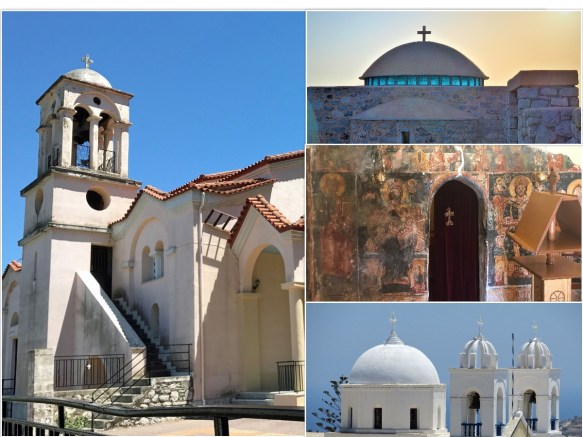
The soul of the village is its priest–the father (παπάς) of the congregation who ministers, counsels and guides his people. Together, the villagers and their beloved πάπα navigate mortality and attend to its holy sacraments.
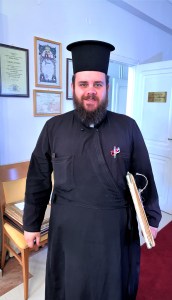
Papa Panagiotis, priest of Theologos, Lakonia, whom I met at the Metropolis of Sparta last summer

I continue to be awed by the number of churches dotting the Greek landscape. Even the smallest villages may have several. Some are erected by families to commemorate a loved one; some are older and no longer attended except on its patron saint holiday; some are tiny holy places excavated within rock caves, and others are simple, small buildings. My village of Agios Ioannis has eight churches!

Tiny church excavated within a cave, Faneromeni Monastery, Mani

Small church in Vordonia, Lakonia

Not all churches have a priest serving every Sunday, but at some point in the year, most host at least one divine liturgy.

Today, priests are appointed and remunerated by the state. But this was not always so–before 1967, priests were commissioned and compensated by each village. Candidates were identified and elections were held with voters (e.g., heads of household) casting their ballots and choosing their new ecclesiastical leader. This  practice resulted in a rare and exciting collection recently made available on GreekAncestry–Parish Voter Lists, which I wrote about here.

When I was digitizing marriage documents at the Metropolis of Sparta, I came across one that caught my attention because it did not appear to be wedding-related. It was a letter with three pages of signatures. I was able to read the words Αγιός Ιωάννης (St. Johns) which caused me to stop work immediately. This is my village and my curiosity was raised–what is this document? My colleague, Gregory Kontos, explained that it was a petition from the residents of Agios Ioannis to the Bishop, requesting that a second priest be appointed. There were over 200 families in the village and the villagers felt that having just one priest was not sufficient to meet the needs of the people. They proposed that a local man, Panagiotis Poulimenakos, be ordained.

This document, created in 1894*, was signed by 70 men and one woman. It is a historical and genealogical treasure. It supplements the 1872 Election Lists and fills gaps in the Male Registers of Agios Ioannis. Now preserved are the handwritten signatures of the parishioners–most of whom would have signed few, if any, documents during their lifetime. The document shows us who is literate, and who is not. The signature of Charifalitza V. Maltziniotou denotes that her husband, Vasileios, was deceased, and that the prominence of the Maltziniotis family in the village lended credence and weight to the parishioners’ petition.

Below is the document and its translation, for which I am forever indebted to Gregory Kontos. We now have a glimpse into the dealings of these humble people who are seeking a second priest to tend to the spiritual and temporal needs of their families.
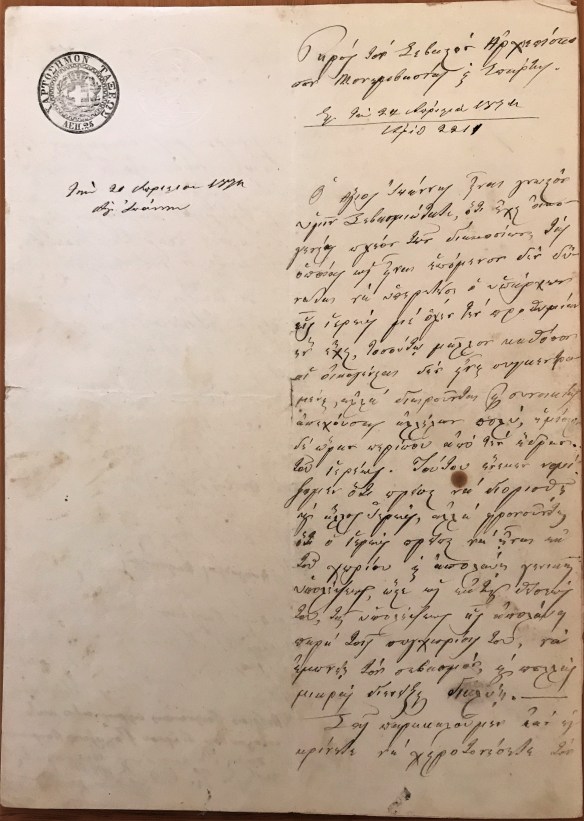
Agios Ioannis, Petition, 1894, p.1

Agios Ioannis, Petition, 1894, p.2
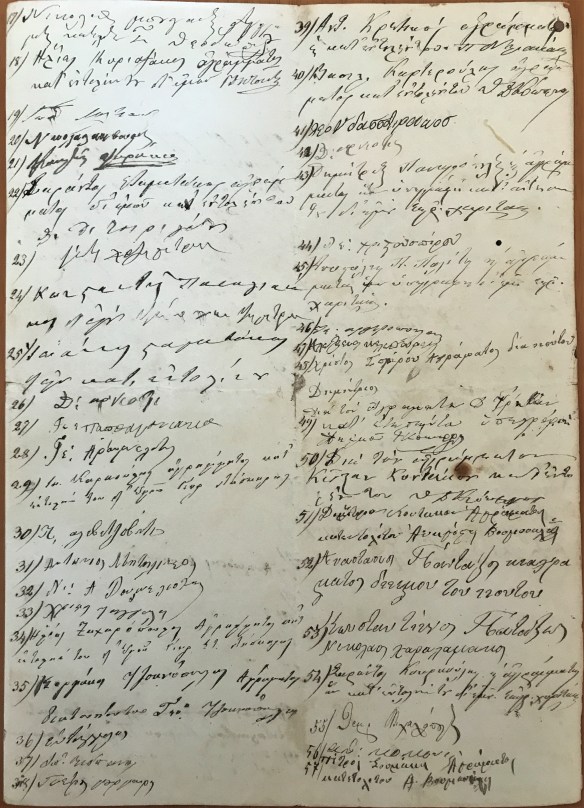
Agios Ioannis, Petition, 1894, p.3
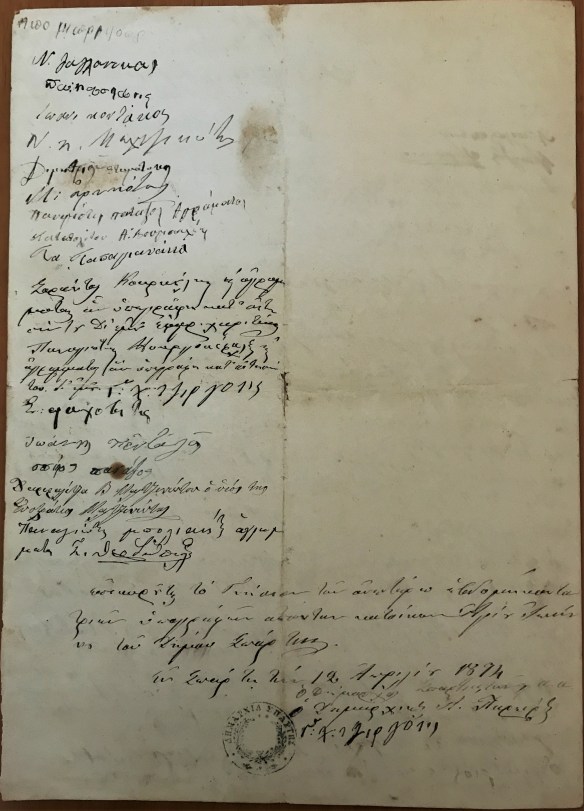
Agios Ioannis, Petition, 1894, p.4

To the Honorable Bishop of Monemvasia and Sparti
Received on April 27th, 1894
No. 221
April 20th, 1894
Agios Ioannis

It is known to you, your Eminence, that Agios Ioannis has over two hundred families, which, as follows, cannot be ministered by the current one priest with all the willingness he has, especially as the families are not concentrated, but are dispersed in neighborhoods, which are quite far from each other, about half an hour from where the priest is based. For this reason, we believe that one more priest has to be appointed and that the priest needs to be from this village and of general renown, so that through his position and his estimation from his co-villagers he will command respect and resolve many little disputes.

If you approve, we ask you to ordain our co-villager, Panagiotis Poulimenakos, a good and honest man of letters, valued by everyone, and also virtuous, pious and with ecclesiastical knowledge.

The residents of the village of Agios Ioannis

1. Panagiotis Papa[…]
2. D. P. Maltziniotis
3. P. Th. Ko[…]
4. Efstr. Charitakos
5. I. Ch. Tzirgotis
6. Th. D. Tsirigotis
7. Ioannis Gianniopoulos
8. Th.  D. Kopanos
9. K [?] Haralambakos
10. Anagnostis V[…]lias
11. Dimitrios Moustakaros
12. Dimitrios Vasilakos
13. Georgios St. Laskaris
14. Ath. Voulgaris, illiterate. On his order and behalf, Geor. Laskaris.
15. Andreas Loumakis, illiterate. On his order and behalf, Polyzois Loumakis.
16. Spyros Lampropoulos, illiterate. On his order and behalf, K. Theodoropoulos.
17. Nikolaos Bougadis, illiterate. On his order and behalf, Theodopoulos.
18. Ilias Kyriazakis, illiterate. On his order and behalf, G. D. […].
19. Ioan. M[.]ltiad[.] [possibly Miltiades]
20. Nikolaos […]
21. Konstantis Psyrakis
22. Sarantos Stamatakos, illiterate. On his order and behalf, D. [?] P. Tsirigotis.
23. Zois [?] […]
24. Konstantis Panagianakos. On his behalf, Chatzipetros.
25. Ioannis Stamatakos, on his order and behalf.
26. D. Arniotis
27. Io. Papagiannakos
28. Ge. Aramel[…]
29. Io. Karkoulis, illiterate. On his order and behalf, Geor. Laskaris.
30. P. Alevetzovitis
31. Antonios Mitilinaios
32. N. A. Roumeliotis
33. Christos Tagkalos
34. Ilias Zacharopoulos, illiterate. On his order and behalf, Geor. St. Laskaris.
35. Kargakos Tzounopoulos, illiterate. On his behalf, Geo. Tzounopoulos.
36. Efta[…]
37. Ioannis Kopanos
38. Petros Gourgouris
39. Ant. Kritikos, illiterate.On his order, P. N. Liakakos.
40. Vasileios Karteroulis, illiterate. On his order, D. Kopanos.
41. Leonidas Sotirakos
42. D. Arniotis
43. Dimitrios Panagopoulos, illiterate. On his order and behalf, Efstr. Charitakos.
44. Le. Christou Spirou
45. Apostolis P. Politis, illiterate. On his order and behalf, Efstr. Charitakos.
46. K. Argyropoulos
47. Alexandros Kelepouris
48. Christos Spyrou, illiterate. On his behalf, Dimitrios.
49. On behalf of D. Gravas [?, possibly Grivas], G. Kokoris.
50. On behalf of illiterate Konstas Kontakos, Th. D. Kopanos.
51. Dimitrios Kontakos, illiterate. On his order and behalf, Anagnostis Vougiouklas.
52. Anastatios Pantazos, illiterate. On his behalf, his son.
53. Konstantinos Pantazos, Nikolaos Charalampakos
54. Sarantos Kourkoulis, illiterate. On his order and behalf, Efstr. Charitakos.
55. Them. Michalopoulos
56. An. Kokonis
57. Petros Soumakis, illiterate. On his order, A. Vougiouklis [?]
[58.] N. Lagchanikas [?]
[59.] Papasionis [?]
[60.] Ioannis Kontakos
[61.] N. N. Maltziniotis
[62.] Dimitrios Stamatakos
[63.] M. Arniotis
[64.] Panagiotis Pantazos, illiterate. On his order, A. Vougiouklis.
[65.] Pa. Papagiannakos
[66.] Sarantos Kourkoulis, illiterate. On his order and behalf, Efstr. Charitakos.[67.] Panagiotis Mourgokefalos, illiterate. On his order and behalf, G. Ch. Tzirgotis.
[68.] S. […]
[69.] Ioannis Pantazos
[70.] Spyros Pantazos
[71.] Charifalitza V. Maltziniotou, her son, Efstratios Maltziniotis
[72.] Panagiotis Mpolianitis, illiterate. On his behalf, S. Theodopoulos.

The authenticity of the above 70 signatures of all the residents of Agios Ioannis of the Municipality of Sparta is verified.

Sparta, April 12th, 1894
The Mayor of Sparta,
The Representative of Parori,
Ch. Tzirgotis

________

*The year appears on both the first and last pages. It is not clearly written and could be either 1874 or 1894; we are assuming it is 1894 as there is no line through the stem of the 7, which is how that number is always written in Greek.
Beyond the Basics: Parish Voter Lists

The Orthodox Church is the state religion in Greece and, but for few exceptions, it is the faith of the people. Its records are kept in village churches, priests’ homes, monasteries and Metropolis (archdiocese) offices. This “covid summer” sadly put a halt to my digitization work in Sparta, but my colleague, Gregory Kontos of GreekAncestry, headed there in June to digitize yet another collection of church records, Parish Voter Lists of 100 Sparta villages.

Gregory’s detailed post about this collection explains that prior to 1967 when priests became state employees, each village was responsible for finding a priest for its church and paying his salary. Those eligible to vote were the heads of households–either men or widows–and a list of their names and ages was compiled. This specific collection spans the early to mid-1900’s and information includes:

  • name of head of household
  • father’s name
  • age
  • village
  • a column for notes

If there is a collection for your village (a list is at the end of this post), you are in luck! This name-indexed, online collection will help you find your ancestor in a specific village at a specific year, and provide his age and father’s name. This information is mandatory to access records such as Male Registers and Dimitologion/Town Registers from Archives and Town Halls, whether you go in person or write a letter.

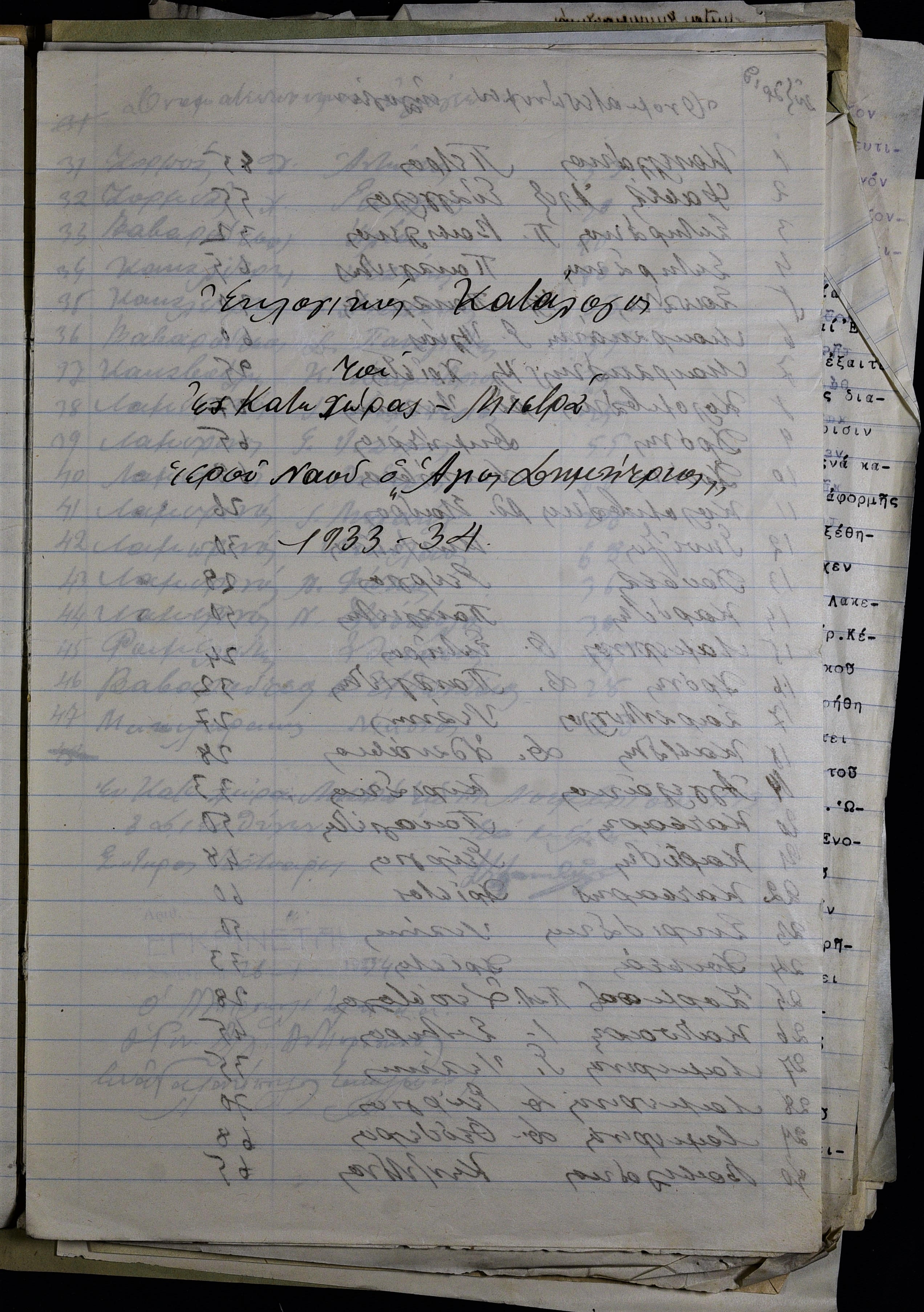
This image is the cover page of the 1933-34 Parish Voter List for Kato Chora, Mystras. It reads:  Eκλογικός Κατάλογος ((Electoral Catalog) Κάτω Χώρας-Μιστρά (Kato Chora-Mystra) Ίερου (Priest) Ναου ό Άγιος Δημήτριος (Temple of Agios Dimitrios), 1933-34.

(Click on any image to enlarge it)

Kato Chora, 1933 Parish Voter List, cover page

This is a page from the Kato Chora Parish Voter List. First column is the number of the voter, second column is voter’s surname and given name, third column is his age. Translation of line 1: Kanellakos, Petros age 85.

Kato Hora Parish Voter List, 1933

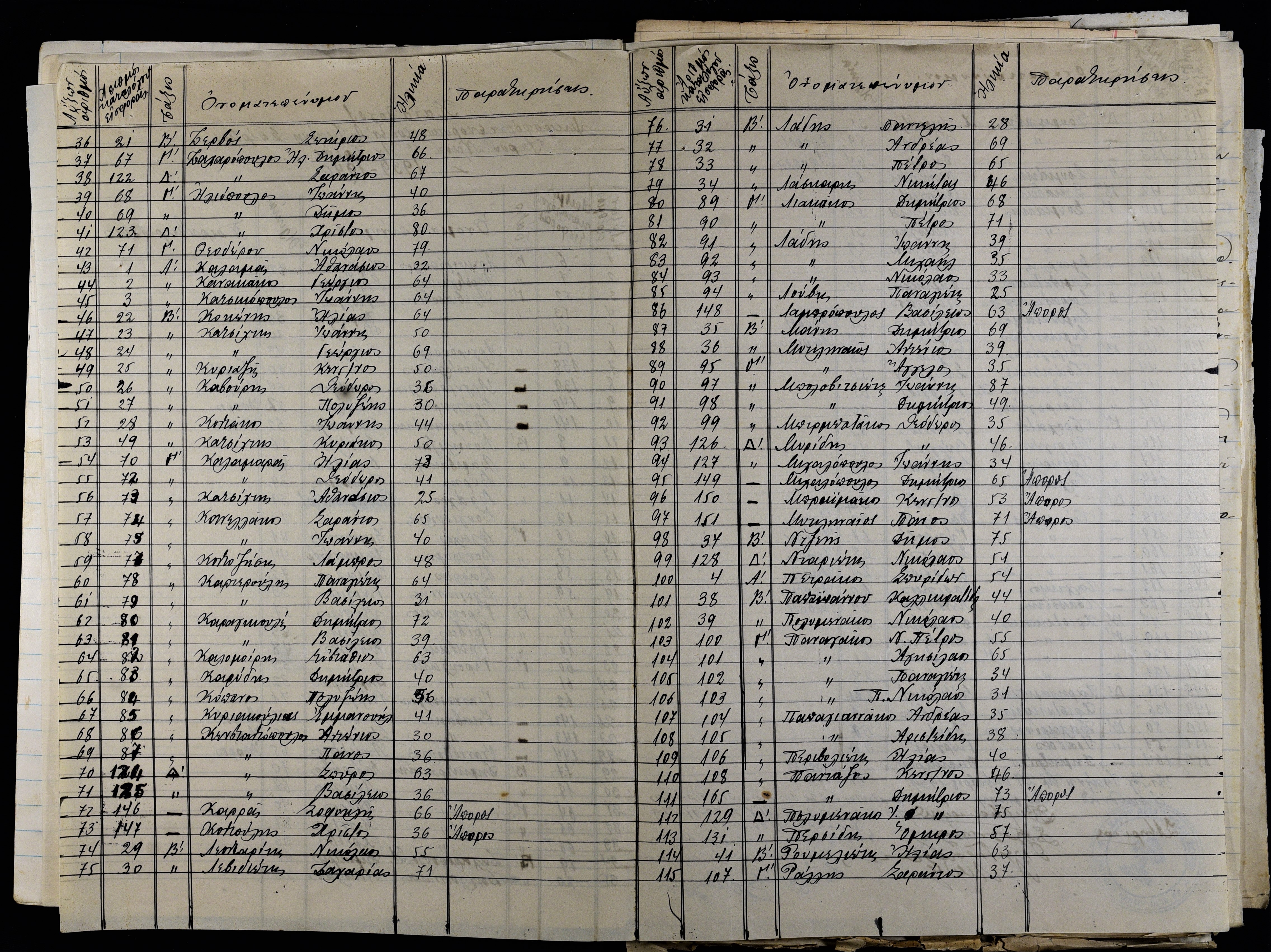
The page below is a 1939 Parish Voter List from Agios Ioannis, Sparta. It has two additional columns because it is a combination voter list and contribution list. Column one is the voter number, column two is the voter’s serial number in the contribution list,  column three is the grade/level of donation given, column four is the voter’s surname and given name, column five is notes.

Translation of line1:
Number 36, contributor number 21, contribution level B, contributor: Zervos, Sotirios, age 48.

1939 Parish Voter List, Agios Ioannis, Sparta

It is fascinating to look at the contribution levels of various families. This page shows four levels:  Α, Β, Γ, Δ (A, B, C, D). Those who could not donate have a horizontal line in the contribution level column, and are marked άωπρος (destitute) in the notes column. For example, see lines 72 and 73 on the left side, and several on the right side.

Important notes about these records:

  1. Whenever a new priest was needed, the village compiled a Voter List. Those which changed priests several times have a list for each election. Be sure to get all lists for your village. Look at the years and compare the names and ages to see who is in the village for each year.
  2. Many villages have undergone name changes between 1913 and today. The villages are listed by their names at the time the Voter List was created, NOT today’s name.  A quick search on Wikipedia reveals that 827 villages were renamed in the Peloponnese between 1913-1966, and that does not include additional changes made since then. Use the website Πανδέκτης to find the old and new village names; or, contact GreekAncestry.net.
  3.  When you research the old and new village names, you will learn such interesting history. For example, Κοντεβιάνικα (Kontevianika) which is the village name in the records, is now Άσωπος (Asopos). The first settlers of that area were the Conte family who originated in the village of Viani, Crete–thus,they named the settlement Kontevianika after themselves.
  4. To research old village names, copy the village name in Greek (as it is written below) and paste it into a search engine. A webpage will come up in Greek, then use Google translate to turn the page into English. In the example of Kontevianika, one “hit” was the website of the local government of Monemvasia (the village region) which provided the story of the naming of the village.
  5. Another example: I put the name Κουρτσούνα (Kourtsouna) in Google. The search went to the EETAA.gr website where the history of the village, from 1835 to present, was given as taken from notices in the ΦΕΚ (Government Gazette). It was renamed Βασιλική (Vasiliki) in 1955. That’s a recent change, so if you have cousins today living in Vasiliki, but your grandparents or great-grandparents came from Kourtsouna, the family remained in the same village.

As with any new record collection, there is so much to explore in these Parish Voter Lists. The list can be searched by name or village, in English or Greek, at the GreekAncestry website. If you search by village, you will get a list of all the names in that village in all collections current on the website.

This is a list of the villages and the years as found on GreekAncestry here.

Metropolis of Sparta, Parish Voter Lists by Village & Year
Ag. Kyriaki – Αγ. Κυριακή – 1913
Ag. Andreas – Άγ. Ανδρέας – 1935
Ag. Dimitrios Monemvasias – Άγ. Δημήτριος Μονεμβασίας – 1934
Ag. Dimitrios Zarakos – Άγ. Δημήτριος Ζάρακος – 1934
Ag. Ioannis – Άγ. Ιωάννης – 1934, 1939-40
Ag. Ioannis Theologos – Άγ. Ιωάννης Θεολόγος – 1932-33
Ag. Nikolaos – Άγ. Νικόλαος – 1934
Ag. Nikolaos Monemvasias – Άγ. Νικόλαος Μονεμβασίας – 1930
Ag. Nikolaos Voion – Άγ. Νικόλαος Βοιών – 1934-35
Ag. Vasileios – Άγ. Βασίλειος – 1927, 1933
Agoriani – Αγόριανη – 1936, 1938
Agrapidoula – Αγραπιδούλα – 1935
Agrianoi – Αγριάνοι – 1932-33
Alampei – Αλάμπεη – 1928
Alampei [Alaimpei] – Αλάμπεη [Αλαΐμπεη] – 1926, 1934
Alepochori – Αλεποχώρι – 1934-35
Alevrou – Αλευρού – 1934-35
Anavryti – Αναβρυτή – 1932-33, 1935
Angelona – Αγγελώνα – 1934-35
Anogeia – Ανώγεια – 1935
Apidea (Apidia) – Απηδέα (Απηδιά) – 1934-35
Apidia – Απηδιά – 1920
Arachova – Αράχωβα – 1915
Asteri (Vriniko) – Αστέρι (Βρίνικο) – 1920, 1933, 1936
Charakas – Χάρακας – 1915, 1934-35
Chatziaga – Χατζήαγα – 1912
Chrysafa – Χρύσαφα – 1934-35
Dafni – Δαφνί – 1931, 1933, 1938
Daimonia – Δαιμονιά – 1932-33
Elaia (Elia) – Ελαία (Ελιά) – 1932
Elia (Elaia) – Ελιά (Ελαία) – 1916
Elika – Ελίκα – 1926-29, 1932-33
Faraklo – Φαρακλό – 1927, 1930, 1935
Filisi – Φιλήσι – 1926, 1928-29
Foiniki – Φοινίκι – 1925-27, 1929, 1936
Foutia – Φούτια – 1933-34, 1936
Fregkra – Φρέγκρα – 1936
Georgitsi – Γεωργίτσι – 1926, 1929, 1934-35
Geraki – Γεράκι – 1926, 1929, 1935
Gkoritsa – Γκοριτσά – 1934-35
Godena – Γοδένα – 1939
Goranoi – Γοράνοι – 1934-35
Gounari (Gounari) – Γούναρι (Γούναρη) – 1935
Gouves – Γούβες – 1927-29, 1933-35
Grammousa – Γράμμουσα – 1925, 1933, 1935
Ierakas – Ιέρακας – 1932-33
Ierax (Ierakas) – Ιέραξ (Ιέρακας) – 1927
Kalogonia – Καλογωνιά – 1925-26, 1930, 1934-36
Kalyvia Sellasias – Καλύβια Σελλασίας – 1934
Kamaria – Καμάρια – 1935
Kaminia – Καμίνια – 1934-35
Kampos – Κάμπος – 1925,1934, 1936
Karitsa – Καρίτσα – 1925
Karotsa – Καρότσα – 1933
Karyes – Καρυές – 1934-35
Kastorio (Kastania) – Καστόριο (Καστανιά) – 1934-35, 1940
Katavothra (Metamorfosi) – Καταβόθρα (Μεταμόρφωση) – 1923-29, 1934
Kato Chora Mystra – Κάτω Χώρα Μυστρά – 1933
Katsarou – Κατσαρού – 1939
Katsoulaiika – Κατσουλαίικα – 1934-35
Kefalas – Κεφαλάς – 1929, 1934-35
Kladas – Κλαδάς – 1929, 1930, 1932-33, 1935
Kokkinorachi (Tsouni) – Κοκκινόραχη (Τσούνι) – 1926, 1929, 1935
Koniditsa – Κονιδίτσα – 1928-29, 1933-35
Kontevianika – Κοντεβιάνικα – 1924-25, 1929, 1934-35
Kotsatina – Κοτσατίνα – 1922
Koulentia (Elliniko) – Κουλέντια (Ελληνικό) – 1933, 1934, 1936
Kounoupia – Κουνουπιά – 1933, 1935
Koupia – Κουπιά – 1927-29
Kourtsouna (Vasiliki) – Κουρτσούνα (Βασιλική) – 19335, 1935-36
Kremasti – Κρεμαστή – 1915, 1933
Krokees – Κροκεές – 1934-35
Kyparissi – Κυπαρίσσι – 1931
Lachi – Λάχι – 1924, 1926-28
Lagia – Λάγια – 1917
Lagio – Λάγιο – 1936
Leimonas – Λεήμονας – 1919
Magoula – Μαγούλα – 1927-28
Mari – Μαρί – 1933
Molaoi – Μολάοι – 1927, 1929
Monemvasia – Μονεμβασία – 1913, 1915,1927, 1929, 1933
Mousga – Μούσγα – 1935
Myrtia – Μυρτιά – 1929-30
Mystras – Μυστράς – 1916
Niata – Νιάτα – 1924, 1929
Nomia – Νόμια – 1912
Pakia – Πάκια – 1916
Palaiochori – Παλαιοχώρι – 1934-35
Panigyristra – Πανηγυρίστρα – 1929
Pantanassa Monemvasias – Παντάνασσα Μονεμβασίας – 1928
Pardali – Παρδάλι – 1932
Parori [Parori] – Παρόρι [Παρώρι] – 1929-30
Pellana (Kalyvia) – Πελλάνα (Καλύβια) – 1934, 1936
Platana – Πλατάνα – 1921
Platanaki – Πλατανάκι – 1933
Polovitsa – Πολοβίτσα – 1928-29
Pritsa (Palaiovrysi) – Πρίτσα (Παλαιόβρυση) – 1915
Pyri – Πυρί – 1931
Sellasia – Σελλασία – 1935
Skala – Σκάλα – 1940
Sklavochori – Σκλαβοχώρι – 1939
Skoura – Σκούρα – 1912
Sparti – Σπάρτη – 1934
Syrkia – Σύρκια – 1912
Tarapsa – Τάραψα – 1917
Tsasi – Τσάσι – 1926, 1928-29, 1935
Varsiniko – Βαρσίνικο – 1932-33
Varsova – Βάρσοβα – 1934-35
Vassaras – Βασσαράς – 1932, 1935
Velanidia Voion – Βελανίδια Βοιών – 1932-34
Vergadeika (Bergadeika) – Βεργαδέικα (Μπεργαδέικα) – 1927, 1933
Vlachiotis – Βλαχιώτης – 1921, 1925, 1934-35
Vordonia (Vordonia) – Βορδώνια (Βορδόνια) – 1932, 1934, 1936
Voutianoi – Βουτιάνοι – 1925
Vresthena – Βρέσθενα – 1935
Vrontamas – Βρονταμάς – 1933-35
Vroulias (Sellasia) – Βρουλιάς (Σελλασία) – 1924-25
Xirokampi – Ξηροκάμπι – 1935
Zagana – Ζαγάνα – 1921
Zarafona – Ζαραφώνα – 1913, 1915, 1933
Zelina (Melitini) – Ζελίνα (Μελιτίνη) – 1933, 1939
Zoupaina (Ag. Anargyroi) – Ζούπαινα (Άγ. Ανάργυροι) – 1932-33

Kosta’s Map

I love speaking with the villagers in Sparta. They know their land with a level of intimacy that astonishes me:  every hiding place in the Taygetos mountains, every olive tree on their land, every goat trail that leads to an abandoned kalivia (shepherd’s hut), and the origins of every family in the village. Last summer, simply by hearing the surname, Christos told me that my great-grandfather, Andreas Kostakos, was from the now-abandoned village of Perganteika (read that post here).

The Kostakos family origins have mystified me for years and have morphed into my never-ending quest. The -akos suffix designates the Mani region, but I can’t find the family in any records outside of the Sparta area before 1844. The reason? Greece became an independent country on February 3,1830, after 400 years of Ottoman rule. It took time for the new government to begin record keeping; not much exists prior to 1840. Thus, all Greeks have the proverbial brick-wall during this timeframe.

Christos’ insistence that the Kostakos family was first in Perganteika, then in Anavryti, then in Agios Ioannis after the War of Independence (about 1835-40) has not satisfied my desire for proof. (An elusive commodity in Greek research). So, I pester anyone whom I meet with many questions. In return, I get bits and pieces, and sometimes a treasure like the one below (click on image to enlarge it).

Last July at the home of Peter Adamis in Pellana, I received an exensive history-geography lesson from Peter’s friend, Kostas Sgourdas. A native of the area and a renowned stone and marble mason, Kosta’s artisan work is found in government buildings, churches and homes throughout Lakonia. He has a comprehensive knowledge of the region and its people. And he shared much with me.

Kosta explained what I heard many times:  people fled to the towering Taygetos mountains to escape Ottoman dominion; after 1830 they started their descent into the valleys to begin a life of freedom. Kosta patiently and carefully sketched the map above to depict “layers of villages,” beginning at the top of the Taygetos range and descending into the plains of Sparta. I could now plainly see how the villages were staggered and, at times, stacked upon each other. As his pen moved down the page, I could almost visualize people moving down, incrementally, from the peaks. It was a logical movement of humanity and a powerful moment of clarity.

Kosta’s stories mesmerized me. These people–my people–were resilient, tough, inventive, smart, and scrappy survivors. The more I hear about village life in the 1800’s, the more I want to learn. I love Kosta’s map. It has not solved the Kostakos origin mystery, but it has enhanced my understanding. My respect for my ancestors grows with each fact I learn, and I am proud to be their descendant.