Double Date

No, this is not a post about two couples going out for dinner or a movie date. It is, however, a description of something important that I learned this past weekend.

On Saturday, at the Greek Genealogy Conference held in Tarpon Springs, Florida, I taught a class entitled, “Using U.S. Records to Begin Greek Research.” In this presentation, I used numerous examples of records that may have information to help  find the original name of an ancestor (such as Papadopoulos, not just Pappas), and also the village of birth (very important, as records in Greece are cataloged by location).

I emphasized the importance of finding every record that could have possibly been created in the U.S. for an ancestor. The reason is that each document may have new or different information. When documents for a direct ancestor are hard to find, look for documents of siblings or other family members, and do your best to locate every piece of paper on which they could possibly be listed.

As an illustration, I used both civil and church marriage records for my maternal grandparents. This is the State of New York Certificate and Record of Marriage for Ilias Papagiannakos and Angelina Eftaxias; note that the date is May 10, 1914:

New York State Certificate and Record of Marriage, Ilias Papagianakos and Angelina Eftaxias

State of New York: Civil Marriage Record Louis Papagianakos and Angelina Eftaxia GROOM: age 32; occupation: oyster dealer; birthplace: Greece; father’s name: Panagiotis; mother’s maiden name: Caterina Eliopoulis BRIDE: age 20; birthplace: Greece; father: Constantinos; mother’s maiden name: Stafia Zaharopoulo. Joined in marriage at 358 West 44th Street, Manhattan on 10th of MAY 1914

This is the Greek Orthodox Marriage Certificate from Holy Trinity Church in New York for the same grandparents. Note that the date of marriage is:  27/10 April, 1914.

pappas-louis-angelina-marriage-certif-001

Greek Orthodox Marriage Record; Holy Trinity Church.   Of Agios Ioannis, Sparta, Ilias Panag. Papagiannakos and of Mistra Aggeliki Kon. Eftaxia married on 27/10 APRIL 1914 Best man: Christos Aridas FATHERS: Panagiotis Papagiannakos KON [Konstandinos] Eftaxias

As I described the differences between the civil and the church marriage records, I mentioned that I was puzzled by the “double date” on the church record. I did not understand the discrepancy between the two dates and what 27/10 April was referring to.

After the presentation, Adamantia Klotsa, Consul General of Greece, approached me and solved the mystery. She explained that the “double date” on the Greek certificate referred to the dates as they were calculated by both the Julian Calendar (27 April) and the Gregorian Calendar (May 10). There is a 13-day difference between the dates in these calendars, and the Greek record reflected both because Greece used the Julian calendar until 1922. With this marriage occurring in 1914, it now makes sense as to the correctness of the date as noted on the Greek Orthodox Marriage Record–the difference between April 27 and May 10 is exactly thirteen days.

Genealogy is never boring–there is always something new to learn!

Marriage: Andreas Kostakos & Politimi Christakos

Trying to read 1800’s Greek script is both exhilarating and frustrating. Recognizing a name gives me an adrenalin surge; struggling over a name sends me to chocolate.

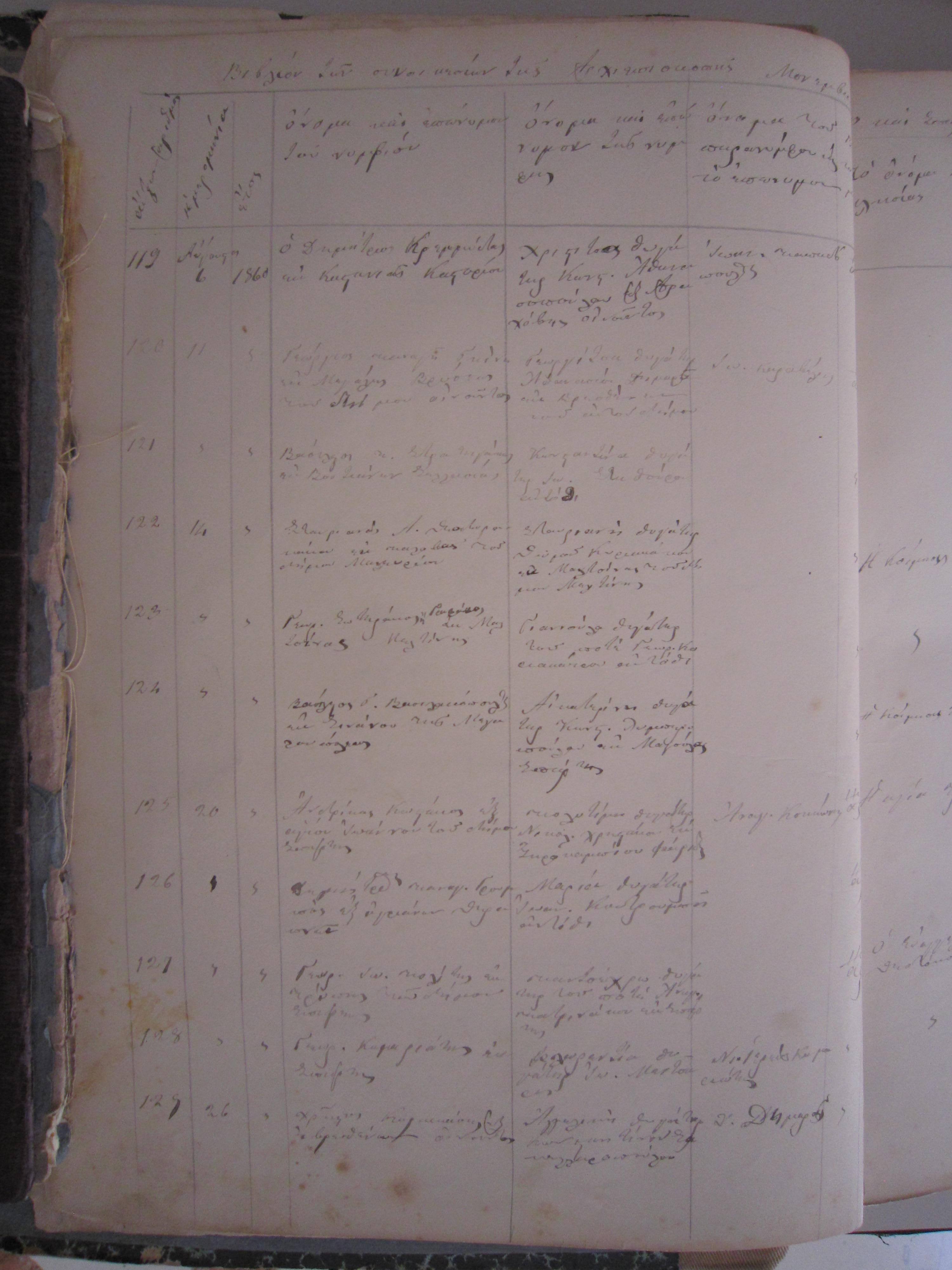
Two nights ago, I got the surge of a lifetime. I found an entry in the 1860 Marriage Book of the Mitropolis of Sparta for my great-grandparents, Andreas Kostakos and Politimi Christakos. My friend, Giannis Michalakakos, confirmed that I read the record correctly.

Mitropolis of Sparta, Marriage Book, 1860 Page 1: Date: August 20, 1860; Number: 125; 1st column: Andreas ( Andrikos) Kostakos of Agios Ioannis. 2nd column: Poletimi, daughter of Nikolaos Christakos of Xirokambi, Faridos.

Mitropolis of Sparta, Marriage Book, 1860
Page 1: Date: August 20, 1860; Number: 125; 1st column: Andreas ( Andrikos) Kostakos of Agios Ioannis.  2nd column: Politimi, daughter of Nikolaos Christakos of Xirokambi, Faridos.

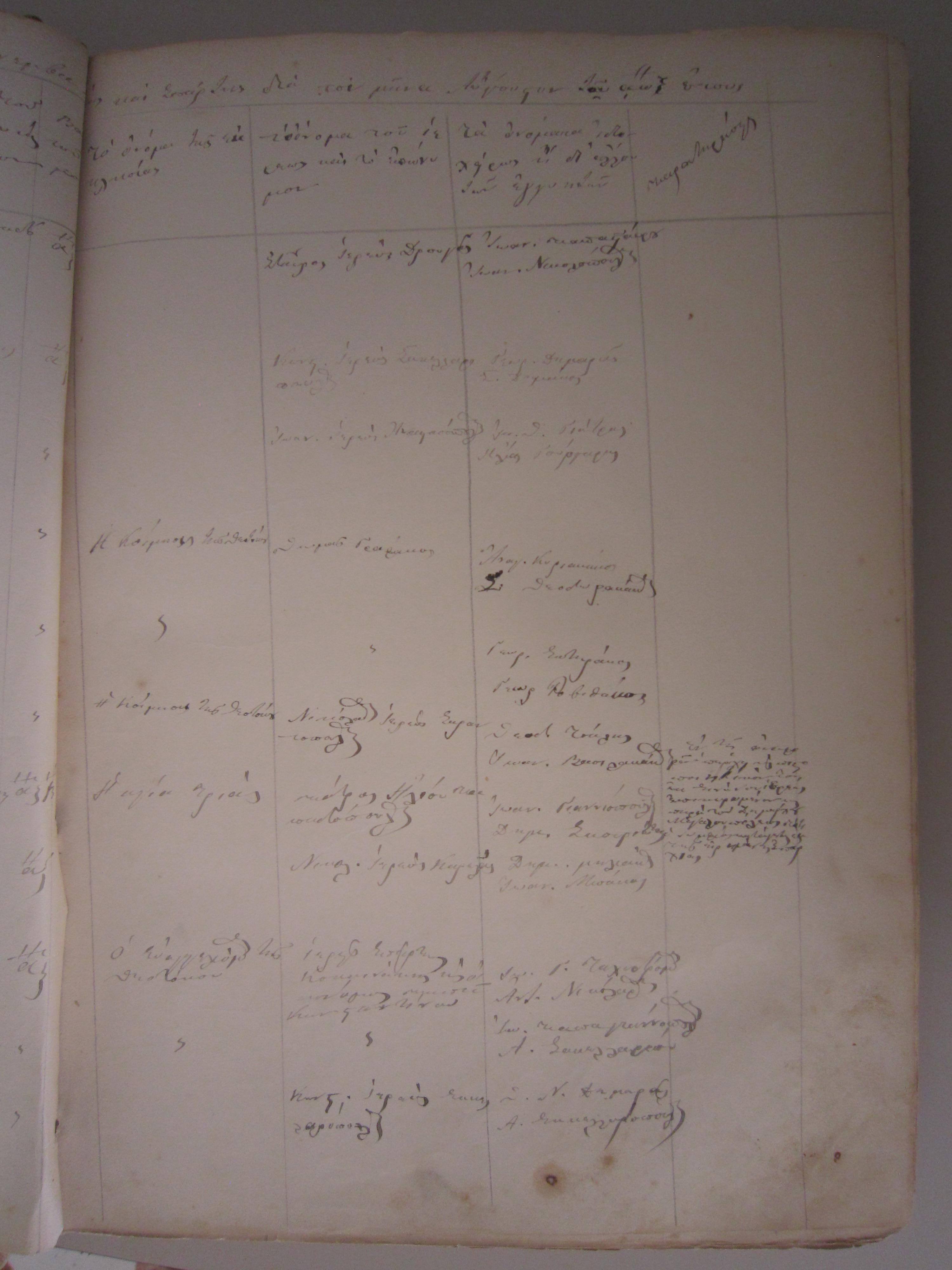
Page 2, Marriage of Andreas Kostakos and Poletimi Christakos

2nd page, 7th entry: 1st column: Church: Holy Trinity; second column: Priest’s name, Mitros Hlia Papadopoulos Witnesses: Ioannis Giannopoulos, Dimitris Skouriotis

After hours of struggling to read every name, I decided to try the tactic that my friend, Gregory Kontos, used when we were at the Mitropolis of Sparta in 2014. He looked in the column of the male’s name for the first name of someone I was seeking. If his eye caught that name, he then read the entire entry.

Interestingly, the name “Andreas” does not appear often in the villages of Sparta where I am researching:  the most common names are Panagiotis, Nikolaos, Georgios, Konstandinos. So…skimming down the left column of page one, looking for Andreas, made the search much easier and saved my eyes and my sanity.

As soon as I saw the capital “A,” I stopped. When the next name began with a “K,” my hopes soared. When I made out “Kostakos,” I rejoiced!

Enlarged image of Entry 125.

Enlarged image of Entry 125.

I knew that Andreas had two wives:  first, Anastasia; then Poletimi Christakos (my great-grandmother). Honestly, if I did not know Politimi’s name, I would have been stumped as I strained to read the female information in column 2. But, I could make out the letters, and then — a great bonus — I saw Poletimi’s father’s name, Nikolaos! This was a new and very exciting find, as I am now back one more generation!

This exhilarating discovery fostered a new mystery:  Andreas and Poletimi were married in 1860, but their first child, Antonia, was born in 1870. That’s 10 years — a very long time, especially in the pre-birth control era. Some hypothesis that Giannis and I mulled over:

  1. Politimi must have been raising Andreas’ children with Anastasia (my father had been told that they had 6 sons, but we only know of one, and his descendants are my cousins in Agios Ioannis today). Could the stress of raising a large family have affected Poletimi?
  2. There could have been stillborn children
  3. Children could have been born and died as infants
  4. There could have been female children born, who were not registered in any records

I am entering the area of lost information and the “great unknown;” and, speculation will not bring resolution. However, I am grateful beyond expression to have found this record.

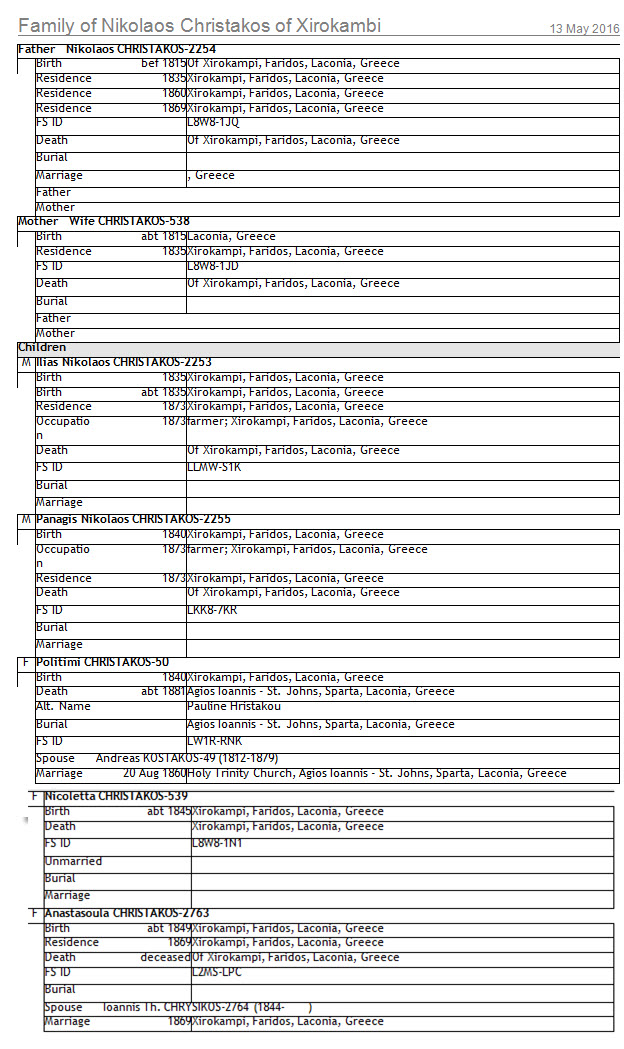
I have been collecting information on the surnames in my villages, and from various sources, I now am able to structure the family of my great-great grandfather, Nikolaos and”wife” Christakos. Oh, happy day!

Christakos, Nikolaos FamGrpSheet