1946 Engagement Photo: George Paul Morfogen and Georgia Pappas

This photo has been hiding in a drawer in my grandparents’ home for over 70 years. When my cousin found it, he snapped a picture with his cell phone and sent it to me in a text:  I don’t think we digitized this one [during our cousin scanfest in 2015] and he was correct. What a treasure!

1946 Engagement Party, George Paul Morfogen and Georgia Pappas, held at Michel’s Restaurant, Brooklyn, New York

This photo has captured my heart and kindled my fascination. It evokes memories of the stories my mother shared about the galas, dances, and special events that were the hallmark of that time. People dressed in their finest with hats and gloves as de rigueur. Extended families gathered and new “matches” of young couples were forged by enterprising relatives. The magical combination of live music, fine dining and spirited conversations produced many an “enchanged evening.” Truly, I feel like I am missing something very special.

But I especially love looking at all these beautiful faces (and truly they are lovely!). The joy they express reveals a familial happiess that lies in connections which stretch back generations. Starting in Agios Ioannis (Pappas) and Anavryti (Morfogen) and now rekindled in Brooklyn, these immigrants settled themselves and their families in close-knit neighborhoods. They started successful businesses and helped each other become established in a new land.

This union of Pappas (Papagiannakos) and Morfogen (Morfogenis) shows how the intermarriages of immigrant Greek families expanded and drew the family circles tighter together. In this example, the families of both my father (Kostakos) and my mother (Papagiannakos) and thus, all of their cousins, now became linked with the Morfogen family and the circle ever widens. Both of my parents are in this photo, as are their siblings and their parents!

This family continuity is my foundation and fortitude.These are the generations on whose shoulders I stand and whose strength I carry.

My deepest gratitide and sincerest thanks to members of the Morfogen family who have identified almost all of the people. Below is the same picture with people numbered, and a chart with the people identified. [click on either of the photos to expand them]

If any additional people can be identified, or any corrections should be made, please let me know by sending an email to spartanroots1 at gmail.com. Thank you!

1Mrs. Zaharia Chahalis
2Pauline Morfogen Kokines
3First name?  Pavlounis
4William Kokines 
5Vivian Kokines Parlamis 
6Ethel Pavlounis Chahalis
7George Chahalis
8John Andrew Kostakos
9Georgia Kostakos Doukas
10Angelo John (Al) Doukas
11Andrew John Kostakos
12Catherine Pappas
13Angelina Eftaxia Pappas
14Nicholas Louis Pappas
15unidentified
16Calliope P. Coutros
17Peter Spyridon Coutros
18Stavroula (Stella) Kostakos Coutros
19Aphrodite (Frieda) Kostakos
20Panagiota (Bertha) Pappas
21unidentified
22Mary Coutros,(later married George Karagis)
23Peter Coutros 
24unidentified
25unidentified
26unidentified
27unidentified
28unidentified
29unidentified
30business associate: Mrs. Vassilaros 
31business associate: Irene Vassilaros 
32business associate wife 
33business associate: Mr. Chios
34business associate: Mr. Vassilaros Sr.
35Andrew Spyros Marinos
36Mary Marinos Neckles
37Petros Neckles
38George Spyros Marinos
39Helen Marinos (later married George Diakomis)
40unidentified
41unidentified
42unidentified
43unidentified
44Nicholas Spyros Pappas
45unidentified
46Father Eugene Pappas and next to him, his father, Leon
47unidentified
48Nicholas Christopher Pappas
49unidentified
50unidentified
51unidentified
52unidentified
53Christina Morfogen Marinos
54Anthony Spyros Marinos
55unidentified
56John Lambrinos 
57Areti Kostakos Lambrinos
58unidentified
59unidentified
60Lucretia Leakakos Pappas
61Pauline Drivas Pappas
62unidentified
63Effie Landis Pappas
64Stella Geaneas 
65George Geaneas 
66Mary Landis 
67Wife of James Landis
68James Landis 
69unidentified
70unidentified
71unidentified
72unidentified
73unidentified
74unidentified
75unidentified
76unidentified
77Catherine DeSimone Pappas
78Peter James Pappas
79John Salatas
80Catherine Pappas Salatas
81Christina Christakos Morfogen 
82James George Morfogen 
83Wilhemina Pappas
84Athanasia Morfogen Pappas
85Diamond Stavracos Morfogen 
86Sam George Morfogen 
87Vivian Morfogen Brauman 
88George Sam Morfogen 
89unidentified
90unidentified
91Paul George Morfogen 
92Anna Landis Morfogen  
93George Paul Morfogen   
94Georgia Pappas Morfogen 
95Calliope Kostakos Pappas 
96James Nicholas Pappas 
97Father Michalopoulos, Priest from Three Hierarchs
98Lily Landis Nikas  
99James  Nikas 
100Marie Nikas Combias 
101unidentified
102Vivian Morfogen Geaneas
103unidentified
104unidentified

Free Access to MyHeritage Greek Records on Sunday, June 28 and Webinars

Tomorrow on June 28, 2020, MyHeritage is offering free access to its three Greek record collections which can be accessed at these links:

Sparta Marriages, 1835-1935

Vlachogiannis Election Rolls (complete collection) 1863-1924

Corfu Vital Records (Birth-Marriage-Death) 1841-1932

There will be two events where Gregory Kontos and I will discuss these records. Access to the events is free, and will be broadcast through the MyHeritage FB page. 

The first is Sunday, June 28, at 2:00 EDT. We will give a brief overview of the collections and answer questrions.  UPDATE:  This session was recorded and can be viewed here.

The second is Tuesday, June 30, where we will discuss these records in more depth. UPDATE: To view the webinar, click here.

EXAMPLES OF RECORDS

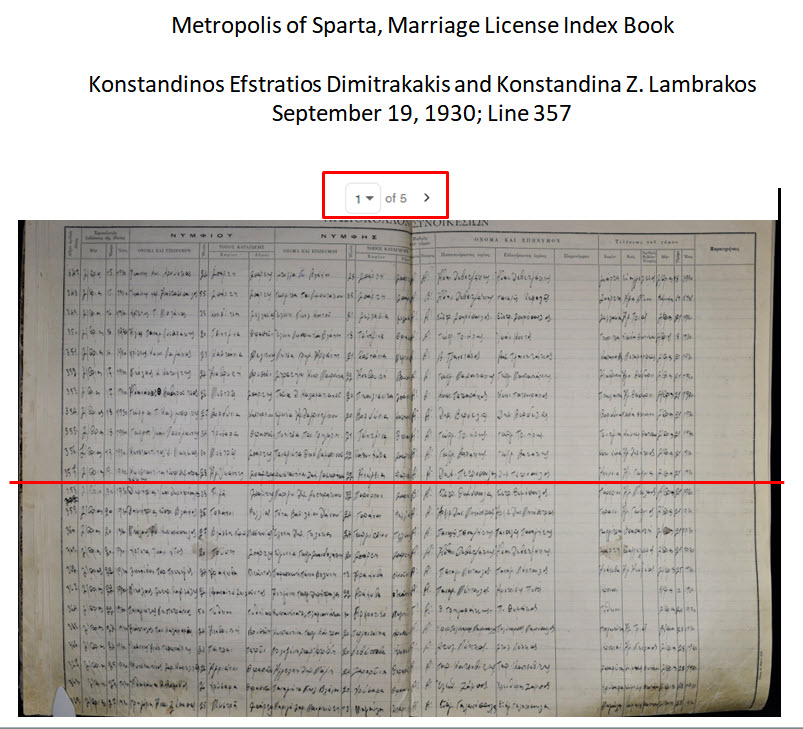
Sparta Marriages 1835-1935  includes images of the Marriage Index book of the Metropolis of Sparta, and any documents associated with the marriage. An example is below. Note that there are 5 documents for this marriage. Some marriages have more documents, some (especially ones in the 1800s) may have only the index book:

Page from Marriage Index book of the Metropolis of Sparta

Letters between village priest and bishop, requesting and approving marriage

Municipal record and marriage affidavit

Vlachogiannis Election Registers, 1863-1924   This collection comprises names of men eligible to vote in all areas of Greece. Sometimes, there are two lists for a village that are one or two years apart. This allows the researcher to compare information on an individual, as the example below shows.

1872, line 1975: Panag. Pappagiannakos, age 31, father: Nikolaos; occupation: landowner
1873, line 2146: Panag. Papagiannakos, age 32, father: Nikolaos; occupation: landowner

Corfu Vital Records, 1841-1932   Birth, marriage and death records are primary documents of crucial importance. This collection is comprised of civil records from the island of Corfu ( Kerkyra /Κέρκυρα).

Marriage and birth documents, Corfu

Finding Greek records on the MyHeritage website is exciting, but having a family tree on the site makes the hunt even easier–the algorithms of the website will provide record hints and do the research for you! As you confirm matches to records, the algorithm is refined and will become even more exact. Record matches can come from any collection in the MyHeritage database and from the millions of names in its family trees.


Take the opportunity to browse these records for free tomorrow, and to join Gregory and me for the webinars to better understand the important information in these rich collections.

Six Dots to Marriage

Do you have a family tree that looks like this?

If you were in Greece and planning to marry a person who had the same last name and  who was from the same village, this diagram might be on your marriage license. It represents the abbreviated pedigree charts of the engaged couple and would indicate whether their marriage could be performed by the Orthodox Church.

Marriages are not permitted between people who are closer than  six dots to each other (approximately third cousins). To simplify understanding the relationship, the village priest could create this chart which would show the couple’s connection to each other, back to their common ancestor.

This is how we would read the chart:  count the number of dots between the groom and the bride, including their common ancestor. If the groom was the second generation dot and the bride was the second generation dot, the 5-dot connection meant that no marriage could occur.

If the groom was the second generation dot and the bride was the third generation dot, a marriage could occur because the couple has a 6-dot connection.

This is the document which revealed this interesting and important rule.

Sparta Marriage Record, Marriage #199, year 1930

In this letter requesting permission for marriage, the bride, Anastasia, is a 4th generation dot (left side) and the groom, Vaselios, is a 3rd generation dot (right side). Counting up the triangle to the common ancestor and down, there is a 7 dot connection. This meets the minimum of 6 and the marriage can be performed.

I love that the priest put an arched row of tiny dots to ensure that the chart could not be misread. Documents like this are a reason why I love digging into old records!

Dowry Contracts: Pictures of the Past

We have pictures of the past, but not the full image. When I first heard Giannis Michalakakos make this comment, I accepted its veracity–but with reluctance. I want the full image of my ancestors’ lives! A Male Register, Town Register, or Election List may provide a birth year and an occupation. But a Contract reveals so much more. Who purchased land, and from whom and where? Who borrowed money, and from whom and why? Who was the bride, and whom did she marry? What did her family provide for her dowry?

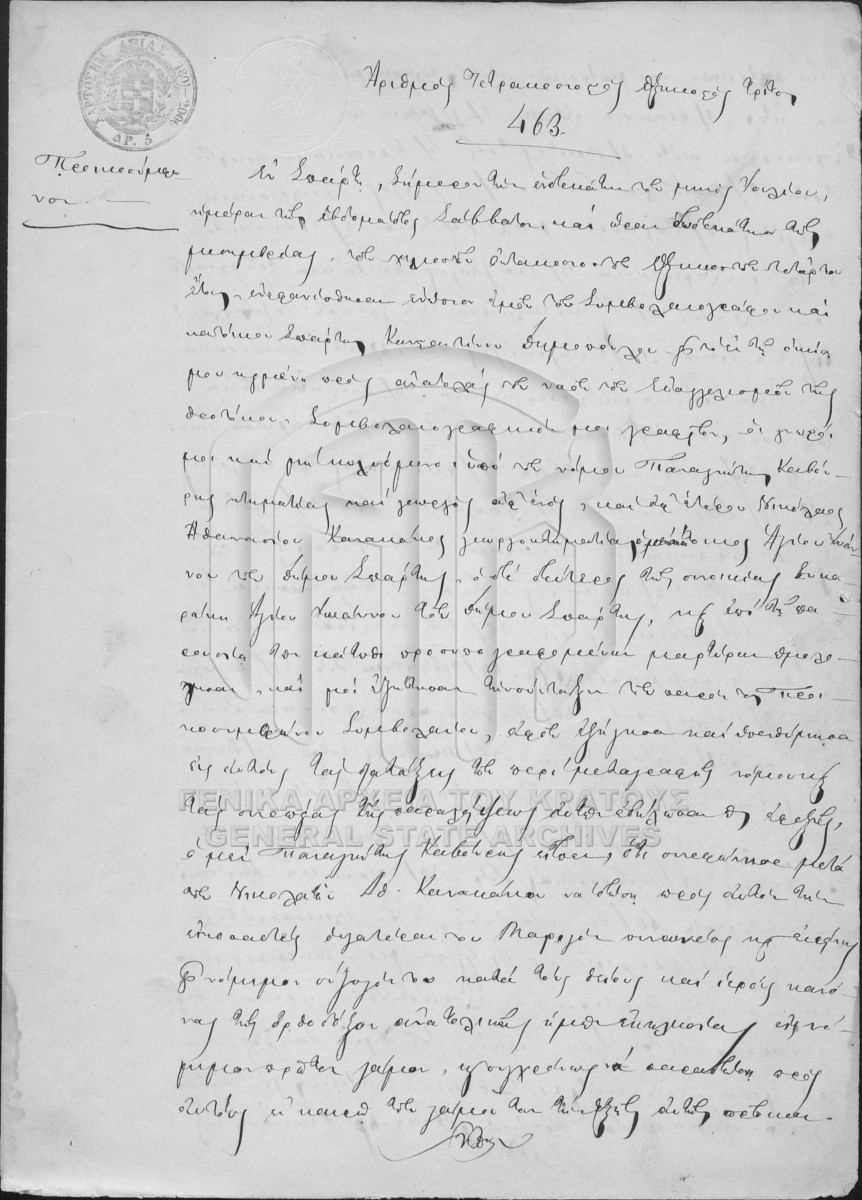
On 11 July 1864, four men gathered at the office of Konstandinos Dimopoulos, notary of Sparta, to execute a dowry contract: Nikolaos Athanasios Kanakakos of Sikaraki (groom), Panagiotis Kavvouris of Agios Ioannis (father of Marigo, the bride), Georgios Stathopoulos of Magoula (witness) and Ilias Kalogerakos of Parori (witness). These men were engaging in an honored tradition that was instituted in ancient times and not officially rescinded in Greece until 1983.
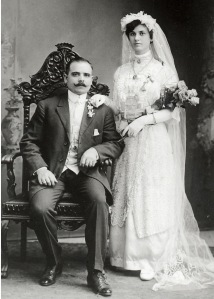
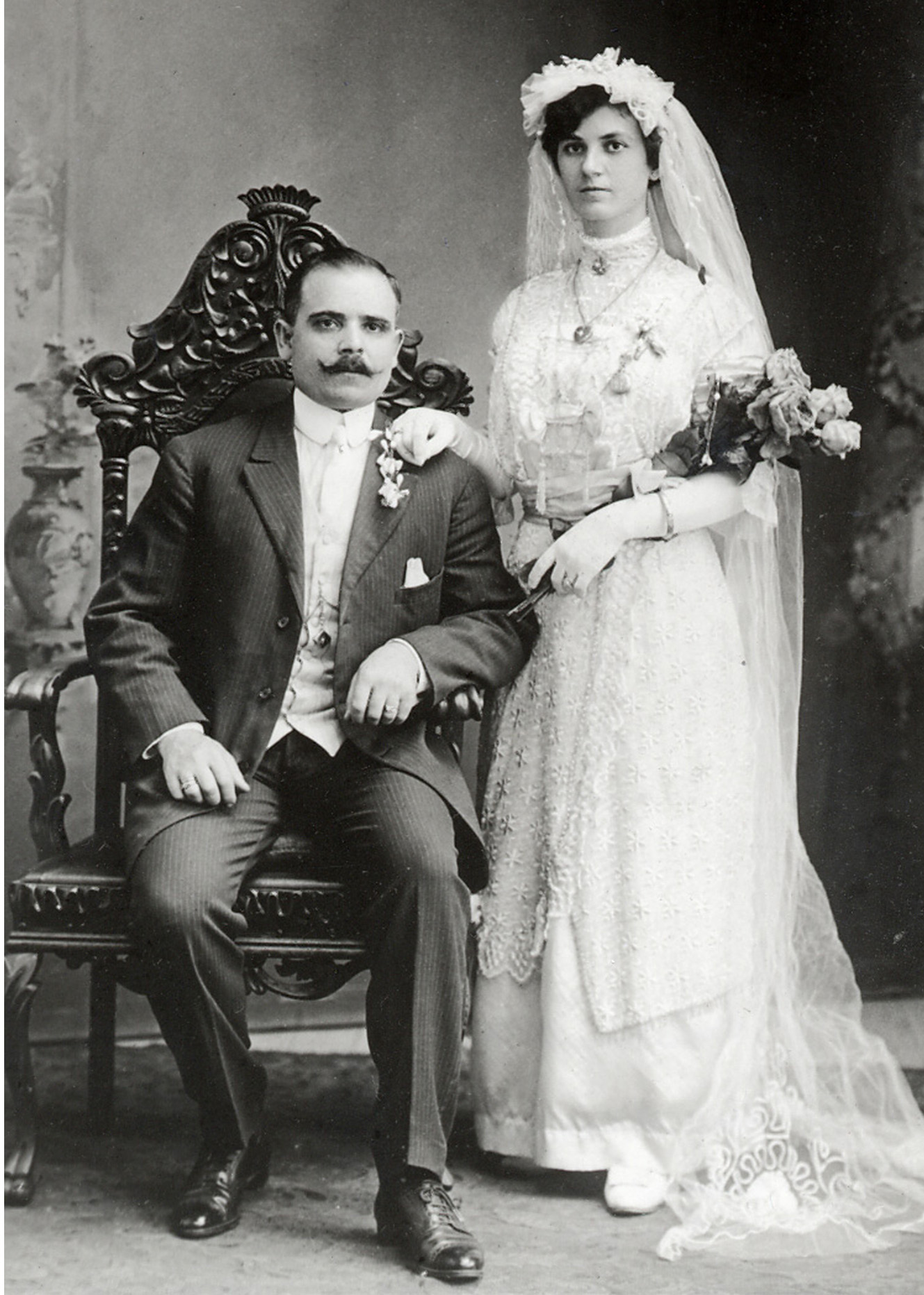
My maternal grandparents, Ilias Papagiannakos and Aggeliki Eftaxias, 1914, New York

A  marriage dowry (prika) was a custom adapted from Eastern cultures. Created by economic need, it was prevalent an era when the roles of men and women were defined by a patriarchal society. Especially in mainland Greece, families generally were poor. Men were farmers, landowners, shepherds; or worked in handcrafts such making baskets, ropes, or leather items. Women were homemakers.

When a new union was formed, both were expected to contribute items needed to establish the home. The bride’s dowry provided household or clothing items, property or animals. The groom provided a house and income for the family. Thus, both bequeathed what they could to secure a foundation for their new marriage.

The Kavvouris-Kanakakos contract is translated below. It is a fascinating picture which helps us better understand the image of life in mid-1800’s Sparta. Commentary and historical information is added with footnotes or brackets, and photographs are representations of the types of items the dowry contains.

Page 1 of 4, Dowry Contract 463. Panagiotis Kavvouris and Nikolaos Athanasios Kanakakos, Sparta, Greece. July 11, 1864. Source: General Archives of Greece: http://arxeiomnimon.gak.gr/browse/resource.html?tab=tab02&id=197332

Contract 463, 11.7.1864, Dowry and Notary Deed
On this day, 11 July, Saturday, at 12:00 noon of year 1864, came before me, Konstandinos Dimopoulos, notary and citizen of Sparta, to my home and office, being east of the Church of Evangelismo of Theotokos,1  Panagiotis Kavvouris, estate owner and farmer of Agios Ioannis of Sparta on one hand, and on the other Nikolaos Athanasiou Kanakakos, farmer and citizen of the neighborhood, Sikaraki, of Agios Ioannis of the municipality of Sparta; both are familiar to me and of legal status. In my presence and the witnesses, they sign this dowry contract after my explanation of the laws.

Panagioti Kavvouris makes an agreement with Nikolaos Athanasios Kanakakos to give Nikolaos his daughter, Marigo, as his legal wife according to the holy rules of the Orthodox Church. The groom takes from the maternal and paternal legacy: 

1.  Two tall fezes (kind of traditional hat)
2.  Gemenia – women’s head cover
3.  
Three basinas – a bowl for cooking
4.  
Three sets of kreponia – women’s clothing, dark in color
5.  
Twelve madilia – women’s head cover
6.  
One pair of vergetes– earrings, expensive
7.  
One silver cross
8.  
Three silver rings
9.  
One pair of crystal dessert plates
10. 
Six dessert spoons
11. 
One serving dish
12.  
Two men’s vests, decorated with fur
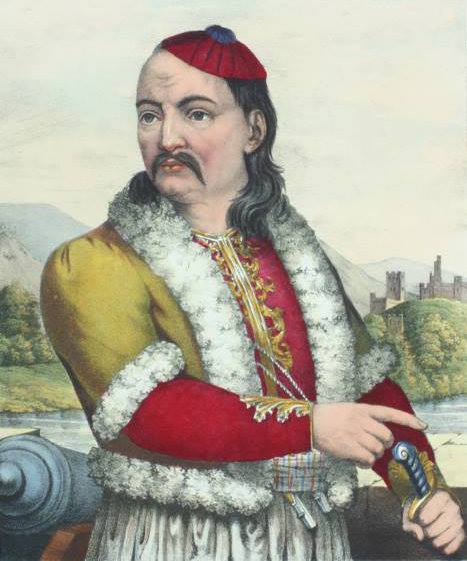
Man’s vest with fur

13. Ten women’s skirts
14. 
Two dresses
15. 
Twenty-five shirts
16. 
Twelve sets of underwear
17. 
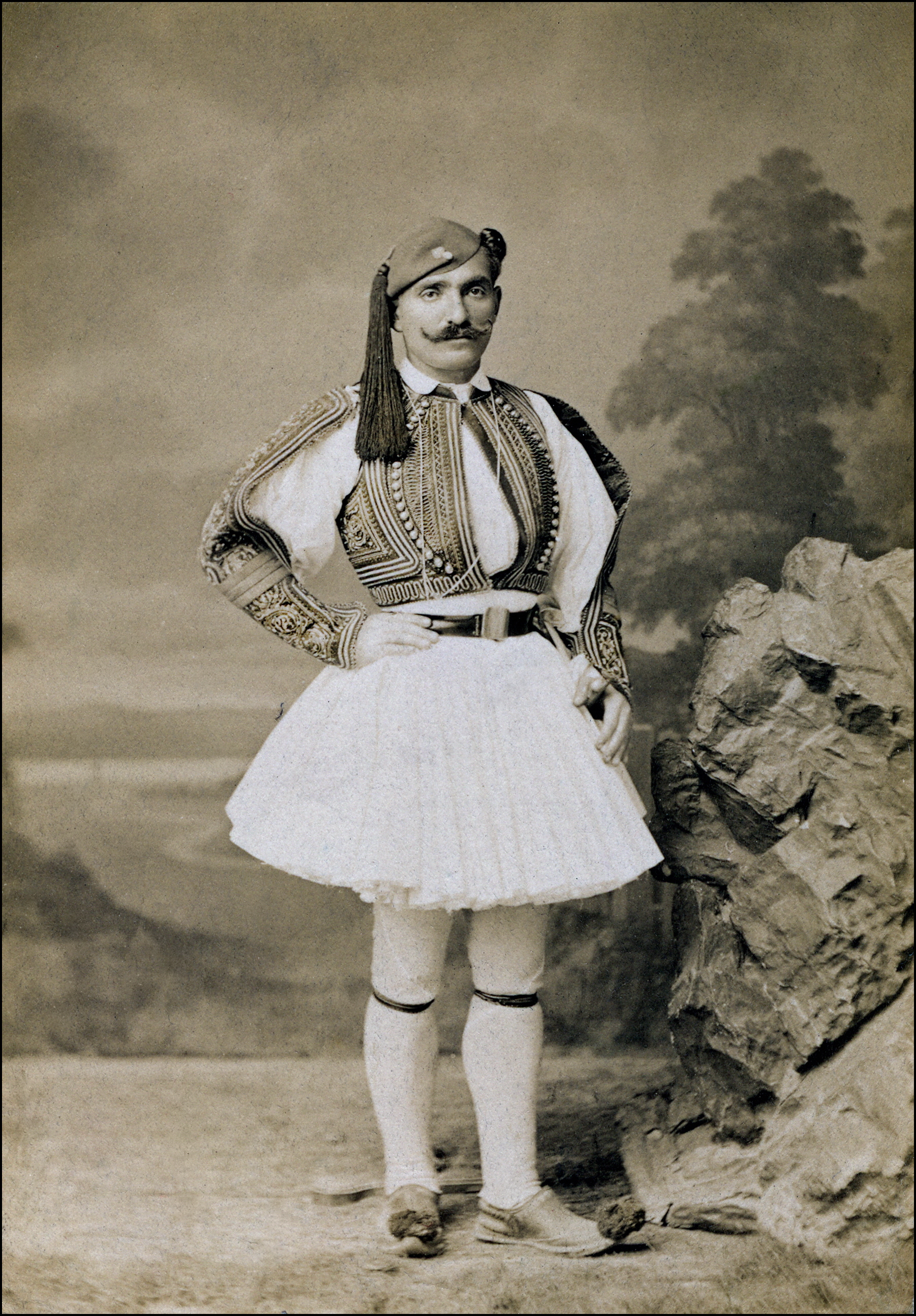
Two men’s fustanella 
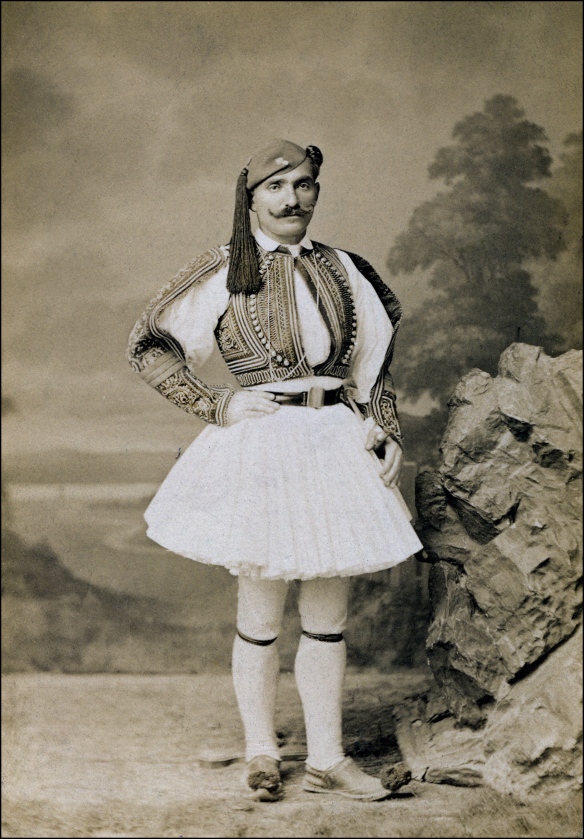
Traditional fustanella; Flickr Creative Commons

18. Two disakia (small packages to hold items)
19.  Two paploma, bed comforters
20.  
Ten soaps
21.  
Two makatia. decorative sofa covers
22.  
Eleven big pillows
23.  
Four small pillows
24.  
Two andromedes (unknown)
25.  
One peskidi (a nice throw cover for the sofa)
26.  T
wo table scarfs/covers for the dining room table
27.  
Two nice scarfs/covers for chair backs and arm rests
28.  
Six fakiolia, small women’s head covers
29.  
Eight mpoiles, a kind of towel
30.  
Twelve spoons, knives and forks
31.  
Twelve plates
32.  
Seven mpouxades, wool cloth which hold liquids when making cheese
33.  
Eight vrakozones, traditional men’s clothing worn below the waist
34.  T
wo casellas, similar to a hope chest which hold clothing and linens
35.  
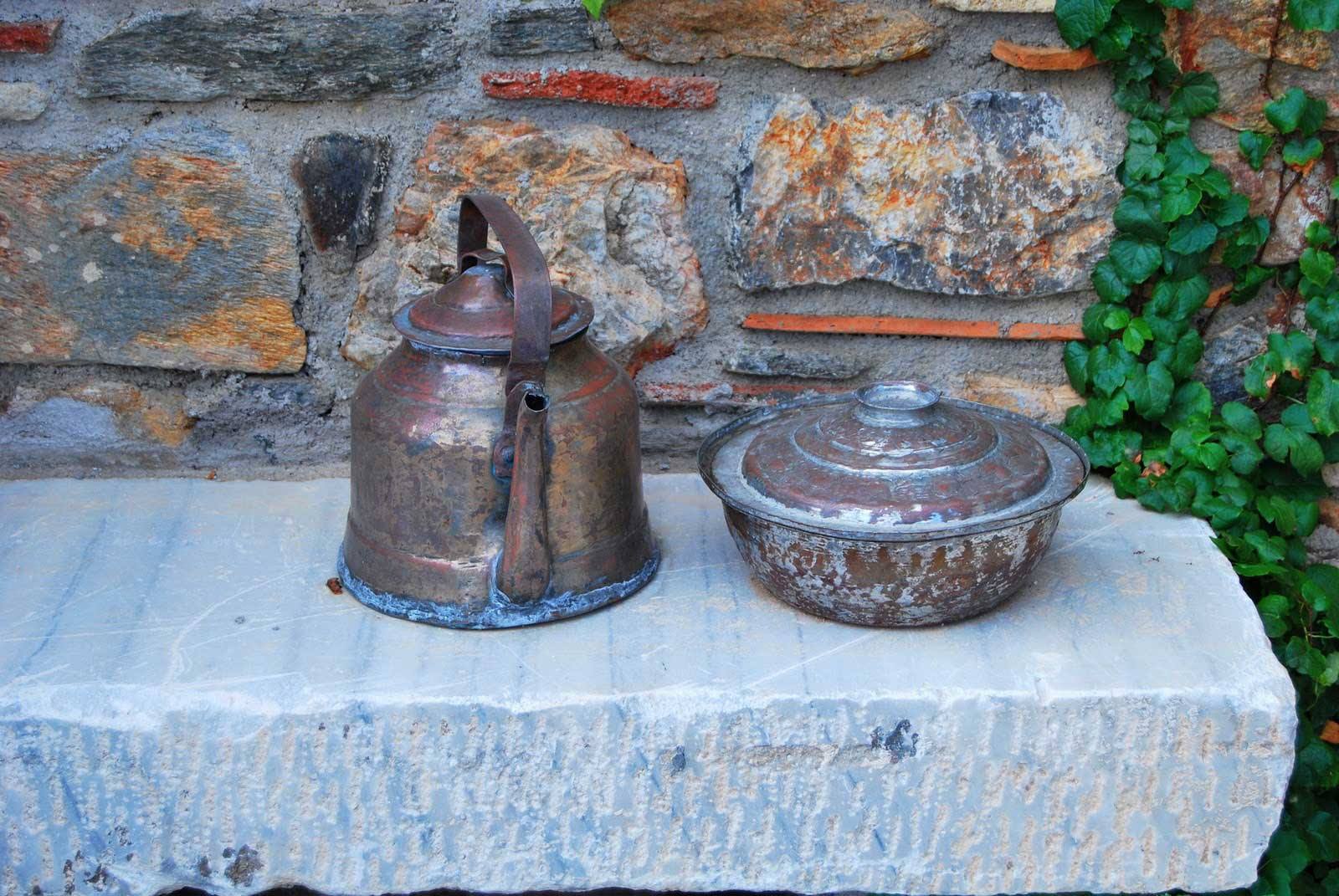
Two kapaki, cooking pots with covers
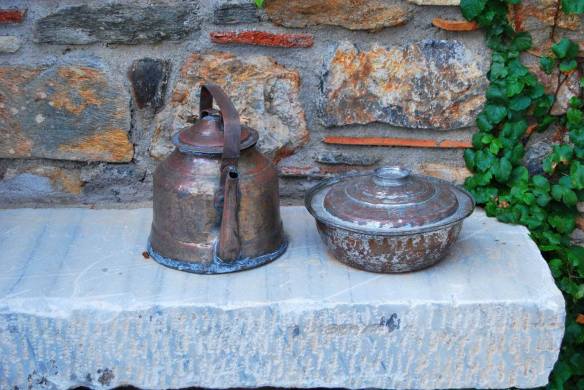
Kapaki, cooking pans with covers


36.  One 
tapsi, circular metal roasting pan used in ovens

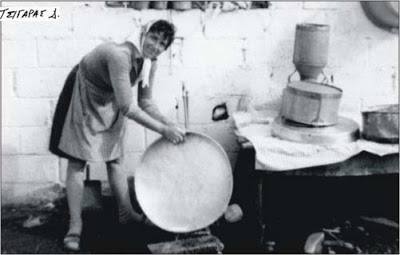
Woman holding a circular tapsi; on the right is a vethoura

37. One harani – metal bucket that can hold one okres (a unit of measure)
38. Two siderostia – iron tripods to hang pots over an open fire
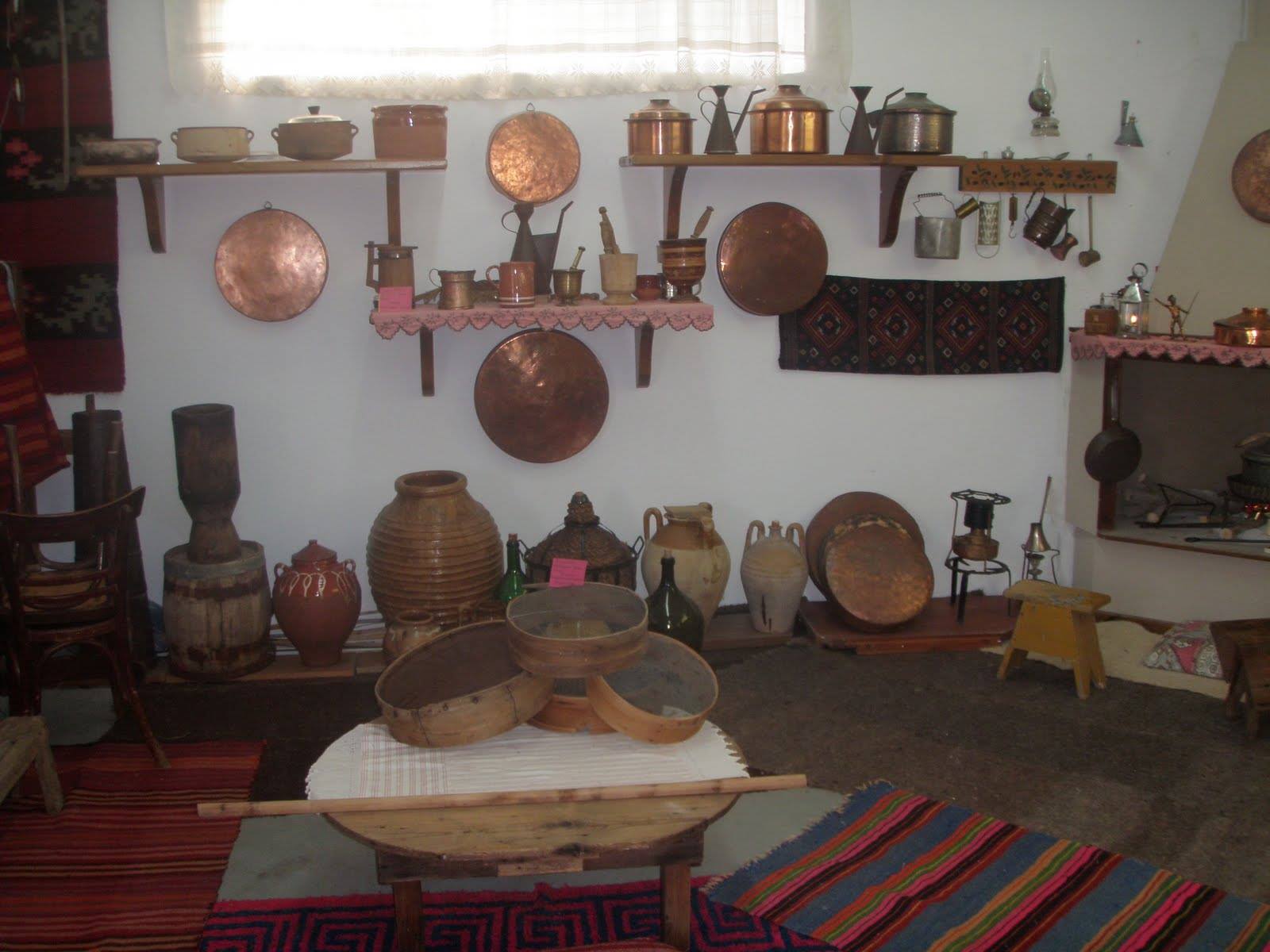
39. One pan

Kitchen items, mid-1800’s, Greece

40. One stremma [unit of measure] with 14 olive trees located in the borders of Agios Ioannis, Sparta. The land is bordered:  on the east with a national estate [land which belongs to the municipality], on the west with Panagioti Kamarados, on the north with Giannis Giannos, in the south with Georgios Bakopoulos.

41. One individual estate, a small field, two stremmata with all it contains [perhaps a small hut] and 7 small trees located in the location Sourakaki of Agios Ioannis, Sparta; it borders:  on the east with a road, on the west with church fields, on the north with the national estate, and on the south with Pangiotis Pachigiannis.

42. Some trees that were planted in the national field in the location Kefalari of Agios Ioannis, Sparta; and borders on the east with Saltaferos [a family in Mystras], on the west with the road, on the north with Panagiotis Kavvouris and on the south with a road.8

43. Twenty barrels containing orange trees that the groom took a few days ago to replant them in his own land.

The total of the dowry and property (moved and unmoveable) is 1,463 drachmas.4

The groom, Nikolaos Athanasios Kanakakos,5 expresses that he accepts Marigo as his legal wife and the dowry given by her father. He understands exactly the dowry that was previously reported and offered to him by Marigo. He also offers Marigo 500 drachmas [bridewealth].6

The two sides additionally, with me the contract maker, evaluate the total value of all things as 1,963 drachmas plus the postcard [the notary’s fee].

To verify this contract and this dowry, the two sides listened to the dowry spoken aloud and clearly, and agreed to it.

Called as witnesses: Georgios Stathopoulos, estate owner and citizen of Magoula and Ilia Kalogerakos, farmer and citizen of Parori of the municipality of Sparta. They are familiar to me, they are Greek citizens without any legal exceptions, and they verify this contact because because neither of the two sides can sign their names.7

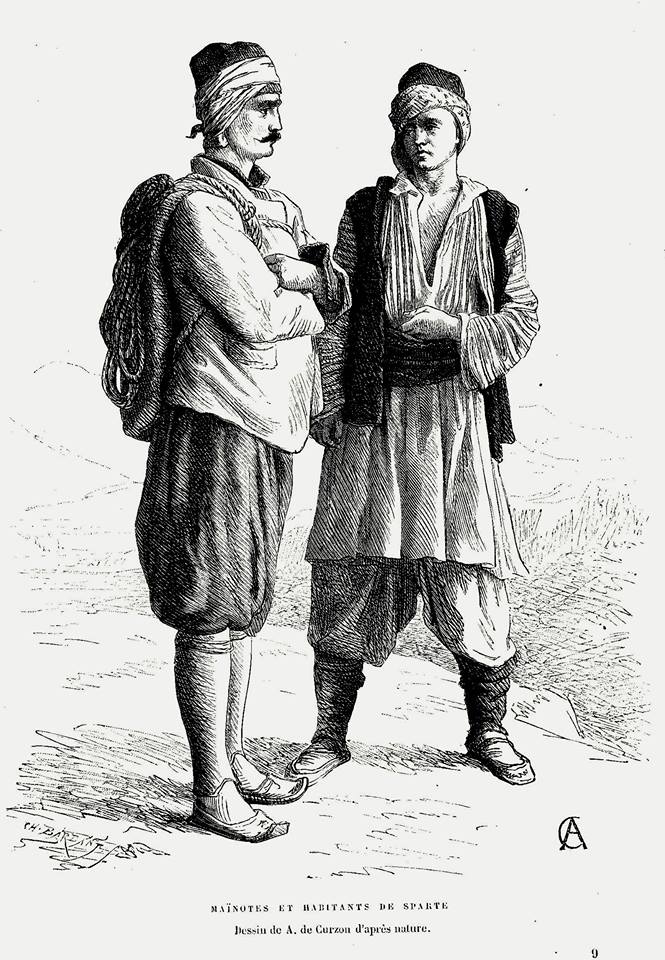
Maniate men in Sparta. Many people from the Mani region, like the Kanakakos family, moved north to Sparta after the Revolution.

I initially became acquainted–and fascinated–with contracts during my first trip to the Sparta Archives in 2014, when I went with Gregory Kontos. This 2015 post describes a contract, translated by Gregory, for the purchase of land by Panagiotis Iliopoulos of Machmoutbei. Each succeeding research trip has yielded new information, as documented recently in Research in the Archives of Sparta.

Contracts are challenging: not many are digitized or online, paper copies are difficult for Archivists to obtain, and the handwriting is akin to hieroglyphics. But with good luck and good friends, they can be accessed and interpreted, enlightening our understanding and giving us a fuller (albeit not full) picture of our ancestors’ lives.

Important note: This post would not have been possible without the assistance of Giannis Michalakakos, teacher, historian, and author of Maniatika blog. Giannis completed all translations, found the photos, and provided the historical content to explain the customs of this era. I am grateful for his friendship and expertise.

____________

1  This exact description of the location of the Dimopoulos home and office is given because Sparta in the mid-1800s had few roads and no street addresses.

Many of descriptive words come from the Ottoman period and are unrecognizable in today’s language; they may be a hybrid mix of Greek, Ottoman and Venetian vocabulary and are no longer in use.

When a meal is prepared using a tapsi, it is also served from it; the family would sit around and eat out of it together. A vethoura, the double pot on the right, is where sheeps’ milk is stored.

This is a sizeable dowry, indicating that the bride’s family had financial means.

5Kanakakos is a big family in Mani; members were officers in the Army and heroes in the Revolution of 1821.

6 As a bride brings a dowry, sometimes, a groom will offer a sum of money or property to the bride’s parents to help establish the new home.

7 Normally, there would be five signatures: the groom, the bride’s father, the two witnesses and the notary. In this contract, only the witnesses and notary signed as the groom and bride’s father were unable to write their names.

8 After marriage, land named in the dowry belongs to the bride’s husband. The property was given by her father to establish her new home. In 1800s Sparta, divorce was unheard of; and men were responsible for providing and maintaining financial security of the family.
Double Date

No, this is not a post about two couples going out for dinner or a movie date. It is, however, a description of something important that I learned this past weekend.

On Saturday, at the Greek Genealogy Conference held in Tarpon Springs, Florida, I taught a class entitled, “Using U.S. Records to Begin Greek Research.” In this presentation, I used numerous examples of records that may have information to help  find the original name of an ancestor (such as Papadopoulos, not just Pappas), and also the village of birth (very important, as records in Greece are cataloged by location).

I emphasized the importance of finding every record that could have possibly been created in the U.S. for an ancestor. The reason is that each document may have new or different information. When documents for a direct ancestor are hard to find, look for documents of siblings or other family members, and do your best to locate every piece of paper on which they could possibly be listed.

As an illustration, I used both civil and church marriage records for my maternal grandparents. This is the State of New York Certificate and Record of Marriage for Ilias Papagiannakos and Angelina Eftaxias; note that the date is May 10, 1914:

New York State Certificate and Record of Marriage, Ilias Papagianakos and Angelina Eftaxias

State of New York: Civil Marriage Record Louis Papagianakos and Angelina Eftaxia GROOM: age 32; occupation: oyster dealer; birthplace: Greece; father’s name: Panagiotis; mother’s maiden name: Caterina Eliopoulis BRIDE: age 20; birthplace: Greece; father: Constantinos; mother’s maiden name: Stafia Zaharopoulo. Joined in marriage at 358 West 44th Street, Manhattan on 10th of MAY 1914

This is the Greek Orthodox Marriage Certificate from Holy Trinity Church in New York for the same grandparents. Note that the date of marriage is:  27/10 April, 1914.

pappas-louis-angelina-marriage-certif-001

Greek Orthodox Marriage Record; Holy Trinity Church.   Of Agios Ioannis, Sparta, Ilias Panag. Papagiannakos and of Mistra Aggeliki Kon. Eftaxia married on 27/10 APRIL 1914 Best man: Christos Aridas FATHERS: Panagiotis Papagiannakos KON [Konstandinos] Eftaxias

As I described the differences between the civil and the church marriage records, I mentioned that I was puzzled by the “double date” on the church record. I did not understand the discrepancy between the two dates and what 27/10 April was referring to.

After the presentation, Adamantia Klotsa, Consul General of Greece, approached me and solved the mystery. She explained that the “double date” on the Greek certificate referred to the dates as they were calculated by both the Julian Calendar (27 April) and the Gregorian Calendar (May 10). There is a 13-day difference between the dates in these calendars, and the Greek record reflected both because Greece used the Julian calendar until 1922. With this marriage occurring in 1914, it now makes sense as to the correctness of the date as noted on the Greek Orthodox Marriage Record–the difference between April 27 and May 10 is exactly thirteen days.

Genealogy is never boring–there is always something new to learn!