Lakonia Studies 6th Annual Conference

The Society of Lakonia Studies organization fulfills a vital role in documenting and preserving the history of the prefecture of Lakonia. The organization brings together historians, archaeologists, linguists, cultural specialists and other professionals who present their research at the annual conference of the organization. Their research papers are subsequently published in the Journal of Lakonia Studies, which currently consists of twenty-three volumes and numerous supplements.

Lakonia Studies logo

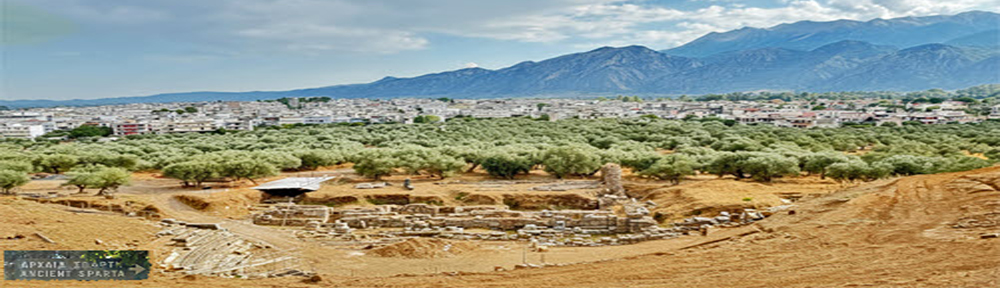
This year, the organization’s annual conference will be held on December 5-7, 2025, at the Cultural Center of the Municipality of Sparta (ground floor of the Library). The theme is “Laconia 330 AD – 1830.”

The presenters are devoted and dedicated researchers.Their goal is to educate and enlighten. Most are native to the region and work with primary source materials which may be unavailable or even unknown to outside scholars. Thus, their works extend beyond basic academics and dive into topics, people and historical elements that are less-studied and even obscure, but historically relevant and important.

This article in Lakonikos.gr outlines (in Greek) the program and speakers. My very rough computer-assisted translation of the program follows:

Friday, December 5
Opening Session (18.00-20.00) | Chair: Socrates Kougeas
18.00-18.30: Arrival
18.30-19.00: Welcome
19.30-19.15: Dimosthenes Stratigopoulos, Nikiphoros Moschopoulos, president of Lacedaemonia (ca. 1288 – ca.1315), and leader in Mystras
19.15-19.30: Dimitrios Th. Katsoulakos, Surnames with Byzantine origin in the villages of Faridos
19.150-19.30: Stavros G. Kapetanakis, Ibrahim’s unsuccessful attempt in 1826 to subjugate the Maniots and its long-term consequences
19.30-20.00: Discussion

Saturday, December 6
First morning session (9.30-11.00) | Chair: Dimitrios Vachaviolos
9.30-9.45: Danae Charalambous, The surviving frescoes of the church of Panagia Krissa in Finiki, Laconia
9.45-10.00: Sofia F. Menenakou, The brushwork of the painters Anagnostis from Lagkada and Nikolaos from Nomitsi in the Church of Saint George in Panitsa (Laconian Mani, 18th century)
10.00-10.15: Leonidas Souchleris, The northern part of the Eurotas valley in the 4th and 5th centuries AD. Residential perspective: urban planning, cemeteries and road network.
10.15-10.30: Georgios P. Kountouris, Monuments of the Early Christian Period in Voies
10.30-10.45: Panagiotis D. Christofilakos, The Byzantine church of Saint Athanasius in Paleochori, Lakedaemon
10.45-11.00: Panagiotis S. Katsafados, Following the traces of icon painters in Mani during the post-Frankish period
11.00-11.30: Break

Second morning session (11.30-13.00) | Chair: Dimosthenis Stratigopoulos
11.30-11.45: Panagiota D. Laskaris, The Laskari clan in Lacedaemon. The biographical stories of Demetrios Laskaris as a starting point for an existential historical investigation
11.45-12.00: Christina Vambouri, Highlighting the history of Byzantine Laconia through the newspaper Embros during the first half of the 20th century
12.00-12.15: Dimitrios S. Georgakopoulos, New information about the founder/donor of Panagia Chrysafistissa
12.15-12.30: Michael Grünbart , An empire vanishes – imperial concepts vs. political reality in late Byzantium
12.30-13.00: Discussion

First afternoon session (17.00-19.00) | Chair: Georgios Kountouris
17.00-17.15: Eleftherios P. Alexakis, Byzantine pronoiai, Venetian captaincies, and the development of the political system of Outer Mani
17.15-17.30: Antonis Mastrapas, Searching for ancient Sparta in the 18th and 19th centuries
17.30-17.45: George V. Nikolaou, Laconia through the work of the English traveler William Leake, envoy of the English government (early 19th century)
17.45-18.00: Kyrillos Nikolaou, Laconia through the second travelogue of the French consul and traveler François Pouqueville (early 19th century)
18.00-18.15: Panagiotis N. Xintaras, Laconian place-names through the pen of French travelers
18.15-18.30: Alexandros Gizelis, Sparta in the political literature of Protestantism during the era of the Religious Wars (16th-17th century)
18.30-19.00: Break

Second afternoon session (19.00-20.30) | Chair: Yannis Tsoulogiannis
19.00-19.15: Yianna Katsougraki, At the end of the thread: from the material to the immaterial. The presence of weaving in Byzantine and modern Laconia
19.15-19.30: Michalis Sovolos, Indexing the first decisions of the Court of First Instance of Sparta: Persons and matters concerning Mani, 1770-1821
19.30-19.45: Georgios A. Tsoutsos, Enlightenment and Ancient Sparta: The case of Gabriel Bonnot de Mably (1709-1785)
19.45-20.00: Dimitrios Galaris, Nikitas Nifakis: the author of the Declaration to the European Courts at the liberation of Kalamata from Ottoman rule
20.00-20.30: Discussion

Sunday, December 7
9.30-10.30: Guided tour of the Archaeological Museum of Sparta
Morning session (11.00-12.30) | Chair: Georgios Nikolaou
11.00-11.15: Marios Athanasopoulos, “In this sacred Struggle, I too, taking up arms in my hands, ran to all the battles of my most beloved homeland…”: The life and deeds of the 1821 fighter, Father Polyzois Koutoumanos
11.15-11.30: Dimitrios Mariolis, Dimitrios Poulikakos. Military leader of 1821 from Vamvaka, Mani
11.30-11.45: Socrates V. Kougeas, Mosaics of the life and actions of the legendary figure Zacharias Barbitsiotis – The actions of the chieftain Sousanis
11.45-12.00: Giannis Michalakakos, Ilias Bispinis, a forgotten fighter of 1821 from Laconia
12.00-12.15: George – Konstantinos K. Piliouras, The Holocaust at the Paleomonastiro of Vrontama
12.15-12.45: Discussion

Afternoon session (17.00-19.00) | Chair: Dimitrios Katsoulakos
17.00-17.15: Pepi Gavala, Court of First Instance of Laconia – Correspondence Register: Transactions and Cases (February-April 1830)
17.15-17.30: Yannis N. Tsoulogiannis, The action of Panagiotis Krevvatas through two letters
17.30-17.45: Dimitrios Th. Vachaviolos – Stylianos D. Dimitropoulos – Dimitrios Ath. Christou, Two unknown documents from the Museum of Ecclesiastical Art of the Holy Monastery of Monemvasia and Sparta concerning Bishop Kyrillos Germos of Karyoupolis († July 1842)
18.00-18.15: Nikos I. Karmoiris, Papa-Kalomoiris, the Levite (cleric) chieftain from Vordonia
18.15-18.30: Katerina Diakoumopoulou – Maria Giatrakou, “ For Giatrakos’ great struggles.’ The monumental speeches in Parliament and the indirect references in the dramaturgy of M. Chourmouzis.
18.30-19.00: Discussion
End of the conference proceedings

These papers will be published in the next issue of the Journal. If there is an essay of interest to you, contact the Lakonia Studies organization at: etlasp@gmail.com. This pdf document lists the Table of Contents for each of the twenty-three volumes of Lakonia Studies, prior to this 2025 conference. Volume(s) can be purchased from the Lakonia Studies organization for 20 euros per book.

The work of this organization and its members is important, and must be accessible to people worldwide. I have written previously about bringing the Journal of Lakonian Studies to the Library of Congress, first in 2024 and this year in 2025. Let’s spread the word together and introduce the world to our modern-day Spartan intelligentsia!

Journal of Lakonia Studies at the Library of Congress, Part 2

In October 2024, I delivered the first twelve of twenty-three volumes of the Lakonia Studies journals to the Library of Congress. Last week, I delivered volumes thirteen through twenty-three. They are now housed in the European Reading Room under the supervision of Dr. Nevila Pahumi1 who oversees the Greece and Cyprus collections.

Carol Kostakos Petranek delivers Lakonia Studies Journals, September 19, 2025
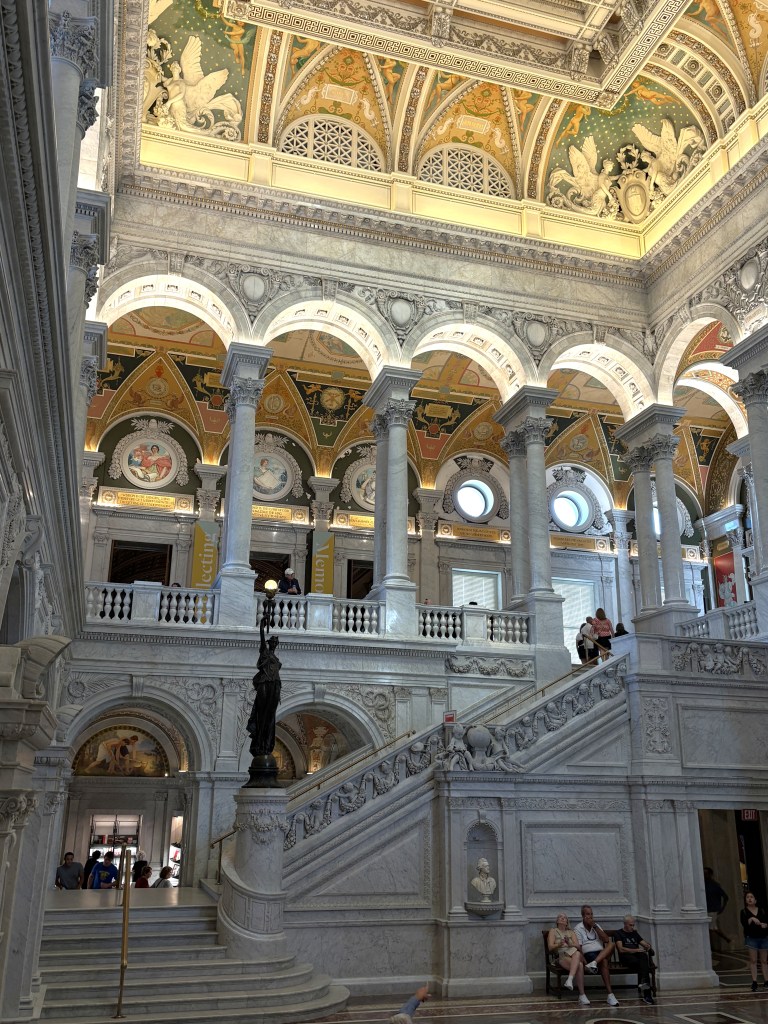
The architectural design of the European Reading Room reflects the classic beauty of the Library

As I explained in this 2024 post, Dr. Pahlumi is most enthusiastic about securing primary sources for the Library’s collections. Historians in their native lands who can walk the grounds, speak with local specialists, and access materials not available outside their countries are the ones who write with first-hand knowledge and accuracy. Their works are eagerly sought by researchers worldwide who visit the Library seeking such materials.

The classical beauty of the Library captivates those who enter

This pdf document lists the Table of Contents for each of the twenty-three volumes of Lakonia Studies2. It is 47 pages–too long to add a typed copy to this post. If there are articles of interest to you, the volume(s) can be purchased from the Lakonia Studies organization for 20 euros per book.

Next year, I will deliver the supplements to the journals. Those books are just as large and comprehensive as the original volumes!

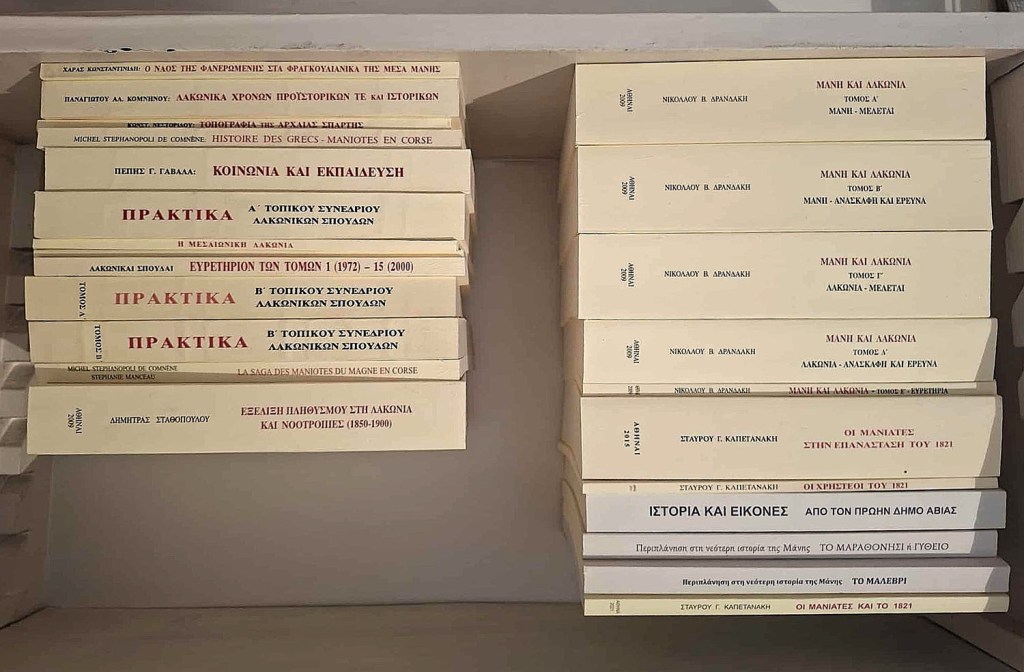
Lakonia Studies Supplements

Contact the organization for more information or to purchase a volume:
e-mail: etlasp@gmail.com.

And if you are in Athens, make an appointment to visit the office and the staff.
63 Charilaou Trikoupi, 4th floor, 104 81, Athens
Office hours: Monday – Wednesday – Friday 11.30 am – 1.00 pm
Telephone: 210-3304422
6936-734920 (Sokrates Kougeas – president)
6974-343619 (Despina Koutsari – general secretary)

These books should be in the hands of researchers worldwide. If you know of an organization, library or repository that would welcome this incredible collection, please contact either the Lakonia Studies organization or me. Our Spartan historians deserve to be referenced and respected for their exclusive and preeminent works.


1Dr. Pahumi is the Reference Librarian for Latin American, Caribbean, and European Division and oversees the Greece and Cyprus collections at the Library of Congress in Washington, D.C.
2The English version was translated using the Greek Genealogy Assistant chatbot which I created in ChatGPT5. My Greek language skills are elementary, and although I reviewed the translations which appear accurate, there may have errors.

Solomos Family of Laconia

Author: Stratis A. Solomos

published in The Faris Newsletter, Issue 73, December 2020, pages 12-16

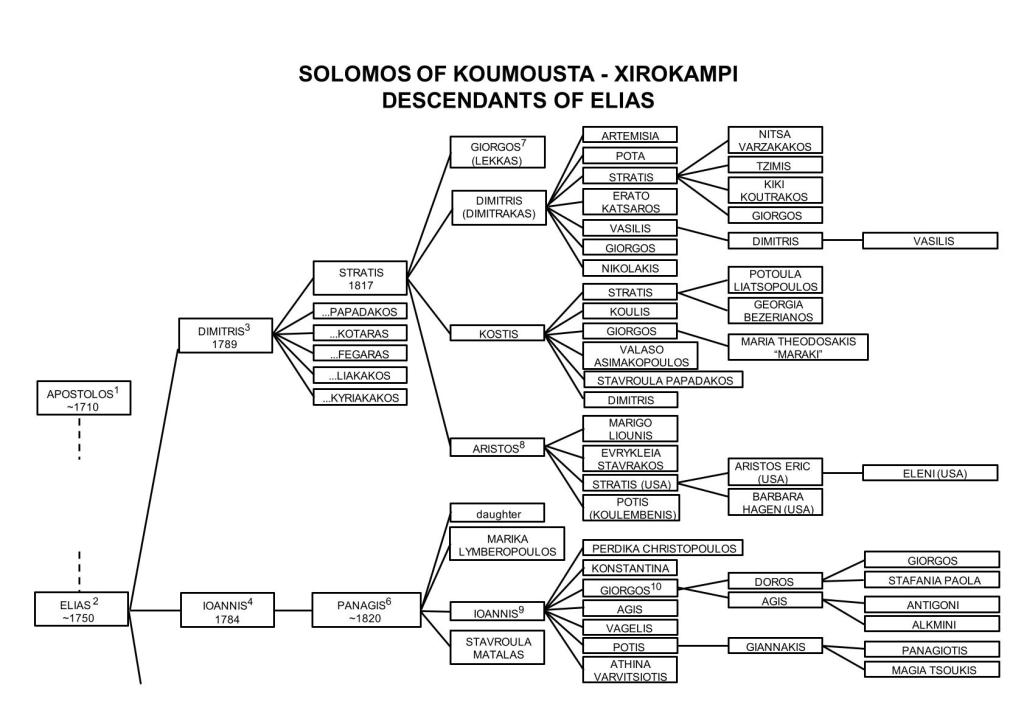
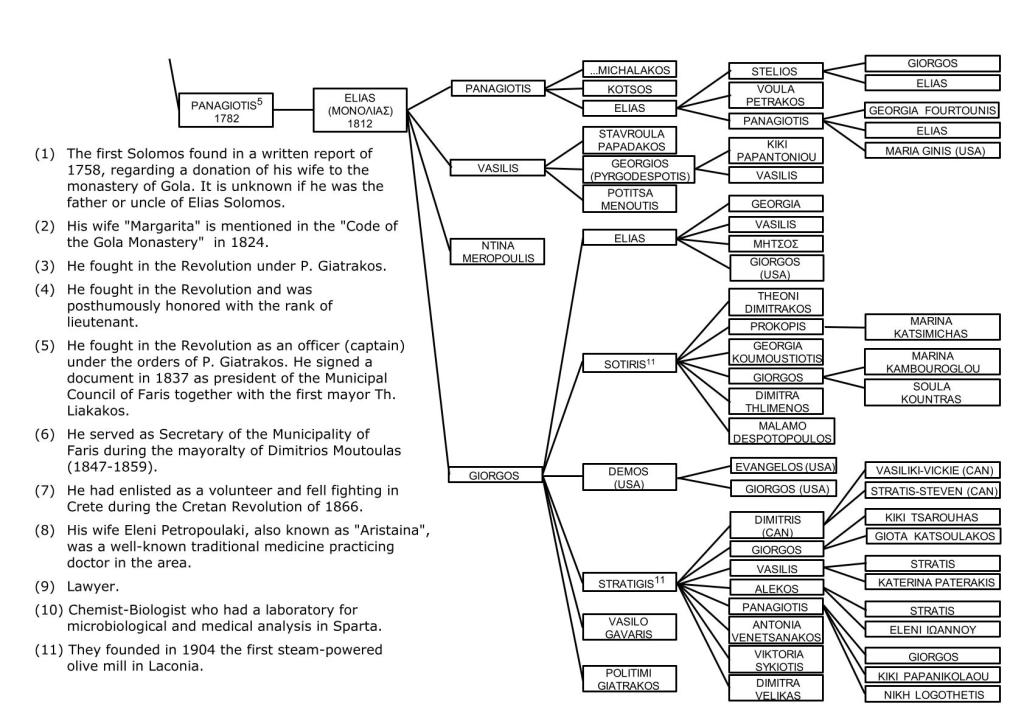
I am most pleased to receive permission from Stratis Solomos to share his genealogy of the Solomos Family of Koumousta and Xirokampi. Stratis wrote: “Last year I was asked by the chief editor [of the Faris newsletter] to write a genealogy on the Solomos family, one of the most important families of Koumousta-Xirokambi…For practical space reasons the family tree was confined to the generation of 1960-70.  By the same token, the few historical footnotes are limited to the older generations only.”

Publicizing and publishing our family history work is an unselfish and important act. It allows us to share what we learn with those who may not have the resources or abilities to conduct such research. They, too, want to know about their ancestors and connect with extended family worldwide. Thank you, Stratis, for your sharing your work with us and for providing this English translation.


The Solomos family of Laconia originates from Koumousta, a village in the Taygetos mountains, close to Sparta. In the 19th century, after the Greek War of independence, most family members moved gradually down to the flat land, to the newly founded village of Xirokampi. The origin of the Solomos family of Laconia is unclear and there is no oral tradition or myth related to the family history. In the 1950s-60s, the lawyer Georgios V. Solomos, known as “Pyrgodespotis” (Castle-Lord), was saying that he had done a bibliographic research that had allowed him to conclude that the family came from Crete in the middle of the 17th century, after the fall of Chandakas (Heraklion) in 1669 and its occupation by the Turks. More specifically, as it was narrated in the informal ‘kafenio’ gatherings, there were initially two brothers, one of whom stayed in Laconia and the other went to Zakynthos. The latter was the great-grandfather of the national poet of Greece Dionysios Solomos. Unfortunately Pyrgodespotis did not leave any written report and the above cannot be confirmed. His version may have been based only on various biographies of Dionysios Solomos.[1]

Nevertheless, the above hypothesis is not completely unfounded and can be based on the following arguments:

1) The family appears in the mountain village of Koumousta in the early 18th century, following the end of the Venetian domination over several Greek territories (and succeeded by the Ottomans).

2) It settles in an area where there are other well-known families, of established Venetian[2], Frankish and Byzantine origin. These families were living in the Laconia plains, but they moved to the mountains in 1715, when the Ottomans again conquered the Peloponnese.

3) More recent publications show that the great-grandfather of Dionysios Solomos, Nikolaos, did not go directly from Crete to Zakynthos, but to Kythira, where he married to Maria Durente[3], a woman from a “noble” family and with a large dowry. The Salamon-Solomos family, which is mentioned as important during the Venetian rule of Crete, had other members who settled in Kythira [4] and probably in the fertile Laconia, where the Venetians had provided them with arable land.

4) In addition, it was at this period that the Turks occupied Kythira for three years (1715-1718), for the island to be finally recaptured by the Venetians. It is possible that the move from Kythira to the neighboring Laconia happened at this time.

5) The wife of Elias Solomos of Koumousta (born around 1750) bears the name “Margarita”, which is not a usual name of Ottoman-occupied Greece. It is a “western” name mostly used in the Greek regions under Venetian rule.

Stratigis & Vasiliki Solomos,
courtesy of Stratis A. Solomos

The Solomos families of Xirokampi and Koumousta, which today number hundreds of descendants in many parts of the world, are divided into two branches which meet somewhere in the late 18th century.

The first and most numerous are the descendants of Elias Solomos. The other branch comprises the descendants of Georgakis Solomos and then Thanasis, who was nicknamed “Lales”, hence their identification as “Lalaioi” (pronounced “Lalei”). Because of this nickname there was a traditional rumor that this family branch came from “Lala” a village in northwestern Peloponnese. However, it is rather unlikely that part of the family, with the same rare surname, came to the isolated village of Koumousta from such a remote area, unless there were relatives with the already settled Solomos of Koumousta. Another rumor has it that one of them fought against the infamous Turcalbanian mercenaries “Lalaioi”.

The reconstruction of the two branches of the published genealogical tree is mainly based on earlier oral reports, but also on documented, written information from the book of Th. Katsoulakos and P. Stoumpos[5]. Some evidence was also found in a report of a court dispute of a certain Meropoulis or Myropoulis, against trespassers of his property[6]. Archival research done by the genealogy research company “”ΟΙ ΡΙΖΕΣ ” (THE ROOTS) [7] was also taken into account. Another source of information was the list of immigrants passed from Ellis Island[8], as several members of the family immigrated early to America, from 1896 to 1921. The internet site of the Ellis Island Foundation has provided precious information concerning marital status, name of spouse, fellow travelers, relatives left in Greece, relatives to be met in the US, previous travels and age. From the age declared we can we conclude the year of birth, although with caution, because they often deliberately changed their age depending on the immigration laws in force. Some of these Solomos came back; for those who remained, there is the indication (USA, CAN) next to their name in the tree.

It is expected that there will be shortcomings and mistakes, especially in the tree of “Lalaioi”, which was done with more recent and less credible present-day oral testimonies. Where there is doubt, this is stated in the footnotes and the parental relationship is drawn with dashed line – – – -. Also missing are members who died in infancy or childhood. A future digitization of the registry files of Xirokampi and additional genealogical surveys could substantially help to improve this two-branch tree.

Although there is still abundant material available on the recent family members, for practical space reasons the tree was confined to the generation of 1960-70. By the same token, the few historical footnotes are limited to the older generations only. The year of birth is only mentioned for the older ancestors. Where the year of birth could not be determined exactly, it was estimated and preceded by the symbol (~). The construction of a more complete family tree that could encompass current family data and include offspring of female members would require a greater research effort and special lnformation Technology tools.

Finally, I would like to thank for their substantial contribution:
1) George P. Solomos (Italy), who decades ago recorded his first family tree version of “Elias Solomos descendants branch” and now helped significantly in the historical research.
2) Doros G. Solomos (Italy), who years ago spent time and resources on additional research for the improvement of the above mentioned family tree.
3) Dimitris “Mitsos” Ath. Solomos (Xirokampi), Nikos El. Solomos (Kalamata) and Dimitra G. Solomos-Giangos (California USA) who helped making the first, integrated version of the genealogical tree of the “Lalaioi” branch.

Stratis A. Solomos
Geneva Switzerland stratis.solomos@bluewin.ch


[1] Ν. Τωμαδάκης: Οικογένειαι Salomon-Σολωμού εν Κρήτη, Επετηρίς Εταιρείας Βυζαντινών
Σπουδών, 1938, Έτος ΙΔ’, 163-181.
[2] Σ. Α. Σολωμός: Η ετυμολογία μια τοπικής λέξης και ήθη της Γαληνοτάτης Δημοκρατίας. Φάρις-Ξηροκάμπι, τεύχος 55, Δεκέμβριος 2011.
[3] Ελένη Χάρου: Μαρία Δουρέντε, η Κυθήρια πρόγονος του Διονύσιου Σολωμού, 27 Μαρ. 2016.
[4] Μπαλτά Ευαγγελία: Η οθωμανική απογραφή των Κυθήρων 1715, Ινστιτούτο Νεοελληνικών Ερευνών ΕΙΕ, Αθήνα 2009.
[5] Θ. Κατσουλάκου και Π. Στούμπου ‘η Κουμουστά της λακεδαίμονος’, 2012.
6] ΣΥΜΒΟΛΑΙΟΓΡΑΦΙΚΕΣ ΠΡΑΞΕΙΣ του «μνήμονος Λακεδαίμονος Κυρίου Γεωργίου
ΧΑΡΤΟΥΛΑΡΗ» 1833-1835.
[7] Γραφείο αρχειακών ερευνών «ΟΙ ΡΙΖΕΣ» ( http://www.oirizes.gr ) Άρης Πουλημενάκος,
[8] Ε. Α. Σολωμός: Μετανάστες των χωριών μας που πέρασαν από το Ellis Island. Φάρις-
Ξηροκάμπι (τεύχος 50, Δεκέμβριος 2009).

In The Box…

At the bottom of a wooden trunk, beneath piles of dusty documents, lay long-forgotten papers unlocking the history of the Konstantarogiannis family of Toriza, Lakonia. Countless years ago, the trunk was procured by an unknown ancestor and placed in the family home. It was a handy repository for documents, certificates, and military papers. But for dozens of years, its cluttered contents remained untouched, unexplored and unexamined.

As a young lad, George Konstas worked the potato fields of Taygetos with his father, Pericles. While they planted and plowed, Pericles told George of their family—its origins, its people, its struggles.

Pericles Konstantarogiannis working his potato fields in the Taygetos mountains.

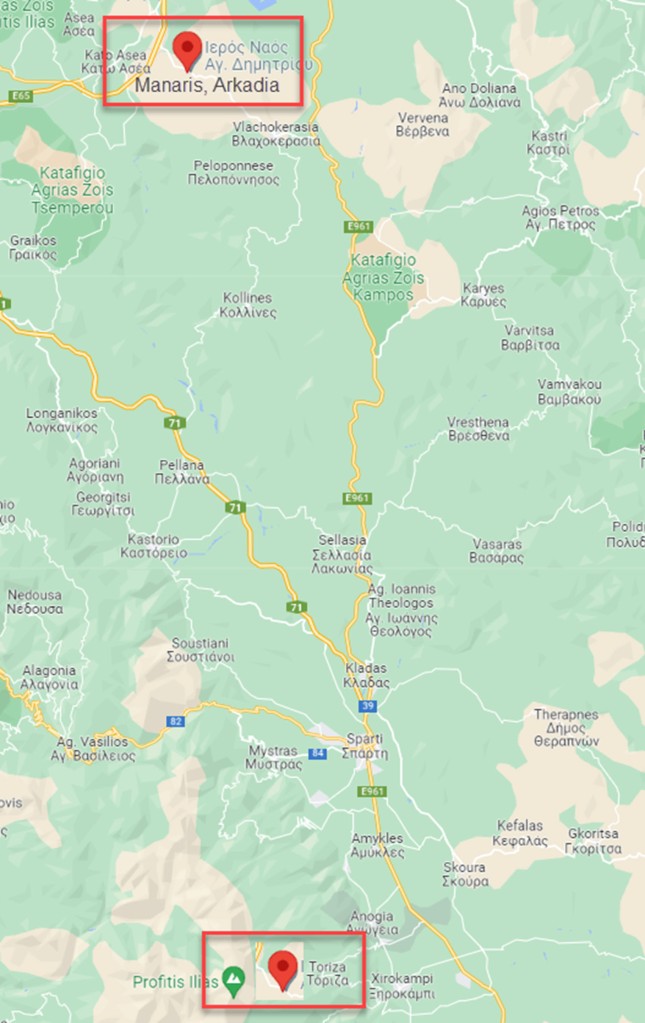
George heard the story of four brothers named Theodoros, Stamatakis, Kyriakos, and Pangiotis who, after Ibrahim’s invasion of the Peloponnese, left their mountain village of Manari, Gortynias, Arkadia and settled in equally mountainous Toriza, 10 kilometers from Xirokampi. Panagiotis was George’s forefather.

Pericles told George of ancestors who supported the 1770 Orloff Revolt, part of Russian Empress Catherine the Great’s failed “Greek Plan” and precursor to the Greek War of Independence. “My father knew these stories, but he never told me that we had documents explaining the family roots,” George related. “He probably hid the documents from previous family members. And sometimes my father confused the events because he had heard the stories handed down from his parents and relatives.”

George was taught by others, as well. “In the evenings, the older people told stories,” he recalled. “We had no electricity, no television, no entertainment, so they talked and I listened. But I thought these were myths, not true facts.”

Despite his skepticism, George was fascinated by his family’s history. As an adult, he began to record all the tales heard during his lifetime. As he wrote, his interest escalated into a passion to preserve what he had been told. He knew that if he did not do so, the history of his family would be forever lost.

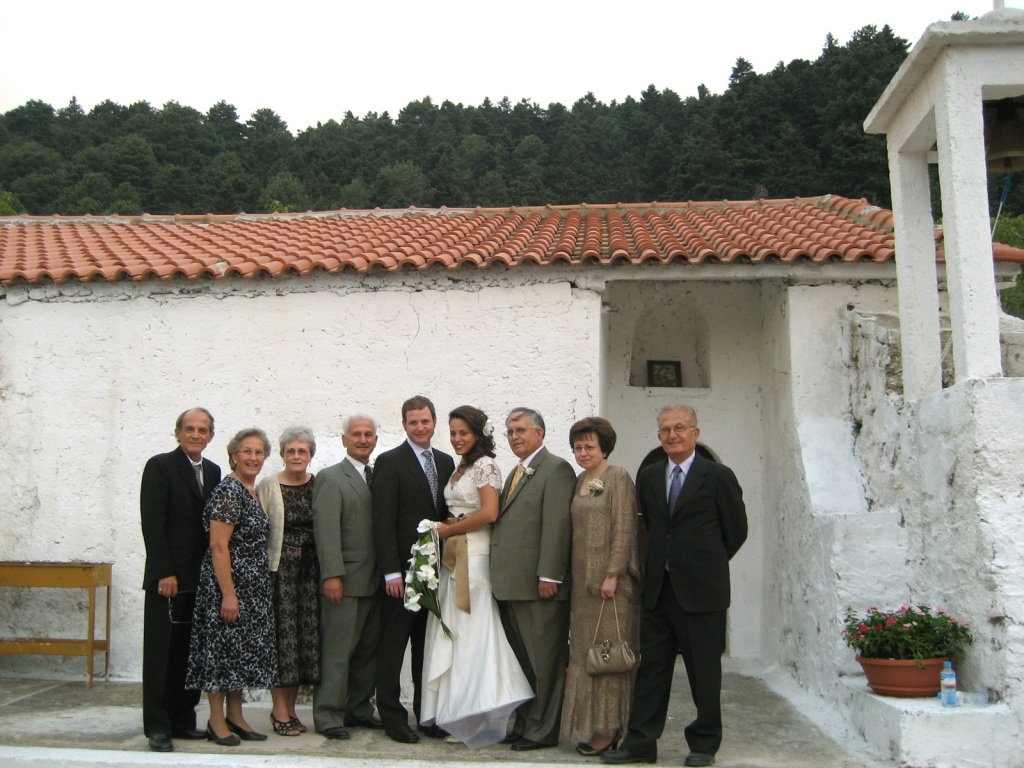
When George’s daughter chose to marry in Toriza in 2007, the extended family returned to their village. Coming from America and Canada, they gathered at their childhood home which by then had been willed to them by their parents.

Konstantarogiannis (Konstas) siblings in front of the "old" family home, 2007

Konstantarogiannis (Konstas) siblings in front of the “old” family home, 2007

The siblings deliberated its disposition. Nobody wanted to sell it, but taxes needed to be paid and other matters settled. George decided to buy his brothers’ shares and he became the sole owner. As people wandered through its rooms, taking items for keepsakes, the wooden trunk was rediscovered. Opening its lid, George found a jumbled mix of papers, many stained and dirty. Too overwhelmed to examine them there, George packed and took the contents to his house in Virginia.

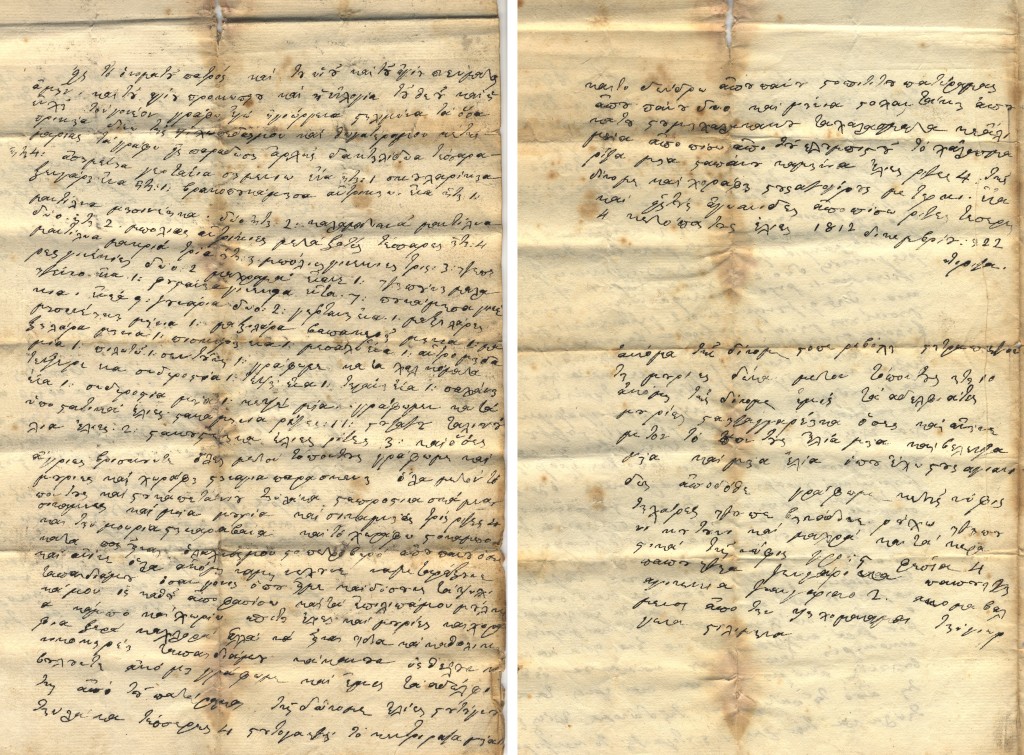
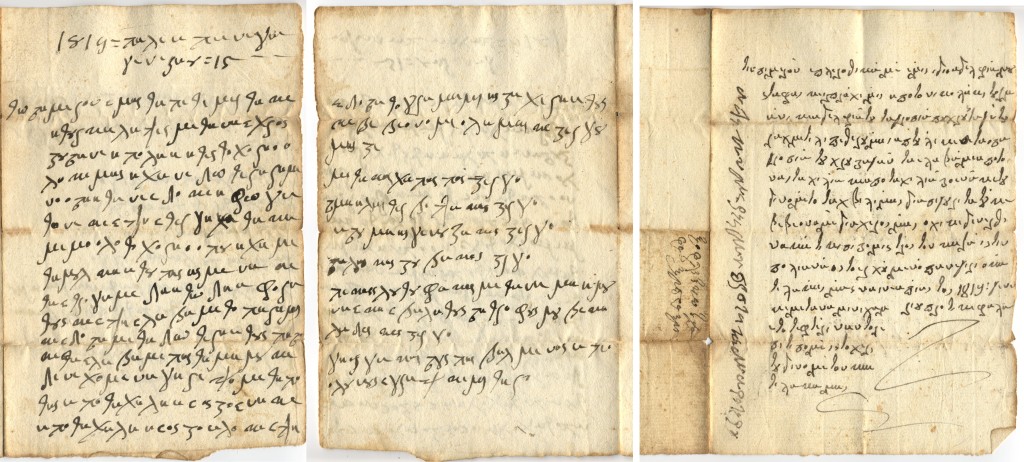
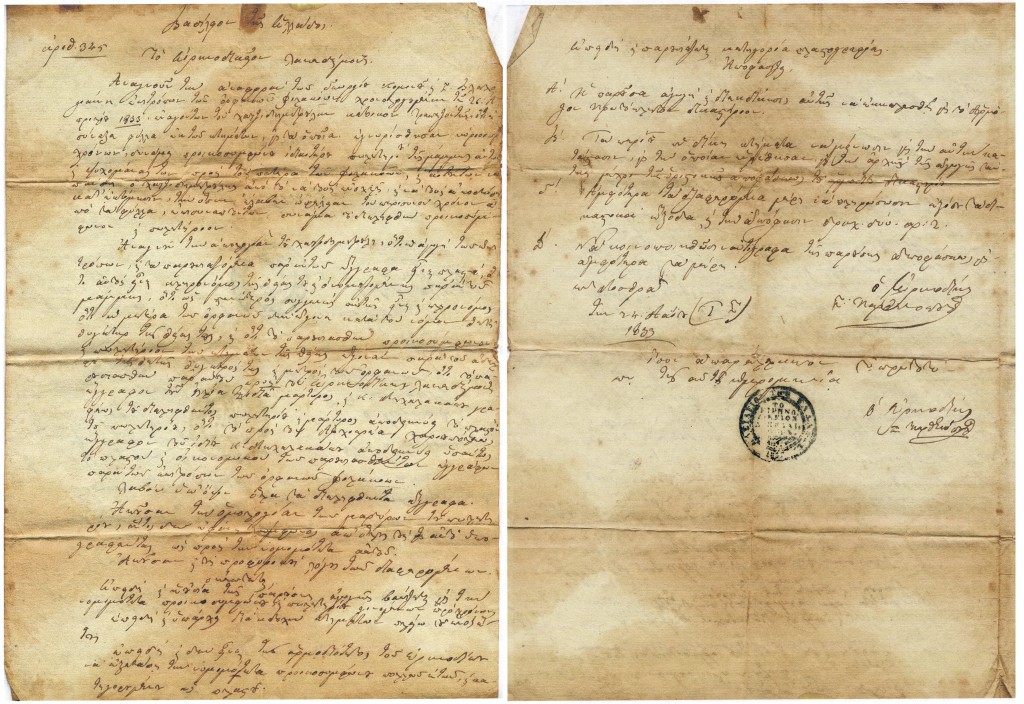
Many of the documents were in almost irreparable condition: torn, water stained, faded, moldy. As he sorted through them, George found a wallet. Folded inside was a disintegrated envelope inscribed with the words, OLD DOCUMENTS BEFORE 1819. He was astounded when he extracted yellowed, crinkled papers dated 1800, 1812, 1819 and 1833. And one dated 1741!

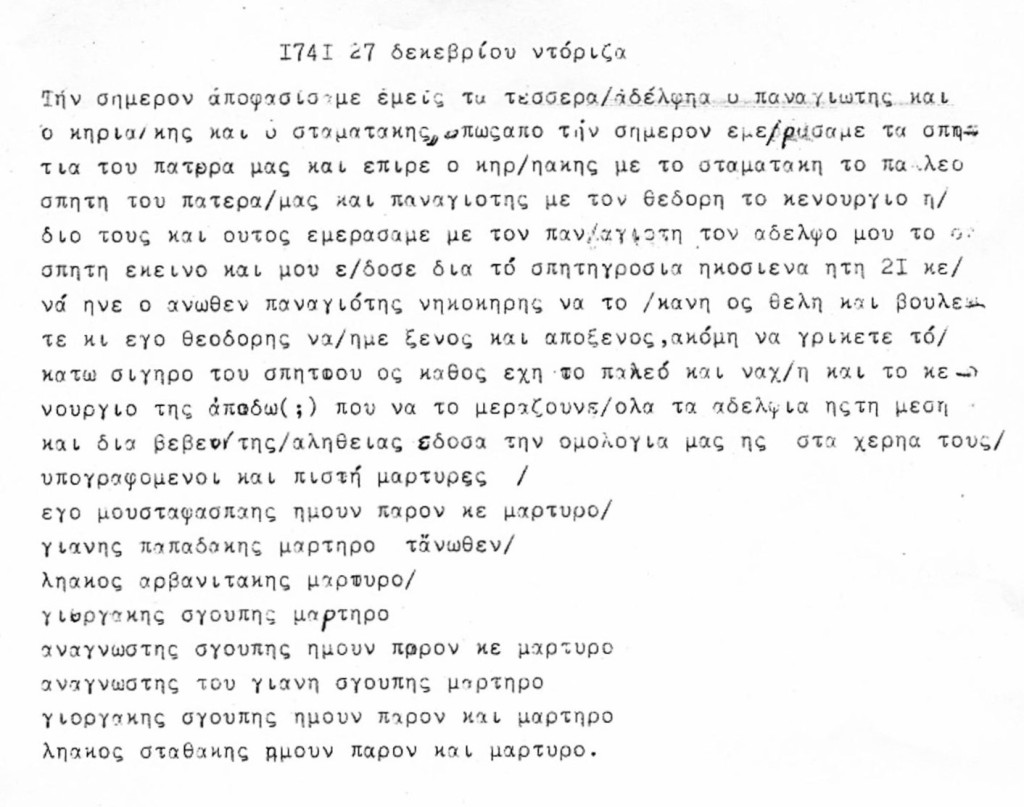
This document dated 27 December 1741 reveals the names of the four brothers– Theodorakis, Panagiotis, Stamatakis, and Kyriakos–who received an inheritance from their father and split up their fortune. They were from Manari and came to Toriza. This is the exact story George’s father described. It was not a myth; it was true.

ENGLISH TRANSLATION
1741 27 December Ntoriza (Doriza)
Today we decided the four brothers, Panagiotis and Theodoris and Kyriakis and
Stamatakis, that from today we have split the houses of our father and Kyriakis and
Stamatakis took our father’s old house and Panagiotis and Theodoris took our father’s
new house the two of them and truly split with my brother Panagioti that house and he
gave me for my half, grosia twenty-one (ie 21) and so the aforementioned Panagiotis is
the owner to do as he pleases and I, Theodoris will be a stranger and estranged, also to
designate the bottom floors of the house just as the old house has so to the new house
over here; where we split, all the brothers, down the middle. And for the certified truth
we gave our word onto the signatures of these trusted witnesses.
I, Mustafaspaïs (Mustafa-Sipahi was a feudal cavalryman), was present and witnessed
it
Giannis Papadakis witnessed everything above
Liakos Arvanitakis witnessed it
Giorgiakis Sgoupis witnessed it
Anagnostes (Church reader) Sgoupis I was present and witnessed it
Anagnostes (Church reader) of Gianni Sgoupis witnessed it (the writer of this document)
Giorgiakis Sgoupis I was present and witnessed it
Liakos Stathakis I was present and witnessed it

Above each image is a description of the documents from the early 1800’s:

1800 September – Lease agreement signed at Mystra for the Koumpari Monastery lands:

1812 December 22 – exhaustive dowry list of Georgina Stilimina for her adopted daughter/grandaughter, Maria:

1819 January 15 – An agreement between the villagers of Paleopanagia and the Turk-Albanians from Boliana in the mountains to direct water for irrigation purposes to the village:

1833 – A decree asking citizens to register their lands and how they came to own them from the newly formed government after independence:

“When I found these documents, I took the stories from the relatives and put them in order. There was so much information. Much of the writing we could not translate because it was in the old Greek language not used today,” George said. I asked if the 1741 document gave the surname of the four brothers. He explained, “They had no last name, so they were known as Anagnostos which means uneducated. Turks did not allow Christian or family names. During those times, people took names from prophets of the Bible, kings and queens, or ancient Greek heroes. And children went to the churches to learn Greek secretly.”

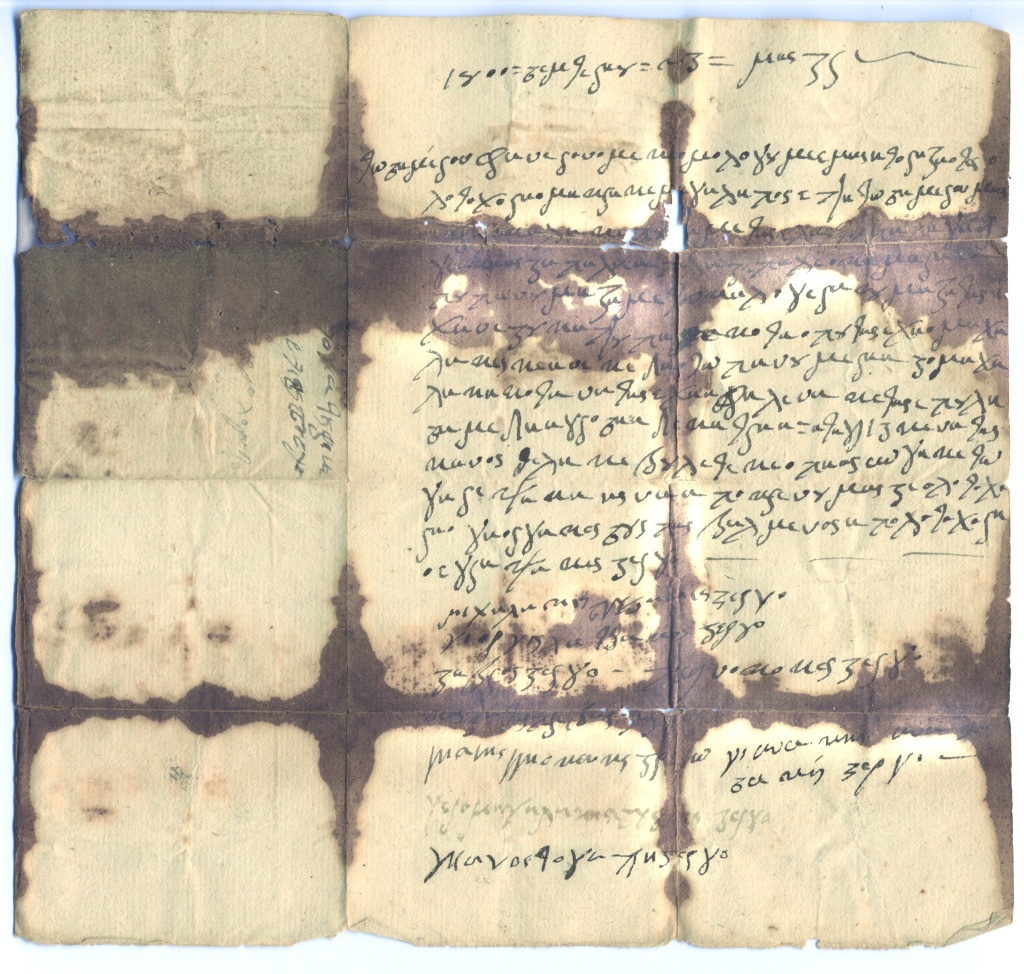
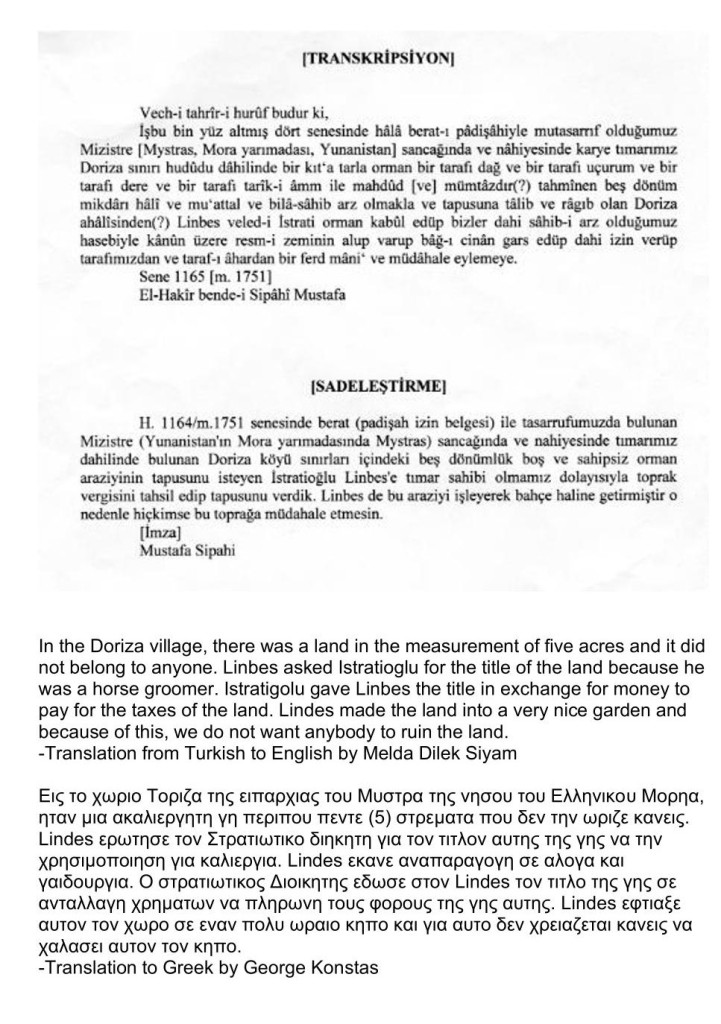
Also in the trunk was an amazing discovery—two documents, from 1751, written in Ottoman script!

First document and its translation:

Second document and its translation:

Translation of Ottoman script requires an expert. Although George had Turkish friends, they could not read the writing. In a unique coincidence, George knew of a man who worked as a translator for the Turkish government. George sent him the documents, and with great interest, the translator called George to ask how he had obtained them. After the documents were converted from Ottoman to modern Turkish, a teacher in Istanbul translated them from modern Turkish into English.

“Those documents and the true stories helped me to make the tree of my family,” George stated.

As he conducted further research in the areas of Paleopanagia and Xirokampi, George discovered the current day surnames of the four brothers:

  • Theodoros’ descendants: Laspitis from Riviotissa, Sparta
  • Stamatakis’ descendants: Nastakos from Paleopanagia
  • Kyriakos’ descendants: Kyriakakos from Xirokampi
  • Panagiotis’ descendants: Konstantarogiannis from Paleopanagia

George’s lifetime of work is now preserved in two books: The first is the history of the family from 1650-1821, and the second is from 1821 to present day. The books are written in his own handwriting, in Greek. With the help of his daughter, they will be translated into English. “I wrote these for my grandchildren, my daughters, and my family in the U.S. There are people we have not yet met, but they too will be able to learn the roots of the family,” George explained. Digital copies have already been sent to family members. 

I had the privilege of meeting George on November 19 at St. Katherine’s Greek Orthodox Church in Falls Church, Virginia, where I was invited to give a presentation. He brought his books and we reviewed them, page by page. I was completely absorbed in learning of his stories and how he has preserved his family’s history. I remain both awed and thrilled with the meticulous and detailed work he has done. His work brings recognition and honor to his ancestors, especially to his parents, Pericles and Christophile, and his grandparents, Konstantinos and Amalia.

George understood the urgency in making sure the original documents were in a safe place where they would be accessible and preserved for future generations. I am so very pleased that he gave the originals and copies of his books to the Sparta office of the General State Archives of Greece. They are now safely stored and available for researchers to learn the origins of Konstantarogiannis and the other families descended from the four brothers, as well as to have access to rare documents from pre-independent Greece.

George’s passion is both infectious and inspiring. He helped me recognize that we have only a sliver of our ancestors’ stories, and that we must not give up the search. We never know what we will find, or where we will stumble upon new information that will help us understand those who came before us. Somewhere, there may be a trunk in your family.


I am deeply grateful to both George and his daughter, Christophile, for giving permission to publish this story. And especially, I give a huge thank you to George who drove two hours from his home to meet me that day at St. Katherine’s. Somehow, he just knew we needed to connect, and that his story needed to be shared!


The Times of Our Ancestors’ Lives: Part One

Who we are is a product of multiple factors:  genetics, environment, and opportunities (or lack thereof). So it was with our ancestors. Where they lived and how they lived framed their mortal existence; but it was their personalities which molded their lives.From the villages of Sparta and the southern Peloponnese came a great exodus of young men in the 1880’s to mid-1900’s. Seeking relief from poverty and focusing on a new world, the majority were from Laconia, perhaps as many as 3/4 of its adult males (ages 18-35) eventually left. They embarked as pioneers and emerged as prototypes, paving the way for the thousands who followed.

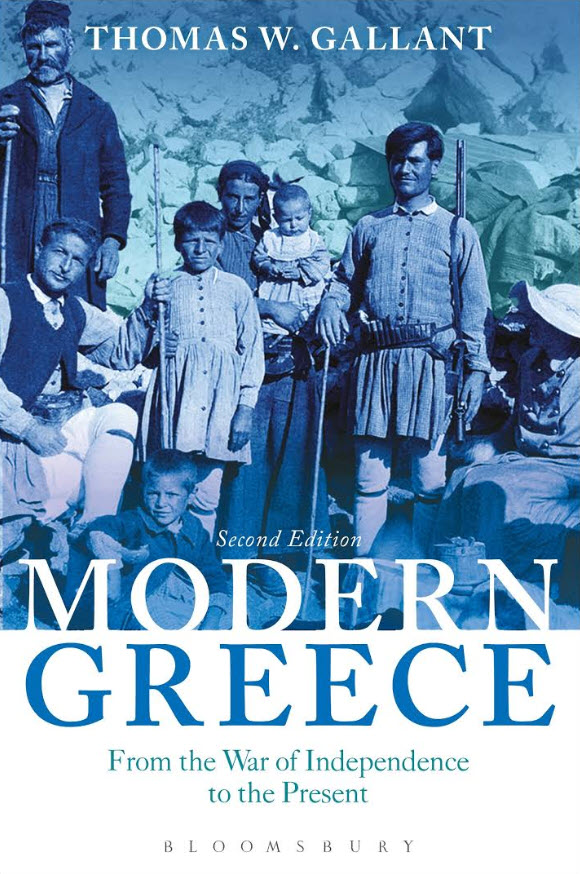
Knowing their environment is critical to understanding the choices our ancestors made. I am finding that Thomas W. Gallant’s Modern Greece is an excellent resource, and its chapter, “Society and Economy” describes the everyday world of a rural Greek village and home. In this post, I have extracted information from Gallant’s book to help us understand the times of our ancestors’ lives.

Although over 50% of the Greek population today resides in the Athens metropolitan area, this was not the case 100 years ago and before. The 1861 census revealed that 74% of adult men were farmers or sharecroppers; by 1920, this barely dropped to 70%. [i] Thus, the majority of families’ financial securities were tied to crops, a variable commodity. The demise of the current crop caused a revenue crisis in the 1890’s which, in turn, was a major factor in the earliest wave of emigration.

The typical village had a population of 200-300, or 600-700 people. In 1920, almost 52% of the population of Greece lived in villages of less than 1,000 people, and about 35% of people lived in villages of less than 500 people.[ii]

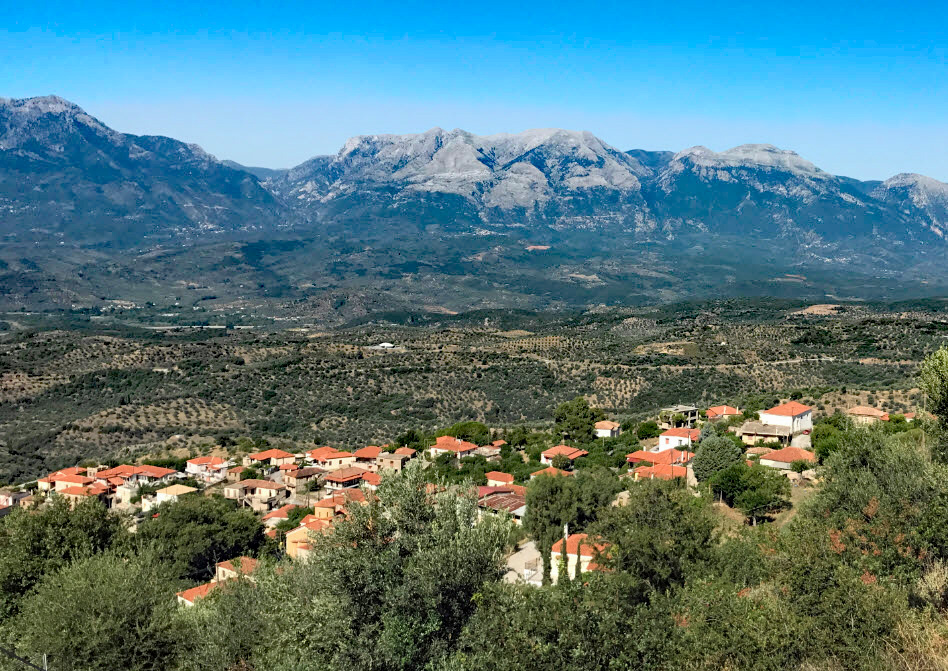
Theologos, Oinountos, Laconia, 2017. This village is 6 km straight up a mountain, and is the home of my great-grandmother, Stathoula Zaharakis

Villages around Sparta are nestled in majestic mountains, and until the mid-1900’s many were accessible only by foot or donkey. Building in the foothills and even atop mountains was a necessity, as flat, arable land was scarce and designated for farming. Space in the center of the village was reserved for the church and the town square or platea, the hub of social life.

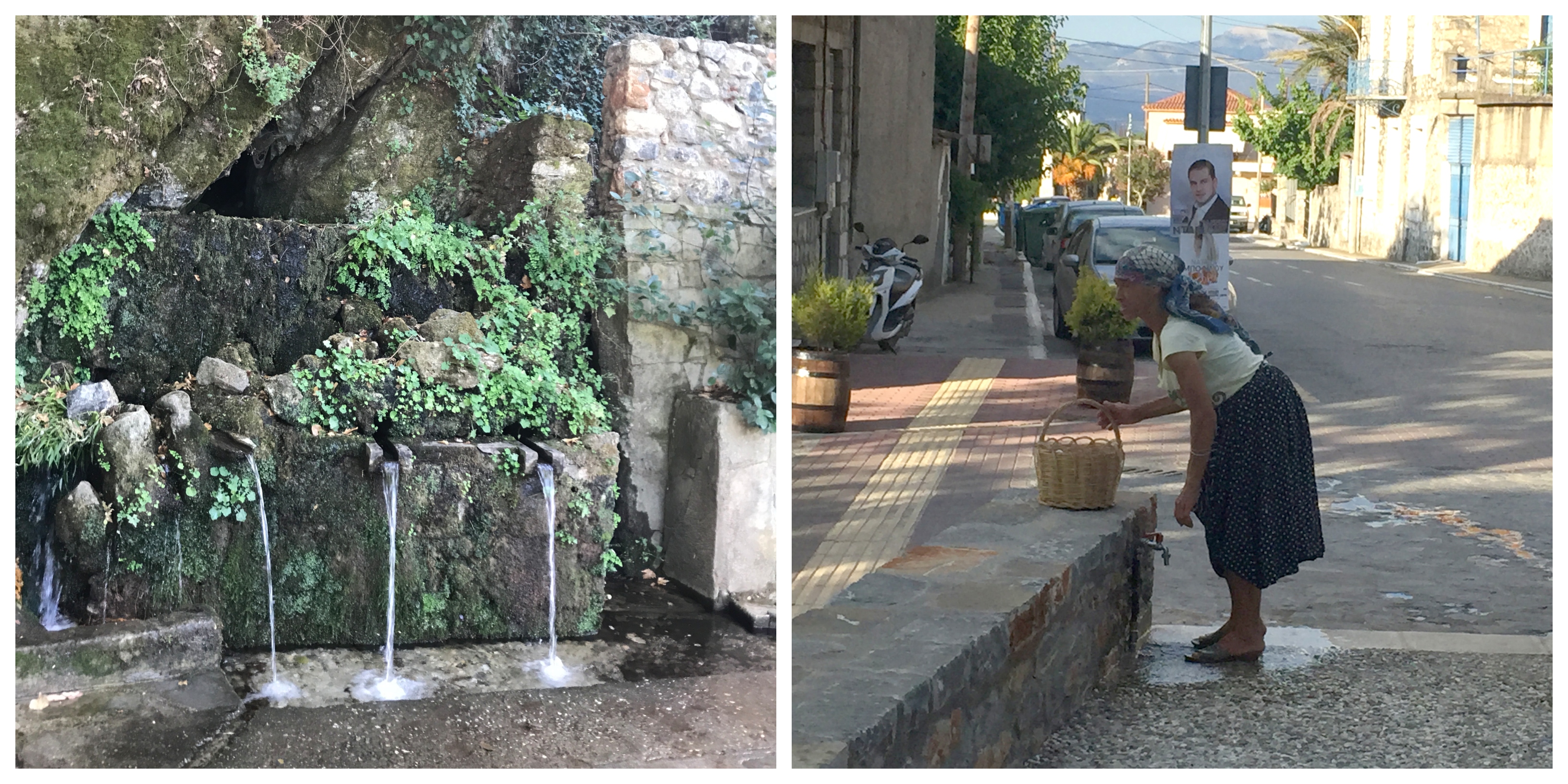
The arid climate and hot, dry summers required a source of water, and villages were settled near rivers or streams. Even today after hundreds of years, pure mountain water gushes freely from rocks and every village has fountains which are in constant use.

left: water gushes from the mountain in Pikoulianika; right: a fountain in the platea of Xirokambi.

In the summer, shepherds took their flocks of goats and lambs to graze high in the verdant hillsides, several kilometers from their home. There, they lived in small huts known as kalyva. A settlement of several huts occupied by shepherds of the same village could get its own name. For example, a group of huts occupied by shepherds from the village of Soha would be given the name Kalyvia Soha. During winter, the shepherds would leave the mountains to reside in their primary home in the village.

Most farms were single-family peasant households. The father was the primary laborer, with his sons assisting as they grew old enough to work in the fields. Women also helped by weeding (considered to be “woman’s work”) and on a seasonal basis during harvests. The primary focus was to provide enough food for the family; therefore, a variety of small crops would be planted:  wheat, barley, maize, legumes with some olive and fruit trees, and vines. Tools were wooden and rudimentary. Livestock would include a donkey; sheep and goats for milk, cheese, hides and wool; and chickens for eggs and meat.[iv]

Despite its self-sufficiency, every Spartan family needed cash. Goods such as salt, tea, coffee, gunpowder, and metal had to be purchased. Dowries had to be provided. Funerals and weddings necessitated money, as did medical and other family expenses. Thus, a means of generating cash income was required. Many families grew a “cash crop” which could be sold locally, such as tobacco, grapes, or cotton. Some produced extra olive oil or wheat. In other cases, groups of male kinsmen (brothers, fathers and cousins) or entire families would work as seasonal wage laborers harvesting grain or picking grapes. Or, men might acquire skills such as smiths, knife sharpeners, carpenters and masons. They would travel the countryside, offering their skills in small villages that could not support a full-time artisan on their own.[v]

Our Spartan ancestors would have encountered a “myriad of movement across the countryside” of ξένοι (foreigners) whose livelihoods necessitated being on the move:  transhumant  shepherds of certain ethnic groups who specialized in large-scale animal husbandry, or itinerant merchants who transported goods over land on donkeys.[vi] “The image of the nineteenth-century Greek villagers as ensconsed in their little villages, isolated from and ignorant of the wider world, is grossly inaccurate. No village was an island unto itself. The Greek countryside was a fairly dynamic place characterized by a relatively constant movement of people across it and periodically punctuated by the larger-scale arrival and departure of work gangs, itinerant merchants and artisans, donkey caravans, shepherds with their families and flocks, and of course, the dreaded bandit gangs which continued to be a menace to society until late in the century.”[vii]

Thus, despite the relative isolation of many villages, people were exposed to news, ideas, and customs which expanded the microcosm of their world.

[Part Two will cover the social world of men and women, and the home.]

____________
[i] Gallant, Thomas. Modern Greece, New York: Bloomsbury Academic, 2016. p.127.
[ii] ibid., pg. 128.
[iii] ibid., pg. 129.
[iv] ibid., pg. 135.
[v] ibid., pg. 140.
[vi] ibid., pg. 140.
[vii] ibid., pg. 141.