It happens in many families. A husband and wife welcome one daughter, then two, then maybe several more into their home. When the childbearing years have passed and no sons are born, the descriptive genealogy term is that the family is “daughtered-out.”
In pre-modern Greece, this situation posed problems for the husband and wife. With several daughters to be married, several dowries were needed — a most difficult situation for poor, rural village families. The surname may or may not disappear: if it is prevalent in the village, and if others with the surname are not daughtered-out, the surname will survive; if that is the only family with the surname, it will end.
But perhaps the biggest concern of the parents is: who will succeed the father as patriarch in the home? Who will be the head of the household, and assume the responsibilities of providing for and protecting the family? The patriarch provides financial support by earning a living and managing the money. He is the decision-maker in the home and provides his family emotional support and guidance. He preserves the family’s traditions and cultural heritage and serves as the primary role model for his children and grandchildren. He is revered–or sometimes feared–but always respected.
One solution to this dilemma is the introduction of a sogamvros, a man who marries one of the daughters. He leaves his father’s home and family to live in his wife’s household, thus assuming the role of patriarch in her family after her father dies.
Here is an example found in a search of the 1844 Voter Lists for the village of Agios Ioannis, Sparta, on GreekAncestry. Notice the suffix, –gamvros, in each name:
Thirty years later, the 1872 Voter Lists of the village reveals these names:
Στρατηγόγαμβρος, Χρ. (Stratigogamvros, Chr.) age 28
Τρακόγαμβρος η Σαχάμ, Π. (Trakogamvros or Sacham, P.) age 32
Τρατόγαμβρος Μιχ. (Tratogamvros, Mich.), age 35
Remember, surnames were “fluid” (changeable) or even non-existent before the 20th century, thus; the sogamvros may or may not change his name upon marriage. We cannot determine if the prefix is the original surname of the man, a nickname, or the name of the family he married into: Kontogeorgo-, Stratigo-, Trato-, Trako-. (As an aside, N. Stratigogamvros and Mich. Tratogamvros are found in both the 1844 and 1872 Voter Lists, which demonstrates the importance of examining all extant records for your surname.)
The irony of a sogamvros is that after he joins his wife’s family, he becomes “lost” in his own. He has left his home, resides in his wife’s house, and has a change in his name. If we find that a sogamvros has married in our family, how can we determine which family and village he was from?
Gregory Kontos of Greek Ancestry explained: “We may never know the man’s original name unless we find a document or notary record (contract, will, etc.) that states his father’s name or which village he was originally from. Or, if there is a family story that provides that information.”
In my recent interview with researcher Tom Frangoulis, he related that the only way he knew a male relative became a sogamvros in another village was because a family member mentioned that fact in a written family history.
Alternately, if we are “missing” a male in our family, could he have become a sogamvros in another village?
My branch of the Kostakos family is now daughtered-out. My father was the only son; my brother was the only son, and he has two daughters. If we lived in our village of Agios Ioannis a couple of generations ago, someone who married one of my nieces would become a sogamvros. To reflect his new role as patriarch, perhaps he would have chosen to take Kostakos surname, thus becoming a “Kostagamvros.” By leaving his family and joining ours, his identity would change. If no one documents this fact, his origins may be forever lost.
Let’s be sure we write something about the history of our family. How sad it would be if people “disappeared” because we did not take the time to document what we have learned about our ancestral lines.
ADDENDUM: My sincere appreciation to Achilleas Gazis, who wrote the following corrections to this post: “Two points to notice: the prefix is always the name of the family he married into; Your sogamvros would be Kostogamvros, not Kostagamvros.”
With three of my four grandparents born in Agios Ioannis (Aridas, Kostakos, Papagiannakos), I am related to almost every family in our village. My desire to understand our family connections both intrigues and entices me to document how we all interconnect.
I have spent several summers at the Archives of Sparta, the Lixarcheion office and the Municipal Office (KEP), researching our families. I have gathered information from primary sources: the Dimotologion Koinotitos, Mitroon Arrenon, School Archives, Church Books, Election Registers of 1844 and 1872, and Marriage Records from the Metropolis of Sparta. To complete the project, I must extract additional names from marriage, church and school records, but the basic family structure of the village is now documented.
This data has now been compiled into a website, Spartan Roots Family Trees, which can be accessed here. As I continue to add information, the website will automatically update.
Important: Only people who are deceased are in this website!
To use the site, click on the home page, then on the left menu, click on “name index“. Using the alphabetical letters at the top of the page, click on the letter of a surname. A list of surnames will appear and the number next to each name indicates how many people with that spelling are in the database. Click on the letter of interest. Name spellings vary a lot and some begin with two-letter consonants (see Notes below). Alternately, type a surname in the search box. If a name does not appear, then click on the first letter of the name and scroll until you find it.
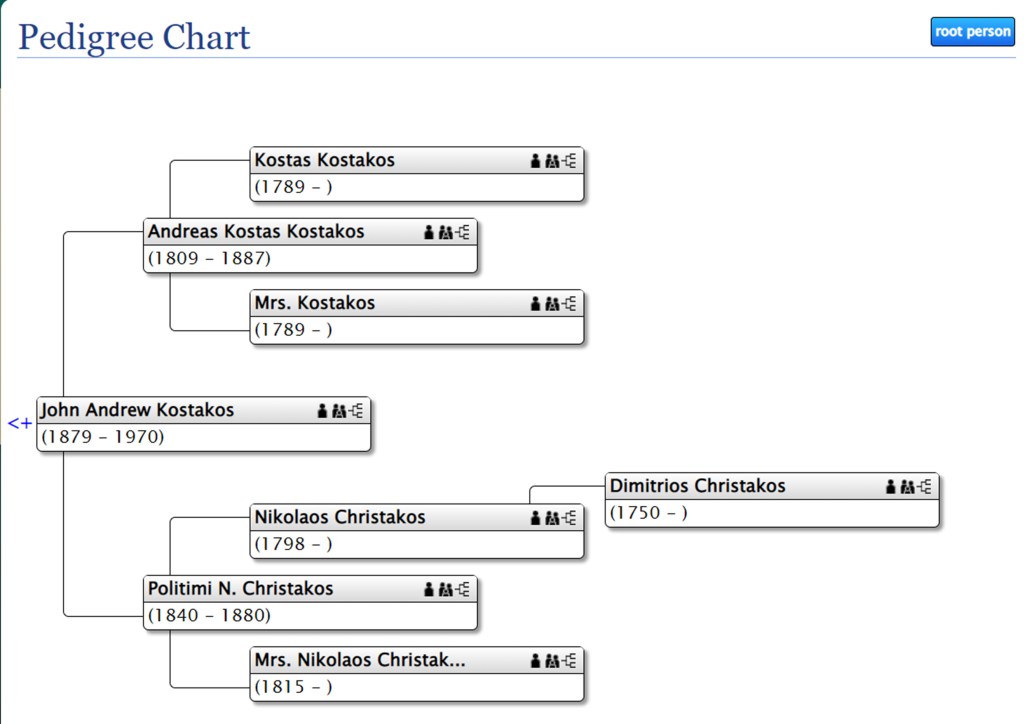
For example, I am looking for my grandfather, John Andrew Kostakos.
When you find a name of interest, you will see three icons on the right. Each takes you to a page with additional information about that person.
Number 1 is the Individual Page, with vital statistics, facts and notes about that person.
Number 2 is a Family Group Sheet. You can choose whether to view that person as a parent with his/her spouse and children; or as a child in the household of his/her parents.
Number 3 shows the person in a Pedigree view. He is the first person on the left, with his ancestors on the right.
Notes:
(1) to navigate, use the left and right arrows at the top of your browser to go one page back or forward.
(2) Be alert for names which begin with two-letter consonants. These are: μπ = b or mb; ντ = d or nd; γκ = g or ng; γγ = g or ng; τσ = ts; τζ = dz.
These two-letter consonants could be translated more than one way; e.g., Bolovitsiotis in English is spelled Μπολοβιτσιώτης in Greek, so it could begin with either a B or an Mp.
(3) If you know of a name that is not on the site, please contact me so we can determine why it is missing.
It is my deepest hope that this website will help you to trace your family back through time. Some men in the Election Register of 1844 were born in the late 1700’s! Our families have a deep and proud heritage, and I am so honored to have roots in our beautiful village!
I am so pleased that this initiative has been accepted into the Greek Ancestry Village History Project Initiative, which is explained here.
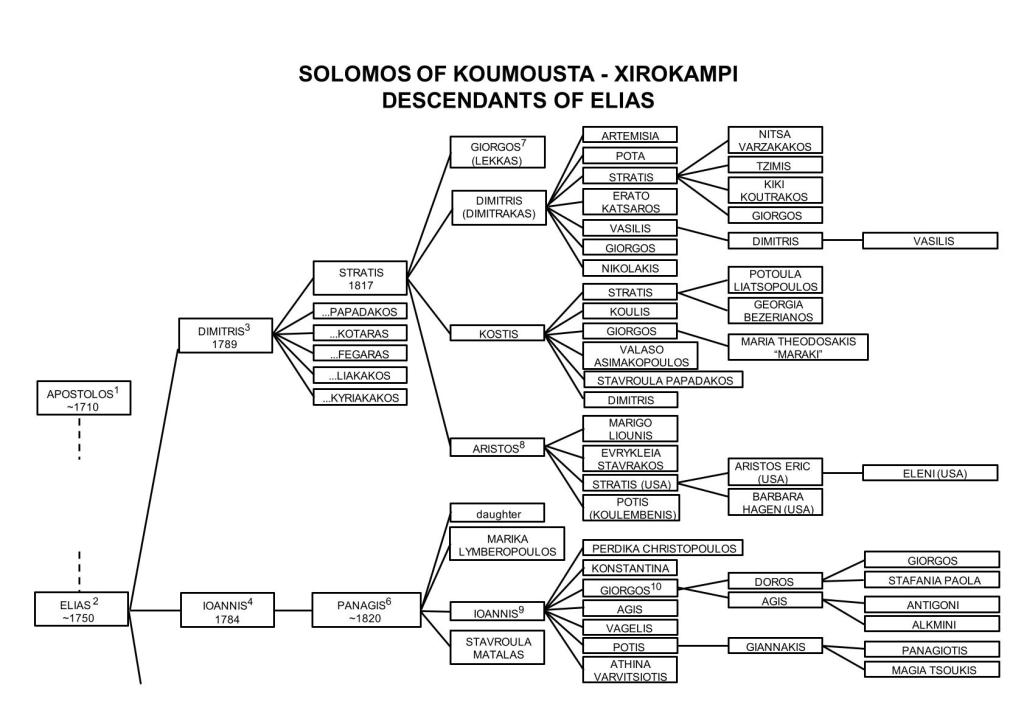
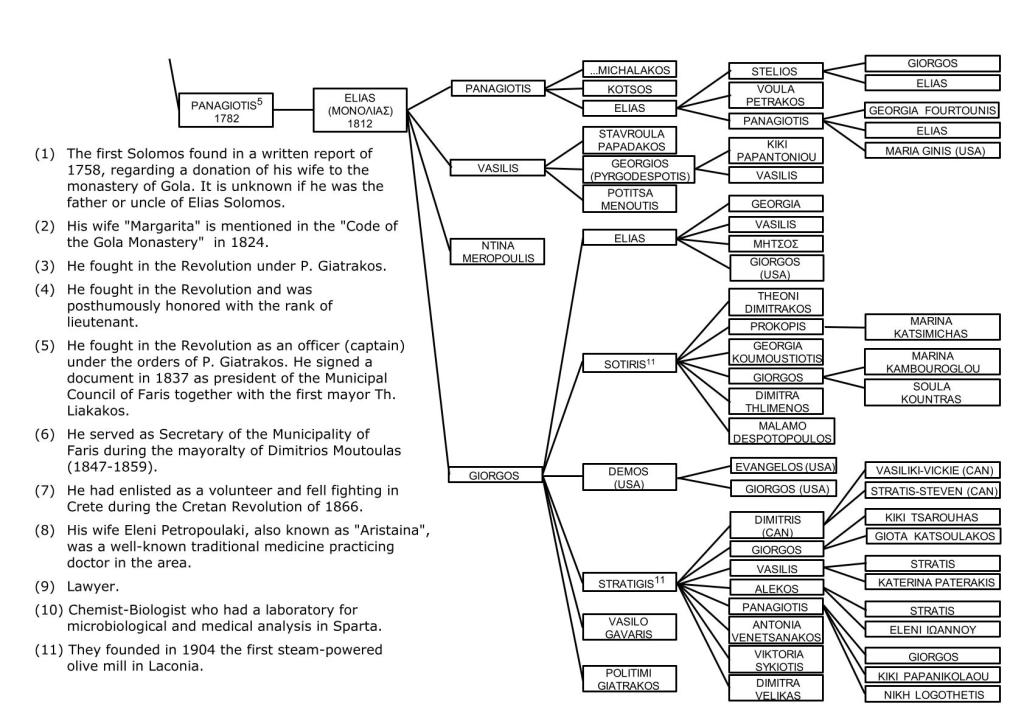
I am most pleased to receive permission from Stratis Solomos to share his genealogy of the Solomos Family of Koumousta and Xirokampi.Stratis wrote: “Last year I was asked by the chief editor [of the Faris newsletter] to write a genealogy on the Solomos family, one of the most important families of Koumousta-Xirokambi…For practical space reasons the family tree was confined to the generation of 1960-70. By the same token, the few historical footnotes are limited to the older generations only.”
Publicizing and publishing our family history work is an unselfish and important act. It allows us to share what we learn with those who may not have the resources or abilities to conduct such research. They, too, want to know about their ancestors and connect with extended family worldwide. Thank you, Stratis, for your sharing your work with us and for providing this English translation.
The Solomos family of Laconia originates from Koumousta, a village in the Taygetos mountains, close to Sparta. In the 19th century, after the Greek War of independence, most family members moved gradually down to the flat land, to the newly founded village of Xirokampi. The origin of the Solomos family of Laconia is unclear and there is no oral tradition or myth related to the family history. In the 1950s-60s, the lawyer Georgios V. Solomos, known as “Pyrgodespotis” (Castle-Lord), was saying that he had done a bibliographic research that had allowed him to conclude that the family came from Crete in the middle of the 17th century, after the fall of Chandakas (Heraklion) in 1669 and its occupation by the Turks. More specifically, as it was narrated in the informal ‘kafenio’ gatherings, there were initially two brothers, one of whom stayed in Laconia and the other went to Zakynthos. The latter was the great-grandfather of the national poet of Greece Dionysios Solomos. Unfortunately Pyrgodespotis did not leave any written report and the above cannot be confirmed. His version may have been based only on various biographies of Dionysios Solomos.[1]
Nevertheless, the above hypothesis is not completely unfounded and can be based on the following arguments:
1) The family appears in the mountain village of Koumousta in the early 18th century, following the end of the Venetian domination over several Greek territories (and succeeded by the Ottomans).
2) It settles in an area where there are other well-known families, of established Venetian[2], Frankish and Byzantine origin. These families were living in the Laconia plains, but they moved to the mountains in 1715, when the Ottomans again conquered the Peloponnese.
3) More recent publications show that the great-grandfather of Dionysios Solomos, Nikolaos, did not go directly from Crete to Zakynthos, but to Kythira, where he married to Maria Durente[3], a woman from a “noble” family and with a large dowry. The Salamon-Solomos family, which is mentioned as important during the Venetian rule of Crete, had other members who settled in Kythira [4] and probably in the fertile Laconia, where the Venetians had provided them with arable land.
4) In addition, it was at this period that the Turks occupied Kythira for three years (1715-1718), for the island to be finally recaptured by the Venetians. It is possible that the move from Kythira to the neighboring Laconia happened at this time.
5) The wife of Elias Solomos of Koumousta (born around 1750) bears the name “Margarita”, which is not a usual name of Ottoman-occupied Greece. It is a “western” name mostly used in the Greek regions under Venetian rule.
Stratigis & Vasiliki Solomos, courtesy of Stratis A. Solomos
The Solomos families of Xirokampi and Koumousta, which today number hundreds of descendants in many parts of the world, are divided into two branches which meet somewhere in the late 18th century.
The first and most numerous are the descendants of Elias Solomos. The other branch comprises the descendants of Georgakis Solomos and then Thanasis, who was nicknamed “Lales”, hence their identification as “Lalaioi” (pronounced “Lalei”). Because of this nickname there was a traditional rumor that this family branch came from “Lala” a village in northwestern Peloponnese. However, it is rather unlikely that part of the family, with the same rare surname, came to the isolated village of Koumousta from such a remote area, unless there were relatives with the already settled Solomos of Koumousta. Another rumor has it that one of them fought against the infamous Turcalbanian mercenaries “Lalaioi”.
The reconstruction of the two branches of the published genealogical tree is mainly based on earlier oral reports, but also on documented, written information from the book of Th. Katsoulakos and P. Stoumpos[5]. Some evidence was also found in a report of a court dispute of a certain Meropoulis or Myropoulis, against trespassers of his property[6]. Archival research done by the genealogy research company “”ΟΙ ΡΙΖΕΣ ” (THE ROOTS) [7] was also taken into account. Another source of information was the list of immigrants passed from Ellis Island[8], as several members of the family immigrated early to America, from 1896 to 1921. The internet site of the Ellis Island Foundation has provided precious information concerning marital status, name of spouse, fellow travelers, relatives left in Greece, relatives to be met in the US, previous travels and age. From the age declared we can we conclude the year of birth, although with caution, because they often deliberately changed their age depending on the immigration laws in force. Some of these Solomos came back; for those who remained, there is the indication (USA, CAN) next to their name in the tree.
It is expected that there will be shortcomings and mistakes, especially in the tree of “Lalaioi”, which was done with more recent and less credible present-day oral testimonies. Where there is doubt, this is stated in the footnotes and the parental relationship is drawn with dashed line – – – -. Also missing are members who died in infancy or childhood. A future digitization of the registry files of Xirokampi and additional genealogical surveys could substantially help to improve this two-branch tree.
Although there is still abundant material available on the recent family members, for practical space reasons the tree was confined to the generation of 1960-70. By the same token, the few historical footnotes are limited to the older generations only. The year of birth is only mentioned for the older ancestors. Where the year of birth could not be determined exactly, it was estimated and preceded by the symbol (~). The construction of a more complete family tree that could encompass current family data and include offspring of female members would require a greater research effort and special lnformation Technology tools.
Finally, I would like to thank for their substantial contribution: 1) George P. Solomos (Italy), who decades ago recorded his first family tree version of “Elias Solomos descendants branch” and now helped significantly in the historical research. 2) Doros G. Solomos (Italy), who years ago spent time and resources on additional research for the improvement of the above mentioned family tree. 3) Dimitris “Mitsos” Ath. Solomos (Xirokampi), Nikos El. Solomos (Kalamata) and Dimitra G. Solomos-Giangos (California USA) who helped making the first, integrated version of the genealogical tree of the “Lalaioi” branch.
Stratis A. Solomos Geneva Switzerland stratis.solomos@bluewin.ch
[1] Ν. Τωμαδάκης: Οικογένειαι Salomon-Σολωμού εν Κρήτη, Επετηρίς Εταιρείας Βυζαντινών Σπουδών, 1938, Έτος ΙΔ’, 163-181. [2] Σ. Α. Σολωμός: Η ετυμολογία μια τοπικής λέξης και ήθη της Γαληνοτάτης Δημοκρατίας. Φάρις-Ξηροκάμπι, τεύχος 55, Δεκέμβριος 2011. [3] Ελένη Χάρου: Μαρία Δουρέντε, η Κυθήρια πρόγονος του Διονύσιου Σολωμού, 27 Μαρ. 2016. [4] Μπαλτά Ευαγγελία: Η οθωμανική απογραφή των Κυθήρων 1715, Ινστιτούτο Νεοελληνικών Ερευνών ΕΙΕ, Αθήνα 2009. [5] Θ. Κατσουλάκου και Π. Στούμπου ‘η Κουμουστά της λακεδαίμονος’, 2012. 6] ΣΥΜΒΟΛΑΙΟΓΡΑΦΙΚΕΣ ΠΡΑΞΕΙΣ του «μνήμονος Λακεδαίμονος Κυρίου Γεωργίου ΧΑΡΤΟΥΛΑΡΗ» 1833-1835. [7] Γραφείο αρχειακών ερευνών «ΟΙ ΡΙΖΕΣ» ( http://www.oirizes.gr ) Άρης Πουλημενάκος, [8] Ε. Α. Σολωμός: Μετανάστες των χωριών μας που πέρασαν από το Ellis Island. Φάρις- Ξηροκάμπι (τεύχος 50, Δεκέμβριος 2009).
At the bottom of a wooden trunk, beneath piles of dusty documents, lay long-forgotten papers unlocking the history of the Konstantarogiannis family of Toriza, Lakonia. Countless years ago, the trunk was procured by an unknown ancestor and placed in the family home. It was a handy repository for documents, certificates, and military papers. But for dozens of years, its cluttered contents remained untouched, unexplored and unexamined.
As a young lad, George Konstas worked the potato fields of Taygetos with his father, Pericles. While they planted and plowed, Pericles told George of their family—its origins, its people, its struggles.
Pericles Konstantarogiannis working his potato fields in the Taygetos mountains.
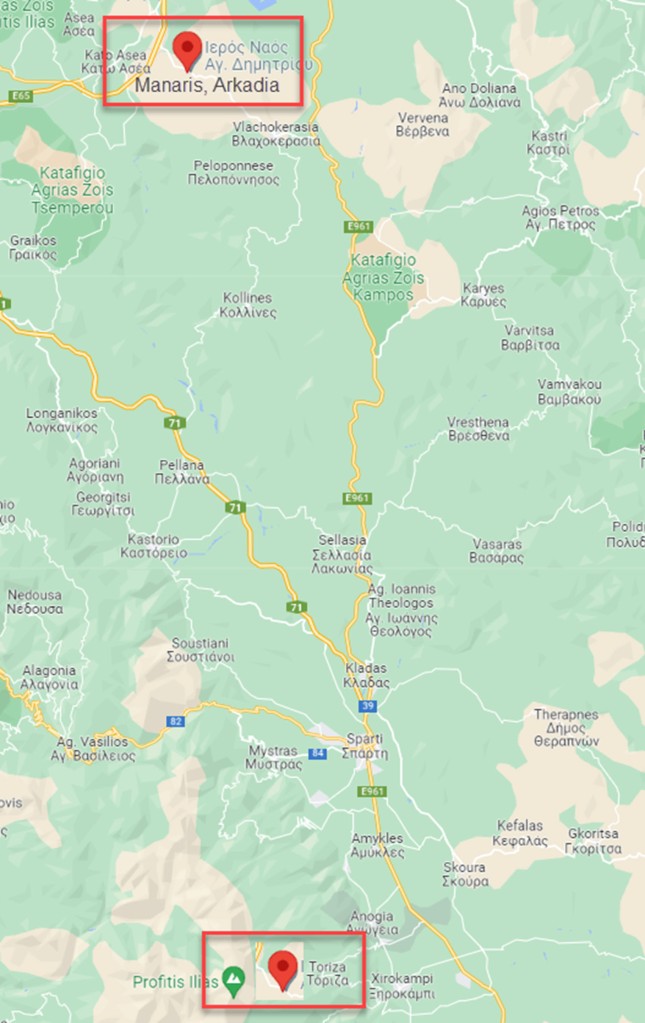
George heard the story of four brothers named Theodoros, Stamatakis, Kyriakos, and Pangiotis who, after Ibrahim’s invasion of the Peloponnese, left their mountain village of Manari, Gortynias, Arkadia and settled in equally mountainous Toriza, 10 kilometers from Xirokampi. Panagiotis was George’s forefather.
Pericles told George of ancestors who supported the 1770 Orloff Revolt, part of Russian Empress Catherine the Great’s failed “Greek Plan” and precursor to the Greek War of Independence. “My father knew these stories, but he never told me that we had documents explaining the family roots,” George related. “He probably hid the documents from previous family members. And sometimes my father confused the events because he had heard the stories handed down from his parents and relatives.”
George was taught by others, as well. “In the evenings, the older people told stories,” he recalled. “We had no electricity, no television, no entertainment, so they talked and I listened. But I thought these were myths, not true facts.”
Despite his skepticism, George was fascinated by his family’s history. As an adult, he began to record all the tales heard during his lifetime. As he wrote, his interest escalated into a passion to preserve what he had been told. He knew that if he did not do so, the history of his family would be forever lost.
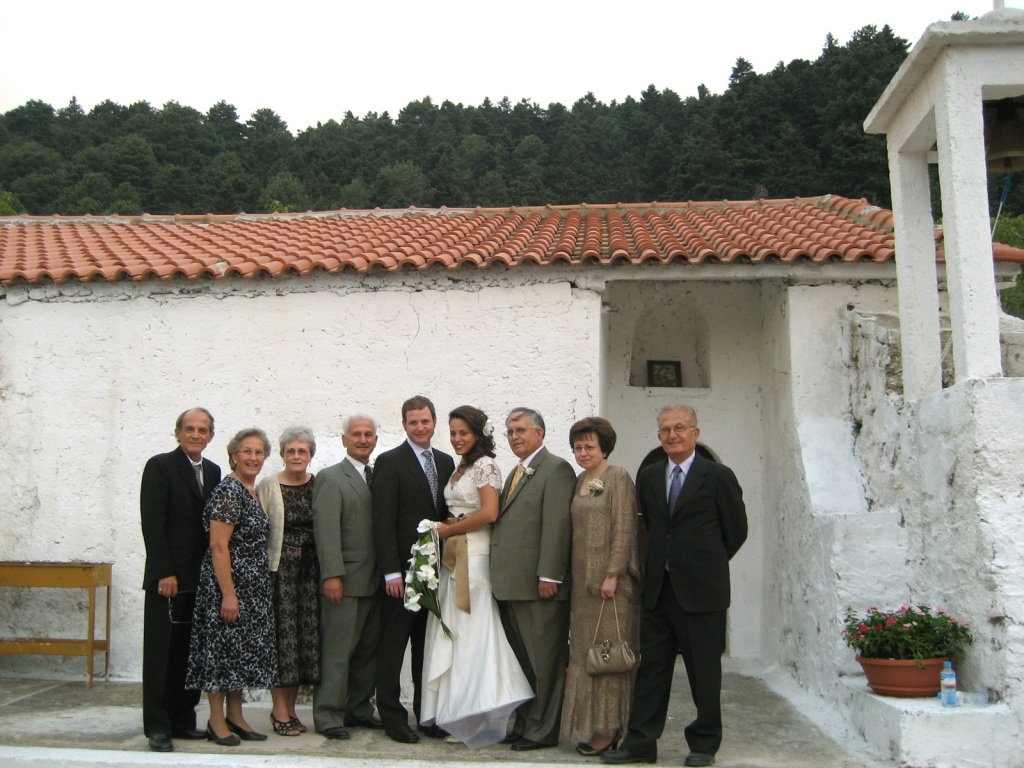
When George’s daughter chose to marry in Toriza in 2007, the extended family returned to their village. Coming from America and Canada, they gathered at their childhood home which by then had been willed to them by their parents.
Konstantarogiannis (Konstas) siblings in front of the “old” family home, 2007
The siblings deliberated its disposition. Nobody wanted to sell it, but taxes needed to be paid and other matters settled. George decided to buy his brothers’ shares and he became the sole owner. As people wandered through its rooms, taking items for keepsakes, the wooden trunk was rediscovered. Opening its lid, George found a jumbled mix of papers, many stained and dirty. Too overwhelmed to examine them there, George packed and took the contents to his house in Virginia.
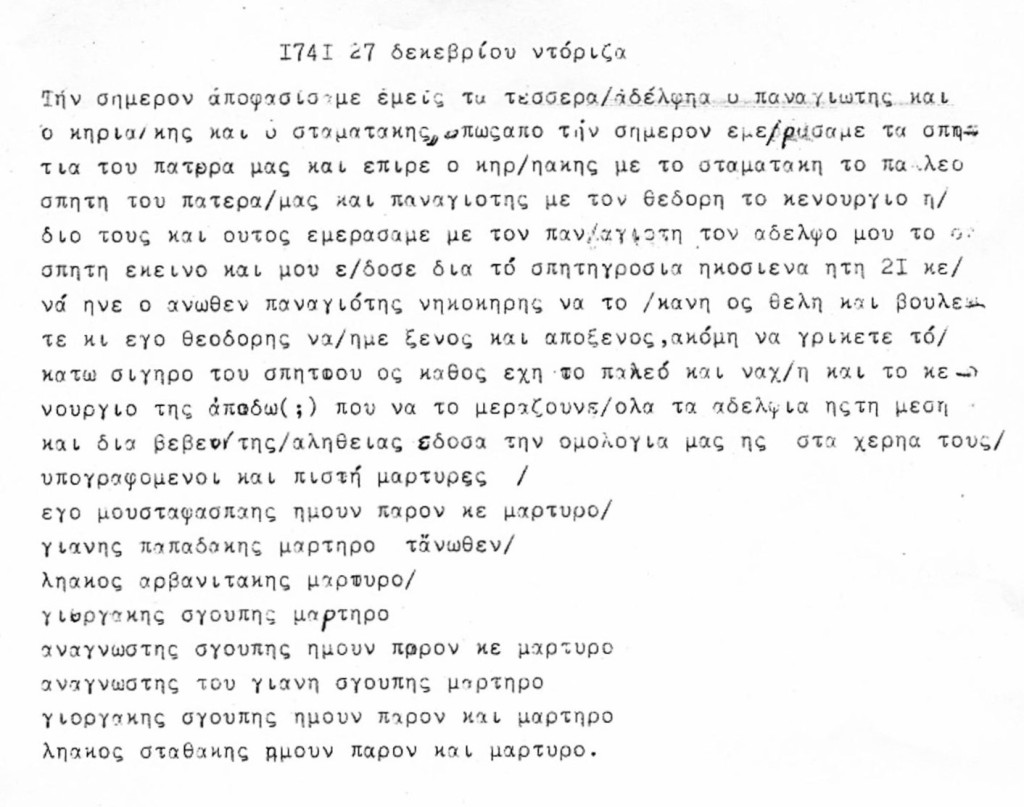
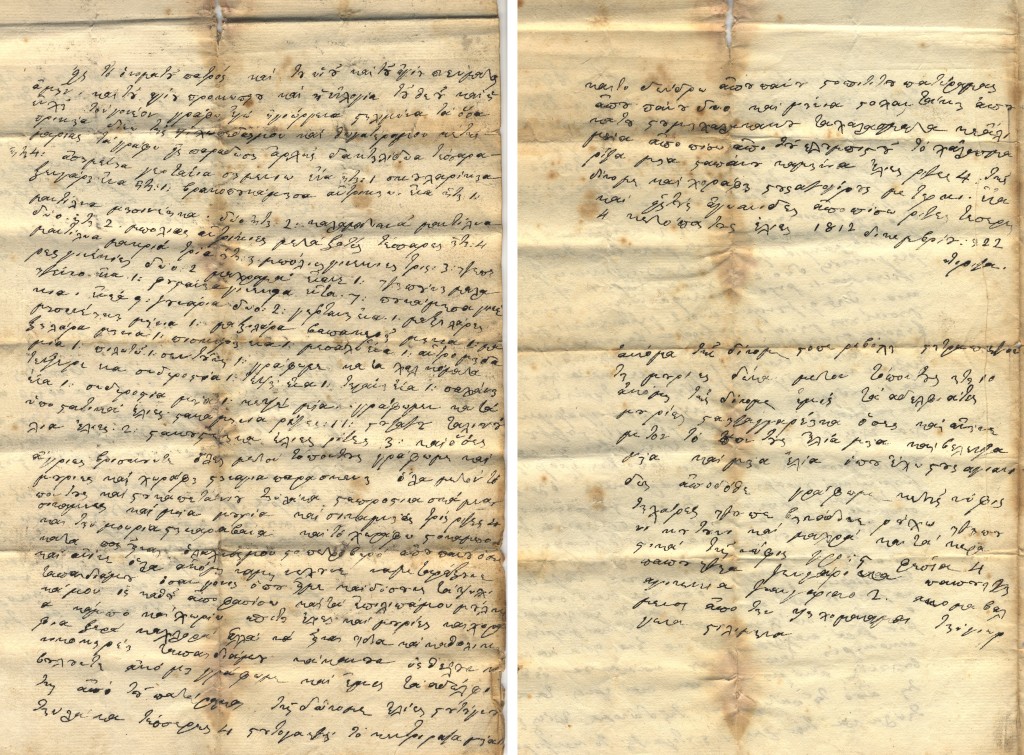
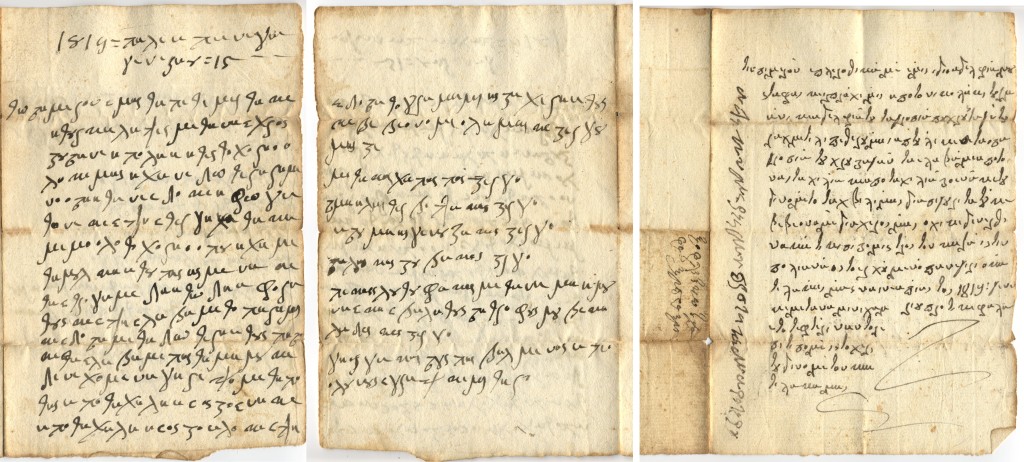
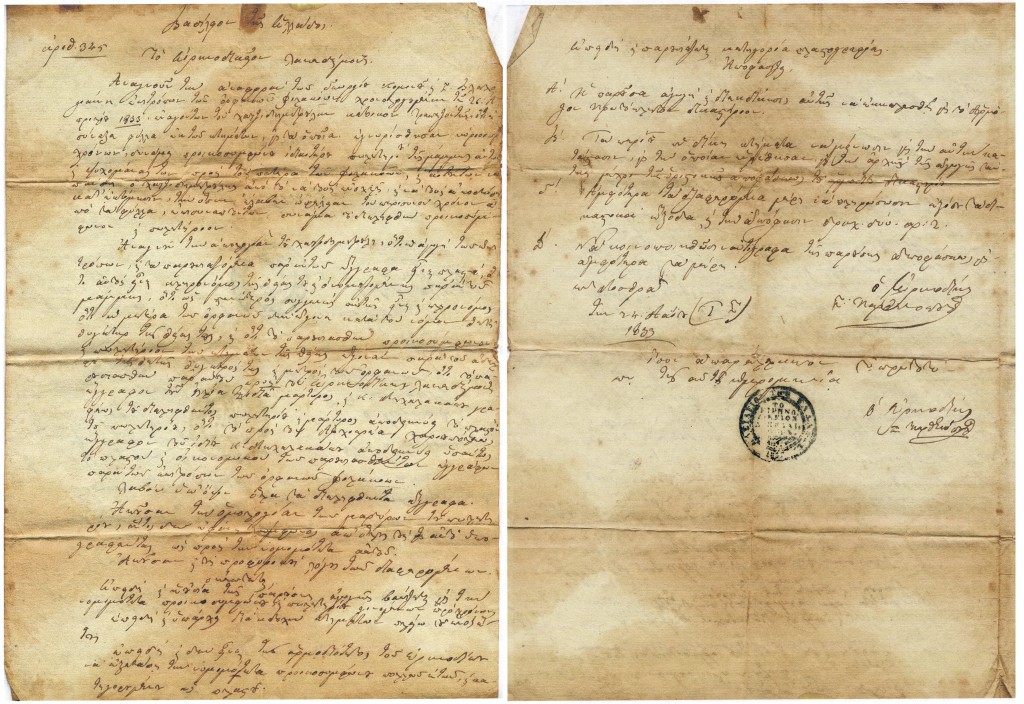
Many of the documents were in almost irreparable condition: torn, water stained, faded, moldy. As he sorted through them, George found a wallet. Folded inside was a disintegrated envelope inscribed with the words, OLD DOCUMENTS BEFORE 1819. He was astounded when he extracted yellowed, crinkled papers dated 1800, 1812, 1819 and 1833. And one dated 1741!
This document dated 27 December 1741 reveals the names of the four brothers– Theodorakis, Panagiotis, Stamatakis, and Kyriakos–who received an inheritance from their father and split up their fortune. They were from Manari and came to Toriza. This is the exact story George’s father described. It was not a myth; it was true.
ENGLISH TRANSLATION 1741 27 December Ntoriza (Doriza) Today we decided the four brothers, Panagiotis and Theodoris and Kyriakis and Stamatakis, that from today we have split the houses of our father and Kyriakis and Stamatakis took our father’s old house and Panagiotis and Theodoris took our father’s new house the two of them and truly split with my brother Panagioti that house and he gave me for my half, grosia twenty-one (ie 21) and so the aforementioned Panagiotis is the owner to do as he pleases and I, Theodoris will be a stranger and estranged, also to designate the bottom floors of the house just as the old house has so to the new house over here; where we split, all the brothers, down the middle. And for the certified truth we gave our word onto the signatures of these trusted witnesses. I, Mustafaspaïs (Mustafa-Sipahi was a feudal cavalryman), was present and witnessed it Giannis Papadakis witnessed everything above Liakos Arvanitakis witnessed it Giorgiakis Sgoupis witnessed it Anagnostes (Church reader) Sgoupis I was present and witnessed it Anagnostes (Church reader) of Gianni Sgoupis witnessed it (the writer of this document) Giorgiakis Sgoupis I was present and witnessed it Liakos Stathakis I was present and witnessed it
Above each image is a description of the documents from the early 1800’s:
1800 September – Lease agreement signed at Mystra for the Koumpari Monastery lands:
1812 December 22 – exhaustive dowry list of Georgina Stilimina for her adopted daughter/grandaughter, Maria:
1819 January 15 – An agreement between the villagers of Paleopanagia and the Turk-Albanians from Boliana in the mountains to direct water for irrigation purposes to the village:
1833 – A decree asking citizens to register their lands and how they came to own them from the newly formed government after independence:
“When I found these documents, I took the stories from the relatives and put them in order. There was so much information. Much of the writing we could not translate because it was in the old Greek language not used today,” George said. I asked if the 1741 document gave the surname of the four brothers. He explained, “They had no last name, so they were known as Anagnostos which means uneducated. Turks did not allow Christian or family names. During those times, people took names from prophets of the Bible, kings and queens, or ancient Greek heroes. And children went to the churches to learn Greek secretly.”
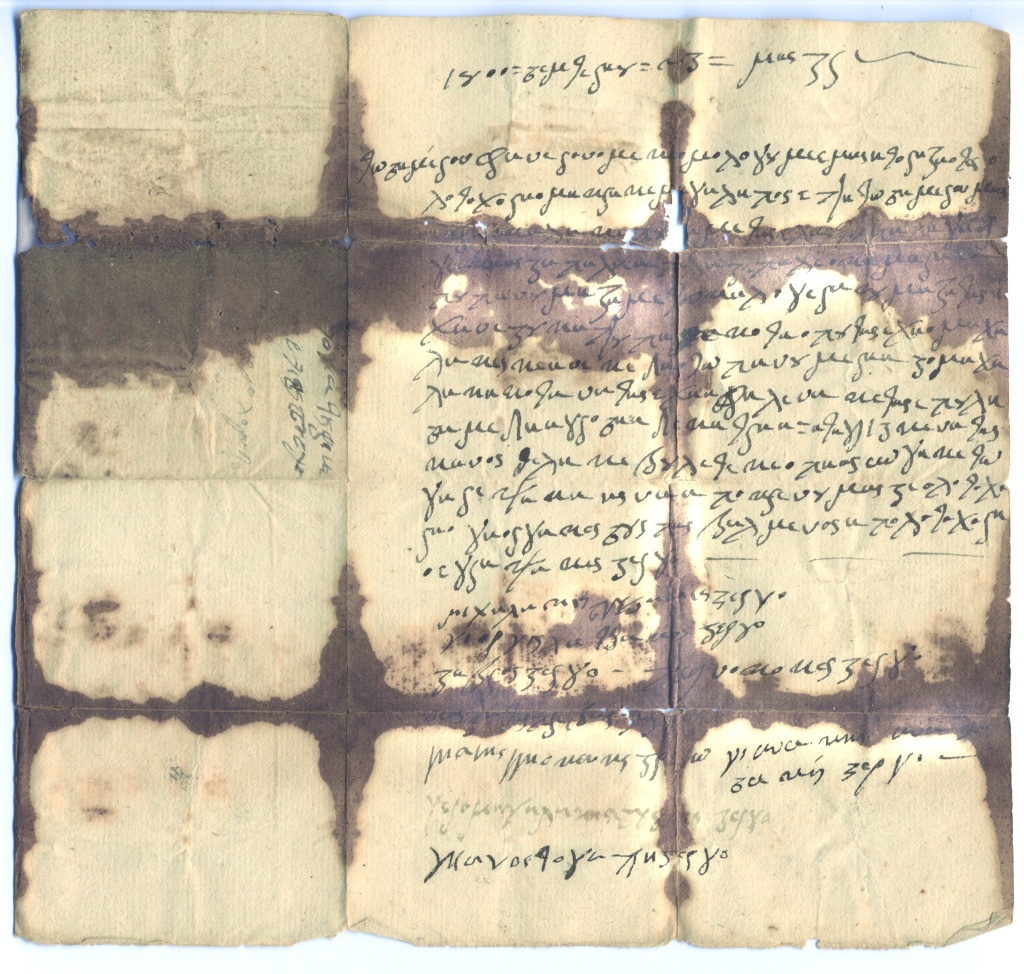
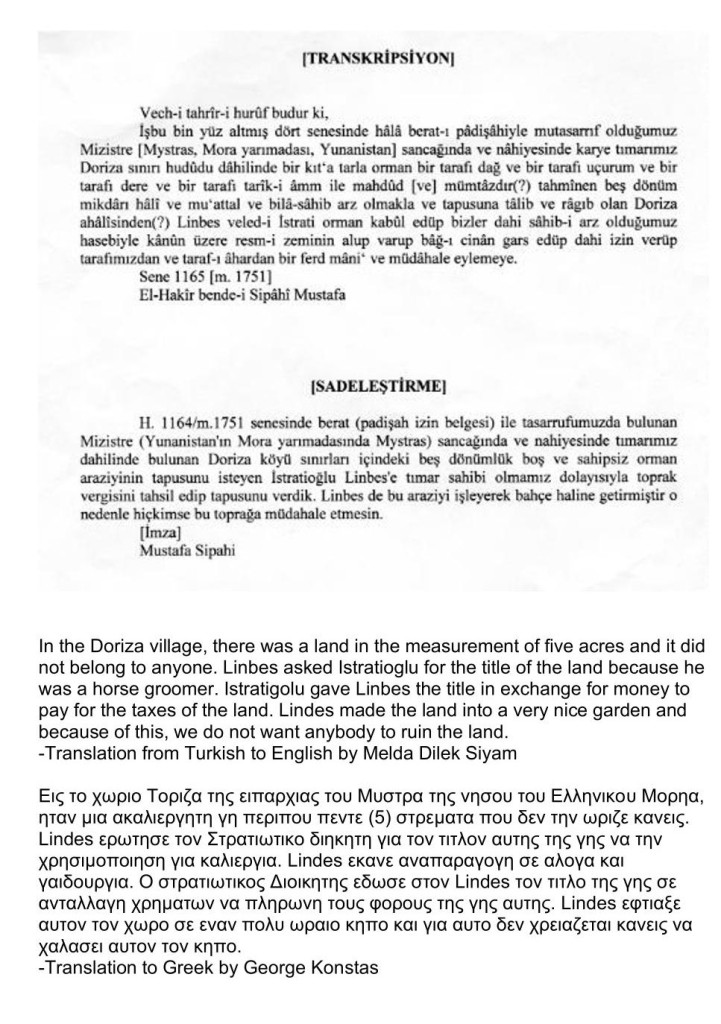
Also in the trunk was an amazing discovery—two documents, from 1751, written in Ottoman script!
First document and its translation:
Second document and its translation:
Translation of Ottoman script requires an expert. Although George had Turkish friends, they could not read the writing. In a unique coincidence, George knew of a man who worked as a translator for the Turkish government. George sent him the documents, and with great interest, the translator called George to ask how he had obtained them. After the documents were converted from Ottoman to modern Turkish, a teacher in Istanbul translated them from modern Turkish into English.
“Those documents and the true stories helped me to make the tree of my family,” George stated.
As he conducted further research in the areas of Paleopanagia and Xirokampi, George discovered the current day surnames of the four brothers:
Theodoros’ descendants: Laspitis from Riviotissa, Sparta
Stamatakis’ descendants: Nastakos from Paleopanagia
Kyriakos’ descendants: Kyriakakos from Xirokampi
Panagiotis’ descendants: Konstantarogiannis from Paleopanagia
George’s lifetime of work is now preserved in two books: The first is the history of the family from 1650-1821, and the second is from 1821 to present day. The books are written in his own handwriting, in Greek. With the help of his daughter, they will be translated into English. “I wrote these for my grandchildren, my daughters, and my family in the U.S. There are people we have not yet met, but they too will be able to learn the roots of the family,” George explained. Digital copies have already been sent to family members.
I had the privilege of meeting George on November 19 at St. Katherine’s Greek Orthodox Church in Falls Church, Virginia, where I was invited to give a presentation. He brought his books and we reviewed them, page by page. I was completely absorbed in learning of his stories and how he has preserved his family’s history. I remain both awed and thrilled with the meticulous and detailed work he has done. His work brings recognition and honor to his ancestors, especially to his parents, Pericles and Christophile, and his grandparents, Konstantinos and Amalia.
George understood the urgency in making sure the original documents were in a safe place where they would be accessible and preserved for future generations. I am so very pleased that he gave the originals and copies of his books to the Sparta office of the General State Archives of Greece. They are now safely stored and available for researchers to learn the origins of Konstantarogiannis and the other families descended from the four brothers, as well as to have access to rare documents from pre-independent Greece.
George’s passion is both infectious and inspiring. He helped me recognize that we have only a sliver of our ancestors’ stories, and that we must not give up the search. We never know what we will find, or where we will stumble upon new information that will help us understand those who came before us. Somewhere, there may be a trunk in your family.
I am deeply grateful to both George and his daughter, Christophile, for giving permission to publish this story. And especially, I give a huge thank you to George who drove two hours from his home to meet me that day at St. Katherine’s. Somehow, he just knew we needed to connect, and that his story needed to be shared!
by: Georgia Stryker Keilman and Carol Kostakos Petranek
Greeks, like most ethnic groups, engaged in “chain migration” upon leaving their homelands. A man or a family would follow others who left their village and settle near—or even with—them in their new country. By associating at church, work, or in Greek organizations, immigrant families would form tightly knit groups, celebrating namedays, holidays and other traditions together. An important component of these immigrant communities was to bring young couples together to form new families. Whether by formal matchmaking or simple introductions, it was ensured that the next generation was able to meet and marry compatriots.
Georgia Stryker Keilman’s immigrant grandmother, Georgia Bebetsos and her three brothers, Sam, James and Tom were all living at 355 Chicago Avenue (Source: 1920 Census). This address was located just outside of the old “Greek Delta” area of Chicago where thousands of Greek immigrants settled. While recently reviewing the record again Georgia realized that she knew of marriages between members of some of the families living in the buildings at 353 and 355 Chicago Avenue.
Families in 1920 census; color-coded to show intermarriages
Was there a previous connection between these families?
The families were from various villages in the Sparta area and one from the Arcadia Region.
Georgia noticed that the 1920 Census documented that all the men in these families were working in the restaurant business; 1 assistant manager of a restaurant, 4 waiters, and 1 cook.
Could that be the connection?
Georgia researched the World War I Draft Registration forms or Naturalization applications to identify where they worked in 1917.
Name
Home Address
Employer
George P. Dounias
?
Charles Pappas, 344 W. Chicago Ave
John Magoulias
344 W. Chicago Ave
n/a – assume same as above
James Bebetsos
744 W. Division St
Chas. Papas, 744 W. Division St
Thomas Bebetsos
2510 Blue Island Ave
Charles Pappas, 2510 Blue Island Ave
George Magoulias
161 Hill Street
Mitchell Bros, 316 W. Division St
Angelo Pleotis
859 Sedgwick Ct
Hotel Green Mills Garden, Broadway & Lawrence
Notice that the first 4 people shown in the chart are associated with an employer named Charles Pappas. Also, they list their residence as the same address as their employment. We are assuming that they lived in rooms above the restaurant.
For example, in the 1920 Census, Charles Pappas was living at 744 W. Division Street. His occupation was proprietor of a restaurant. He was living with his wife and son, two brothers who were working as waiters and two roomers who were working as a waiter and a dishwasher. It is most likely that the restaurant was on the ground floor with apartments above.
Also note that the 344 W. Chicago Avenue address referenced in the above chart is about 1 block from the apartments at 353 and 355 W. Chicago Avenue. If the men referenced in the 1920 Census at this address were working for Charles Pappas at the 344 W. Chicago Avenue address, they could have walked to work.
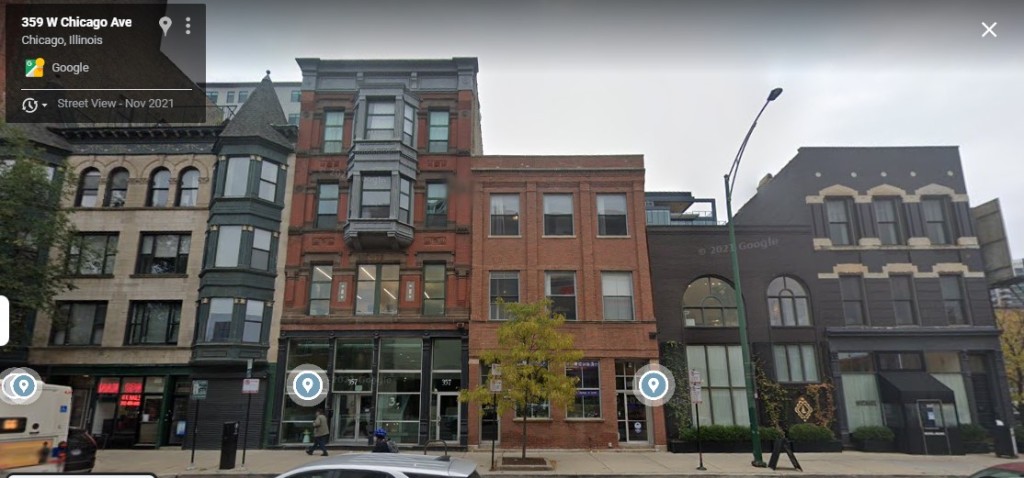
Although the 353-355 W. Chicago Ave. apartments were demolished, some buildings from that era are still standing across the street. Below is a photo which shows that many of the buildings in this area had a “store front” on the bottom floor and apartments above. The idea that the waiters, etc. could be living above the restaurant is a reasonable conclusion.
359 West Chicago Avenue, 2022 Google map
Naturally, questions arose: • How did these people from neighboring villages end up in the same building? • What are the connections? Or, who instigated the connections? • The men who lived in the same buildings worked in restaurants. How did they know each other? What was Charles Pappas’ connection to them? • How did these couples, living in the same building, become introduced and get married? • How did so many apartments become available at the same time to provide housing for all these people?
We can hypothesize answers based on our understanding of the Greek immigrant community: chain migration; connections through the church and associations; matchmaking; business owners hiring fellow compatriots. But the details, which add to the richness of the human story, remain unknown. How important it is to get our family stories documented by those who know the specific facts!
In our 21st century society, it may seem like an anomaly to have this level of intertwining among unrelated people. But as we study the village records of our families, it is readily apparent that such connections were not only common, but were the very fabric of village life. Our ancestors were simply duplicating these intricate, woven relationships in their new lands.











 Spartan Roots (Σπαρτιατικές Ρίζες)