The Zaharakis / Zacharakis Families of Theologos, Oinountos, Laconia

The family of my great-grandmother, Stathoula Zaharakis, has been an elusive mystery to me. Her photo, which is on my desk, reminds me daily to think of her as well as all those who came before me.

Stathoula Zaharaki Eftaxias

Stathoula Zaharaki Eftaxias

Her face haunts me at times. How did she feel as she sent all three of her daughters to the U.S. so they could marry and have a better life? She had no sons; who took care of her as she aged? My mother said that she died as she was preparing to come to the U.S. to visit her daughters and their families in the mid-1950’s. How heartbreaking!

When Gregory Kontos and I were at the Greek Orthodox Mitropolis in Sparta in 2014, he found the marriage record for Stathoula and Konstandinos Ioannis Eftaxias.

Marriage Record, Konstandinos Ioannis Eftaxias and Stathoula Zaharaki, February 16, 1891, line 68. Translation of Marriage Record received from the Holy Diocese of Monemvasias & Spartis Certifies that: As it appears on the books of Marriages of the Office of the Holy Diocese Monemvasias & Spartis a licence -number 68 - was issued on 16 February 1891, for Konstantinos Eutaxiarhis, resident of Mystra - of the former municipality Spartis in second marriage, and for Stathoula Zaharaki daughter of Dimitrios, resident of Theologos -of the former municipality Sellasias in first marriage. The holy matrimony was officiated by the local priest S. Dimitrakopoulou.

Marriage Record, Konstandinos Ioannis Eftaxias and Stathoula Zaharaki, February 16, 1891, line 68. Received from the Holy Diocese of Monemvasias & Spartis.
Certifies that:
As it appears on the books of Marriages of the Office of the Holy Diocese Monemvasias & Spartis a licence -number 68 – was issued on 16 February 1891, for Konstantinos Eftaxias, resident of Mystra – of the former municipality Spartis in second marriage, and for Stathoula Zaharaki daughter of Dimitrios, resident of Theologos -of the former municipality Sellasias in first marriage. The holy matrimony was officiated by the local priest S. Dimitrakopoulou.

From this marriage record, I learned that Stathoula’s father was Dimitrios. I knew that the family lived in Theologos, Oinountos – just north of Sparta.

At the office of the General Archives of Greece in Sparta, Gregory and I digitized pages from the Dimotologion Koinothtos (Town Register) of Theologos which listed the Zaharakis families. I can’t believe that I overlooked the Male Register – a critical component to understand father/son relationships! Until I return to the Archives next summer, I have only the Dimotologia, Election Lists of 1872 & 1844, and information sent by family members to organize the structure of the Zaharakis family prior to 1940. I know the Male Registers will eventually provide missing information.
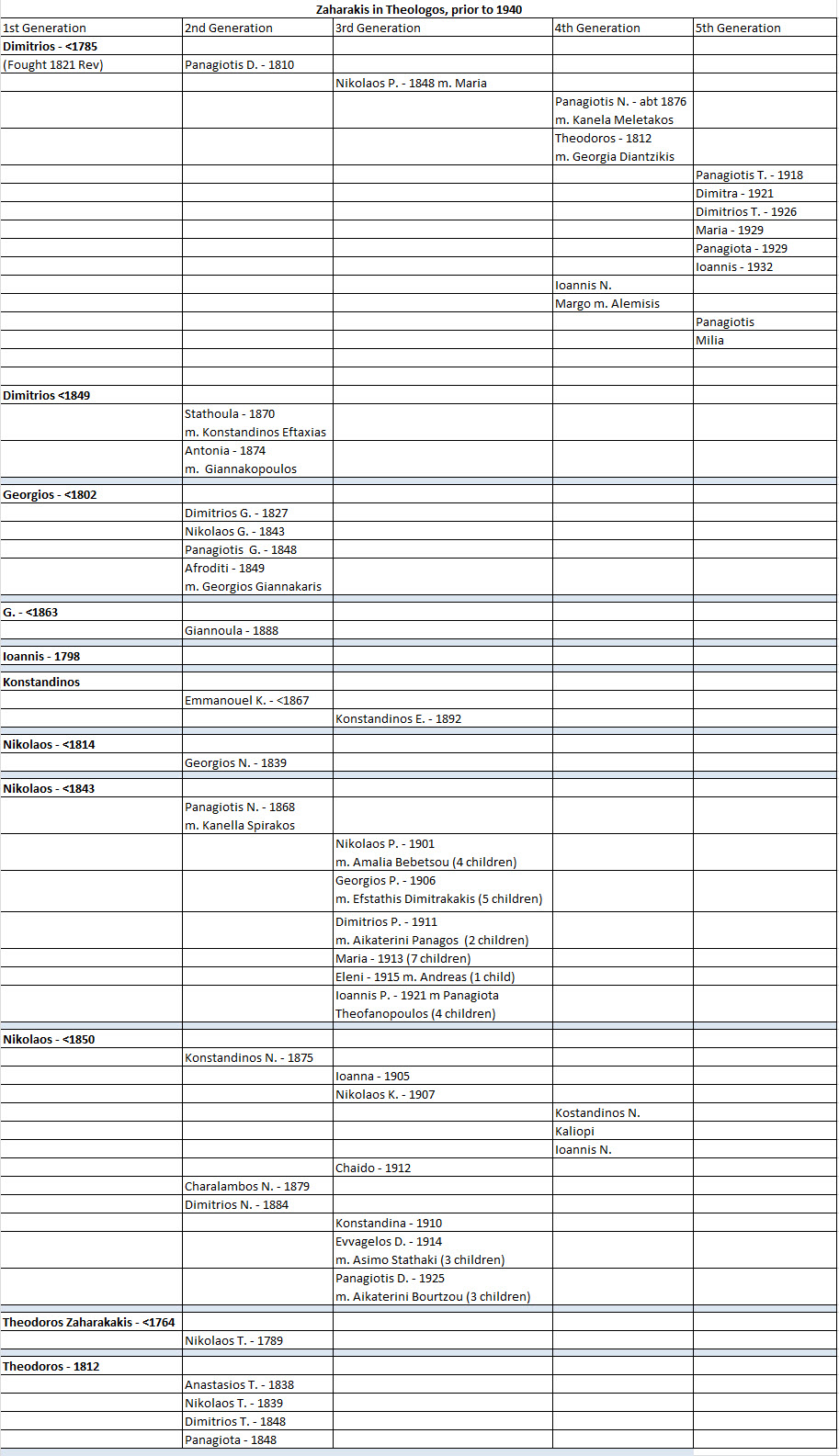
Zaharakis Families in Theologos, Pre-1940

Zaharakis Families in Theologos, Pre-1940. < symbolizes “before”

As I worked through the various resources, I learned an important detail about the 1844 Election Lists: there is an index at the beginning of each municipality. In the image below, notice two columns of numbers to the left of each name. The first number is the line number in the index; the second number is the line in the record itself. In this image on line 272 (right column, 3rd down) is Ioannis Zaharakis or Zaharakakis; the number 236 indicates the line in the record where his registration is recorded. (see next image)
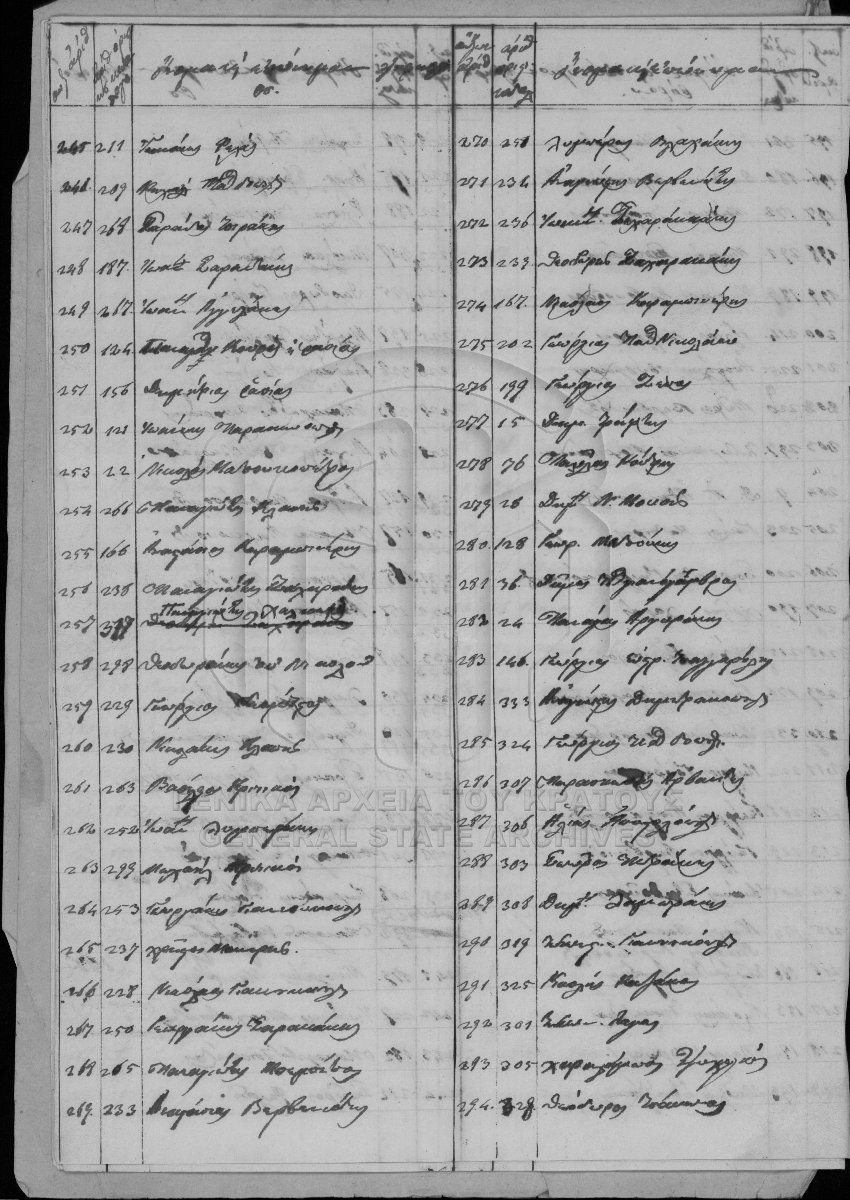
1844 Election Lists, Laconia, File 22, image 1209 Index

1844 Election Lists, Laconia, File 22, image 1209, Theologos. Index.

This is an image of the voter registration page. Ioannis is found on line 236, which reads: Ioannis Zaharakis, age 46, farmer.
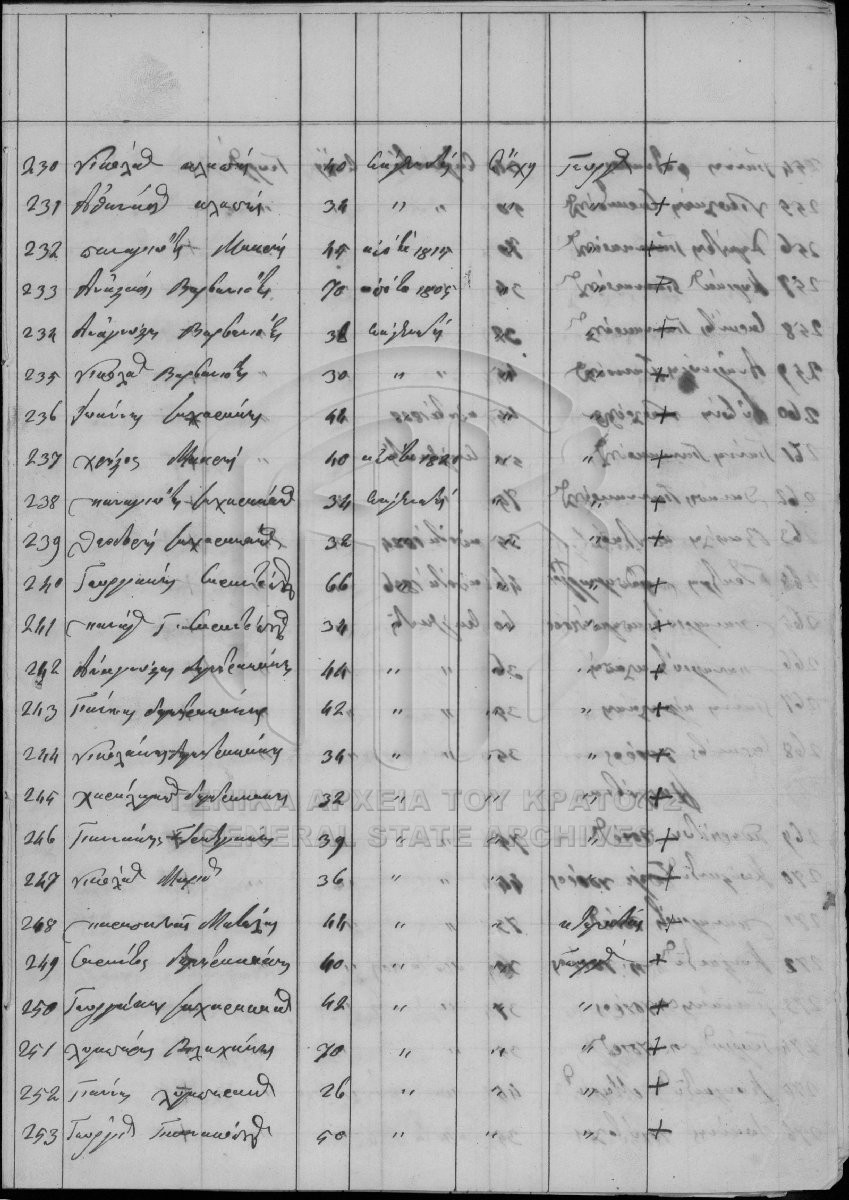
1844 Election Lists Laconia, File 22, Image 1222 Theologos.

1844 Election Lists Laconia, File 22, Image 1222 Theologos.

Also found on both of these pages are:
Index line 256/Record line 238 – Panagiotis Zaharakakis, age 34, farmer
Index line 273/Record line 239 – Theodoros Zaharakakis, age 32, farmer
Index line 267/Record line 250 – Georgios Zaharakis, age 42, farmer

Big important note: Thank you, Gregory Kontos, for finding these names for me. You have my undying gratitude forever! I can read records that are typewritten, but the handwritten ones are Greek to me.

I will update this post after my next trip to the Archives in Sparta in July 2016. This time I’ll have the Male Registers and I will be able to further corroborate and correct what I have documented.

If anyone has information that can shed further light on these families, or give a better translation of the handwritten Greek, I would be most grateful!

Now I can put this aside to enjoy the holidays. Merry Christmas!


1890 Linguistic Map of the Peloponnese

A recent discussion on the Facebook page, HellenicGenealogyGeek, centered around the various ethnic groups that populated the Peloponnese in the late 1800’s. My friend and historian, Giannis Michalakakos, posted this map which shows the areas where various languages and dialects were spoken.

1890 Linguistic Map of the Peloponnese

1890 Linguistic Map of the Peloponnese by Alfred Philippson

In a subsequent telephone conversation, Giannis told me many interesting facts. Alfred Philippson was a German geologist who took yearly journeys through various areas of Greece and Asia Minor to study geology. His maps provided valuable information not readily found during that time frame. In the Peloponnese, he visited many ancient sites such as Olympia and Mistras. More information about Philippson can be found on Wikipedia here.

Giannis explained the various colors on the map:
–  Purple:  Greek language
– Blue:  Tsakonian dialect, one of the oldest in Greece (more here)
– Rose:  Arvanitika, spoken by people of northern Epirus and Albania who migrated and settled in several areas, most notably around Corinth. This language is a mixture of Albanian and Greek. Those who speak this language call themselves Greek Arvanites  to distinguish themselves as Greek rather than Albanian (more here).
– Darker Rose:  Mixed Greek and Arvanitika.
– Pale Rose: Also Greek and Arvanitika.
– Yellow lines:   denote areas where the Slavic population existed during the years 800-1200.

This map intrigued me for several reasons. First, it is a visual depiction of the major ethnicities populating this area after the Revolution of 1821. Second, it helps me understand the various dialects which continue to exist to this day, particularly in the less-accessible mountainous regions.

But the third reason is the most profound one for me, personally. I have taken DNA tests which show my ethnicity to be:
68% Italy/Greece
20% Caucasus
9% Eastern Europe
2% Western Europe
less than 1% Jewish

Ethnicity map

Science doesn’t lie! I am a mixture of many ethnicities. What Philippson’s map reveals is just because I am a mix, that does not mean that my ancestors came from all of these various countries. Some or all of them could have lived in the Peloponnese for many generations, yet intermarried with people from other cultures.

It is an eye-opening and fascinating perspective of who they were; and consequently, who I am.

I express my deepest appreciation to Giannis for his patience in teaching me and expanding my horizon of knowledge. In his blog, Maniatika, Giannis posted Philippson’s map and included an in-depth description of it written by Elli Skopeteas. That Maniatika article can be found here.

Collecting Cousins

On November 7, I went to Orlando, Florida to teach 4 classes at the Central Florida Genealogy Conference. Although my classes were well attended, the one on “Researching Your Greek Ancestry” attracted two people. Nevertheless, I was happy to be able to give them individualized help in the areas they need to research.

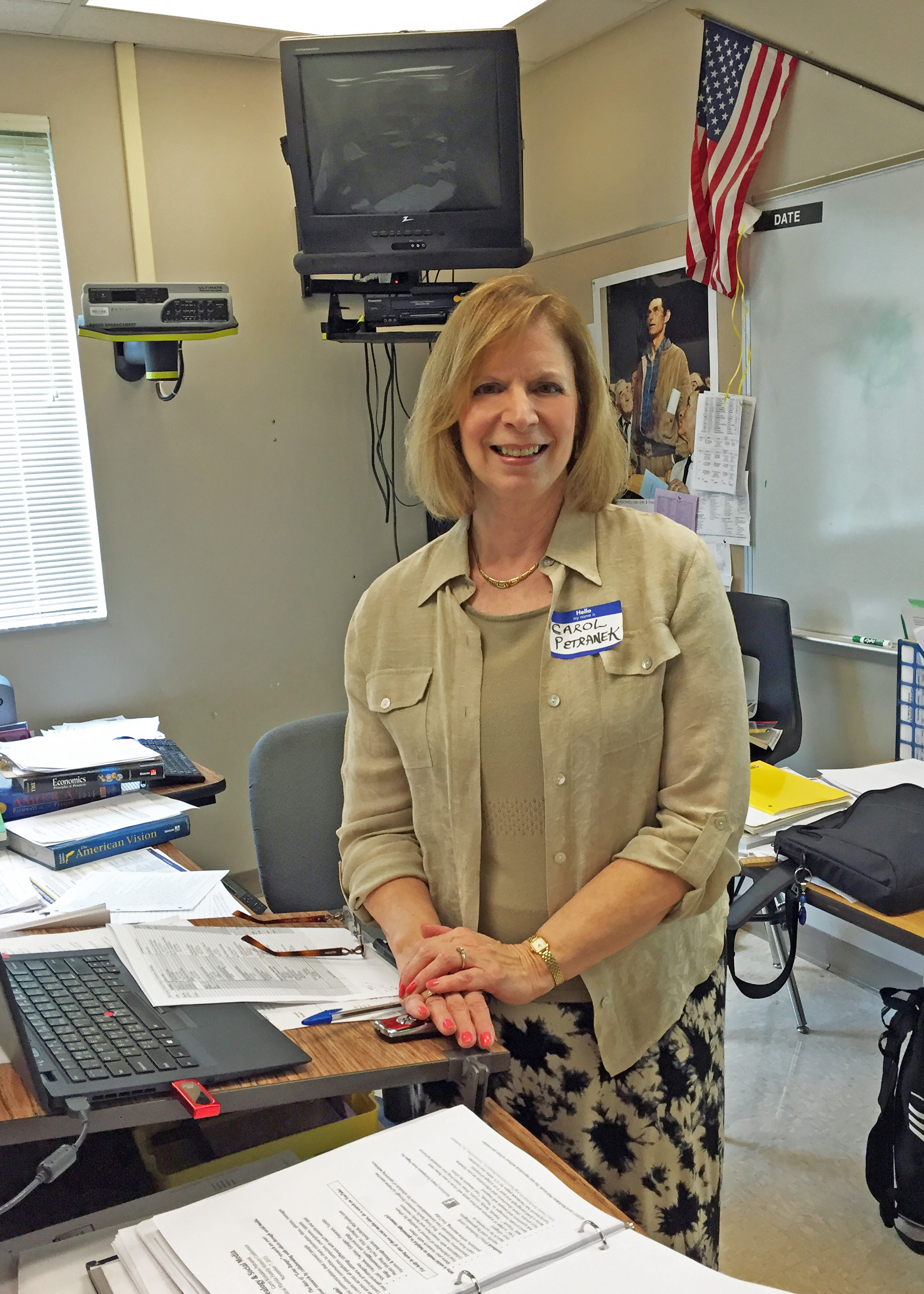
Carol Petranek, teaching at the Central Florida Genealogy Conference

Carol Petranek, teaching at the Central Florida Genealogy Conference

While in Florida, I took full advantage of connecting with new cousins. On Friday evening, I met Maria Lambrakos Skordilis and her son, Peter, for dinner in Ybor City (downtown Tampa). Peter, Sophia and I are DNA cousins, and according to GEDmatch Peter and I are about 4.6 generations from our “most recent common ancestor” (MCRA); Sophia and I are 4.8.

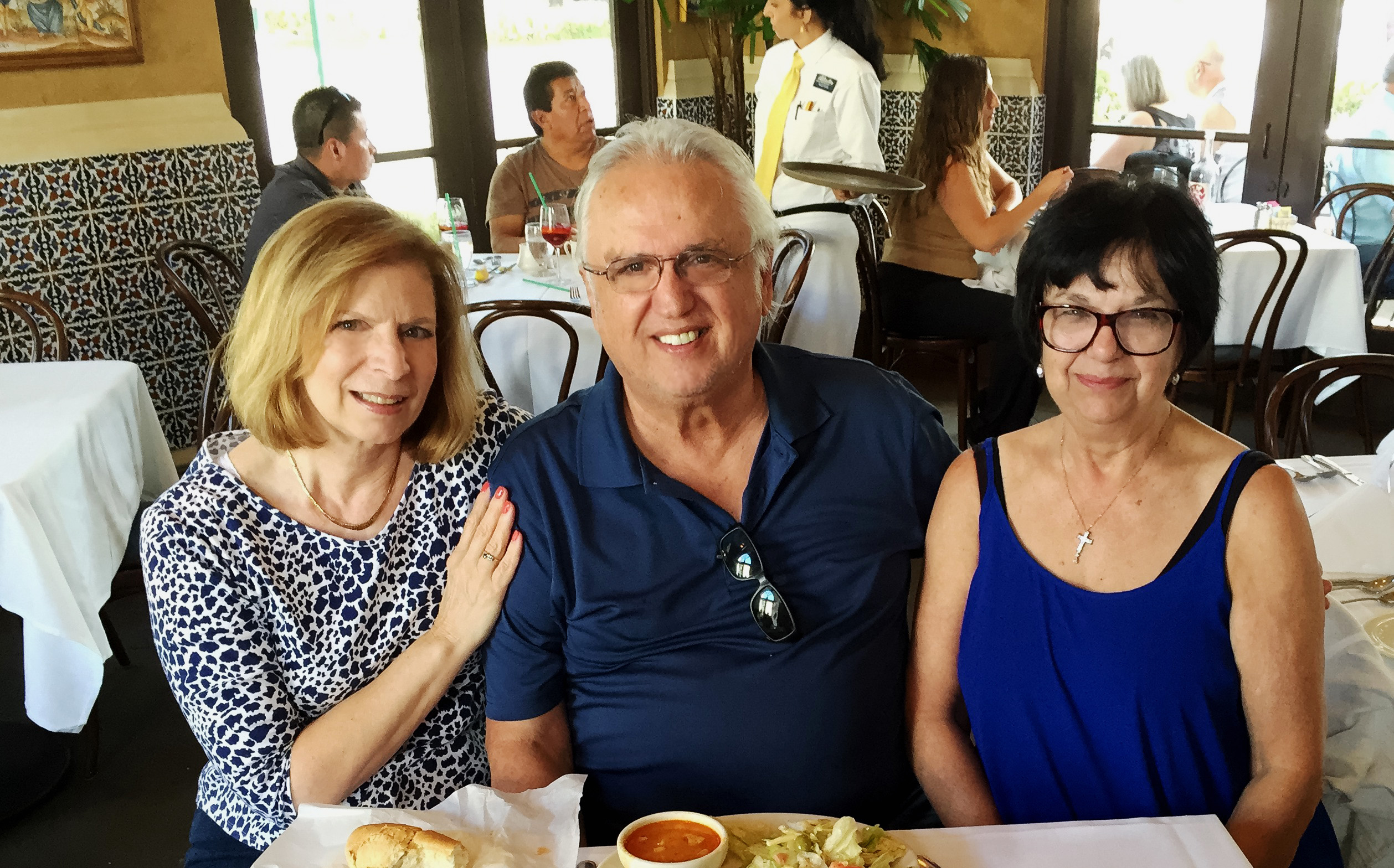
Sophia Skordilis, her son, Peter and Carol Petranek. Tampa, Florida, November 2015

Sophia Skordilis, her son, Peter and Carol Petranek. Tampa, Florida, November 2015

We share Brooklyn, New York roots: Peter and I were both baptized at St. Constantine & Helen Church, which is also where Sophia was married. We recognized many Greek Brooklynite names, but as hard as we tried, we couldn’t determine our common ancestor. Sophia’s pedigree includes the surnames Lambrakos, Papastratis, Stratakos, Lambrianakos and Doukas. These families are from Gorani, about  6 miles south or a 1/2 hour drive from Sparta and Agios Ioannis. I’m thinking that Sophia and I are related through my maternal line, as she looks as if she could be a twin to one of my cousins. Even our waitress commented that there is a strong resemblance between us!

Agios Ioannis, Sparta to Gorani

Agios Ioannis, Sparta to Gorani

On Saturday evening after the conference, I visited with George Topalidis whom I had met at our Hellenic Genealogy Conference in Salt Lake City on September 26. We were discussing plans for a similar conference in Tarpon Springs, Florida next fall.

George and Eva Capous Topalidis, Carol Petranek; Orlando, Florida, November 2015

George and Eva Capous Topalidis, Carol Petranek; Orlando, Florida, November 2015

Was I ever surprised to learn that George’s wife, Eva, and I also share Brooklyn connections! Her family is from Anavriti, the village next to Agios Ioannis (honestly, I think everyone in Brooklyn has ties to Anavriti!) Her father’s family is Capous; her mother’s line is Chrisomalis. We started comparing notes and I learned that her Chrisomalis family married into my grandmother Aridas’ family, and that she is thus a cousin to one of my 2nd cousins. Huh? What are the chances???

On Sunday morning, I had brunch with my 2nd cousin, Jim Stavracos and his lovely wife, Maria. This was the first time we met. Jim’s grandmother, Antonia Kostakos Stavracos, is the sister of my paternal grandfather, John Andrew Kostakos. Of course, Jim and I are Brooklyn-born although both of us left the city as young children. He grew up in Baltimore and I grew up in New Jersey, then Maryland.

Carol Petranek, Jim and Maria Stavracos. Orlando, Florida; November 2015

Carol Petranek, Jim and Maria Stavracos. Orlando, Florida; November 2015

I had found Antonia’s death certificate and her husband, Peter’s naturalization records which I brought to Jim. He filled me in on many family stories and shared photographs. He said he has a photo of Antonia holding a shotgun, standing in front of the family home in Greece. I sure hope he can find that one!

I am so excited to meet these new family members and look forward to collecting more cousins!

On another note…last Monday evening, I gave a presentation at the Carroll County, Maryland Genealogy Society and met a woman named Antigoni Lefteris (Eleftheriou) Ladd. Her family is from Trikala, a city in north central Greece. They emigrated and settled in the town of Westminister in western Maryland.

Antigoni Leftheris Ladd, Carol Petranek; Westminster, Maryland; November 2015. Antigoni is the editor of The Greek Families of Westminster, Maryland.

Antigoni Leftheris Ladd, Carol Petranek; Westminster, Maryland; November 2015. Antigoni is the editor of The Greek Families of Westminster, Maryland.

In April 2013, Antigoni became involved in an initiative begun by Westminster’s physician, Dr. Dean Griffin, to collect and preserve the stories of local Greek families. From these first-person narratives, photos and news articles, a community history evolved and is now preserved in the fascinating book, Honoring Our Heritage, The Greek Families of Westminster, Maryland. The following families comprise the heart of the book: Amprazes, Sirinakis, Haralampoulos, Koretos, Bourexis, Lefteris, Letras, Nickolas (Nikolaou), Pappas (Batayiannis), Samios, Sharkey (Chakou).

Antigoni became the editor of this project, and it was her persistence and dedicated effort that culminated its publication in August 2015. I love this book! It is so inspiring and heartwarming to see the stories of these Greek families memorialized and preserved for the generations to come.

More of us need to follow Antigoni’s example. With each generation, we slip further away from our immigrant ancestors. Their stories will be lost to future generations if we don’t write what we know and collect what we can find. That is a tragedy which we can prevent — but only if we choose to act.


Reading a Town Register and a Male Register

My friend and Greek genealogist, Gregory Kontos, prepared some excellent handouts for the Hellenic Genealogy Conference in Salt Lake City on September 26, 2015.

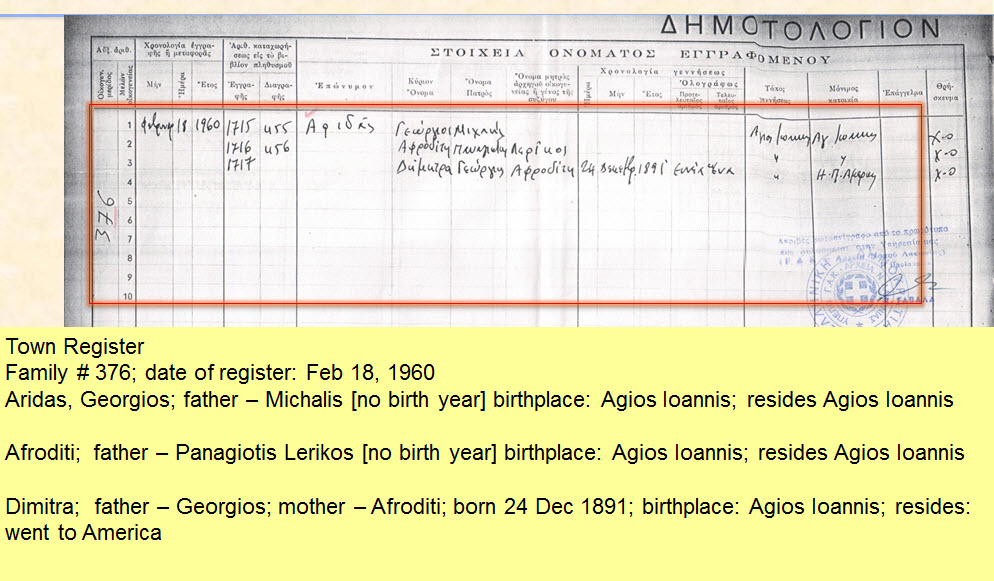
This is a sample of a Dimotologion Koinothtos, or Town Register. It is similar to a U.S. census record as it lists the families in the villages, with parents and children’s names, birthdates, birth places, and other relevant information. These records were created in the 1900’s. The oldest families will have parents born in the late 1800’s, with their children born in the early-mid 1900’s. To my knowledge, there is no such record collection dated earlier than this timeframe, which is unfortunate as we cannot go back to find a father or a mother in this record, when he/she is listed as a child in their parents’ family.

This is page 1 of 2.

Dimotologion 1st page description

Here is an example of the 1st page of the Dimotologion, with an entry translated into English.

Dimotologion extracted 1st page

This is page 2 of a Dimotologion. It gives additional information about each person in the family.

Dimotologion 2nd page description

This is a Mitroon Arrenon, or Male Register. It is a record of every male born in a village. It was kept by the government for military draft purposes, and is considered an official register of birth.

Mitroon Arrenon 1st page description

These two record sets are the backbone of genealogy research in Greece. The regional offices of the General State Archives of Greece (GAK) have books with these record collections for the villages over which they have jurisdiction.

A list of the Regional  GAK offices can be found here: http://www.gak.gr/Cont/cont-py-00.html. The page can be translated into English using Google translate. If you write for information, include whatever you know about the family you are searching. It is especially important to know the spelling of the original surname in Greek (e.g., Papagiannakos, not just Pappas). You must also know the exact village and its location because there are many villages with the same name (e.g., not just Agios Ioannis, but Agios Ioannis Sparta).

2nd Hellenic Genealogy Conference, September 26, 2015, Salt Lake City, Utah

Holy Trinity Cathedrals were the sites of the first and second Hellenic Genealogy Conferences held in the United States:  the first in New York City on April 25, 2015; the second in Salt Lake City on September 26, 2015. I am thrilled to have these opportunities to meet new friends and to be part of a team that teaches the intricacies and nuances of Greek genealogy research. Seventy-four people attended our Salt Lake Conference; some traveling from Florida, California, Oregon, Washington and Canada.

Holy Trinity Cathedral

Father Matthew was delighted to host our Conference and we discussed the importance of families and how genealogy bridges generations, unites families and strengthens children. He stayed with us for the first hour and opened our conference with a beautiful prayer.

Our conference was sponsored by:the Hellenic Cultural Association of Salt Lake CityHellenicGenealogyGeek, and the Ethnic and Mining Museum of Magna, Utah.

Conference organizers were: Dawna Stevens, Georgia Stryker Keilman, and me.

Georgia Stryker Keilman - Dawna Stevens - Carol Petranek Sept 26 2015 SLC Utah

l-r: Georgia Stryker Keilman – Dawna Stevens – Carol Petranek

Conference Agenda

9:00 – 9:15 Welcome: Hellenic Cultural Association

9:15 – 9:45 Keynote Speaker: Dr. Lica Catsakis
Topic: The Evolution of Hellenic Genealogy: Then and Now
Dr. Catsakis, the “pioneer” of Hellenic Genealogy research, will explore the changes in Greek genealogy over the past 30 years. As the author of several Greek genealogy manuals, the Greek specialist at the Family History Library, and former President of SIPEO, she has been in the unique position of observing and guiding this growing movement.

9:45 – 10:15 Georgia Stryker Keilman
Topic: How US Records Can Help You Prepare for Research in Greece
Learn which documents provide pertinent information for Greek research, including Passenger Lists, Social Security Applications, Death Certificates, Obituaries and others.

10:25 – 10:55 Gregory Kontos (via Skype)
Topic: Research in Greece: Using Civil and Church Records
This presentation will cover Civil Records found in Town Halls, records at the General Archives of Greece (GAK) and Church records. Learn about each record collection, what they contain and how to access them. A 10-minute question and answer period will follow.

11:15 – 11:35 Marina Harami (via Skype)
Topic: Resources for Research in Greece: Libraries, Websites, Books, Newspapers
Featuring online and print resources for research in Greece. A 10-minute question and answer period will follow.

12:30 – 1:00 Dr. Lica Catsakis
Topic: Resources for Greek Research at the Family History Library
FamilySearch.org and the Family History Library have Greek microfilms, books, maps, newspapers and additional information not found in other U.S. repositories. Dr. Catsakis has been a long-time volunteer and consultant to the Family History Library, and she will teach which records are available and how to access them.

1:00 – 1:20 Dr. Margarita Dounia (via Skype)
Topic: Why Did They Leave? Greek Emigration in the 1900’s
This presentation will describe the political and economic conditions that influenced the wave of emigration from Greece in the early 1900’s.

1:30 – 1:50 Giannis Michalakakos (via Skype)
Topic: The Revolution of 1821 and Its Impact on Your Ancestors (1821-1900)
After 1821, our ancestors’ lives changed dramatically. This lecture will describe how the the changes in economic conditions, migration patterns, occupations and other matters influenced our ancestral families, and how this impacts your research. A 10-minute question and answer period will follow.

2:00 – 2:30 Dr. Lica Catsakis
Topic: Geographic and Administrative Boundary Changes in Greece
Learn how to find and access records that have been affected by the many geographic and administrative changes in Greece.

2:45 – 3:05 Bob Curtis
Topic: “Using Community Trees to Track Descendants of Greek Immigrants in the U.S.”
“Community trees” are particularly effective for Greek genealogy due to the common practice of Greeks marrying other Greeks in the community. The “Greeks in the Western U.S. Community Tree” was created to link descendants of the 5000 Greek immigrants who came to Utah and surrounding states in the early 1900’s to work in the mines and railroads, and currently includes 9700 descendants. This presentation will describe objectives, methods and contents of the “Greeks in the Western U.S. Community Tree.”

3:05 – 3:20 Dawna Stevens / Carol Kostakos Petranek
Topic: Making Connections: Facebook and Blogs
Greeks around the world are using today’s media to share information, find new cousins, and help each other. This presentation will be an overview of connecting through Facebook and how to create a blog.

3:20 – 3:40 Carol Kostakos Petranek
Topic: Planning a Research Trip to Greece
A trip to Greece is an exciting adventure, and becomes even more meaningful when combined with a research goal. Learn what you need to prepare: items to bring; whom to contact; trip strategies.

3:50 – 5:00 Angie Bush
Topic: DNA as a Tool for Greek Research
This session will provide an overview of DNA tests, surname projects and tips on using DNA to connect with living family members.

Conference handouts and YouTube videos can be accessed at:
https://hellenicgenealogyconference.wordpress.com/hand-outs

Lica Catsakis and Bob Curtis Sept 26 2015

Presenters: Dr. Lica Catsakis and Bob Curtis

Audience 2

Our 3rd conference will be held in Chicago next Spring. The interest and enthusiasm among Greek people to trace their roots and preserve their heritage is exploding. I feel honored to be a part of this exciting movement and anticipate that it will continue to grow exponentially.