The new road from Athens to Sparta

During my first visit to Sparta years ago, the main road from Athens to Sparta was winding and narrow, making the trip long (over 4 hours) but picturesque as I drove over the Corinth Canal and through the many villages.

In 2014, a new road extended from Athens to Tripoli. It bypassed Corinth and the villages to Tripoli. It was a breeze to drive the smoothly paved, new superhighway; however, I had to exit onto local roads to continue from Tripoli to Sparta.

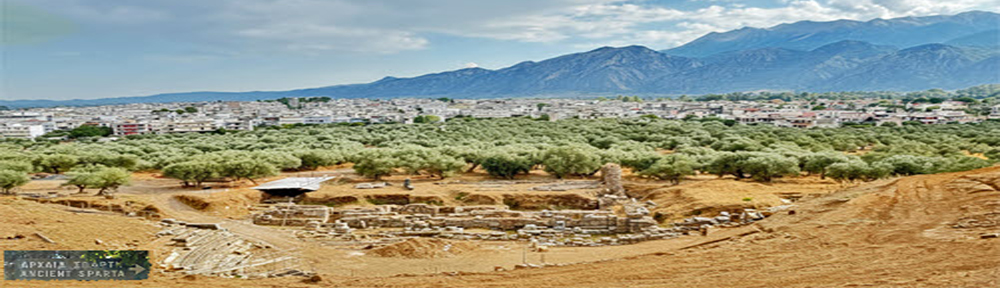
Now, the new highway is competed, cutting the travel time down to 2-1/2 hours. Today (April 8, 2016), Eleftharia online posted a video of the new road with this brief description (google translated):  Within the next ten days awaiting delivery motorway Lefktro – Sparta (A71), which will reduce the distance of laconic capital from Kalamata, Tripoli and Athens. The Eleftheriaonline.gr visited the motorway and publish shots of the new road, the statue of Leonidas, the municipal stadium, but also a panoramic view of Sparta …

Finished just in time for my next visit! I loved seeing the new road I will soon be traversing. Enjoy the view with me!


My Third Cousins, The Revelos Family of Middletown, Ohio

Several years ago, a Greek research friend put me in touch with George Nicholas Revelos whose mother, Effrosyni, was a Michalakakos/Aridas from Agios Ioannis (St. Johns, Sparta). Although we never met in person, we became great friends as we wove together the various threads of our extended families. George and I are third cousins. Our common ancestor is Michail Aridas and his wife, Stamatina, who were born in the early 1800’s in Agios Ioannis. We descend from two of Michail’s sons — George is from Christos, and I am from Georgios.

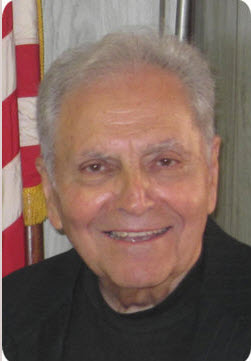
George N. Revelos, undated.

George N. Revelos, undated.

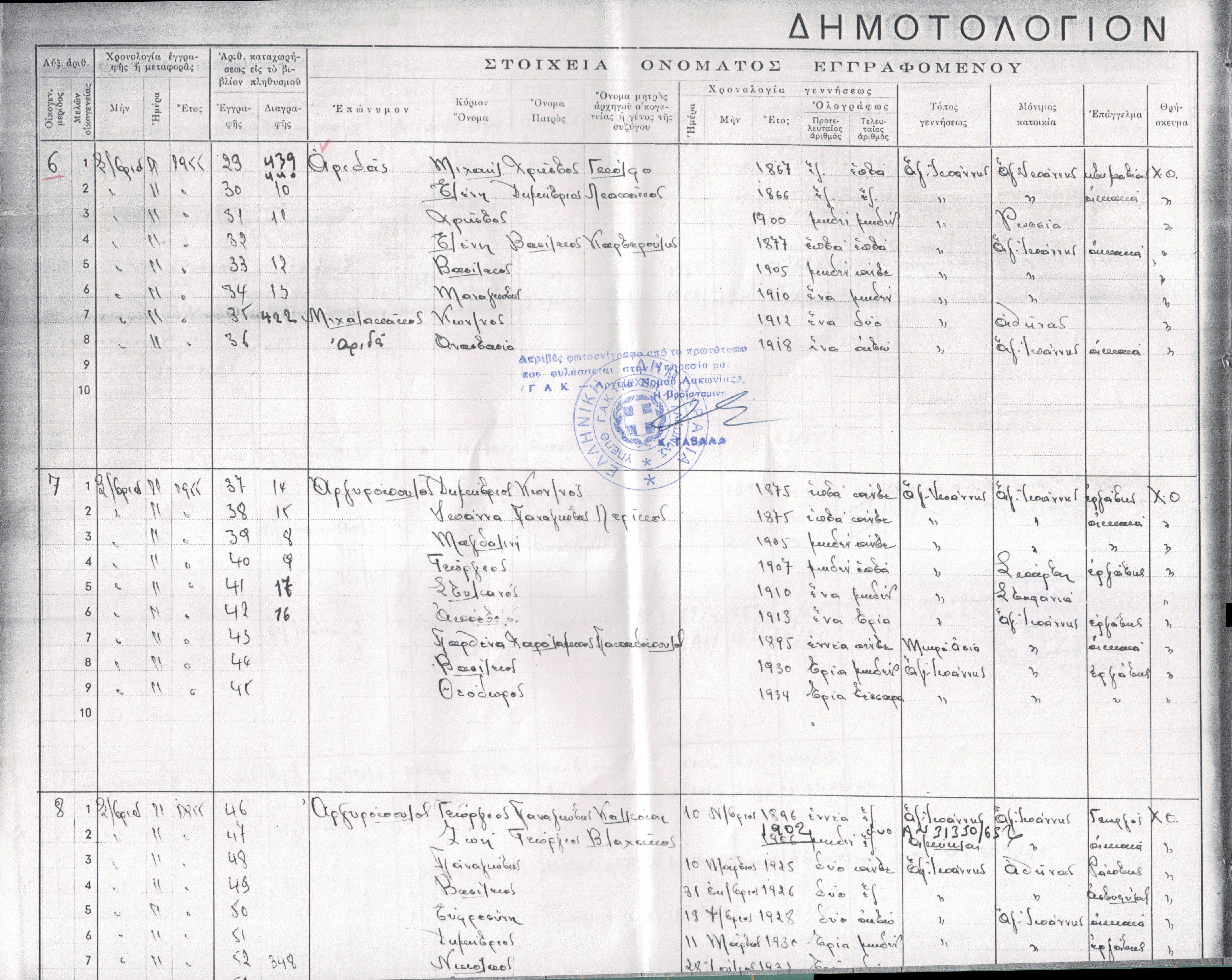
During my first trip to Sparta some years back, an archivist told me that Aridas was a very unusual name and not native to Laconia. That got me thinking (dangerous!) how the name came to be. When I received a Town Register for the Aridas family from the Archives in Sparta, I saw the name “Konstandinos Michalakakos” listed with the family. (see first family listed)

Dimotologion (Town Register) family of Michail and Eleni Aridas with Konstandinos Michalakakos; General Archives of Sparta

Dimotologion (Town Register) family of Michail Christos and Eleni Leakakos Aridas with Konstandinos Michalakakos; General Archives of Sparta

Thanks to George, I learned the origins of the Aridas name, which was Michalakakos. In an email dated 2009, George related, ” My uncle wrote my mother back in the late 1940’s that he had uncovered the real name for Aridas as Mihalakakos.  He said that one of the ancestors had long legs which is what Aridas translates to from arida (leg). It was a nickname (παρατσουκλι) that stuck.  So, there for a while we were saying that mom was a Mihalakakos.  It didn’t take long for that to disappear.”

George related many interesting stories about his family. His grandfather, Nicholas George Revelos, immigrated from Kosma in 1906 and with his brothers, opened a confectionery store in Middletown.

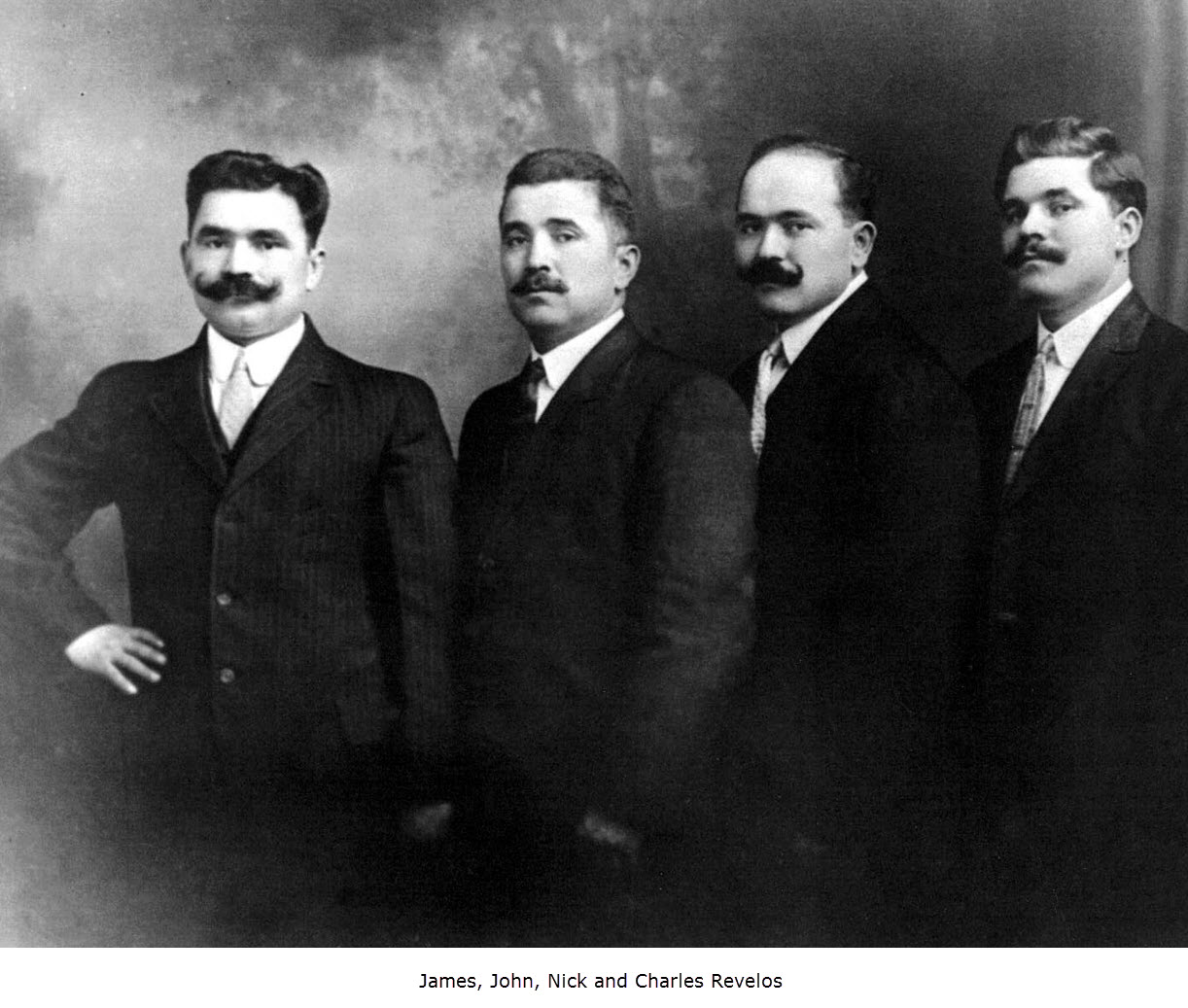
James, John, Nick, Charles Revelos, undated.

James, John, Nick, Charles Revelos, undated. Source: Greek Ancestry in Middletown, Ohio.

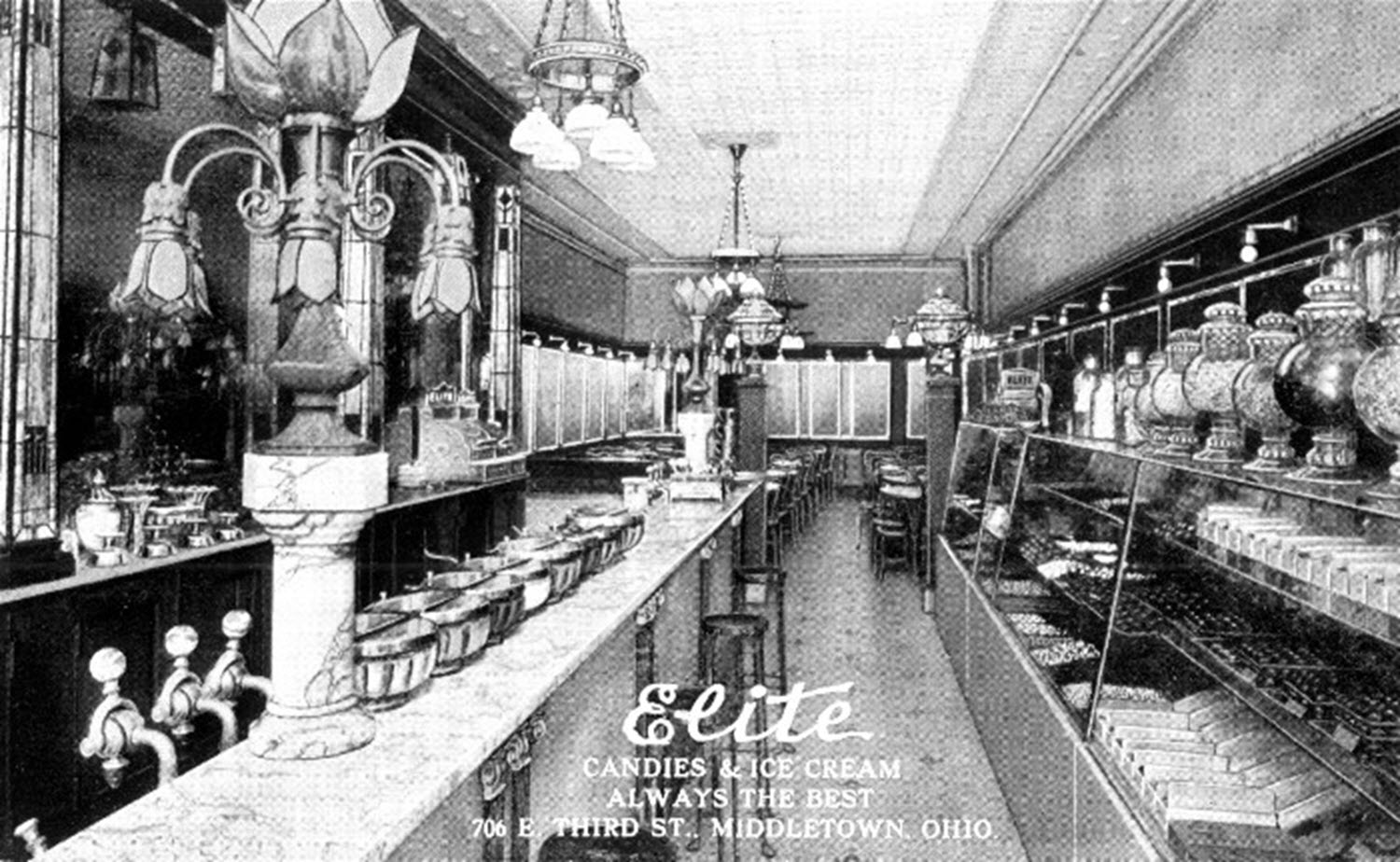
The store, Elite Ice Cream and Candy Company, was a huge success and one of the cornerstone businesses of Middletown. Businesses like this played an important role during the Depression of the 1930’s, as they were not only sources of tax revenue for ailing governments but also places of refuge for families seeking relief from the sadness and difficulties of life.

Elite Ice Cream Store, Middletown, Ohio. undated.

Elite Ice Cream Store, Middletown, Ohio. undated. Source: Greek Ancestry in Middletown, Ohio.

George’s brother, Mike Revelos, wrote a fascinating and extensive history of his family and the Elite Ice Cream Store, which can be accessed here: http://www.rootsweb.ancestry.com/~ohgaim/EliteCandyCo.htm
More info about the business is here: http://www.rootsweb.ancestry.com/~ohgaim/BusinessHistory.htm

A newspaper article in the Middletown Journal, October 9, 2010, gives a brief history of the business and relates how George rescued an eight foot sign with the store name: history: http://www.rootsweb.ancestry.com/~ohgaim/images/EliteStory.pdf

Stories and photos about the Revelos family, and the many other Greek families in Middletown, can be found by scrolling through homepage of the website, Greek Ancestry in Middletown, Ohio:  http://www.rootsweb.ancestry.com/~ohgaim/index.htm. This website is a treasure-trove of genealogical and historical information for anyone with Greek ancestry from Middletown and its surrounding area. Photos, histories, business information and even a link to Ohio death certificates for the city are included.

I was thrilled to come across this site which gave me new insights into my third cousins and their families. I miss George, but I can feel him cheering me on as I prepare for another trip to Sparta this summer to learn more about our Aridas family roots.


A Photo, A Story, and A Surprise

My parents moved from bustling, multi-cultural Brooklyn to the all-American Norman Rockwell-ish town of Hillsdale, New Jersey, when I was almost five. I grew up there with my Mom’s side of the family (Pappas/Papagiannakos) who lived nearby, but we didn’t get back to Brooklyn very often to see my Dad’s side (Kostakos).

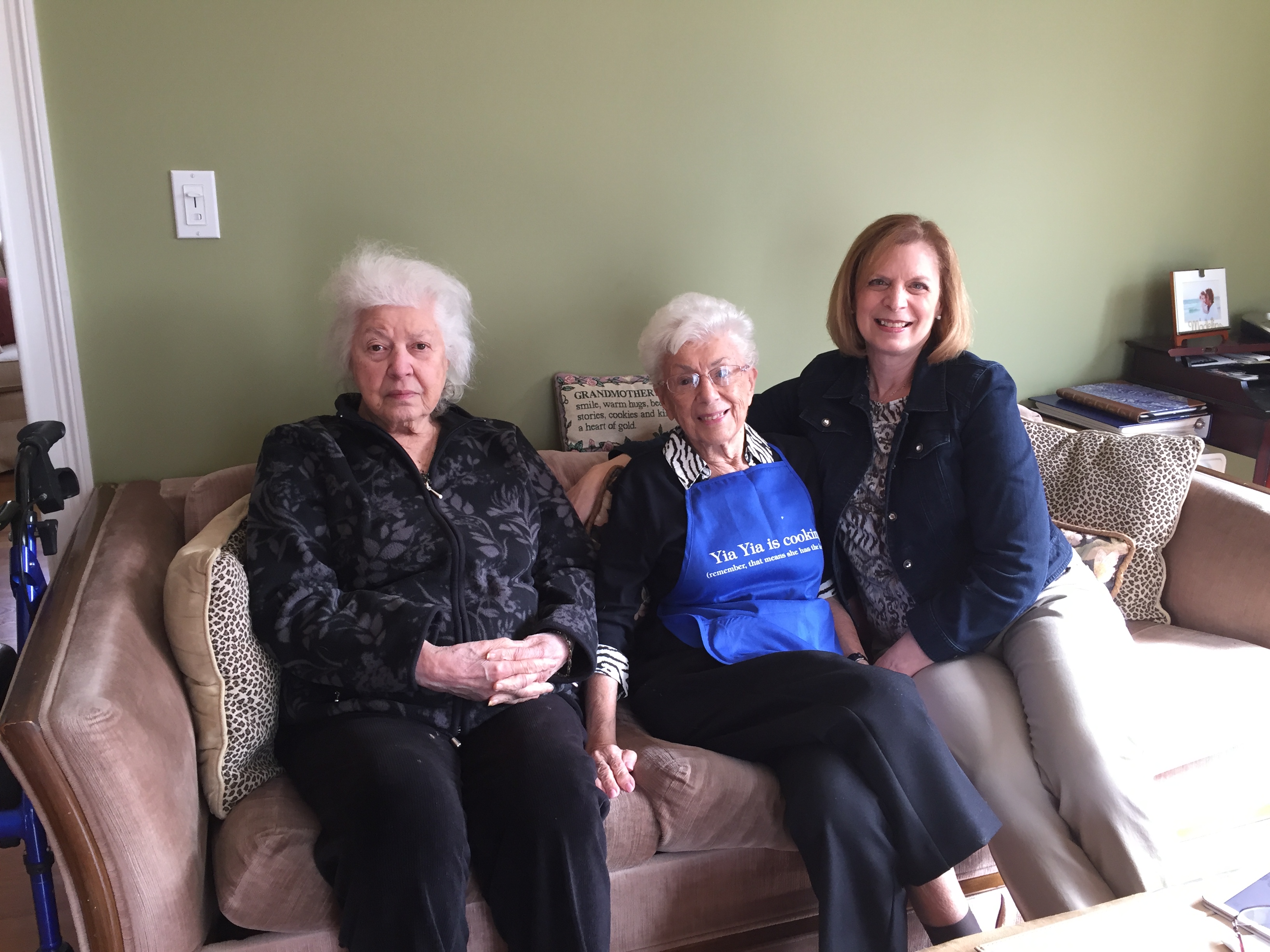
My Dad (Andrew) had four sisters; only two are living:  Aunt Georgia Kostakos Doukas, and Aunt Alice Kostakos. Last Sunday, these two aunts and three of my cousins gathered at Aunt Georgia’s where we shared a lot of memories.

??????????????????????????????????????????????????????????????????????????????????????????????????????????????????

l-r: Alice Kostakos, Georgia Kostakos Doukas, Carol Kostakos Petranek, March 6, 2016

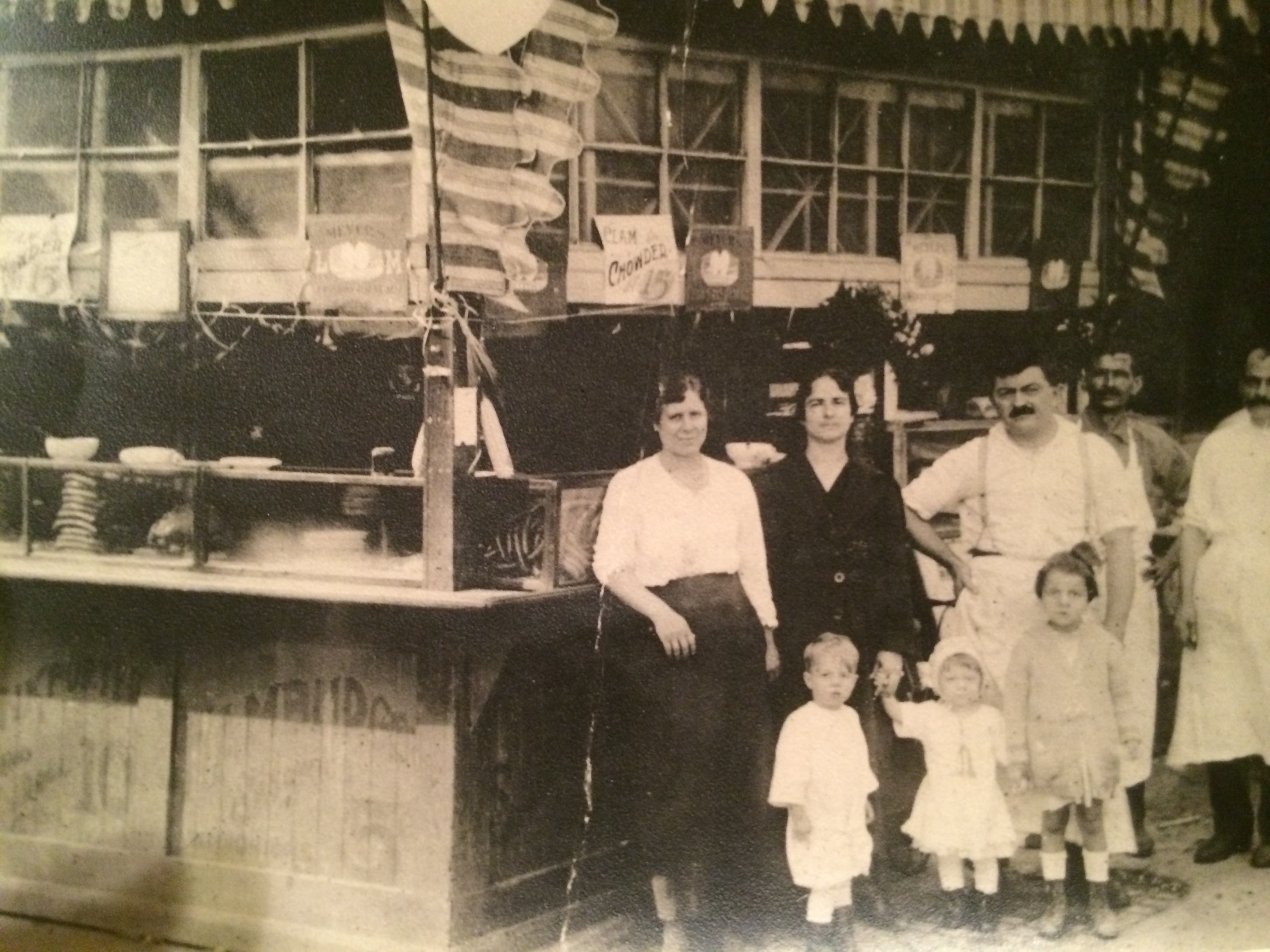
My cousin, John Stakis, and Aunt Alice share a two-family home that my grandfather, John Andrew Kostakos, built in Brooklyn. Two years ago, Hurricane Sandy flooded the basement of that house and everything was lost — including many family photos. John mentioned seeing one with my grandmother and my father when he was 2 years old, standing in front of a kiosk that my grandfather had just opened in Coney Island. The year was 1919.

1919 Coney Island, kiosk of John Andrew Kostakos. left: Hariklia Aridas Kostakos and in front of her, Andrew John Kostakos, my father

1919 Coney Island, kiosk of John Andrew Kostakos. left: Hariklia Aridas Kostakos and in front of her, Andrew John Kostakos, my father; woman in black is Paraskevi Panagakos Drivas (married to Konstandinos Drivas) and her daughter, Pauline who married Leonidas Papagiannakos (Pappas). Others in the photo are unknown.

I was stunned, as I have not one photo of my father (Andrew John) as a child. John took a picture of this photo when he returned home, and sent it to me. What a treasure!

The story behind this photo is a huge surprise to me — something I had never heard previously. Aunt Georgia related that my grandfather had initially gone to Lowell, Massachusetts after he “got off the boat” at Ellis Island. His older brother, Vaselios (William or Bill), who was the first to emigrate to America, was living there and John went to join him. Aunt Georgia referred to Lowell as “the hub” of the Greeks in the U.S. in the early 1900’s. But this hub did not appeal to John and Bill. The brothers left Lowell and went to Brooklyn. There is a contradiction to this part of the story:  my father had told me “when my father first came over in 1899 through Ellis Island, he had a hard time finding work but he got a job at General Electric in Pittsburgh. After a short time, he left because the work wasn’t steady.  In the morning, men would line up for work and the foreman would pick out the ones who would be able to work that day, and the rest were sent home. My father then made his way to Brooklyn and began working as a fruit peddler. He and his future brother-in-law, Peter Stavracos, peddled during the day, and at night they shared a furnished room with other men.”

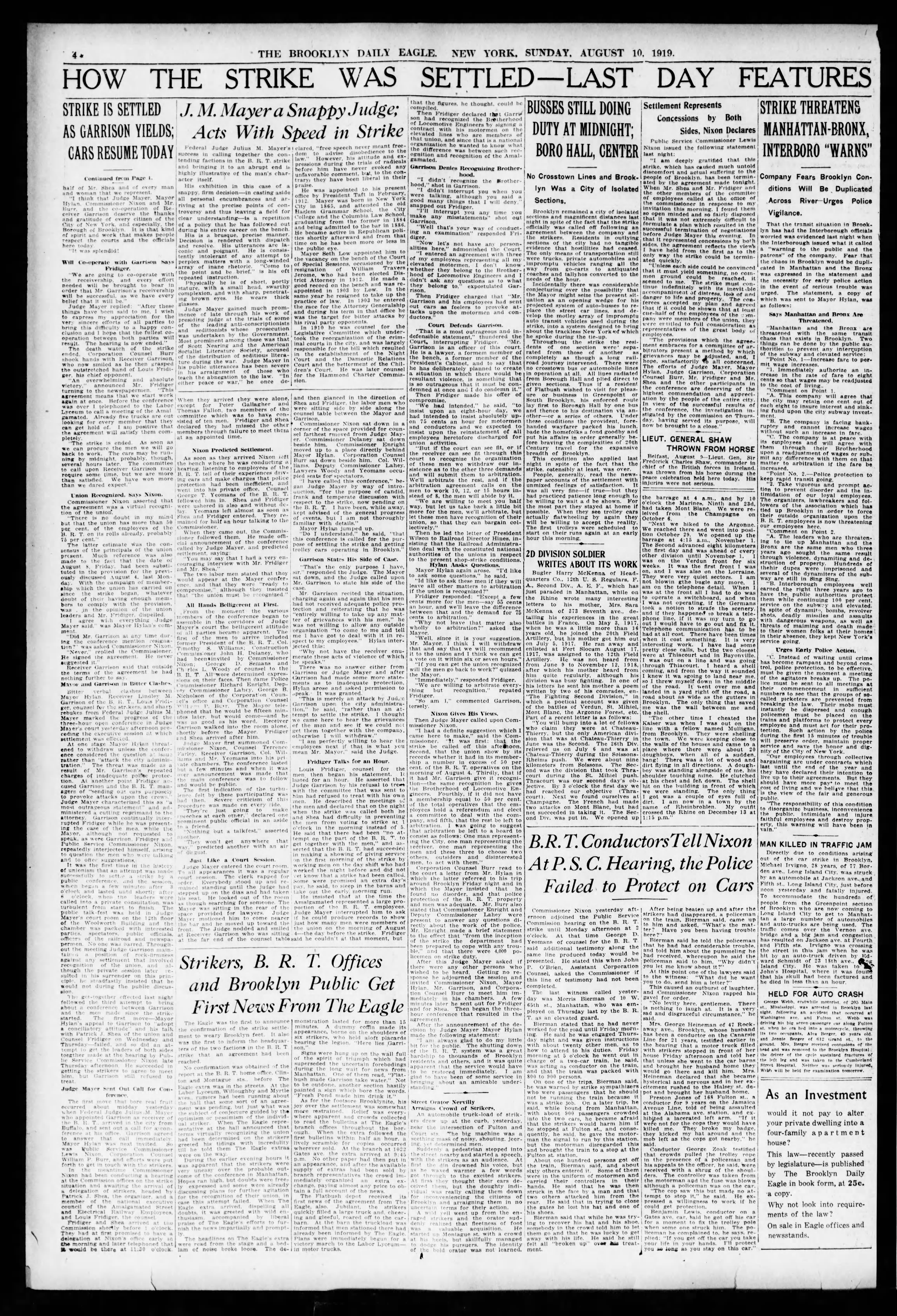
John sold fruit from a push cart and after some time, he opened a stand, like a kiosk, in Coney Island in 1919. Unfortunately, that was the summer of the Brooklyn Rapid Transit system (B.R.T.) train strike that paralyzed mass transit in Brooklyn and its surrounding areas — including Coney Island.

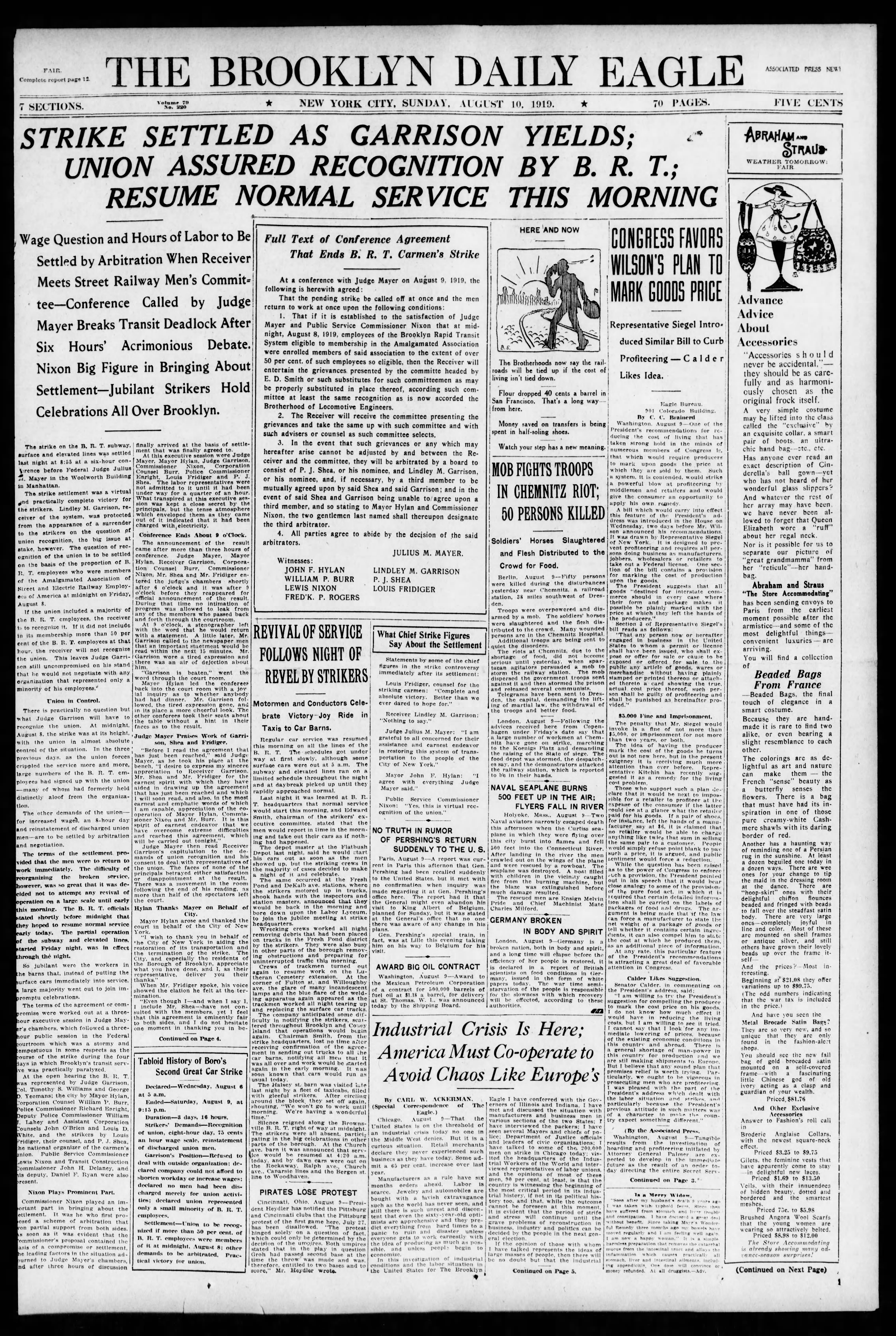
I found an article in the Brooklyn Daily Eagle, August 19, 1919, about the ending of this strike. August 19 is the end of summer, and the end of tourist season. For three months, there were no trains, no tourists, and no income for the vendors. In a stroke of bad luck, John went out of business, bankrupt.

Brooklyn Daily Eagle, Aug, 10, 1919

Brooklyn Daily Eagle, Aug, 10, 1919

Train Strike-Brooklyn_Daily_Eagle_Sun__Aug_10__1919 p4

This devastating incident convinced my grandfather that he would never work in a business where conditions beyond his control would determine whether he would succeed or fail. He eventually opened his own seafood restaurant in Brooklyn which was a successful venture.

This story has my head spinning for a couple of reasons. First — this was the first time I ever heard that my grandfather was in Lowell, Massachusetts. He and his brother, Bill, eventually went into the restaurant business. I’m thinking that the factories and mills in Lowell were not to their liking, which is why they headed south to Brooklyn.

Second, I know that my grandfather was a brilliant businessman. He owned a thriving restaurant in Brooklyn and invested in several real estate properties, both in Brooklyn and on Long Island. He made enough money to provide for himself, his invalid wife, and his daughter for the rest of her life. Hearing of this difficult and rocky start in his new homeland has given me even more respect for his determination to achieve the “American dream” and make it a reality for himself and his family.

What a tremendous legacy of perseverance and fortitude. Thank you, Papou.


Ioannis Zacharakis, Hero from Theologos, Oinountos, Laconia

In a recent post, the Zaharakis/Zacharakis Family of Theologos, I mentioned that the earliest member of this family that I could find was Ioannis, born approximately 1798 in Theologos.

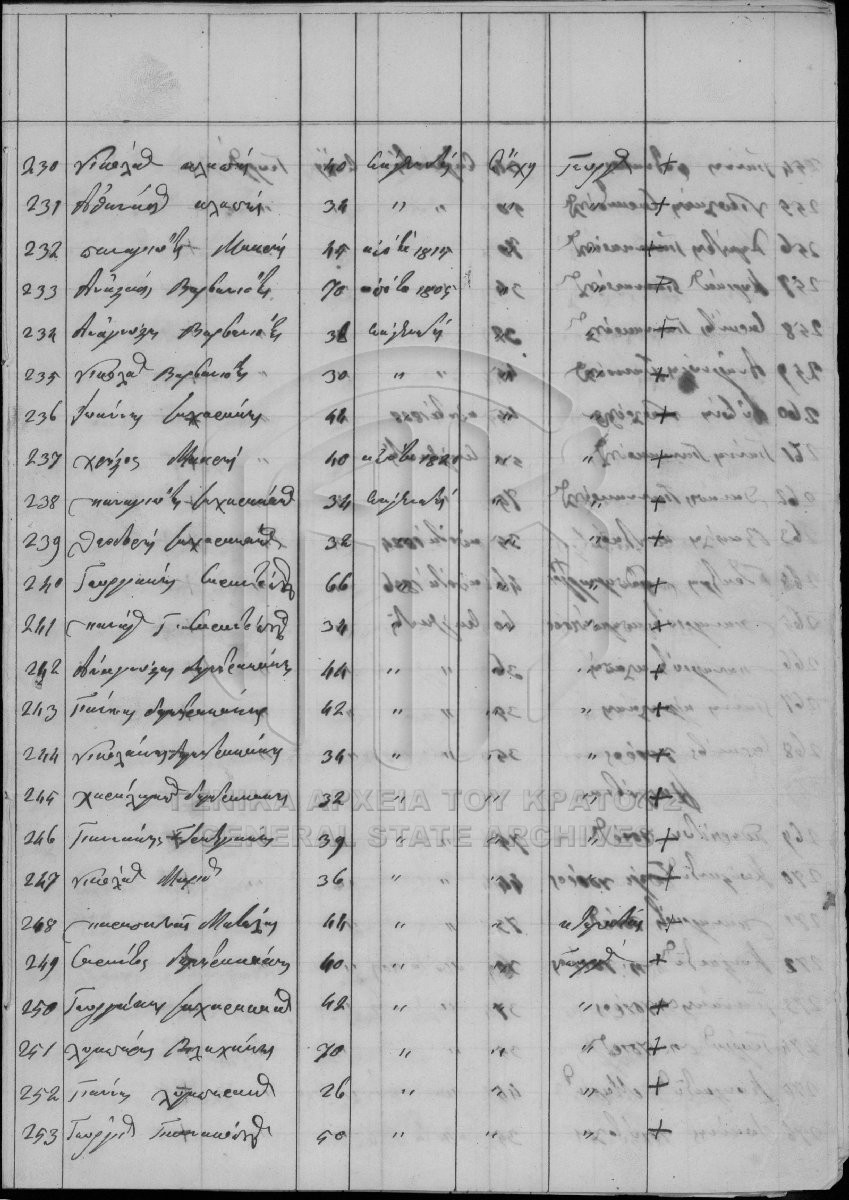
Ioannis is found on line 236 of the 1844 Election List for Theologos, where he is listed as being age 46.

1844 Election Lists Laconia, File 22, Image 1222 Theologos.

1844 Election Lists Laconia, File 22, Image 1222 Theologos; Line 236, Ioannis Zacharakis, age 46

I was thrilled when my friend, Giannis Michalakakos, sent me documentation that cites Ioannis as being the recipient of an Aristeia for his military service in the 1821 Revolution. Aristeia comes from the word άριστος (aristos) which is defined as “excellent.” In Greek warfare, an aristeia (αριστείο) is an award of great prestige and distinction. It is earned by a soldier for his exemplary actions in battle. In the eyes of his comrades, he is a hero and is recognized as such.

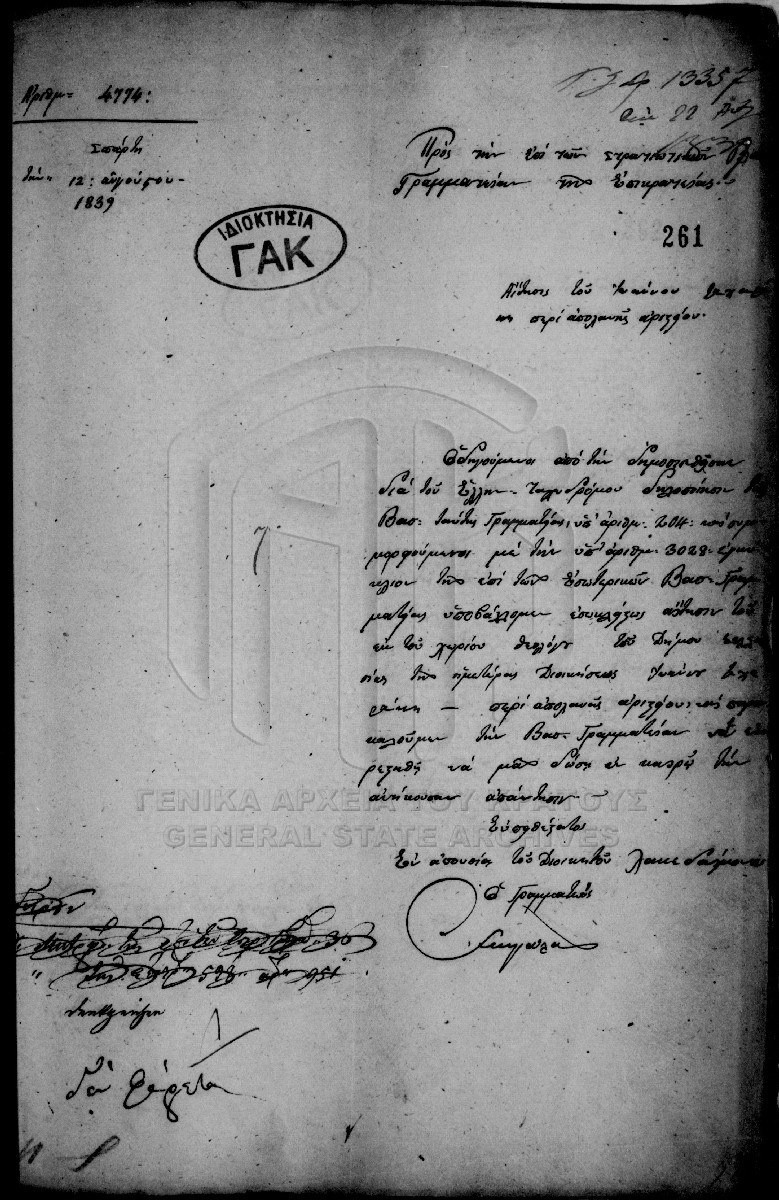
This is a copy of the Application of Ioannis for an Aristeia:
Document #261  – Application dated 1839
The request and application of Ioannis Zaharakis for certification of military service. The request was made to the Royal Secretary of Lacedaimon under the existing law 3028, to receive medals and certifications. I am making use of this law and I submit my certification for the Aristeia.

Aristeia Application 261 of Ioannis Zaharakis

Aristeia Application 261 of Ioannis Zaharakis

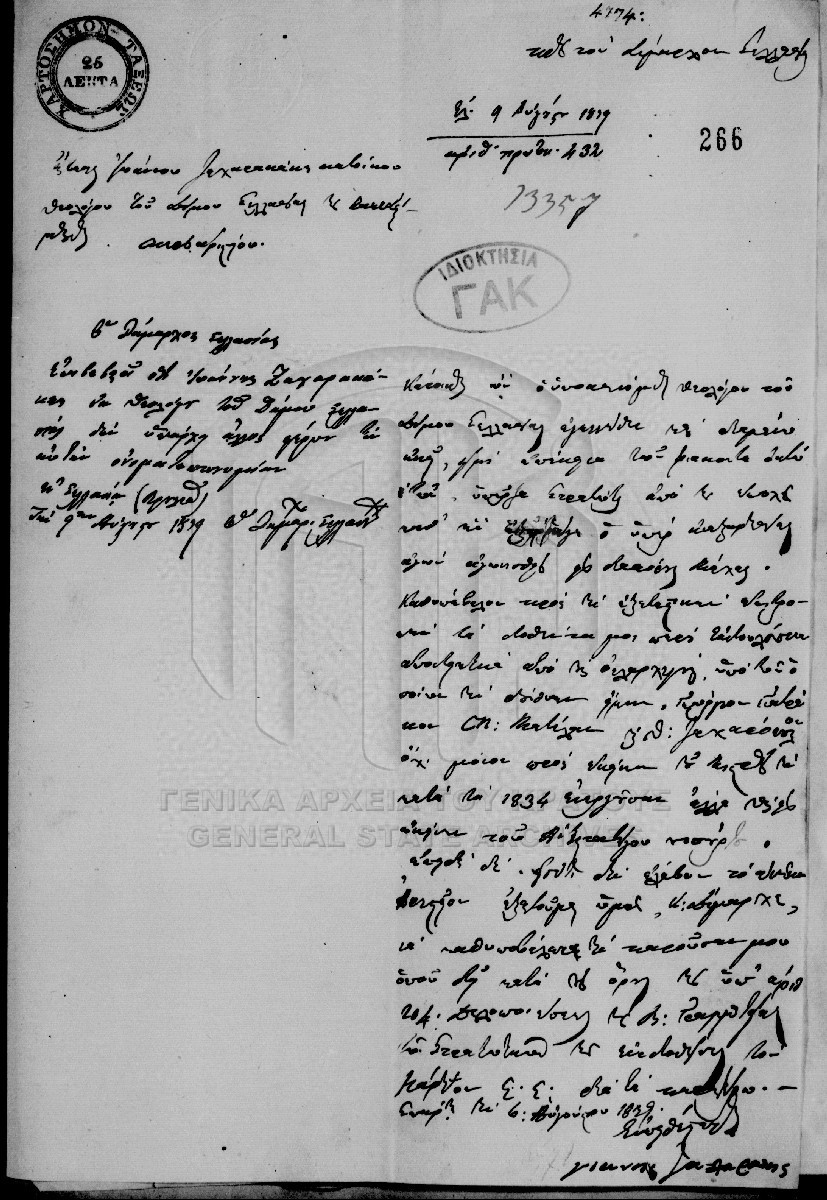
This document #266 contains the signature of Ioannis at the bottom.

Signature of Ioannis Zaharakis at bottom

Signature of Ioannis Zaharakis at bottom

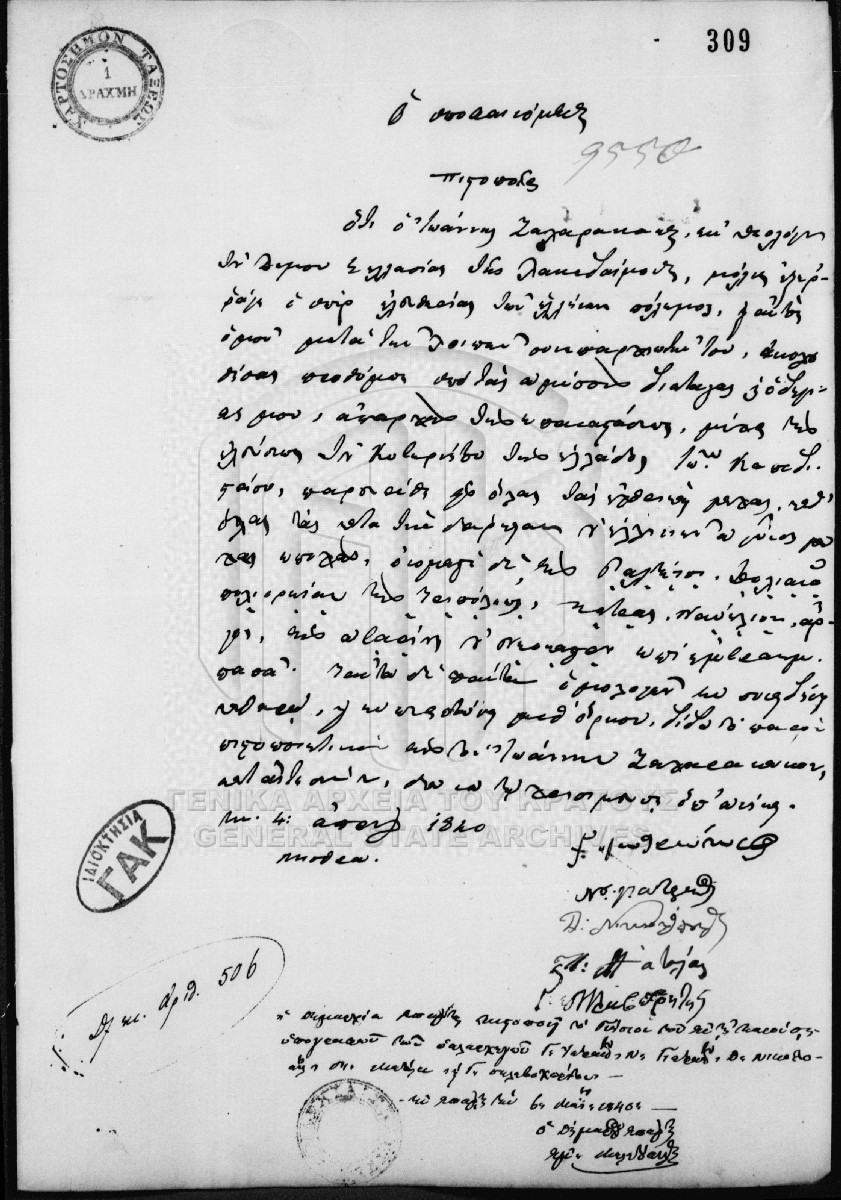
Document #309  – Certificate, dated 1839
The man that is holding this paper certifies that Ioannis Zaharakis of Theologos of Sellasia, in the beginning of the war, with his fellow villagers, willingly fought under orders of my brother, the captain (Georgios Giatrakos).In the start of the revolution with other people of the government of Greece, Ioannis Karakasou or Kastasou; he participated in many battles: Valtetsi,  Doliana, the siege of Tripoli, the city of Naplion, city of Argos, city of New Kastorio Pylos during the invasion…. We certify and give this certification to Ioannis Zaharakis for any use. Date: Aug 4, 1840 in Mystra.
Signed by: George Giatrakos; Nikos Giatrakos; Dimitri Nikolopoulos; Ioannis Matalas; Georgios Sklavahoritis (possibly); last signature is the mayor of the area, unintelligible. (Link to document online at website of General State Archives of Greece: http://arxeiomnimon.gak.gr/search/resource.html?tab=tab02&id=561094)

Aristeia, Letter of Certification #309 for Ioannis Zaharakis

Aristeia, Letter of Certification #309 for Ioannis Zaharakis


I am always excited to find any document for any member of my family — it is a clue to who they are, where they were, and what they did.

Knowing that Ioannis received an Aristeia brings me a profound feeling of both joy and pride. His blood runs in my veins which makes me the descendant of a hero!


Eftaxias / Eftaxas in Laconia

Searching my Eftaxias family in Laconia is yielding some exciting results. My great-great grandfather, Ioannis Eftaxias1, was born in 1809 in Mystras. As far as can be determined, he is the oldest Eftaxias in Mystras. He had two sons listed in the 1872/1873 Election Rolls: my great-grandfather, Konstandinos2, (born 1840) and Georgios(born 1848).

Dimitrios Eftaxias4, born 1846 in Mystras, is also found in these Election Lists; however, his father is not named. It is very likely that Ioannis is his father, because Ioannis is the only male Eftaxias in Mystras who is of the age to be a father during that time period. I am hoping that the staff at the Archives office in Sparta will be able to resolve this by finding Dimitrios in the Male Register, which will list his father.

My friend, historian and teacher, Giannis Michalakakos, has found the name in two areas in Laconia: Mystras and Lagia (Mani). He said this name is rare and may be Byzantine in origin. It is likely that all Eftaxias from Laconia are blood-related. Giannis surmises that members of the Eftaxias family moved from Lagia north to Mystra after the 1821 Revolution, as this was a time of widespread migration throughout southern Greece. When the Ottoman occupation ended, families were free to move about, unmolested and unafraid. It was common for families to leave their hiding places in the forbidding mountains to find work in cities and farming opportunities in the fertile plains of Laconia.

A newly-found Eftaxias relative was told by his father that his family originated in Kalamata. Corroborating this, the map below reveals the route from Lagia through Kalamata to Mystras. Understanding migration patterns helps us move back through time.
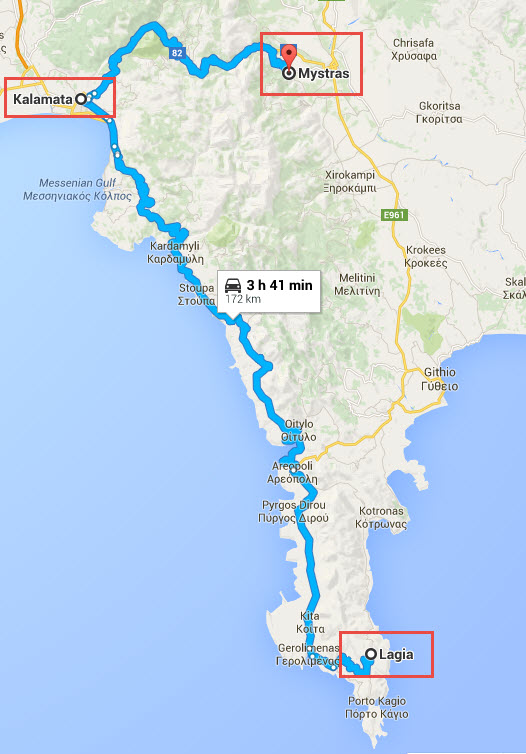
Lagia-Kalamata-SpartaGiannis determined that the oldest Eftaxias in the village of Lagia is Mihalis Eftaxias, born about 1800. He fought in the 1821 Revolution. Mihalis had a son named Vrettos, and Vrettos had two sons: Michalis5 (born 1826) and Panagiotis6 (born in 1832).

The Eftaxias name is found in Atatka, the first Modern Greek dictionary! The Atatka was compiled by Adamantios Korais, a Greek humanist scholar who played an influential role in the Greek Enlightenment, the 1821 Revolution, and in particular the development of the “purist” Greek language, Katharevousa. His monumental work, Atatka, is comprised of 17 volumes and was published in France in 1832.

Recently Giannis sent me an entry from page 147 of Volume One of Atakta, where the name “Eftaxias” appears.
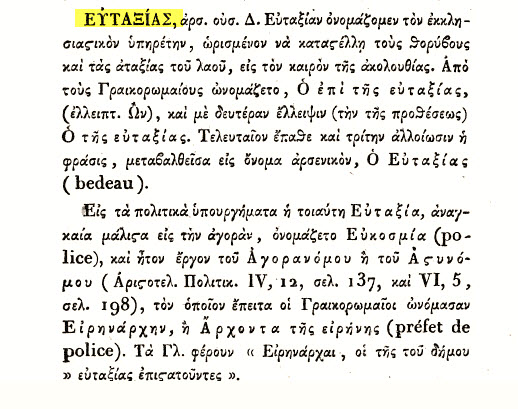
Page 147, "Eftaxias"

Page 147, “Eftaxias”

A rough translation reveals that Eftaxias is an ecclesiastical servant; one who keeps the order of the church. [From Gregory Kontos: Ευταξίας: good=ευ, order=τάξη]. He is the one that ensures there is orderliness among the people by preventing disorderly conduct, noise and mischief. There is reference in this document that Eftaxias was named “the Lord of peace.” This description gives me a most interesting insight into my ancestor who was first given (or adopted) this name.

Some families spell the name without an “i”:  Eftaxas. Giannis explained that in the Maniate language, the name is pronounced Eftaxeas (accent on the 2nd e, and pronounced as a long e). The family is part of a Maniat clan (blood related families with different names) named Ksifomaheridianoi. Other branches of families from this clan are Kassimis, Royssakos, and Kapylorihos, all of whom remained in Lagia.

Along with clan affiliations, name changes pose real challenges. Most occur from either παρατσούκλι (paratsoúkli) which is a nickname; or creating a surname from a given name —  males taking the given names of their fathers and adding -akos to indicate “son of.” Example: my surname, Kostakos, means “son of Kostas.” Thus, the original surname is lost. Reading through Election Rolls, I see this phenomenon on almost every page in Mani records. With the Eftaxias name having a distinct definition, there is no name change. Tracking down the “first” Eftaxias would be a fabulous find!

Sources:

1General Archives of Greece, Election Lists, 1843-44
File 22, Image 62, Line 239, Mystras
Ioannis Eftaxias, age 35, owns property; gardener; no father listed

2General Archives of Greece, Election Lists, 1872
File 25, Image 404, Line 573, Mystras
Konstandinos Eftaxias, age 32, shepherd; father: Ioannis

3General Archives of Greece, Election Lists, 1875
1872: File 25, Image 402, Line 480, Sparta-Mystras
Line 480 : Georgios Eftaxias, age 24, b.1848; occupation: student; father: not named

4General Archives of Greece, Election Lists, 1872
1872: File 25, Image 403, Line 506, Sparta-Mystras
Line 506: Dimitrios Eftaxias, age 26, occupation: shepherd; father: not named

5 General Archives of Greece, Election Lists, 1875
File 9, Image 99, Line 188, Lagia
Mihalis Eftaxias, age 49, farmer, father: Vrettos,

6 General Archives of Greece, Election Lists, 1875
File 9, Image 100, Line 237, Lagia
Panagiotis Eftaxias, age 43, farmer; father: Vrettos