The market of our village [Xirokampi, Lakonia] is, for me, the most familiar and beloved part of the village after my paternal home. In the summers, in fact, it is the “center of the world.” Everything happens in the market (or the square, as we also call it). The meetings with acquaintances and friends, the new acquaintances, the company, the discussions, the walks, the celebrations and the feasts… There, under the three plane trees and the bitter orange trees, next to the sweet acacia tree in the center, around the welcoming tables of the cafes… from morning until late in the evening… or even at night.
The Plateia of Xirokampi; Photos by Carol Kostakos Petranek
The market does not seem to change in character in terms of the people who frequent it. However, it has changed form since it was created until today, with cement pavements, stone pavements, tree planting, lighting… Mainly, however, its character has changed in terms of the composition of the shops and the commercial activities of the residents and visitors in the wider area.
According to a note published continually, in the first issues of our newspaper [the Faris](from the first to the fifth issues of the years 1966-70), in the wider area of the market, there were operating then: many cafes and restaurants or taverns, wine shops that were also wineries (in basements), a kiosk (always), a market for agricultural products and animals (once a week), a pharmacy (always), doctor’s offices, law offices, post office and telephone office, a bank (formerly), a closed cinema venue, a dance school, a bookstore, a photo studio, barbershops, hair salons, grocery stores, cheese shops, coffee shops, agricultural drug stores, a dried fig station, fabric and clothing stores, tailors, shoemaking and shoe stores, a bicycle repair shop and a traffic light shop, blacksmiths, carpenters and cabinet makers, a tannery, …
Commercial activities in retail stores selling goods and services, as well as the shops themselves, have drastically decreased today, while production activities and manufacturing workshops have disappeared.
A typical example is the shoe stores that were once also cobbler shops, the well-known “tsagkarika” that mainly repaired or even custom-made shoes “on order” and “to the measure” of the customer. The usually large families of the area, most of them agricultural or working-class, provided and maintained a clientele for many cobblers, with their low prices. The requirement for durability was the main concern, while design options were limited compared to today.
A second typical example is the wineries in addition to the wine shops. In many basements, there were barrels (or vats) for the “boiling” of the grape must, which was done with the guidance of a winemaker of Sparta or empirical recipes. Wine was usually sold on the ground floor or bought by enthusiastic neighbors or even compatriots in Athens if it arrived there in good condition.
I (Carol Kostakos Petranek) am honored to receive permission from the Katsoulakos family to translate and share articles from The Faris. Translation verification and corrections have been made by GreekAncestry.net. This is the eighteenth article of the ongoing series. Previous articles can be viewed here.
At the end of the fourth decade of the 20th century, marriages were mainly arranged by matchmaking. The role of the matchmaker was undertaken by a female relative, a neighbor, or even a stranger. The matchmaker was responsible for bringing together the two families concerned, informing them about the “situation,” meaning the financial requirements. At a festival, celebration, or a relative’s house, the parents or close relatives would meet. If they agreed to the terms, the groom and the bride would go to this meeting: there they would finalize the arrangement.
Engagement usually followed shortly after. On the designated Sunday, after church, the betrothal ceremony took place. There was a feast with meat, plenty of wine, and the celebration included dancing, many jokes, and well-wishes.
Then, the wedding preparations followed. The bride and groom’s clothes had to be bought, sweets prepared, and rings purchased. The economic conditions of the time did not allow for the purchase of other jewelry as gifts for the bride. In the meantime, they took care of adding anything missing from the dowry, such as pillows, wool blankets, quilts, and embroidery or woven cloths.
When everything was ready on both the bride’s and groom’s sides, the wedding date was set. Weddings always took place on Sundays, never on Saturdays, as Sunday was dedicated to God, and the couple was not allowed to be together on Saturday night.
Παραδοσική γαμίλια πομπή στην Αταλάντη – Traditional wedding procession in Atalanti Photo credit: el.wikipedia, accessed May 26, 2024
The relatives, the “psiki” (the celebration procession) accompanied the bride and the groom to the church on decorated horses. However, many people stayed at home and did not attend the ceremony, to help prepare for the feast that would follow. The meat for the feast was prepared from Saturday. Usually, the wedding table included meat with potatoes in the oven or pot roasted. The meat was roasted in large pans. The pasta was boiled in tin-plated pots. Once the pasta was cooked and sprinkled with cheese, it was placed on platters from which everyone ate in turn with the same fork. The celebration included dancing and singing many songs a cappella, as the economic situation of the time did not allow for hiring musicians. They danced syrtos, tsamikos, as well as the Charleston and foxtrot. The celebration was filled with jokes and well-wishes for the couple. In the meantime, a man would serve wine from a bottle, and everyone drank from the same glass. The celebration lasted until dawn. There were also many sweets, usually kourabiedes but also koulouria, baked in the oven and decorated. The bride would throw the koulouria into the air for the unmarried women to catch. It was believed that whoever caught a koulouri would marry soon.
After the party, the newlyweds went to the groom’s house or stayed a few days at a hotel in Sparta or sometimes in Tripoli. Then they went to the in-laws’ house, where relatives gathered to verify the bride’s “honor.” They cheered and fired shots in joy.
If the bride was not a virgin, she was either sent away or additional dowry was demanded if the groom agreed.
A decade later, the improvement in economic conditions led to a differentiation, but not in the essence, of marriage customs. Once the betrothal was fixed, the dowry agreement was sometimes written at the bride’s house and paid with her money. At the engagement, the bride received not only the ring but also additional jewelry, if possible. The groom and the bride were accompanied by professional musicians, who were hired by both sides, and they remained for the celebration, as noted by the couple Vasiliki and Yiannis Poulakos from Mousga*. The groom’s procession had 98 horses. Guests no longer brought only animals to the newlyweds but also household items – glassware, plates, glasses.
The better economic situation, however, did not eliminate superstitions and preserved beautiful and interesting wedding customs of previous decades. The bride had to go to the fountain to fetch water, accompanied by a small child whose both parents were alive and who had to throw silver coins to the fountain. This custom is probably related to fertility and childbearing. The bride went to the church, having the church key and a black-handled knife at her waist to protect her from spells. When she would go to the groom’s house, she had to lie down with a small boy to have healthy children. At the entrance door, she had to eat honey given by her mother-in-law for a sweet life. Also, they poured honey on the door three times, and the couple entered the house covered with a handkerchief.
A song that was sung when the bride was about to be get married:
“Come away, bride, come away from your parents’ Where are you going, little bride, to your in-laws Stand like a cypress, root like a tree Bloom like an apple tree, bear fruit, Make nine sons and one daughter.”
Testimonies: Eugenia Konidi, 87 years old. She finished elementary school and 2 classes of Greek school. She married on 22/10/1939. Vasiliki Ioan. Poulakou. Born on 20/7/1922. She finished elementary school. She married on 21/8/1949.
The Dowry Agreement
In the name of the Father and the Son and Saint Prokopios Amen. I, Georgios Ath. Rigakos from Gorani, give my daughter for marriage, Vasiliki Georg. Rigakos to Ioannis Pan. Poulakos from Mousga, endowing her with the following items:
* Their wedding was the last in the area where guests arrived riding horses and mules.
I (Carol Kostakos Petranek) am honored to receive permission from the Katsoulakos family to translate and share articles from The Faris. Translation verification and corrections have been made by GreekAncestry.net. This is the seventeenth article of the ongoing series. Previous articles can be viewed here.
Two articles published in our journal concern the medical practices that were applied and pharmaceutical means available to our compatriots in the past. Specifically, they refer to the era of the great uprising of 1821 and the time of the 1918 flu (see Stavros Th. Kalkanis, “Empirical doctors and medical practices in our region – and elsewhere – in ’21”, Faris 68 (2018) 3-6, and “The Spanish flu of 1918 as experienced (?) by a family in Goranoi”, Faris 73 (2020) 5-8.
Injuries in 1821 were treated with amputations and improvised poultices, while the 1918 flu, which wiped out entire families in our villages, was dealt with by our compatriots (and the entire world) with a little quinine and whitewashing of houses.
Similar was the treatment of the problems that our compatriots had with their teeth up to the middle of the past century. They used improvised “remedies” (or concoctions), which were essentially herbal remedies from the region. Unfortunately, these dealt with pain and other dental problems in a rudimentary way. They usually resulted in painful tooth extractions.
Our compatriots of today – especially the young – do not know or can hardly imagine the conditions, the means and possibilities of treatment but also the usual outcome of dental problems until the beginning of – at least – the past century.
Medicines and extractions were usually applied or carried out by elderly village women, and men or women who had the reputation of experienced and skilled “specialists”. They were the so-called “good doctors” of the teeth or “kompogiannites”, in other words empirical doctors who lacked the primary knowledge and the tools or materials available today.
The herbs (or botanicals or drugs) were placed on the gums of the aching tooth (after being crushed in oil or dried and ground into powder) or were soaked in water for days (compresses) or dissolved in boiling water (extracts) or in alcohol (tincture)…
With these, they made gargles, pads, or compresses, but some were swallowed (pills). Almost always, however, they started with tsipouro and olive oil, which they gargled for a long time to alleviate the pain. When the tsipouro was swallowed, it naturally acted as a “dizzying” substance… However, there was always the question – and the concern – of dosage or possible toxicity.
We have gathered information and memories from our wider region and documented the most common herbal remedies from our land, as well as their common uses and actions. Some of these were:
• anise (as powder or toothpaste or by chewing seeds, as decoction, extract, compress, essential oil, …for loose teeth and gums, tonic), lavender (as a decoction for toothache relief or as a tooth fixative…), orange (as an oil for calming effect / relaxation…)
• nettle (crushed, dried or boiled as a compress or wash and as a decoction to stop bleeding of the gums…), honeysuckle (as an ointment or poultice or gargle against toothache but also as a remedy for bad breath…), mulberry (as a thick decoction of its leaves for gargle against tooth and gum pain…)
• cloves -mainly, thyme, ginger, and marjoram (as a toothpaste, as a powder or mashed ointment for compresses, as crushed oil, as infusions or extracts…against tooth pain and breath freshening,… and as antiseptic, antibacterial, anti-inflammatory…)
• mint, spearmint, and pennyroyal-which are related plants- (as ointments in compresses and poultices, as extracts and essences, oils, patches of their fresh leaves…, for aroma, antiseptics…)
The women from our villages usually undertook the collection, processing, and administering of the above-mentioned medicines. The names of most of the men or women in our area who had these capabilities have unfortunately been lost or are only maintained in the memory of their family members. With this note, we preserve the name of Stavroula Sourtzi (née Stratakou, originating from Goranoi) who died bedridden in Xirokampi. Her daughter, Ourania Panteli Frangi, who lived in Xirokampi (and her later years in Canada), has narrated and written that many who collected some of the herbs we mentioned would give them to her mother for processing.
However, even then – and now for those who still use them – special attention should (and must be) paid to their dosage or toxicity. Especially today with the existence of sprays and pesticides. Herbs are not a panacea.
Rarely in the past did our compatriots take care of their teeth as long as they did not have problems. One of the practices they used to take care of them was chewing the ends of thin twigs, or roots of some of the plants mentioned above, that were easy to find. By chewing these, they created tassels that facilitated cleaning the teeth and prevented plaque buildup.
A more drastic method was the use of improvised “toothbrushes” with long handles (also called “tooth-rubbers”). They were made from animal hair (mainly from pig bristles), and with these, they rubbed the teeth, applying powders or paste / ointment or oil from some of the above-mentioned herbs (such as chamomile, ginger, clove, or mint…).
When the medicines were not effective or sufficient for treating dental problems and pain from bleeding, then skilled or simply calm old women usually took further action, which was the only way. Extraction of the tooth. Many resorted to the “good doctors” or “kombogiannites” who were villagers or wanderers. They were called “good doctors” because they referred to themselves and advertised as such, and they were also called “kombogiannites” because they used to keep their medical remedies secret, wrapped in handkerchiefs tied in knots (“kompoi”). Many of them were simply skilled individuals who also practiced the profession of barber, or even specializing in bloodletting with leeches collected from stagnant waters.
Many tooth specialists had special pincers (called “tooth forceps” or “dental pliers”) for extracting teeth. It is known that sometimes they missed and extracted (instead of the painful tooth) another nearby tooth or teeth. These pliers were passed down from generation to generation in the families who owned them. Two of these pliers are saved by the family of Petros Stavros Rigakos (see photo). These were brought to Goranoi from America (around 1950) by the mother of Georgios K. Rigakos (or Stavrakos), Stavroula (nee Kyriakakou). “During those years, these pliers relieved many Goranites by removing their damaged teeth…” notes Aimilia P. Rigakou.
Two examples of “dental pliers” (from 1950) retrieved from the family of Petros Rigakos
We record, finally, one of the many superstitions of the inhabitants of our village who attributed the falling out of teeth to the fact that some sufferers had their mouths open while a number of pine caterpillars crawled on the ground in front of them.
We also record one of the many scams that were attempted at that time. In the 1950s, glass bottles or jars – called “yalakia” or “gyalakia” – containing, according to labels, “tooth tonic” were circulated and sold in the cities of Athens and Patras. This was advertised “as the only healing medicine that relieves pain and protects teeth from any possible disease…”. These jars, according to testimonies of older people, had even reached our villages.
All these remedies, practices, and quack doctors ended or, at least, slowly disappeared (?) when the first dentists graduated from the University and settled in our area.
But let this note be a memorial for those well-intentioned “doctors” whose purpose was to ease pain and heal the sick.
I (Carol Kostakos Petranek) am honored to receive permission from the Katsoulakos family to translate and share articles from The Faris. Translation verification and corrections have been made by GreekAncestry.net. This is the fifteenth article of the ongoing series. Previous articles can be viewed here.
Sharing our Lakonian heritage with compatriots worldwide is both important and gratifying. It is a major reason I started this blog on January 25, 2012 with the goal of documenting my Greek research and assisting others who are embarking on this exciting journey.
Our experience in learning about our ancestors’ lives has been greatly enriched by the Faris (Φαρις) newsletters of Xirokampi. We are instantly transported back in time as we read the heartfelt stories of the older generations, captured by the writers and editors. These Faris authors are providing an essential archival service by ensuring that the histories of their villages will be preserved. I am grateful for the privilege of translating these stories into English and sharing them with people worldwide. Whether our roots are in Xirokampi or any other rural Greek village, we are all edified by learning of the everyday lives of our ancestors and seeing how they coped with–and triumphed over–their hard times.
Recently, I was taken by complete surprise when I saw this post on the blog of our our Pan-Laconian friends in South Australia. I thank them sincerely, from the bottom of my heart, for sharing the wonderful Faris stories with their readers. You can follow and read the interesting and informative newsletter of the Pan-Laconian Society of South Australia “Leonidas” at https://pallakonikodeltio.blogspot.com/.
By cross-posting and sharing articles about our Lakonian heritage, we can bring many more people expanded opportunities to learn of and understand their rich ancestral past.
In 2023, I brought home the full collection of Faris newsletters and placed them in the Library of Congress, where researchers worldwide now have access to primary source materials created at the local level. As the archivist wrote to me: “while we cannot predict when a researcher will need to look at material, we would be thrilled to have the ability to provide them with hard-to-find regional materials when they come to us.”
If you know of a Laconian online newsletter, website or blog, please send a link to me at spartanroots1@gmail.com and I will add it to the Spartan Roots Resource page. Thank you!
Barter economy (or labor) was a common practice in the past in our region and elsewhere. More common was the exchange of labor in olive picking and other agricultural and livestock tasks among families. Usually, barter labor occurred between families, but also between professionals, involving building houses or other activities or even household production of cheese, soap, pasta, etc. However, there were also notable and characteristic cases and stories of barter economy between communities or even between ecclesiastical authorities and the residents or professionals of the villages.
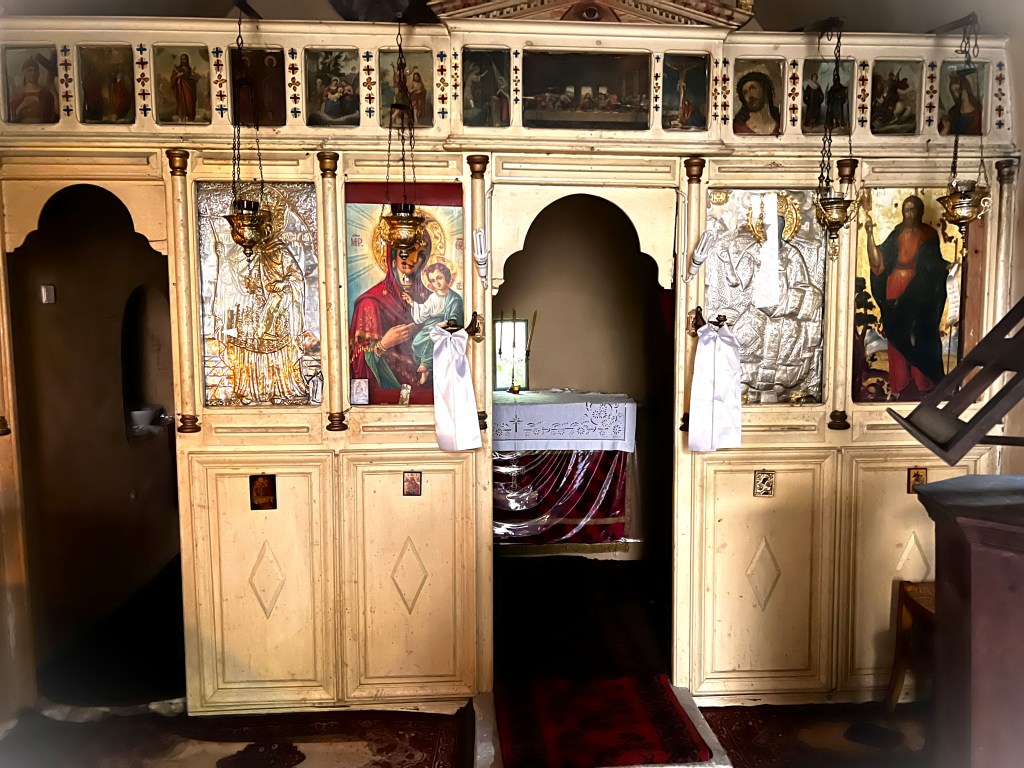
A first case/story is the one that has come down to us and concerns the painting of some of the icons of the altarpiece (iconostasis) of the Holy Trinity of Xirokambi. These are the 14 small icons in a row at the top of the iconostasis. As the old resident of the village, Dim. Men. Xanthakos, narrated before his death, an iconographer, Pan. Lazaris, lived in our area during the time of the Italian-German occupation. He painted icons for churches in exchange for olive oil. Each icon of the iconostasis that he painted (in one day, as remembered by D. M. X.) was “exchanged” for a can of oil!
Holy Trinity Church, Xirokampi showing the 14 icons across the iconostasis Photo by Carol Kostakos Petranek, June 2023
Another story that is characteristic of barter labor (and on a large scale) is the following: In Xirokambi until the early 1960s, long queues of residents lined up in front of the communal faucets at a few points in the village. Everyone waited to fill containers or pitchers, wooden barrels, or metal jugs with drinking water for all uses. At that time, the community council with presidents Georgios and Nikolaos Koumoustiotis successively, commissioned contractors for a large project for the village and its residents. Water was to be supplied to all houses with underground metal pipes from the tank that had been built in Anakolo. The “contract” with all the residents entailed their mandatory personal labor, “exchanging it” for the provision of water to each house. Instead of personal labor, some residents exchanged with the community a worker or an animal for transportation or a skilled craftsman with money or oil. The project was completed in the early 1970s and changed life in our village and elsewhere.
Woman at communal water faucet in the plateia (village square), Xirokampi, July 2018 Photo by Carol Kostakos Petranek
The third case concerns the operation (in the mid-1960s) in Xirokambi of a Branch of the Gymnasium [high school] of Sparta for the students of our area until an independent Gymnasium was established. At that time, many students used to stop their studies after Primary School or continue their studies in Sparta by renting rooms and receiving baskets of food every day… With the initiative of some residents, pharmacist Theof. G. Kalkanis and merchants Elias Chr. Kapetanakos and Ilias N. Liakakos, the establishment and operation of the branch became possible (after persistent efforts). The original and remarkable thing is that the teachers who were transferred from the Gymnasium of Sparta were “bartered” with the oil collected by the parents from the committee (…)
I (Carol Kostakos Petranek) am honored to receive permission from the Katsoulakos family to translate and share articles from The Faris. Translation verification and corrections have been made by GreekAncestry.net. This is the fourteenth article of the ongoing series. Previous articles can be viewed here.




 Spartan Roots (Σπαρτιατικές Ρίζες)