Mystras – 1872 Election Registers

Among the oldest records of genealogical value in the modern Greek state are the Election Registers of 1844 and 1872, which are lists of men eligible to vote. These records are now name indexed and available online (1844 at GreekAncestry.net; 1872-3 at MyHeritage). These Registers are critical for identifying which families resided in specific villages at specific points in time. In 2012, long before these records were name indexed and posted online, Georgia Stryker Keilman undertook the task of translating these registers from many villages in the Peloponnese, and her work can be found here.

I have Eftaxias ancestors from Mystras, which sent me to the 1872 Election Registers for that village. Mystras had been the seat of Byzantium in the Peloponnese until overtaken by Ottoman Rule. After the Greek Revolution for Independence, the population of Mystras began to decline as people descended from the castle area on the mountain top. Some formed the village of Mystras in the valley while others relocated to the emerging city of modern Sparta.

Mystras, Looking Towards Sparta, ca. 1890-1910. Library of Congress

When the Election Registers of 1872 were created, a man had to be at least 21 years old to vote. The number of men in Mystras on the election list was 268 and their average age was 38 years.

The “new” village of Mystras needed a mix of tradesmen, laborers, landowners and professionals to meet the needs of its population. The chart below, which lists the occupations of the voters, reveals that the village had the requisite composition to support its residents.

occupationnumber
Baker7
Bailiff17
Bricklayer1
Butcher4
Clerk3
Coachman/driver1
Cobbler4
Coffee seller2
Court official1
Doctor2
Farmer27
Farrier1
Gardener10
Gendarme4
Grocer12
Laborer30
Landowner53
Lawyer1
Magistrate2
Mason2
Mayor1
Merchant3
Mule driver7
Unemployed2
Official / Clerk3
Pharmacist1
Police Inspector1
Quilt Maker1
Rag Seller2
Retailer1
Sandal Maker3
Servant7
Shepherd23
Shoemaker1
Soldier7
Student10
Superintendent1
Surgeon1
Tailor4
Trader1
Veteran1
Wine Sales2

Which families are found in the village during this time? This chart lists the names of the voters, their ages and occupations in alphabetical order. Some surnames have “disappeared” over time, but many are found in Mystras today.

1872 Election Register, Mystras

This is the Register in Greek.

1872 Election Register, Mystras, in Greek

My great-grandfather, Konstantinos Eftaxias, is found on line 573. This Register gave me his father’s name, Ioannis, and his occupation as a shepherd. Also listed are Georgios, who were identified in the 1873 Election Register as being the son of Ioannis.

1873: Line 537, Georg. Eftaxias, age 25, father: Ioannis; occupation: student
1873: Line 597, Dimitr. Eftaxias, age 27, no father listed; occupation: shepherd

Although the father of Dimitrios is not listed, further research indicated that there was only one Eftaxias family in Mystras during this period.These Eftaxias examples show the importance of trying to find your ancestors in every available record. 

A Chance(?) Encounter in Lagia

What are the chances that a document which reveals an abstract branch of your family is given to you by a stranger? That’s exactly what happened to me on my recent journey to visit the ghost town of Vathia.

There is only one road that connects Sparta with Mani. Much of it follows the seaside of the Laconian Gulf, traversing through quaint villages and along scenic coastlines.This was the only way for me to reach my destination.

I stayed overnight in a lovely renovated tower house in Kokkala. The sea view was spectacular and the architecture and history of the towers always captivate me. This was the perfect place to stop on this journey, to rest and to soak in the beauty of Mani.

Charming Kokkala

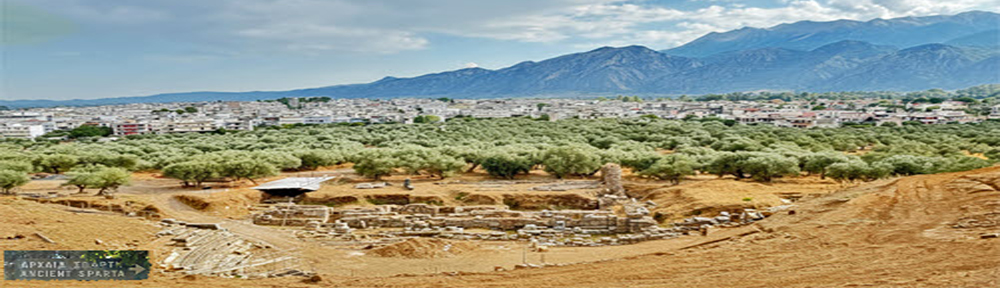
The next morning, I hit the road and with my sights set on Vathia. No stops were planned, and no side trips were considered. My focus was to spend as much time as possible in the ghost village, then return that night to Sparta. But along the way, I got sidetracked. About 1/2 hour south of Kokkala, I rounded a corner and there appeared a charming tower village nestled in the mountains. Lagia.

Approaching Lagia

I hopped out to take photos, thinking that I would just breeze through the village and keep going. But when the road led into the plateia, there was something about the village that enticed me to stop. I parked the car and started walking.

Views from the plateia of Lagia

The streets were deserted and the quiet of the village exuded a sense of tranquility. The imposing stone houses were of traditional Maniate style.

As is customary, the church, Koimisi tis Theotokou, was situated adjacent to the plateia. I went inside.

Koimisi tis Theotokou Church on the plateia
Church interior. I lit a candle for my ancestors (lower right)

My heart was touched when I read a sign that was posted on the small icon stand situated at the entrance. It read:

Welcome to the Holy Temple of our village “Lagia.”
Look around you and visualize freely the hard efforts of our ancestors,
within a rough place with different values, principles and under adverse conditions,
who managed to complete the construction of this gorgeous Church.
This Temple was constructed before 200 years with the full participation of the local men and women, with building materials gathered from the surrounding mountains of the village and carried on their backs and shoulders.
It was built with main purpose the reconciliation and peace between the families of the village, as during that period of time confrontations, conflicts, frictions, disputes, and vendettas dominated the area.
It replaced and gathered under its protection all the local family churches, at about 30 small and picturesque, which were scattered all around between alleys, traditional towers and fields.
Support warmly the effort for the continuation, conservation, preservation, improvement and progression of this harbour of Love, Hope and Faith.

I became emotional, and I still don’t know why these words penetrated so deeply into my soul. Was it was the message of reconciliation and the fervent desire for peace? Was it the unity of 30 disparate church communities? Was it the sacrifices and the physical toil of the people to build this temple? Whatever it was, I was transfixed by Lagia.

Cafenion, at the plateia

I was not ready to leave the village. As I walked around the plateia, I noticed three men sitting at a table at the cafenion. Normally I don’t start conversations with strangers, but something prompted me to do so this time. I said, in my very broken Greek, “You live in a beautiful village.” Their faces lit up, and the questions came: What is your name? Are you Greek? Where are your people from? When I told them that my family was from Sparta, the discussion grew quite animated. They asked for my surnames and as I responded, they commented on each one.

Kostakos? That name is found farther south, in Pakia (I knew that, but it’s a different family with the same patronymic surname).
Papagiannakos? Not in this village.
Eftaxias? That is an old family name found here.

That stopped me. I recalled that some years ago, my Eftaxias cousin in Mystras mentioned that there was a branch of the family in Lagia. Was it true? As my mind debated a possible connection, one of the men said, “We have a book inside that you should see.” He disappeared, then returned and handed me a spiral bound notebook.

The Male Register (Μιτώον Αρρένον) of Lagia, 1839-1888

I couldn’t believe what I was holding. It was the Male Register of Lagia, a list of every man born in the village during the years 1839-1888. I was given permission to photograph it, and I have made it available in a pdf file which can be downloaded here: Male Register of Lagia 1839-1888.

Year 1882, line 124
Eftaxias, Michail, father: Panagiotis, born in Lagia.

My cousin was correct. It was our family that was in this village. There was only one Eftaxias listed; he was found in the year 1882, line 124: Michail Panagiotis Eftaxias born in Lagia.

I am now able to correlate this family with previous but uncorrelated information found: Michalis Eftaxias from Lagia fought in the Revolution of 1821. He had a son named Vrettos, and Vrettos had two sons: Michalis (born 1826) and Panagiotis (born in 1832).1 Panagiotis, named above as the father of Michail, was the right age to be the son of Vrettos. With only one Eftaxias in the village, it had to be the same family. When I returned to Sparta, the Archive office gave me the Town Register for Eftaxias in Lagia which further documented this line.

I know that serendipitous things happen when you travel to the land of your ancestors and follow your instincts. Yet, whenever they do, I marvel that people are prompted to be in certain places, at certain times, to fulfill certain reasons. It is my hope that chance encounters, such as this, will also happen to you.


11875 Election Register of Lagia

Greece 2017. Archives Research: Kalamata

My research trips are super-intensive. This is due in part to my personality, and in part to the limited working hours at Greek repositories. Archives and libraries’ hours of operation are 8:00 a.m. until 2:30 p.m., and unlike shops, they do not reopen after 6:30. None are open on Saturdays, not even the Central Library of Sparta.

So, my weekday work schedule looks like this:
7:00 – wake up
8:00 – be at the repository
2:30 – leave (or get kicked out)
2:30-6:00 – go someplace that is open: a cemetery, an archaeological or historical site, or take a drive through a village. It’s beastly hot in mid-afternoon in July, but I won’t waste three precious hours.
6:00-midnight – change clothes, visit family or friends for dinner which usually begins around 9:00

Honestly, I came home more tired than when I left. But I also came home with tons of new information.

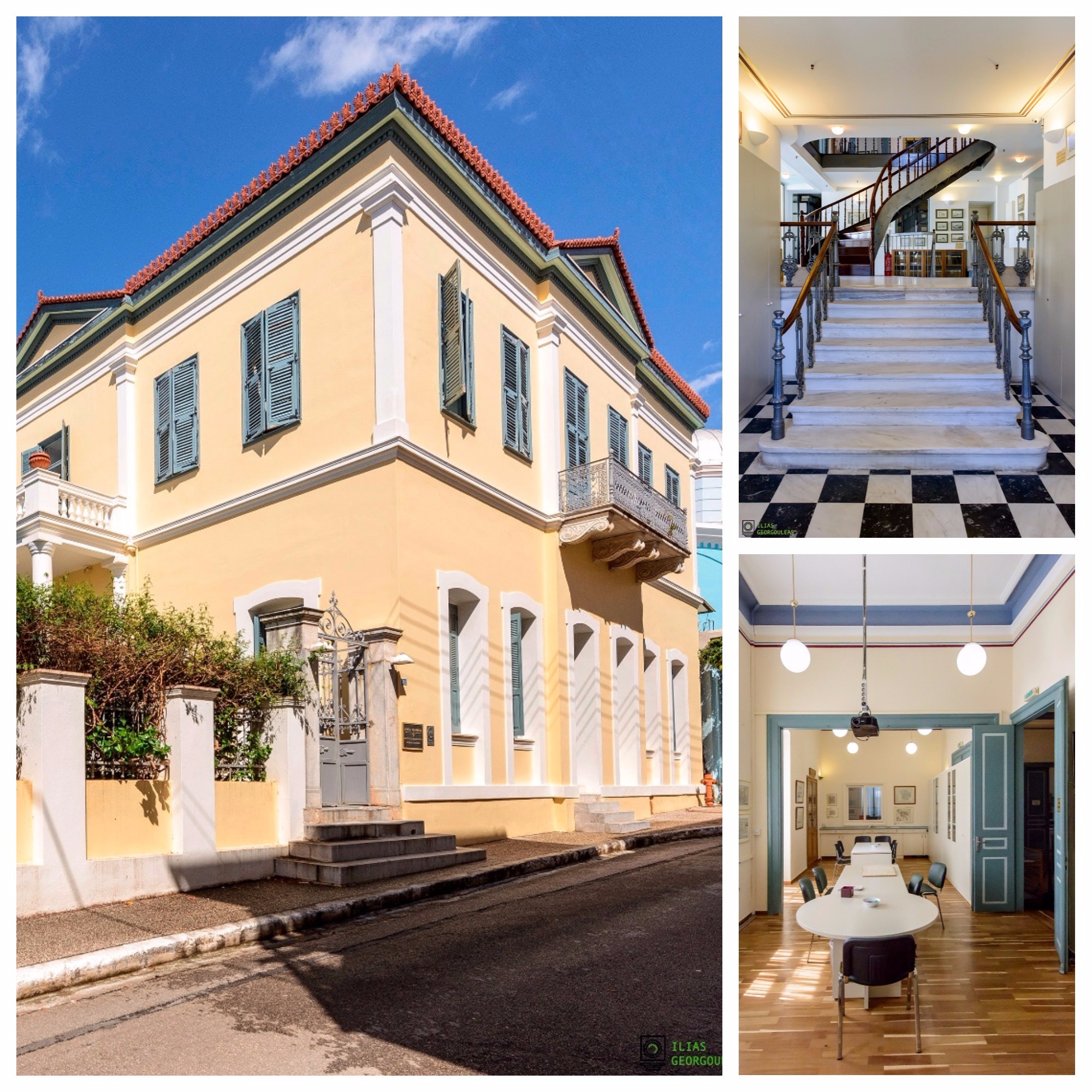
I was anxious to return to the Archives in Kalamata. During my visit of July 2016, the office was moving to a new location and everything was packed in boxes, which made research impossible. I was thrilled to see its new home: a stunning neoclassical building constructed in the 1880’s and rebuilt after the earthquake of 1986.

General Archives of Greece, Kalamata, Messinia

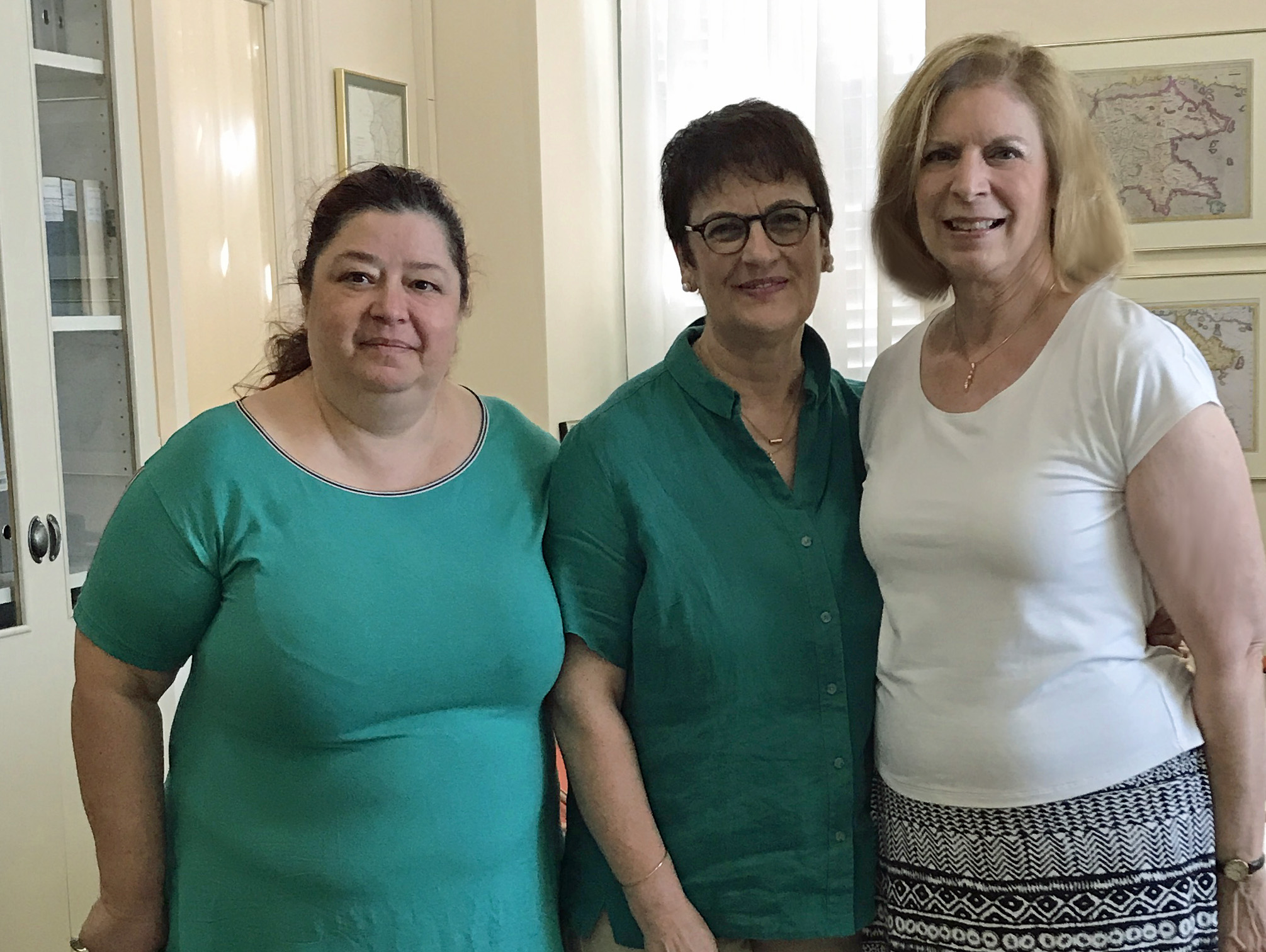
I am ever grateful for the help and kindness of my friend, Giota Siora, who met me in Kalamata and escorted me to the Archives. Giota knows the archivist, Anastasia Milioni, who was eager to assist us in any way possible. My goal was to search for information about two families with possible early ties to the Kalamata region: Eftaxias (prior to relocating to Mystras) and Zaharakis (prior to relocating to Theologos).

GAK, Kalamata: Giota Siora; Anastasia Milioni, Archivist; Carol Kostakos Petranek, July 2017

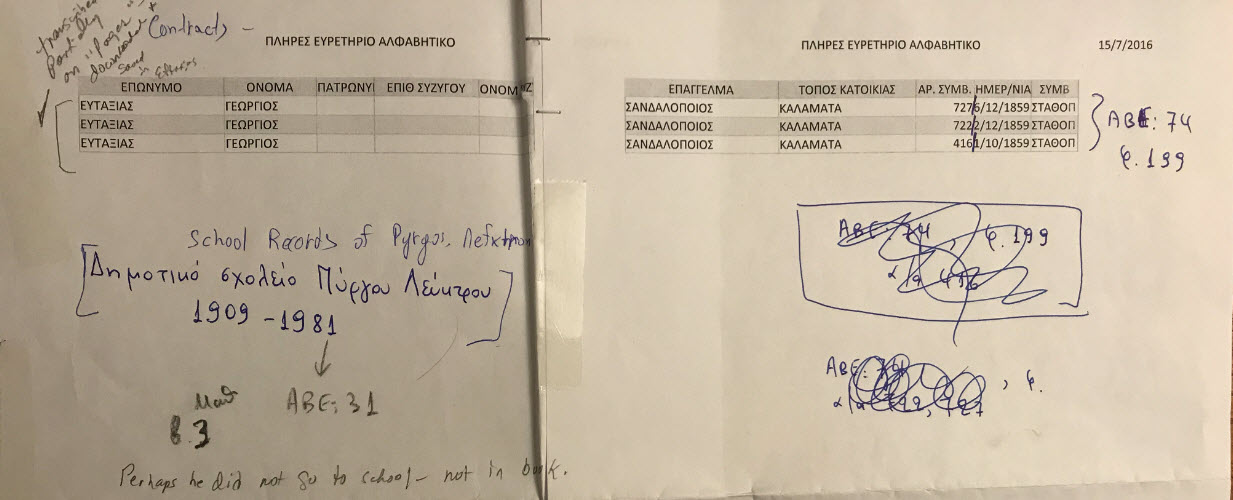
In 2016, Mrs. Milioni had given me a print-out of contracts with the Eftaxias name. There were three for Georgios Eftaxias who was in Kalamata in 1859.

Eftaxias contracts, 1859. General Archives of Greece, Kalamata, Messinia

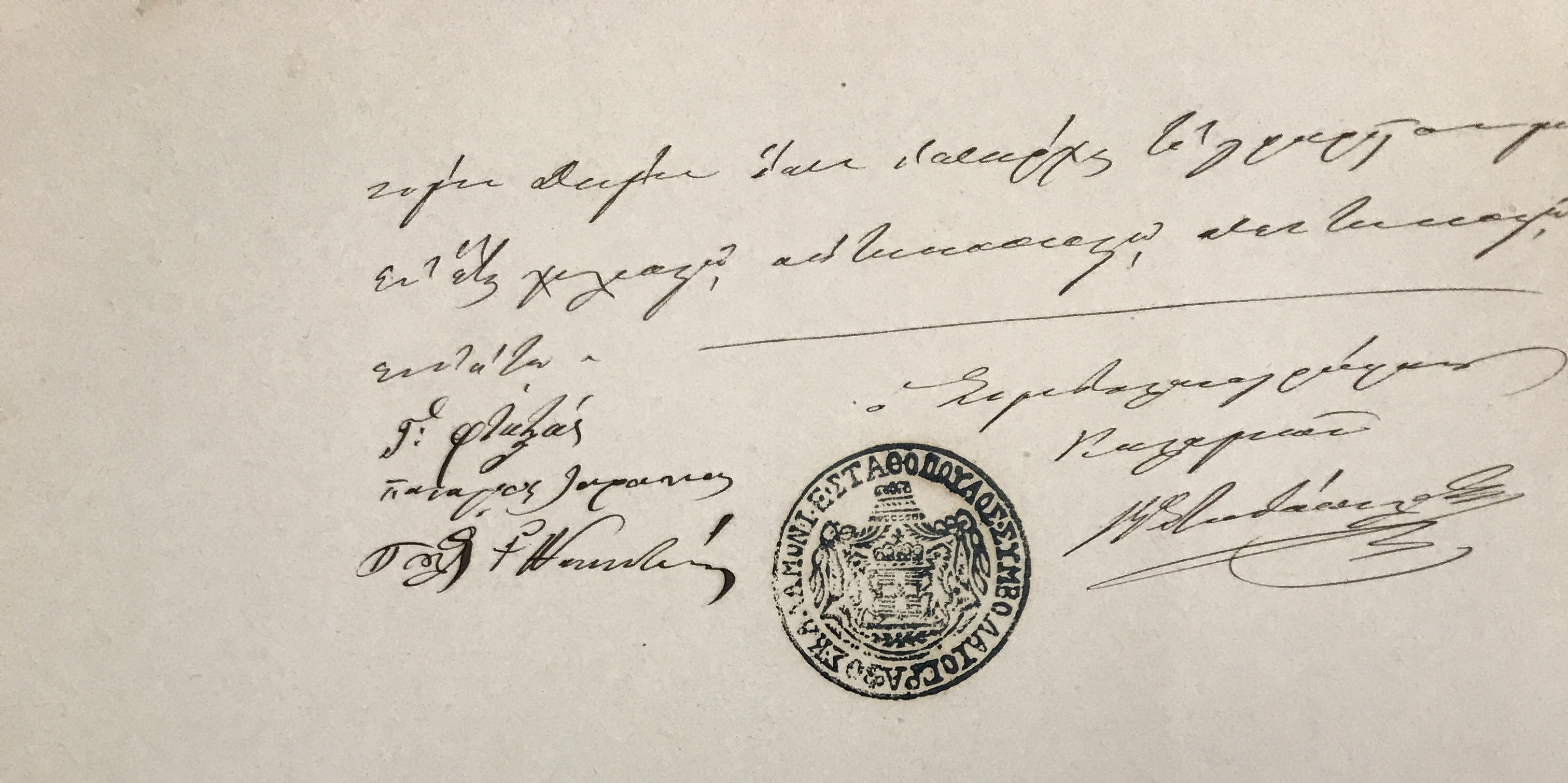
After the contracts were retrieved, Giota amazed me with her ability to read the documents. They were not written in typical old Greek script, but in a specific type of calligraphy used by lawyers and high government officials in the 1800’s.

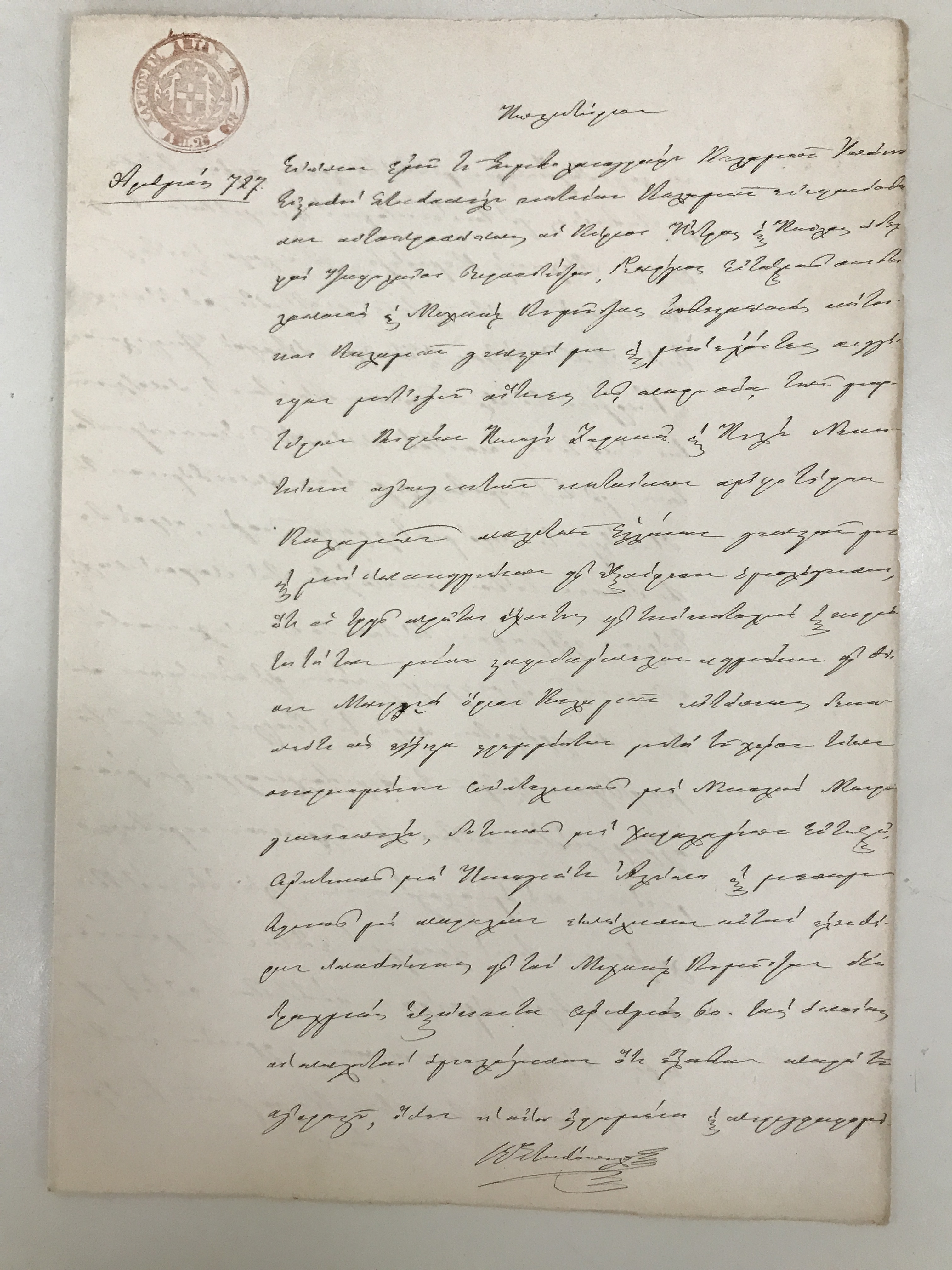
Below are page one and the signature page of Contract 727 for Georgios Eftaxias, along with a synopsis by Giota.

Eftaxias, Georgios; Contract 727 p.1. Kalamata, Messinia. July 2017

Eftaxias, Georgios; Contract 727 p.3 – signatures.. Kalamata, Messinia. July 2017

Contract 727 Georgios Eftaxias in Kalamata 1859
Final payment on land purchase
Georgios Eftaxias bought a field at Mavria (on the border of Messinia and Laconia). He paid 60 drachmas on the balance due. He bought the land from Michail Koumoutsas who was a lime maker. One of the owners of land bordering his is Haralambos Eftaxias.

With three contracts for Georgios Eftaxias, I now have proof that a family was in Kalamata. But is this my family? Possibly yes, possibly no.

  • I have an Eftaxias “DNA cousin,” Peter, who was born in a village adjacent to Mystras. His father said that their Eftaxias family came from Kalamata. This is definitely his family. Since we have a genetic connection, this is one point on the “yes” side.
  • The very name, Eftaxias, has ecclesiastical connotations. Gregory Kontos sent me this definition: the one that is in charge of the good order of the church:   good=ευ order=τάξη. So, this could be an example of families who had worked in a church and adopted the position title as a surname. This is one point on the “no” side.

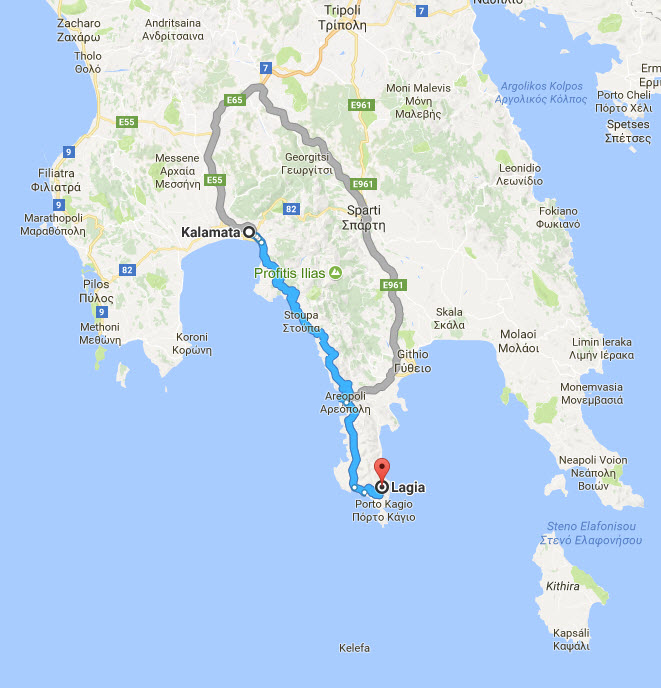
Another twist:  the Election Lists of 1875 show a Michalis Eftaxias who was born around 1800, fought in the Revolution, and lived in Lagia. That is 117 km from Kalamata, a 39-hour walk! Is it possible these two families are related? Not impossible, but perhaps improbable. This could be an example of the second bullet–someone working in a church, taking the ευταξη title as a surname.

So, the definite answer to my question is, “I don’t know.”
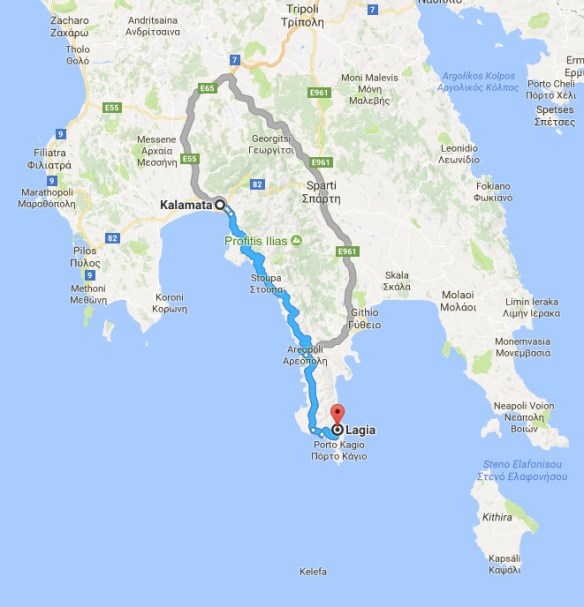
Lagia to Kalamata is 117 kilometers

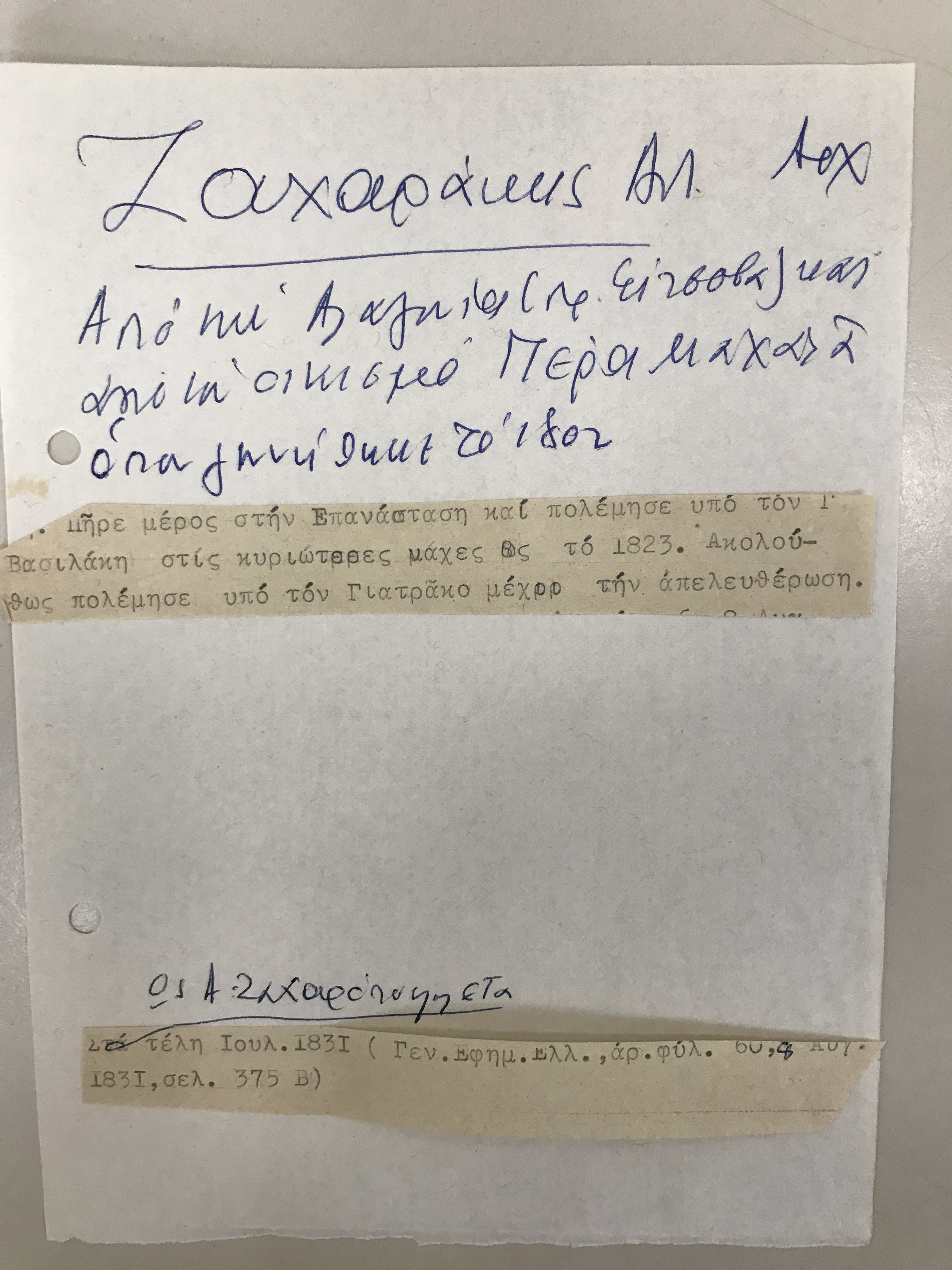
The Archives in Kalamata has a one-of-a-kind collection created by Μίμη Iλ. Φερέτος (Dimitris or Mimi Il. Feretos).  Giannis Michalakakos described Mr. Feretos as a journalist and writer who gathered information on fighters of the 1821 Revolution. In the early 1900’s, he interviewed people who had fought (or whose relatives fought) in the War of Independence. Mr. Feretos created a surname index which include brief notes and reference sources to find the original documentation. The GAK in Kalamata has a bookcase filled with Mr. Feretos’ notebooks. They are arranged in alphabetical order, and Giota easily found the Eftaxias and Zaharakis surnames.

This is a copy of one of the Feretos pages for Zaharakis. I found it fascinating to see how Mr. Feretos compiled and annotated information, long before the computer age.
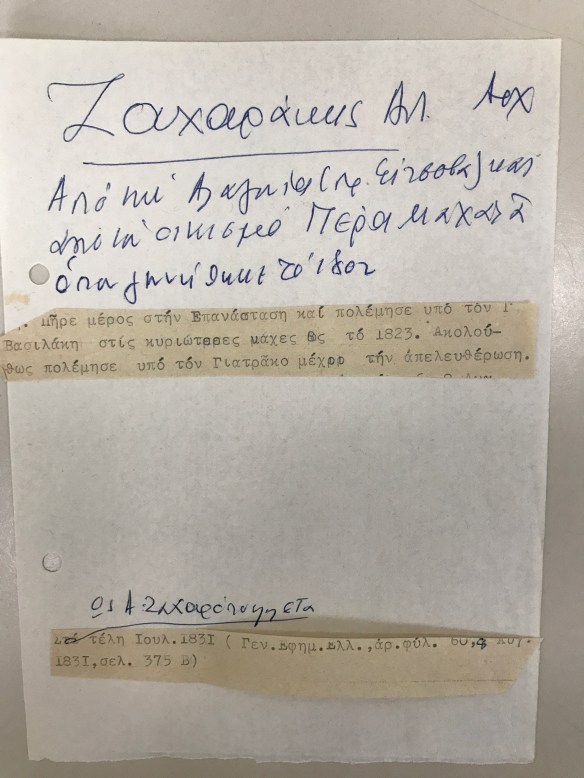
Zaharakis surname, notes from the files of Mimis Il. Feretos, GAK Kalamata, July 2017

A simple translation of this document, with my thanks to Giannis: M. Zaharakis, born in Sitsova [now known as Alagonia on the border of Messinia and Laconia]. He fought in the Revolution under George Vasilakos, in the main battles until 1823. Afterwards, he fought in the war under the Giatrakos family. In some documents, he is referred to as Zaharopoulos.

This document reveals two important things: first, M. Zaharakis is not my family; he was born in a region far from Theologos at a time when my Zaharakis are found in documents in Theologos. Second, M. Zaharakis was also known as Zaharopoulos. This is a critical piece of information because there is a long-standing (and frustrating!) pattern of Greeks changing their names. Having written proof that Zaharakis and Zaharopoulos in Kalamata are the same family, saves years and tears for the serious researcher.

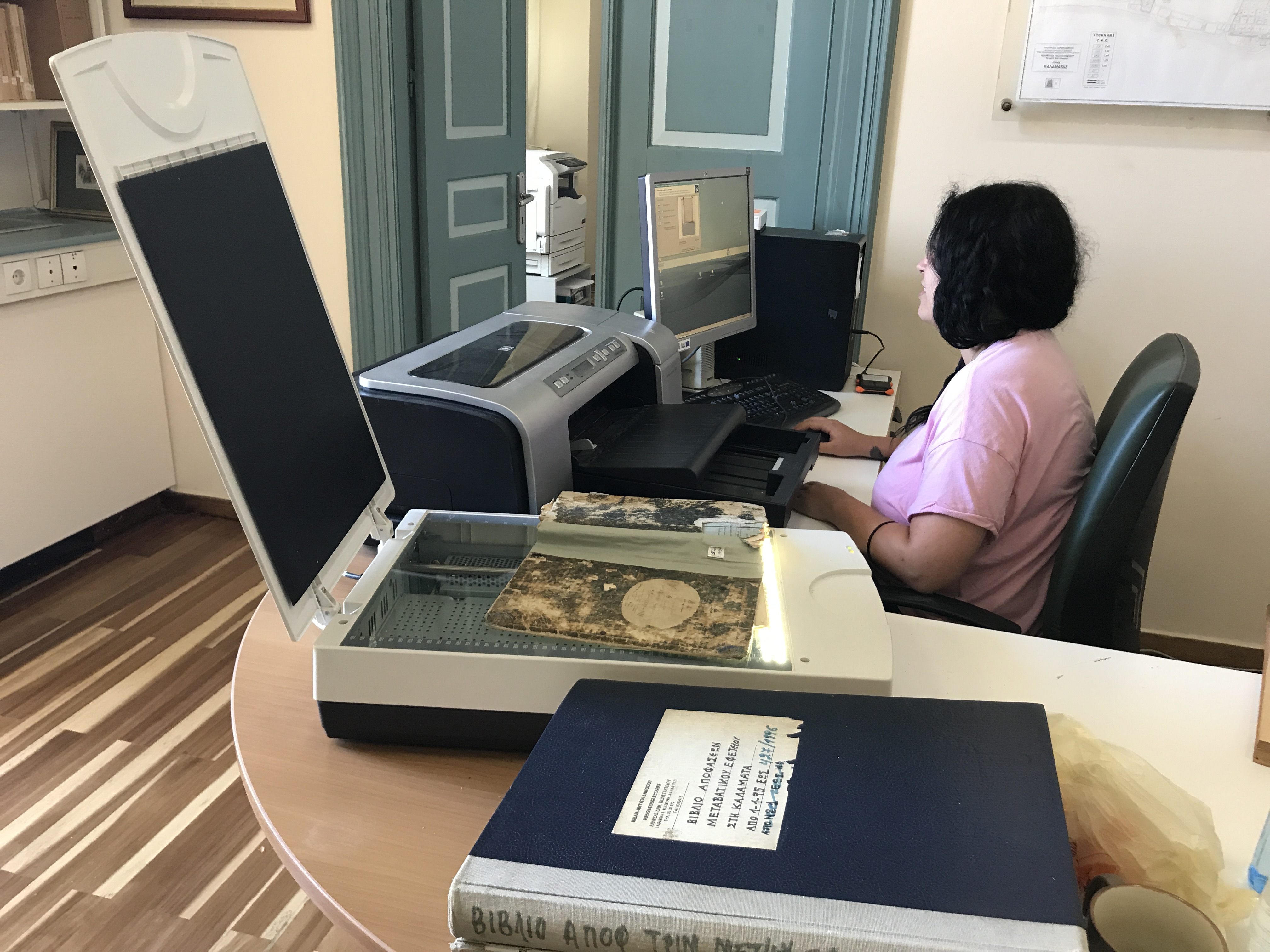
For anyone researching in Messinia, the Archives in Kalamata is an essential repository. The staff is actively digitizing as much of its collection as possible. They are friendly, helpful and supportive in every way.

Digitization underway at the Messinia Archives in Kalamata

Here are links to access the Archives website; its online digital collections; and its YouTube channel.This link is especially helpful, as it shows the collections in the Archives.

Was my research trip to Kalamata a success? Yes! I did not find the definitive information I was seeking to link my families in Laconia to the ones in Kalamata. However, I explored a new Archive, discovered the Feretos collection, found documentation to prove (and disprove) some of my theories. I visited the Kalamata Museum, filled with incredible antiquities and artifacts. Most importantly, I spent a delightful day with Giota, who inspires me with her continual desire to help and teach. Thank you, my friend!
 

Double Date

No, this is not a post about two couples going out for dinner or a movie date. It is, however, a description of something important that I learned this past weekend.

On Saturday, at the Greek Genealogy Conference held in Tarpon Springs, Florida, I taught a class entitled, “Using U.S. Records to Begin Greek Research.” In this presentation, I used numerous examples of records that may have information to help  find the original name of an ancestor (such as Papadopoulos, not just Pappas), and also the village of birth (very important, as records in Greece are cataloged by location).

I emphasized the importance of finding every record that could have possibly been created in the U.S. for an ancestor. The reason is that each document may have new or different information. When documents for a direct ancestor are hard to find, look for documents of siblings or other family members, and do your best to locate every piece of paper on which they could possibly be listed.

As an illustration, I used both civil and church marriage records for my maternal grandparents. This is the State of New York Certificate and Record of Marriage for Ilias Papagiannakos and Angelina Eftaxias; note that the date is May 10, 1914:

New York State Certificate and Record of Marriage, Ilias Papagianakos and Angelina Eftaxias

State of New York: Civil Marriage Record Louis Papagianakos and Angelina Eftaxia GROOM: age 32; occupation: oyster dealer; birthplace: Greece; father’s name: Panagiotis; mother’s maiden name: Caterina Eliopoulis BRIDE: age 20; birthplace: Greece; father: Constantinos; mother’s maiden name: Stafia Zaharopoulo. Joined in marriage at 358 West 44th Street, Manhattan on 10th of MAY 1914

This is the Greek Orthodox Marriage Certificate from Holy Trinity Church in New York for the same grandparents. Note that the date of marriage is:  27/10 April, 1914.

pappas-louis-angelina-marriage-certif-001

Greek Orthodox Marriage Record; Holy Trinity Church.   Of Agios Ioannis, Sparta, Ilias Panag. Papagiannakos and of Mistra Aggeliki Kon. Eftaxia married on 27/10 APRIL 1914 Best man: Christos Aridas FATHERS: Panagiotis Papagiannakos KON [Konstandinos] Eftaxias

As I described the differences between the civil and the church marriage records, I mentioned that I was puzzled by the “double date” on the church record. I did not understand the discrepancy between the two dates and what 27/10 April was referring to.

After the presentation, Adamantia Klotsa, Consul General of Greece, approached me and solved the mystery. She explained that the “double date” on the Greek certificate referred to the dates as they were calculated by both the Julian Calendar (27 April) and the Gregorian Calendar (May 10). There is a 13-day difference between the dates in these calendars, and the Greek record reflected both because Greece used the Julian calendar until 1922. With this marriage occurring in 1914, it now makes sense as to the correctness of the date as noted on the Greek Orthodox Marriage Record–the difference between April 27 and May 10 is exactly thirteen days.

Genealogy is never boring–there is always something new to learn!

Return to Greece, 2016. Part Six: It’s All About Family

This is the sixth post in a series about my trip to Greece, June 30-July 20, 2016 — an amazing journey of history, family and discovery. Previous posts can be found here.

Open arms with tight hugs. Kisses on both cheeks. Happy smiles and joyful reunions. This is how my family greets me when I return to Sparta. There are so many places to explore and discover; but for me this is the bottom line:  it’s all about family. Prior to my visits to Greece, the names and places on my pedigree chart were simply long names and dots on a map. Now, they are attached to real people who have become a vibrant and important part of my extended family.

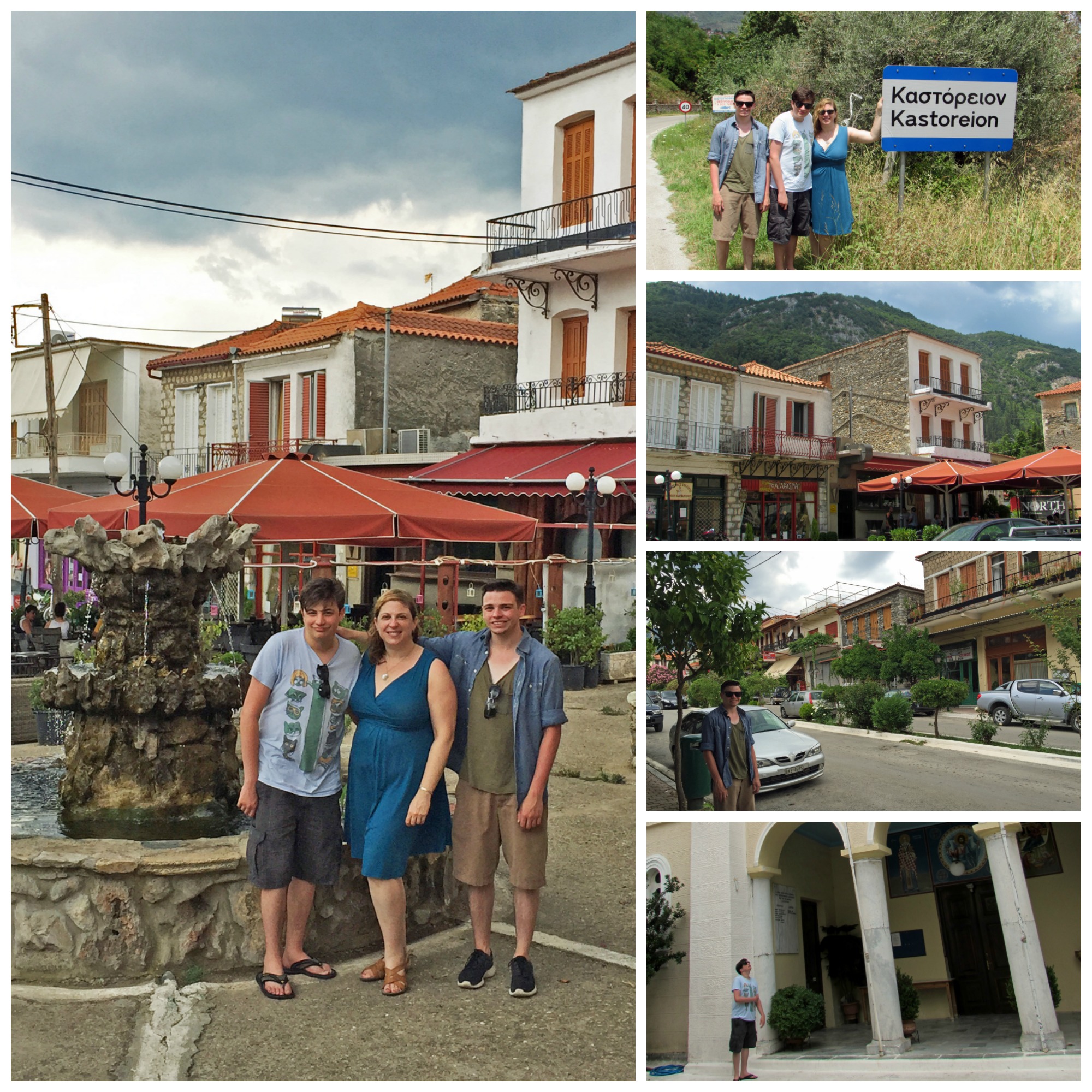
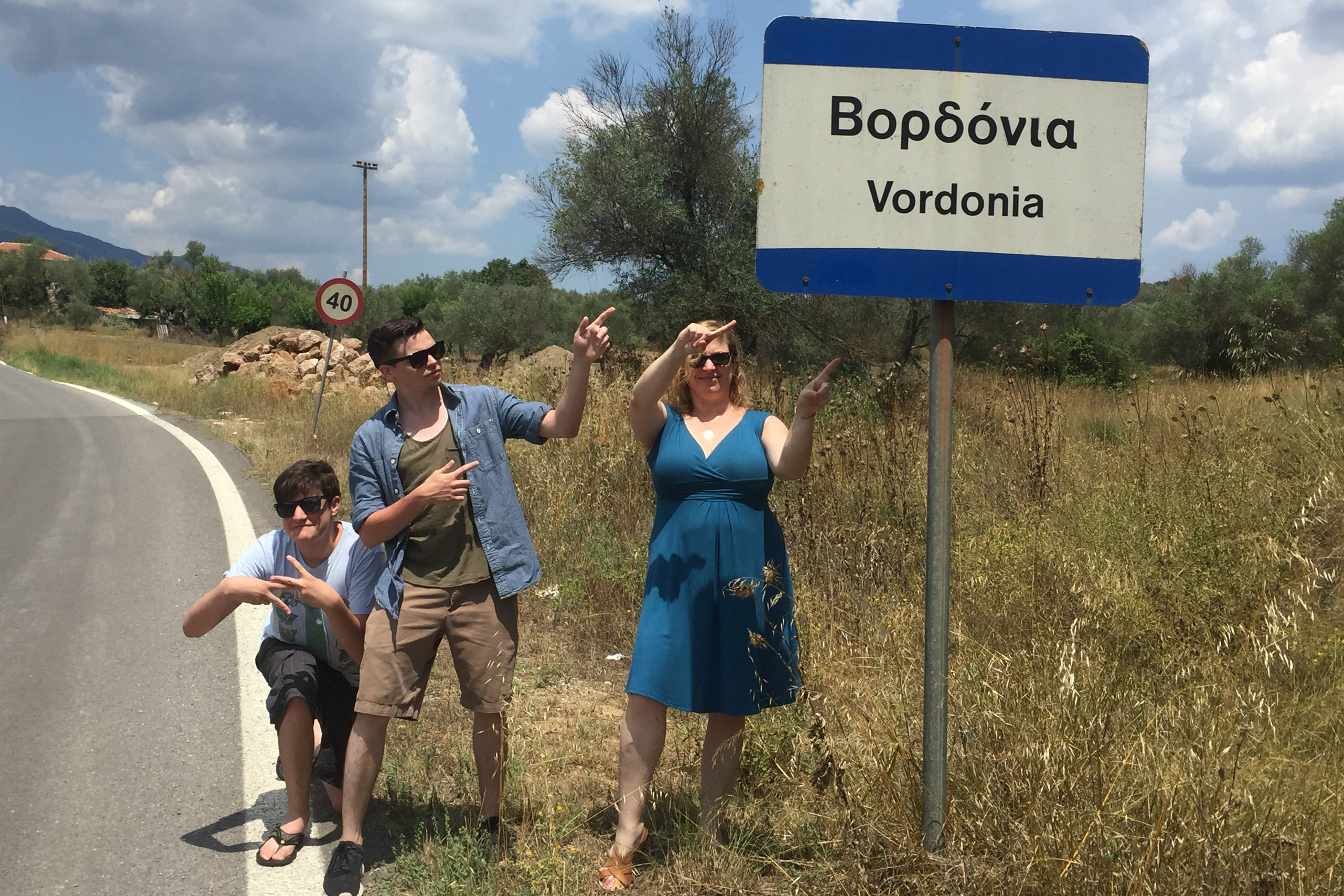
Joy is sharing what you love with whom you love. For me, joy is introducing my family to their roots — touring our villages and meeting our relatives. Kathy’s paternal grandparents are Kallianes from Kastania (now Kastoreion) and Linardakis from Vordonia. Although we don’t know of family now living there, we so enjoyed exploring the towns, peering into shops, watching chickens, dogs and cats roam their yards, and looking at stone and stucco houses that have sheltered countless families through countless years.

Kastoreion, Laconia. July 2016

Kastoreion, Laconia. ancestral village of the Kallianes family, July 2016

Vordonia, Laconia, July 2016

Andrew, Ben and Kathy at the Linardakis village of Vordonia, Laconia, July 2016

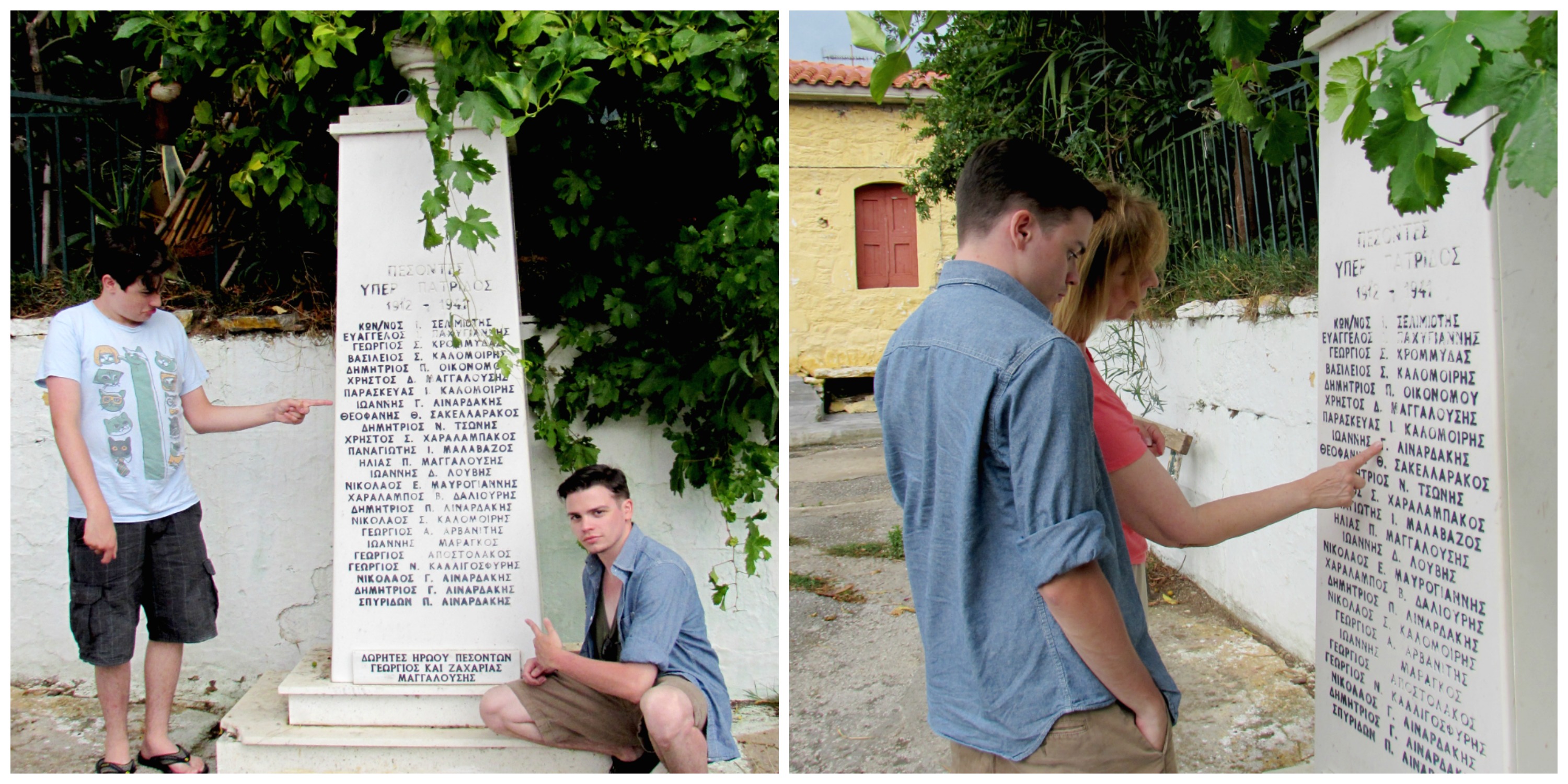
I love the monuments erected in every town that memorialize those who died in military service. My heart skips whenever I find an ancestral name etched in marble. Even if I cannot connect that individual to my line, I know that in these small villages, people with the same surname are almost certain to be related. While driving in Vordonia, we turned into a back street and unexpectedly were confronted by the village monument. stopping to examine it, I became emotional when I showed Ben and Andrew several men with the Linardakis surname.

Finding the Linardakis surname; Vordonia, July 2016

Finding the Linardakis surname; Vordonia, July 2016

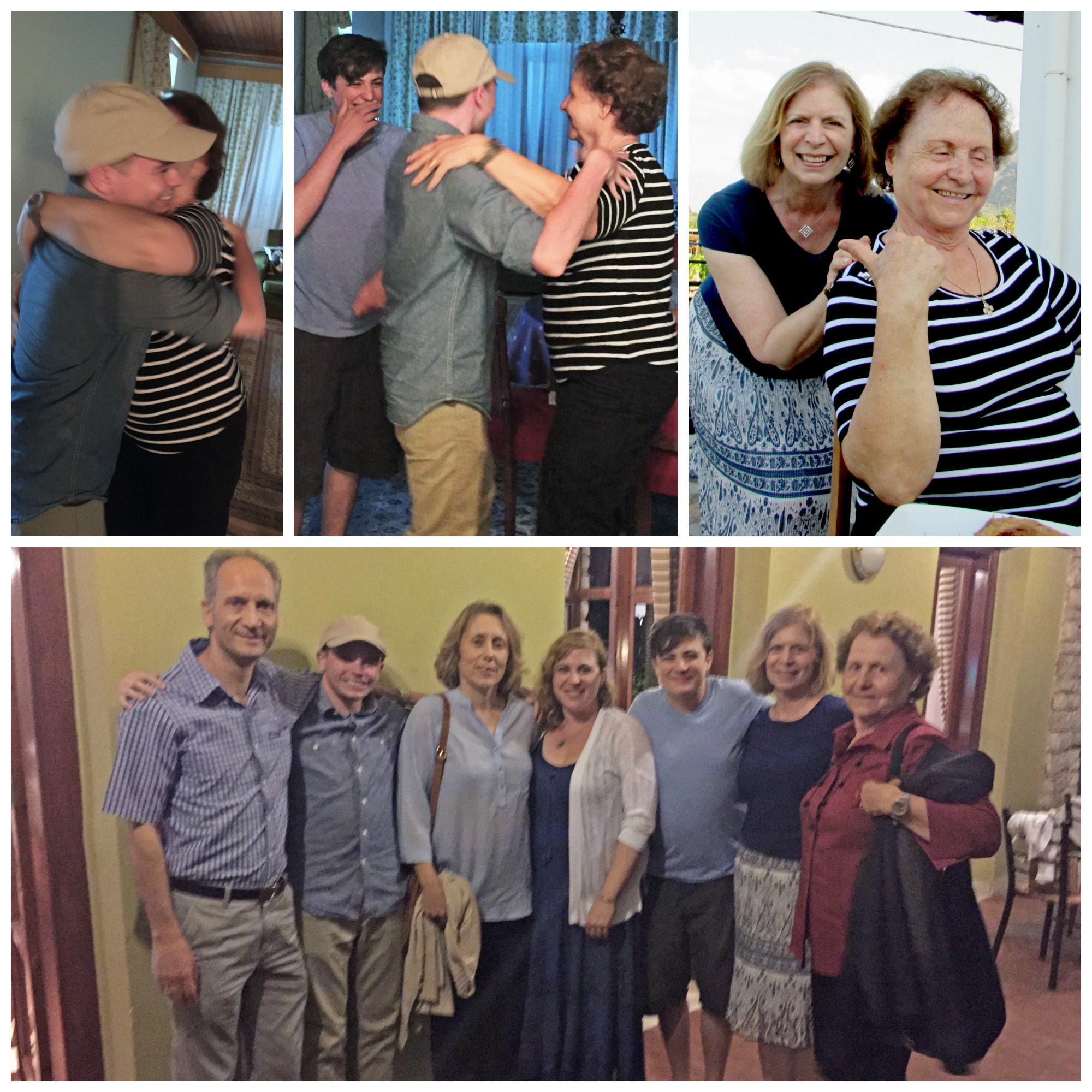
Visiting our Aridas and Kostakos familes in Agios Ioannis has endeared my grandchildren to their Spartan relatives and grounded them to the land of their ancestors. Bridging the Atlantic and meeting kin has widened their concept of family. Eating a meal in a house built by their ancestor in the mid-1800’s has brought them a sense of “rootedness” that is unparalleled. And best of all, they were warmly embraced and loved immediately by all who met them.

These are photos of my Kostakos and Aridas family in Agios Ioannis, Sparta. They are on my father’s side — my grandparents were John Andrew (Ioannis Andreas) Kostakos and Hariklia Aridas, both born in Agios Ioannis. On the Kostakos side, our common ancestor is Andreas Kostakos who was married twice: first to Anastasia, then to Poletimi Christakos. These two Kostakos families are descended from Andreas and Anastasia; I am descended from Andreas and Poletimi. On the Aridas line, our common ancestor is Michail Aridas and his wife, Stamatina.

Ioanna Kostakos Family, with Ben Soper, Andrew Soper, Kathy Lynard, Carol Kostakos Petranek, Peggy and Vassilis Vlachogiannis, Agios Ioannis, July 2016

Family of Ioanna Kostakos of Agios Ioannis. With Ben Soper, Andrew Soper, Kathy Lynard, Carol Kostakos Petranek, Peggy and Vassilis Vachaviolis, and Ioanna Kostakos, July 2016

family-kostakos-eleni-group-07-13

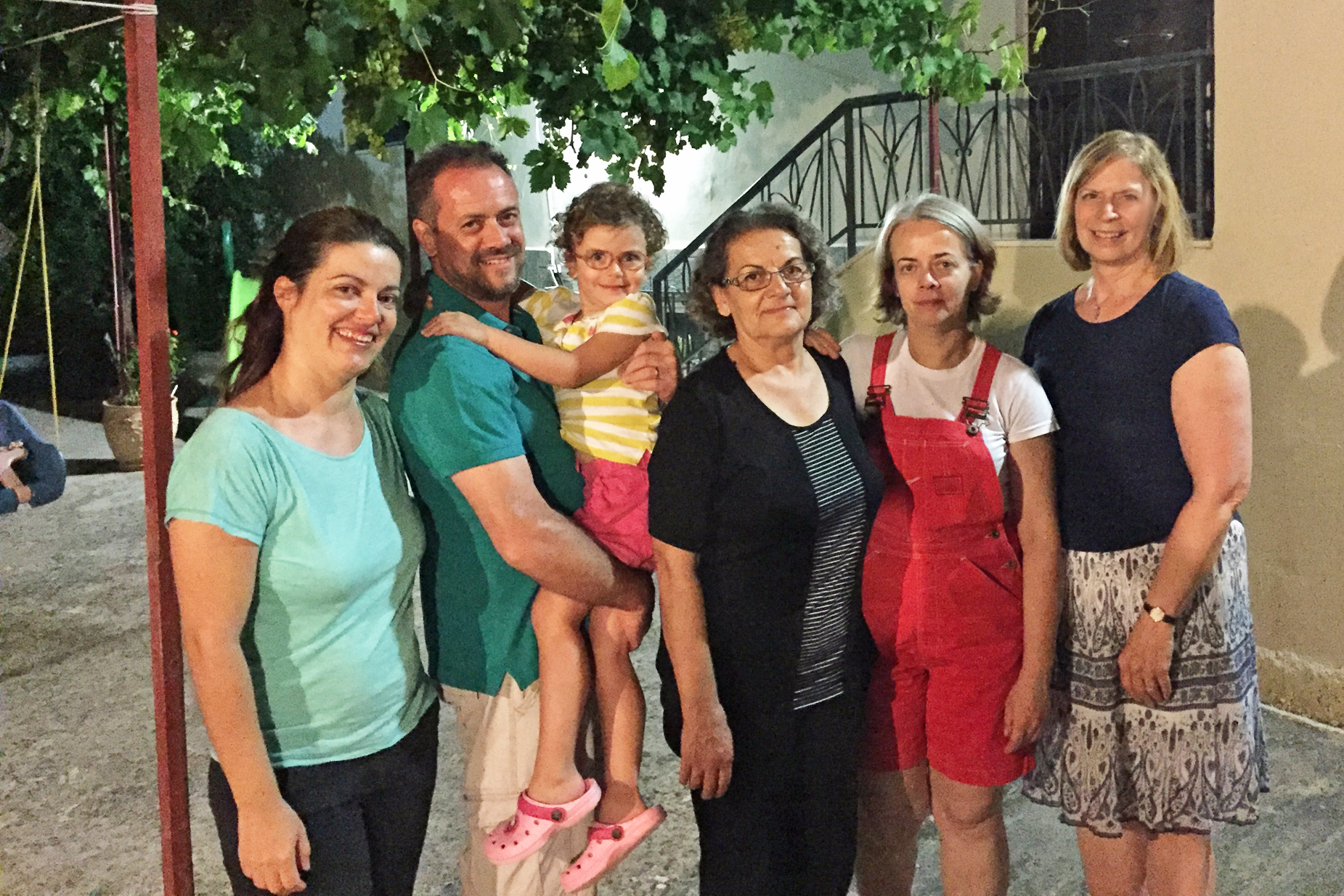
Family of Eleni Kostakos of Agios Ioannis. Natasa, Panos, Eleni, Eleni, Panorea, Carol Kostakos Petranek, July 2016

Family of George Aridas, Agios Ioannis. George, Roula, Adamandia Aridas; George's sister, Afroditi. July 2016

Family of George Aridas, Agios Ioannis. George, Roula, Adamandia Aridas; George’s sister, Afroditi. July 2016

This is the Chelidonis Family of Athens. Nikos is my second cousin on my mother’s line. His mother was Tasia Eftaxia from Mystras; our common ancestor is Ioannis Eftaxias, born 1809. My grandmother, Angelina Eftaxias Papagiannakos, was Tasia’s aunt. Panagiotis found me on Facebook three years ago, and we met in person during my trip in 2014. We were so excited to connect our families, as neither of us knew that the other existed!
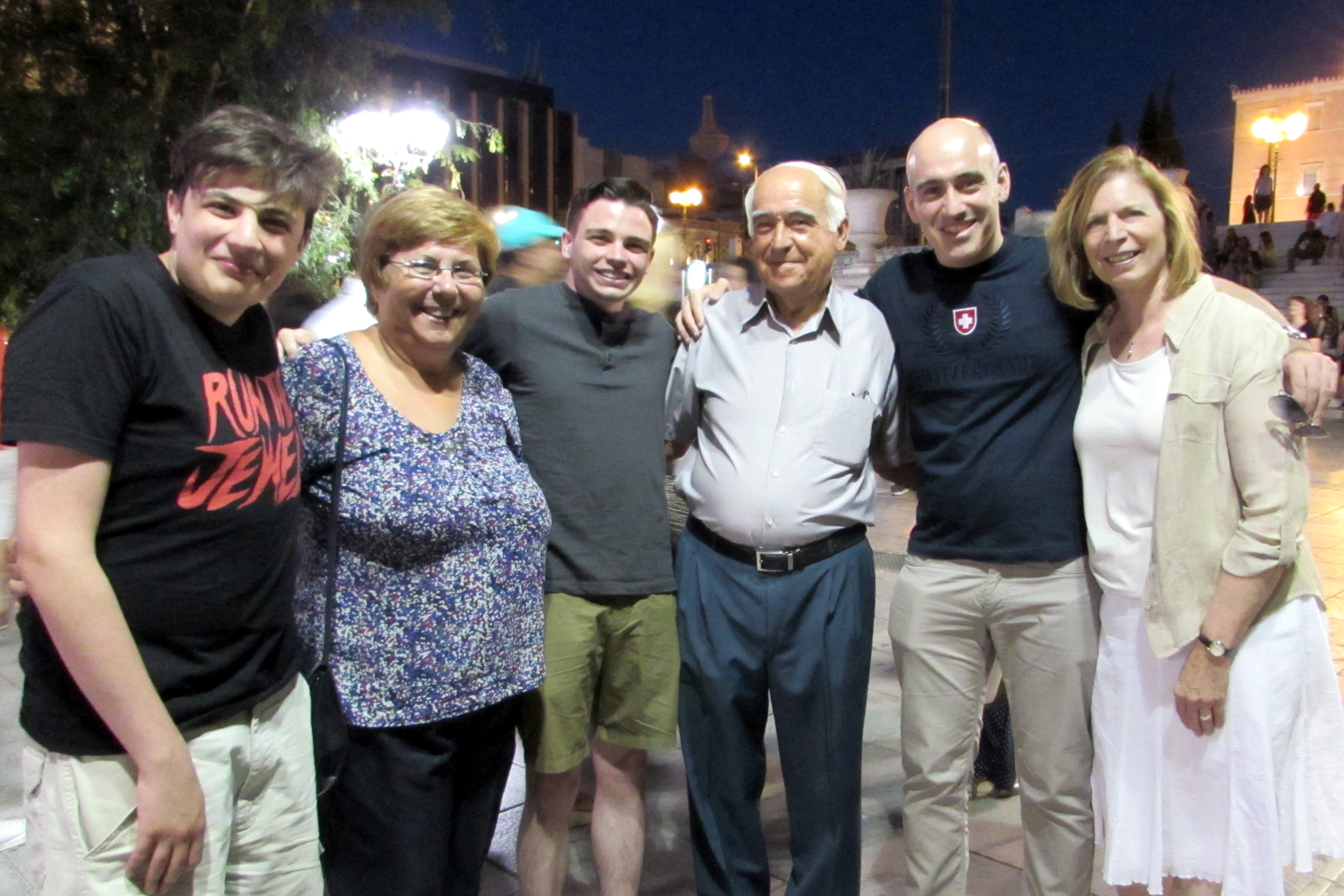
Family if Nikos Chelidonis, Athens. Viki, Nikos, Panagiotis. July 2016

Family if Nikos Chelidonis, Athens. Viki, Nikos, Panagiotis. July 2016

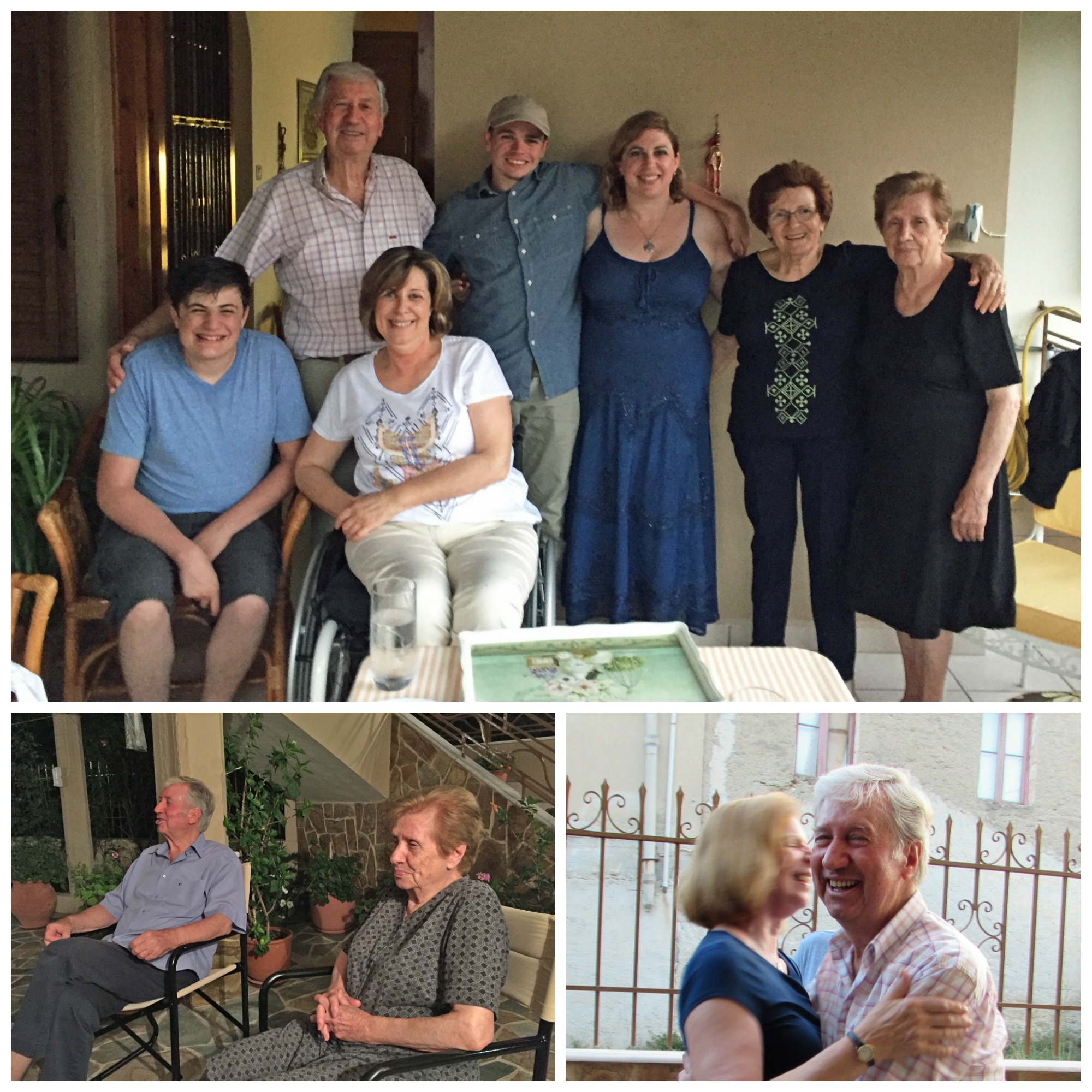
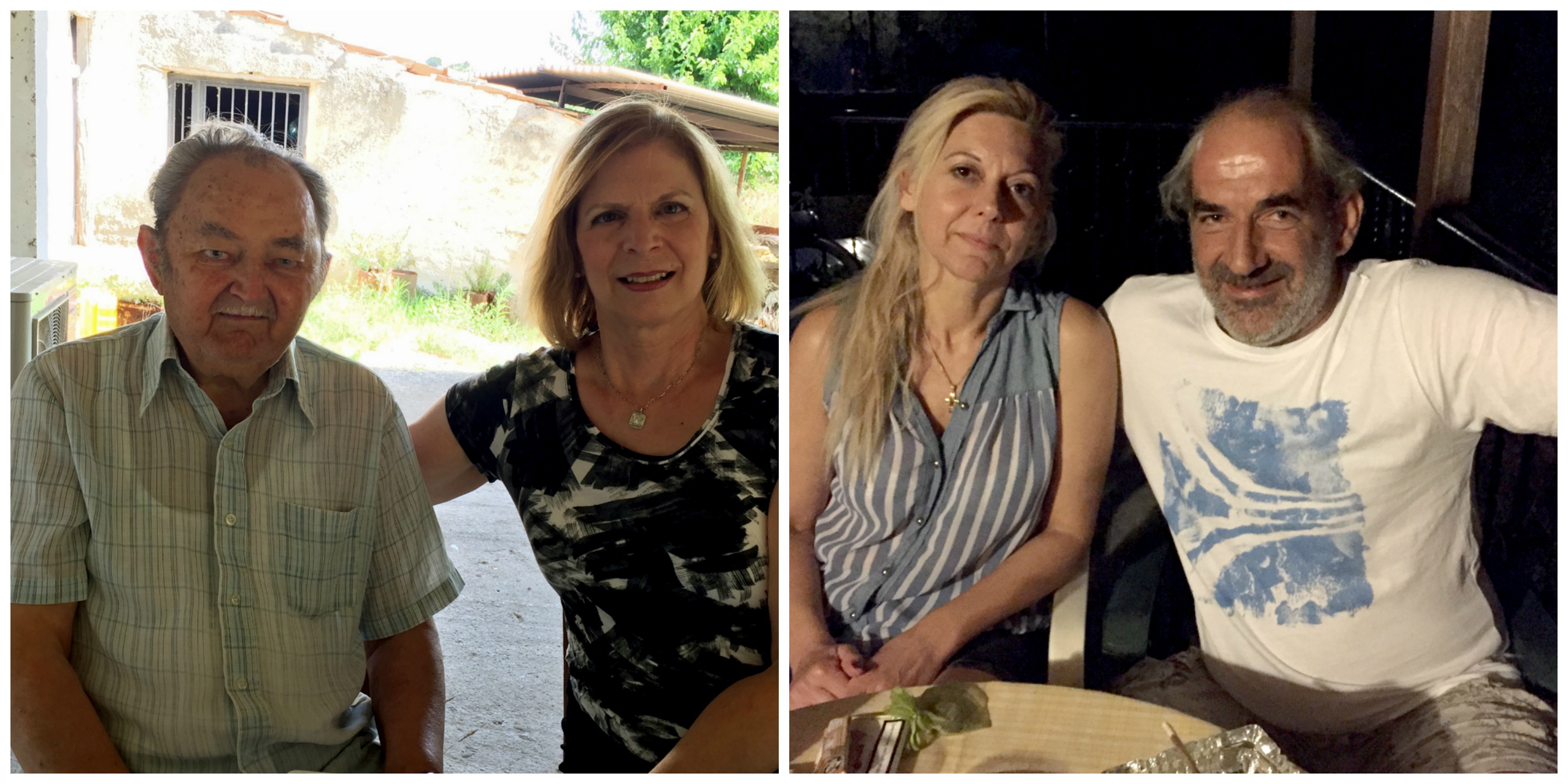
The Eftaxias family of Mystras has long roots in Mystras. My grandmother, Angelina Eftaxias is the aunt of Andreas (photo on left). Andreas’ son, Lewnidas, is a master stone mason and works on churches and other buildings throughout southern Laconia.

Andreas Eftaxias, his son. Lewnidas ad Afroditi. Mystras, July 2016

Andreas Eftaxias, his son. Lewnidas ad Afroditi. Mystras, July 2016

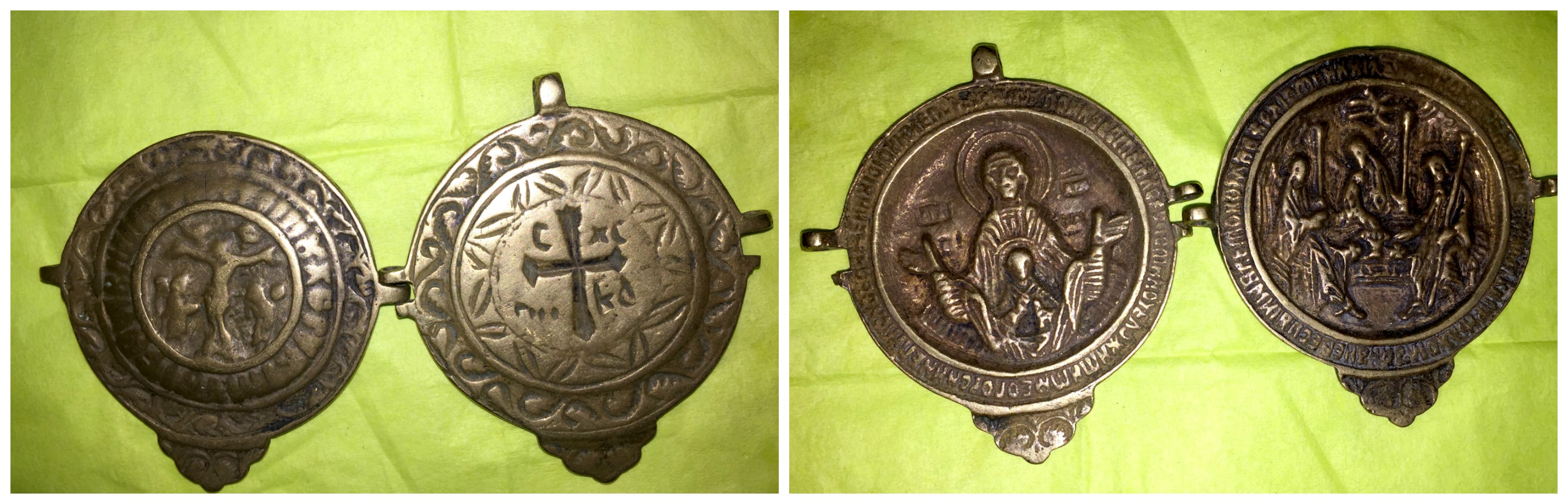
Lewnidas and Andreas told me that our first Eftaxias ancestor escaped from Constantinople during the Ottoman conquest in 1453! He and three friends fled together and settled in Mystras. Lewnidas showed me a bronze medallion that was brought by this ancestor and kept by the family for generations. I posted this photo on our HellenicGenealogyGeek Facebook page and knowledgeable friends there described the medallion: l-r: Christ on the cross; Byzantine cross with words, ” Ιησούς Χριστός Νικά”; the Holy Mother, Mary; and the Holy Trinity, possibly based on Rublev‘s painting of the same name.
Medallion dating to 1453, belonging to Eftaxias family; Mystras, July 2016

Medallion dating to 1453, belonging to Eftaxias family; Mystras, July 2016

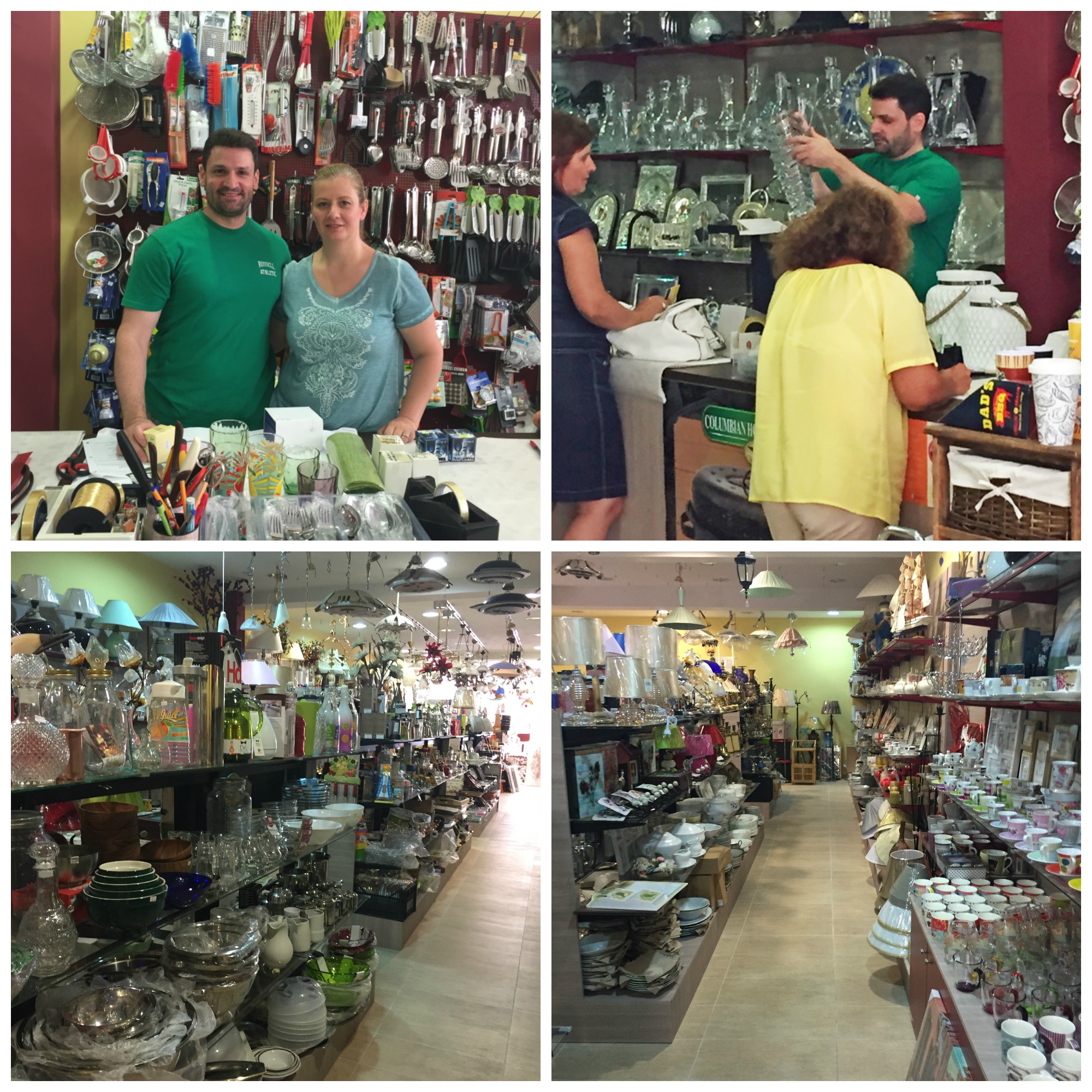
I was so thrilled to extend my family further on this trip. My new-found cousin, Dimitrios Papagiannakos, and his wife, Georgia, own a beautiful home goods store in Sparta which sells a myriad of items from cooking utensils to beautiful crystal. I think I gave Dimitrios quite a shock when I walked into his store and introduced myself as his cousin from America! I had brought photos of his Pappas family in the U.S., including a group shot taken at our Pappas Cousin’s Reunion. Working around his customers, we managed to have a spirited and lovely conversation about our families. My only regret was that his parents were out of town and I was unable to meet them. Next trip!

papagiannakos-store-collage

Dimitrios and Georgia Papagiannakos in their lovely home goods store, Sparta, July 2016

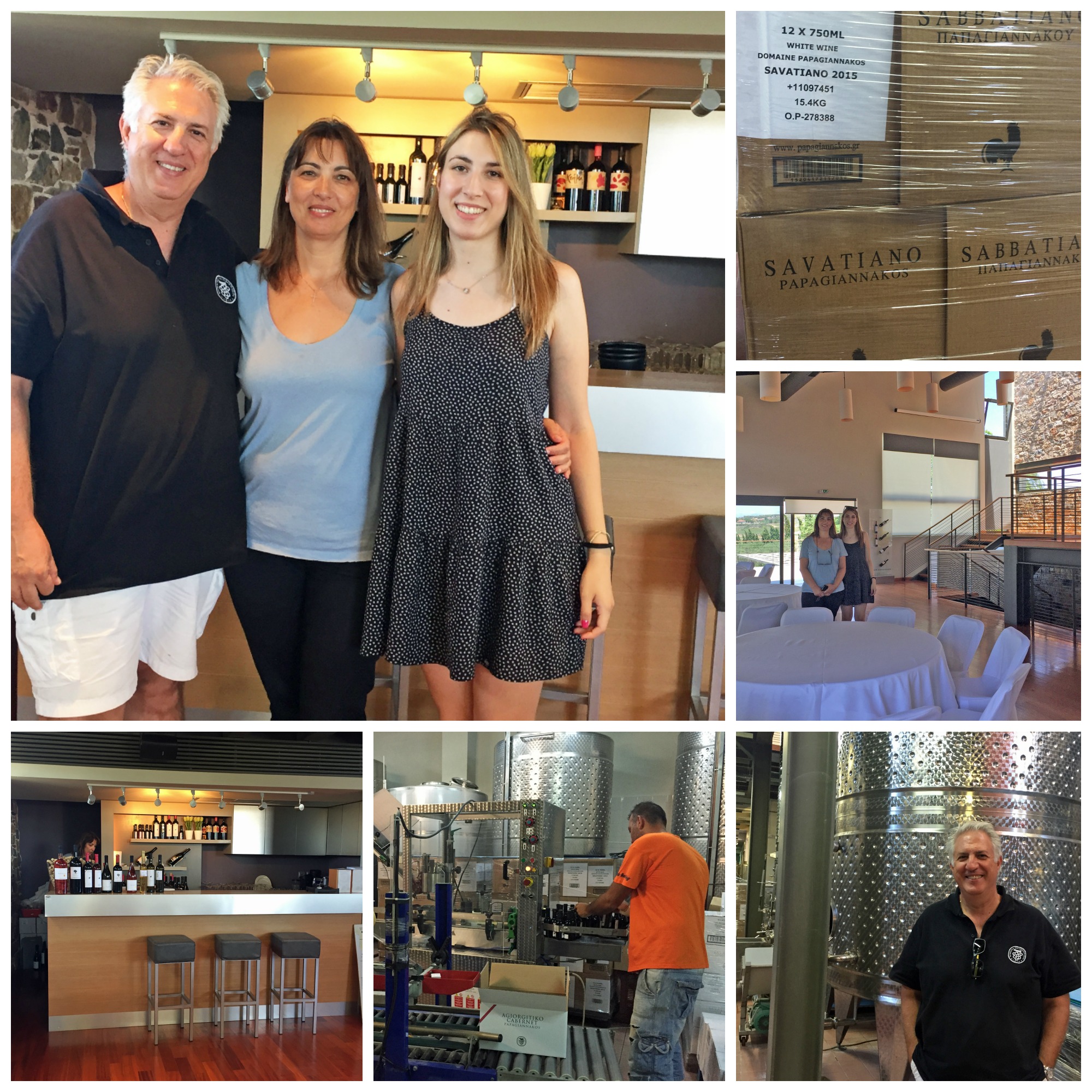
I also traveled to Markopoulos, northeast of Athens, to meet Vassilis Papagiannakos, owner of the Papagiannakos Winery. The winery was started by his grandfather, also named Vassilis, in 1919. Now managed by the 3rd generation of Papagiannakos’, Vassilis and his wife, Antonia, have expanded the business, developed new and award-winning wines, and constructed a beautiful edifice where business events, weddings and other activities are held. Although Vassilis and I do not know how–or if– we are related, we are looking to explore our family roots together.

papagiannakos-winery-collage

Vassilis and Antonia Papagiannakos and their daughter, Aggeliki. Papagiannakos Winery, Markopoulos, July 2016

Every trip to Greece strengthens my family ties. I love these cousins. They set an example of hard work, honesty and devotion to our family and our heritage. I am ever-grateful to have the means and the opportunity to introduce them to my own descendants. Together, we carry on traditions and relationships that honor our ancestors.