Beyond the Basics: Contracts

Notary files in archive offices contain gems of information about families, businsess dealings, and traditions. People who entered into contracts–whether for dowries, businesses, or loans–ensured that the contract was legally binding by signing before a notary and witnesses. At the Sparta, Lakonia office of the General State Archives of Greece, Gregory Kontos and I found several notary files of great interest to me which documented transations by my ancestral family.

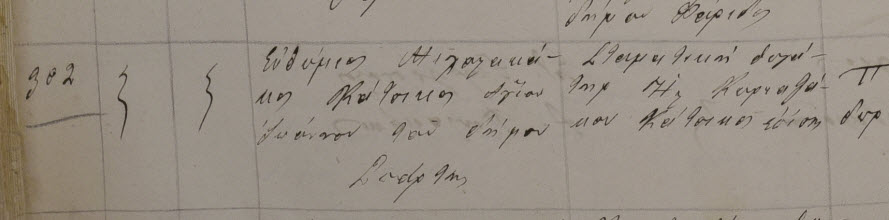
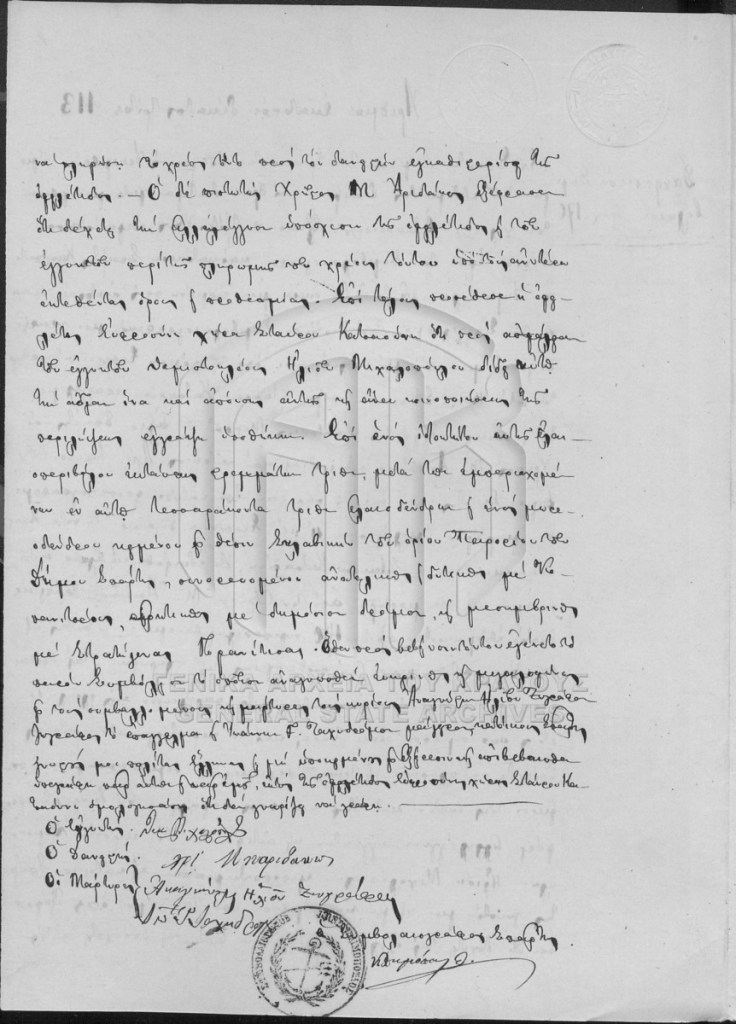
This is one of those notary documents. My great-grand uncle, Christos Aridakos (Aridas) entered into a contract to loan money to Ephrosyni Stasinakis. The document is dated December 30, 1863. The details are fascinating! This translation was done by Gregory Kontos.

Lending contract between Christos Aridakos and Ephrosyni Stasinakis, 12/30/1863

page 1

(page 1)
In Sparta, today, on the 30th of month December, day Monday, and at 2pm, of year 1863, Ephrosyni, daughter of the late Konstantinos Stasinakis and widow of Stavros Katsaounis, housekeeper and resident of Mystras of the Municipality of Sparta, and Christos M. Aridakos, landowner and resident of Agios Ioannis of the Municipality of Sparta, both known to me and legal people, appeared before me, notary and resident of Sparta, Konstantinos Dimopoulos, at my notarial office, located at my house which is at the east of the Church of the Annunciation of Theotokos. In the presence of the witnesses signing below they stated the following: Ephrosyni, daughter of the late Konstantinos Stasinakis and widow of Stavros Katsaounis, declared that she borrowed and got, before me and the witnesses, 170 drachmas from Christos M. Aridakos, including their interest until the expiration of the payment, and promises to return this money to him after the lapse of one whole year from this day without any interest. In case of a deferred payment, she promises to pay an agreed interest of 20% per year; and in order for the lender to be secure, she adds Themistocles Ilia Michalopoulos, merchant-landowner and resident of Sparta, present, known to me and legal, as a joint and several guarantor. He (Themistocles) stated that he accepts this guarantee of the debtor and promised
page 2

(page 2)
to pay this debt to the lender. On the other hand, the creditor, Christos M. Aridakos, declared that he accepts the promises of the debtor and the guarantor to pay this debt under the above mentioned terms and deadlines. Lastly, the debtor, Ephrosyni, widow of Stavros Katsaounis, added that in order for the guarantor, Themistocles Ilia Michalopoulos, to be secure she gives him the permission to mortgage an olive grove of herself, 3 acres big, together with the 43 olive trees in it and a […]tree, located at the place “Sklaviki” at the borders of Parori of the Municipality of Sparta; on the east and west side the field is adjacent to the Koumanitoros family, on the north side to a public road and on the south side to Stratigena Goranitissa. And as an indication was the present agreement contract created, which, after being read sufficiently and loudly before the stipulators and the witnesses, Mr. Anagnostis Ilia Zografos, painter, and Ioannis G. Tahydromos, cook, residents of Sparta and Greek citizens known to me, and after being confirmed, was signed by them and by me, except for the debtor, Ephrosyni, widow of Stavros Katsaounis, who claimed she’s illiterate.

The guarantor, Them. Michalopoulos
The lender, Chri. M. Aridakos
The witnesses: Anagnostis Ilia Zografos; Io. G. Tahydromos
The notary of Sparta, K. Dimopoulos

page 3

(page 3)
[…] It is requested from every bailiff to execute the present contract, and from every  attorney to do his duty, and from all the judges and public officials to help, if they’re legally asked to.

[…] In Sparta, July 7th 1866.
The notary of Sparta, K. Dimopoulos


Source: General Archives of Greece, GAK Lakonia, Sparta Office
Notary: Konstandinos Dimopoulos, Volume: 12.1.1
Contract Reference Number:  113/31.12.1863 (Contract #113; date: 31 December 1863)
Accessed July 2014; Carol Kostakos Petranek & Gregory Kontos   

Family History Book: John Andrew Kostakos and Harikleia Aridas

In October 2012, Hurricane Sandy flooded the streets of Brooklyn, New York. Among the damaged homes was that of my Aunt Alice Kostakos. Two of my cousins rescued hundreds of photos and many albums which were floating in the mucky water. In 2016, my cousins and I digitized these photographs, which I described in this post.

These pictures formed the basics of this family history book which documents the lives of my paternal grandparents, Ioannis Andreas Kostakos and Harikleia Aridas, both of Agios Ioannis, Sparta. Combined with family stories and many documents from the U.S. and Agios Ioannis, the book came together easily.

I loved every minute of working on this project. It enabled me to better understand the lives of our grandparents and their ancestors, and to truly appreciate my heritage. A pdf version of this book can be accessed here.

It is time to get information out of my computer and into the hands of family and relatives. With the multitude of documents I have accessed during my research trips to Greece, there are many more books to write about all of my family lines in various villages of Sparta. I have only just begun.

Beyond the Basics: Aristeia Awards, 1821 Revolution

March 25 is a day of celebration and pride for Hellenes throughout the world, as we celebrate the commencement of the War of Independence from 400 hundred years of Ottoman rule. Men throughout Greece banded as brothers to battle for the freedom of their homeland. Those who fought with exemplary actions and bravery were awarded an aristeia (αριστείο). The word άριστος (aristos) means excellence; and the award is one of great prestige and distinction.* Men who received an aristeia displayed exceptional bravery in battle and were considered heroes.

There are three levels of Aristeia awards: silver, iron, and bronze. These are on display at the War Museum in Athens, which I visited in 2017 with my friend and guide, Giannis Mihalakakos. (Take a virtual tour of the museum here.)

War of Independence Awards, display of Aristeia awards

Many fighters of the Revolution received aristeia awards from the Government of Greece. Among them are members of my extended family. In a previous post, I wrote about Ioannis Zaharakis, born circa 1798 in Theologos, who received an Aristeia for his service. I have since learned of others, and on this commemorative day, I recognize these men of my family with honor and pride:

  • Mihail Aridakos / Aridas of Agios Ioannis
  • Efstratios and Dimitrios Iliopoulos of Agios Ioannis
  • Christos Kostakos of Anavryti
  • Georgios Christakos of Agios Ioannis
  • Christos Lerikos of Agios Ioannis
  • Dimitrios, Vasileios and Nikolaos Maltziniotis of Agios Ioannis
  • Kalogeros Papagiannakos of Agios Ioannis
  • Ioannis Zaharakis of Sellasia/Theologos
  • Dimitrios, Ioannis and Georgios Zarafonitis of Sklavohori

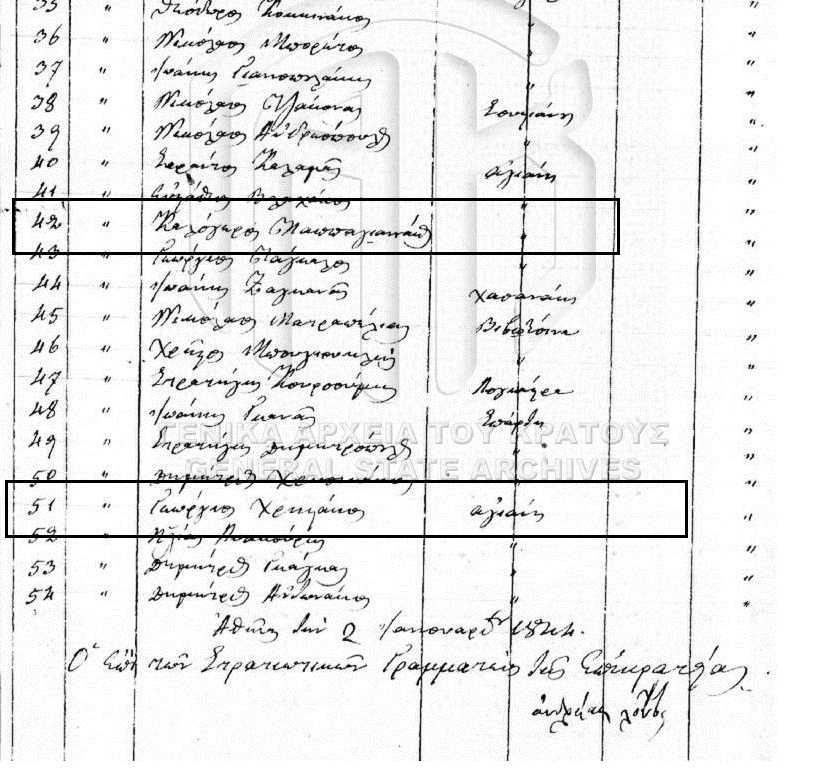
This image shows recipients Kalogeros Papagiannakos (line 42) and Georgios Christakos (line 51) of Agios Ioannis who received the Iron Medal.

Aristeia Awards, Line 42: Kalogeros Pappagiannakis; Line 51: Georgios Christakos, both of Agios Ioannis, Sparta. Research by Konstandinos Koutsodontis, 2020

The General State Archives of Greece is the repository for Aristeia Records. It has thousands of lists, each filled with thousands of names. There are files online at the GAK , but working through them to locate villages and names is beyond my ability. Researching in this collection is best left to Greek genealogy professionals. Those who have examined these archives for me are: Gregory Kontos of GreekAncestry.net, Konstandinos Koutsodontis of Greek Genealogist, and Giannis Mihalakakos of Maniatika. I am grateful to each of them, my colleagues and friends. 🙂

Next year on March 25, 2021, and throughout the year, the 200th anniversary of the Revolution will be celebrated. Konstandinos, Gregory and Giannis will be writing about the men who freed Greece from captivity. Use their resources to find the heroes in your family, and contact them for research help. Gregory Kontos’ “Tracing Freedom: 1821” collection has just launched with searchable lists of captives from Lakonia.

Your ancestors fought and secured the freedom of Greece, thus securing a sovereign nation for the birth of your family. They deserve to be recognized and honored.

*A Hellenic historian shared the following: Aristeia is an ancient Greek word meaning “prize for excellence, prowess, the best and the bravest.”

How Do They Call You? Πως σε λένε;

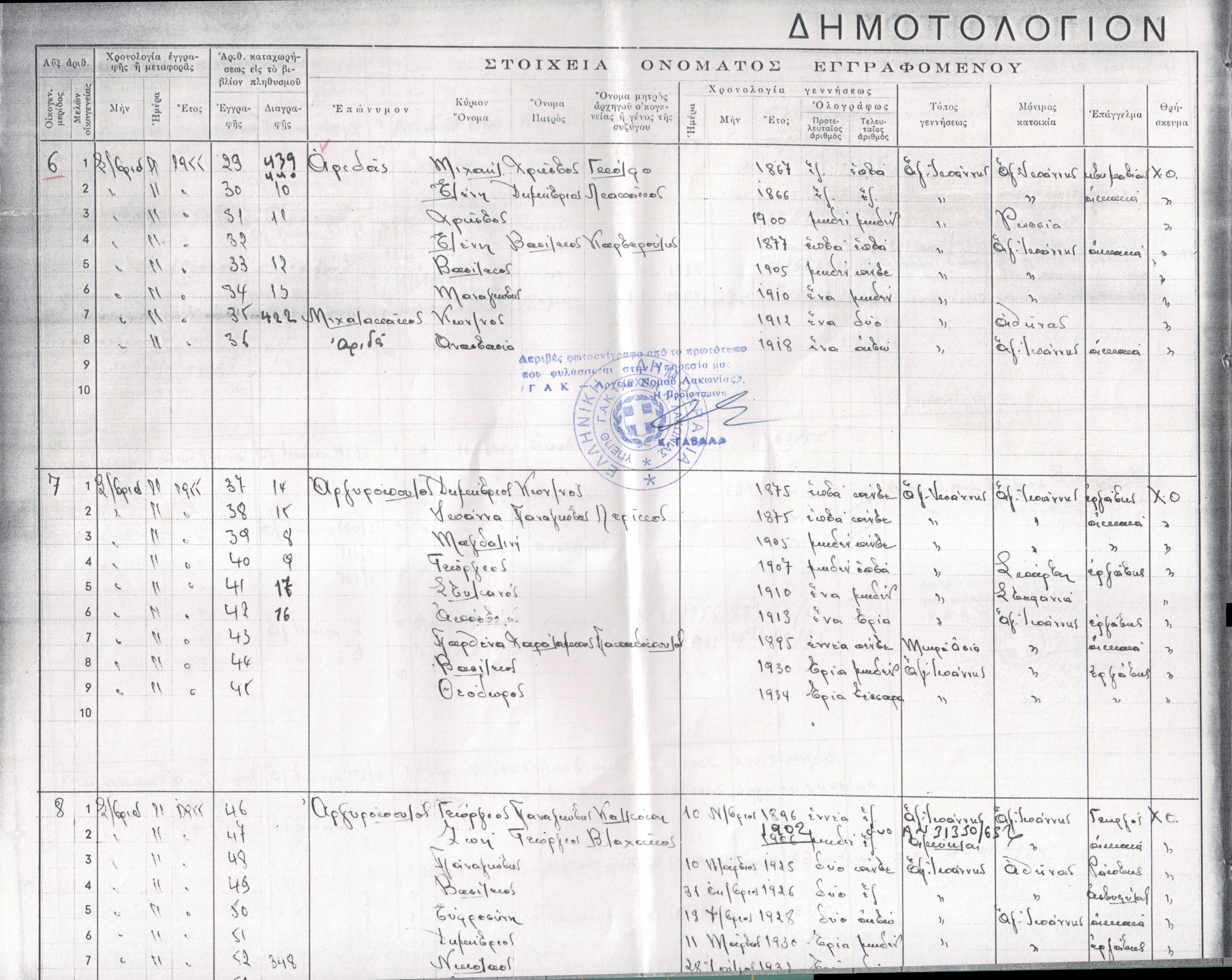
My dive into the bewildering world of ever-evolving Greek surnames started in October 2008, when I received this Town Register from the Sparta Archives office:

Agios Ioannis, Dimotologion (Town Register) Family #6, Aridas, page 1 of 2

The first entry, family #6, is the household of Michail Chistos Aridas of Agios Ioannis, relatives of my paternal grandmother, Harikleia Aridas Kostakos:

Aridas, Michail; father: Christos, mother: Gkolfo, born 1867
Aridas, Eleni; father: Dimitrios Liakakos, born 1866
Aridas, Christos, born 1900
Aridas, Eleni; father: Vasileos Karteroulis, born 1877
Aridas, Vasileios, born 1905
Aridas, Panagiotis, born 1910
Michalakakos, Konstandinos, born 1912
Aridas, Anastasia, born 1918

I was surprised to see that  Michail had two wives: Eleni Liakakos and Eleni Karteroulis, with their respective children listed under the name of their birth mother. But I was stunned to see the name Konstandinos Michalakakos. Who is he, and why is he in this family? My first thought was that he is a cousin, an uncle, or even a friend living in Michail’s household.

Wrong! He is Michail’s son.

My first lead came from an Aridas relative whose mother visited Agios Ioannis in the 1950s. She was told that Michalakakos was the original name and Aridas had begun as a nickname or paratsoukli (παρατσόυκλι) for an ancestor who had long legs. The Collins Greek-English dictionary verified the translation, with definition (b) leg.

Last summer in Agios Ioannis, one of my Aridas cousins verified that the names were used interchangeably. However, he was certain that Aridas was the original name and Michalakakos (son of Michail) was a spin-off; and that Konstandinos chose to use Michalakakos because that name was “more professional and respectful” in his work as a theologian in Athens.

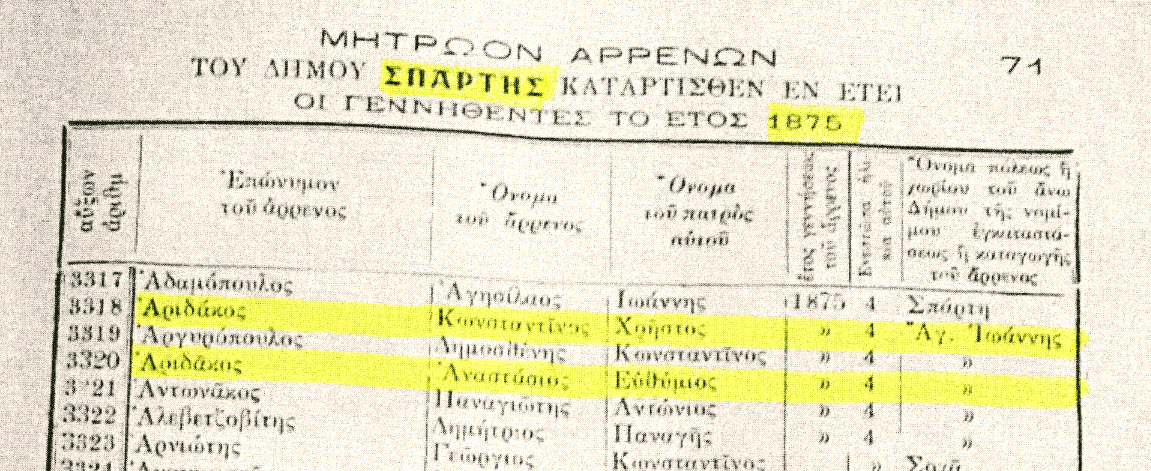
And there is yet another derivative of the name– “Aridakos” (son of Arida) as shown in this 1875 Male Register: line 3318: Konstandinos Aridakos, son of Christos, and line 3320: Anastasios Aridakos, son of Efthymios.

Mitroon Arrenon, 1875, Sparta, Greece.

Question: which name is correct?
Answer: all of them!

And how can that be? Giannis Michalakakos (no relation) remarked: “In Greece, we ask: πως σε λένε; how do they call you?”  Those words — πως σε λένε — struck me powerfully, as my mind processed that people are generally asked, “how do they call you?” NOT “what is your name?”

So, a person can reply any way he chooses: call me the son of Michael (Michalakakos), or call me the son of Aridas (Aridakos) or simply, call me Aridas.

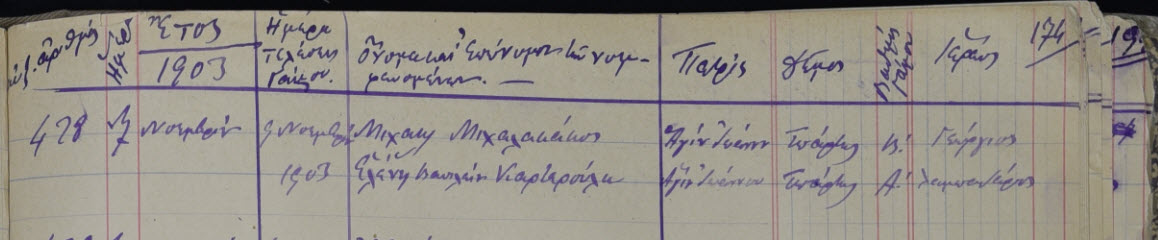
Following the paper trail of Michail Christos proves that this practice was customary. He is named Aridas in the Town Register above, in his Male Register, and on his passenger ship record. But in his marriage record of 1903 he designates himself as Michail Michalakakos.

Sparta Mitropolis Marriage Index Book; Sparta: Oct 1899-Sept 1907; page 174; #478: 9 November 1903; Michail Michalakakos and Eleni Vaseleios Karteroulis; second marriage for him; first marriage for her; both from Agios Ioannis, Sparta.

Interestingly but not surprisingly, some of Michail’s children followed his pattern of using whichever name they wanted, whenever they chose.

Aikaterini: (not in the above Town Register): her 1913 passenger ship record uses Aridas; her marriage record uses Mihalakakou and lists her father as Mike Mihalakakon.

Gkolfo:  her 1921 passenger ship record uses Aridas; her marriage record uses Mihalakakos and lists her father as Mihael Mihalakakos.

Konstandinos:  Male Register uses Michalakakos with a notation regarding a surname change; Agios Ioannis school records use Aridas; Town Register uses Aridas.

Anastasia: Town Register uses Aridas; school records use Michalakakos.

Efrosyni:  consistently used the Aridas surname, but this news article reveals that as late as 1950, Michail was known as both Aridas and Michalakakos. (Efrosyni married Nikolaos Revelos):

Efrosyni Aridas Revelos visit to her Michalakakos family in Agios Ioannis

Digging deeper into all members of the Aridas family produced many documents, both Greek and U.S., which verify the interchangeable use of the three names.

This example is a marriage record for Efthymios Michail Michalakakos who is the son of Michail Efthymios Aridas, another branch of the Aridas family in Agios Ioannis:

Mitropolis of Sparta, Marriage Index Book: Sparta, 1866-1872; Year: 1871; Entry #302
License Date: October 30, 1871; Groom: Efthymios Michalakakos; no father listed; residence: Agios Ioannis; Bride: Stamatiki Karnazakou; father: Ilias; residence: Agios Ioannis

Πως σε λένε? You get to choose!

Which name is the original family name? The jury is still out. It is understood that surnames (as are defined today) did not become standardized in Greece until after the 1900’s. Anything before then is fluid, and determined by the practices of each family and its individual members.

Πως σε λένε? I am slowly learning to think like a native Greek. Understanding the culture, the history and the language is vital. And, it lessens frustration and expands acceptation.

This article, published in the National Herald, adds additional insights into this topic:
Demetrios is now Jimmy.

Postscript: November 2, 2019: Since writing this original post, I have learned of two additional reasons for double surnames.

  1. Children who were raised by people other than their birth parents (known as “soul children”) may have two surnames–their birth surname and their surrogate parents’ surname. These could be children who were orphaned or given up by a parent who could not care for him/her; or a couple may have adopted a child.
  2. I found a man who appeared to have three surnames when he was called for military service in 1886.*


Hellenic Genealogy Geek Facebook page members clarified that there are only two surnames, Καψής ή Παναναγιωτόπουλος, the soldier’s name is Ανδρέας, and his father’s name is Γιαννάκη ή Παρασκευα. This makes more sense than having three surnames! In summary, don’t be surprised to find alternate names for both the surname and the given name.

An excellent article describing the origin of Greek surnames can be found here.

*Source:  this entry is found in the Φ.Ε.Κ. Government Gazette, 1886; location: Faron, Patreon, Achaiolidas (Αχαιοηλιδος Πατρεων Φαρον).

Return to Greece, 2016. Part Six: It’s All About Family

This is the sixth post in a series about my trip to Greece, June 30-July 20, 2016 — an amazing journey of history, family and discovery. Previous posts can be found here.

Open arms with tight hugs. Kisses on both cheeks. Happy smiles and joyful reunions. This is how my family greets me when I return to Sparta. There are so many places to explore and discover; but for me this is the bottom line:  it’s all about family. Prior to my visits to Greece, the names and places on my pedigree chart were simply long names and dots on a map. Now, they are attached to real people who have become a vibrant and important part of my extended family.

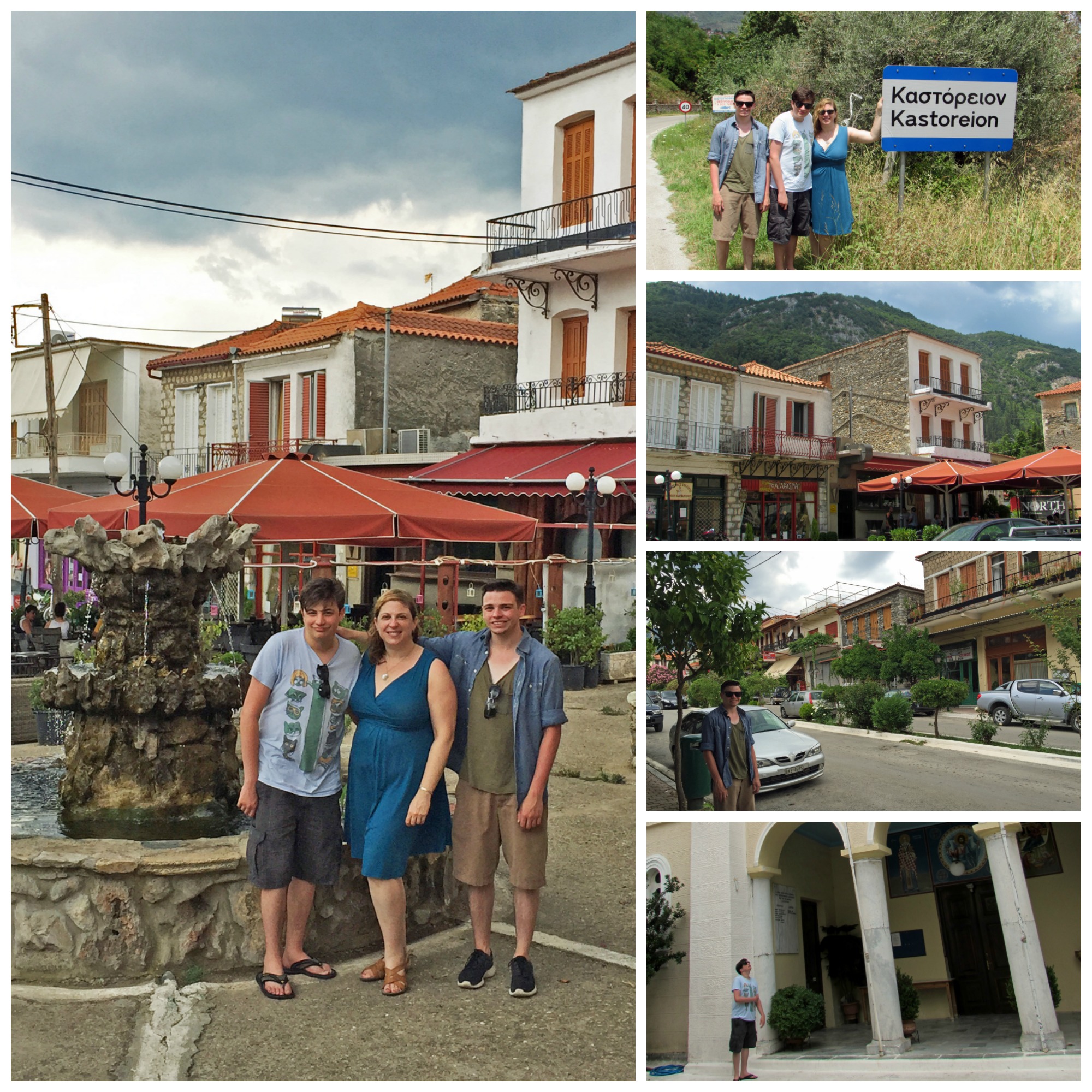
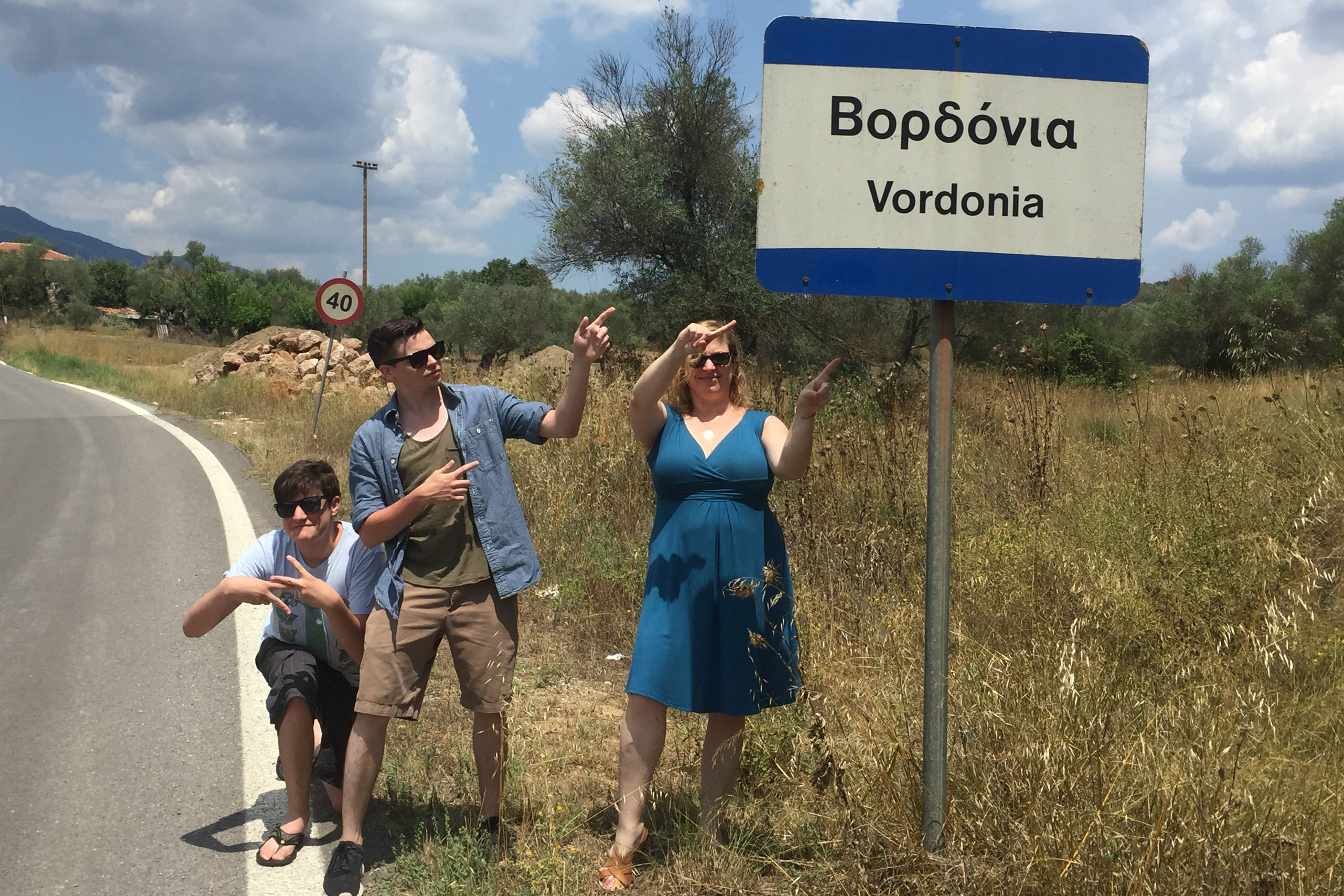
Joy is sharing what you love with whom you love. For me, joy is introducing my family to their roots — touring our villages and meeting our relatives. Kathy’s paternal grandparents are Kallianes from Kastania (now Kastoreion) and Linardakis from Vordonia. Although we don’t know of family now living there, we so enjoyed exploring the towns, peering into shops, watching chickens, dogs and cats roam their yards, and looking at stone and stucco houses that have sheltered countless families through countless years.

Kastoreion, Laconia. July 2016

Kastoreion, Laconia. ancestral village of the Kallianes family, July 2016

Vordonia, Laconia, July 2016

Andrew, Ben and Kathy at the Linardakis village of Vordonia, Laconia, July 2016

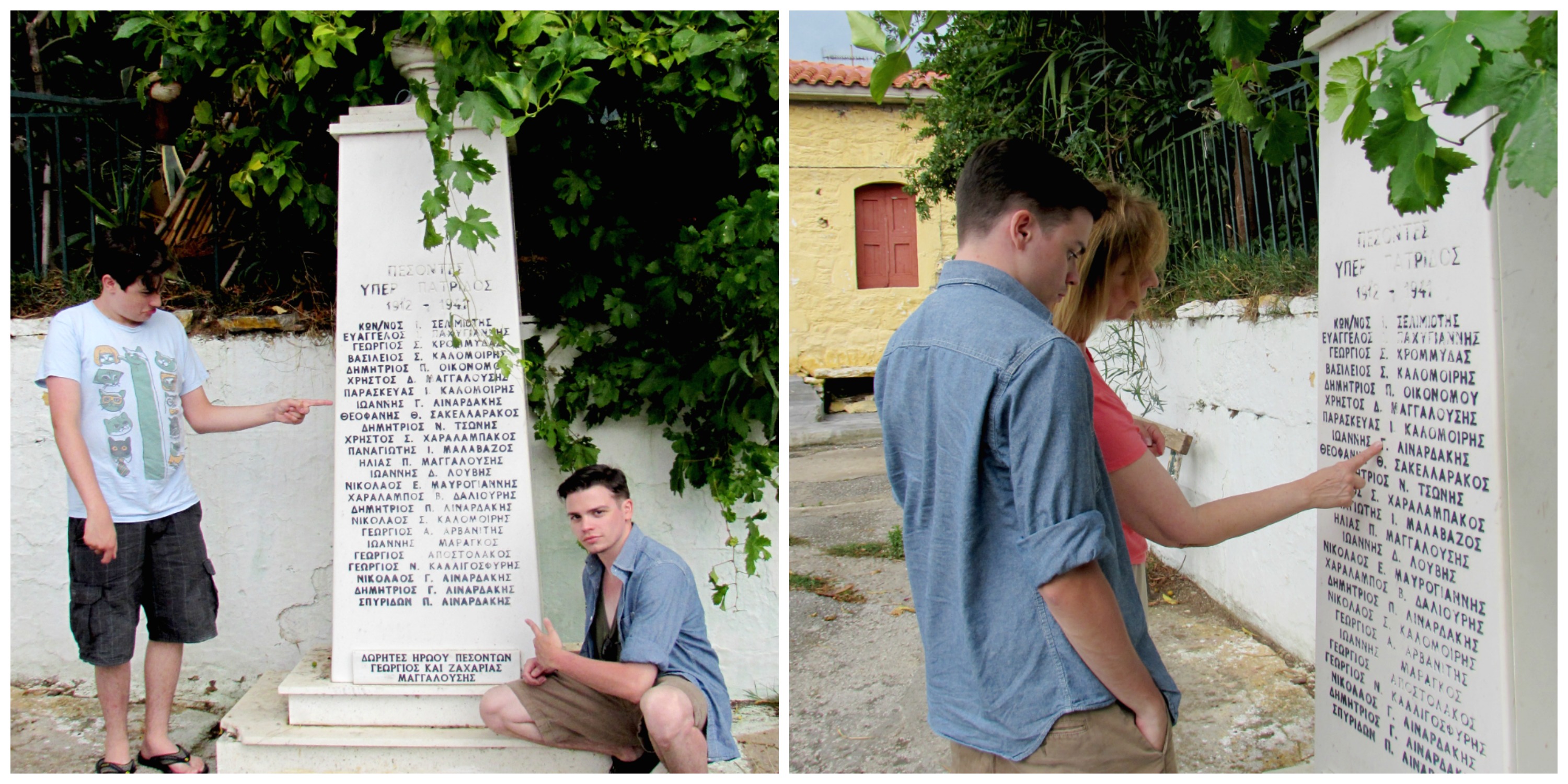
I love the monuments erected in every town that memorialize those who died in military service. My heart skips whenever I find an ancestral name etched in marble. Even if I cannot connect that individual to my line, I know that in these small villages, people with the same surname are almost certain to be related. While driving in Vordonia, we turned into a back street and unexpectedly were confronted by the village monument. stopping to examine it, I became emotional when I showed Ben and Andrew several men with the Linardakis surname.

Finding the Linardakis surname; Vordonia, July 2016

Finding the Linardakis surname; Vordonia, July 2016

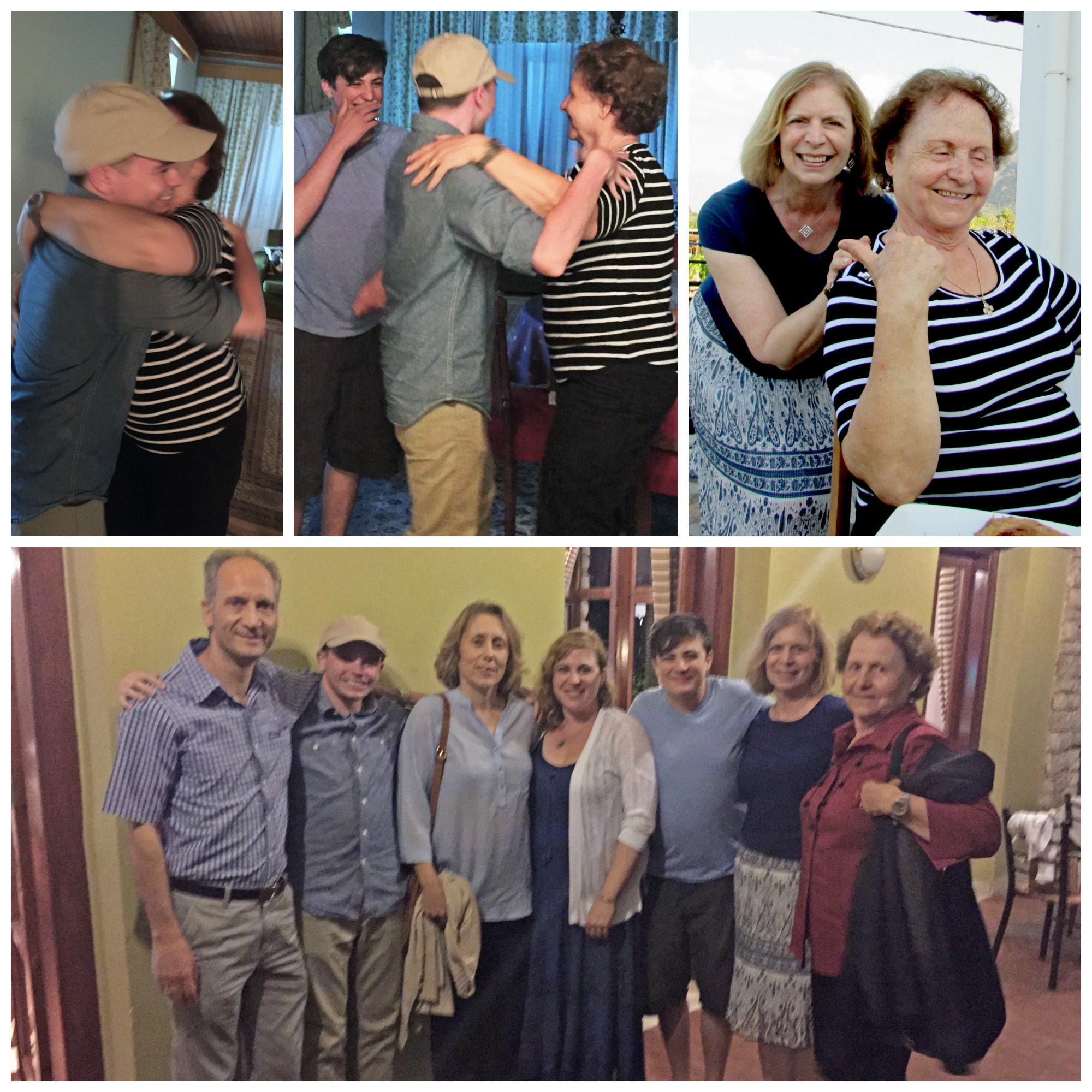
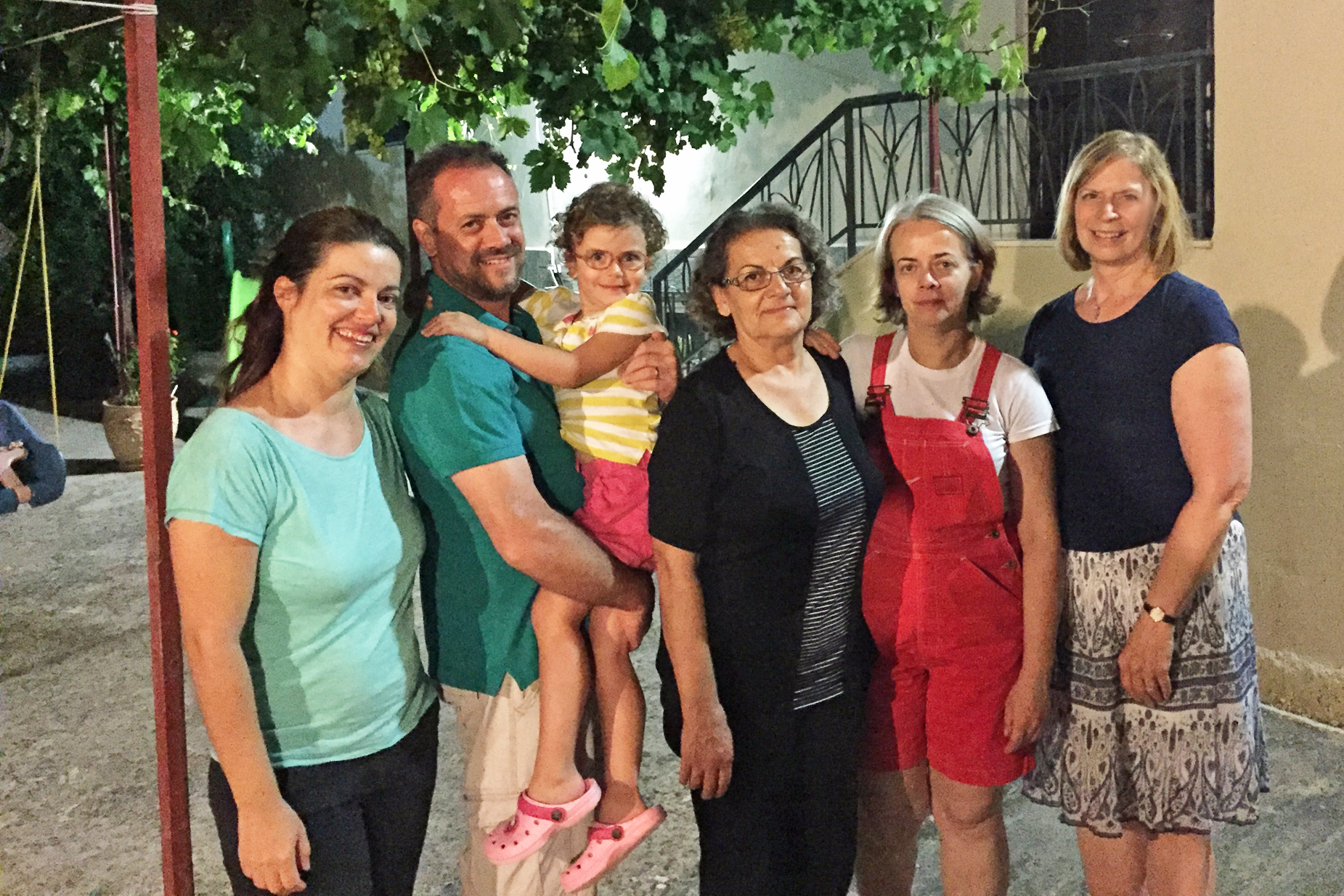
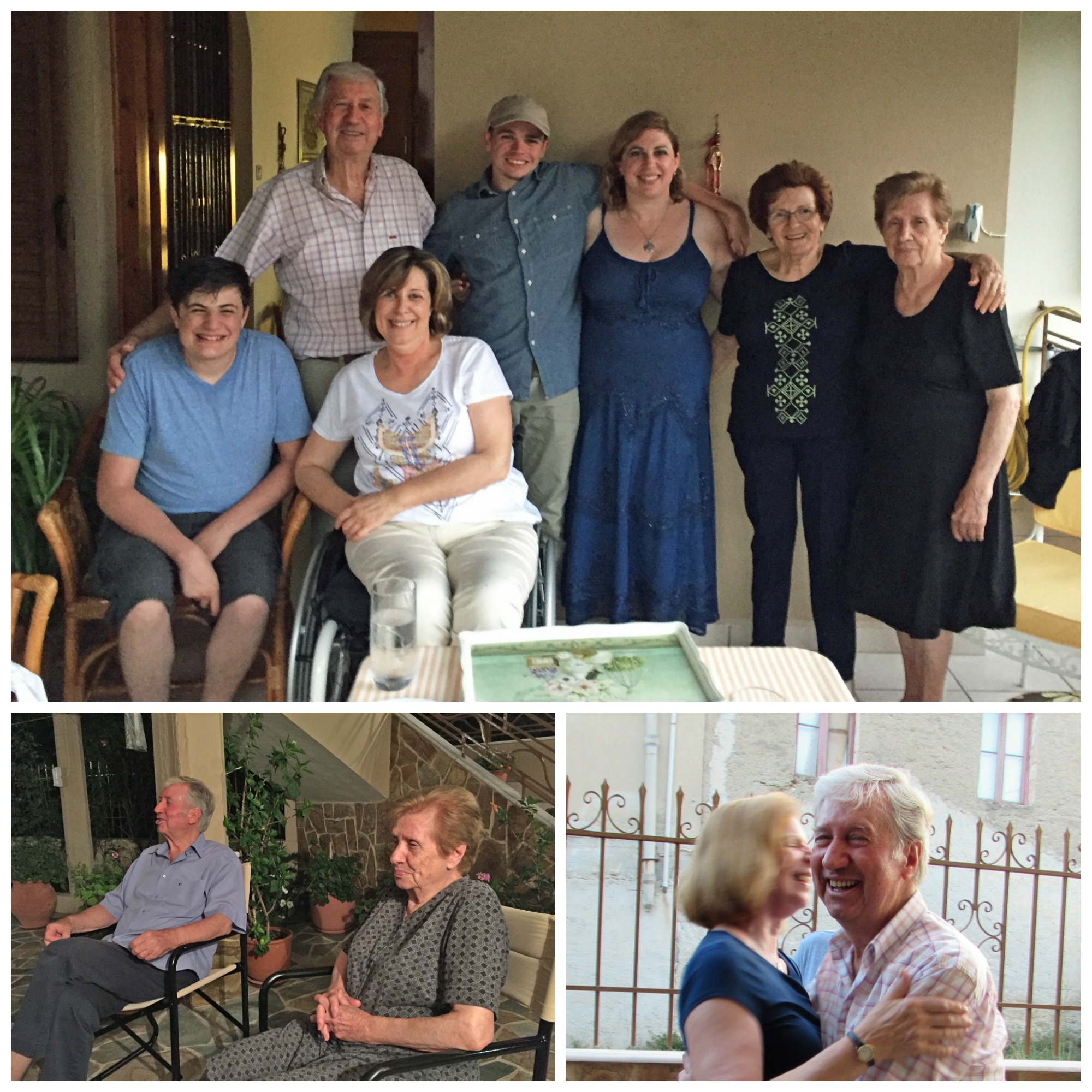
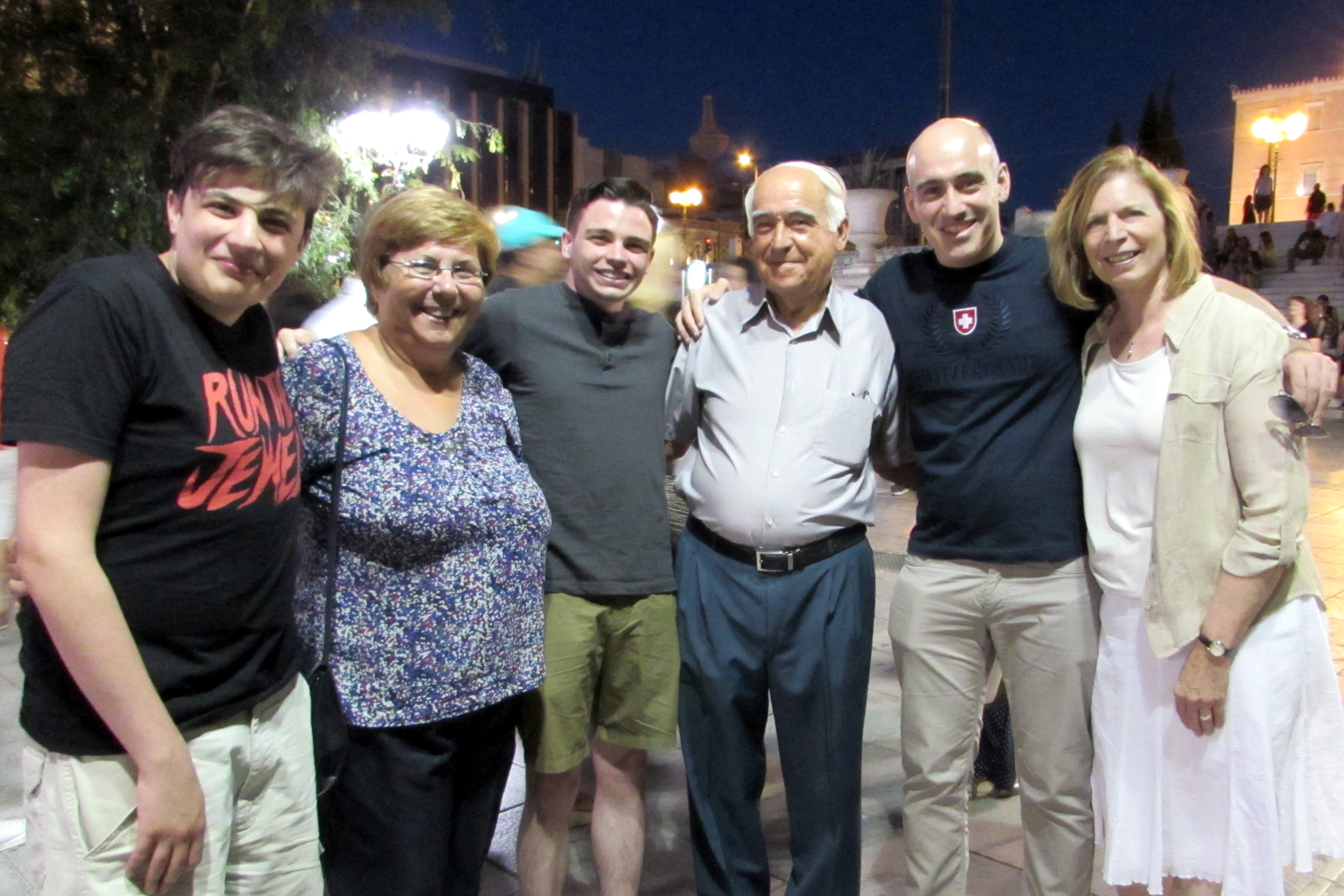
Visiting our Aridas and Kostakos familes in Agios Ioannis has endeared my grandchildren to their Spartan relatives and grounded them to the land of their ancestors. Bridging the Atlantic and meeting kin has widened their concept of family. Eating a meal in a house built by their ancestor in the mid-1800’s has brought them a sense of “rootedness” that is unparalleled. And best of all, they were warmly embraced and loved immediately by all who met them.

These are photos of my Kostakos and Aridas family in Agios Ioannis, Sparta. They are on my father’s side — my grandparents were John Andrew (Ioannis Andreas) Kostakos and Hariklia Aridas, both born in Agios Ioannis. On the Kostakos side, our common ancestor is Andreas Kostakos who was married twice: first to Anastasia, then to Poletimi Christakos. These two Kostakos families are descended from Andreas and Anastasia; I am descended from Andreas and Poletimi. On the Aridas line, our common ancestor is Michail Aridas and his wife, Stamatina.

Ioanna Kostakos Family, with Ben Soper, Andrew Soper, Kathy Lynard, Carol Kostakos Petranek, Peggy and Vassilis Vlachogiannis, Agios Ioannis, July 2016

Family of Ioanna Kostakos of Agios Ioannis. With Ben Soper, Andrew Soper, Kathy Lynard, Carol Kostakos Petranek, Peggy and Vassilis Vachaviolis, and Ioanna Kostakos, July 2016

family-kostakos-eleni-group-07-13

Family of Eleni Kostakos of Agios Ioannis. Natasa, Panos, Eleni, Eleni, Panorea, Carol Kostakos Petranek, July 2016

Family of George Aridas, Agios Ioannis. George, Roula, Adamandia Aridas; George's sister, Afroditi. July 2016

Family of George Aridas, Agios Ioannis. George, Roula, Adamandia Aridas; George’s sister, Afroditi. July 2016

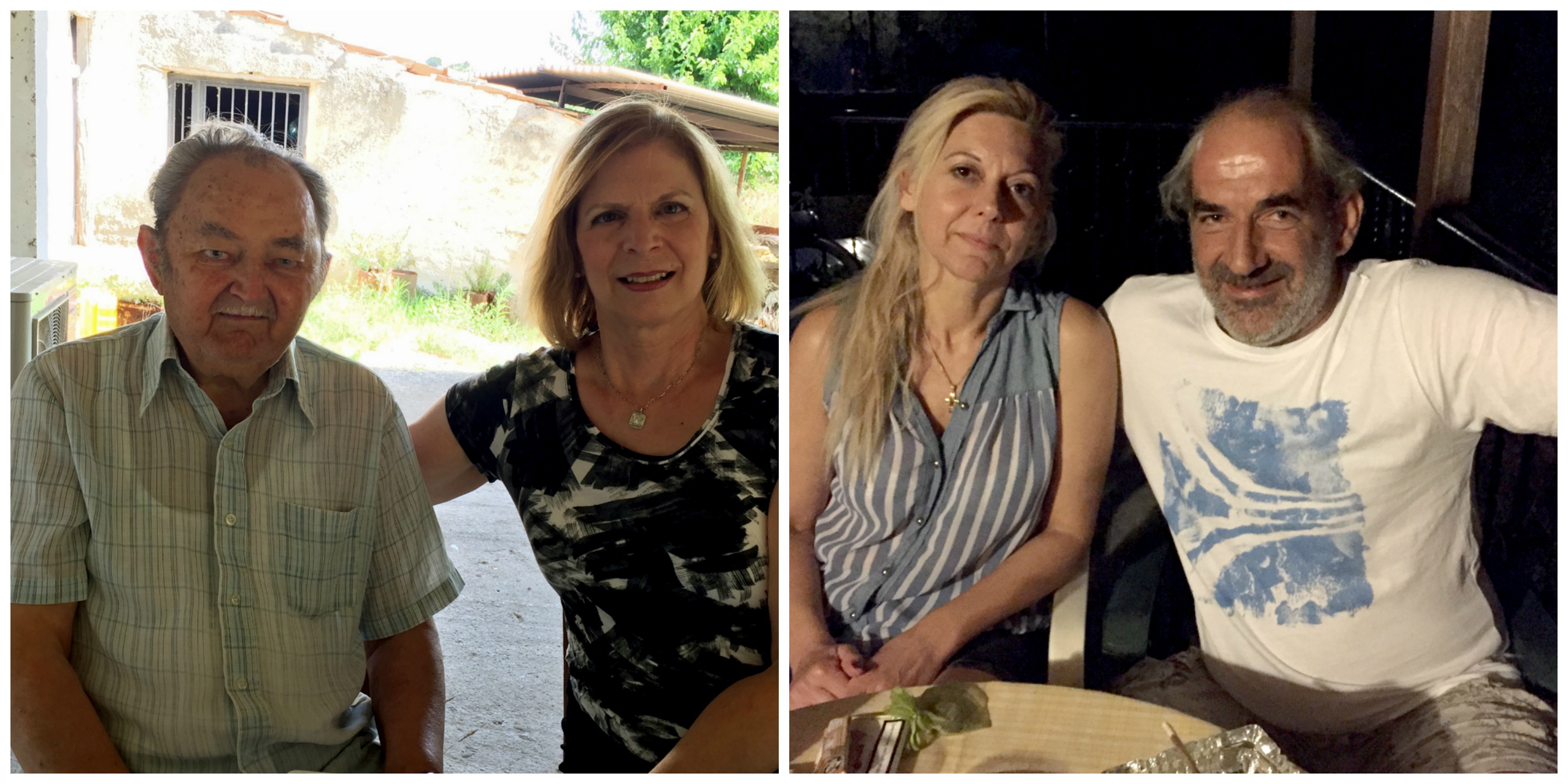
This is the Chelidonis Family of Athens. Nikos is my second cousin on my mother’s line. His mother was Tasia Eftaxia from Mystras; our common ancestor is Ioannis Eftaxias, born 1809. My grandmother, Angelina Eftaxias Papagiannakos, was Tasia’s aunt. Panagiotis found me on Facebook three years ago, and we met in person during my trip in 2014. We were so excited to connect our families, as neither of us knew that the other existed!

Family if Nikos Chelidonis, Athens. Viki, Nikos, Panagiotis. July 2016

Family if Nikos Chelidonis, Athens. Viki, Nikos, Panagiotis. July 2016

The Eftaxias family of Mystras has long roots in Mystras. My grandmother, Angelina Eftaxias is the aunt of Andreas (photo on left). Andreas’ son, Lewnidas, is a master stone mason and works on churches and other buildings throughout southern Laconia.

Andreas Eftaxias, his son. Lewnidas ad Afroditi. Mystras, July 2016

Andreas Eftaxias, his son. Lewnidas ad Afroditi. Mystras, July 2016

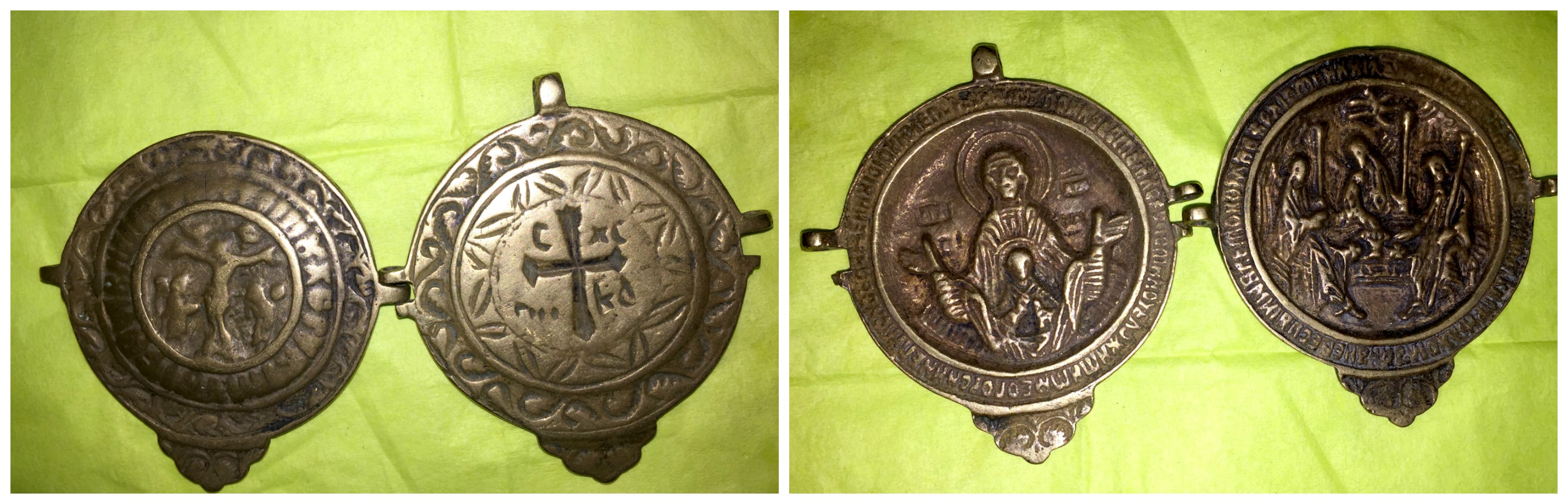
Lewnidas and Andreas told me that our first Eftaxias ancestor escaped from Constantinople during the Ottoman conquest in 1453! He and three friends fled together and settled in Mystras. Lewnidas showed me a bronze medallion that was brought by this ancestor and kept by the family for generations. I posted this photo on our HellenicGenealogyGeek Facebook page and knowledgeable friends there described the medallion: l-r: Christ on the cross; Byzantine cross with words, ” Ιησούς Χριστός Νικά”; the Holy Mother, Mary; and the Holy Trinity, possibly based on Rublev‘s painting of the same name.

Medallion dating to 1453, belonging to Eftaxias family; Mystras, July 2016

Medallion dating to 1453, belonging to Eftaxias family; Mystras, July 2016

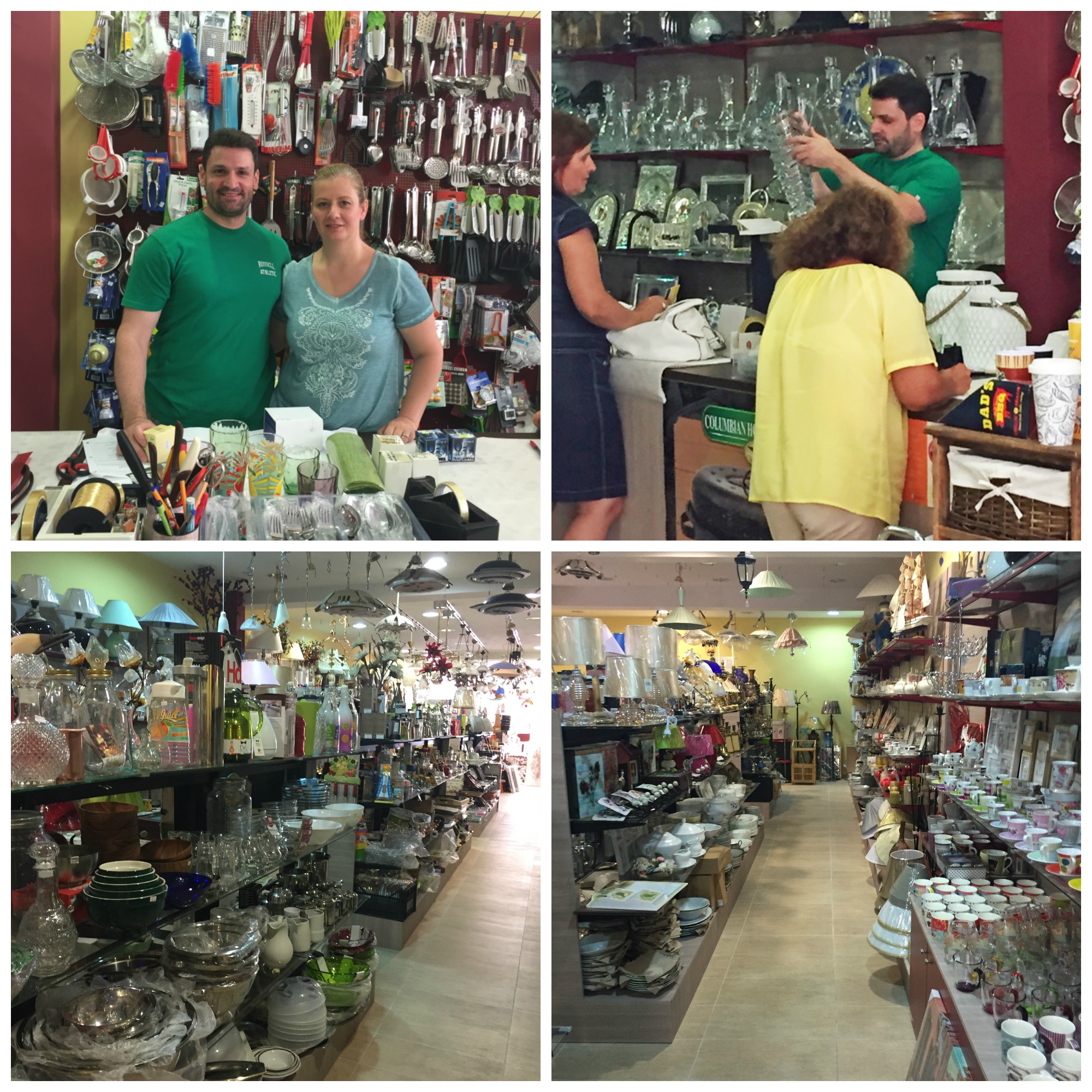
I was so thrilled to extend my family further on this trip. My new-found cousin, Dimitrios Papagiannakos, and his wife, Georgia, own a beautiful home goods store in Sparta which sells a myriad of items from cooking utensils to beautiful crystal. I think I gave Dimitrios quite a shock when I walked into his store and introduced myself as his cousin from America! I had brought photos of his Pappas family in the U.S., including a group shot taken at our Pappas Cousin’s Reunion. Working around his customers, we managed to have a spirited and lovely conversation about our families. My only regret was that his parents were out of town and I was unable to meet them. Next trip!

papagiannakos-store-collage

Dimitrios and Georgia Papagiannakos in their lovely home goods store, Sparta, July 2016

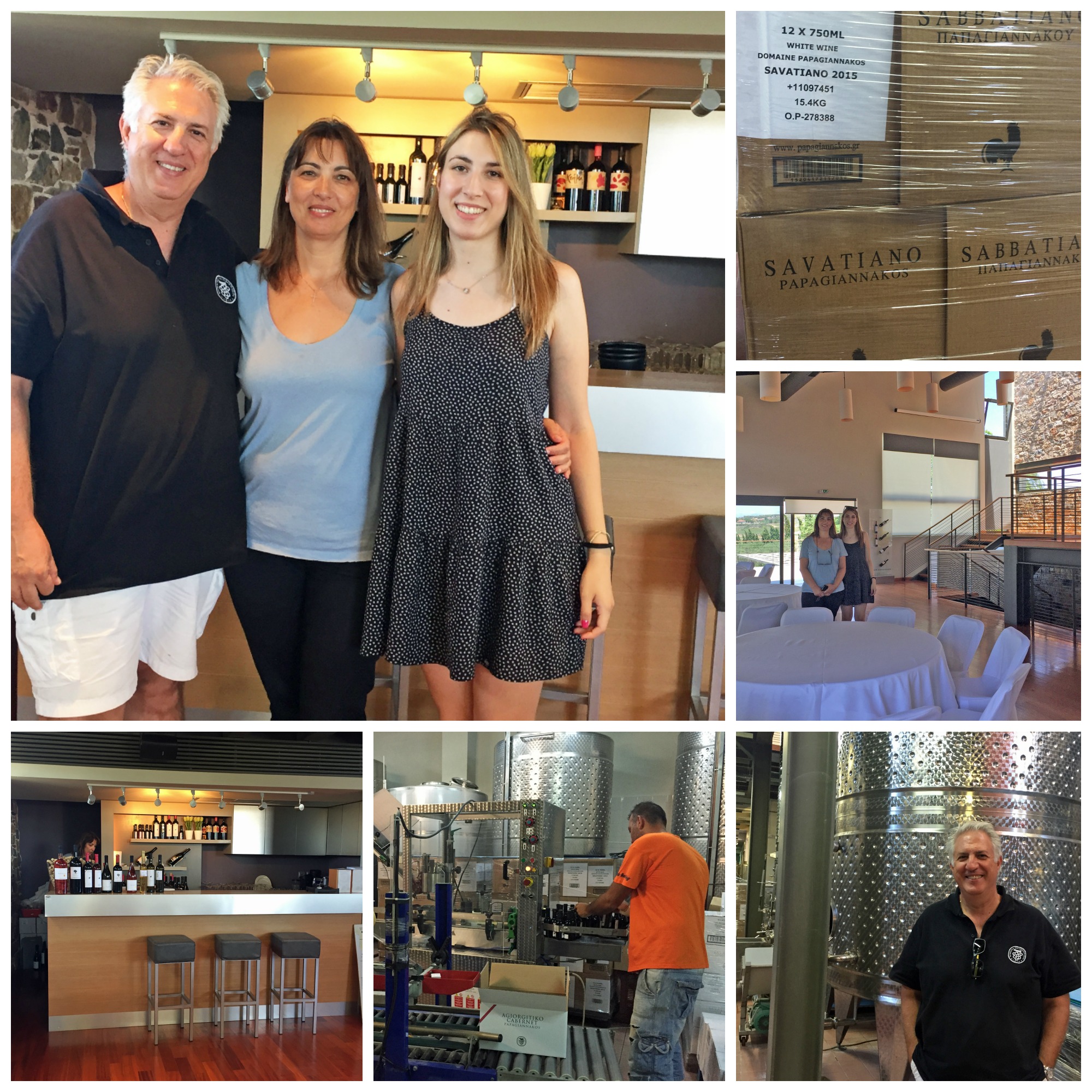
I also traveled to Markopoulos, northeast of Athens, to meet Vassilis Papagiannakos, owner of the Papagiannakos Winery. The winery was started by his grandfather, also named Vassilis, in 1919. Now managed by the 3rd generation of Papagiannakos’, Vassilis and his wife, Antonia, have expanded the business, developed new and award-winning wines, and constructed a beautiful edifice where business events, weddings and other activities are held. Although Vassilis and I do not know how–or if– we are related, we are looking to explore our family roots together.

papagiannakos-winery-collage

Vassilis and Antonia Papagiannakos and their daughter, Aggeliki. Papagiannakos Winery, Markopoulos, July 2016

Every trip to Greece strengthens my family ties. I love these cousins. They set an example of hard work, honesty and devotion to our family and our heritage. I am ever-grateful to have the means and the opportunity to introduce them to my own descendants. Together, we carry on traditions and relationships that honor our ancestors.