Surnames from Agios Ioannis (St. Johns), Sparta

During my visit to the Archives in Sparta last summer, I obtained pages of the Mitroon Arrenon (Male Registers) for the village of Agios Ioannis, Sparta. The records begin in 1844. This village is the birthplace of three of my four grandparents (Papagiannakos, Kostakos, Aridas/Michalakakos). Almost every page had surnames of my grandparents’ families, or those who married into my family. I was thrilled to have copies of these records!

I am ever-grateful to the staff at the GAK in Sparta: Pepi Gavala (Archivist), Maria Stellakou, and Michalis Sovolos. They are kind, gracious and most helpful!

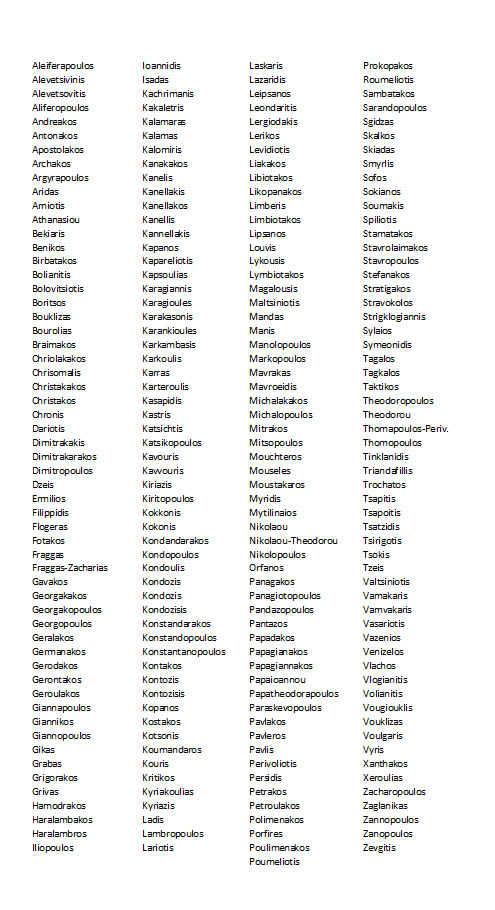
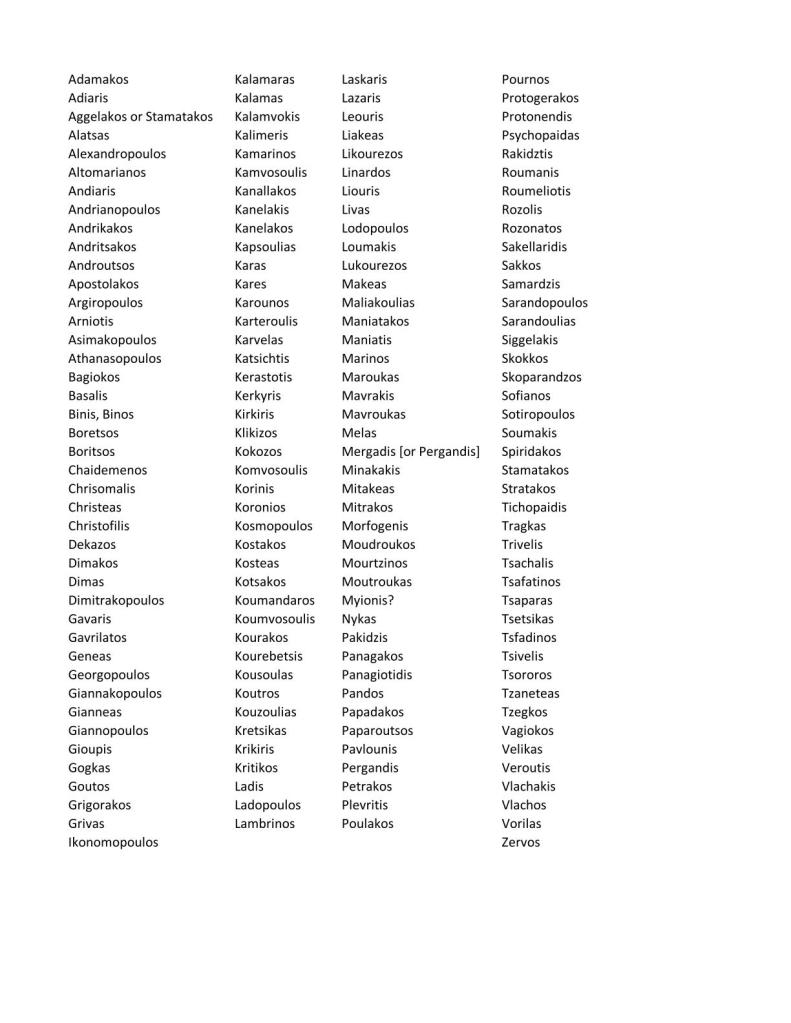
Below is an index of the surnames in the pages that I obtained (this list may not be complete.

Surnames - Agios Ioannis

The Elementary School of Anavriti (municipality of Vryseon) in 1838

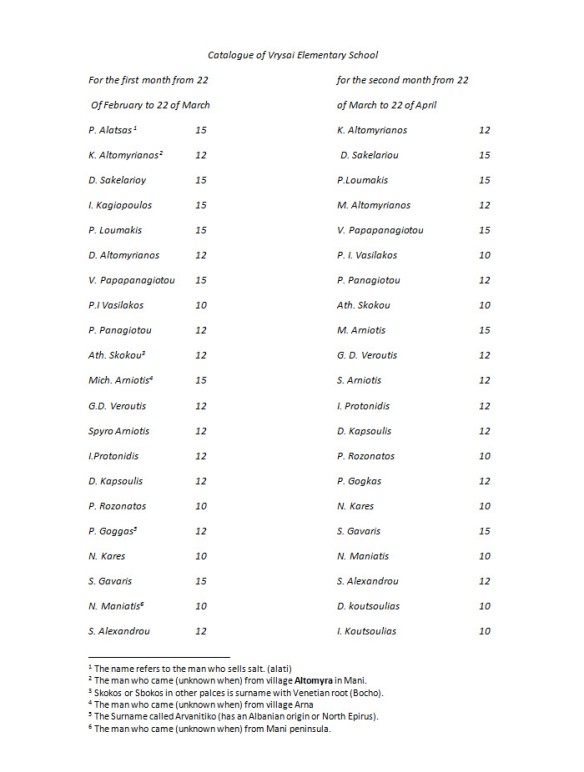
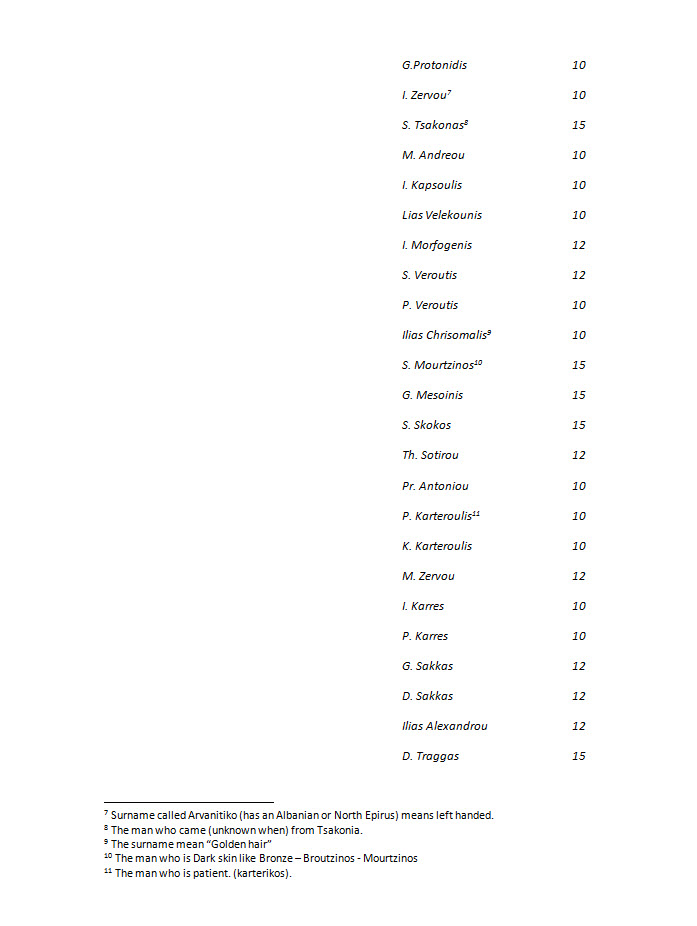
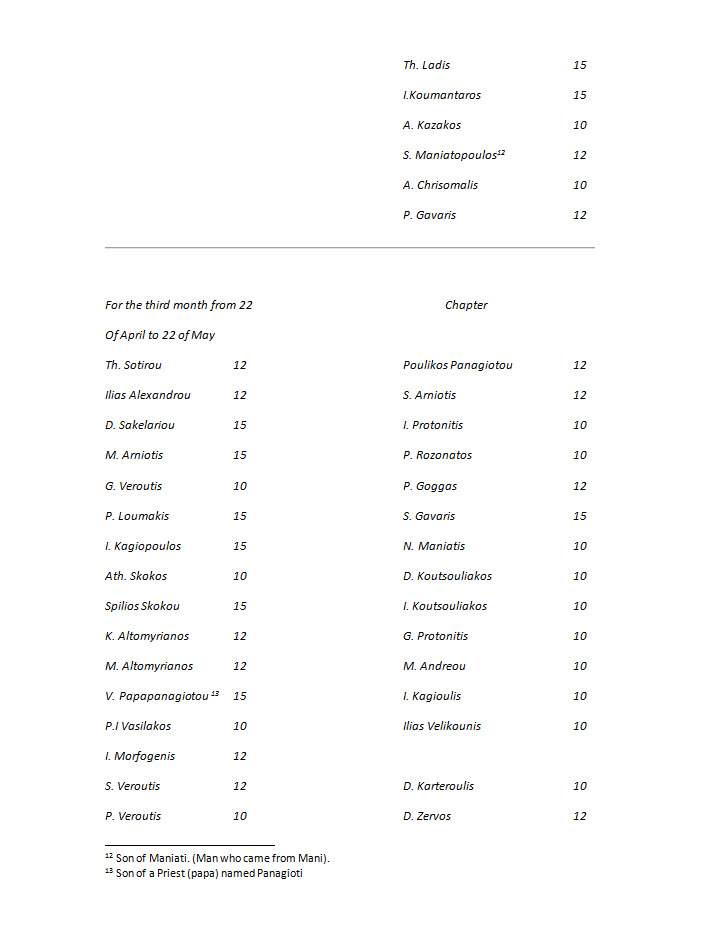
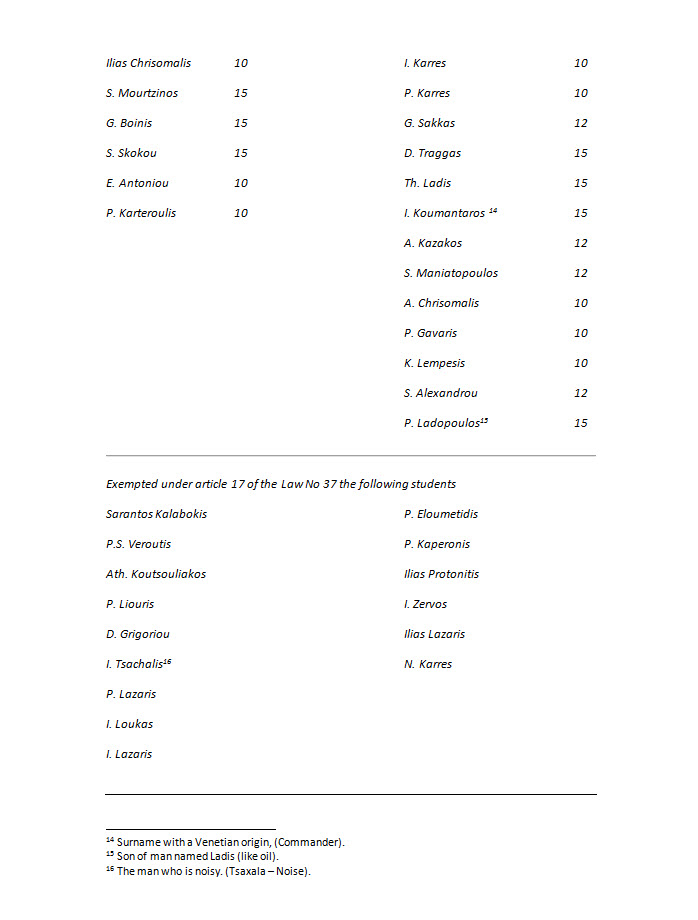
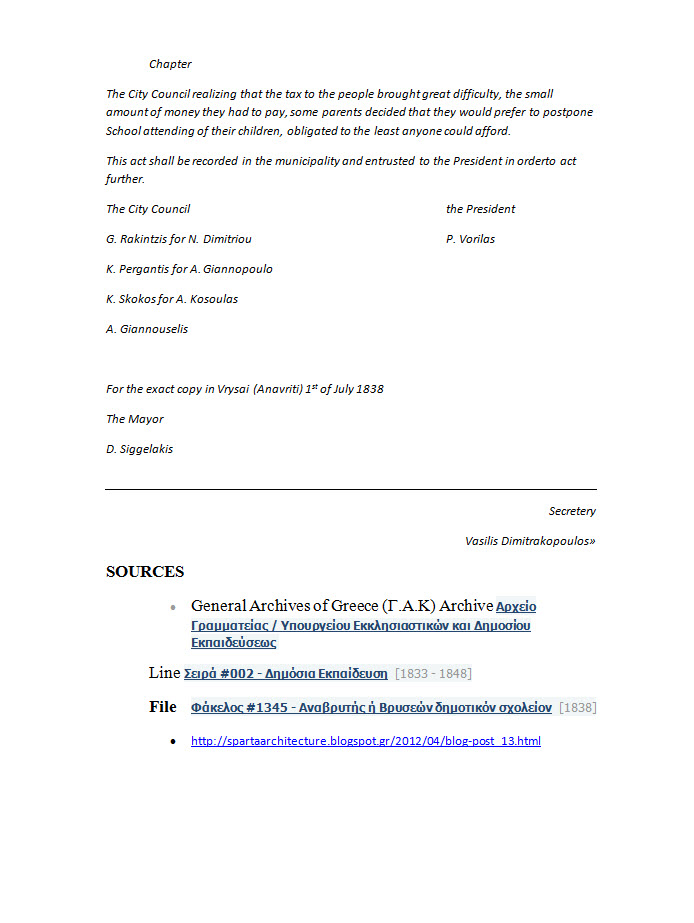
My friend, teacher, and historian, Giannis Michalakakos, has translated a list of children enrolled in school in Anavriti in 1838. The original digitized records can be found online at the General Archives of Greece (see source at end of document),  images 38, 39, 40.

Giannis has added valuable information about the origin of many of the names in these records (look for a superscript number). He also provided links at the end of this document to the GAK Archives and to a blog dedicated to architecture in Sparta, and specifically to an article about Anavriti.

I extend to Giannis my deepest appreciation for his time and effort in finding and translating this list. The year 1838 predates many extant records (including Mitroon Arrenon); and as Giannis explained to me, if you calculate that the fathers of these children could be 30-40 years old, they would have fought in the Greek War of Independence in 1821!

To read more of Giannis’ writings about history, genealogy, and other issues concerning Mani, follow his bog, Maniatika.  Again, thank you so very much, Giannis!

Giannis Michalakakos


Written by Giannis Michalakakos
Teacher of Home Economics and Ecology
Email. gnifiatis@hotmail.com


THE ELEMENTARY SCHOOL OF ANAVRITI 1838

Searching in the General State Archives for information about the Anavriti village (capital of Vrysai municipality) and the families who lived there I found a list of the students of the village’s elementary school. The following documents include the decision of the local council translated.

«The City Council gathered under president P. Vorilas and the rest members of the council G. Rakintzi, K. Perganti, K. Skokkou, Alex. Giannopoulou and A. Kousoula for meeting today 3rd of July in decision No. 2525 after the invitation of the Royal Command of Lacedaemon according to the article 26 of the Law Teaching to arrange the amount of money that monthly is paid by students parents and create a fund for the teacher. The council arranges the names from 29 of May and onwards.  

Anavriti School 1838 p1
Anavriti School 1838 p2 Anavriti School 1838 p3 Anavriti School 1838 p4 Anavriti School 1838 p5 Anavriti School 1838 p6


Families of Anavryti

Last summer at the Sparta office of the General Archives of Greece, I was given permission to take digital images of pages of records of the Male Registers (Mitroon Arrenon) and Dimotologion (Town Registers) that listed names found in my family tree. I have created an index of the families of Anavriti, as found in the pages of the Male Registers that I obtained.

If your family name is listed below, please contact the GAK office in Sparta for assistance in obtaining copies of the records. The staff is kind and most helpful: Maria, Michalis, and K. Gavala speak English and are sincerely desirous to be of assistance.

The GAK office email address is: mail@gak.lak.sch.gr

The mailing address is:
GAK – Archives of Laconia
174 Vrasidou
Sparta 23100
Telephone:  27310-22884

Please note that this list may not complete.

Research & Remembrances, Part 4

Research in the General Archives of Greece, Sparta office

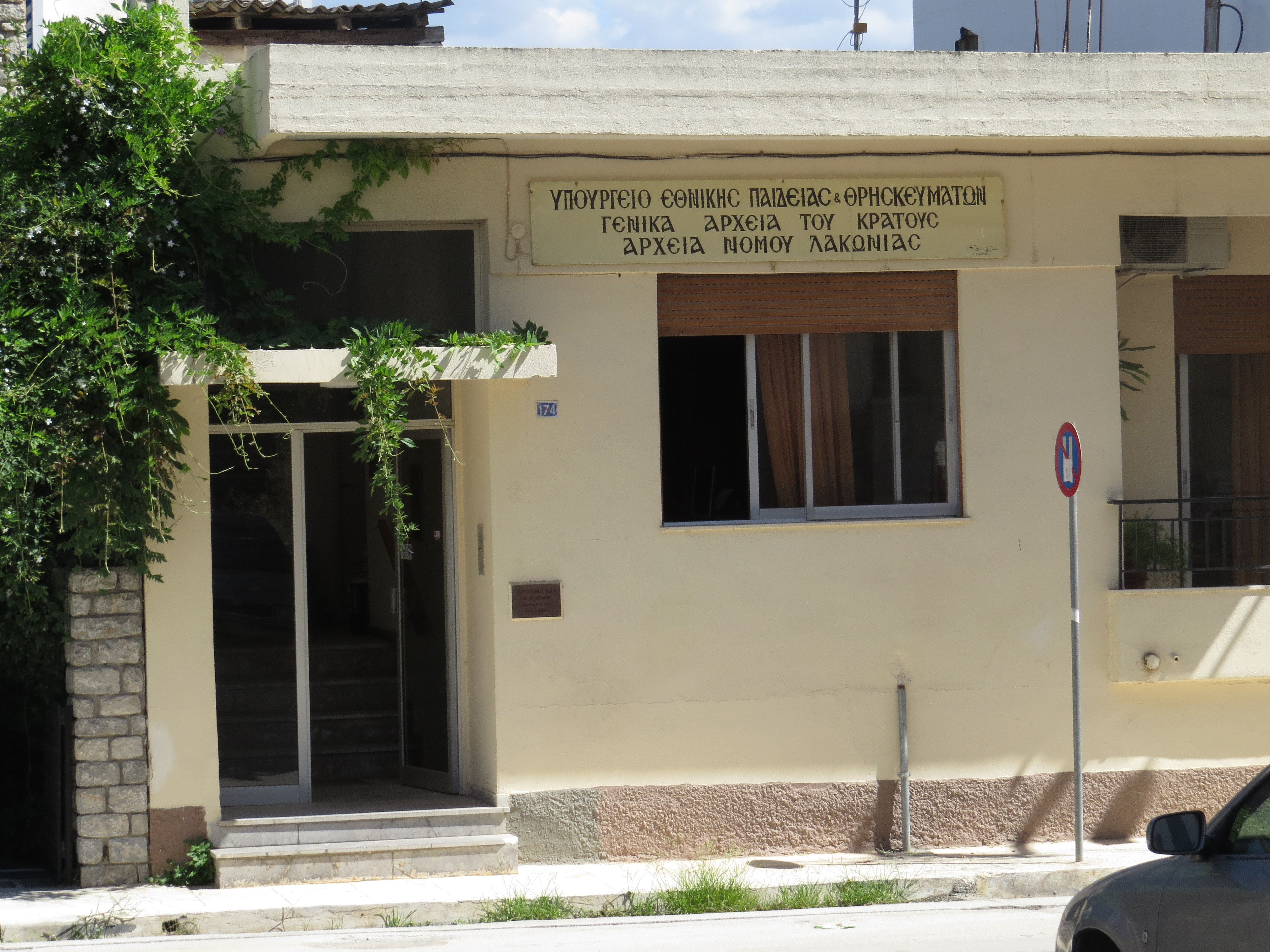
After months of preparation, I was so very excited to go in person to the General Archives of Greece office in Sparta! It located in a building on Vrasidou Street in the center of Sparta.

http://gkfamilytrees.wordpress.com/

General Archives of Greece, Sparta office

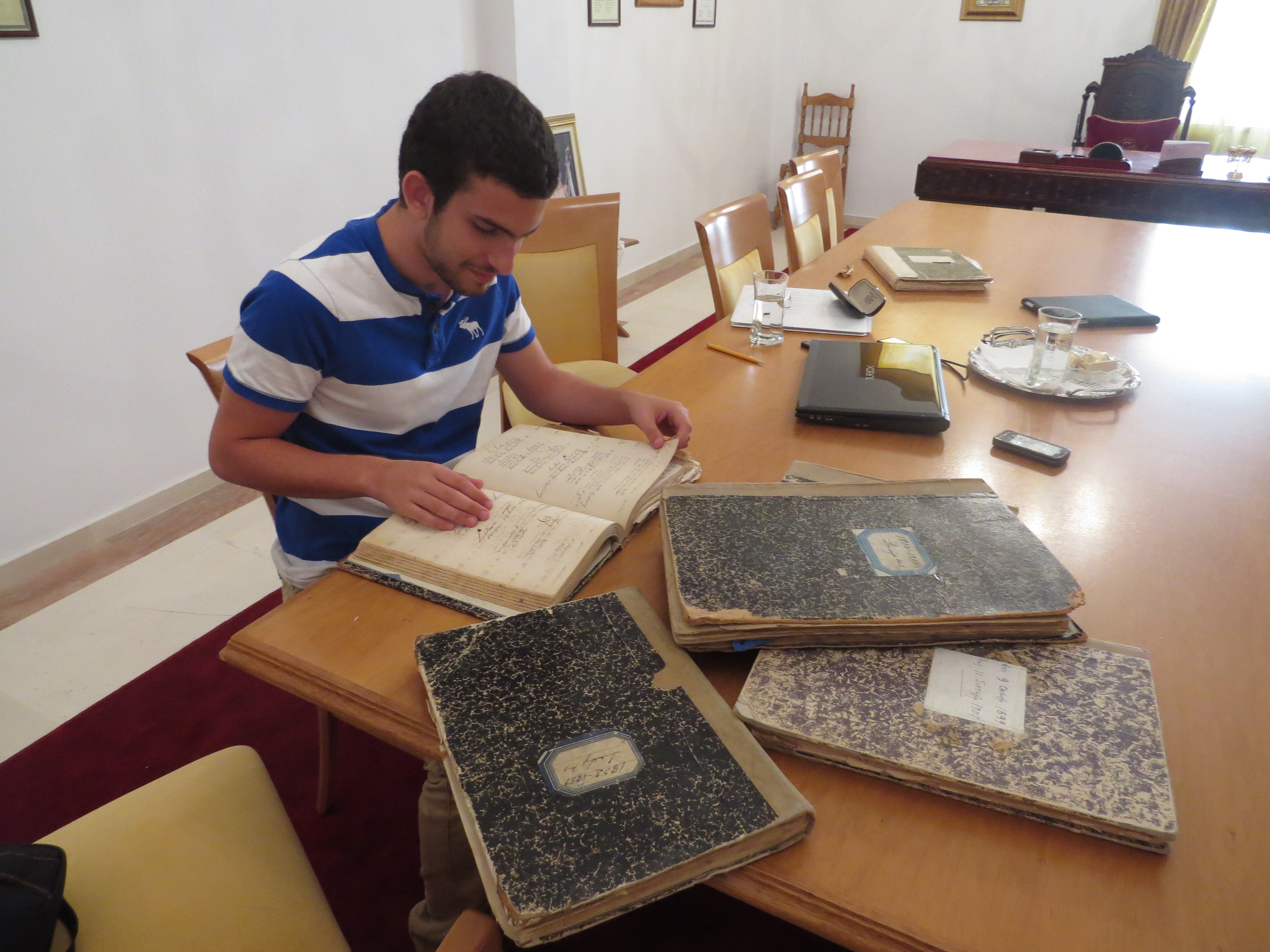
The Archives has offices for staff and a spacious research room. It also has off-site storage areas where most of the books and records are kept. Some records for Sparta which are listed at the GAK website may also be available. The research room has a large table, perfect for reviewing the oversized books and taking notes.

Research room, Archives office, Sparta

Research room, Archives office, Sparta

In the lobby, there are several  display cases featuring historic photos and documents.

Display case, Archives office, Sparta

Precious documents and photos are on display at the Archives

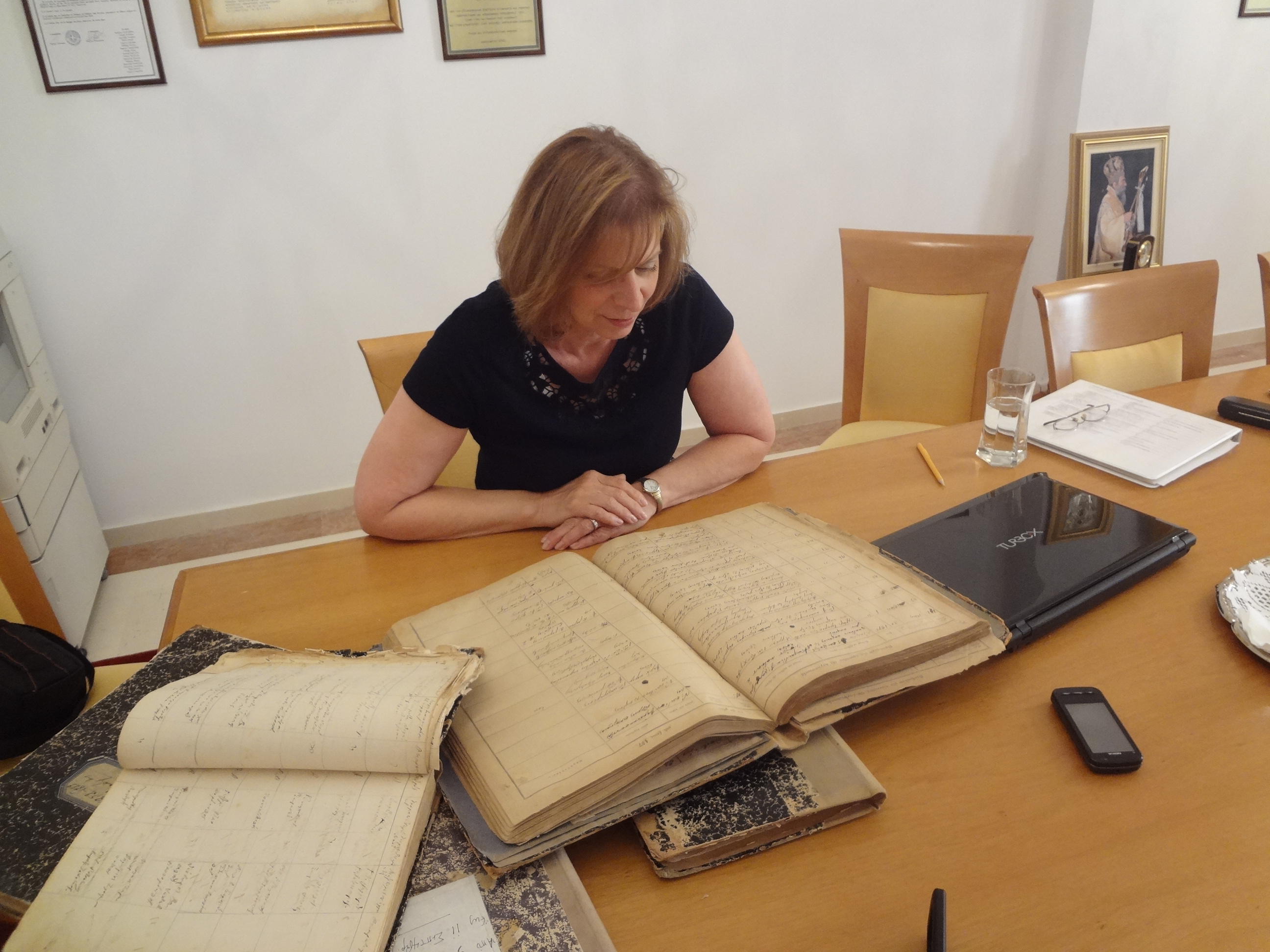
Gregory Kontos and I were finally able to meet our new archivist friends with whom we had connected through Greek genealogy Facebook groups — Maria Stellakou and Mihalis Sovolis. I had sent Maria an email in advance, letting her know exactly when we would be arriving. These dear people had offered to assist us in every possible way, and that is exactly what they did. They asked us which locations we were researching and what types of records we were seeking. They told us that they would have the appropriate books ready for us when we arrived the following morning.

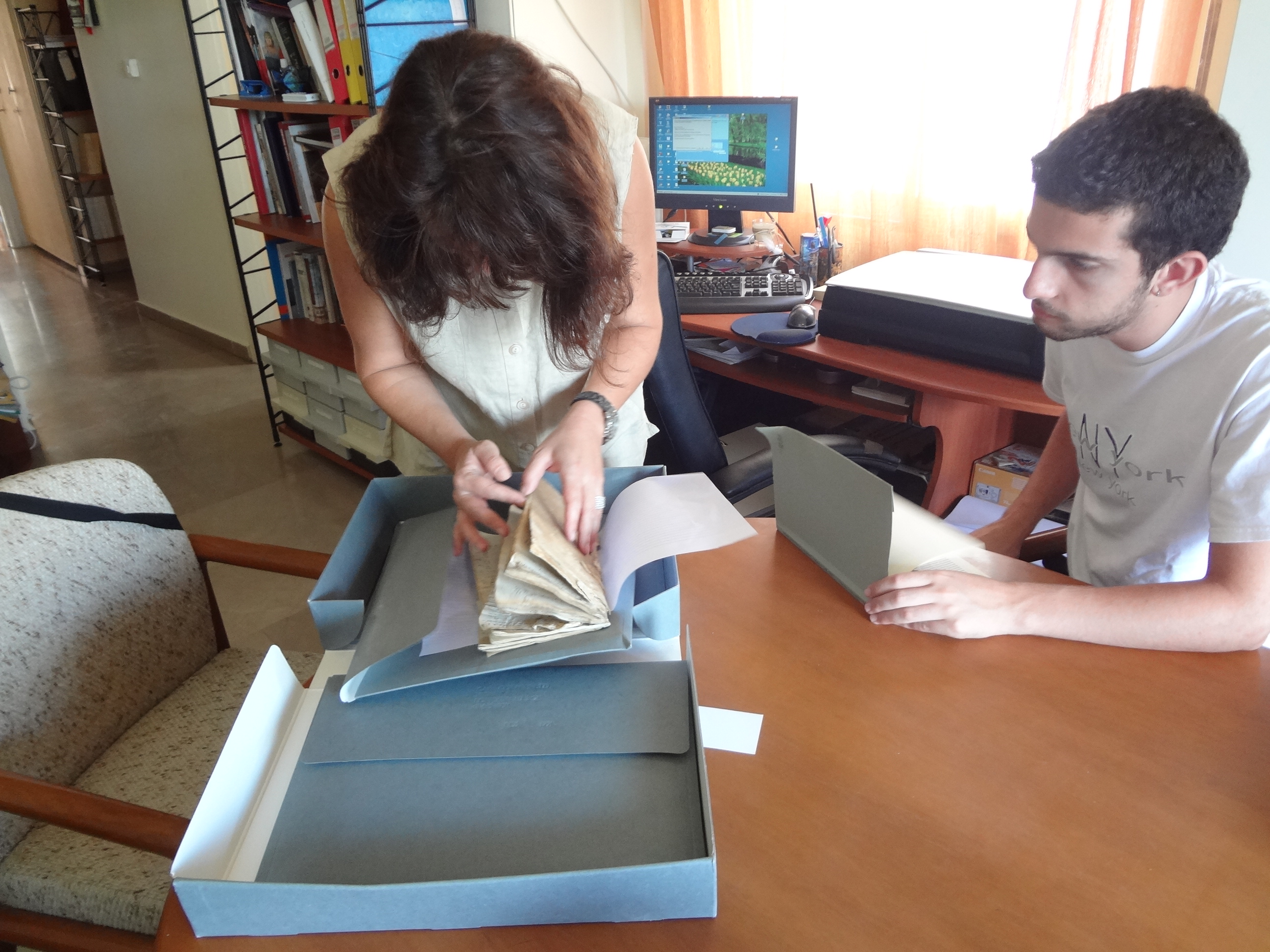
Maria Stellakou looks for a record.

Maria Stellakou looks for a record.

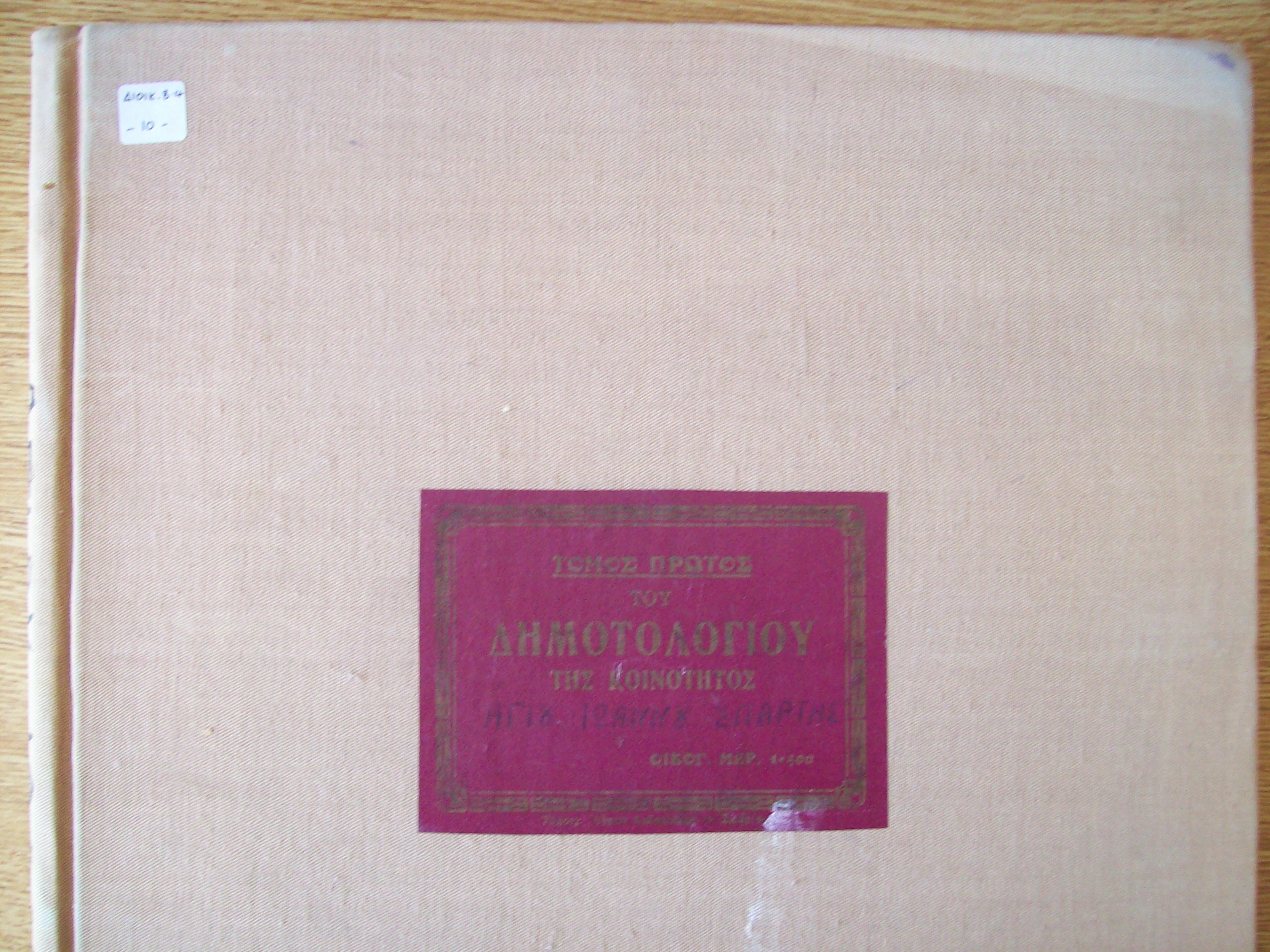
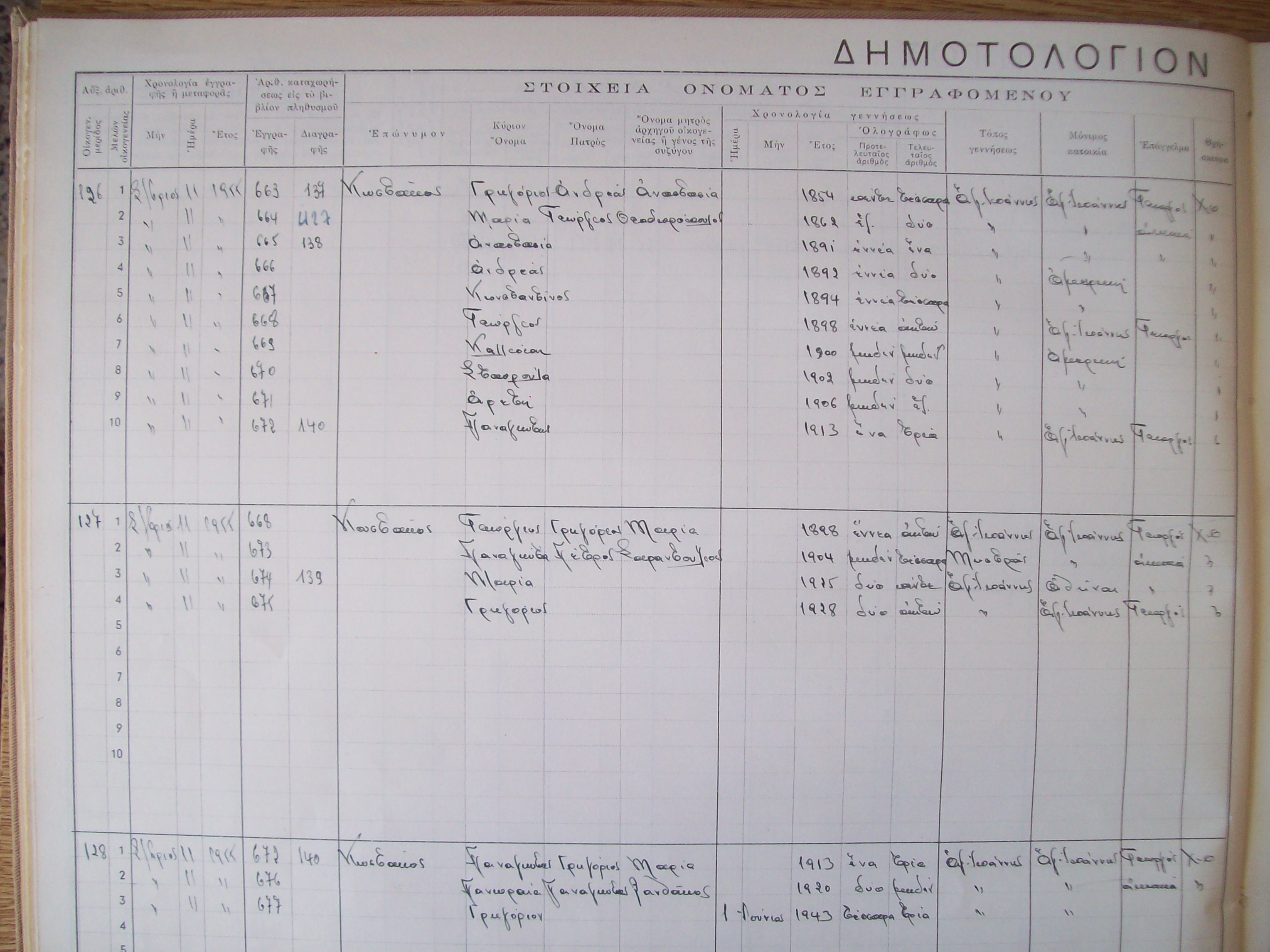
Can you imagine how thrilled I was to see the Dimotologion book for Agios Ioannis, the ancestral home of three of my grandparents? The Dimotologion is a register of families, listing husband, wife and children with their birth dates and other information. It is comparable to a U.S. census record.

Dimotologion for Agios Ioannis, Sparta

Dimotologion for Agios Ioannis, Sparta

When I opened that book and turn the pages, I found three Kostakos families. These records appear to have been created in the 1900’s, as that is when most of the children were born. Unfortunately, there are no similar family records for the 1800s.

Kostakos families, Dimotologion

Kostakos families, Dimotologion

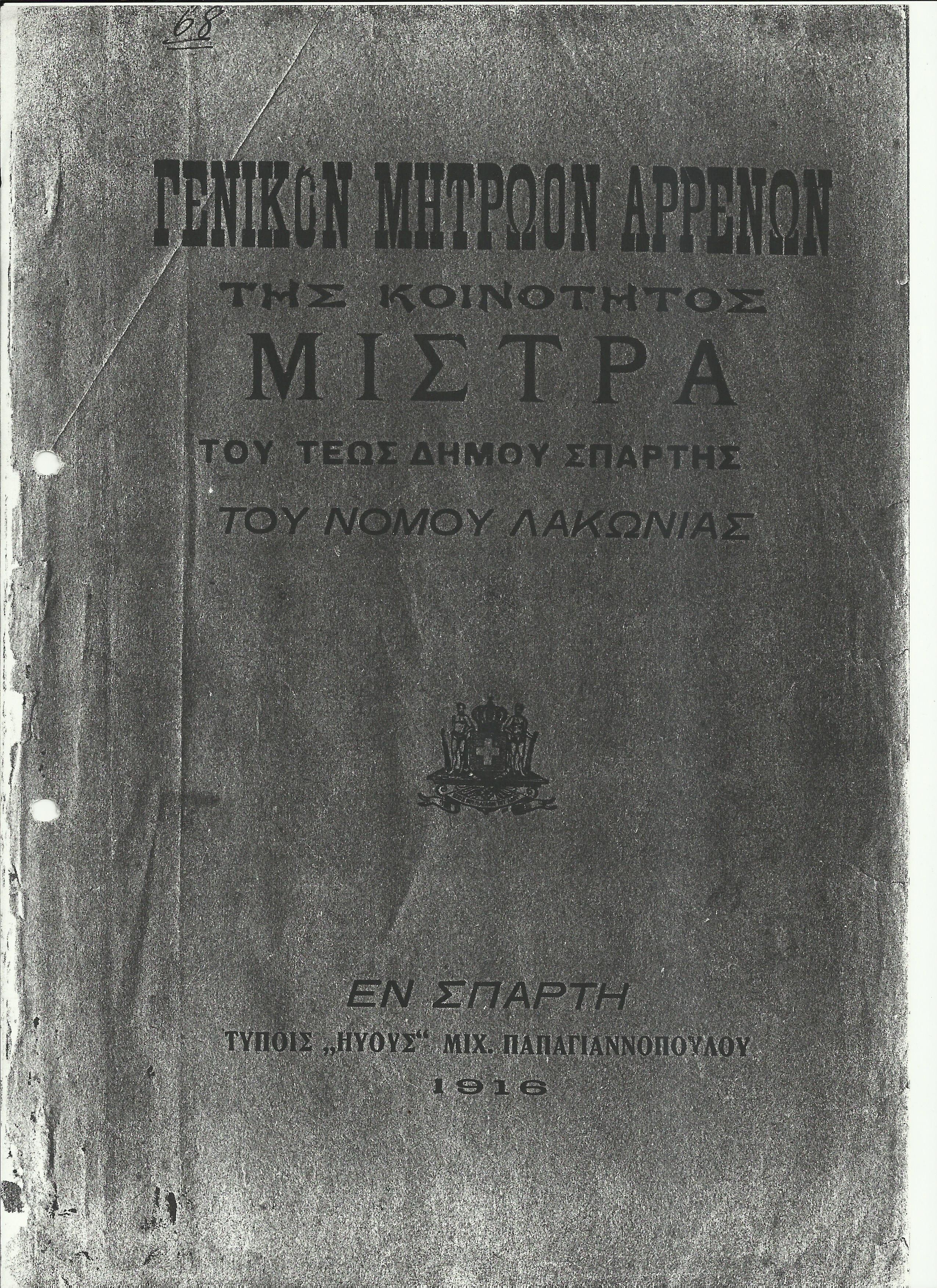
I looked at Mitroon Arrenon, Male Registers, for Agios Ioannis, Mystras, and other nearby villages.

Mitroon Arrenon (Male Register) for Mystras, Sparta

Mitroon Arrenon (Male Register) for Mystras, Sparta

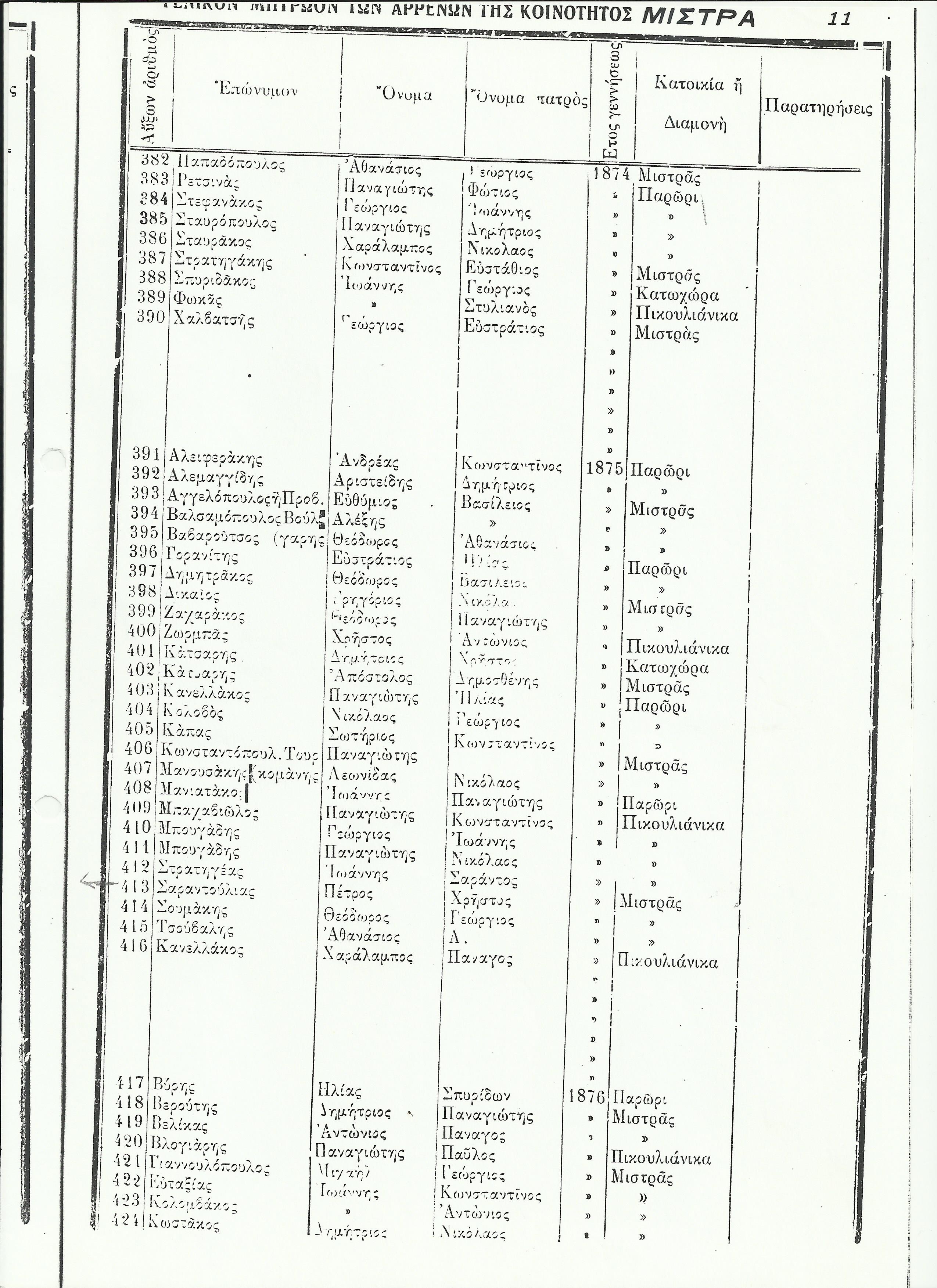
In the book for Mystras, I found an entry for my granduncle, Ioannis Eftaxias born in 1876. Konstandinos, my great-grandfather, is named as Ioannis’ father. Gregory and I were given permission to use our cameras to take photographs of any pages containing my family names.

Line 122: Eftaxias, Ioannis; father Konstandinos; born 1876 in Mystras.

Line 422: Eftaxias, Ioannis; father Konstandinos; born 1876 in Mystras.

Maria has begun to digitize some of these books herself. That is quite an ambitious project! She uses a scanner and then uploads the images to the office computers. With digitization, the old books can be preserved. They can also be easily accessed by computer.

Gregory and I spent all day on Tuesday (July 15) and Wednesday morning at the Archives. We were delighted to meet Pepi Gavala, the archivist, on Wednesday. Over the years, I have come to know Ms. Gavala by name, as she signs letters that I have written to the Archives when I was requesting information. She is a delightful woman, dedicated to her job and sincerely wanting to assist researchers in every possible way.

Here is an example: when we arrived on Wednesday morning, I asked if the books for Vordonia and Kastania were available. These are the ancestral villages of my first husband, Peter Lynard (Linardakis). Although I had not planned to research those areas, I had a strong impression that I should do so. Mihalis was at one of the offsite storage areas, and Maria called to ask him if he would go to the building where the Vordonia and Kastania books were kept. He stopped what he was doing, found the books, and brought them to us as quickly as he could.

I left the Archives, thrilled to have digital copies of civil records that are helping me piece together the various branches of my family. I also left behind new friends: Maria, Mihalis and Ms. Gavala. They made this visit both pleasant and productive. I am ever grateful for their cheerful help and their sincere desire for my success in finding the records I was seeking. I hope that someday I will be able to return their kindness and be of help to them.

Research and Remembrances, Part 3


Research at the Mitropolis of the Greek Orthodox Church, Sparta

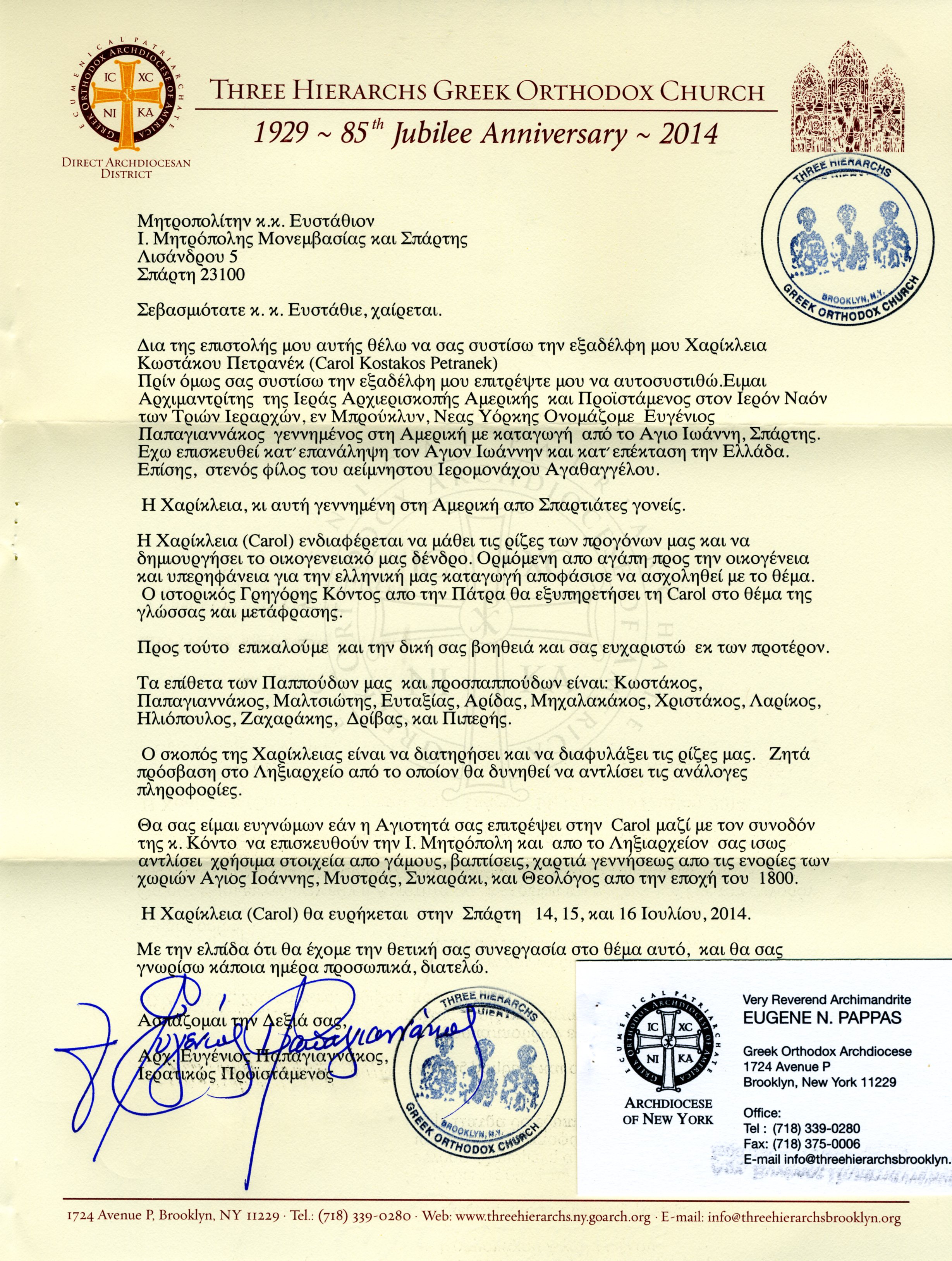
I had spent months preparing for this research trip, and I was anxious to visit the Archives and the Mitropolis of the Greek Orthodox Church with my friend, Gregory Kontos. We had decided in advance that our first stop would be the Mitropolis to search marriage and other church records. Thinking ahead, I had asked Father Eugene Pappas, a “cousin” on my mother’s line (we’re still trying to pinpoint our common ancestor) to write a letter to the Bishop of Sparta, asking permission for Gregory and me to conduct research at the Mitropolis at a specific date and time. In addition, Gregory’s father had called the Bishop who had known Gregory’s grandfather.
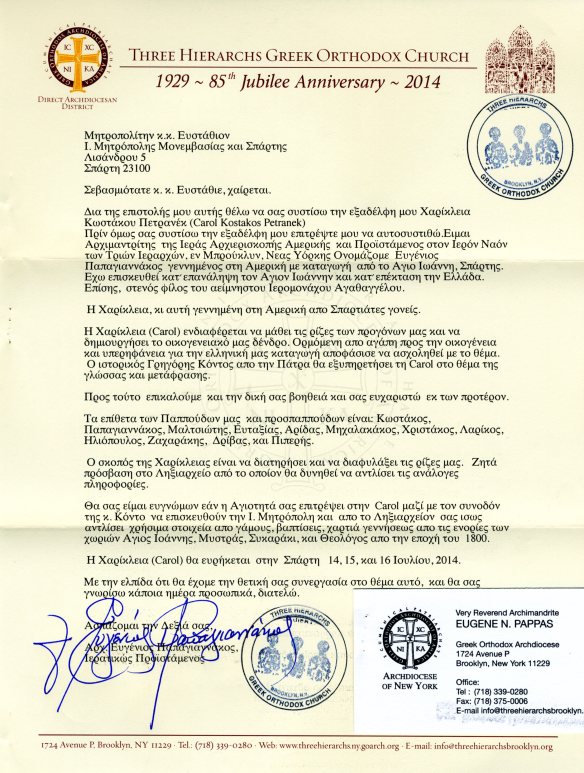
Letter from Father Eugene to the Bishop of Sparta, requesting permission for Gregory and me to research

Letter from Father Eugene to the Bishop of Sparta, requesting permission for Gregory and me to research

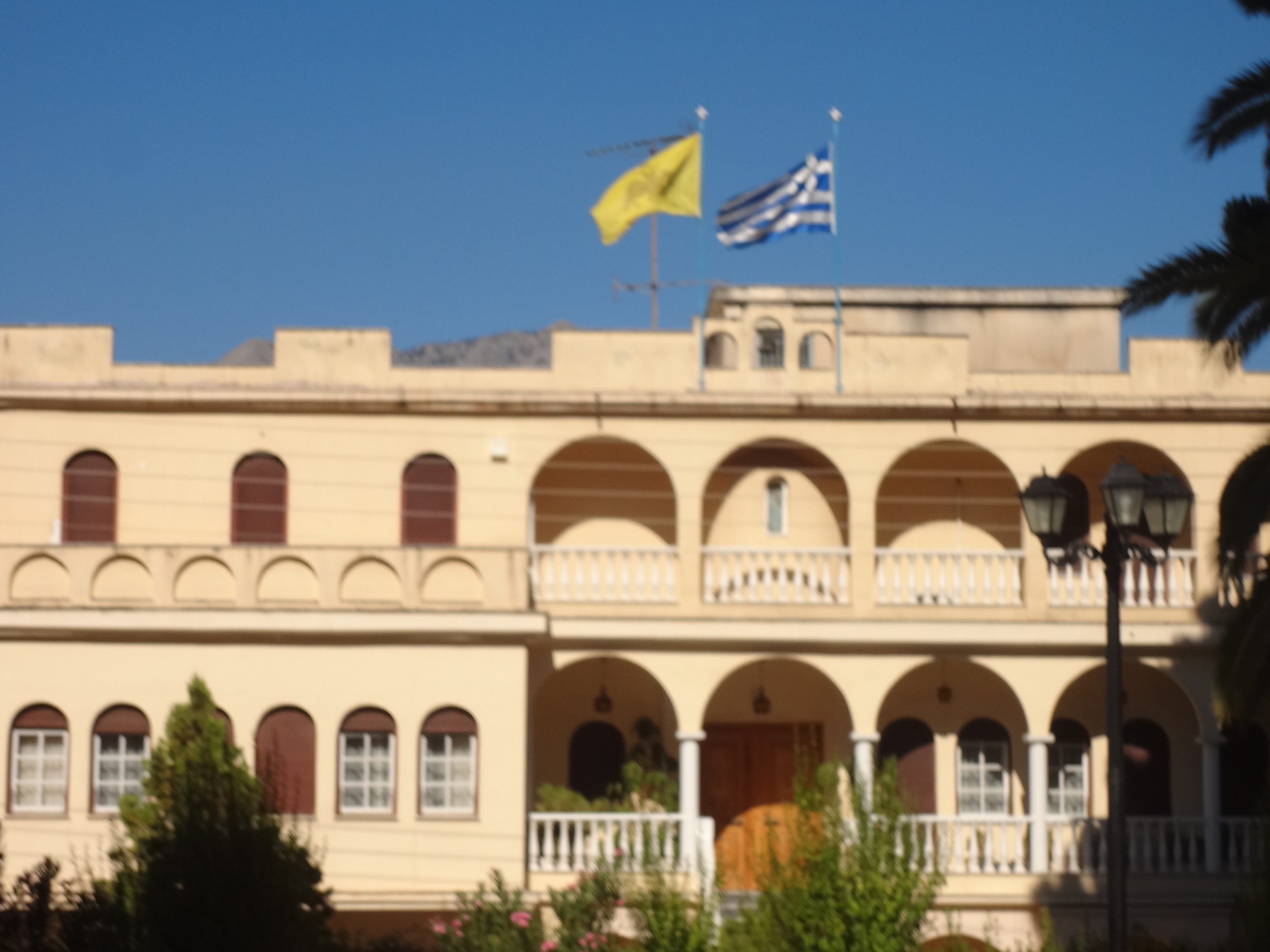
The groundwork was laid. Early on a Monday morning, Gregory and I approached this stately and beautiful building that rises majestically in the midst of the busy city.
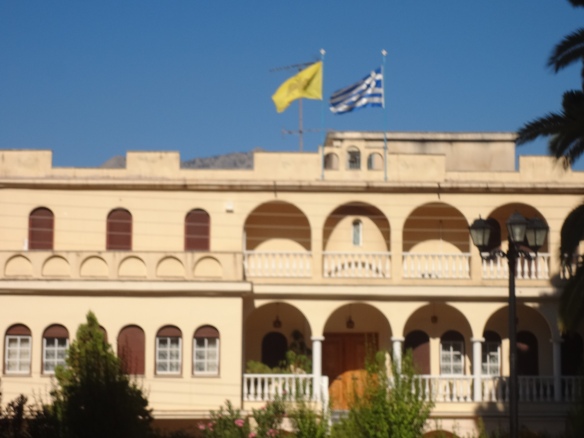
The Mitropolis of the Greek Orthodox Church, Sparta

The Mitropolis of the Greek Orthodox Church, Sparta

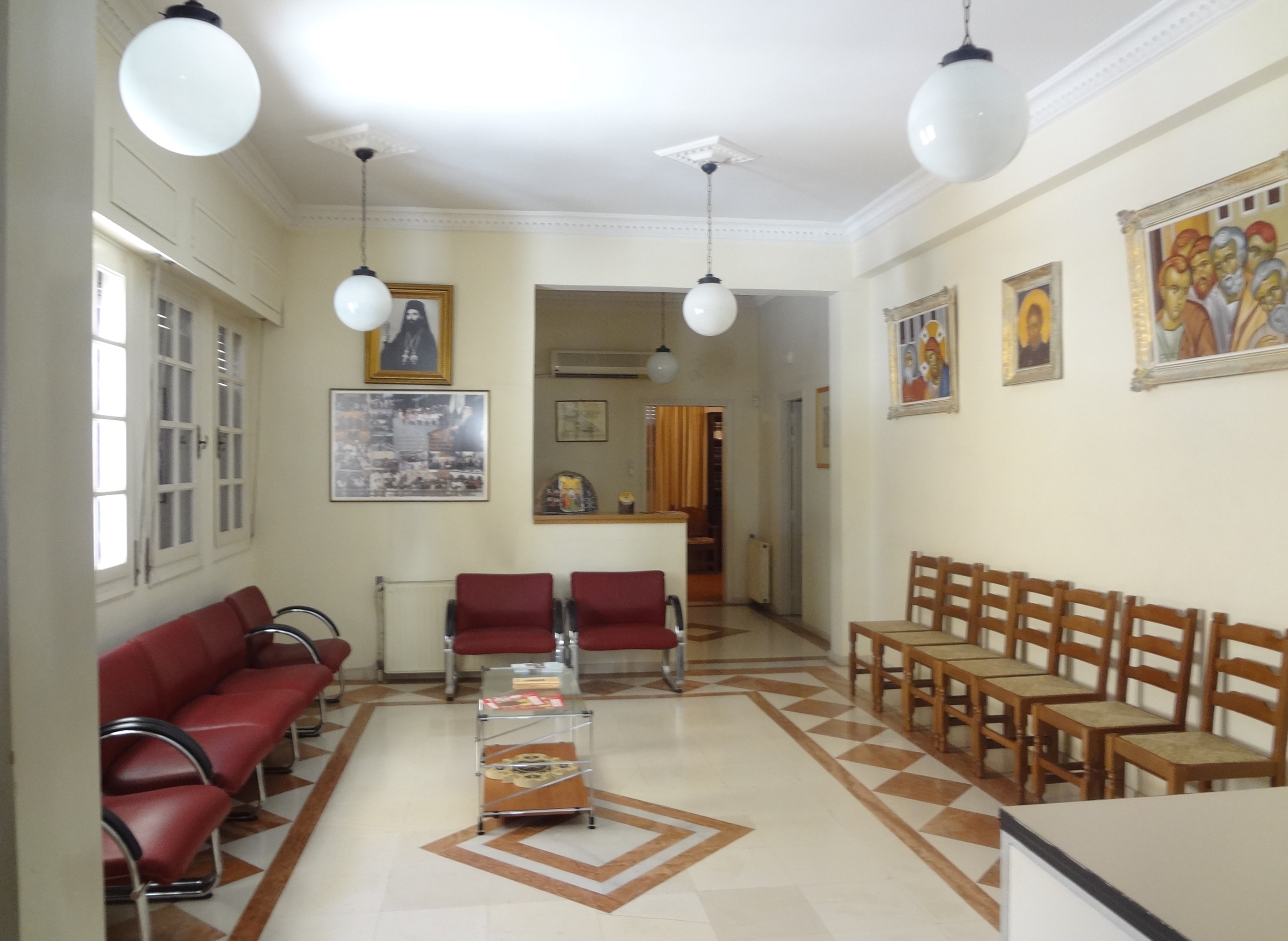
It is one thing to think about doing research in a religious institution, but it is quite another to actually be there. Gregory and I felt somewhat intimidated as we knocked on the door, but that escalated to total intimidation when it was answered by a somber faced priest with a long beard and piercing black eyes. His floor-length black robe and round cap added to our anxiety level. This was not like walking into the local library and asking for help! Thank goodness Gregory was with me! He explained in Greek who we were, and immediately the priest smiled and invited us in. Our letter to the Bishop had been received and we were expected. With great relief, we followed the priest into a beautiful waiting room ringed with icons, paintings and mosaics.
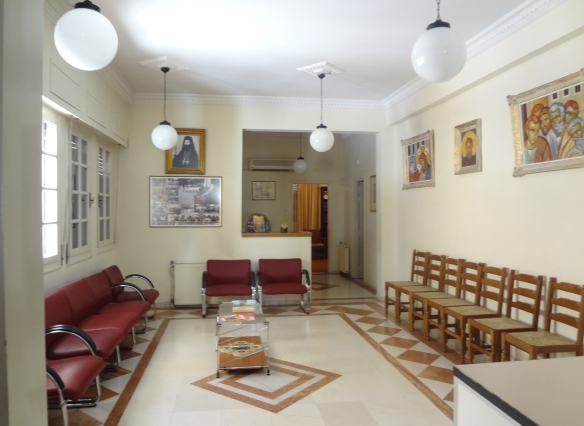
Waiting room of the Mitropolis, Sparta

Waiting room of the Mitropolis, Sparta

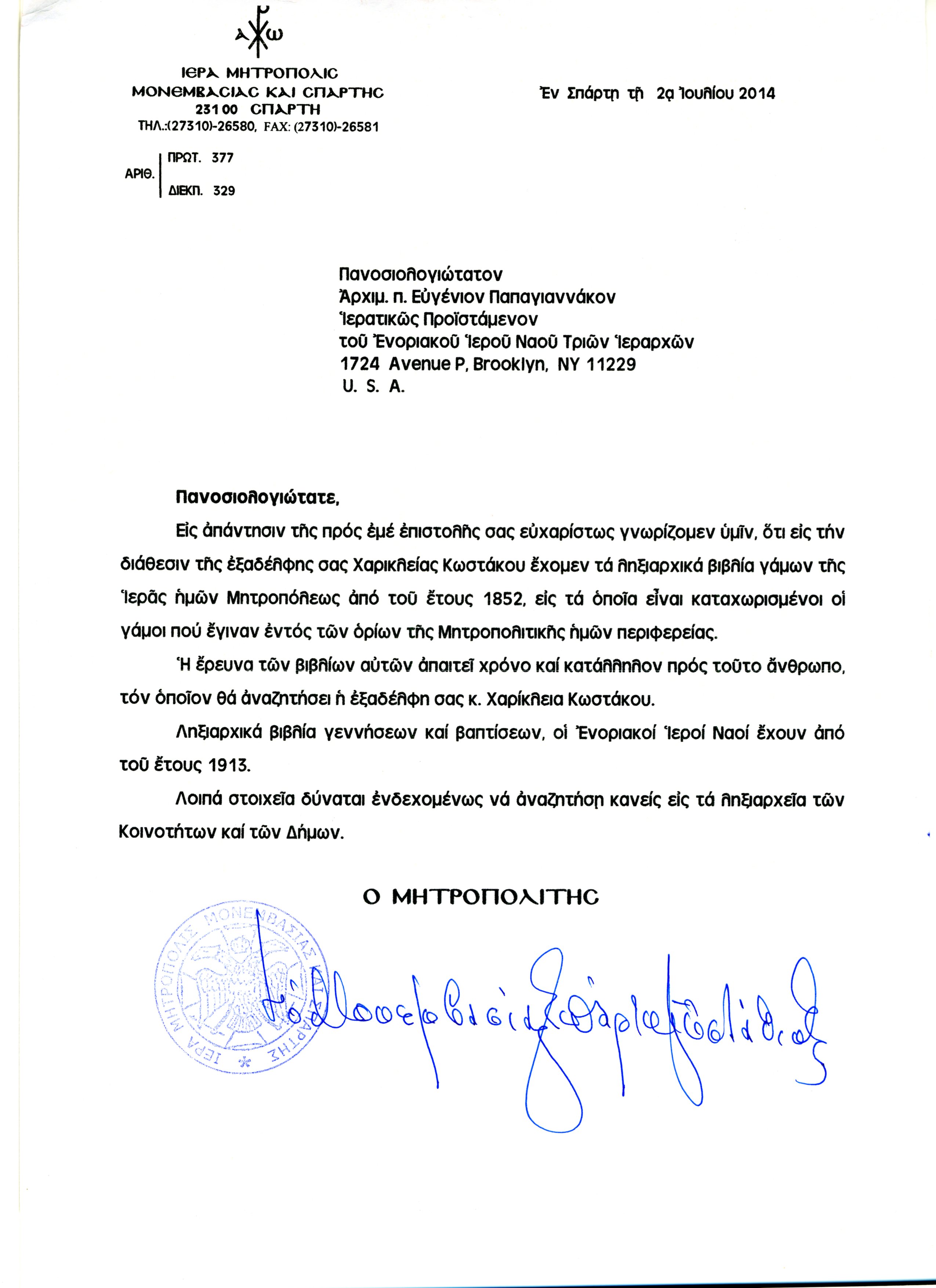
Shortly, we were cordially greeted by a man who told us that the Bishop had received Father Eugene’s letter and that we were welcome to review the records. He handed us the Bishop’s written response. It was both exciting and unsettling to have this document — just think, the Bishop now knows my name!
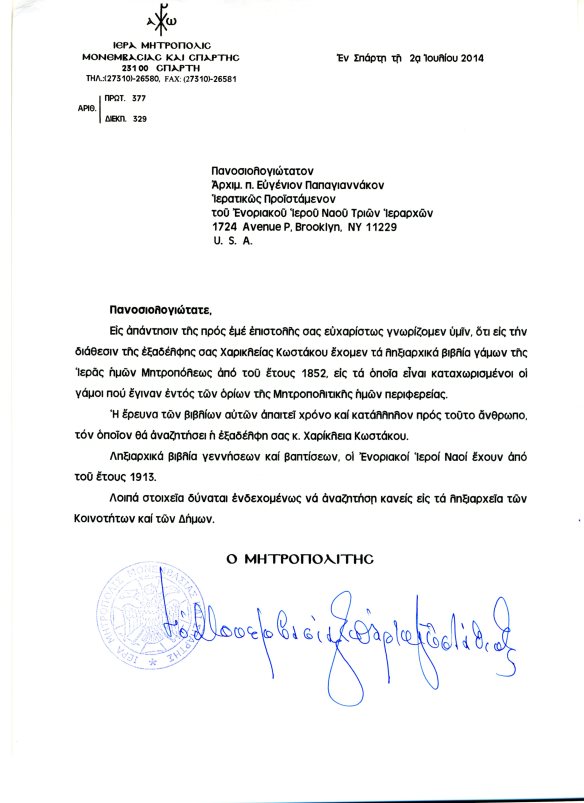
Letter from Bishop of Sparta-permission to view records 001

Letter from Bishop of Sparta giving us permission to view records

We were invited into a spacious, comfortable room with a large conference table. Our host brought us a plate of chocolates and water. He asked which books we wanted to review, and graciously brought us any that we asked for. The Mitropolis has books of marriage records, but not baptismal or death — those are kept by the local churches. Although I work with historical documents at the National Archives and the Maryland Archives, I was still awed to see these precious registers. Turning their fragile pages, I wished with all my heart that these records could be made available to the thousands of people who are seeking to their Spartan roots.
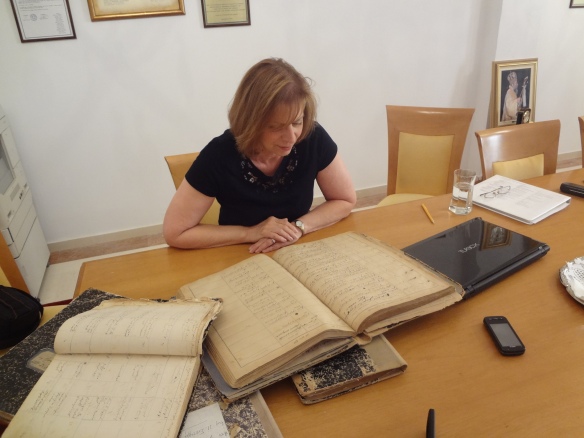
Mitropolis (4 Carol)

I wished I could have read these records! The old handwriting was just too difficult for me.

As hard as I tried, I was extremely disappointed that I could not read the old handwriting. I was occasionally able to decipher first names but the rest of the script was beyond my limited abilities. Realizing quickly that I would be of no use to Gregory, we came up with a plan. He would read the records and when he came to one I needed, I would take the digital photo. I gave him the names and approximate marriage dates for my great-grandparents. Because just a few first names were used in the late 1800’s (mostly the names of saints for males and a derivative for females) they were easy to recognize. Gregory found it was quicker to scan the pages by looking for first names.
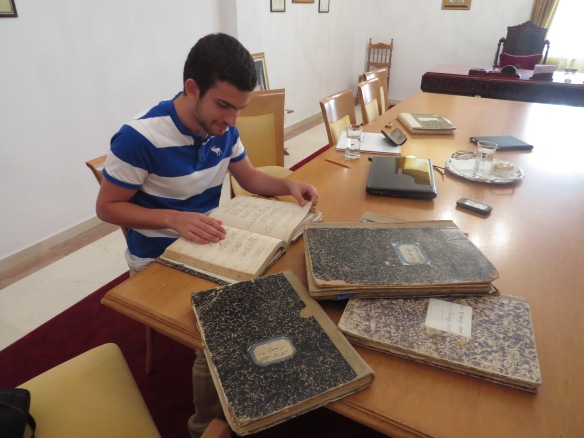
Gregory finds the marriage record of my great-great grandparents, Panagiotis Nikolaos Papagiannakos and Aikaterini Eliopoulos.

Gregory finds the marriage record of my great-great grandparents.

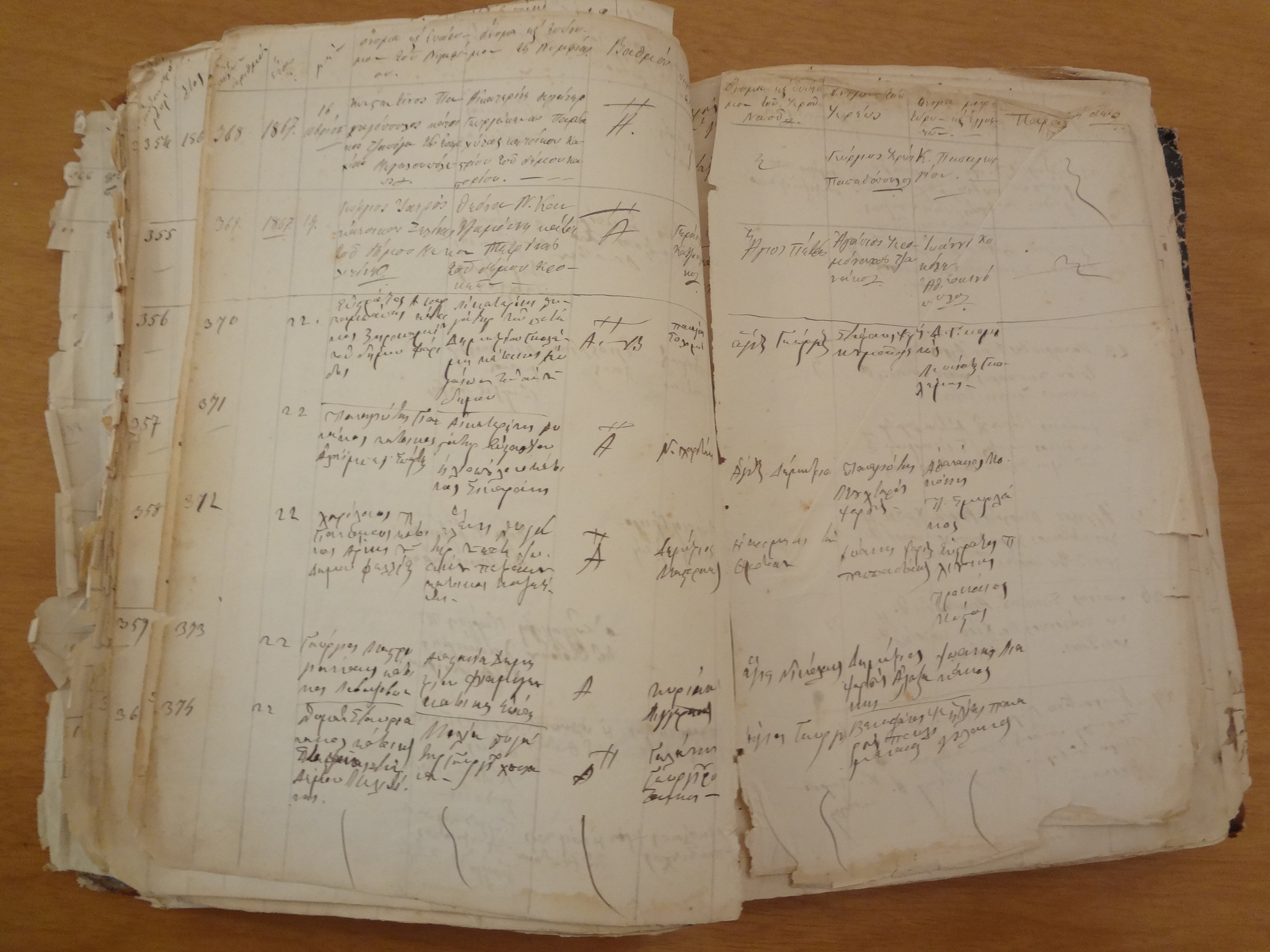
I was thrilled when he found the marriage record for my great grandparents, Panagiotis Nikolaos Papagiannakos and Aikaterini Eliopoulou, married December 22, 1867!
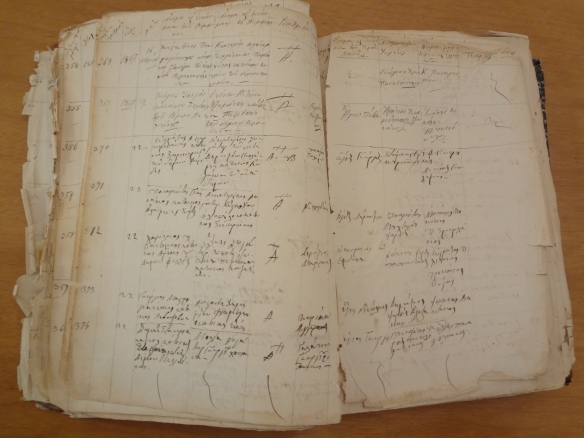
Line #371 – 1867, December 22. Panagiotis Giannakos, resident of Alaimbey, Sparta, married Aikaterini, daughter of Efstatios Eliopoulos of Sikaraki. Their first marriage. Agios Dimitrios Church. Priest: Panagiotis Mouhtaras. Witnesses: Athanasios Moukasis and P. Smyrlakos.

Line #371 – 1867, December 22. Panagiotis Giannakos, resident of Alaimbey, Sparta, married Aikaterini, daughter of Efstatios Eliopoulos of Sikaraki. Their first marriage. Agios Dimitrios Church. Priest: Panagiotis Mouhtaras. Witnesses: Athanasios Moukasis and P. Smyrlakos.

As you can see, the condition of these old registers is heartbreaking. The pages are crumbling and tattered. It truly frightens me to think that, without digital preservation,  the priceless information contained therein will be lost to future generations.

As we perused the registers, I concluded that they must be copies of originals because the same ink and handwriting would be found on several pages, then it would change. I wondered if the Mitropolis received records from the churches and then transcribed the information. These marriage registers listed the date of the marriage, name of groom, name of bride, occasionally the bride’s father’s name, the names of witnesses and the name of the priest. There was a column for notes, but it was usually blank. I also wondered if the original church records had more information, such as the names of the parents.

The books are kept chronologically by year and the data is not sorted by village. This is both good and bad:  good because if you don’t know the exact village of your ancestor, you can browse chronologically and look for your surnames; bad because if you do know the village but you’re not sure of the year, you have to read pages and pages of names until you find your ancestor.

Occasionally, a priest would stop in and ask how our work was going. When he saw the excitement in my face and voice as I said in my broken Greek that Gregory had found the marriage record for my great-grandparents, a smile crossed his face. After four hours, Gregory had found a few records with my surnames. Because we could not search a specific village, we realized that it would take many hours (perhaps days) to look through all the registers. We decided to leave, thanking our gracious guests for their help and cordiality.

I left with a deep appreciation for the kindness and respect that we were granted. The clergy allowed us to enter their hallowed building and trusted us with their books and records. I will be ever grateful to them.

Next… on to the Archives!