1946 Engagement Photo: George Paul Morfogen and Georgia Pappas

This photo has been hiding in a drawer in my grandparents’ home for over 70 years. When my cousin found it, he snapped a picture with his cell phone and sent it to me in a text:  I don’t think we digitized this one [during our cousin scanfest in 2015] and he was correct. What a treasure!

1946 Engagement Party, George Paul Morfogen and Georgia Pappas, held at Michel’s Restaurant, Brooklyn, New York

This photo has captured my heart and kindled my fascination. It evokes memories of the stories my mother shared about the galas, dances, and special events that were the hallmark of that time. People dressed in their finest with hats and gloves as de rigueur. Extended families gathered and new “matches” of young couples were forged by enterprising relatives. The magical combination of live music, fine dining and spirited conversations produced many an “enchanged evening.” Truly, I feel like I am missing something very special.

But I especially love looking at all these beautiful faces (and truly they are lovely!). The joy they express reveals a familial happiess that lies in connections which stretch back generations. Starting in Agios Ioannis (Pappas) and Anavryti (Morfogen) and now rekindled in Brooklyn, these immigrants settled themselves and their families in close-knit neighborhoods. They started successful businesses and helped each other become established in a new land.

This union of Pappas (Papagiannakos) and Morfogen (Morfogenis) shows how the intermarriages of immigrant Greek families expanded and drew the family circles tighter together. In this example, the families of both my father (Kostakos) and my mother (Papagiannakos) and thus, all of their cousins, now became linked with the Morfogen family and the circle ever widens. Both of my parents are in this photo, as are their siblings and their parents!

This family continuity is my foundation and fortitude.These are the generations on whose shoulders I stand and whose strength I carry.

My deepest gratitide and sincerest thanks to members of the Morfogen family who have identified almost all of the people. Below is the same picture with people numbered, and a chart with the people identified. [click on either of the photos to expand them]

If any additional people can be identified, or any corrections should be made, please let me know by sending an email to spartanroots1 at gmail.com. Thank you!

1Mrs. Zaharia Chahalis
2Pauline Morfogen Kokines
3First name?  Pavlounis
4William Kokines 
5Vivian Kokines Parlamis 
6Ethel Pavlounis Chahalis
7George Chahalis
8John Andrew Kostakos
9Georgia Kostakos Doukas
10Angelo John (Al) Doukas
11Andrew John Kostakos
12Catherine Pappas
13Angelina Eftaxia Pappas
14Nicholas Louis Pappas
15unidentified
16Calliope P. Coutros
17Peter Spyridon Coutros
18Stavroula (Stella) Kostakos Coutros
19Aphrodite (Frieda) Kostakos
20Panagiota (Bertha) Pappas
21unidentified
22Mary Coutros,(later married George Karagis)
23Peter Coutros 
24unidentified
25unidentified
26unidentified
27unidentified
28unidentified
29unidentified
30business associate: Mrs. Vassilaros 
31business associate: Irene Vassilaros 
32business associate wife 
33business associate: Mr. Chios
34business associate: Mr. Vassilaros Sr.
35Andrew Spyros Marinos
36Mary Marinos Neckles
37Petros Neckles
38George Spyros Marinos
39Helen Marinos (later married George Diakomis)
40unidentified
41unidentified
42unidentified
43unidentified
44Nicholas Spyros Pappas
45unidentified
46Father Eugene Pappas and next to him, his father, Leon
47unidentified
48Nicholas Christopher Pappas
49unidentified
50unidentified
51unidentified
52unidentified
53Christina Morfogen Marinos
54Anthony Spyros Marinos
55unidentified
56John Lambrinos 
57Areti Kostakos Lambrinos
58unidentified
59unidentified
60Lucretia Leakakos Pappas
61Pauline Drivas Pappas
62unidentified
63Effie Landis Pappas
64Stella Geaneas 
65George Geaneas 
66Mary Landis 
67Wife of James Landis
68James Landis 
69unidentified
70unidentified
71unidentified
72unidentified
73unidentified
74unidentified
75unidentified
76unidentified
77Catherine DeSimone Pappas
78Peter James Pappas
79John Salatas
80Catherine Pappas Salatas
81Christina Christakos Morfogen 
82James George Morfogen 
83Wilhemina Pappas
84Athanasia Morfogen Pappas
85Diamond Stavracos Morfogen 
86Sam George Morfogen 
87Vivian Morfogen Brauman 
88George Sam Morfogen 
89unidentified
90unidentified
91Paul George Morfogen 
92Anna Landis Morfogen  
93George Paul Morfogen   
94Georgia Pappas Morfogen 
95Calliope Kostakos Pappas 
96James Nicholas Pappas 
97Father Michalopoulos, Priest from Three Hierarchs
98Lily Landis Nikas  
99James  Nikas 
100Marie Nikas Combias 
101unidentified
102Vivian Morfogen Geaneas
103unidentified
104unidentified

Papou’s “Pistopoitiko”

A pistopoitiko (πιστοποιητικό) is a document issued by an authorized agent attesting to the proof of a fact. In Greece, these are predominantly used to certify birth (πιστοποιητικό γεννήσεως), marriage ( πιστοποιητικό γάμου) or death (πιστοποιητικό θανάτου). Thus, it is likely that a genealogist will encounter this document at some point in the research process.

For anyone seeking Greek citizenship, the pistopoitiko of birth for a parent or grandparent is mandatory. It certifies that the ancestor is registered as a citizen in Greece and proves the applicant’s Greek heritage. Knowing that it is an important genealogical record and could be of future value to my family, I went to the KEP (Citizen’s Service Center) in Sparta to obtain a pistopoitiko for my paternal grandfather, John Andrew Kostakos (Ioannis Andreas Kostakos – Ιωάννης Ανδρέας Κωστάκος).

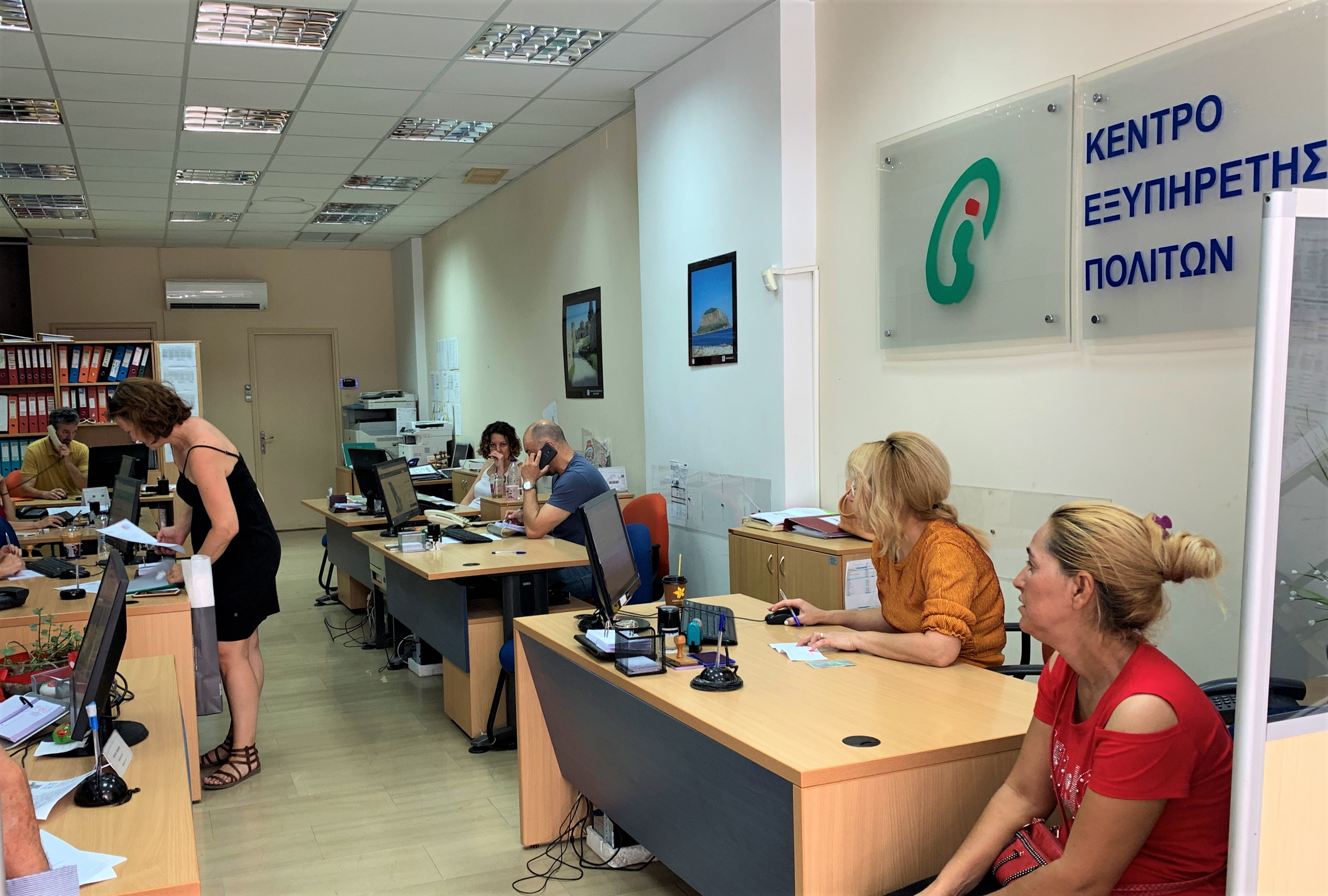
KEP Office, Sparta, Greece

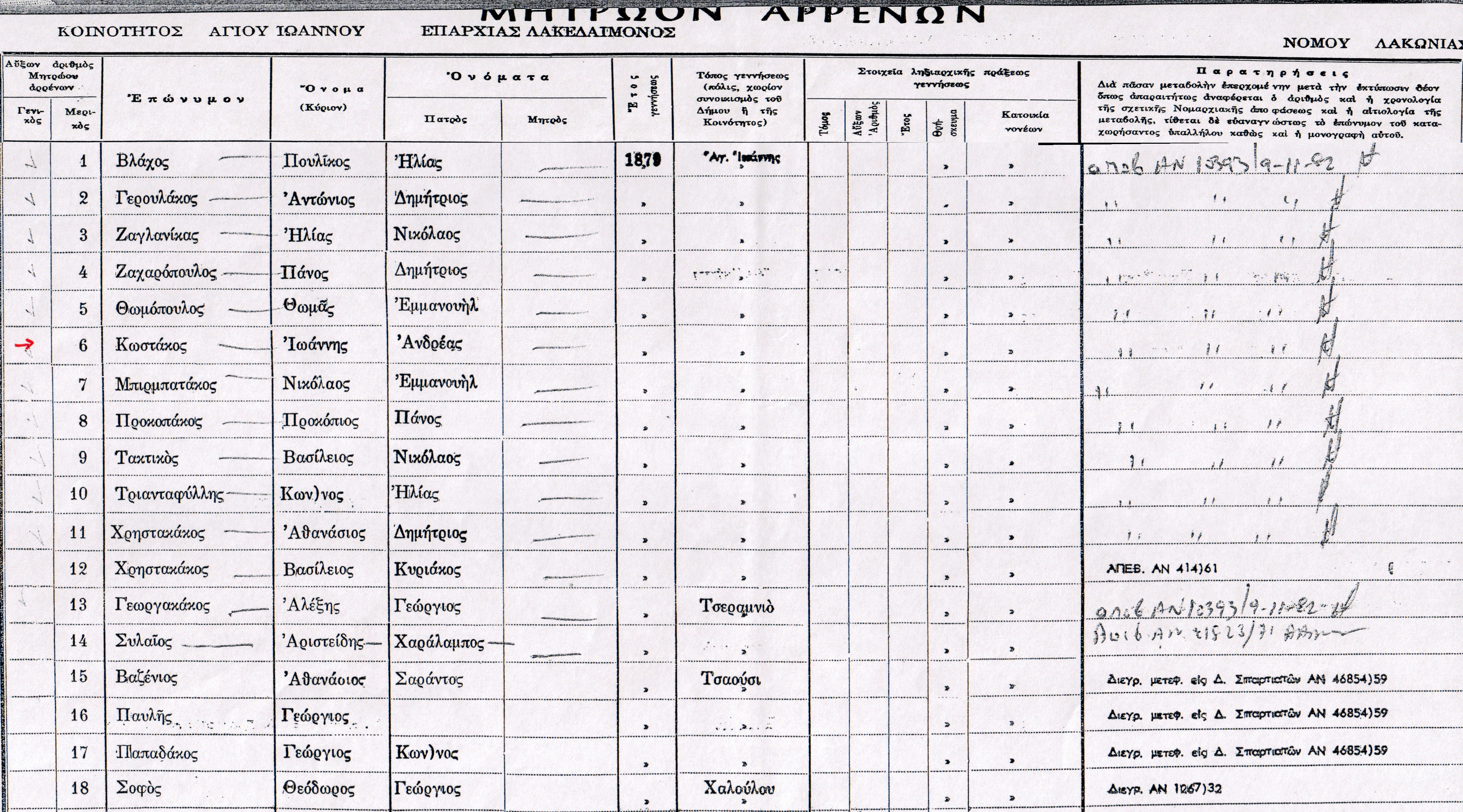
Before a pistopoitiko of birth can be issued, a copy of the Male Register (Μιτρώοv Αρρένον ) listing the ancestor must be procured. These can usually be found at a regional office of the General State Archives of Greece. If the Archive office does not have the Male Register for your ancestor’s village, it will be at the Mayor’s office (Dimarheion), the Civil Registry Office (Lixarheion) or the KEP.

One of the first documents I obtained in Greece years ago was the Mitroo Arrenon for my papou Kostakos. He was born in 1879 in Agios Ioannis, and his name is on line 6 below.

Mitroon Arrenon, village of Agios Ioannis, year 1879

I brought a copy of this to Greece with me, and I’m glad I did. It made the process very easy because I did not have to locate it at the Archives or the KEP office.

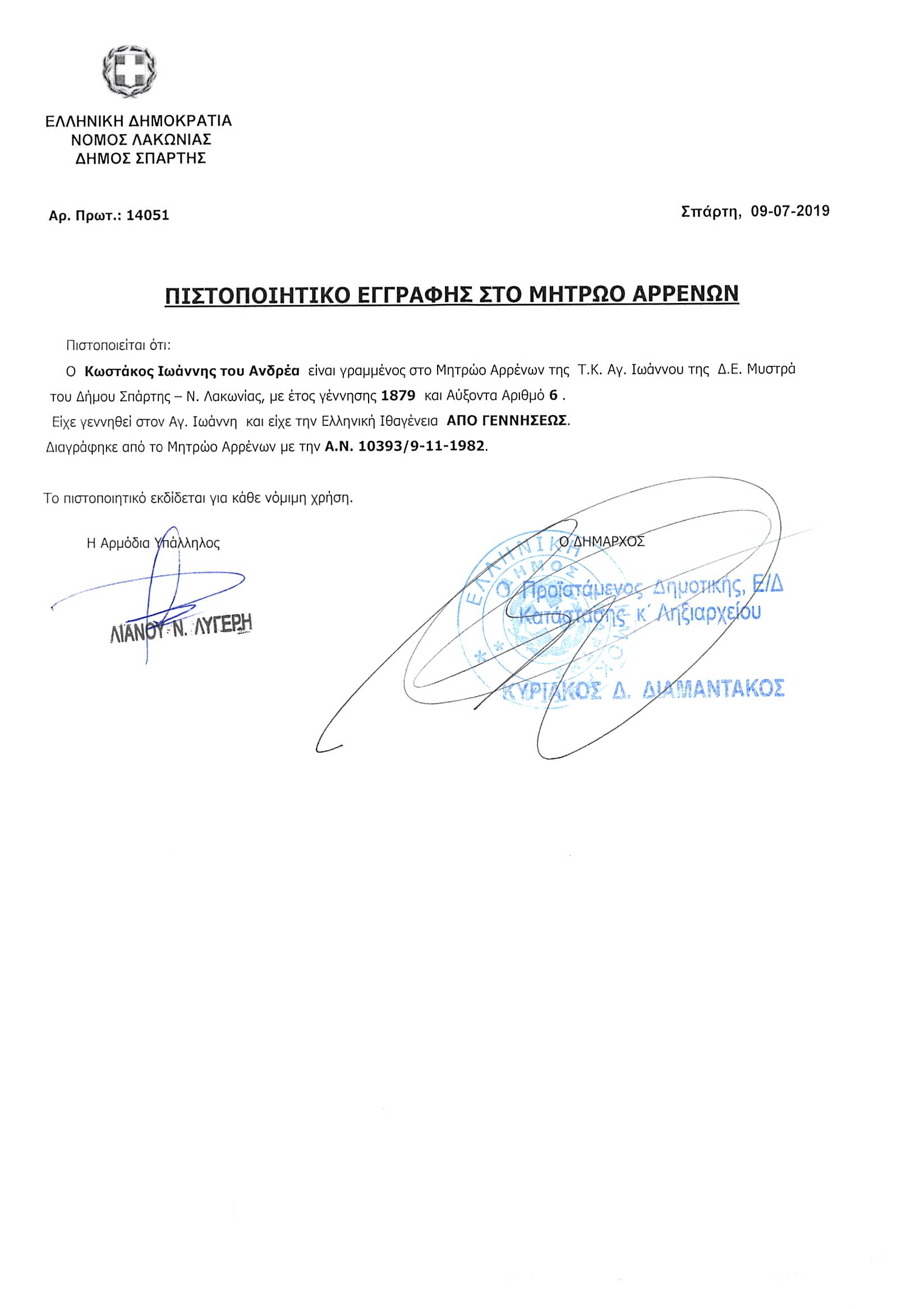
At the KEP, the first question asked was:  “for what purpose do you need a pistopoitiko?” I replied “for Greek citizenship,” because I knew that was an acceptable response whereas “genealogical research” may not be. I was then asked the name, birth year and village of my grandfather so that a search for his Male Register could commence. This is when I took out the copy and handed it to the clerk. She asked if I obtained the copy from the KEP, and I said no, that it was from the Archive office. She examined it carefully and looked at me several times; I wondered if it was an acceptable copy. Without a word, she turned to her computer and began typing. This is what she handed me:

Pistopoitiko of Birth, John Andrew Kostakos. Obtained at the Sparta KEP office, July 2019.

Translation:
Certification that:  Kostakos, Ioannis of Andreas is written in the Mitroo Arrenon of the village of Agios Ioannnis of the Municipality of Mystra of the Dimos Sparta, Nomos Lakonias, with the birth year of 1879 and serial number 6. He was born in Agios Ioannis and is of Greek nationality by birth. His name was deleted from the Mitroo Arrenon with A.N. 10393/9-11-1982. This pistopoitiko is issued for legal use. The document is signed by an official, and also by the mayor, Kyriakos D. Diamantakos.

Being in Sparta, having the Mitroon Arrenon, and going in person to the KEP made the acquisition of this document an easy process. From a remote location, one could obtain the Mitroo through the regional archive, then contact the KEP office in the area of one’s ancestral village, send the Mitroo, and request a pistopoitiko. Alternatively, the entire process of obtaining both the Mitroo and the pistopoitiko can be done solely through the KEP. The issue is always, will the KEP office respond in a timely manner.

My recommendation is:  if you will be in Greece and you want a pistopoitiko of birth, marriage, or death, plan time in your visit to obtain this in person. Having such a document in your possession may someday be important to you or a member of your family. I am thrilled to have this certification of birth for my papou.

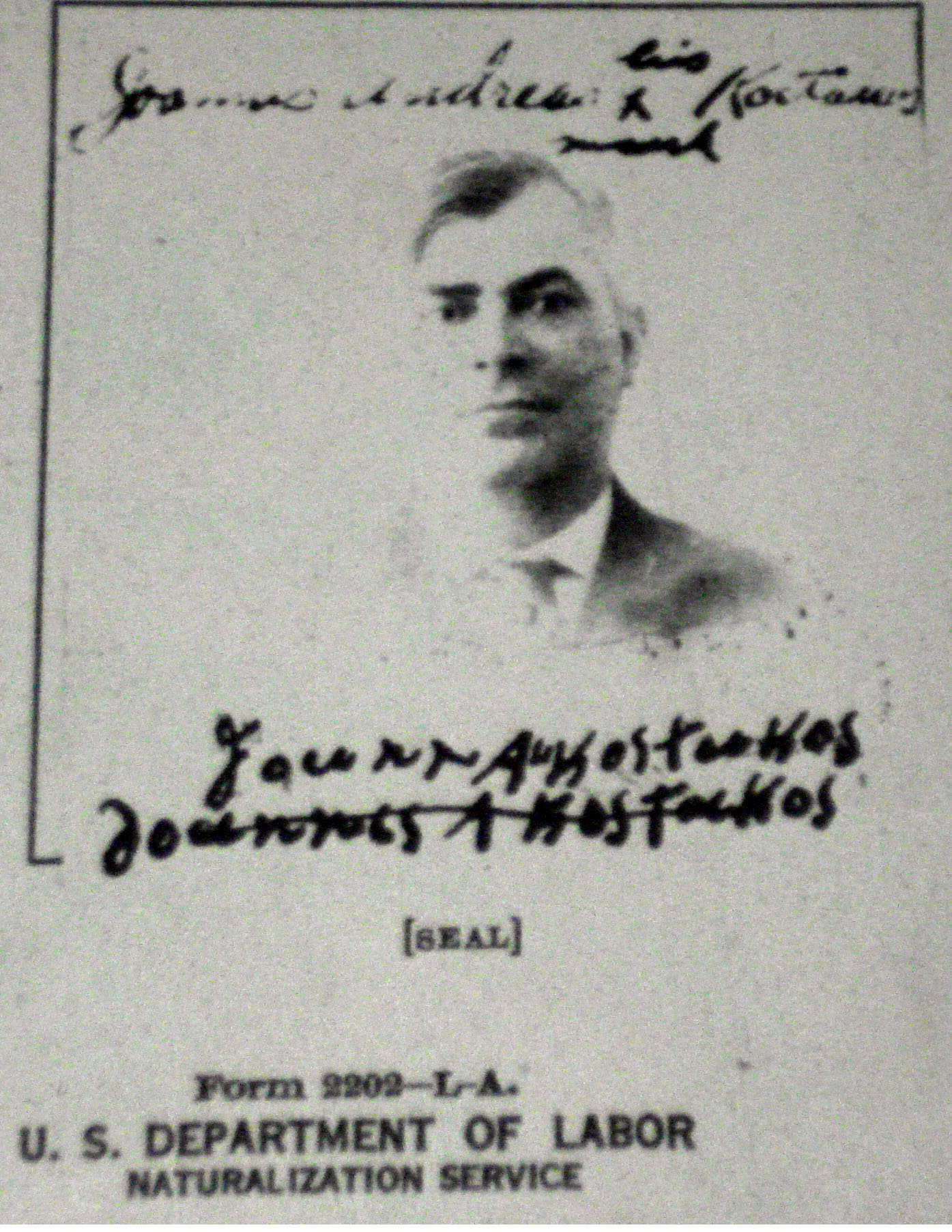
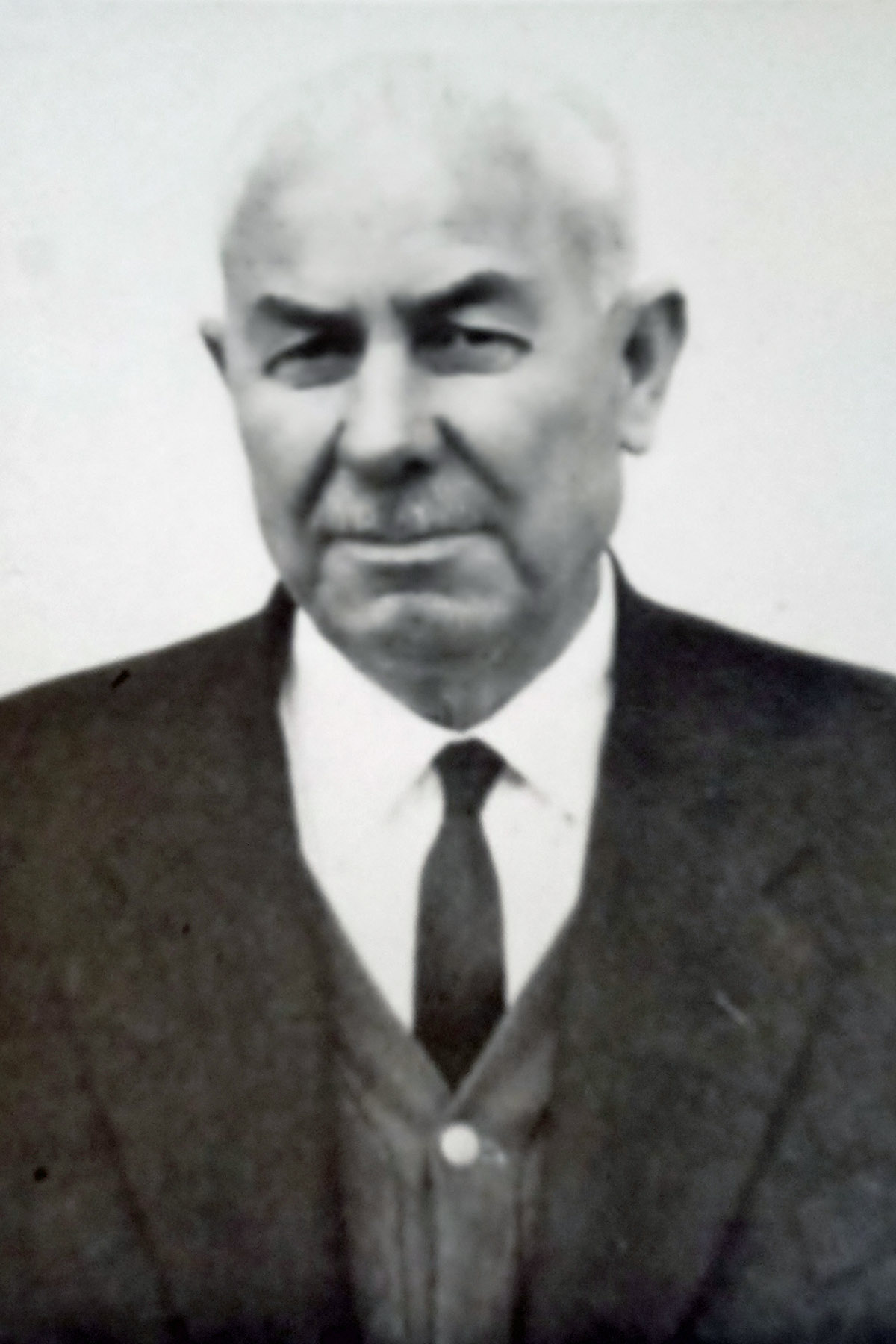
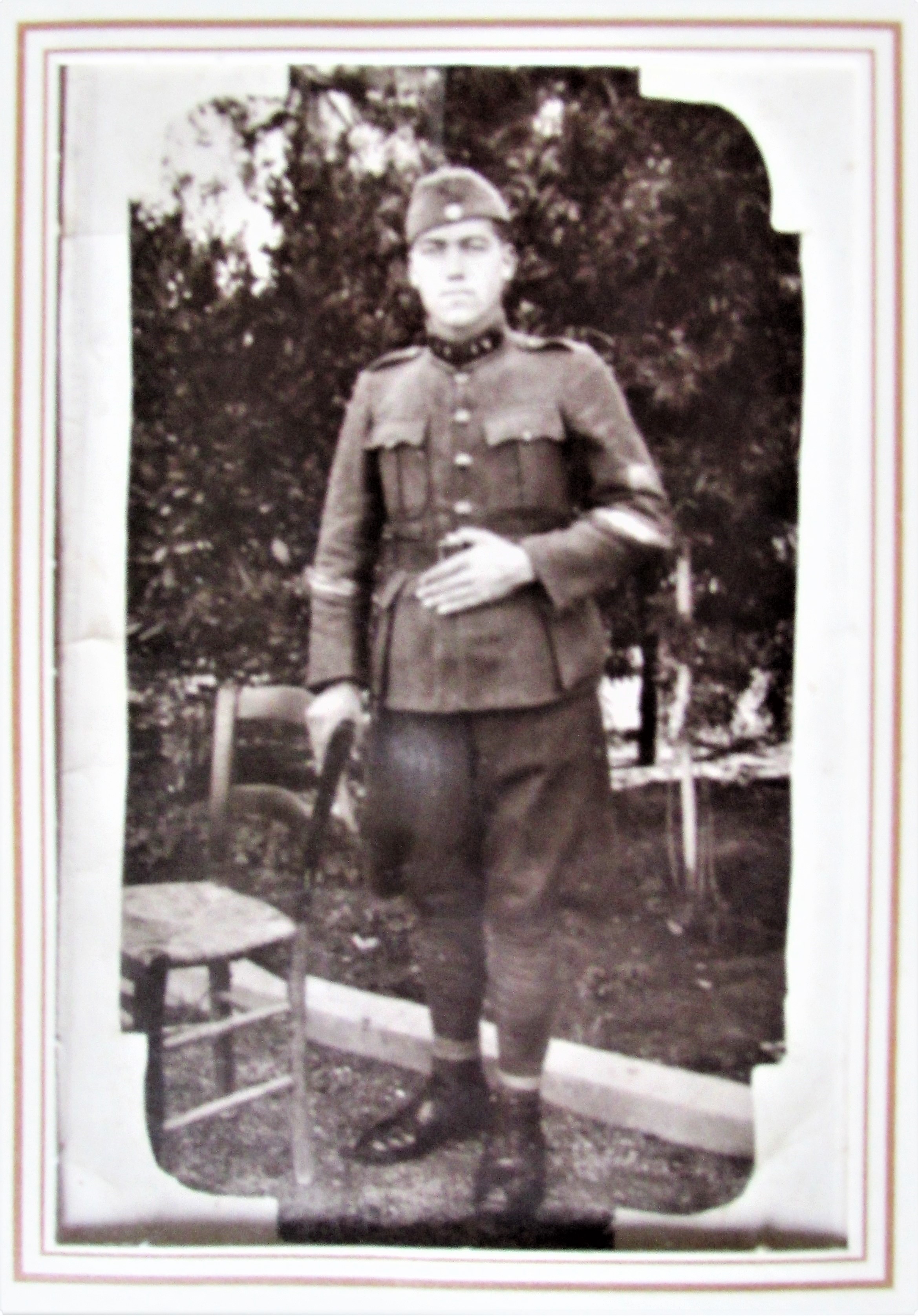
John Andrew Kostakos; my grandfather’s photo from his naturalization papers, 1931


Full Circle

Spending two months in Sparta and Agios Ioannis this summer has turned my heart more deeply to this land. I love the vitality of the city and the peaceful nature of the village. This is where it all began for me, as it is the birthplace of my four grandparents. It continues to be the residence of my cousins, and my “home away from home.”

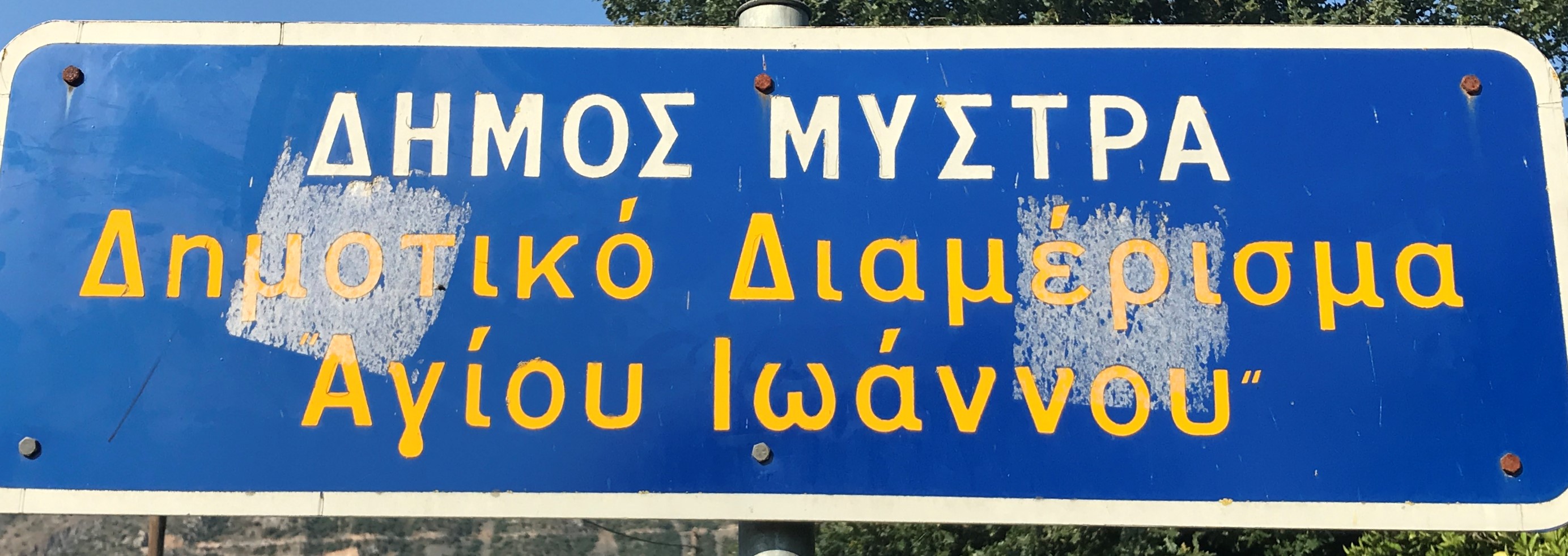
Dimos Mystra – Municipal District – Agiou Ioannou

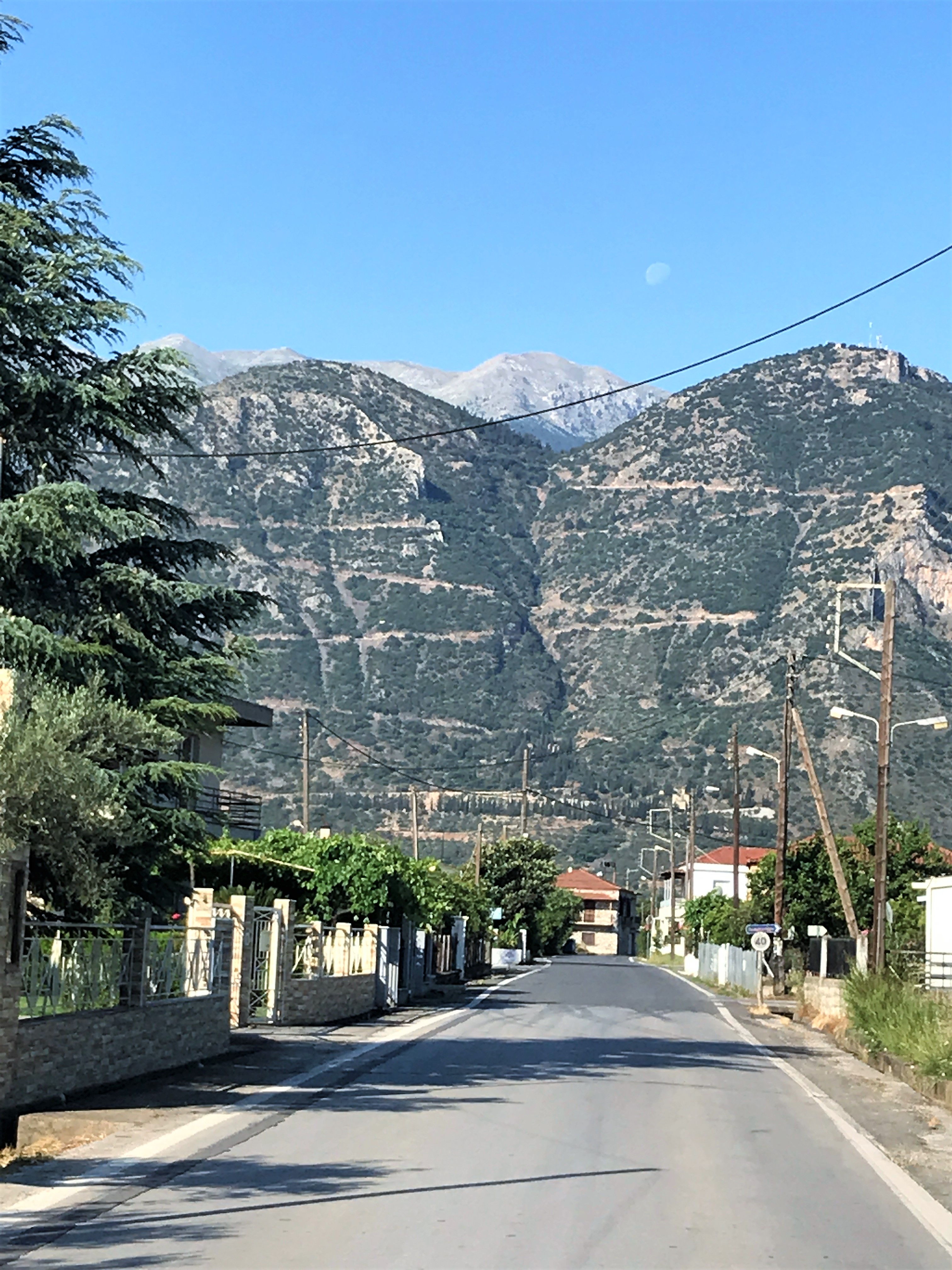
I enjoyed many happy evenings in Agios Ioannis, visiting with family and absorbing the spirit that permeates the stone homes and verdant orchards. Agios Ioannis is nestled in the plains of Sparta, under the towering Taygetos mountains. What appears to be a ribbon across the mountain is actually the road to the village of Anavryti, situated at the very top on the right.

Road into Agios Ioannis, from Sparta

My Kostakos, Aridas and Papagiannakos grandparents hail from Agios Ioannis. These families have had a profound influenced in the village. Some remained and served; others emigrated yet “gave back,” never forgetting their origins.

The Aridas family owned and operated the regional bus line. My granduncle, Aristedes Georgios Aridas, was the proprietor who provided a vital service for the town’s residents. Aristedes lived in Agios Ioannis his entire life, and his descendants continue to live in the beautiful home which he had built.

Aristedes Georgios Aridas, 1905-1992

My second cousin, Grigorios Georgios Kostakos, also remained in Agios Ioannis and did not emigrate. He was very active in village affairs and held positions on the town council. He constructed the municipal building which now has many uses, including a preschool which his Kostakos cousins attend today.

Grigorios Georgios Kostakos, 1927-2001

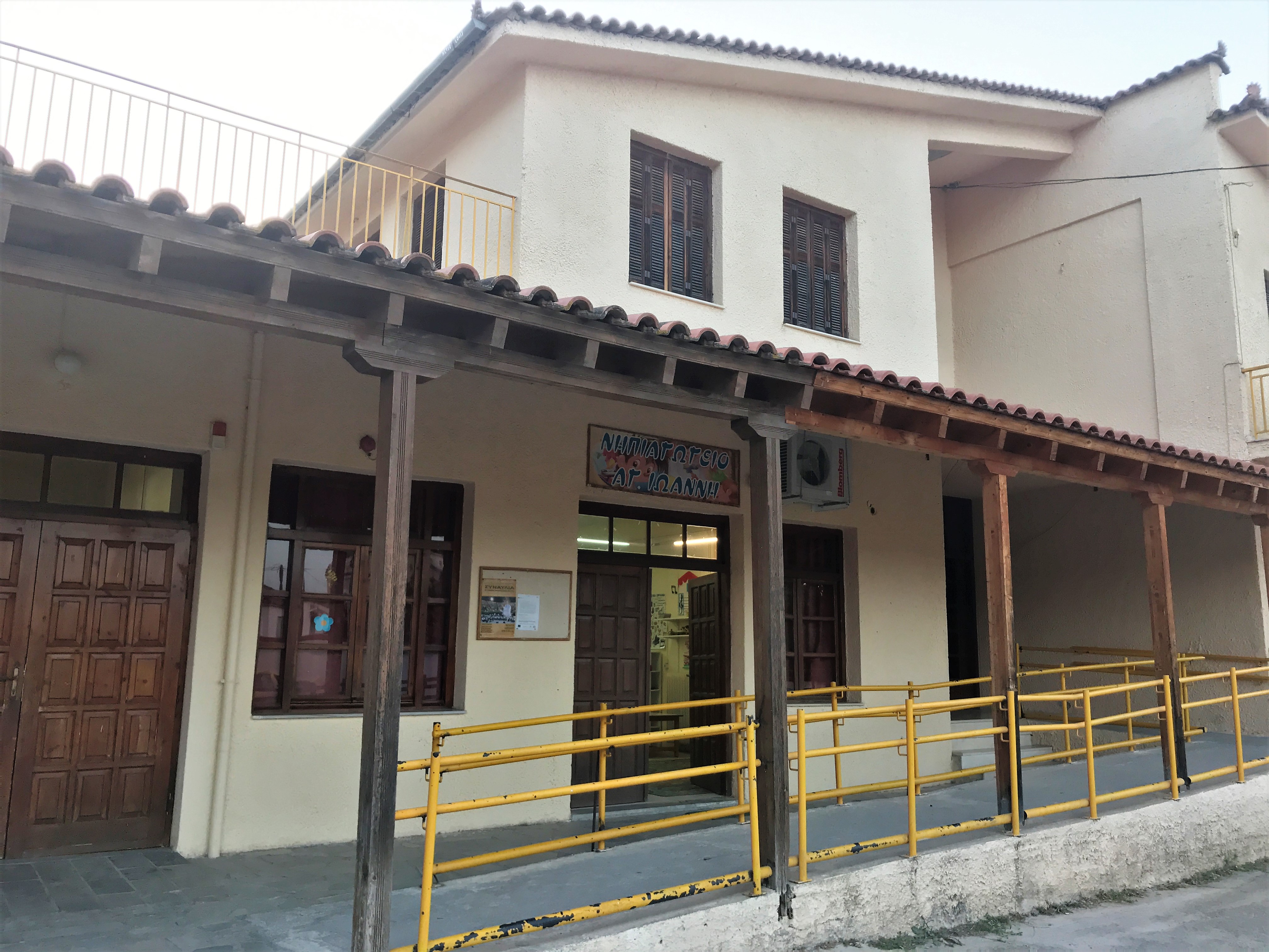
This is the Agios Ioannis municipal building which Grigorios had constructed, and which has served the community for many years.

Agios Ioannis Municipal Building

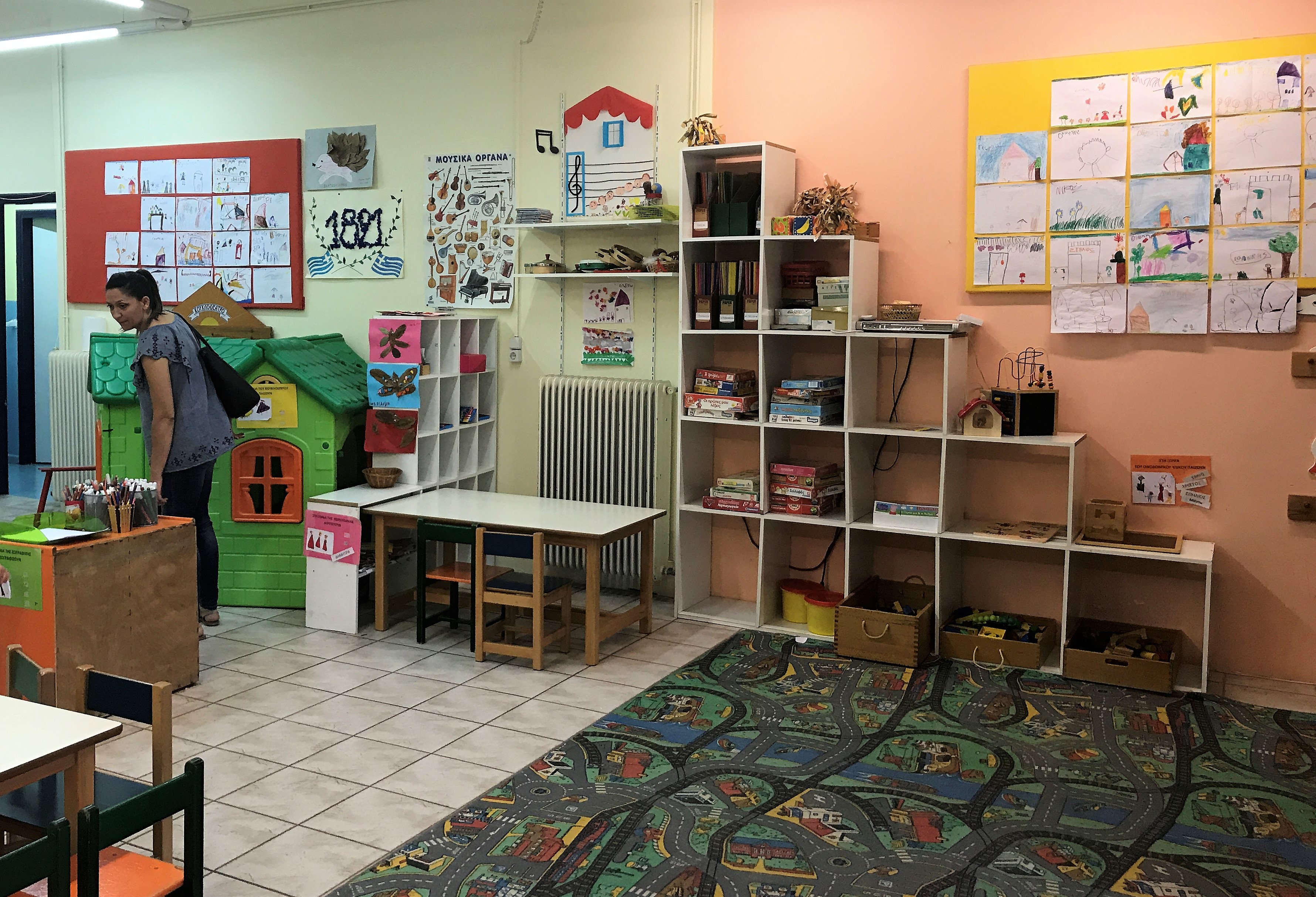
This room in the municipal building is now used as a preschool, and where the children of Georgios’ extended family now attend.

Preschool room in the Agios Ioannis municipal building

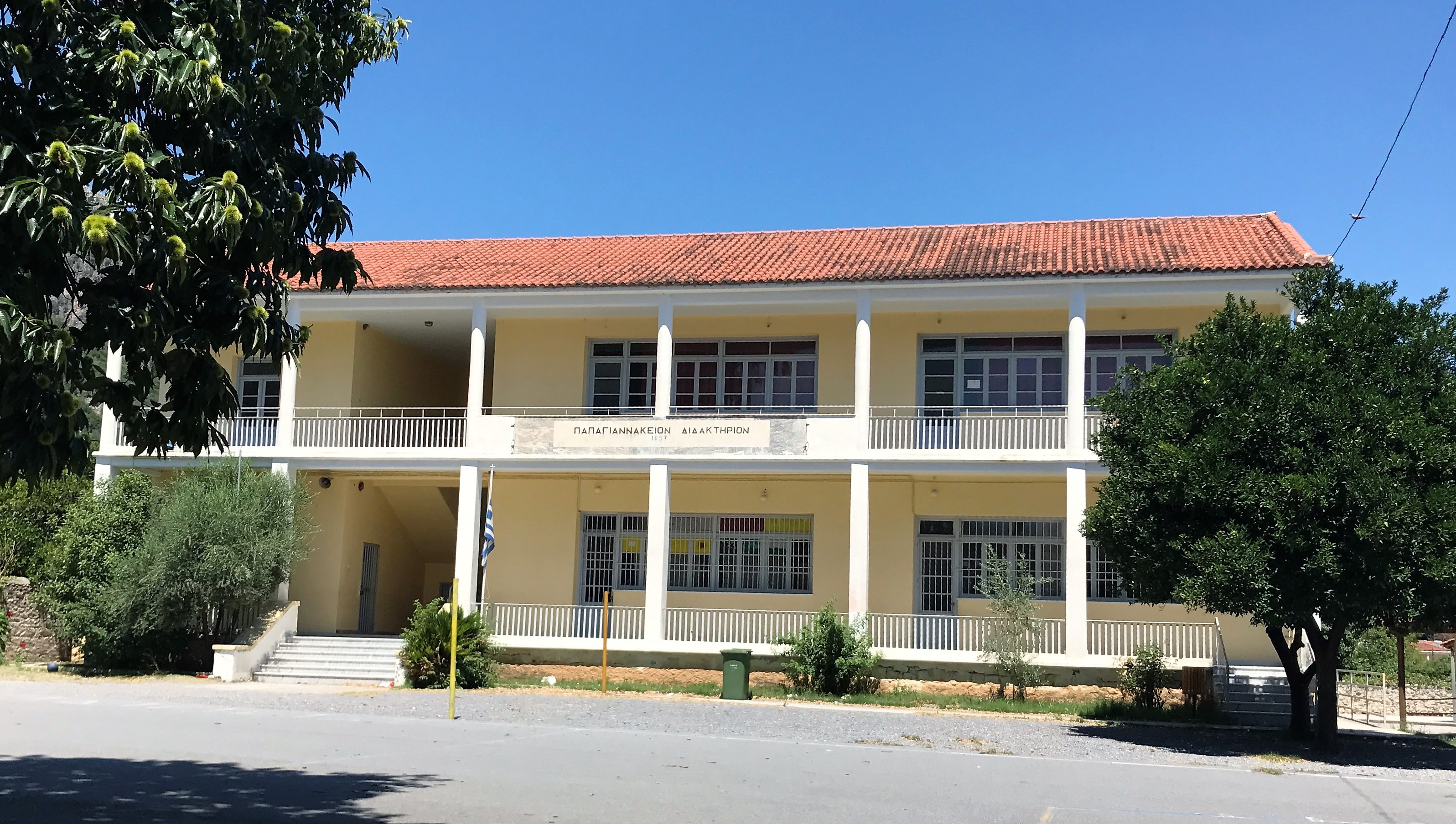
Dimitrios Nikolaos Papagiannakos, (known as Jimmy Pappas) emigrated in 1914 at the age of 18 with several men (and relatives) from his village: Georgios Grigorios Kostakos, Constantinos Kolokotas, Christos Papagiannakos and Panagiotis Cavouris. Jimmy became a successful restaurateur in Brooklyn, NY. He returned regularly to Agios Ioannis, and had an earnest desire to provide children with a quality education. In 1957, he constructed the Papagiannakos School which continues to serve the needs of children in Agios Ioannis and neighboring villages.

The Papagiannakos School, built in 1957

My cousins–Jimmy’s family–attended here, as now do their children. I think Jimmy would be truly pleased to know that his contribution to the community continues, and that his dream is fulfilled.

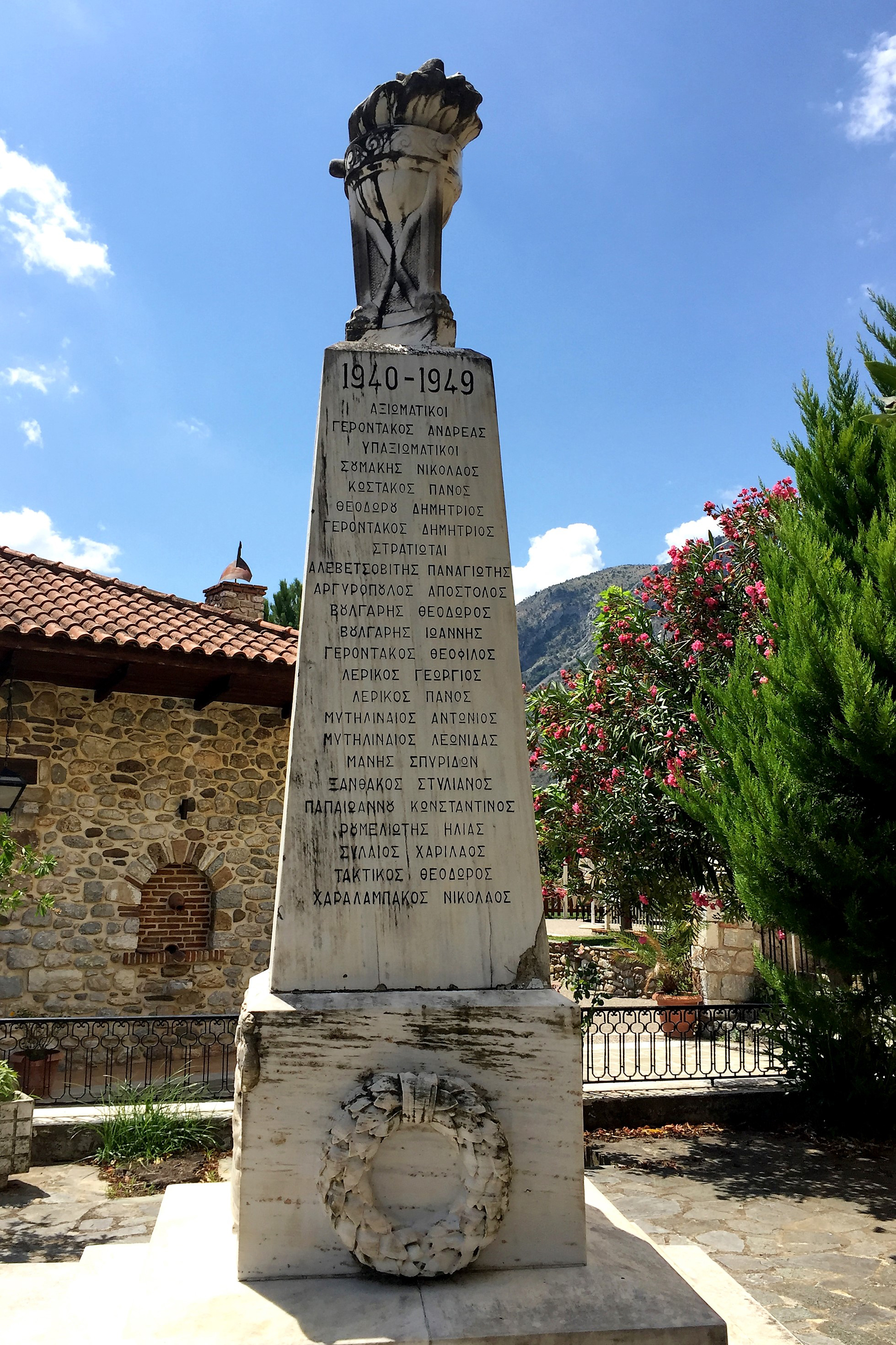
Every village has a “war memorial,” inscribed with the names of those who died in battle, or in the Greek Civil War. It is sobering to stand in front of these, but even more so when you see your own family names. My first cousin once removed, Panos Kostakos, was killed execution-style by the Nazis in Mystras.

Panagiotis Grigorios Kostakos, 1913-1944

His is the third name from the top.

World War II War Monument

So we come “full circle,” from my grandparents to my generation, and to the ones continuing forward. Visiting an ancestral village brings me this perspective of beginnings and continuation. It is a comprehension that cannot be experienced virtually–you must go to understand.

In my last post, “Telos,” I wrote that my work of marriage record preservation in the Sparta Mitropolis this summer was part of my desire to offer service, and to “give back” in gratitude for my heritage and ancestral land. This post recognizes a few members of my family for the services they so willingly gave. They have influenced me profoundly. I recognize and honor their examples, and am proud to follow in their footsteps.


Πανηγύρι (Panegyri) – It’s Time for Village Festivals

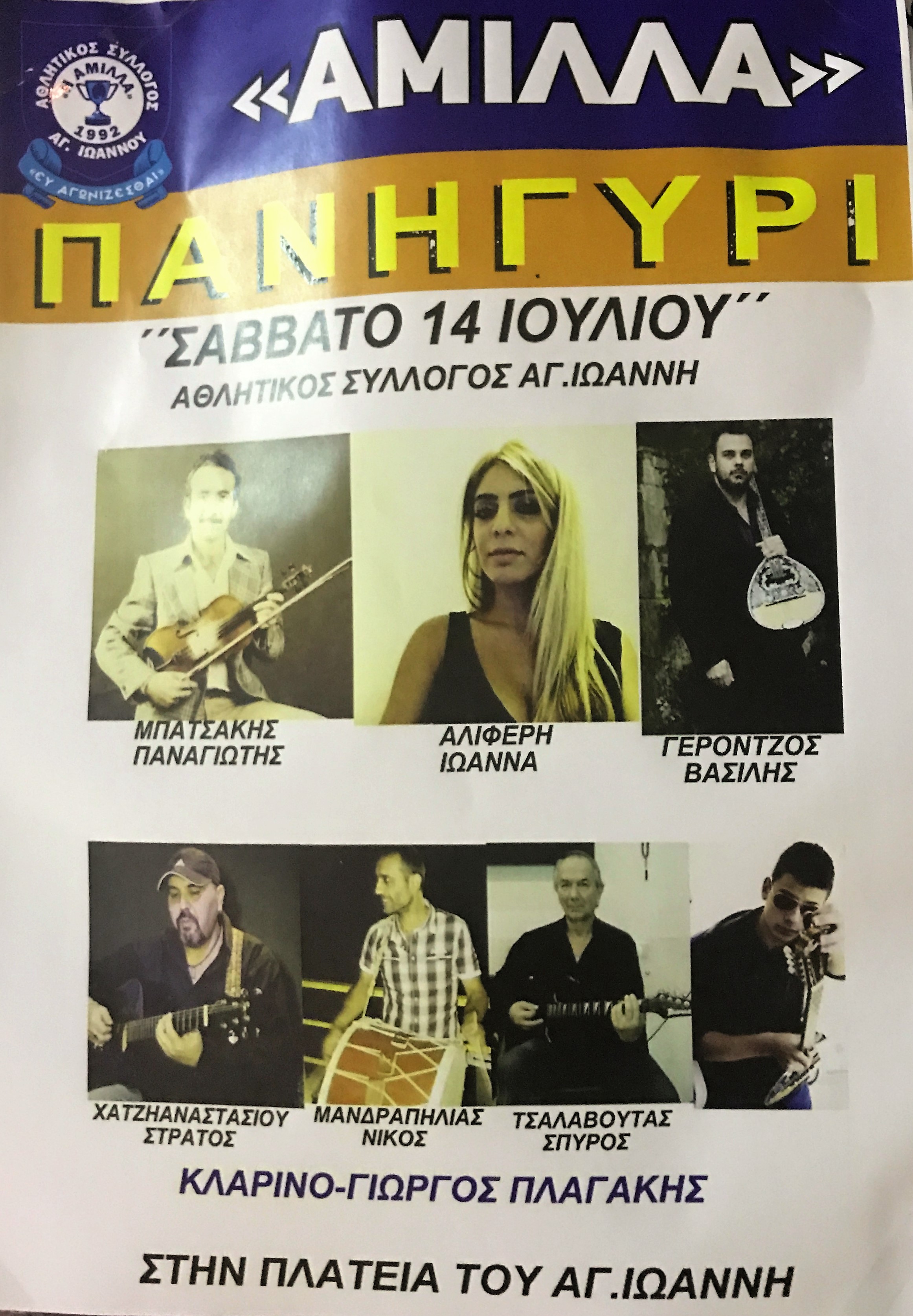
Music, dancing, food and friends–the perfect combination for a festive summer evening. This is panegyri  time and posters announcing village festivals are found everywhere.

Agios Ioannis, July 14, 2018

Each village has a church, and each church is named after a saint. Thus, each village holds its panegyri at the time of the church saint’s nameday or, if the nameday falls during a colder month, the festival is held in spring or summer. I attended panegyris in Amykles, Theologos and Agios Ioannis–three ancestral villages.

The photos and videos below depict the pure enjoyment of these festivities.

AGIOS IOANNIS (Sparta)

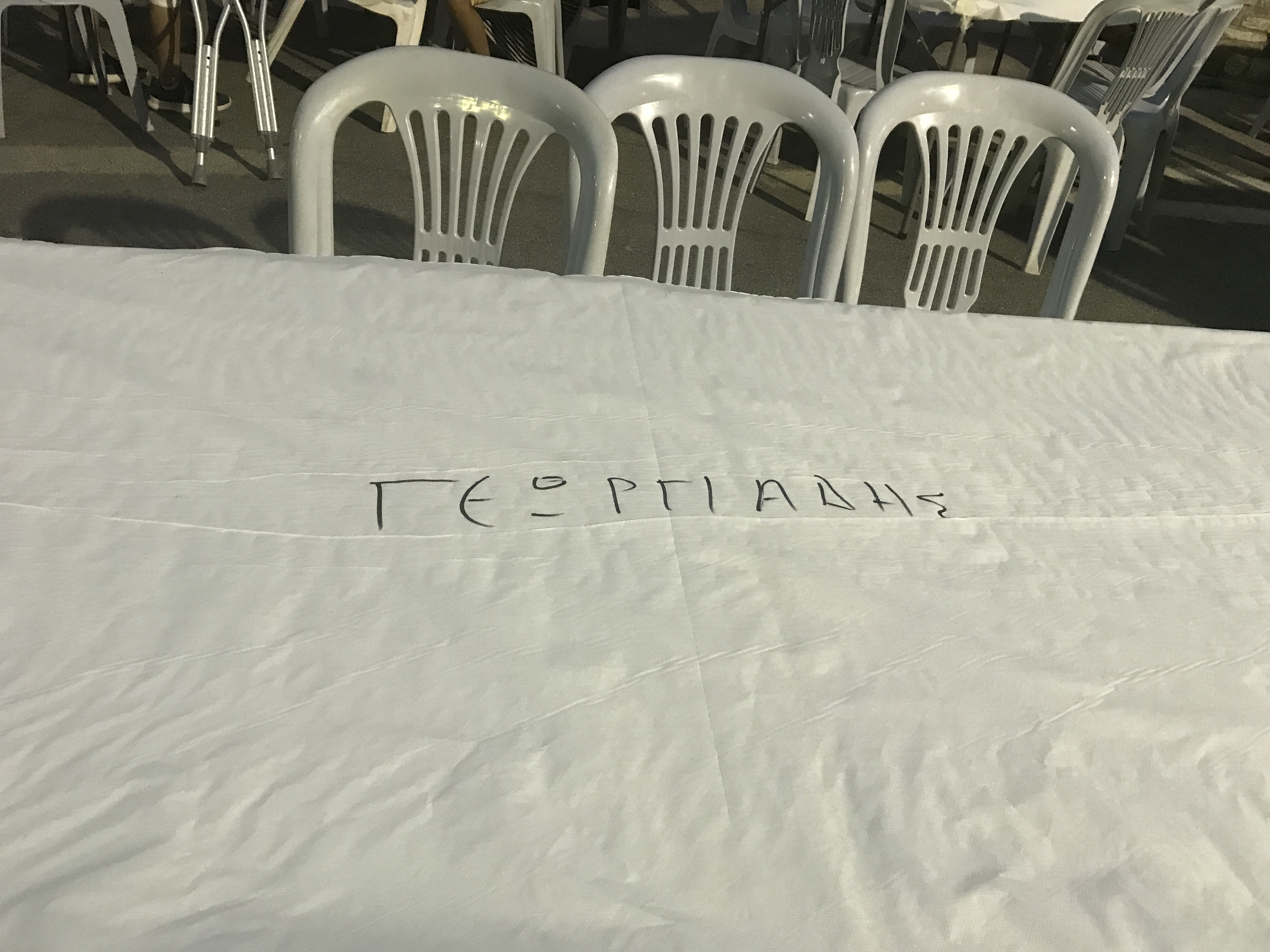
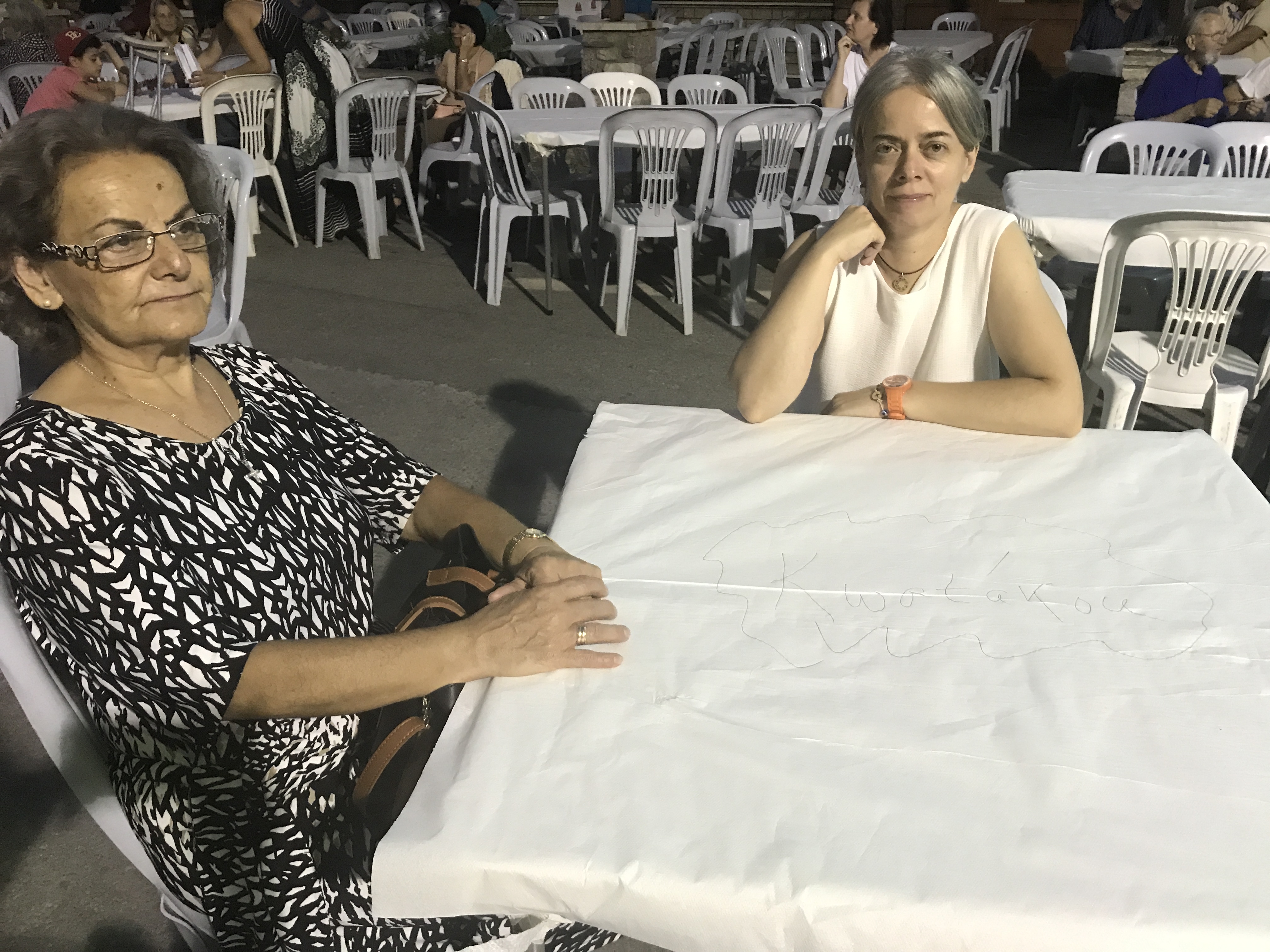
This is my “home village” — birthplace of three of my grandparents: Andreas  Kostakos, Hariklia Aridas, and Ilias Papagiannakos. I attended its panegyri with my cousins, Eleni and Panorea Kostakos. Eleni was anxious to arrive early as she was concerned that we would not get a table. When we walked into the platea (town square) at 8:00, I thought her worries were not valid as the area was empty. That is, until I saw that people had “reserved” their places by scrawling their names across the paper tablecloths!

The Georgiades family has marked its spot!

Eleni (left) and Panorea Kostakos are holding our table; I wrote our surname on the cloth

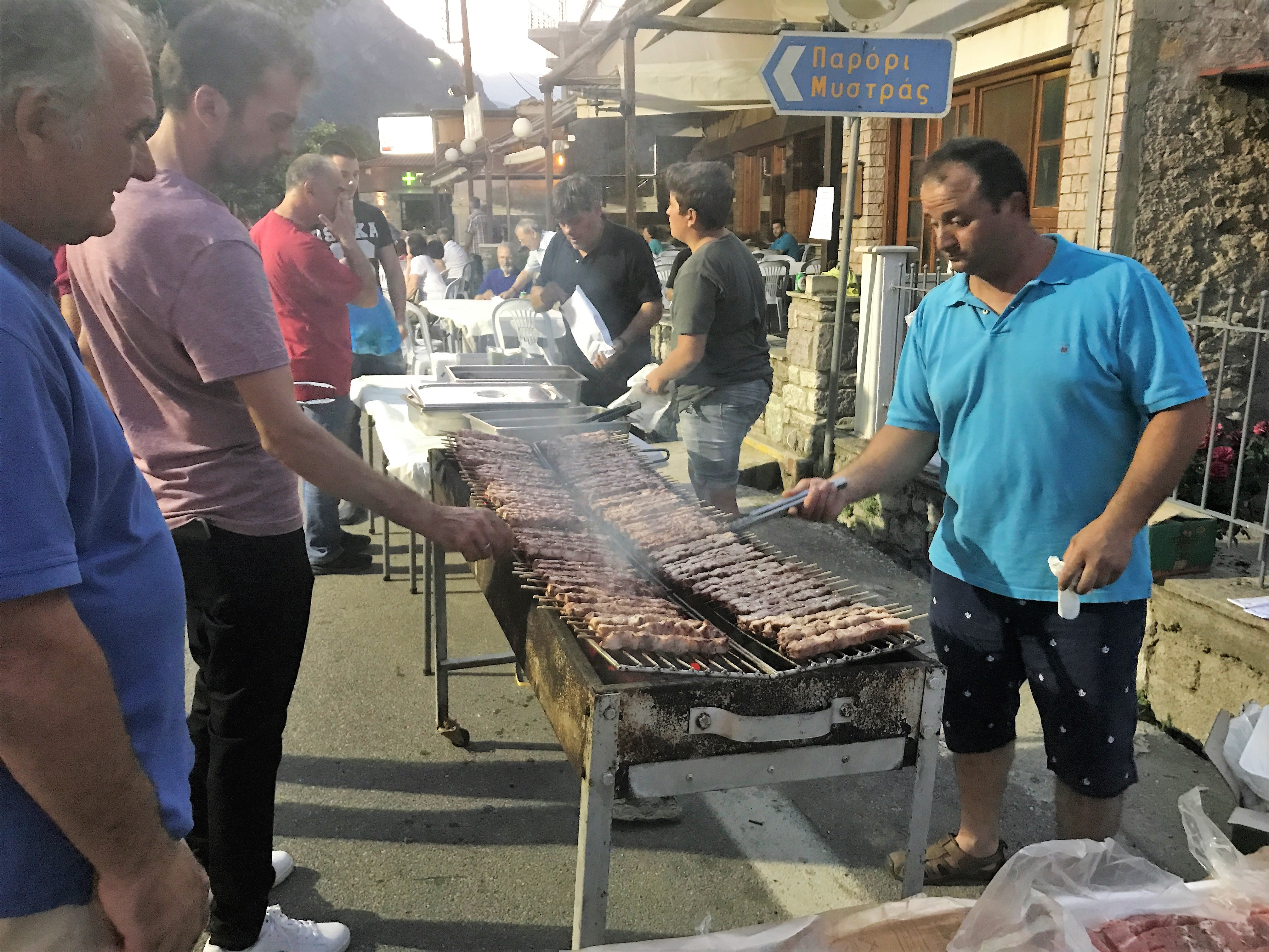
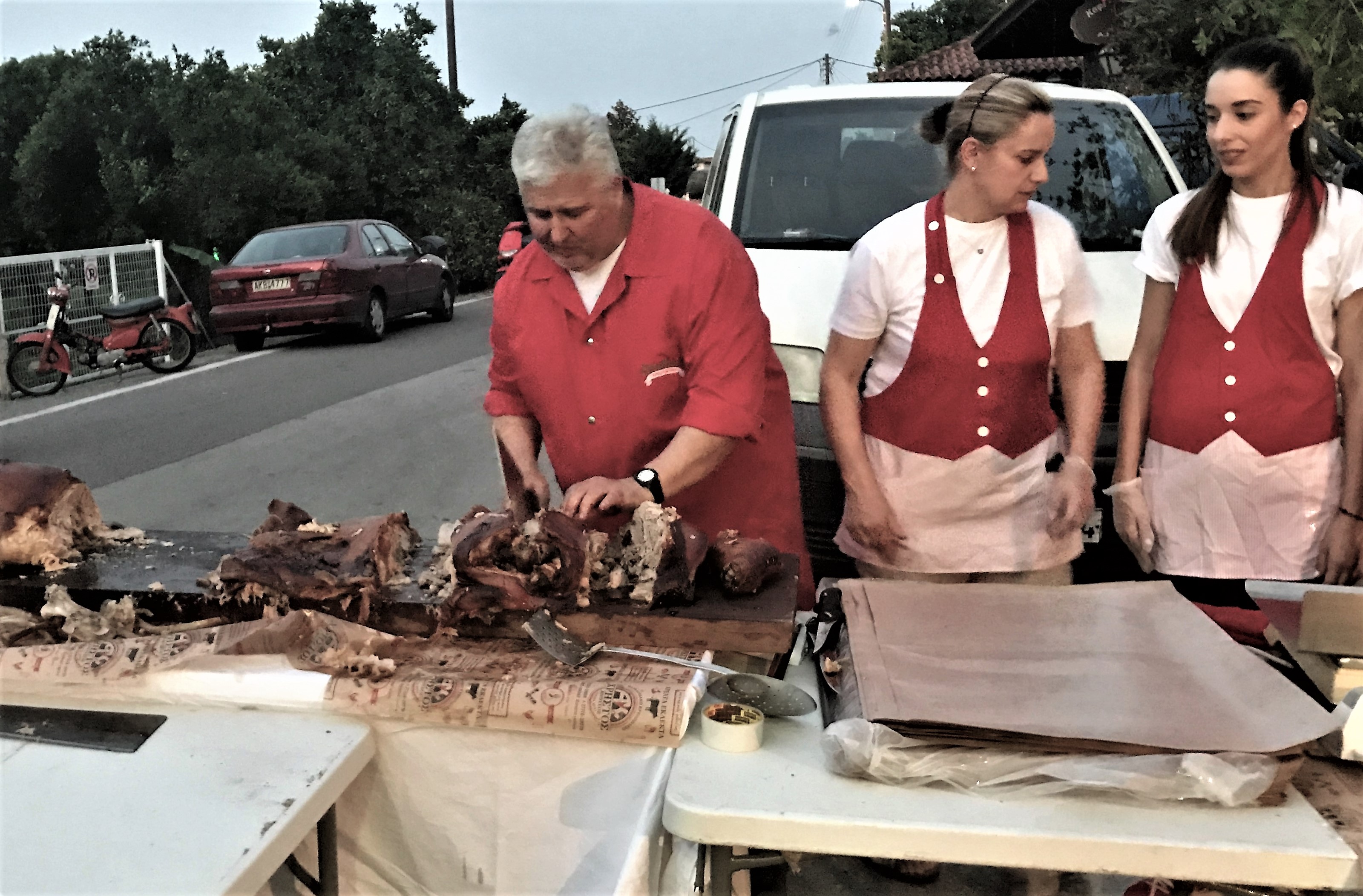
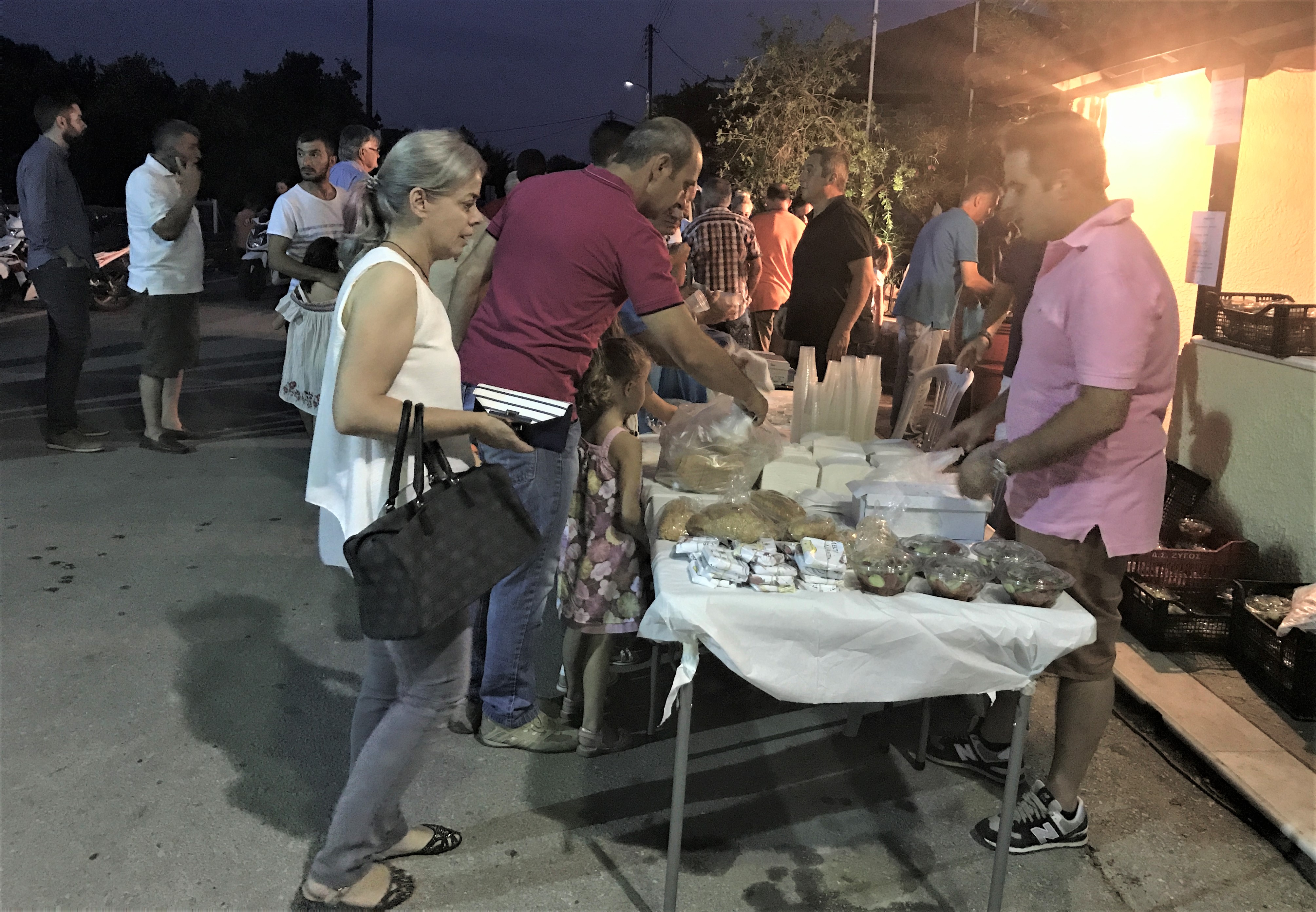
Food vendors worked throughout the evening. The tantalizing smell of souvlaki, roasted corn, smoked ham and Greek desserts enticed long lines of hungry partygoers.

Souvlaki, the staple of Spartan diets

Roasted and smoked ham

Panorea in the dessert line

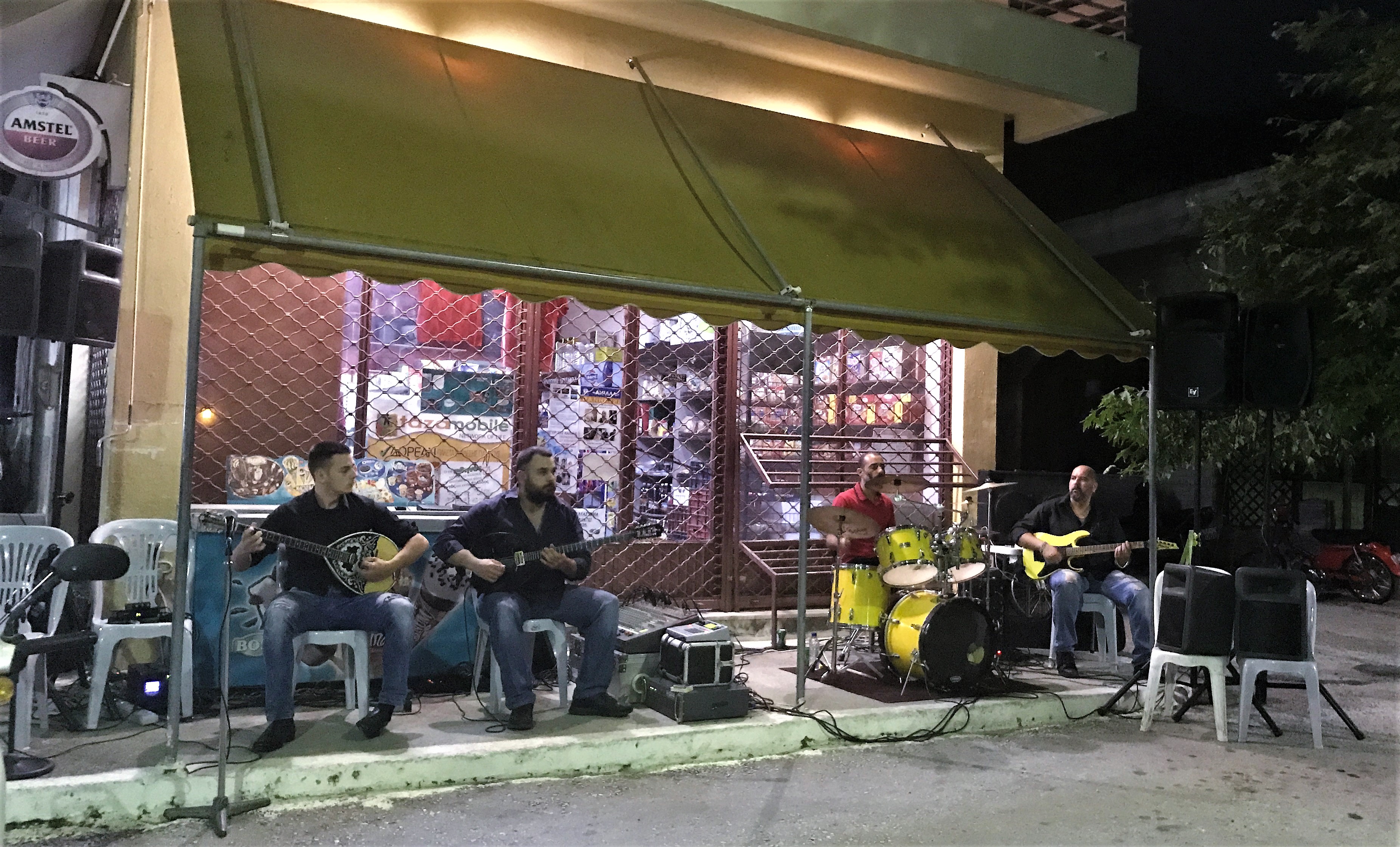
Live music, singers and dancing brought villagers together to celebrate their heritage and their village.

Traditional Greek music enhances the festivities

And of course, there is dancing!

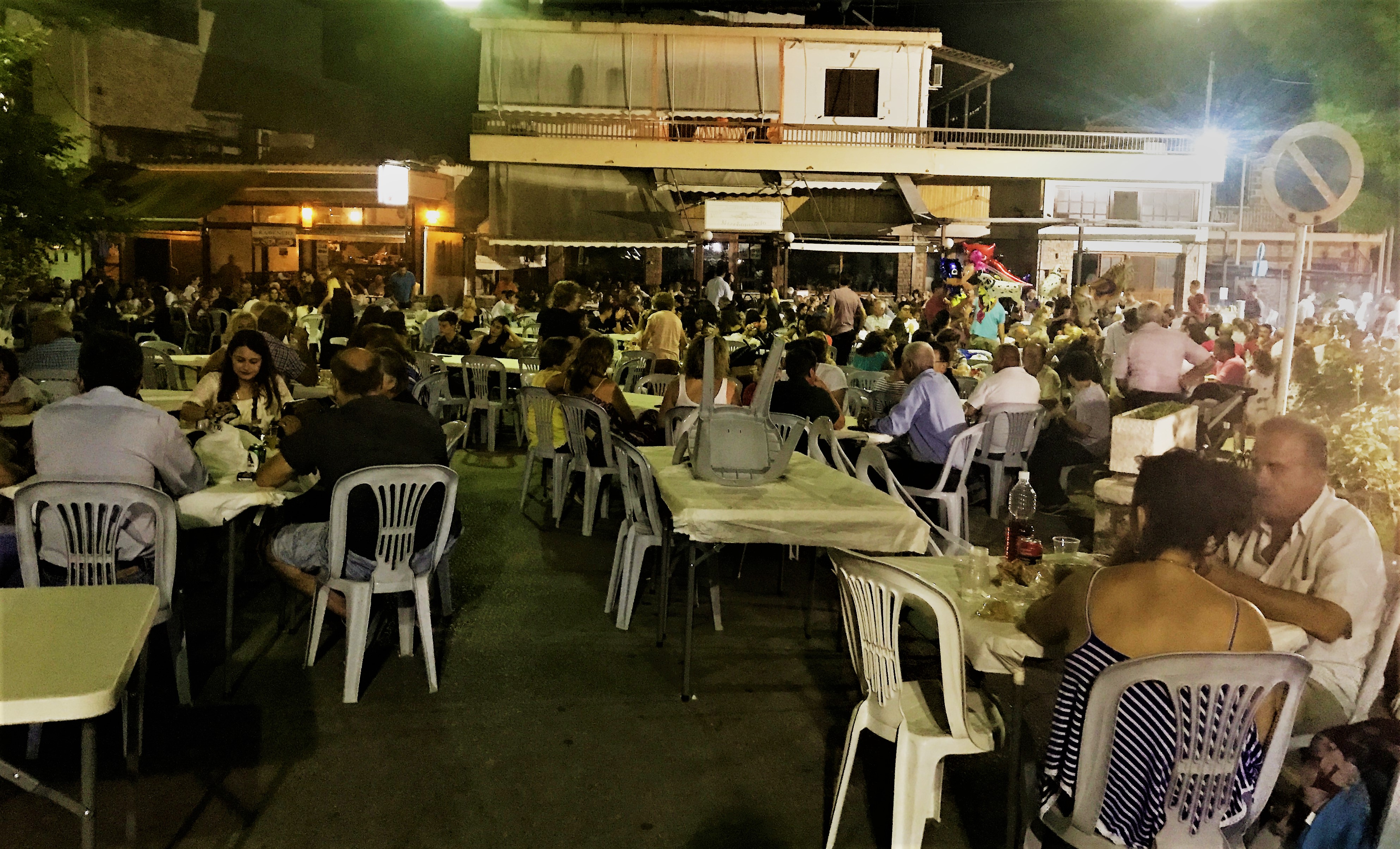
The platea quickly filled to capacity as families and friends table-hopped. The decibel level of voice and music increased significantly as the night progressed.

The platea is filled

THEOLOGOS

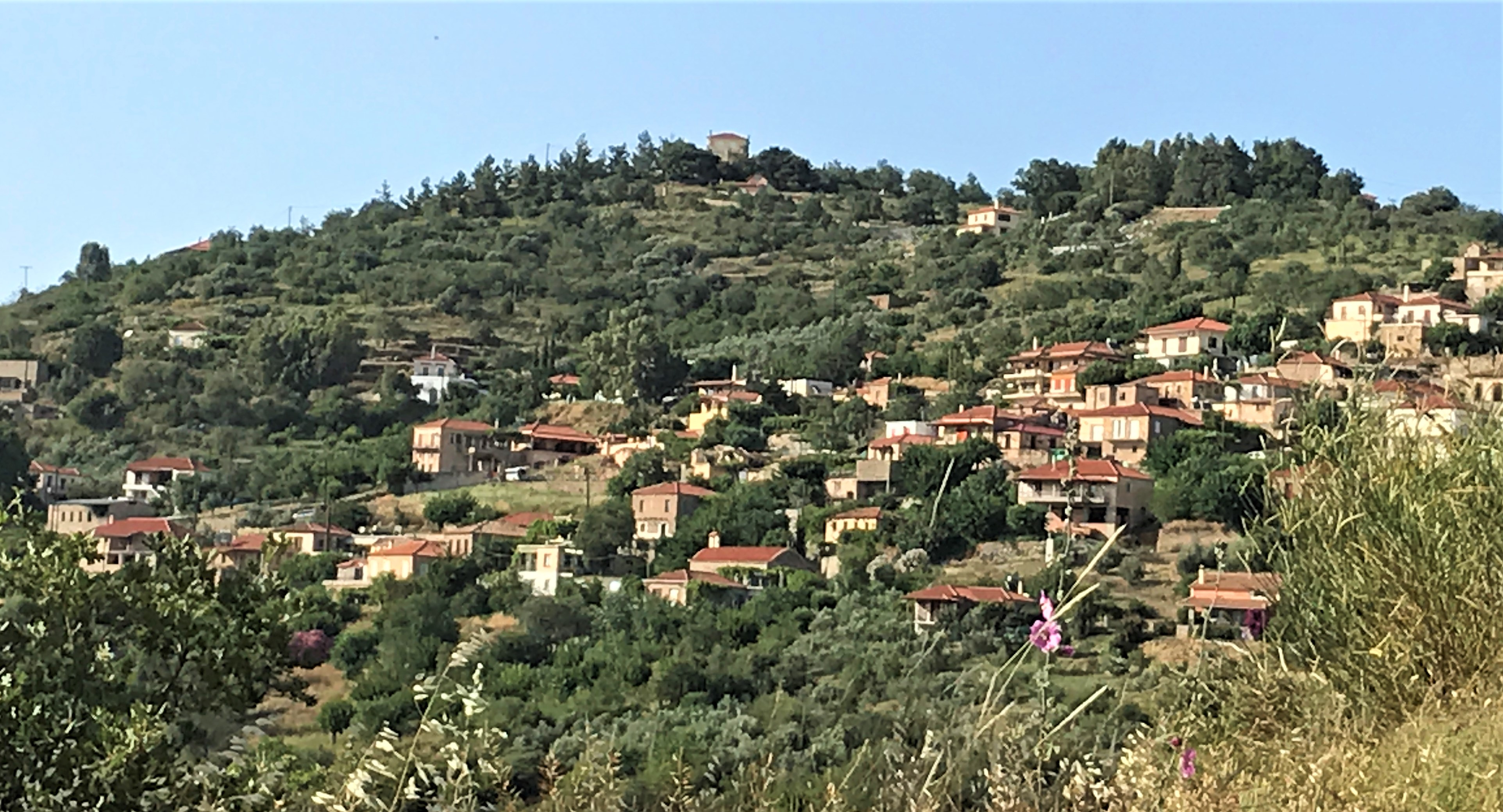
This is the village of my great-grandmother, Stathoula Zaharakis, daughter of Dimitrios Zaharakis of Theologos and Giannoula Zarafonitis of Amykles. Situated 6 km straight up a mountain, it is quaint and beautiful.

Theologos nestled in the mountains

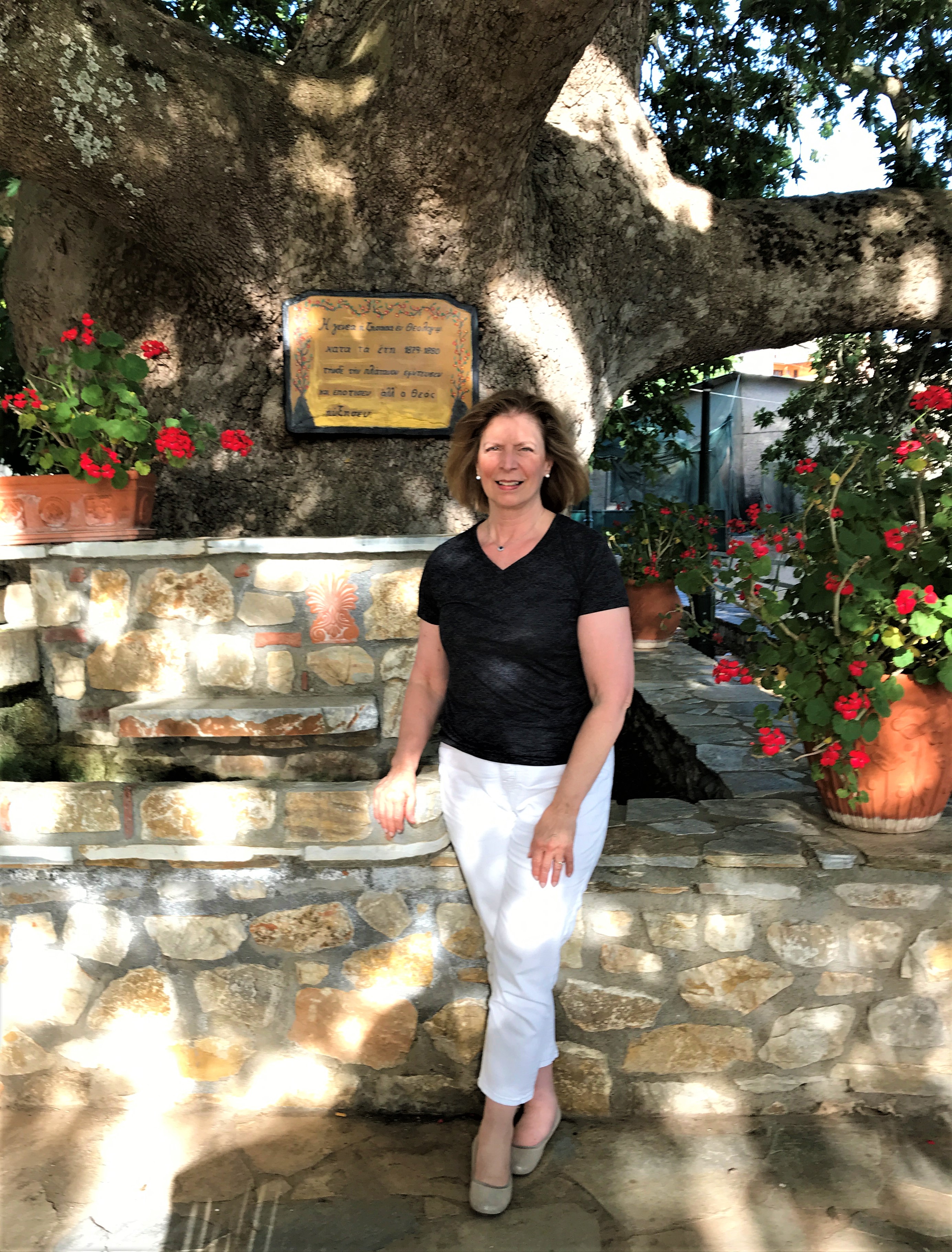
Me, under the sprawling tree of the Theologos platea.

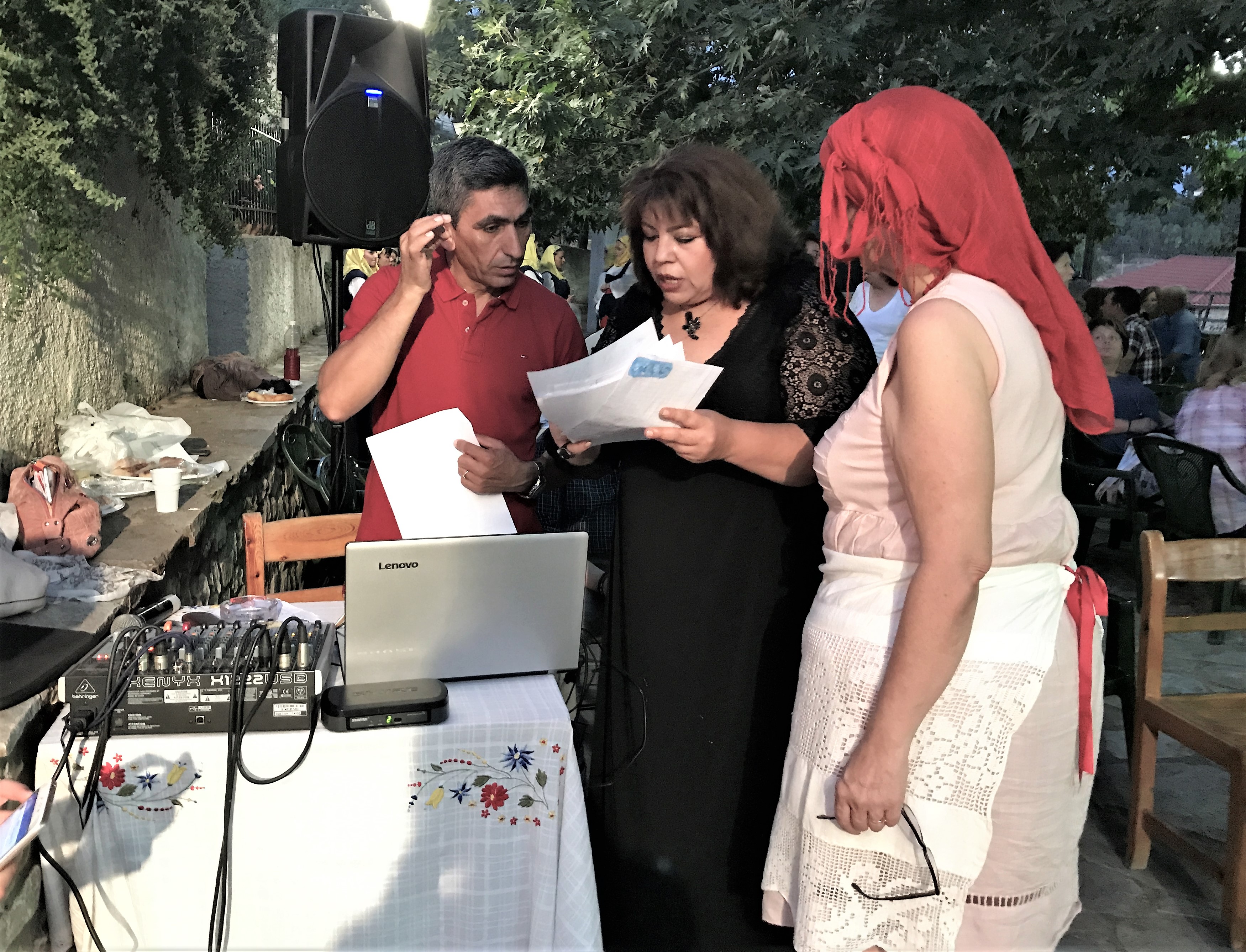
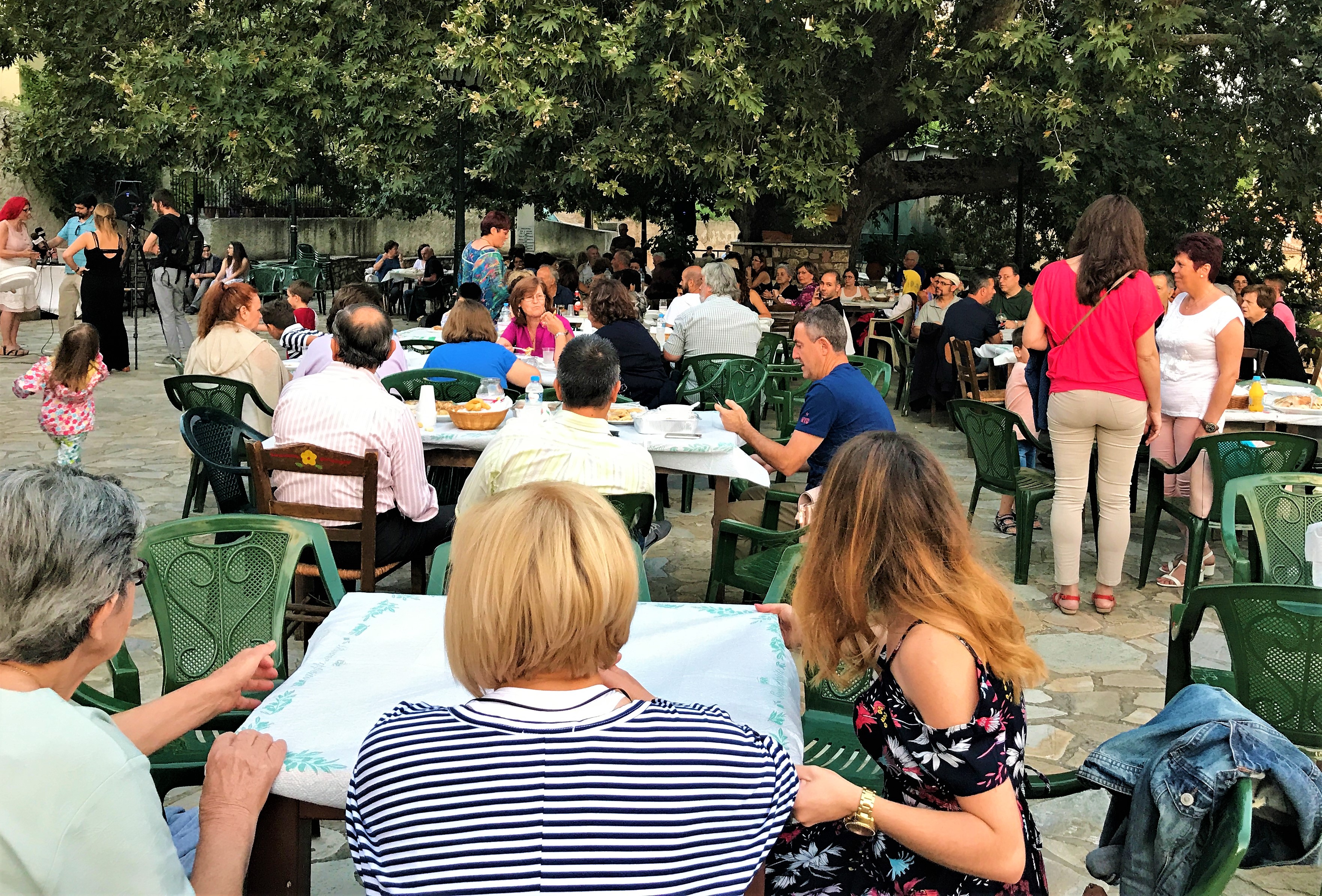
Last year, my cousin, Georgia Zaharakis, organized a Women’s Syllogos of Theologos to preserve and maintain the culture and heritage of the village and I joined their sisterhood. On July 8, the syllogos held a panegyri.  I offered to help and was given the job of working with the tech crew. Being part of this was great fun, even though I scrambled to keep up with instructions given in rapid-fire Greek.

The technical crew, going over last minute details: l-r: Vassilis, Dimitra, Georgia.

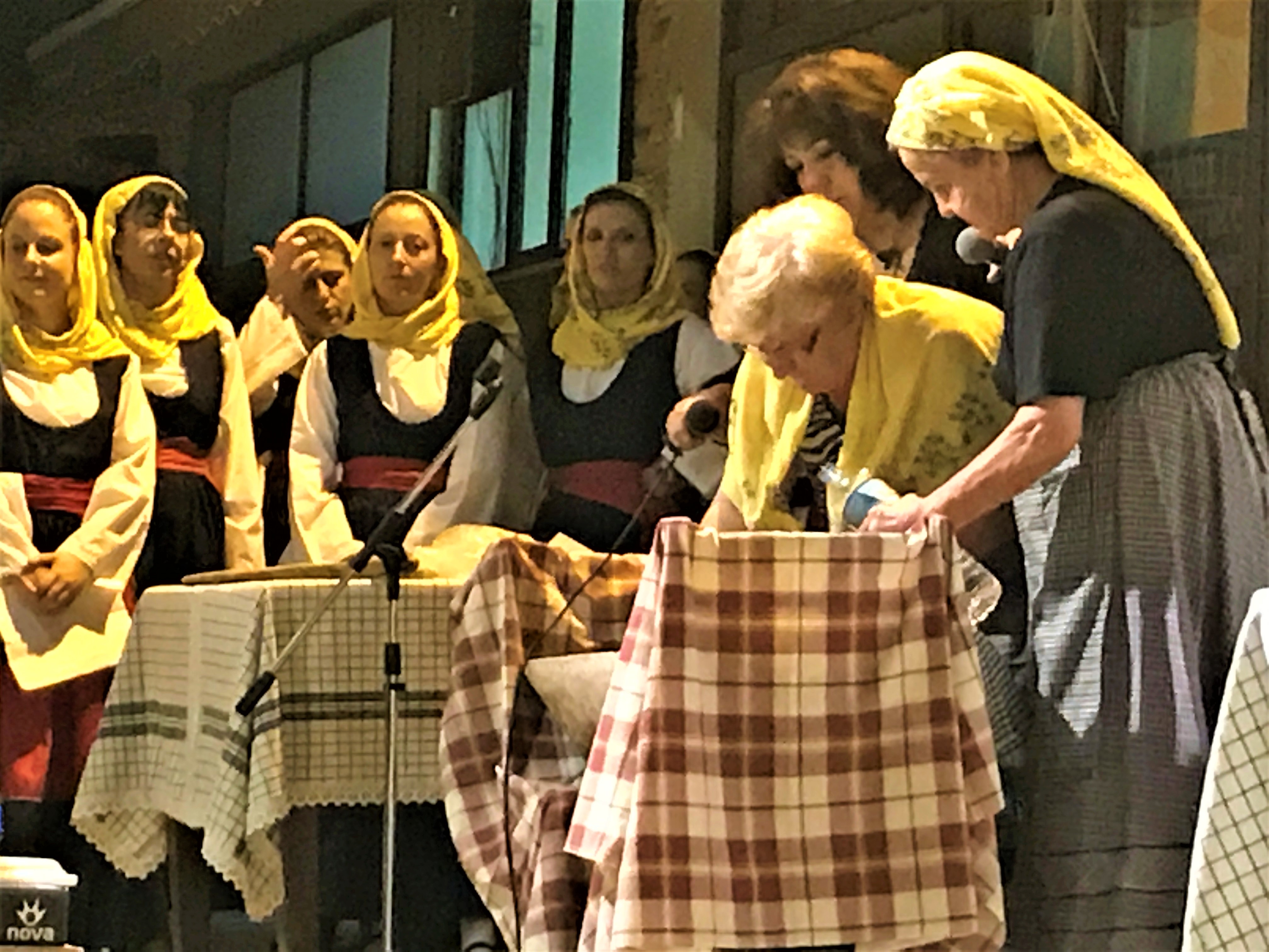
The theme was centered on the grain harvest and making of bread. Video, literary readings and bread-making demonstrations brought the “feast of wheat” to life.

Village women demonstrate bread making

Over 300 people attended; the platea filled throughout the night

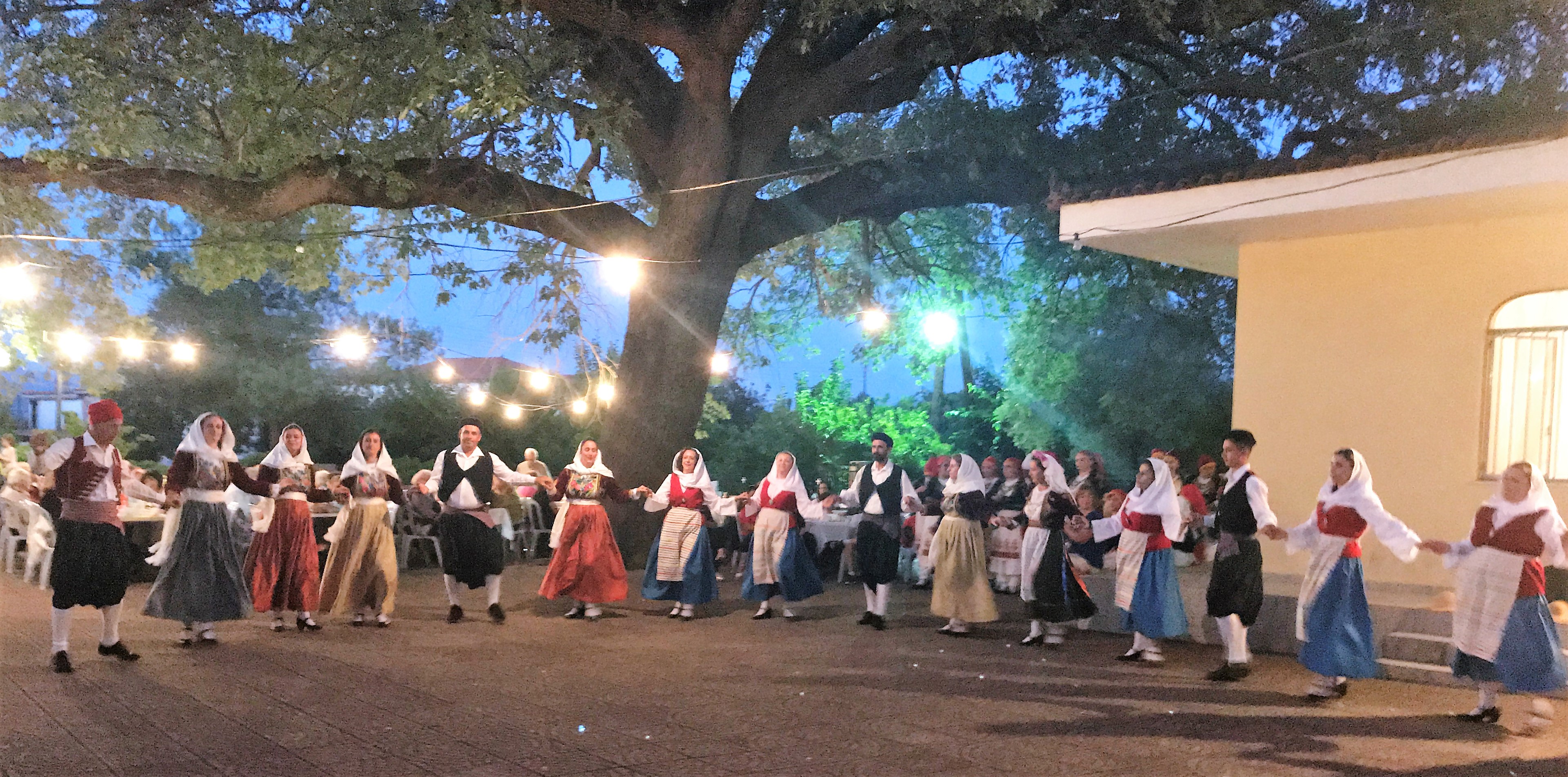
Women in traditional costumes, led by Vassilis Andronis, performed dances from all over the country.

And of course, the entire village also joined in!

The news media picked up this story; video and photos can be found here.

AMYKLES

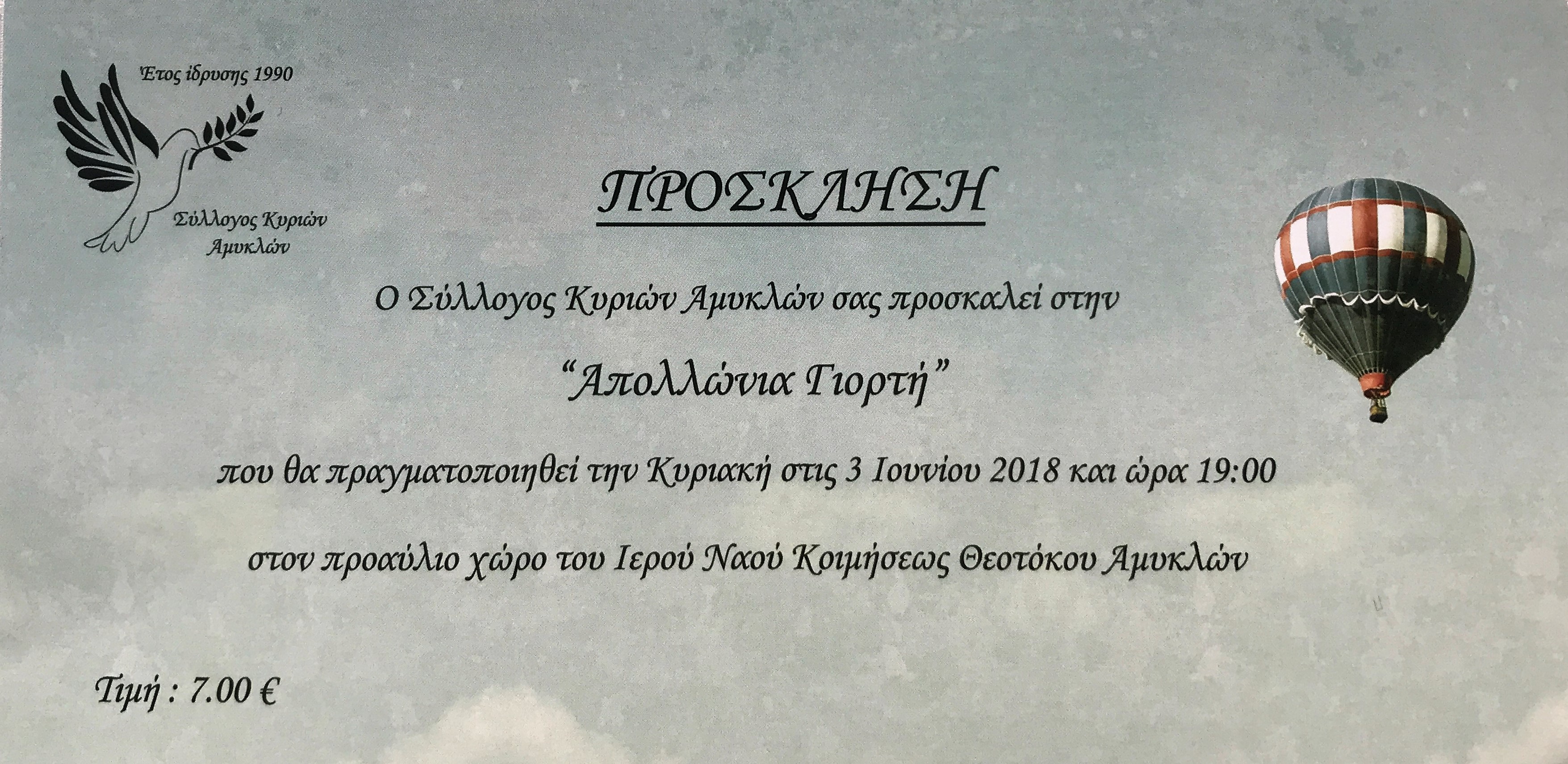
The ancient and historic village of Amykles was the home of my great-grandmother, Giannoula Zarafonitis. I visited Amykles early in my trip and wrote a post here. The syllogos of Amykles held a festival on June 3 to raise money to help the poor.

Invitation to Amykles festival, June 3, 2018

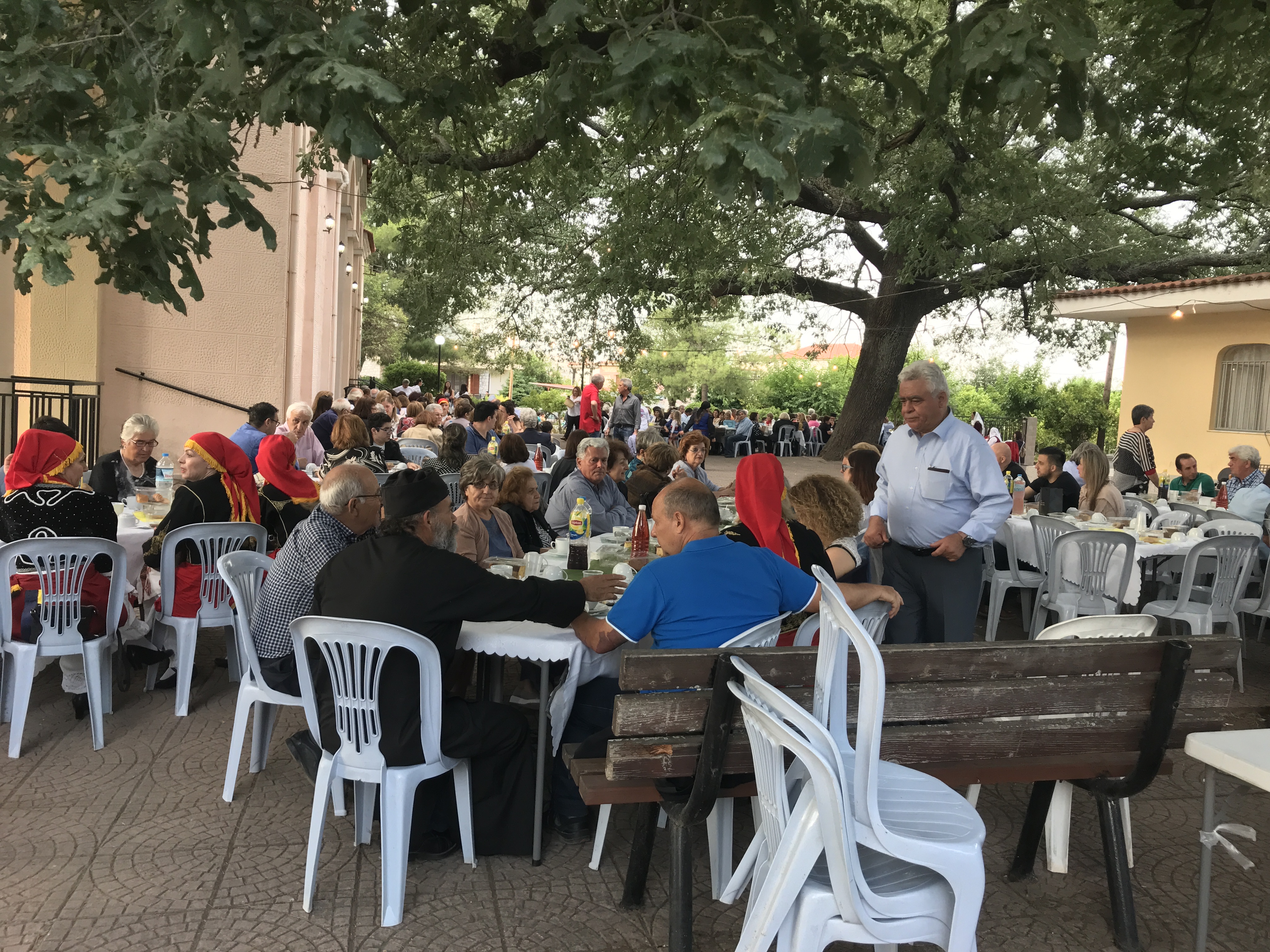
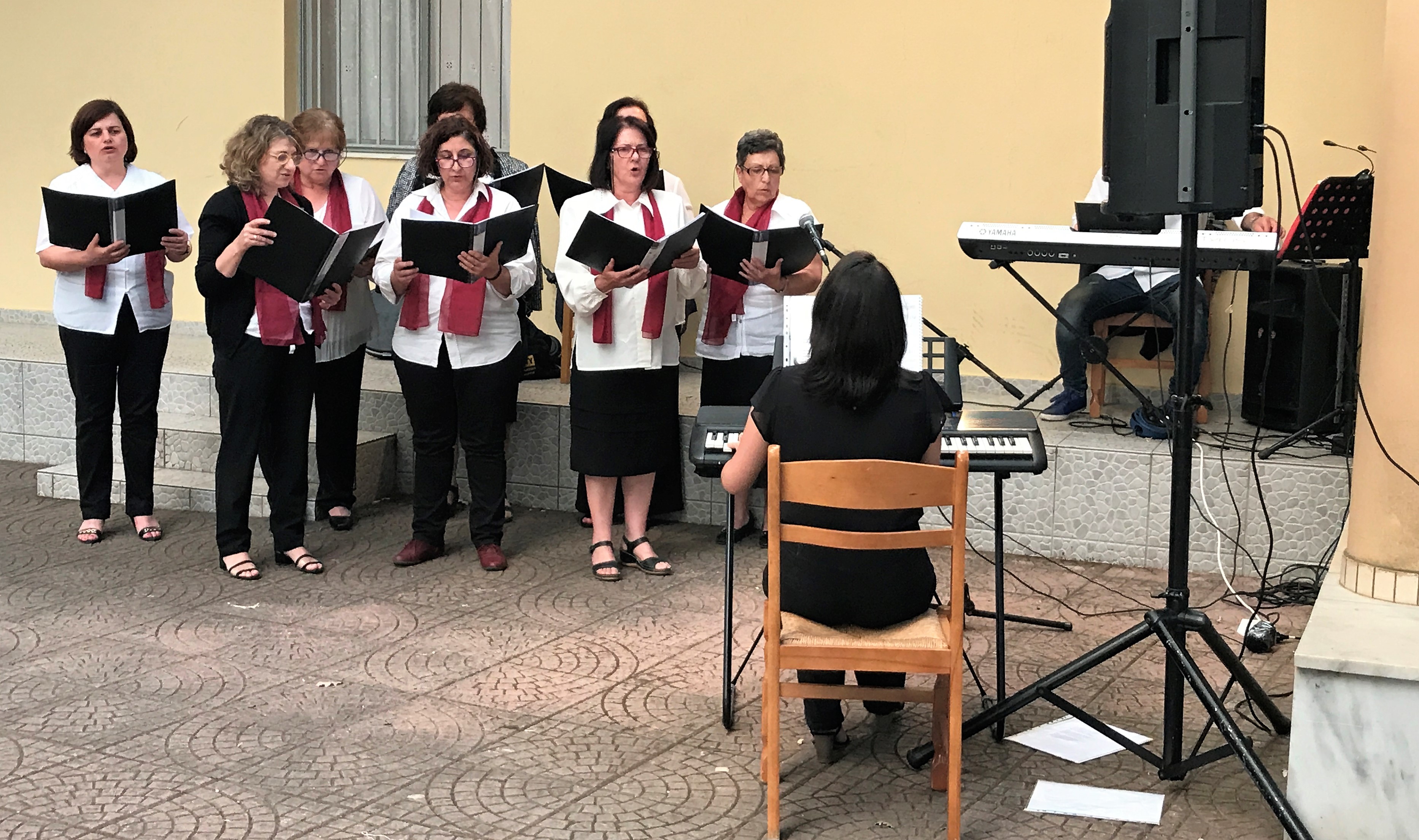
Under the shadow of the church, people congregated. A choir sang, and costumed men and women danced.

Amykles Panegyri

Amykles choir

Men and women engage in traditional dance

These panegyris are an important part of the social fabric of Greece. Villagers are extremely proud of their Laconian heritage and the traditions of their village. As I joined these festivals, I remembered that I was participating in the same rituals as my grandparents and great-grandparents. Doing so is one of the joys of “going home.”


How Do They Call You? Πως σε λένε;

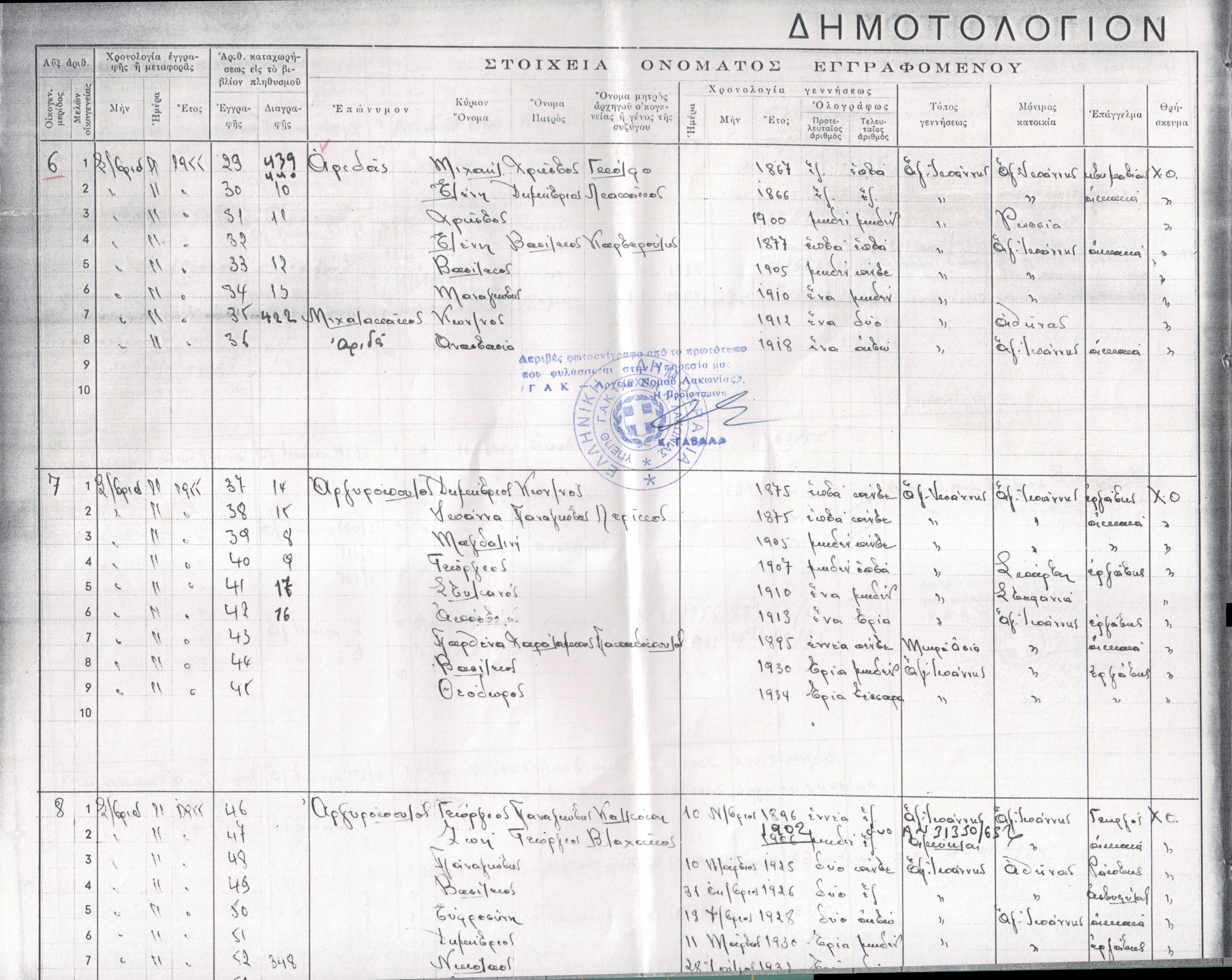
My dive into the bewildering world of ever-evolving Greek surnames started in October 2008, when I received this Town Register from the Sparta Archives office:

Agios Ioannis, Dimotologion (Town Register) Family #6, Aridas, page 1 of 2

The first entry, family #6, is the household of Michail Chistos Aridas of Agios Ioannis, relatives of my paternal grandmother, Harikleia Aridas Kostakos:

Aridas, Michail; father: Christos, mother: Gkolfo, born 1867
Aridas, Eleni; father: Dimitrios Liakakos, born 1866
Aridas, Christos, born 1900
Aridas, Eleni; father: Vasileos Karteroulis, born 1877
Aridas, Vasileios, born 1905
Aridas, Panagiotis, born 1910
Michalakakos, Konstandinos, born 1912
Aridas, Anastasia, born 1918

I was surprised to see that  Michail had two wives: Eleni Liakakos and Eleni Karteroulis, with their respective children listed under the name of their birth mother. But I was stunned to see the name Konstandinos Michalakakos. Who is he, and why is he in this family? My first thought was that he is a cousin, an uncle, or even a friend living in Michail’s household.

Wrong! He is Michail’s son.

My first lead came from an Aridas relative whose mother visited Agios Ioannis in the 1950s. She was told that Michalakakos was the original name and Aridas had begun as a nickname or paratsoukli (παρατσόυκλι) for an ancestor who had long legs. The Collins Greek-English dictionary verified the translation, with definition (b) leg.

Last summer in Agios Ioannis, one of my Aridas cousins verified that the names were used interchangeably. However, he was certain that Aridas was the original name and Michalakakos (son of Michail) was a spin-off; and that Konstandinos chose to use Michalakakos because that name was “more professional and respectful” in his work as a theologian in Athens.

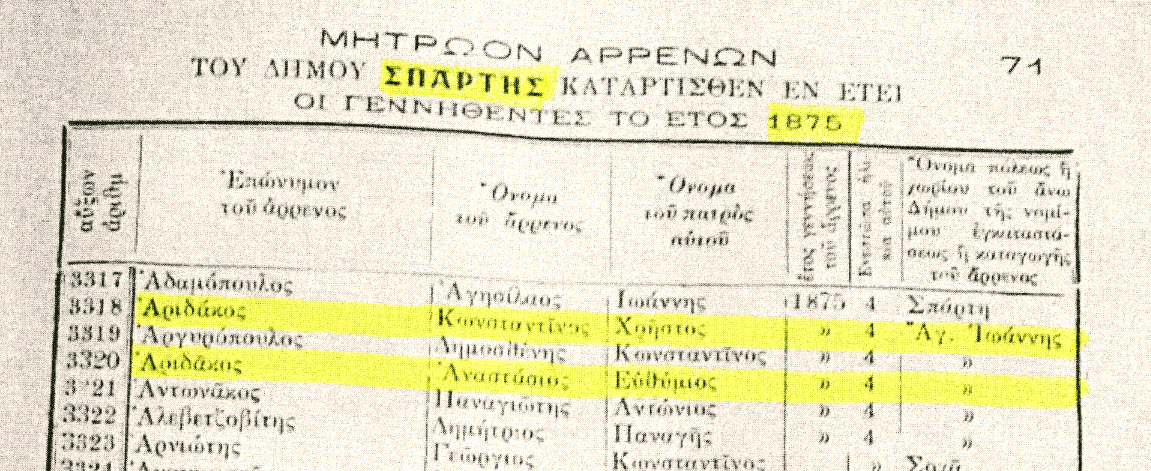
And there is yet another derivative of the name– “Aridakos” (son of Arida) as shown in this 1875 Male Register: line 3318: Konstandinos Aridakos, son of Christos, and line 3320: Anastasios Aridakos, son of Efthymios.

Mitroon Arrenon, 1875, Sparta, Greece.

Question: which name is correct?
Answer: all of them!

And how can that be? Giannis Michalakakos (no relation) remarked: “In Greece, we ask: πως σε λένε; how do they call you?”  Those words — πως σε λένε — struck me powerfully, as my mind processed that people are generally asked, “how do they call you?” NOT “what is your name?”

So, a person can reply any way he chooses: call me the son of Michael (Michalakakos), or call me the son of Aridas (Aridakos) or simply, call me Aridas.

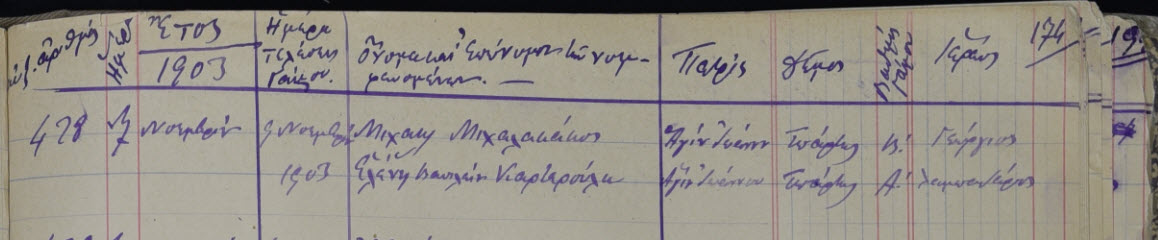
Following the paper trail of Michail Christos proves that this practice was customary. He is named Aridas in the Town Register above, in his Male Register, and on his passenger ship record. But in his marriage record of 1903 he designates himself as Michail Michalakakos.

Sparta Mitropolis Marriage Index Book; Sparta: Oct 1899-Sept 1907; page 174; #478: 9 November 1903; Michail Michalakakos and Eleni Vaseleios Karteroulis; second marriage for him; first marriage for her; both from Agios Ioannis, Sparta.

Interestingly but not surprisingly, some of Michail’s children followed his pattern of using whichever name they wanted, whenever they chose.

Aikaterini: (not in the above Town Register): her 1913 passenger ship record uses Aridas; her marriage record uses Mihalakakou and lists her father as Mike Mihalakakon.

Gkolfo:  her 1921 passenger ship record uses Aridas; her marriage record uses Mihalakakos and lists her father as Mihael Mihalakakos.

Konstandinos:  Male Register uses Michalakakos with a notation regarding a surname change; Agios Ioannis school records use Aridas; Town Register uses Aridas.

Anastasia: Town Register uses Aridas; school records use Michalakakos.

Efrosyni:  consistently used the Aridas surname, but this news article reveals that as late as 1950, Michail was known as both Aridas and Michalakakos. (Efrosyni married Nikolaos Revelos):

Efrosyni Aridas Revelos visit to her Michalakakos family in Agios Ioannis

Digging deeper into all members of the Aridas family produced many documents, both Greek and U.S., which verify the interchangeable use of the three names.

This example is a marriage record for Efthymios Michail Michalakakos who is the son of Michail Efthymios Aridas, another branch of the Aridas family in Agios Ioannis:

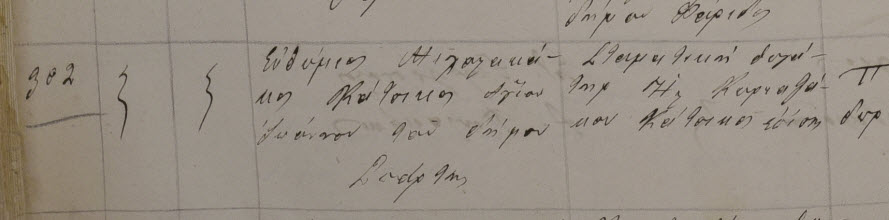
Mitropolis of Sparta, Marriage Index Book: Sparta, 1866-1872; Year: 1871; Entry #302
License Date: October 30, 1871; Groom: Efthymios Michalakakos; no father listed; residence: Agios Ioannis; Bride: Stamatiki Karnazakou; father: Ilias; residence: Agios Ioannis

Πως σε λένε? You get to choose!

Which name is the original family name? The jury is still out. It is understood that surnames (as are defined today) did not become standardized in Greece until after the 1900’s. Anything before then is fluid, and determined by the practices of each family and its individual members.

Πως σε λένε? I am slowly learning to think like a native Greek. Understanding the culture, the history and the language is vital. And, it lessens frustration and expands acceptation.

This article, published in the National Herald, adds additional insights into this topic:
Demetrios is now Jimmy.

Postscript: November 2, 2019: Since writing this original post, I have learned of two additional reasons for double surnames.

  1. Children who were raised by people other than their birth parents (known as “soul children”) may have two surnames–their birth surname and their surrogate parents’ surname. These could be children who were orphaned or given up by a parent who could not care for him/her; or a couple may have adopted a child.
  2. I found a man who appeared to have three surnames when he was called for military service in 1886.*


Hellenic Genealogy Geek Facebook page members clarified that there are only two surnames, Καψής ή Παναναγιωτόπουλος, the soldier’s name is Ανδρέας, and his father’s name is Γιαννάκη ή Παρασκευα. This makes more sense than having three surnames! In summary, don’t be surprised to find alternate names for both the surname and the given name.

An excellent article describing the origin of Greek surnames can be found here.

*Source:  this entry is found in the Φ.Ε.Κ. Government Gazette, 1886; location: Faron, Patreon, Achaiolidas (Αχαιοηλιδος Πατρεων Φαρον).