One of the earliest genealogical records of the modern Greek state is the 1828 Census, which I wrote about in this post. This was ordered by Ioannis Kapodistrias when he was the Governor of Greece. Digital images of this census are stored on the website of the General State Archives of Greece, but the collection is disbursed across many files and difficult to access (records from the Kapodistrias collection are found here).
In 2020, researcher Konstantinos Koutsodontis sent me this image of the 1828 census of Agios Ioannis. It is possible that this list is not complete, or that there could be another list with more names from the village. For now, this is all that I have.
I have translated the names found in this record, and the translations were verified by Gregory Kontos of GreekAncestry.
1828 Census of Agios Ioannis, Sparta
1828 Census of Agios Ioannis (names are in same order as written in document)
It is so very interesting to look at these surnames. Some of them are found in the village today (2022). Do you recognize a name that appears in this census, but is now known as a different or modified name? Does your family appear in this census? Please let me know and I will post that information. I would like to trace the evolution of these Agios Ioannis names from 1828 to present day.
From the 12th to 18th centuries, the Venetians controlled a large empire which included parts of Greece. As the Ottomans expanded their conquests in the 14th century, it was inevitable that conflicts between the two empires would arise in the eastern Mediterranean. Indeed, seven wars, the first in beginning in 1463 and the seventh ending in 1718, erupted. Greece was caught in the crosshairs and endured a series of conquests from these two powers.
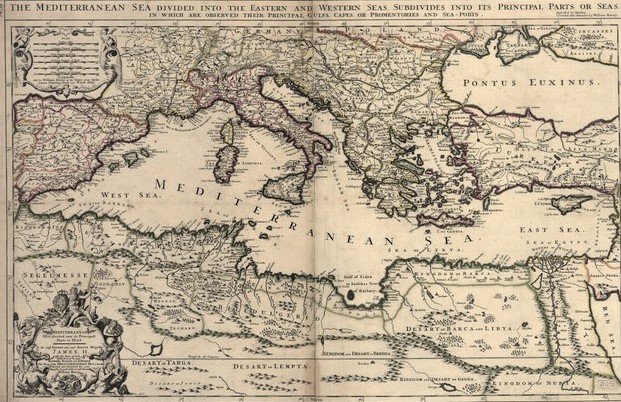
1680 Map of the Mediterranean; source: Wikimedia Commons
The Venetians ruled from 1685-1715, between the first period of Ottoman occupation (1580-1685) and the second (1715-1821). The successful military strategies of General Francesco Morosini brought the Peloponnese and other areas of Greece under Venetian domination. The Peloponnese, known then as the Kingdom of Morea, was divided into four districts (Messenia, Achaia, Lakonia, Romania now the region of Corinth) and within them were twenty-six territories. The entire Peloponnese in 1700 had only fifteen towns/cities with 1,000 or more inhabitants[1] and among these was Mystras.
While reading historian Evangelia Balta’s informative essay, Venetians and Ottomans in the Southeast Peloponnese, 15th-18th century[2], I came across an interesting paragraph referencing Mystras: ”In the Venetian archives there are lists of inhabitants of the wider region of Mystras, who were conscripted in 1698 to work on the fortification works at the Isthmus of Corinth. These lists mention the number of persons that each village in the districts of Mystras, Elous and Chrysapha should provide for the corvee[3]. In the event of someone escaping, the elders of the village were obliged to pay six reals.[4]”
Historical essays on the Peloponnese during its period of Venetian rule often cite documents held at the Venetian Archives. Balta explains the importance of this repository: “ If we have an idea of the settlement pattern and the population of the Peloponnese prior to the Greek War of Independence, we owe this to the published Venetian registers of the late seventeenth century.”[5]
Therefore, I was very excited to learn about the research trip to the Venetian Archives recently undertaken by researcher Nick Santas. He will be speaking about this experience at the 2nd International Greek Ancestry Conference to be held next weekend, January 29-30. Nick describes his session: The Kingdom of Morea Archives collection covers the period of the second Venetian conquest of the Peloponnese (1685-1715). It has been the subject of historical research in the past, but has had very limited genealogical examination.During this session, Nick aims to share his findings with you, help you familiarise yourself with the practical steps when accessing the archives, and give you a taste of what is available.
I was thrilled when Nick sent me the following Venetian Archive document from my village of Agios Ioannis, Sparta (Ayiannis). He also (thankfully) provided a translation. I am extremely grateful for Nick’s thoughtfulness in sending me this document, and for his generous expenditure of time in making the translations, first into modern Greek, then into English.
These historical records bring the past into the present and provide us with invaluable facts about the past. Every one brings us one step closer to understanding our history and our ancestors’ lives.
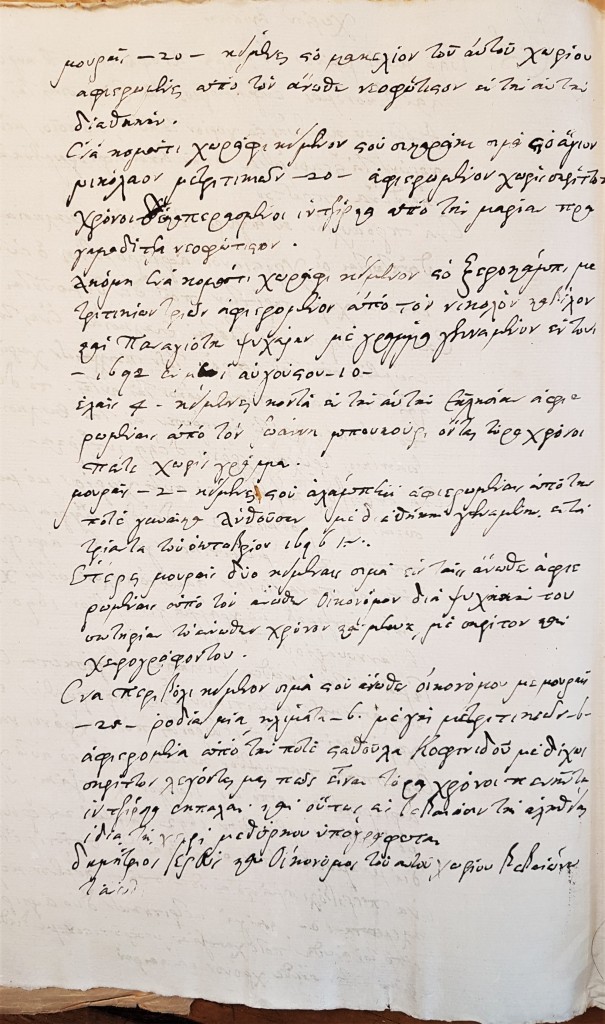
1699 Document, Agios Ioannis Sparta, page 11699 Document, Agios Ioannis Sparta, page 2
TRANSLATION: Village of Ai Yiannis
On May 16, 1699 in Mistras, appeared Mr. Demetrios Priest and Rector of the church of Virgin Mary located in this village (Ai Yiannis), who under oath made known the standing dedications.
First, a yard around the said church, where the Christians are buried, dedicated in years gone by without a document (σκρίττον from the Italian scritto) which no one can recollect
Nearby, there is a place dedicated in years gone by, without a letter. The house (on this land) was built and dedicated to the church by Ioannikios, approximately (ιντζίρκα from the Iltalian incirca) 10 years ago
An orchard lying in the said village with 20 Mulberry trees, 18 fig trees, 12 pomegranates, 20 wild trees with their vines, 6 metritikion in size from Panagiotis Stamatopoulos, approximately 9 years ago with a letter made on 6 January 1690
Near the above church, there is a salad garden, one metritikion (μετρητίκιον) in size dedicated in years gone by without a document, not knowing how many years
A house with a floor, lying inside the said village dedicated by Giorgos Chatzakis a (religious) convert, with a will made on 28 February 1692 for his memorial service (δια μνημόσυνον)
An orchard near the above house lying with 13 mulberry trees, 10 vines and land of 2 metritikion dedicated from the said late Chatzakis with a will
20 Mulberries lying at the [….] of the same village dedicated by the above convert in the same will
One field lying at Sikaraki (Συκαράκι) near St. Nicholas 20 metritikia, dedicated without a document approximately 10 years ago by Maria Pragamaditza, convert
Another field lying at ‘Xerokampi’ (Ξεροκάμπι) three metritikia dedicated by Nikolos Kavilos kai Panagiotis Psicharis by letter written on 10 August 1692
4 olive trees lying near the said church dedicated from Ioannis Boukouris 5 years now, without a letter
2 mulberries lying at ‘Alambei’ (Αλάμπεη) dedicated from the late Anthousa by will made on 30 October 1696
Another 2 mulberries lying near the above ones dedicated from the above Rector for the salvation of his soul with a document
An orchard lying near the above Rectors’ with 25 mulberries, one pomegranate, 6 vines and 6 metritikia land, dedicated from the late Stathoula Kofinidou without a document approximately 50 years ago
For the truthfulness of the above He signs with his own hand
Demetrios Priest and Rector of the said village
TRANSLATION: Greek
Χωρίον Αγιάννης
1699 μηνί μαϊου 16 μιστρά ανεφάνη ο παπα κυρ δημήτριος και Οικονόμος ευφημέριος της Εκκλησίας της Κυρίας Θεοτόκου κυμένης στο χωρίον το αυτό, ο οποίος μεθόρκου φανερώνι τα στεκούμενα, οπού τινα αφιερωμένα από το καθένα, πρώτον Ένα προαύλιον εν τω γύρο τη αυτή εκκλησία, οπού θάπτωνται οι Χριστιανοί αφιερομένος ο αυτός τόπος έκπαλαι χωρίς σκρίττον που δεν θυμούνται. Εκεί σιμά ευρίσκετον εις την εκκλησίαν ένας τόπος αφιερωμένος από τον καιρόν των παλλαιών χωρίς γράμμα και ήτον ο αυτός τόπος μόνον τη αυτή. το δε σπήτι το έκτισεν και το αφιέρωσεν ει την εκκλησία κάποιος Ιωαννίκιος τρέχουν χρόνοι δέκα ιντζίρκα – Ένα περιβόλι κύμενον στο αυτό χωρίον με μουραίς 20 – συκαίς 18 – ροδαίς – 12 – δένδρα άγρια μετά κληματά των – 20 – μετριτικιών γή – 6 – αφιερομένον από τον παναγιότην σταματόπουλον όντας χρόνοι εννία ιντζίρκα με γράμμα γεννομένον 1690 εν μηνί 6 Ιαννουαρίου. Σιμά εις την άνωθεν εκκλησία ευρίσκεται ένας κήπος σαλατικών μετριτικιού ενός αφιερωμένον έκπαλαι χωρίς σκρίττον δεν ιξεύροντας πόσοι χρόνοι να είναι Ένα σπήτι πατομένον κύμενον μέσα στο αυτό χωρίον αφιερωμένον από τον Γιώργον Χατχάκη νεοφώτιστος με διαθήκη γεναμένη 1692 εν μηνί 28 φευρουαρίου δια μνημοσυνον του όντας το άνωθε σπήτι με την αυλήν του Ένα περιβόλι σιμά στο άνωθε σπήτι κύμενον με μουραις 13, κλίματα -10- και γη μετριτικιών δύο αφιερωμένης από τον άνωθε ποτέ Χατζάκη νεοφώτιστον με διαθήκη μοδηρική εις τον άνωθεν χρόνον και καιρόν Μουραίς – 20 – κύμενες στο μακελίον του αυτού χωρίου αφιερωμένες από τον άνωθεν νεοφώτιστον εις την αυτήν διαθήκην. Ένα κομάτι χωράφι κύμενον στου σικαράκη σιμά στο άγιον νικόλαον μετριτικιών – 20 – αφιερωμένον χωρίς σκρίττον χρόνοι δέκα περασμένοι ιντζίρκα από την μαρίαν πραγαμαδίτζα νεοφώτιστον. Ακόμη ένα κομάτι χωράφι κύμενον στο ξεροκάμπι, μετριτικίων τριών αφιερομένον από τον νικολόν καβίλον και Παναγιώτη ψυχάρην με γράμμα γεναμένον εν τους 1692 εν μηνί αυγούστου – 10 – Ελαίς 4 – κύμενες κοντά εν την αυτήν εκλησίαν αφιερωμέναις από τον ιωάννη μπουκούρι όντας τόρα χρόνοι πέντε χωρίς γράμμα. Μουραίς – 2 – κύμενες στου αλάμπεη αφιερωμέναις από την ποτέ γυναίκα ανθούση με διαθήκη γενάμενη εν τη τριάντα του οκτοβρίου 1696 i.v. Έτερες μουραίς δύο κύμεναις σιμά εις ταις άνωθε αφιερωμέναις από τον άνωθε Οικονόμο δια ψυχηκή του σωτηρία το άνωθεν χρόνον και μηνί με σκρίτον και χειρογράφοντου. Ένα περιβόλι κύμενον σιμά στου άνωθεν οικονόμου με μουραίς – 25 – ροδιά μια, κλίματα – 6 με γη μετριτικιών – 6 – αφιερομένα από την ποτέ σταθούλα Κοφινιδού με δίχως σκρίττον λεγοντας μας πως είναι τόρα χρόνοι πενήντα ιντζίρκα εκπαλαι και ούτως ει βεβαιώσιν της αληθίας ιδία τη χειρί μεθόρκου υπογράφεται Δημήτριος Ιερεύς και Οικονόμος του αυτού χωρίου βεβαιώνω τα
__________
[1] As documented by the Grimani Census taken in 1700. The Venetians appointed Giacomo Corner as the governor-general of the Morea. He commissioned Francesco Grimani to undertake the census.
[2] Balta, Evangelia. Venetians and Ottomans in the Southeast Peloponnese, 15th-18th century
[3] Unpaid labor (as toward constructing roads) due from a feudal vassal to his lord; labor exacted in lieu of taxes by public authorities especially for highway construction or repair. Source: Merriam-Webster online dictionary.
[4] Silver coins of Spanish origin in the 1500s; their value was based on free market values of gold and silver. Tezcan, Baki. “The Ottoman Monetary Crisis of 1585 Revisited,” Journal of the Economic and Social History of the Orient, Vol. 52, No. 3 (2009), pp. 460-504 (45 pages); accessed from JSTOR on January 23, 2022.
[5] Balta, Evangelia. Venetians and Ottomans in the Southeast Peloponnese, 15th-18th century, p. 270
In October 2012, Hurricane Sandy flooded the streets of Brooklyn, New York. Among the damaged homes was that of my Aunt Alice Kostakos. Two of my cousins rescued hundreds of photos and many albums which were floating in the mucky water. In 2016, my cousins and I digitized these photographs, which I described in this post.
These pictures formed the basics of this family history book which documents the lives of my paternal grandparents, Ioannis Andreas Kostakos and Harikleia Aridas, both of Agios Ioannis, Sparta. Combined with family stories and many documents from the U.S. and Agios Ioannis, the book came together easily.
I loved every minute of working on this project. It enabled me to better understand the lives of our grandparents and their ancestors, and to truly appreciate my heritage. A pdf version of this book can be accessed here.
It is time to get information out of my computer and into the hands of family and relatives. With the multitude of documents I have accessed during my research trips to Greece, there are many more books to write about all of my family lines in various villages of Sparta. I have only just begun.
At the Greek Ancestry International Conference last weekend, Gregory Kontos announced an innovating and promising new initiative–the Village History Project. Its purpose is three-fold:
to encourage people to “reconstruct their ancestral village” by creating an extended genealogical family tree to include any identifiable inhabitants of a village,
to foster connectedness and collaboration among people who share family names and/or village roots with those who also have ties to that name or location;
to create a “hub” where projects can be publicized and easily found online
There are many individuals who have already embarked on village history projects comprised of thousands of people verified through documentation. These researchers are focused and dedicated, yet they are working solely and inconspicuously. Their ultimate desire is to share their findings with others who have common ancestral roots. Until now, there has not been a centralized place for these projects to be cataloged and located.
The Greek Ancestry Village History Project Initiative (VHPI) fills this void. On this page is a list with projects that have met one or more of the following criteria:
A publicly available familytree which is posted on any genealogy forum (e.g., Tribal Pages, Ancestry, MyHeritage, Geni, WikiTree); and, such tree is extended beyond a specific surname to include all identifiable people residing in a specific village for an extended period of time. (Information on living people is to be excluded).
A website dedicated to a village in Greece, incorporating information about its families and individuals (information on living people is to be excluded unless permission is granted). Adding stories and photos about the village provides important context to understand the lives and traditions of its people.
An e-book written about a village and its families. The publication must be free to access and be posted online.
Having these projects discoverable on the Greek Ancestry website means that people worldwide can more easily find “new cousins” and meet others with roots from their same village. It is exciting to contemplate how this will promote the gathering of extended families!
Every three months, Gregory Kontos will choose a project to receive support which could include one of the following: • purchase of a book relevant to the project • DNA kit(s) • payment to a subscription website (such as MyHeritage.com) • a discount on records purchased from Greek Ancestry.
In addition, the recipient will be interviewed about his/her project and featured in a post published by Greek Ancestry.
Unlike many communities large and small throughout Greece, my ancestral home of Agios Ioannis, Sparta has the distinction of having no written village history book. Typically, these books are written by teachers during their summer breaks and published locally. When I am in Sparta, I ask family, locals, librarians and professional historians why no one has every written the story of “Agianni” and the answer is usually a shrug and a simple “δεν ξέρω” (I don’t know). One historian postulates that the village is considered insignificant as its notable neighbors, Sparta and Mystras, were the locations with significant activities. While I understand this in theory, my heart is sad. How I would love to know the history of the village and its people–my ancestors!
In an attempt to bring Agios Ioannis out of literary obscurity, Georgia Stryker Keilman and I have collaborated and founded the website, Agios Ioannis, Sparta. We are proud to have it listed on the Greek Ancestry VHPI and hope that this platform will help others find us. We are seeking to highlight the families and share photos and stories of the community throughout the years.
I am delighted to have this opportunity to share information with new cousins of Agios Ioannis heritage, and I am honored that our website is part of the Village History Project Initiative.
Can your research expand to become a village history project? Because it was customary for brides and grooms to live within a few kilometers of each other, it is inevitable that your tree will naturally expand to include other families within the village and even surrounding communities.
Please, join us! Just fill out this simple form and add your project to the Greek Ancestry VHPI. Your work will benefit countless others in their quest to learn about their family origins. And, you will meet new cousins and expand the family circle started by our ancestors many years ago.
Do you know if your ancestor owned a business or was considered a “professional” in his village? Now there is a way to find out. The new City Directories series on Greek Ancestry is the very first digitized and name-searchable collection available for over 5,000 towns and cities in Greece.
The City Directory of 1934-1935 is a historical portrayal of Greece’s cities and communities immediately preceeding World War II. It is organized as follows: the first section lists businesses in the cities of Athens, Piraeus, Thessaloniki and Patras. The second section lists select people in Athens and Piraeus. The third section lists, in alphabetical order, each prefecture with its capital and general information, then its primary towns and communities. Unlike other Greek records, directories provide a snapshot of an entire town–not just an individual or a family. They also include business ads, which are so very interesting!
Ad for the Grand Bretagne Hotel in Athens, 1934
These City Directories are not the same as telephone books. They donot list every household found in the village; but they do list every business and professional enterprise and include the name of its owner.
The page below gives information for the Prefecture of Lakonia. Its number of residents is 144,336 and its capital is Sparta. The first paragraph is a brief historical background which reads: The present-day prefecture of Laconia occupies the ancient country of Laconia, inhabited by the Doric people of the Lacedaemonians, who were distinguished for their heroism and fighting ability and which they succeeded for many years in Greece. The most important center of this people was the city of Sparta. Following is a geographic description of the prefecture and the names of its four districts (Gytheio, Epidavrou Limiras, Lakedaimonos, Oitylo).
Below Lakonia is the entry for Sparta. It also provides a brief history and synopsis of the city, and lists its officials, municipal offices (post office, tax office, etc.), churches and monasteries, schools, charitable institutions and cultural associations. A list of the professionals and businesses is then presented.
This is page 2, Επαγγελματίαι (Professionals) for Sparta. It documents the professionals and business owners in these industries: midwifery, silk manufacturing, machinery, hotels for sleep, timber warehouse, carpentry, wine tavern, oxygen welding, gun shop, green grocer, ice shop, inn, grocery store, farrier, hat repair, bicycle repair, sewing machines, tailor, blacksmith, typography, bank, shoemaking, hydraulic (water) works, shoe sales, fabrics, pharmacy, drug warehouse, photography, stationery, dance school, sundries. Doesn’t this provide a fascinating insight into city life in 1934?
Business information for the various Communities of Lakonia follows. Highlighted in red is my community of Agios Ioannis.
The entry reads:
Capital of the community: Agios Ioannis, number of residents 914
Villages in the community: Agia Kyriaki (Tsaousi), Varika (Chaloulou), Kozi, Tseramio and Sinampei
Municipal offices: post office, elementary school, farmers’ association, syllogos (cultural association)
Professionals and Businesses:
Colonial Products (items imported from European colonies such as coffee, tea, cocoa); proprietors: Kalama, K., Tsirigioti, Ilias.
Bakery: Papaioannou, K.
Lawyer: Kyriazis, Kon.
Doctors: Geroulakos, Dimit., Mitrakos, Dim.
Cafes: Gianopoulou, Ad., Sampatakou, Dim.
Hotel: Christakakou, V.
Grocery: Vougioukli, El., Papaioannou, Kal.
Pharmacy: Theodorou, Dim.
Some villages may not have resident professionals or businesses, but they are still listed in the directory with statistical data and other important information. For example, this is the only information provided for the community of Sklavochori in 1934-35:
Capital of the community: Sklavochori, number of residents 607
Villages in the community: Amykles (Machmoutbei), Vafeion (Mpampali), Godena, Kalami, Katarou, Riza.
Municipal offices: post office, elementary school.
Although the information is scant, it reveals important historical data:
As part of the Government reform to abolish names of Turkish, Slav or Albanian origin, thousands of Greek villages underwent name changes. In this 1934-35 directory, the community name is “Sklavochori.” Today, Sklavochori no longer exists. In 1940, that name was eliminated and the area was integrated into Amykles. Consequently, Amykles was then elevated from a village to a community (see this page and this issue of the ΦΕΚ / Government Gazette.)
Of significant importance, this City Directory reveals the “old” names of the villages which had been part of Sklavochori in 1934-35: Machmoutbei and Mpampali. Although those names no longer exist, they do exist in records created at the time the village bore that name. This explains why researchers are stumped when they cannot find, on today’s map, a village that had been listed in an early Voter List or a Male Register.
Tracking a Greek family’s change of residence be challenging. Greece does not have accessible census records which place people in a specific location for a specific time at specific intervals. Just as we relocate, so did our ancestors–especially upon marriage and for business opportunities.
By exploring City Directories, a researcher can see which villages have families with a surname of interest. I look at this map of Sparta and then search for ancestral names in surrounding villages. However, I am super careful not to make assumptions. Patronymic naming conventions absolutely guarantee that all Apstolakos (son of Apostolos) families are not related. And, directories list only businesses and not households.
Despite these precautions, I have found many interesting patterns of family movement and new residences. I also learned which ancestor(s) were business owners or were employed in professional occupations.
Type a village name, then sort the list by “Prefecture” to group results in the region of interest, such as Messinia or Thessaloniki.
The City Directory Collection spans the years 1901-1947 with 200,000 names in 5,000 cities and towns. Some of these may be your villages! What relevant and historical information will you learn about your family?








 Spartan Roots (Σπαρτιατικές Ρίζες)