Unknown's avatar

About Spartan Roots

I am of Greek ancestry with roots in villages near Sparta. My paternal grandparents and maternal grandfather were born in Agios Ioannis (St. Johns), and my maternal grandmother was born in Mystras. I love family history research and have been tracing my roots for many years. I was born in Brooklyn, New York and was raised in a predominantly Greek neighborhood close to extended family. I live in the Washington D.C. metropolitan area and work as a volunteer Co-Director of the Washington, D.C. Family History Center and a genealogy aide/project aide at the National Archives in Washington, D.C. I am always updating and adding new information. Please contact me - I would love to hear from you!

Surnames from Agios Ioannis (St. Johns), Sparta

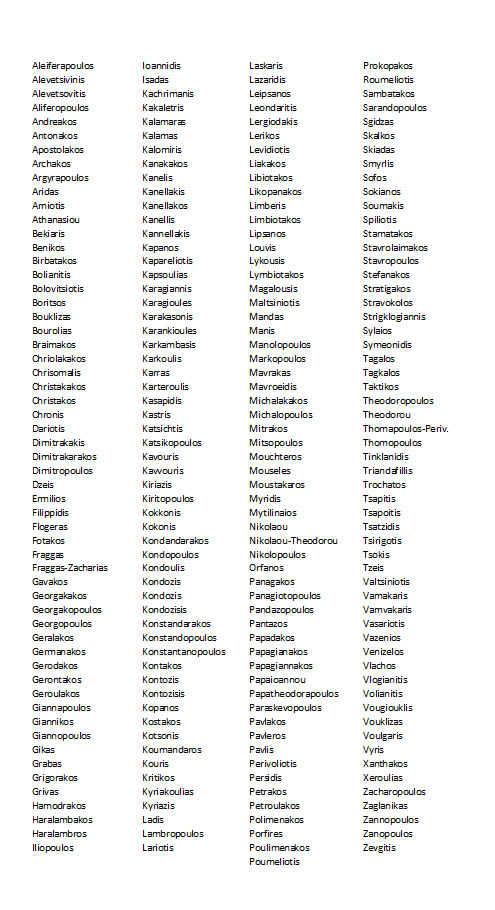
During my visit to the Archives in Sparta last summer, I obtained pages of the Mitroon Arrenon (Male Registers) for the village of Agios Ioannis, Sparta. The records begin in 1844. This village is the birthplace of three of my four grandparents (Papagiannakos, Kostakos, Aridas/Michalakakos). Almost every page had surnames of my grandparents’ families, or those who married into my family. I was thrilled to have copies of these records!

I am ever-grateful to the staff at the GAK in Sparta: Pepi Gavala (Archivist), Maria Stellakou, and Michalis Sovolos. They are kind, gracious and most helpful!

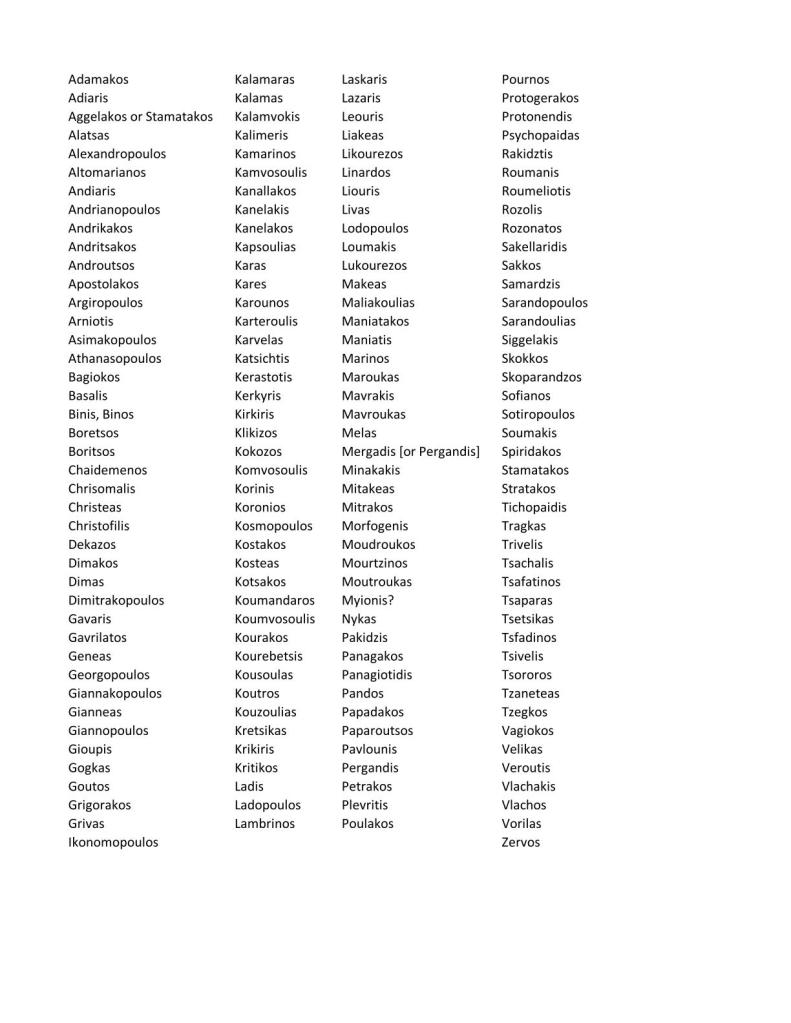
Below is an index of the surnames in the pages that I obtained (this list may not be complete.

Surnames - Agios Ioannis

The Elementary School of Anavriti (municipality of Vryseon) in 1838

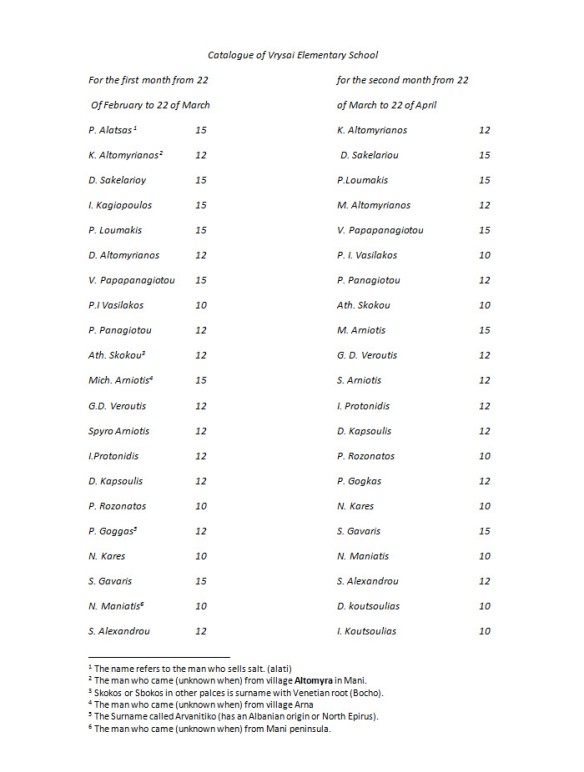
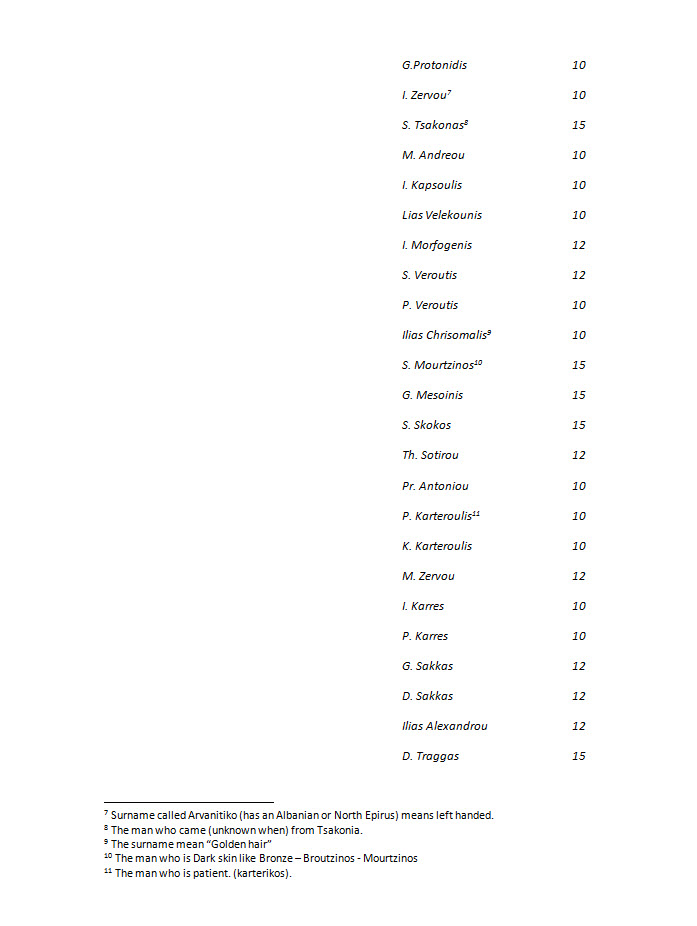
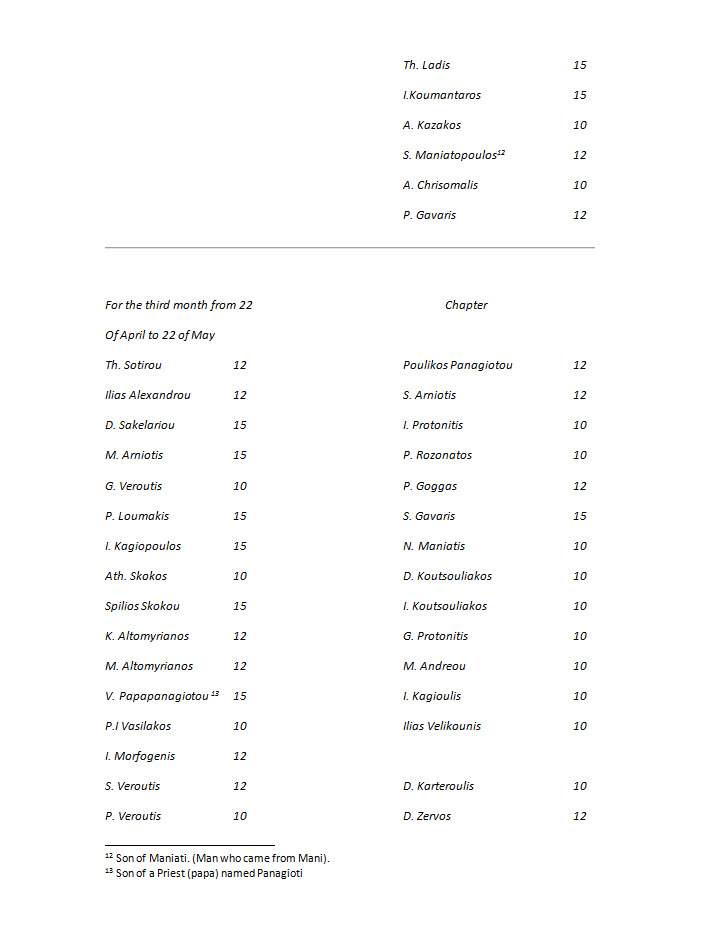
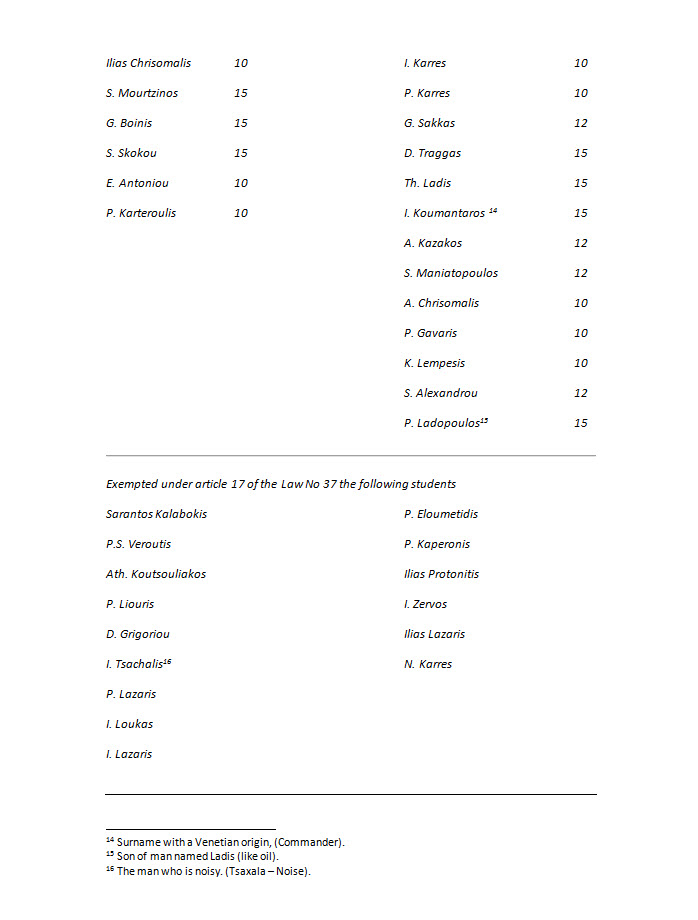
My friend, teacher, and historian, Giannis Michalakakos, has translated a list of children enrolled in school in Anavriti in 1838. The original digitized records can be found online at the General Archives of Greece (see source at end of document),  images 38, 39, 40.

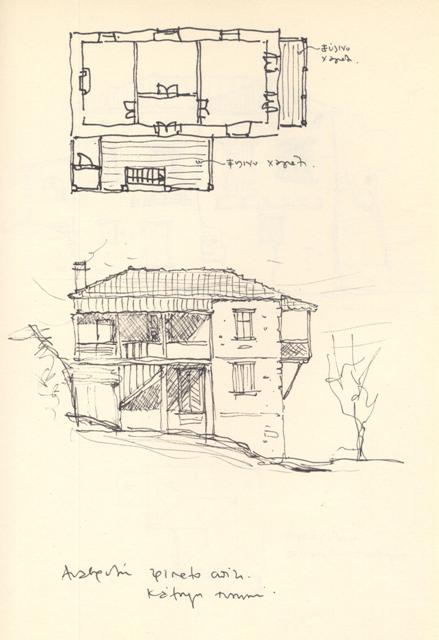
Giannis has added valuable information about the origin of many of the names in these records (look for a superscript number). He also provided links at the end of this document to the GAK Archives and to a blog dedicated to architecture in Sparta, and specifically to an article about Anavriti.

I extend to Giannis my deepest appreciation for his time and effort in finding and translating this list. The year 1838 predates many extant records (including Mitroon Arrenon); and as Giannis explained to me, if you calculate that the fathers of these children could be 30-40 years old, they would have fought in the Greek War of Independence in 1821!

To read more of Giannis’ writings about history, genealogy, and other issues concerning Mani, follow his bog, Maniatika.  Again, thank you so very much, Giannis!

Giannis Michalakakos


Written by Giannis Michalakakos
Teacher of Home Economics and Ecology
Email. gnifiatis@hotmail.com


THE ELEMENTARY SCHOOL OF ANAVRITI 1838

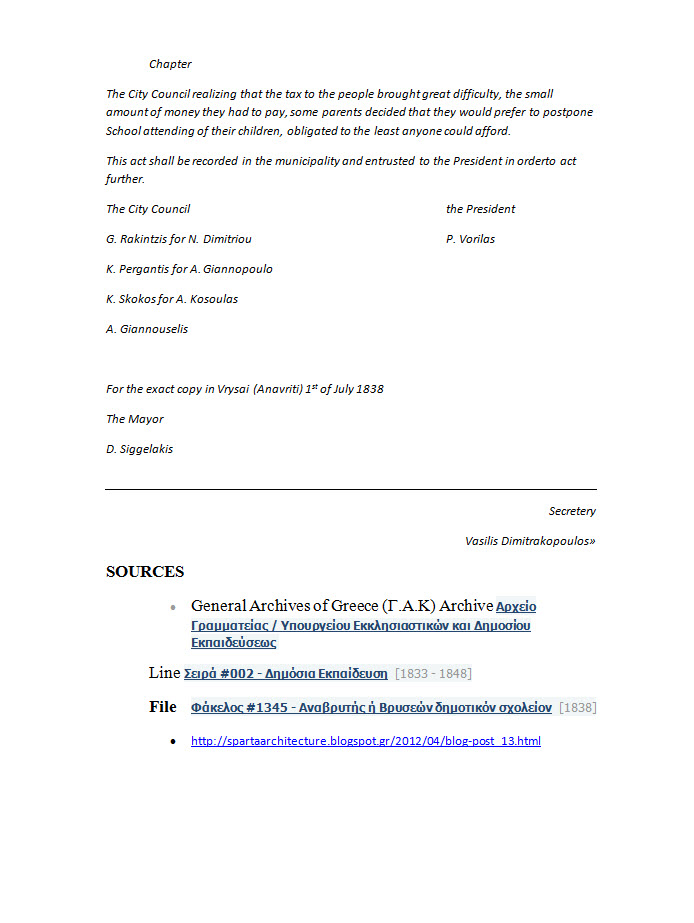
Searching in the General State Archives for information about the Anavriti village (capital of Vrysai municipality) and the families who lived there I found a list of the students of the village’s elementary school. The following documents include the decision of the local council translated.

«The City Council gathered under president P. Vorilas and the rest members of the council G. Rakintzi, K. Perganti, K. Skokkou, Alex. Giannopoulou and A. Kousoula for meeting today 3rd of July in decision No. 2525 after the invitation of the Royal Command of Lacedaemon according to the article 26 of the Law Teaching to arrange the amount of money that monthly is paid by students parents and create a fund for the teacher. The council arranges the names from 29 of May and onwards.  

Anavriti School 1838 p1
Anavriti School 1838 p2 Anavriti School 1838 p3 Anavriti School 1838 p4 Anavriti School 1838 p5 Anavriti School 1838 p6


Families of Anavryti

Last summer at the Sparta office of the General Archives of Greece, I was given permission to take digital images of pages of records of the Male Registers (Mitroon Arrenon) and Dimotologion (Town Registers) that listed names found in my family tree. I have created an index of the families of Anavriti, as found in the pages of the Male Registers that I obtained.

If your family name is listed below, please contact the GAK office in Sparta for assistance in obtaining copies of the records. The staff is kind and most helpful: Maria, Michalis, and K. Gavala speak English and are sincerely desirous to be of assistance.

The GAK office email address is: mail@gak.lak.sch.gr

The mailing address is:
GAK – Archives of Laconia
174 Vrasidou
Sparta 23100
Telephone:  27310-22884

Please note that this list may not complete.

Hellenic Genealogy Conference, NYC

There was a lot of excitement at the Holy Trinity Cathedral annex on Saturday, April 25, as people gathered for the first Hellenic Genealogy Conference. I met attendees who came from Ontario, Portland, Florida and other far-flung places. All came to learn and they eagerly absorbed the information presented.

The event was organized by Ilias Katsos and members of the Education Committee of the Hellenic Chamber of Conference, in association with my friend, Georgia Stryker Keilman of HellenicGenealogyGeek. Probably the most-oft question asked was “which village are your people from?” Everyone was trying to make a new connection and find a new lead to help them learn more about their ancestral lines.

Since my roots are in Spartan villages and Mani, I was especially intrigued to meet people with roots from the mountain village of Anavriti outside Sparta. Many of my connections, DNA and family, have roots there; yet I can’t pinpoint a direct line ancestor from that village. I will at some point, for sure!

One of the highlights of the conference came when Ilias Katsos introduced Reverend Robert George Stephanopoulos to Gregory Kontos (who participated via Skype). Gregory had just completed his presentation on the methods he used to research the Stephanopoulos family for the PBS show, “Finding Your Roots,” which aired last fall. It was exciting for all of us to watch Father Stephanopoulos express his deep appreciation to Gregory for his work.
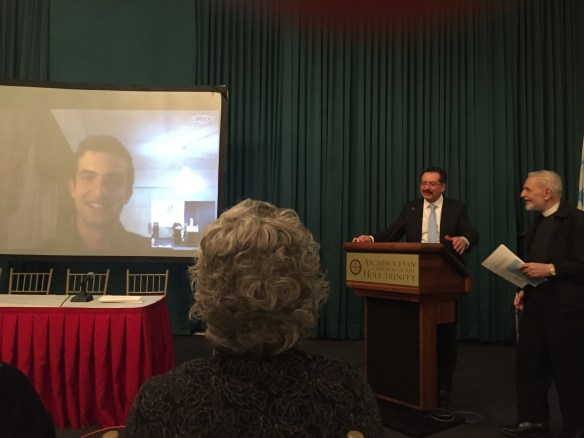
Gregory Kontos-Rev. Stephanopoulos

Ilias Katsos introduces Rev. Stephanopoulos to Gregory Kontos, via Skype


Conference Agenda and Participants
9:00-9:15 am
       Opening Remarks
 9:15-9:45 am        Dr. Peter C. Moskos. Sociology Professor and Author  Greek Americans: Struggle and Success
Topic:  The Greek experience in America, as documented in the Third  Edition of the book
 9:45 -10:30 am     Georgia Stryker Keilman, Founder HellenicGenealogyGeek.com
“How U.S. Records Can Help You Prepare for Research in Greece”
Topic:  Learn which documents provide pertinent information for Greek  research, including Passenger Lists, Social Security Applications, Death Certificates, Obituaries and others including resources available online
10:45-11:45 am    George D. Tselos, Chief Archivist of Ellis Island
“Passenger Ship and Ellis Island Records.”
Topic:  Learn the resources available at the Ellis Island Immigration Museum to decipher the information found in Passenger Ship Records
 11:45-12:15 pm    Professor Louis Katsos, Chairman Education and Culture Committee, HACC; “Brief History of Hellenic Lands”
Topic:  The impact of Hellenic history, geography, boundary and village changes in genealogy research
1:15-2:15 pm Michael Kalavritinos, “Records Available from the General State Archives of Greece
Topic:  Discover online and textual resources held at the Greek Archives
2:15-2:45pm     Peter Dickson, “Using DNA in Greek Family History Research”
Topic:  Understand the potential of DNA testing for positive family identification
 2:45-3:15pm     Debbie Petrides, “A Case Study from Chios”
Topic:  How to use records from Greece to discover the history of your family
 3:45-4:00pm     Gregory Kontos, Historian and Genealogists
Topic: Research for PBS Gates program “Finding your Roots”
 4:00-4:15pm     Carol Kostakos Petranek, “To Your Ancestral Home”
Topic:  How to prepare for a research trip
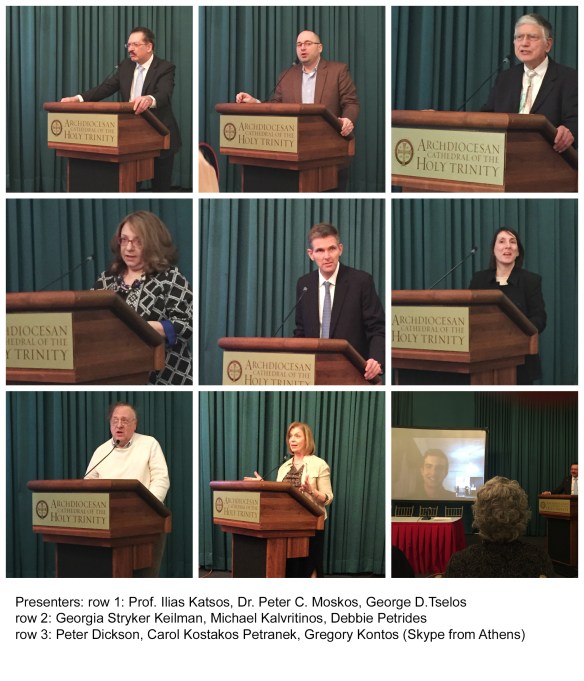
Hellenic Conf NYC Apr 2015 Collage w caption

I was honored to participate in this event, as I am passionate about research and teaching and helping others to learn. I created a handout for my presentation that will help people get ready for a successful trip. Please read and download it here.

I am now working on a committee to prepare for the next Hellenic Genealogy Conference which will be on September 26, 2015 at Holy Trinity Cathedral in Salt Lake City, Utah. The website is here, and the Facebook page is here.

So many exciting events for Greek genealogists! It’s a great time to engage in research – join us!

An update to this post:  A YouTube video of some of the conference presentations can be found at this link:  https://www.youtube.com/watch?v=4n70gTlBMxM

The full conference can be accessed in these six YouTube videos:

Part 1:  https://youtu.be/aX1FhZdAw68

Part 2:  https://youtu.be/dh6P_-isG2o

Part 3:  https://youtu.be/NDJgt9eBZt8

Part 4:  https://youtu.be/nxYOiG_IE2E

Part 5:  https://youtu.be/aZP7slDwRb8

Part 6:  https://youtu.be/jILSMY-5Bq4
Lakonia Studies

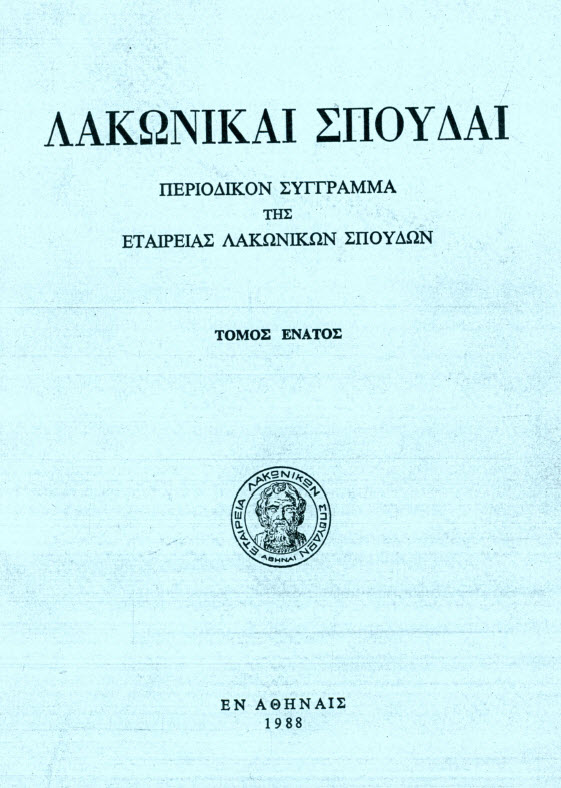
Last summer when I was in Greece, my friend Giannis Michalakakos gave me a copy of Book of Lakonia Studies which contain excerpts of letters and documents from the Venetian conquest of the Peloponnese in the late 1600’s. Specifically, there are transcripts of letters of Francesco Morosini, Doge of Venice 1688-1694, pertaining to Mystras and its surrounding region. The book is in Greek, of course, and my language skills are elementary at best. But, with the help of my teacher, Theodore Papaloizos, Google Translation tools and a Greek-English dictionary, I have begun to read this fascinating history.

I will write posts as I go through this book so others can learn and join me on this journey into the past. Please understand that my translations may not be accurate.

Lakonia Studies

Because this is a transcript of original documents, I am immersed in the first-hand accounts of Morosini, admiral of the Venetian fleet, as he writes to his superiors regarding the state of affairs in the Peloponnese.

The goal of the Venetians and the Turks is to conquer Mani. Both want control of Mystras. The Turks are losing control, and the Venetians don’t want Muslims in Mystras. An agreement is made between the Turks and the Venetians to subdue the Maniates.

12 July 1687. Fleet Admiral Morosini is on board a ship in the sea of Patras. He writes to the Doge of Venice about a new attack made against Mystras. The Venetians and Turks were fighting for Mystras, and the Venetians needed help from the Maniates. Mystras was being guarded by 600 men from Mani and the town of Koroni, in addition to 100 soldiers of the guard. When the Greeks heard the name of the Turk, they threw their axes, swords and their stolen spoils on the ground and fled from the mountain in desperate escape. They were shamed into retreat by 70-80 Turks. Morosini closes his letter by writing that this is a sad report.

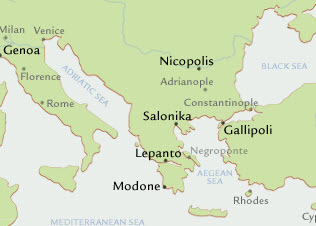
20 August 1687.  Morosini writes to the Doge from the Gulf of Lepanto.

Gulf of Lepanto map

The Maniotes, Captain Bollani and others went to Mystras with a raised white flag and a plan for the mutual exchange of hostages. The Maniates were greedy about the spoils they obtained by looting and stealing, and negotiations had to be done with utmost care. Morosini cautions against not exercising the utmost possibly leniency to the Mystriotes until the Venetians occupied the entire province. He recommends that robust men could be useful as slaves as rowers on boats, and the women, children and the elderly over 50 years could go back to their villages.

Morosini writes a letter to Pasha stating his terms which are dictated by his desire for the common good and to emphasize the decision taken by the Council: Turks are to pay a ransom; a deposit of 200,000 rialia in gold and silver. This money will increase the treasury and operations of the armies. If they do not accept the terms, they will receive notice of a general slaughter.

With other successes, the war will end gloriously. However, the Venetians must not abandon any attempt to ensure the fall of Monemvasia. Efforts will be made in this region as in others, so as not to leave even one Muslim in Mystra.

(Link about the Venetian conquest: http://en.wikipedia.org/wiki/Morean_War)