Unknown's avatar

About Spartan Roots

I am of Greek ancestry with roots in villages near Sparta. My paternal grandparents and maternal grandfather were born in Agios Ioannis (St. Johns), and my maternal grandmother was born in Mystras. I love family history research and have been tracing my roots for many years. I was born in Brooklyn, New York and was raised in a predominantly Greek neighborhood close to extended family. I live in the Washington D.C. metropolitan area and work as a volunteer Co-Director of the Washington, D.C. Family History Center and a genealogy aide/project aide at the National Archives in Washington, D.C. I am always updating and adding new information. Please contact me - I would love to hear from you!

Village History Project: Agios Ioannis Website

At the Greek Ancestry International Conference last weekend, Gregory Kontos announced an innovating and promising new initiative–the Village History Project. Its purpose is three-fold:

  1. to encourage people to “reconstruct their ancestral village” by creating an extended genealogical family tree to include any identifiable inhabitants of a village,
  2. to foster connectedness and collaboration among people who share family names and/or village roots with those who also have ties to that name or location;
  3. to create a “hub” where projects can be publicized and easily found online

There are many individuals who have already embarked on village history projects comprised of thousands of people verified through documentation. These researchers are focused and dedicated, yet they are working solely and inconspicuously. Their ultimate desire is to share their findings with others who have common ancestral roots. Until now, there has not been a centralized place for these projects to be cataloged and located.

The Greek Ancestry Village History Project Initiative (VHPI) fills this void. On this page is a list with projects that have met one or more of the following criteria:

  • A publicly available family tree which is posted on any genealogy forum (e.g., Tribal Pages, Ancestry, MyHeritage, Geni, WikiTree); and, such tree is extended beyond a specific surname to include all identifiable people residing in a specific village for an extended period of time. (Information on living people is to be excluded).
  • A website dedicated to a village in Greece, incorporating information about its families and individuals (information on living people is to be excluded unless permission is granted). Adding stories and photos about the village provides important context to understand the lives and traditions of its people.
  • An e-book written about a village and its families. The publication must be free to access and be posted online. 

Having these projects discoverable on the Greek Ancestry website means that people worldwide can more easily find “new cousins” and meet others with roots from their same village. It is exciting to contemplate how this will promote the gathering of extended families!

Every three months, Gregory Kontos will choose a project to receive support which could include one of the following:
• purchase of a book relevant to the project
• DNA kit(s)
• payment to a subscription website (such as MyHeritage.com)
• a discount on records purchased from Greek Ancestry.

In addition, the recipient will be interviewed about his/her project and featured in a post published by Greek Ancestry.

Unlike many communities large and small throughout Greece, my ancestral home of Agios Ioannis, Sparta has the distinction of having no written village history book. Typically, these books are written by teachers during their summer breaks and published locally. When I am in Sparta, I ask family, locals, librarians and professional historians why no one has every written the story of “Agianni” and the answer is usually a shrug and a simple “δεν ξέρω” (I don’t know). One historian postulates that the village is considered insignificant as its notable neighbors, Sparta and Mystras, were the locations with significant activities. While I understand this in theory, my heart is sad. How I would love to know the history of the village and its people–my ancestors!

In an attempt to bring Agios Ioannis out of literary obscurity, Georgia Stryker Keilman and I have collaborated and founded the website, Agios Ioannis, Sparta. We are proud to have it listed on the Greek Ancestry VHPI and hope that this platform will help others find us. We are seeking to highlight the families and share photos and stories of the community throughout the years.

https://agiosioannis.wordpress.com/

I am delighted to have this opportunity to share information with new cousins of Agios Ioannis heritage, and I am honored that our website is part of the Village History Project Initiative.

Can your research expand to become a village history project? Because it was customary for brides and grooms to live within a few kilometers of each other, it is inevitable that your tree will naturally expand to include other families within the village and even surrounding communities.

Please, join us! Just fill out this simple form and add your project to the Greek Ancestry VHPI. Your work will benefit countless others in their quest to learn about their family origins. And, you will meet new cousins and expand the family circle started by our ancestors many years ago.

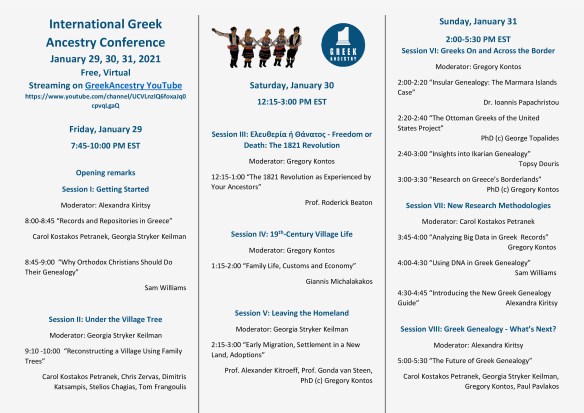
Greek Ancestry Virtual Genealogy Conference, January 29-31, 2021

Recorded session of Day 1 of the Greek Ancestry Conference, January 29, 2021

Day 1, January 29, 2021

Recorded session of Day 2 of the Greek Ancestry Conference, January 30, 2021

Day 2, January 30, 2021

Recorded session of Day 3 of the Greek Ancestry Conference, January 31, 2021

This Conference was sponsored by Greek Ancestry and Hellenic Genealogy Geek.

The purpose of this conference is to share information that will be relevant to both beginning and advanced researchers which will assist them in their quest to learn more about their family history.  Our sessions are presented by professional historians as well as seasoned genealogy researchers who have volunteered their time to share their expertise and knowledge. 

The conference was live-streamed and recorded on the Greek Ancestry YouTube channel.

The agenda for the conference is below. All times given are Eastern Standard Time. The international times for each session are on the second half of the document.

Beyond the Basics: City Directories

Do you know if your ancestor owned a business or was considered a “professional” in his village? Now there is a way to find out. The new City Directories series on Greek Ancestry is the very first digitized and name-searchable collection available for over 5,000 towns and cities in Greece.

The City Directory of 1934-1935 is a historical portrayal of Greece’s cities and communities immediately preceeding World War II. It is organized as follows: the first section lists businesses in the cities of Athens, Piraeus, Thessaloniki and Patras.  The second section lists select people in Athens and Piraeus. The third section lists, in alphabetical order, each prefecture with its capital and general information, then its primary towns and communities.  Unlike other Greek records, directories provide a snapshot of an entire town–not just an individual or a family. They also include business ads, which are so very interesting!

Ad for the Grand Bretagne Hotel in Athens, 1934

These City Directories are not the same as telephone books. They do not list every household found in the village; but they do list every business and professional enterprise and include the name of its owner.

The page below gives information for the Prefecture of Lakonia. Its number of residents is 144,336 and its capital is Sparta. The first paragraph is a brief historical background which reads: The present-day prefecture of Laconia occupies the ancient country of Laconia, inhabited by the Doric people of the Lacedaemonians, who were distinguished for their heroism and fighting ability and which they succeeded for many years in Greece. The most important center of this people was the city of Sparta. Following is a geographic description of the prefecture and the names of its four districts (Gytheio, Epidavrou Limiras, Lakedaimonos, Oitylo).

Below Lakonia is the entry for Sparta. It also provides a brief history and synopsis of the city, and lists its officials, municipal offices (post office, tax office, etc.), churches and monasteries, schools, charitable institutions and cultural associations. A list of the professionals and businesses is then presented.

This is page 2, Επαγγελματίαι (Professionals) for Sparta. It documents the professionals and business owners in these industries: midwifery, silk manufacturing, machinery, hotels for sleep, timber warehouse, carpentry, wine tavern, oxygen welding, gun shop, green grocer, ice shop, inn, grocery store, farrier, hat repair, bicycle repair, sewing machines, tailor, blacksmith, typography, bank, shoemaking, hydraulic (water) works, shoe sales, fabrics, pharmacy, drug warehouse, photography, stationery, dance school, sundries. Doesn’t this provide a fascinating insight into city life in 1934?

Business information for the various Communities of Lakonia follows. Highlighted in red is my community of Agios Ioannis.

The entry reads:

  • Capital of the community: Agios Ioannis, number of residents 914
  • Villages in the community: Agia Kyriaki (Tsaousi), Varika (Chaloulou), Kozi, Tseramio and Sinampei
  • Municipal offices:  post office, elementary school, farmers’ association, syllogos (cultural association)
  • Professionals and Businesses:
    • Colonial Products (items imported from European colonies such as coffee, tea, cocoa); proprietors: Kalama, K., Tsirigioti, Ilias.
    • Bakery: Papaioannou, K.
    • Lawyer: Kyriazis, Kon.
    • Doctors: Geroulakos, Dimit., Mitrakos, Dim.
    • Cafes:  Gianopoulou, Ad., Sampatakou, Dim.
    • Hotel: Christakakou, V.
    • Grocery: Vougioukli, El., Papaioannou, Kal.
    • Pharmacy: Theodorou, Dim.

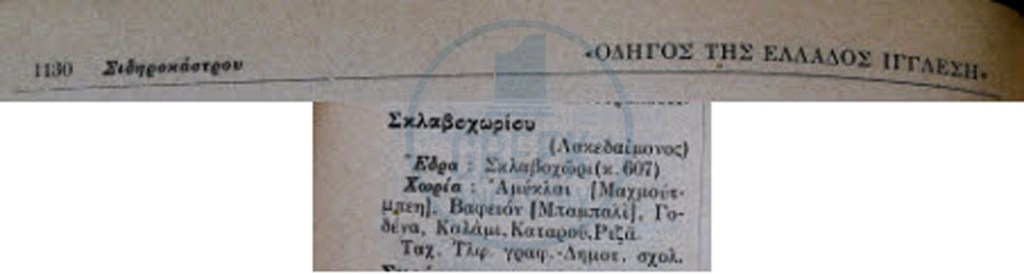
Some villages may not have resident professionals or businesses, but they are still listed in the directory with statistical data and other important information.  For example, this is the only information provided for the community of Sklavochori in 1934-35:

  • Capital of the community: Sklavochori, number of residents 607
  • Villages in the community: Amykles (Machmoutbei), Vafeion (Mpampali), Godena, Kalami, Katarou, Riza.
  • Municipal offices: post office, elementary school.

Although the information is scant, it reveals important historical data: 

  • As part of the Government reform to abolish names of Turkish, Slav or Albanian origin, thousands of Greek villages underwent name changes. In this 1934-35 directory, the community name is “Sklavochori.” Today, Sklavochori no longer exists. In 1940, that name was eliminated and the area was integrated into Amykles. Consequently, Amykles was then elevated from a village to a community (see this page and this issue of the ΦΕΚ / Government Gazette.)
  • Of significant importance, this City Directory reveals the “old” names of the villages which had been part of Sklavochori in 1934-35: Machmoutbei and Mpampali. Although those names no longer exist, they do exist in records created at the time the village bore that name. This explains why researchers are stumped when they cannot find, on today’s map, a village that had been listed in an early Voter List or a Male Register.

Tracking a Greek family’s change of residence be challenging. Greece does not have accessible census records which place people in a specific location for a specific time at specific intervals. Just as we relocate, so did our ancestors–especially upon marriage and for business opportunities.

By exploring City Directories, a researcher can see which villages have families with a surname of interest. I look at this map of Sparta and then search for ancestral names in surrounding villages.  However, I am super careful not to make assumptions. Patronymic naming conventions absolutely guarantee that all Apstolakos (son of Apostolos) families are not related. And, directories list only businesses and not households.

Despite these precautions, I have found many interesting patterns of family movement and new residences. I also learned which ancestor(s) were business owners or were employed in professional occupations.  

To learn more about the Greek Ancestry City Directory collection, click here: https://greekancestry.net/greek-ancestry-city-directories-collection/

To search the City Directories, click here: https://greekancestry.net/all-greece-discounted

Type a village name, then sort the list by “Prefecture” to group results in the region of interest, such as Messinia or Thessaloniki.

The City Directory Collection spans the years 1901-1947 with 200,000 names in 5,000 cities and towns. Some of these may be your villages! What relevant and historical information will you learn about your family?

Greek Ancestry International Conference

I am honored and delighted to be one of the organizers of the Greek Ancestry Conference being held January 29-31. It is virtual, free, and will be live-streamed on the Greek Ancestry YouTube channel. The link will be provided the week of the conference. Please join us — we have outstanding presenters and topics which will be of significant help for your research 😀

1946 Engagement Photo: George Paul Morfogen and Georgia Pappas

This photo has been hiding in a drawer in my grandparents’ home for over 70 years. When my cousin found it, he snapped a picture with his cell phone and sent it to me in a text:  I don’t think we digitized this one [during our cousin scanfest in 2015] and he was correct. What a treasure!

1946 Engagement Party, George Paul Morfogen and Georgia Pappas, held at Michel’s Restaurant, Brooklyn, New York

This photo has captured my heart and kindled my fascination. It evokes memories of the stories my mother shared about the galas, dances, and special events that were the hallmark of that time. People dressed in their finest with hats and gloves as de rigueur. Extended families gathered and new “matches” of young couples were forged by enterprising relatives. The magical combination of live music, fine dining and spirited conversations produced many an “enchanged evening.” Truly, I feel like I am missing something very special.

But I especially love looking at all these beautiful faces (and truly they are lovely!). The joy they express reveals a familial happiess that lies in connections which stretch back generations. Starting in Agios Ioannis (Pappas) and Anavryti (Morfogen) and now rekindled in Brooklyn, these immigrants settled themselves and their families in close-knit neighborhoods. They started successful businesses and helped each other become established in a new land.

This union of Pappas (Papagiannakos) and Morfogen (Morfogenis) shows how the intermarriages of immigrant Greek families expanded and drew the family circles tighter together. In this example, the families of both my father (Kostakos) and my mother (Papagiannakos) and thus, all of their cousins, now became linked with the Morfogen family and the circle ever widens. Both of my parents are in this photo, as are their siblings and their parents!

This family continuity is my foundation and fortitude.These are the generations on whose shoulders I stand and whose strength I carry.

My deepest gratitide and sincerest thanks to members of the Morfogen family who have identified almost all of the people. Below is the same picture with people numbered, and a chart with the people identified. [click on either of the photos to expand them]

If any additional people can be identified, or any corrections should be made, please let me know by sending an email to spartanroots1 at gmail.com. Thank you!

1Mrs. Zaharia Chahalis
2Pauline Morfogen Kokines
3First name?  Pavlounis
4William Kokines 
5Vivian Kokines Parlamis 
6Ethel Pavlounis Chahalis
7George Chahalis
8John Andrew Kostakos
9Georgia Kostakos Doukas
10Angelo John (Al) Doukas
11Andrew John Kostakos
12Catherine Pappas
13Angelina Eftaxia Pappas
14Nicholas Louis Pappas
15unidentified
16Calliope P. Coutros
17Peter Spyridon Coutros
18Stavroula (Stella) Kostakos Coutros
19Aphrodite (Frieda) Kostakos
20Panagiota (Bertha) Pappas
21unidentified
22Mary Coutros,(later married George Karagis)
23Peter Coutros 
24unidentified
25unidentified
26unidentified
27unidentified
28unidentified
29unidentified
30business associate: Mrs. Vassilaros 
31business associate: Irene Vassilaros 
32business associate wife 
33business associate: Mr. Chios
34business associate: Mr. Vassilaros Sr.
35Andrew Spyros Marinos
36Mary Marinos Neckles
37Petros Neckles
38George Spyros Marinos
39Helen Marinos (later married George Diakomis)
40unidentified
41unidentified
42unidentified
43unidentified
44Nicholas Spyros Pappas
45unidentified
46Father Eugene Pappas and next to him, his father, Leon
47unidentified
48Nicholas Christopher Pappas
49unidentified
50unidentified
51unidentified
52unidentified
53Christina Morfogen Marinos
54Anthony Spyros Marinos
55unidentified
56John Lambrinos 
57Areti Kostakos Lambrinos
58unidentified
59unidentified
60Lucretia Leakakos Pappas
61Pauline Drivas Pappas
62unidentified
63Effie Landis Pappas
64Stella Geaneas 
65George Geaneas 
66Mary Landis 
67Wife of James Landis
68James Landis 
69unidentified
70unidentified
71unidentified
72unidentified
73unidentified
74unidentified
75unidentified
76unidentified
77Catherine DeSimone Pappas
78Peter James Pappas
79John Salatas
80Catherine Pappas Salatas
81Christina Christakos Morfogen 
82James George Morfogen 
83Wilhemina Pappas
84Athanasia Morfogen Pappas
85Diamond Stavracos Morfogen 
86Sam George Morfogen 
87Vivian Morfogen Brauman 
88George Sam Morfogen 
89unidentified
90unidentified
91Paul George Morfogen 
92Anna Landis Morfogen  
93George Paul Morfogen   
94Georgia Pappas Morfogen 
95Calliope Kostakos Pappas 
96James Nicholas Pappas 
97Father Michalopoulos, Priest from Three Hierarchs
98Lily Landis Nikas  
99James  Nikas 
100Marie Nikas Combias 
101unidentified
102Vivian Morfogen Geaneas
103unidentified
104unidentified