The road leading to Theologos winds around a verdant mountain, filled with thousands of olive trees. “The trees on this mountain belong to the families of the village,” my cousin, Nikos explains. “Years ago [around the early 1900s], just a few families owned all of these trees. Now, every family has an olive grove.” I stared out the car window, looking for a some type of sign or marker to delineate one owner’s property from another. I saw none. So I asked, “How do the families know which trees are theirs?” Nikos smiled. “Every family known how many trees they have, and exactly where they are.”
At one time, there were two olive processing plants in this small village. In recent years when stricter safety regulations were passed, the facilities closed and people now take their harvest to Sparta.
Left: a former oil processing plant in Theologos; upper right: mountainside with the olive groves of Theologos; center: Dimos Οinountos, Theologou; bottom right: stone used in olive press
The homes of the families are constructed of stone, and they are literally built into the mountainside. Houses remain in families for generations. They are beautifully maintained and constantly being updated with modern conveniences. Living on a mountain means that there are steps everywhere, and they are steep! You can’t leave your house, or enter another, without walking up a flight. The village roads are precipitous and narrow, yet people are adept at maneuvering and parking their cars and trucks. The plateia appears to have the only flat surface in the village.
Houses, steps, and the flat plateia
The village priest, “Papa” Panagiotis Kotsos, presides over the church of Agios Ioannis Theologos. It is incredibly beautiful and filled with historic icons. I was honored to be shown several holy relics, too sacred to photograph. It’s amazing that a small village church at the top of a mountain would have such treasures.
The Church of Agios Ioannis Theologos and its priest, “Papa” Panagiotis Kotsos
What I love most about returning to the village is to gather with my cousins of the Zacharakis family. My great-grandmother, Stathoula Zacharakis, was born in Theologos1. As I researched her lineage, I created a family tree which documents the various branches of the family. Whenever I visit, I bring the “updated” Zacharakis tree which is spread out along the benches at the perimeter of the plateia. People add and correct information, and we enjoy an evening of reunion and reminiscing. It has become a joyful tradition.
Checking out the family tree! June 23, 2023Back left-right: Antonios Karagiannis, Aggelos Sarantakis, Niki Zacharakis Sarantakis, Asimina Zacharakis, Pepi Vartsaki Zacharakis, Nikos Zacharakis, Panagiota Zacharakis. Front left-right: Ioanna Karagiannis, Panagiotis Karagiannis, Argyro Bebetsos, Anthi Karagiannis, Lygeri Zacharakis Zacharakis, Anastasia Kantzioris, Rozi Kritsepis Zacharakis, John Rakis, Carol Kostakos Petranek, Alexandra Rakis, Konstantina Dariotis Zacharakis, Roula Zacharakis, Pavlos Zacharakis, Amalia Iliopoulos Zacharakis
I love these dear people and am so very grateful for their kinship and friendship. Being together in an ancestral village brings a feeling of generational connectedness. Our ancestors walked these streets, built the churches, and gathered in the plateia. Now it is our turn.
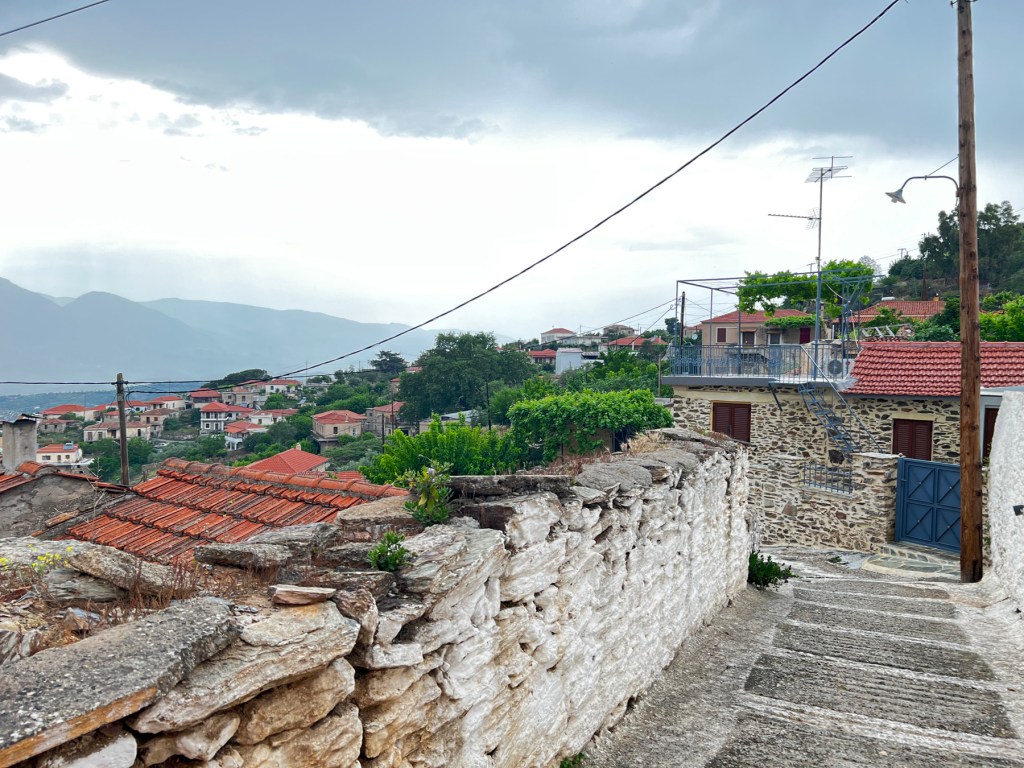
Around the time of the Greek Revolution of 1821, seven brothers left Crete and traveled to the Peloponnese. They scattered and settled in various areas. Three found their new home in a village 7 km north of Sparta, and the Zacharakis family of Theologos was formed. Theologos is situated 5 km straight up to the top of a mountain. Due to its height and spectacular views, the village is known as “the balcony of Lakonia.”
View of Theologos from the home of Georgia Zacharakis Dariotis
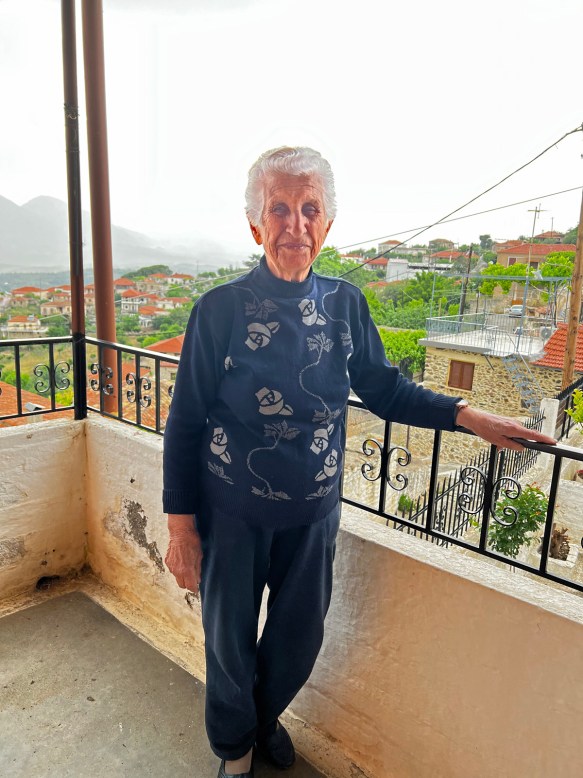
My great-great grandfather, Dimitrios Zacharakis, was among the earliest born in the village, circa1832. What type of life did he and his descendants experience? What were their occupations and their traditions? I asked my cousins to introduce me to the oldest member of the family, Georgia Zacharakis. At 93 years old, she is strong, sharp and sprightly. She continues to maintain the sprawling 100-year-old stone house that she shared with her husband (now deceased), Ioannis Athanasios Dariotis.
Georgia Zacharakis Dariotis on the balcony of her home Theologos, June 1, 2023
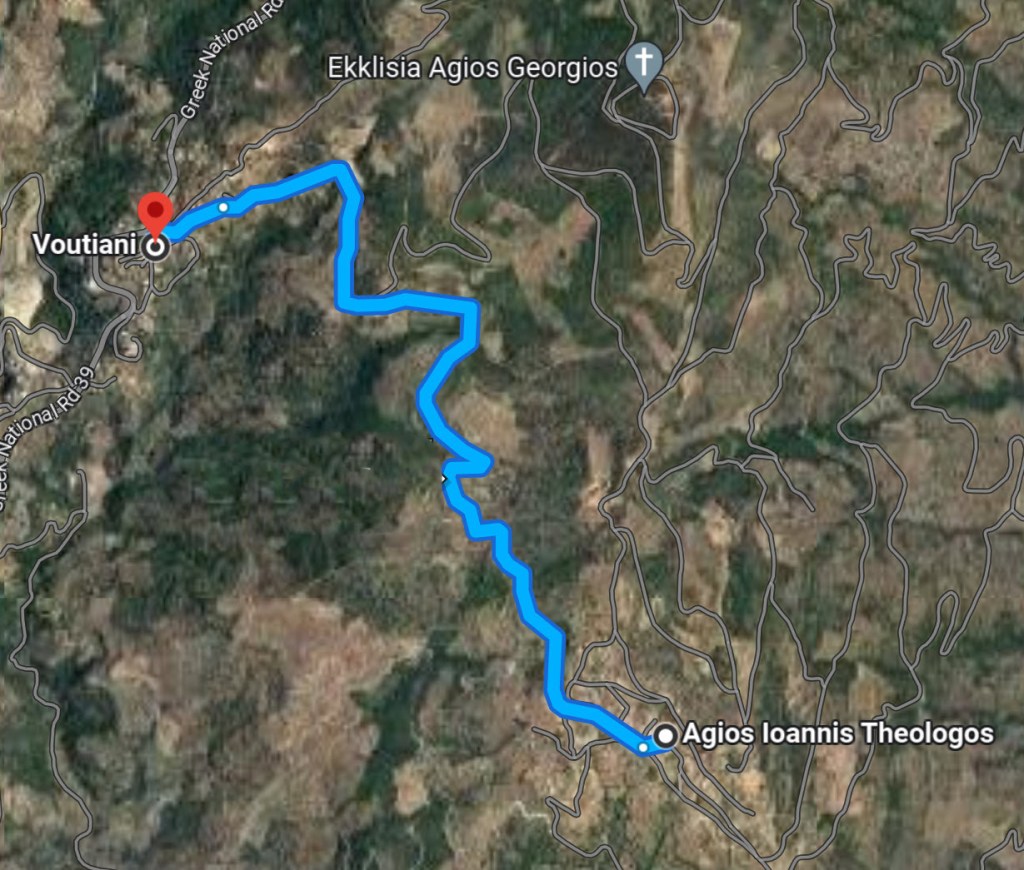
Through her reminisces, Georgia brought the past into the present. Village life was as rugged as its mountain. Transportation was by horse or donkey. It was not until 1970 that a narrow, switchback, paved road to Theologos was constructed. Prior to then, people rode animals or walked 4 km over winding mountain paths to the nearby village of Voutiani which had the only road on the mountain. It led to the city of Sparta where people could shop, conduct business, and access doctors or government facilities. There, horses and donkeys were kept in a χάνι (chani), a house with a large inner courtyard, where travelers and their animals camped and spent the night.1 After returning to Voutiani, people walked the 4 km back to Theologos, and this time their animals — or their arms — were laden with the goods and items purchased. The return trip was all uphill and done barefoot. Shoes were a luxury, not a necessity.
The mountain path from Theologos to Voutiani
Homes were built of stone and, until recently, had no modern conveniences. Nestled in the cliffs, steep steps led to every house.
Steps leading to Georgia’s home
Village families were very close and considered themselves one unit. Because they knew each other well, marriages among their children did not present unexpected surprises such as alcoholism, illness or mistreatment of spouse or children. Marriages were arranged by a matchmaker (either male or female), who received money for their services. Georgia said, with a sparkle in her eyes, that although match with a man from Agios Ioannis, Sparta was being considered for her, she refused it — preferring a man from Theologos. She married Ioannis Dariotis in 1953.
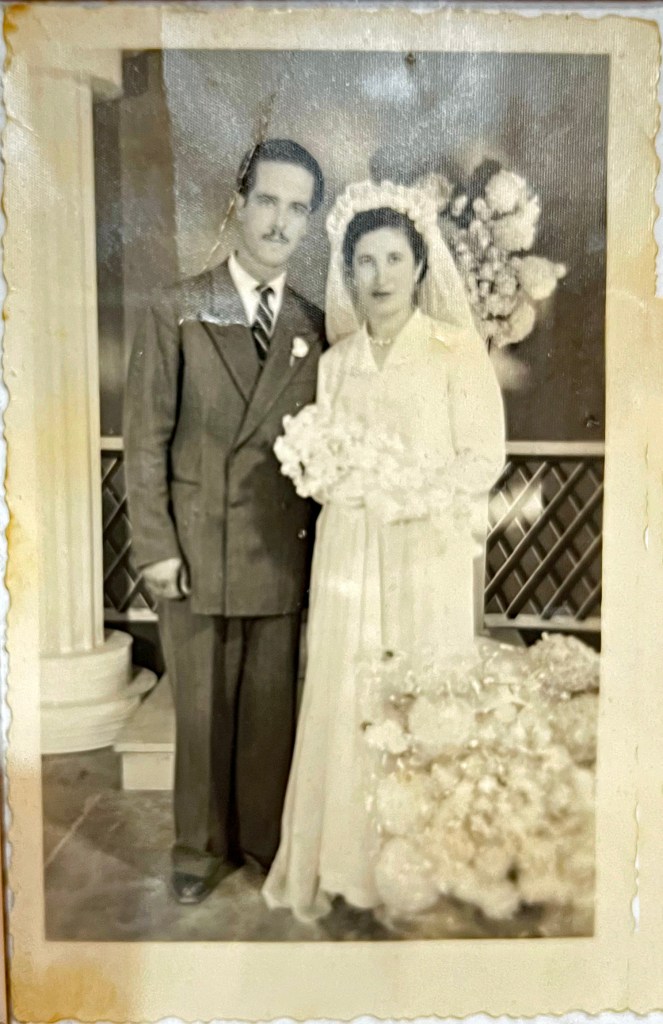
Ioannis and Georgia, June 28, 1953
Both men and women labored ceaselessly. The primary occupation was growing olives. For a time, only about ten families owned all the olive trees that fill the mountainside of Theologos. The rest of the men were laborers, working in the groves. As time passed, almost every family eventually owned at least one grove. Olive oil production was such a large business that two processing plants were built; currently, neither is operational. The villagers now bring their olives into Sparta for processing. Even today, the olive harvest season is long, lasting from October to April, because of the large amount of olives grown on the mountain.
One of two olive oil production facilities in Theologos
A few village men were woodworkers and carpenters or stone masons. Every building is constructed of stone, hewn from the mountain. Georgia’s father, Nikolaos, was a woodworker. Her husband, Ioannis, did not have an occupation when they married, and he worked with Nikolaos to learn the woodworking trade. Ioannis’ father was a farrier, making horseshoes and shoeing the animals in a courtyard at the front of Georgia and Ioannis’ house.
Courtyard where Ioannis Dariotis shoed horses
Children were born at home under the care of the village midwife, Chaido Synodinou (early-mid 1900s). A new mother was granted no reprieve from her tasks: cooking, cleaning, and childcare. Georgia’s mother, Amalia Bebetsos Zacharakis, boiled “bad” oil to make soap for washing clothes and bodies, and sold the product to earn a little money.
In addition to household chores, women harvested wheat and toiled in the fields. After the wheat was threshed, it was baked into bread in an outdoor oven.
Georgia opens the door to the oven, now housed indoors in a separate room
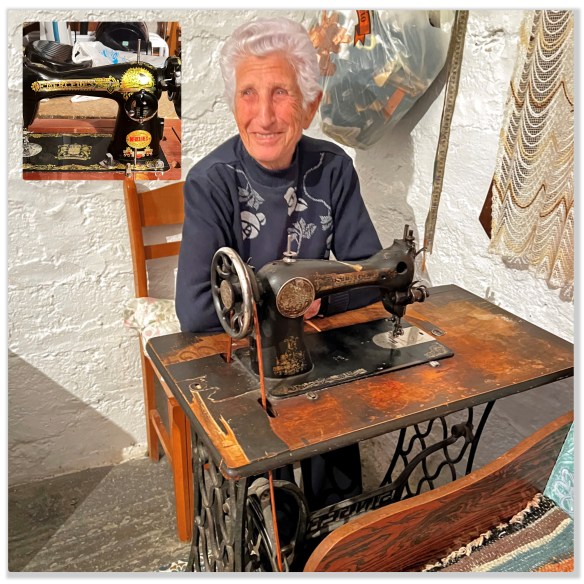
Seeing the hardships endured by village women, Georgia’s father encouraged her to make a better life. With his blessing and support, Georgia studied dressmaking in Sparta and became an outstanding seamstress. She made clothing for men, women and children. She also constructed clothing and vestments for priests, which are both ornate and meticulously embroidered. Georgia’s love of sewing has not subsided, and she took great joy in showing us her two sewing machines.
Georgia in her sewing room. She is sitting at the treadle machine which is operated by her feet; the electric machine is inserted upper left.
Georgia’s brother, Pavlos, and her nephew, Nikolaos, shared memories of growing up in Theologos. People were very poor. When their fathers worked in the fields, they took only bread to eat, leaving the cheese at home for the children. Everyone — children and adults — went barefoot.
Nikolaos, Pavlos, Georgia Zacharakis
Children had handmade toys. Balls were made from old clothing tightly stuffed into socks. Stones were lined up, and the homemade balls were rolled to move them. Sticks of varying sizes were placed on a ledge with half of the stick extended over the edge. The stick was hit hard, and the one whose broken half flew the farthest won the game. Children played leap frog and “heads or tails” with a stone or small coin. Primary school was a one-room building in the village; secondary school was in Sparta.
In the mid-1900s, when children grew into young adults, they left the village to attend college in other areas of Greece. Some returned to the village; many did not. Around the time of the great emigration (early 1900s), men went overseas in search of new opportunities. They walked or took a horse and cart to the nearest port, Gytheion; from there, they boarded small ships to Piraeus and other ports for the journey across the Atlantic. After settling in a new land, they invited their siblings, cousins, and villagers to join them. They brought their sisters to be married, thus relieving parents of the burden of providing a dowry and finding husbands who could give their daughters a better life.
Today, the population of Theologos is about 200 people. Soon, our Zacharakis cousins will gather for a reunion and to enjoy being together. Many are waiting to see the updated family tree which I have compiled using civil and church records. As the plateia (town square) fills, I know our ancestors will rejoice when they see us, their descendants, uniting in remembrance of them.
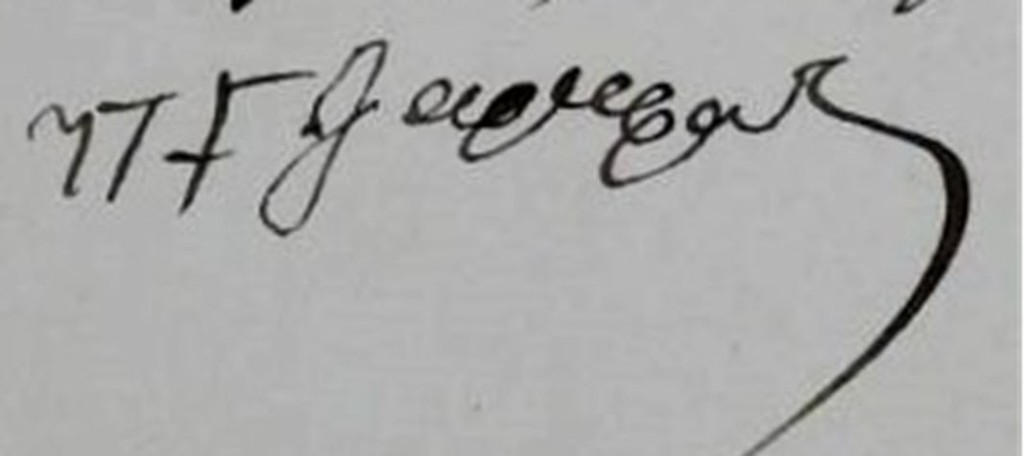
Letter of Consent to Marriage of Giannoula P. Zarafonitis and Dimitrios Nikolaos Zacharakis, April 18, 1869 in Sklavochori (now Amykles), Lakonia, Greece
This letter granting permission for the marriage of my second great-grandparents, Giannoula Zarafonitis and Dimitrios N. Zacharakis, was signed by Giannoula’s father, Panagiotis G. Zarafonitis. By adding the “G” in his signature, Panagiotis (my third great-grandfather born 1821) provided the first initial of his father which took my lineage back one more generation to my fourth great-grandfather! In this area of Sparta and for my family, the initial “G” would most likely indicate the name of Georgios.
P. G. Zarafonitis
I am thrilled that this document –so meaningful to me–is one that I digitized with my own hands. During the summers of 2019, 2018 and 2017, I volunteered to work with Gregory Kontos of GreekAncestry.net to preserve, through the digitization process, marriage books and documents at the Metropolis of Sparta for the years 1835-1935.
It is incredibly emotional for me to see the signature of my third great-grandfather, Panagiotis, and to know that through my work, his handwriting and mark of mortality has been saved and is now viewable by his descendants. And I am especially grateful to him for choosing to include that most important initial of G.
Translation of marriage letter*:
Metropolis of Sparta and Monemvasia Marrriage #89 The consent of the parents and other relatives of the future groom and bride, Dimitriou Zacharakis of the village, Theologos of Dimos Sellasias, and Giannoula daughter of Panagiotou Zarafonitou of the Dimos Sparta and village of Sklavochori, affirming that there is no kinship between the future couple nor any other impediment for them to join in matrimony, both for the first time, with the signature of two guarantors and two witnesses.
In Sklavochori on 18 April 1869
Signatures, left side: Relatives of the groom: N. Papastratis Priest, S. Dimitropoulos For the bride: P. G. Zarafonitis
Signatures, right side: Guarantors: P. Anagnostakos P. Iliopoulos Witnesses: M. Michalalopoulos Ioannis Chatzikos
The family of my great-grandmother, Stathoula Zaharakis, has been an elusive mystery to me. Her photo, which is on my desk, reminds me daily to think of her as well as all those who came before me.
Stathoula Zaharaki Eftaxias
Her face haunts me at times. How did she feel as she sent all three of her daughters to the U.S. so they could marry and have a better life? She had no sons; who took care of her as she aged? My mother said that she died as she was preparing to come to the U.S. to visit her daughters and their families in the mid-1950’s. How heartbreaking!
When Gregory Kontos and I were at the Greek Orthodox Mitropolis in Sparta in 2014, he found the marriage record for Stathoula and Konstandinos Ioannis Eftaxias.
Marriage Record, Konstandinos Ioannis Eftaxias and Stathoula Zaharaki, February 16, 1891, line 68. Received from the Holy Diocese of Monemvasias & Spartis. Certifies that: As it appears on the books of Marriages of the Office of the Holy Diocese Monemvasias & Spartis a licence -number 68 – was issued on 16 February 1891, for Konstantinos Eftaxias, resident of Mystra – of the former municipality Spartis in second marriage, and for Stathoula Zaharaki daughter of Dimitrios, resident of Theologos -of the former municipality Sellasias in first marriage. The holy matrimony was officiated by the local priest S. Dimitrakopoulou.
From this marriage record, I learned that Stathoula’s father was Dimitrios. I knew that the family lived in Theologos, Oinountos – just north of Sparta.
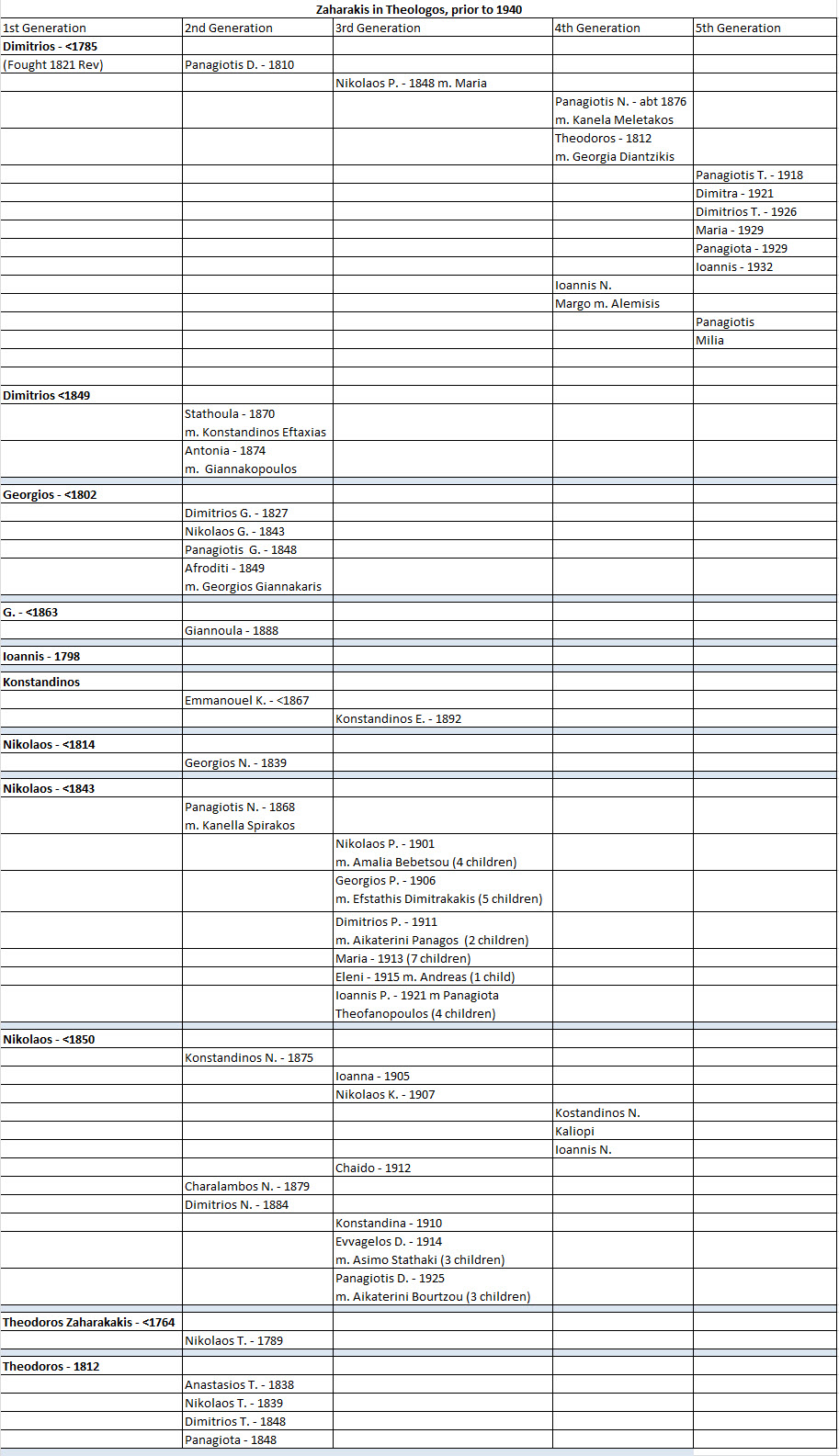
At the office of the General Archives of Greece in Sparta, Gregory and I digitized pages from the Dimotologion Koinothtos (Town Register) of Theologos which listed the Zaharakis families. I can’t believe that I overlooked the Male Register – a critical component to understand father/son relationships! Until I return to the Archives next summer, I have only the Dimotologia, Election Lists of 1872 & 1844, and information sent by family members to organize the structure of the Zaharakis family prior to 1940. I know the Male Registers will eventually provide missing information.
Zaharakis Families in Theologos, Pre-1940. < symbolizes “before”
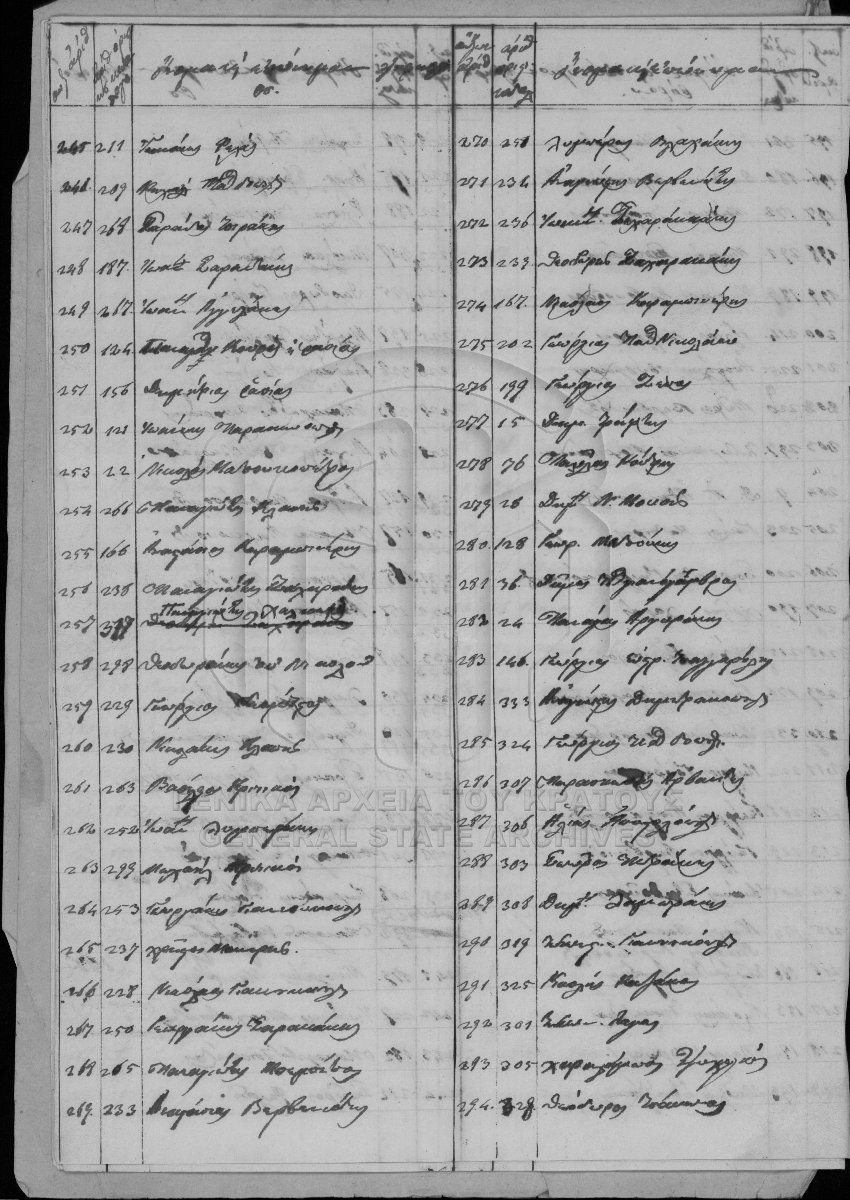
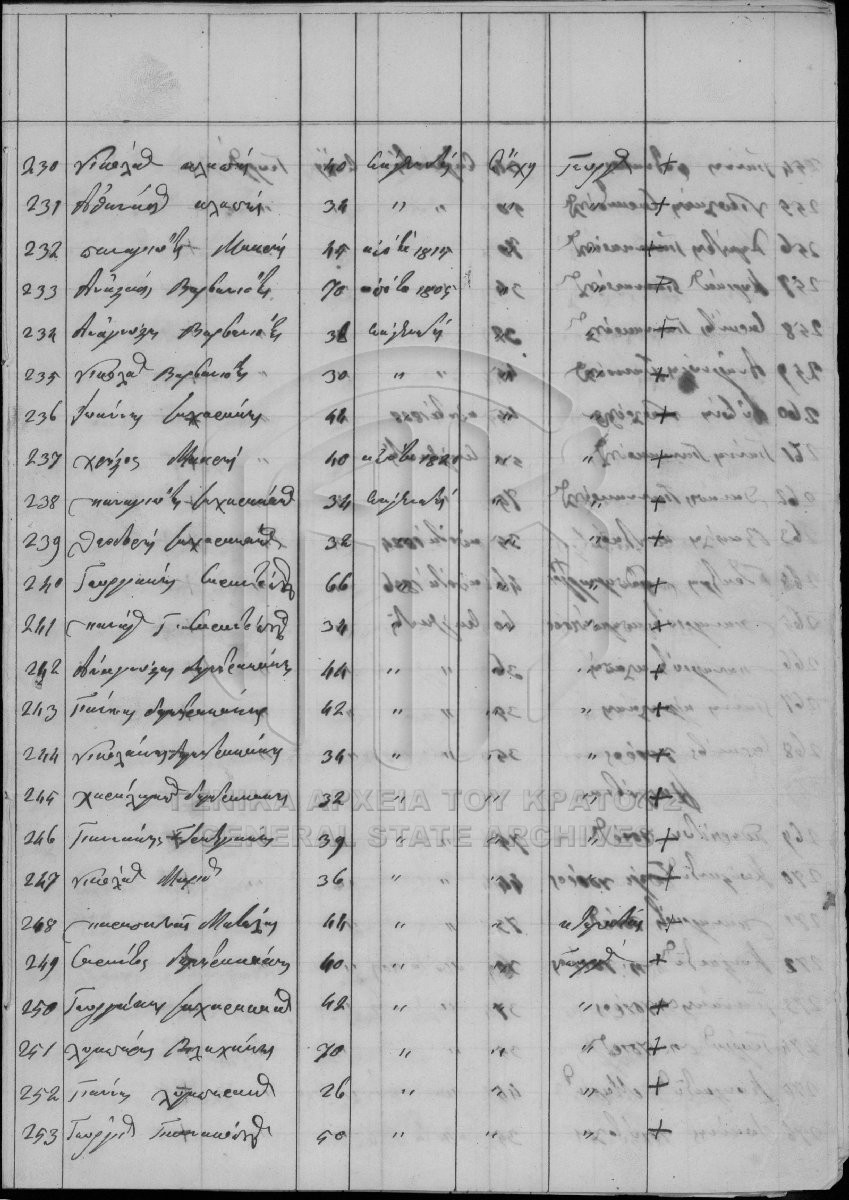
As I worked through the various resources, I learned an important detail about the 1844 Election Lists: there is an index at the beginning of each municipality. In the image below, notice two columns of numbers to the left of each name. The first number is the line number in the index; the second number is the line in the record itself. In this image on line 272 (right column, 3rd down) is Ioannis Zaharakis or Zaharakakis; the number 236 indicates the line in the record where his registration is recorded. (see next image)
Also found on both of these pages are:
Index line 256/Record line 238 – Panagiotis Zaharakakis, age 34, farmer
Index line 273/Record line 239 – Theodoros Zaharakakis, age 32, farmer
Index line 267/Record line 250 – Georgios Zaharakis, age 42, farmer
Big important note: Thank you, Gregory Kontos, for finding these names for me. You have my undying gratitude forever! I can read records that are typewritten, but the handwritten ones are Greek to me.
I will update this post after my next trip to the Archives in Sparta in July 2016. This time I’ll have the Male Registers and I will be able to further corroborate and correct what I have documented.
If anyone has information that can shed further light on these families, or give a better translation of the handwritten Greek, I would be most grateful!
Now I can put this aside to enjoy the holidays. Merry Christmas!









 Spartan Roots (Σπαρτιατικές Ρίζες)