Return to Greece, 2016. Part 8: Meandering in Mani

This is the eighth post in a series about my trip to Greece, June 30-July 20, 2016 — an amazing journey of history, family and discovery. Previous posts can be found here.

Mani. There’s something about this land that speaks to my soul. From the moment I left two years ago, I couldn’t wait to return. The forbidding mountains, expansive plains, and impenetrable stone structures exemplify resilience, fortitude, and never giving up. It is the land of some of my ancestral families. On my first trip to Greece years ago, a man at the Archives looked at my surnames and exclaimed, “Oh, your families are from Mani!” Then he looked at my husband and said without any humor, “Watch out! She’s a Maniot. She  comes from tough people.”

Since then, I have learned so much about these “tough people.” There’s a reason they are so strong and self-reliant. They have weathered the elements and tamed the forbidding soil. They repelled any potential invaders by using rustic, yet effective methods. The Turks never penetrated or conquered the Mani. Neither did the Nazis. The people hid in caves in the hills until danger passed, then returned to their villages and their simple lives. Although the spirit of independence from Ottoman rule had been simmering for years throughout Greece, the spark that ignited the Revolution was in Mani on March 17, 1821.

By al-Qamar - File:Peloponnese relief map-blank.svg, GFDL, https://commons.wikimedia.org/w/index.php?curid=36370154

By al-Qamar – File:Peloponnese relief map-blank.svg, GFDL, https://commons.wikimedia.org/w/index.php?curid=36370154

There are three regions in Mani:  “exo” or outer; “kato” or lower; “mesa” or inner. As the map clearly shows, the entire region is mountainous and sustains little vegetation except wild olive trees, cactus, and brush. Goats scrape by on the sparse grasses, and an occasional flat valley may support orange trees. Wild herbs such as sage and oregano fill the air with a tantalizing scent. Even during hot summers, cool breezes sweep the mountains.

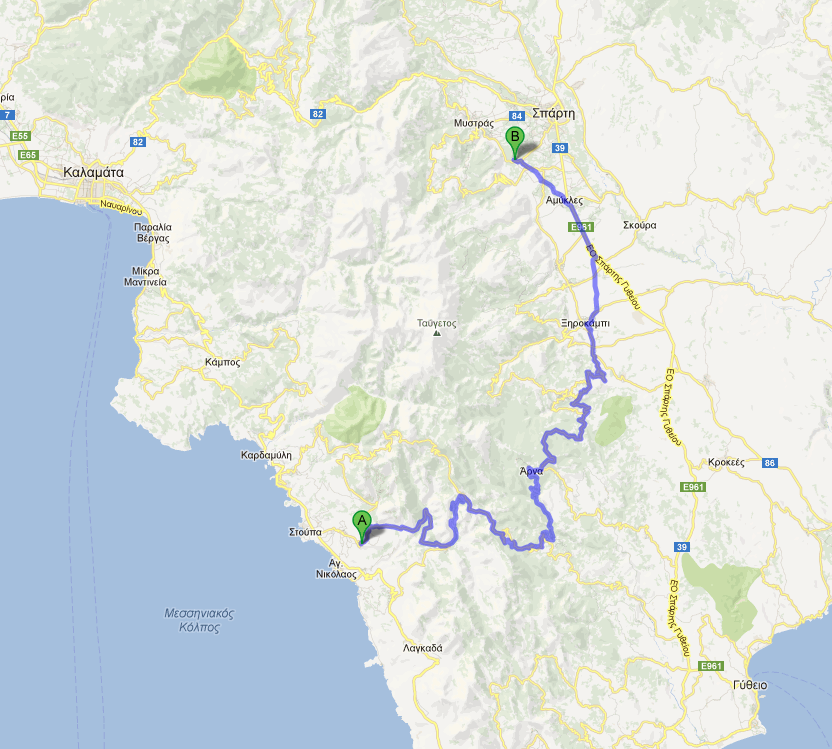
I fulfilled a dream by driving the beautiful, winding road from Kalamata to Areopoli. My GPS estimated the driving time at 1-1/2 hours, but it took me seven. All I did was stop, take photos, and savor every unique site and beautiful view. Being alone, I was able to absorb the atmosphere and revel in the rugged beauty of the land. I felt so peaceful and happy as I drove. I feel like I belong here.

Driving from Kalamata to Areopoli; the mountains, July 2016

Driving from Kalamata to Areopoli – the mountains. July 2016

kalamata-to-aeropoli-9-07-16

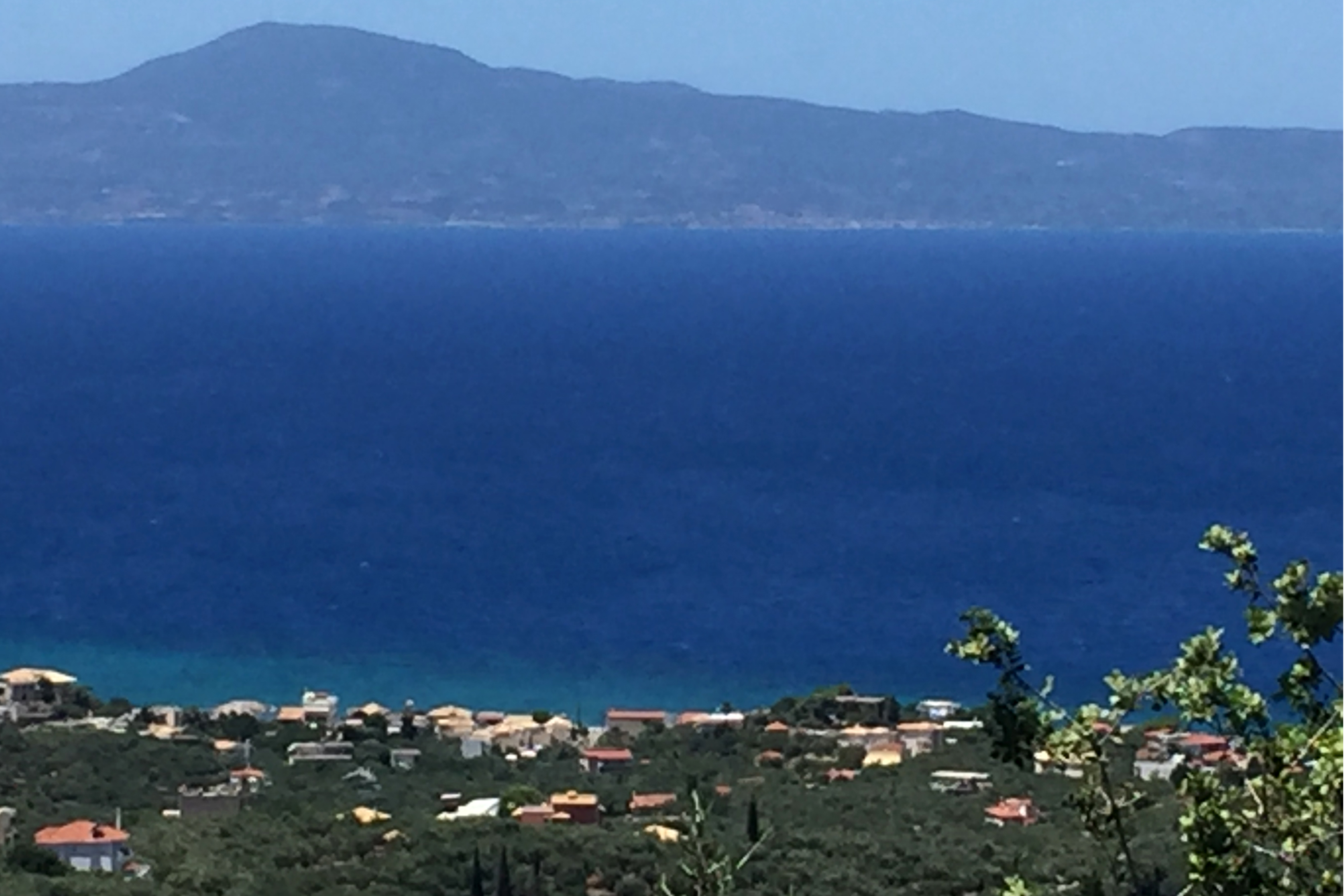
Driving from Kalamata to Areopoli – the sea. July 2016


Kalamats to Areopoli - the buildings. July 2016

Kalamats to Areopoli – the buildings. July 2016

A major item on my Plan A was to visit the village of Pyrgos Lefktro in Messinia. I had been told by an elderly aunt that my great-grandfather, Andreas Kostakos, may have come to Sparta from “Pyrgos over the mountains.” This particular Pyrgos seems to be the most logical place. The village is literally at the top of the mountain. When the mountain road ended, I had to park my car and walk because the village “road” was actually a narrow cobblestone winding path, lined with what seemed like ancient stone homes. It was mid-afternoon when I arrived, so of course, not a soul was to be seen except a stray cat. I wandered all around the town, taking many pictures. I found the church, the cemetery, and even went into the osteofilakio (οστεοφυλάκιο), the ossuary building, and looked at the names on the boxes. I did not see anything that could possibly be Kostakos, but my great-grandfather would have left in the middle 1800’s. If he did come from here, there are no descendants remaining.

At the front of the village was a sign on a tree that read “500 years old”. It would have been in full leaf during my great-grandfather’s time.

500 year old tree, Pyrgos, Messinia. July 2016

500 year old tree, Pyrgos, Messinia. July 2016


Buildings in Pyrgos, which overlooks the sea. July 2016

Buildings in Pyrgos, which overlooks the sea. July 2016

There is a very old museum which was locked; there was no sign as to when it opens. I peered in the windows and was taken aback at the life-size figures in full costume, standing watch over the treasures of the village.

Museum in Pyrgos, Messinia. July 2016

Museum in Pyrgos, Messinia. July 2016

As I was leaving, I did see two elderly women sitting on a veranda. They beckoned me to join them. I asked if they had ever heard the Kostakos name in the village, but their answer was no. I wanted to ask what type of life they had led; what type of work their husbands did; how often they left the village to “go to town” (wherever that was, somewhere down the mountain). They had a hard time hearing me and my vocabulary is limited, so the conversation was limited to pleasantries. One of them blew me a kiss as I said goodbye.

Saying goodbye; Pyrgos, Messinia, July 2016

Saying goodbye; Pyrgos, Messinia, July 2016

Driving back down the mountain, I wondered if I may have come — literally — to the end of the road in trying to learn more about the origins of Andreas Kostakos. But I resolutely pushed that thought from my mind. I guess it’s the fighting Spartan and tough Maniot in me that just refuses to give up!

Continuing on the road to Areopoli, I found a settlement, Tzokeika, that is being reconstructed to portray a traditional Maniot village, including a tower, a church, individual homes and an olive press. How fascinating to walk through the buildings that are under construction! This is a living settlement, with people occupying houses. I spoke with a man who had moved in last year, and he was very enthusiastic about his new home, the beauty of the scenery, and the pleasures of living in a closely knit community.

The settlement of Tza

The settlement of Tzokeika, Messinia, July 2016


Tz

Tzokeika settlement, Messinia, July 2016

I was in Areopoli, the capital of Mani, by 7:00 p.m. It was Saturday evening and the town was filled to capacity with both locals and tourists. When I went to dinner at 11:00 p.m., I could not find an empty table. I love this village! It eneaeropoli-07-16rgizes me. The ambiance is lively, the buildings are beautifully maintained, and it is the home of a favorite bookstore, Adouloti (owned by Georgios Dimakogiannis). There are dozens of tavernas and cafes, and many unique shops. As are most Maniot villages, Areopoli is pure stone — buildings, roads, walkways. The starkness of the rock is punctuated by brilliantly colored flowers. It is a beautiful study in contrasts. Perched at the edge of the sea, the picturesque town is a visual and sensory delight.

Approaching Areopoli, a village by the sea. July 2016

Approaching Areopoli, a village by the sea. July 2016


Adouloti Mani Bookstore, Areopoli, July 2016

Adouloti Mani Bookstore, Areopoli, July 2016


Areopoli, July 2016

Areopoli, Laconia, July 2016
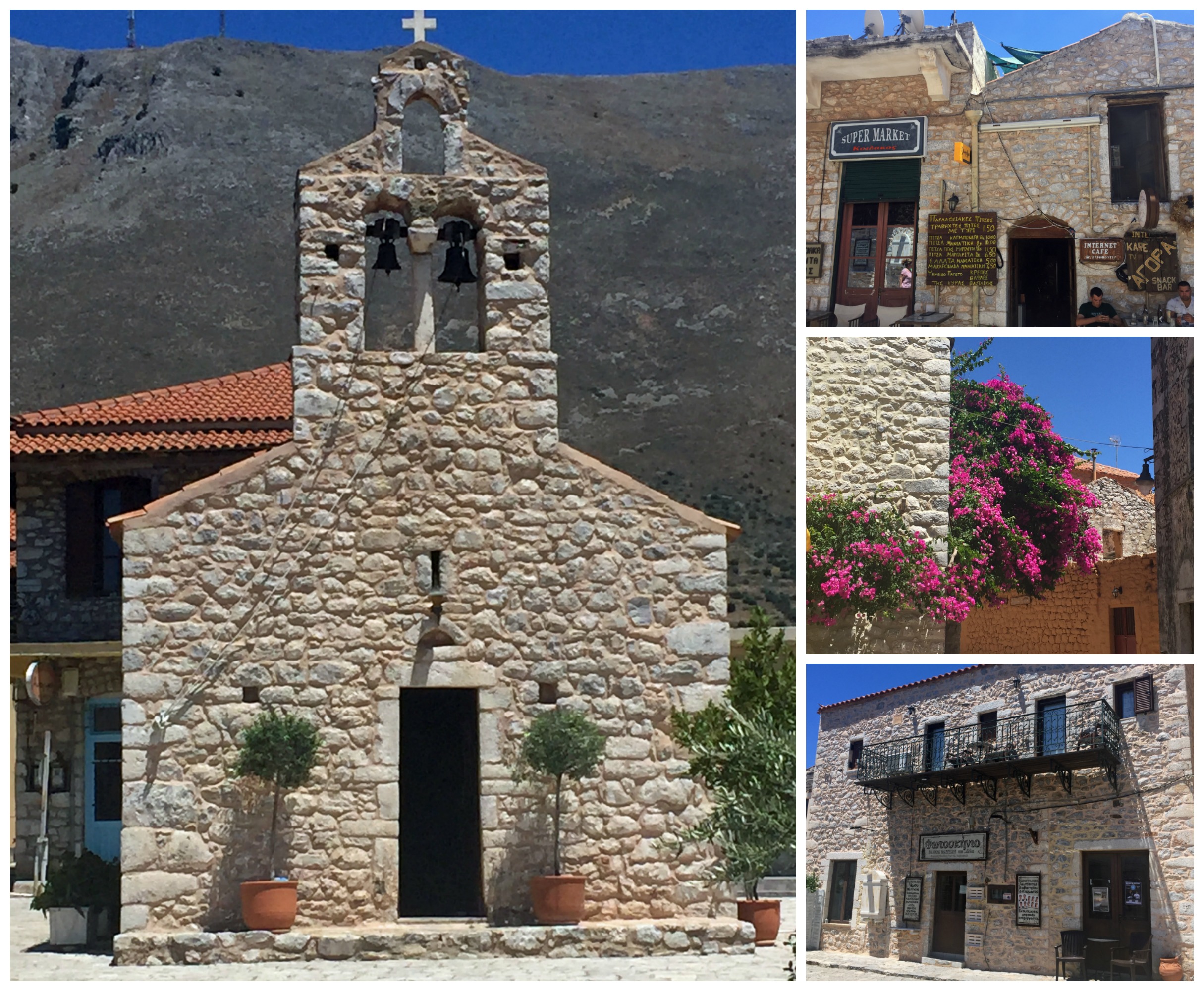

Areopoli, Laconia, July 2016

Areopoli, Laconia, July 2016

On the way back to Sparta, I stopped at Karavelas to see my friend, Margarita Thomakou, and visit her adopted village. Margarita and I had a delightful visit and a delicious lunch, made by her friend, Pietro. Pietro showed me a book about the history of the village. It is heartwarming to see that many villages in Laconia, even some of the smallest, have these wonderful histories.

Karvelas, Laconia, with Margarita Thomakou and Pietro, July 2016

Karvelas, Laconia, with Margarita Thomakou and Pietro, July 2016

My meanderings in Mani were almost over. The road to Sparta threaded through fertile plains, filled with orange and olive groves. Wild and lovely; fruitful and plentiful, this region of Laconia is truly the breadbasket of Greece.

On the road to Sparta, July 2016

On the road to Sparta, July 2016


Kostas – Kostakos: Is This My Family?

Many years ago, my aunt Areti Kostakos Lambrinos said that my great-grandfather, Andreas Kostakos, came to Agios Ioannis (a village near Sparta) “from Pyrgos, over the mountains.” That comment sent me on a hunt for records in the Pyrgos area.

I was excited when a historian and friend in southern Peloponnese sent me a map showing a trail from Pyrgos to Sparta. The Taygetus mountains are steep, treacherous and almost impassable!

Pyrgos - Agios Ioannis

This appears to be one of the only trails to get over the towering mountains that separate Pyrgos in Messinia from Sparta in Lakonia .

I have been looking at names of men who were eligible to vote in 1865, 1867, 1871.  Election Lists are digitized on the website of the General Archives of Greece. In examining surnames in the Pyrgos area, I have not found KOSTAKOS but I have found KOSTAS in the village of Βαρυμπóπι [Varibopi, now known as Monastiri, Tripyli, Trifylia]*. Is this my family? It is a common practice to add a suffix to a name to indicate “son of,” such as -opoulos and -akos. Thus, a male in this Kostas family may have added -akos to his name, thus creating my KOSTAKOS surname.

So far, I have identified three Kostas families in Βαρυμπóπι: (1) father: X (Christos?) and son, Georgios X; (2) father: A (Anastasios?) and sons Georgios A. and Christos A; (3) father: G (Gregorios?) and son, Georgios G. Here is the entry for two of the families:

Lines 310 & 313.

Trifylia, File, 52, page 154, lines 310 & 313.

I don’t know if these are my people, but I am hopeful that I have found a clue to support the oral history given by Aunt Areti. This research is like looking for the proverbial “needle in a haystack,” but it is exciting, challenging, and rewarding!

________

*General Archives of Greece, Electoral Rolls, Region of Trifylia, File 52