The Zaharakis / Zacharakis Families of Theologos, Oinountos, Laconia

The family of my great-grandmother, Stathoula Zaharakis, has been an elusive mystery to me. Her photo, which is on my desk, reminds me daily to think of her as well as all those who came before me.

Stathoula Zaharaki Eftaxias

Stathoula Zaharaki Eftaxias

Her face haunts me at times. How did she feel as she sent all three of her daughters to the U.S. so they could marry and have a better life? She had no sons; who took care of her as she aged? My mother said that she died as she was preparing to come to the U.S. to visit her daughters and their families in the mid-1950’s. How heartbreaking!

When Gregory Kontos and I were at the Greek Orthodox Mitropolis in Sparta in 2014, he found the marriage record for Stathoula and Konstandinos Ioannis Eftaxias.

Marriage Record, Konstandinos Ioannis Eftaxias and Stathoula Zaharaki, February 16, 1891, line 68. Translation of Marriage Record received from the Holy Diocese of Monemvasias & Spartis Certifies that: As it appears on the books of Marriages of the Office of the Holy Diocese Monemvasias & Spartis a licence -number 68 - was issued on 16 February 1891, for Konstantinos Eutaxiarhis, resident of Mystra - of the former municipality Spartis in second marriage, and for Stathoula Zaharaki daughter of Dimitrios, resident of Theologos -of the former municipality Sellasias in first marriage. The holy matrimony was officiated by the local priest S. Dimitrakopoulou.

Marriage Record, Konstandinos Ioannis Eftaxias and Stathoula Zaharaki, February 16, 1891, line 68. Received from the Holy Diocese of Monemvasias & Spartis.
Certifies that:
As it appears on the books of Marriages of the Office of the Holy Diocese Monemvasias & Spartis a licence -number 68 – was issued on 16 February 1891, for Konstantinos Eftaxias, resident of Mystra – of the former municipality Spartis in second marriage, and for Stathoula Zaharaki daughter of Dimitrios, resident of Theologos -of the former municipality Sellasias in first marriage. The holy matrimony was officiated by the local priest S. Dimitrakopoulou.

From this marriage record, I learned that Stathoula’s father was Dimitrios. I knew that the family lived in Theologos, Oinountos – just north of Sparta.

At the office of the General Archives of Greece in Sparta, Gregory and I digitized pages from the Dimotologion Koinothtos (Town Register) of Theologos which listed the Zaharakis families. I can’t believe that I overlooked the Male Register – a critical component to understand father/son relationships! Until I return to the Archives next summer, I have only the Dimotologia, Election Lists of 1872 & 1844, and information sent by family members to organize the structure of the Zaharakis family prior to 1940. I know the Male Registers will eventually provide missing information.
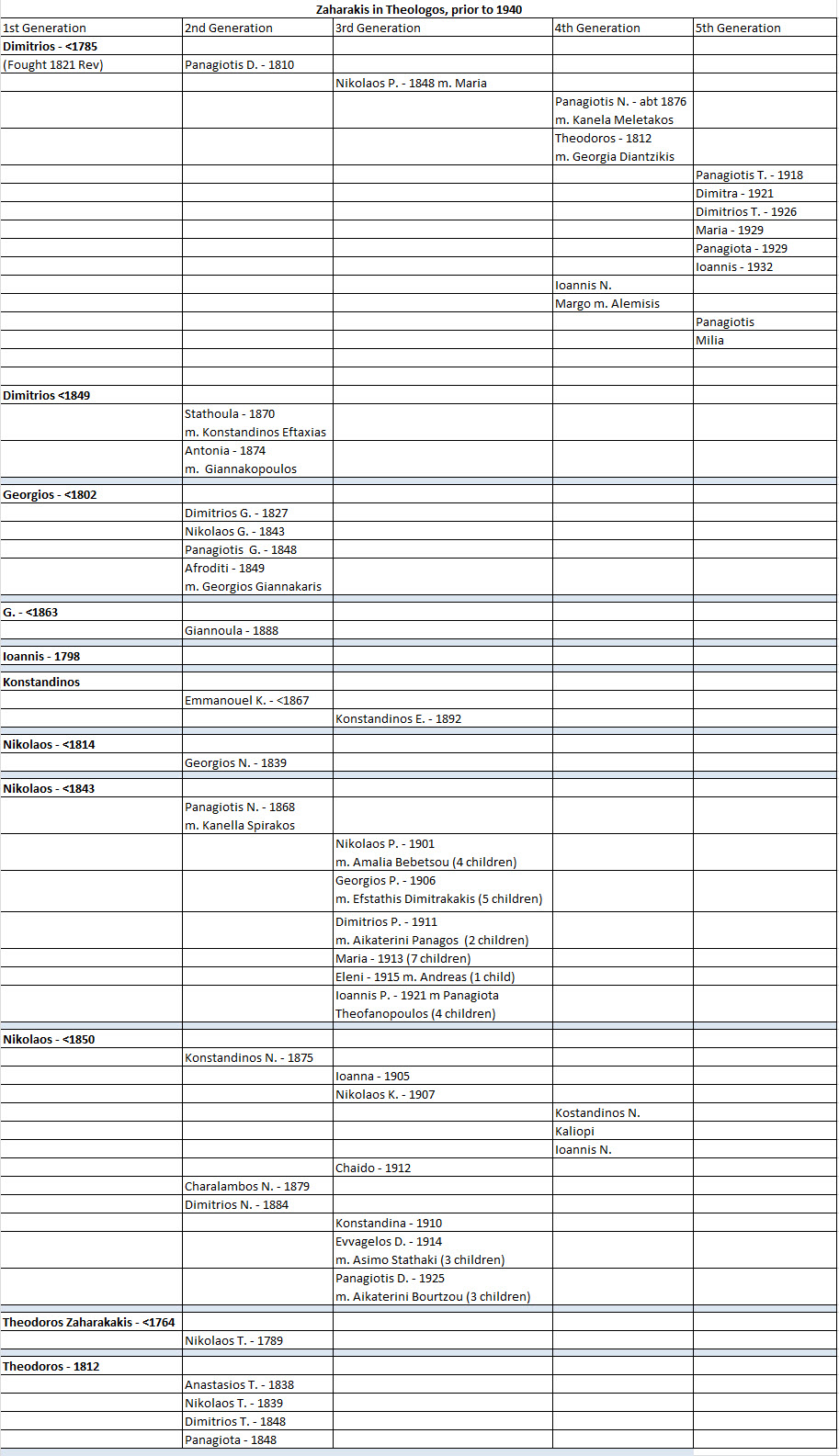
Zaharakis Families in Theologos, Pre-1940

Zaharakis Families in Theologos, Pre-1940. < symbolizes “before”

As I worked through the various resources, I learned an important detail about the 1844 Election Lists: there is an index at the beginning of each municipality. In the image below, notice two columns of numbers to the left of each name. The first number is the line number in the index; the second number is the line in the record itself. In this image on line 272 (right column, 3rd down) is Ioannis Zaharakis or Zaharakakis; the number 236 indicates the line in the record where his registration is recorded. (see next image)
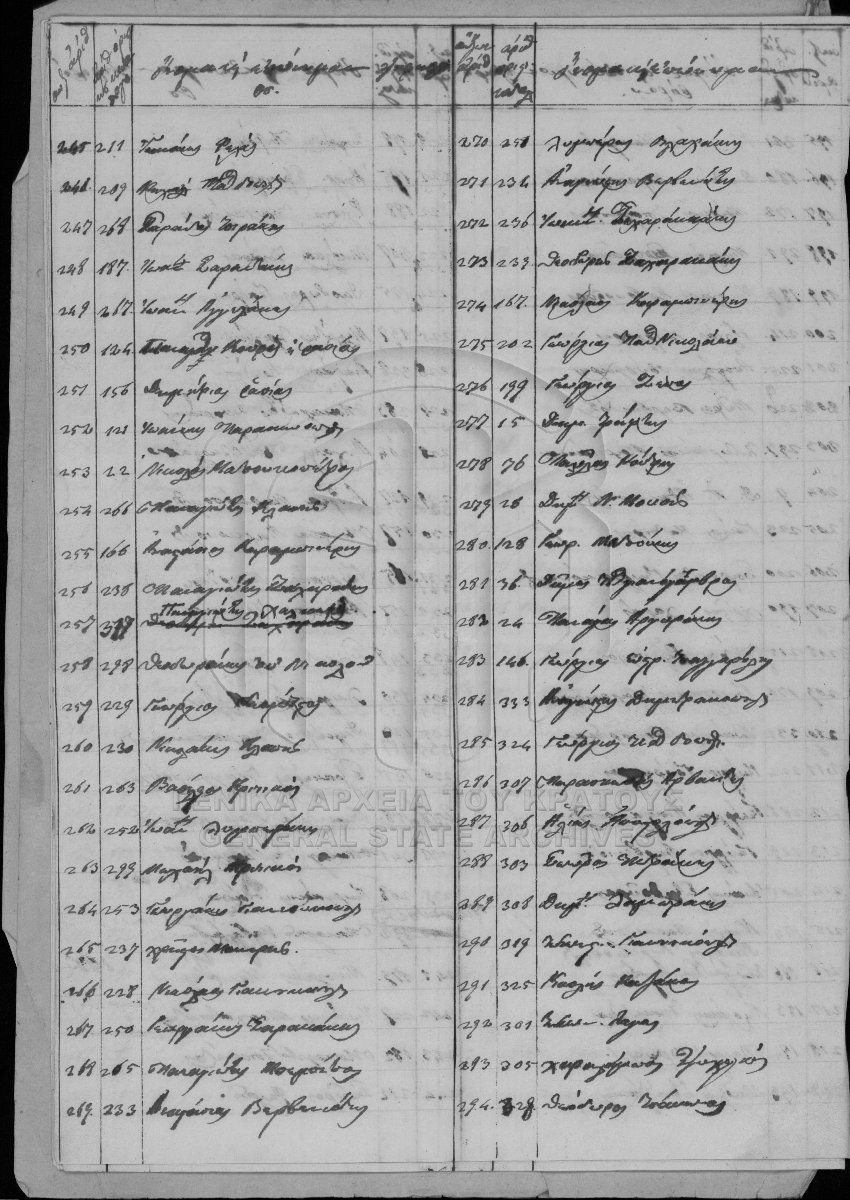
1844 Election Lists, Laconia, File 22, image 1209 Index

1844 Election Lists, Laconia, File 22, image 1209, Theologos. Index.

This is an image of the voter registration page. Ioannis is found on line 236, which reads: Ioannis Zaharakis, age 46, farmer.
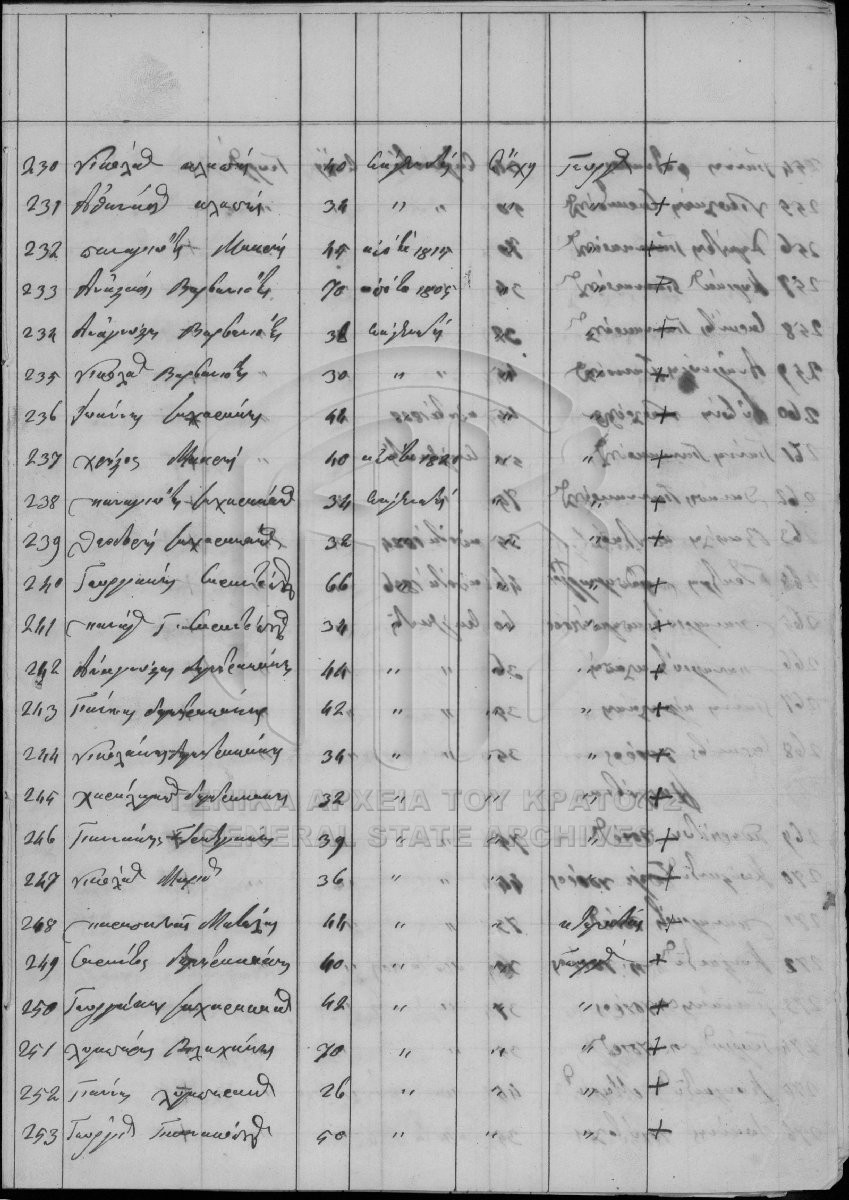
1844 Election Lists Laconia, File 22, Image 1222 Theologos.

1844 Election Lists Laconia, File 22, Image 1222 Theologos.

Also found on both of these pages are:
Index line 256/Record line 238 – Panagiotis Zaharakakis, age 34, farmer
Index line 273/Record line 239 – Theodoros Zaharakakis, age 32, farmer
Index line 267/Record line 250 – Georgios Zaharakis, age 42, farmer

Big important note: Thank you, Gregory Kontos, for finding these names for me. You have my undying gratitude forever! I can read records that are typewritten, but the handwritten ones are Greek to me.

I will update this post after my next trip to the Archives in Sparta in July 2016. This time I’ll have the Male Registers and I will be able to further corroborate and correct what I have documented.

If anyone has information that can shed further light on these families, or give a better translation of the handwritten Greek, I would be most grateful!

Now I can put this aside to enjoy the holidays. Merry Christmas!


Research and Remembrances, Part 3


Research at the Mitropolis of the Greek Orthodox Church, Sparta

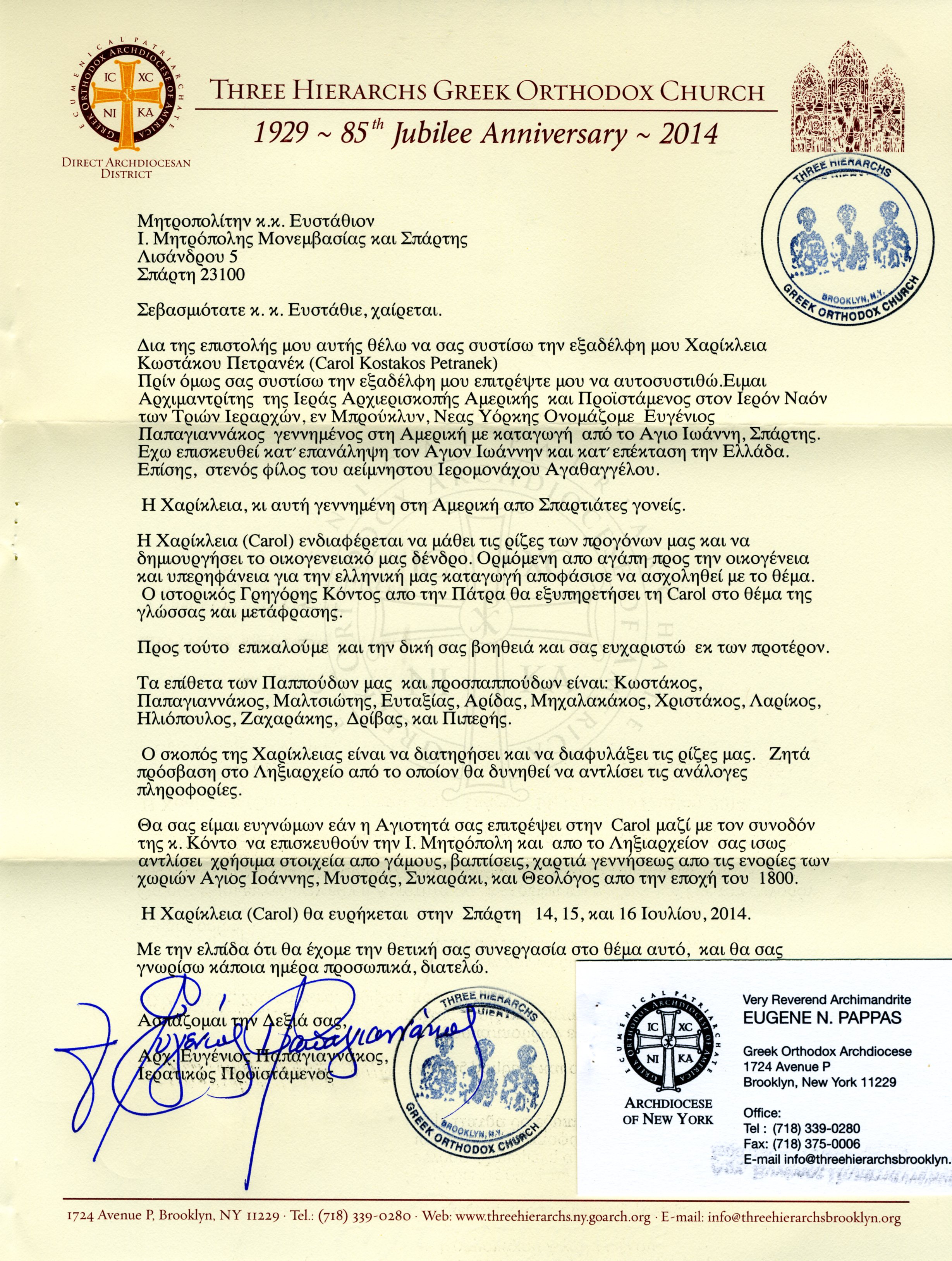
I had spent months preparing for this research trip, and I was anxious to visit the Archives and the Mitropolis of the Greek Orthodox Church with my friend, Gregory Kontos. We had decided in advance that our first stop would be the Mitropolis to search marriage and other church records. Thinking ahead, I had asked Father Eugene Pappas, a “cousin” on my mother’s line (we’re still trying to pinpoint our common ancestor) to write a letter to the Bishop of Sparta, asking permission for Gregory and me to conduct research at the Mitropolis at a specific date and time. In addition, Gregory’s father had called the Bishop who had known Gregory’s grandfather.

Letter from Father Eugene to the Bishop of Sparta, requesting permission for Gregory and me to research

Letter from Father Eugene to the Bishop of Sparta, requesting permission for Gregory and me to research

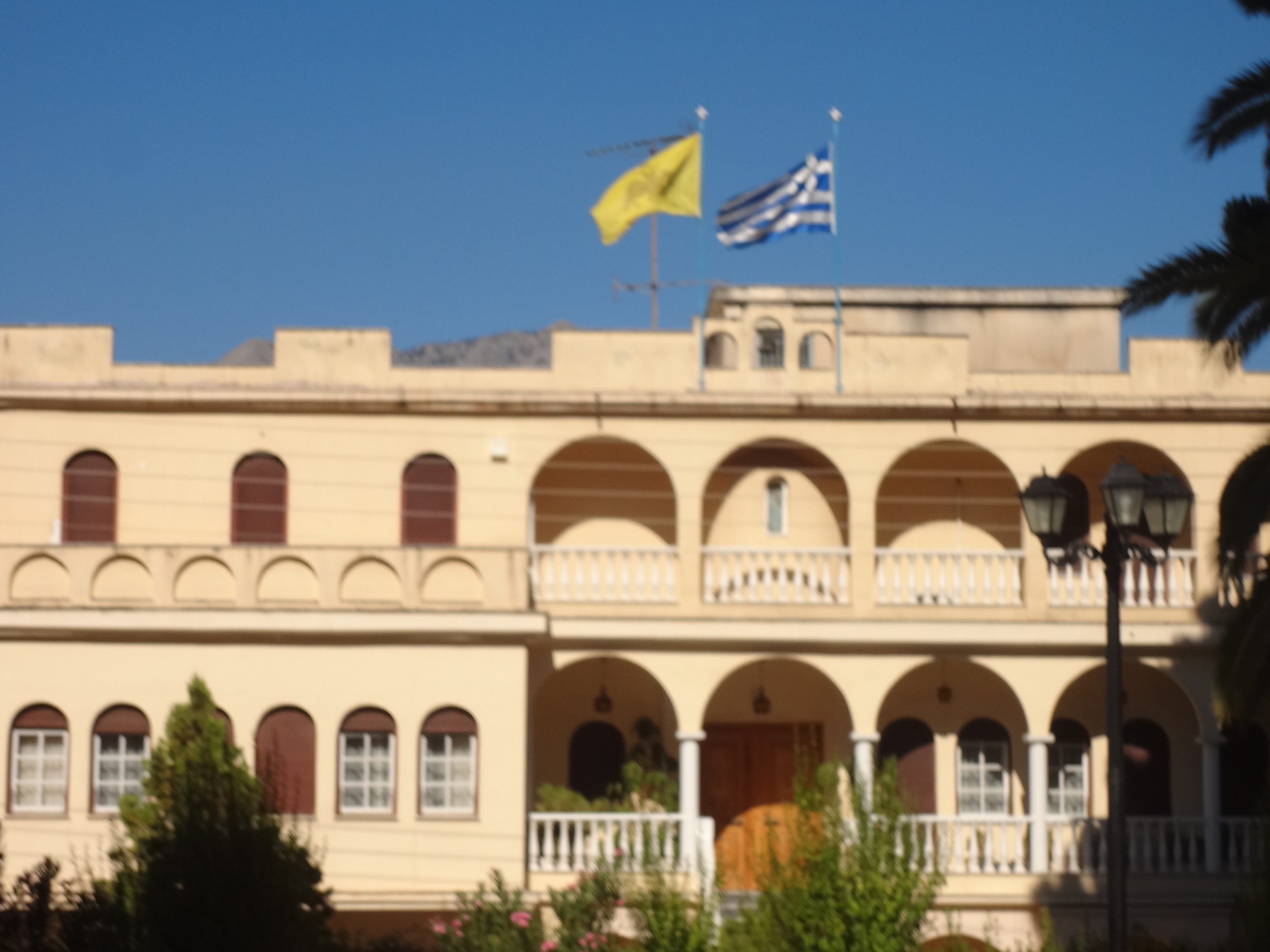
The groundwork was laid. Early on a Monday morning, Gregory and I approached this stately and beautiful building that rises majestically in the midst of the busy city.

The Mitropolis of the Greek Orthodox Church, Sparta

The Mitropolis of the Greek Orthodox Church, Sparta

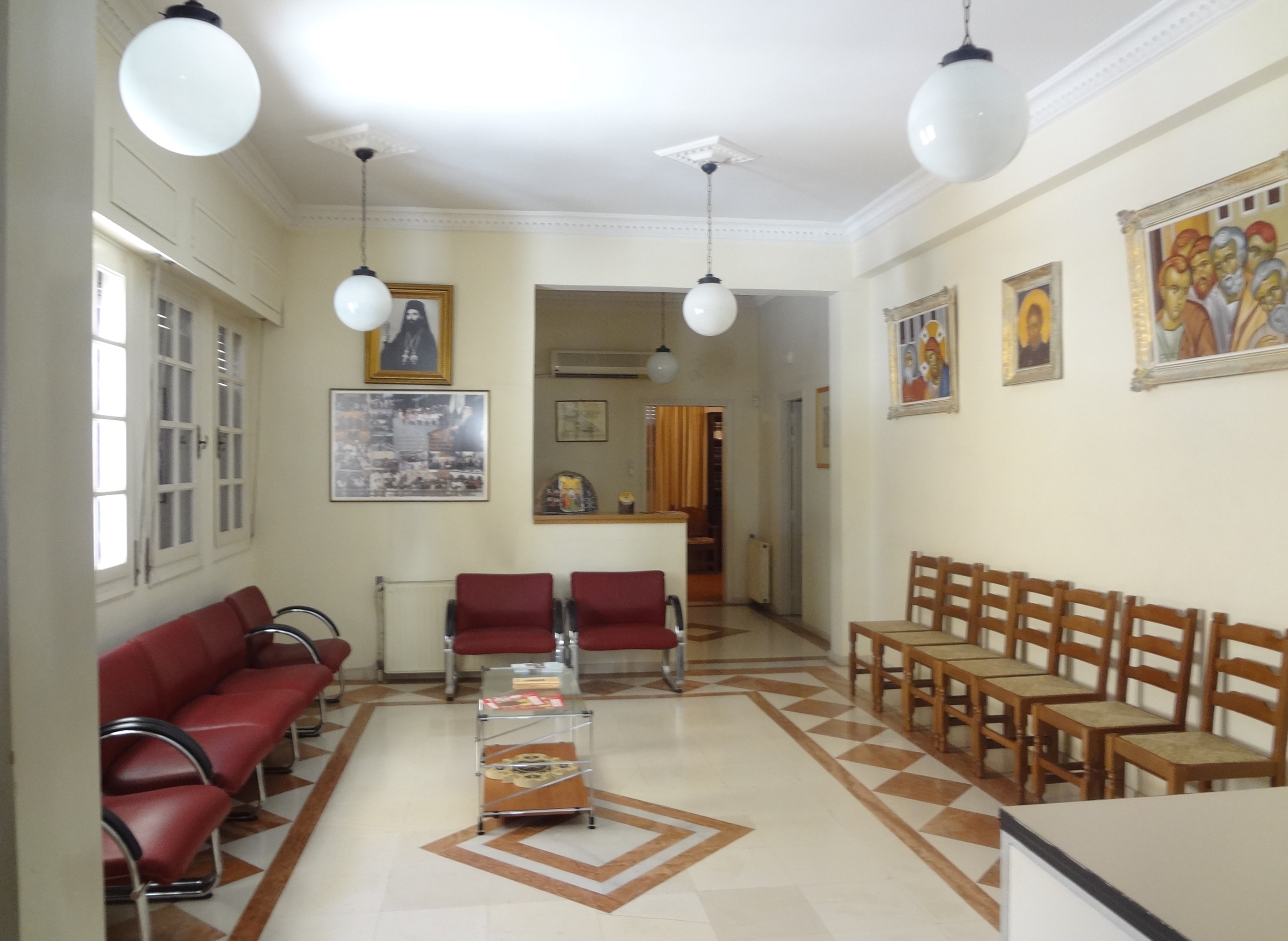
It is one thing to think about doing research in a religious institution, but it is quite another to actually be there. Gregory and I felt somewhat intimidated as we knocked on the door, but that escalated to total intimidation when it was answered by a somber faced priest with a long beard and piercing black eyes. His floor-length black robe and round cap added to our anxiety level. This was not like walking into the local library and asking for help! Thank goodness Gregory was with me! He explained in Greek who we were, and immediately the priest smiled and invited us in. Our letter to the Bishop had been received and we were expected. With great relief, we followed the priest into a beautiful waiting room ringed with icons, paintings and mosaics.

Waiting room of the Mitropolis, Sparta

Waiting room of the Mitropolis, Sparta

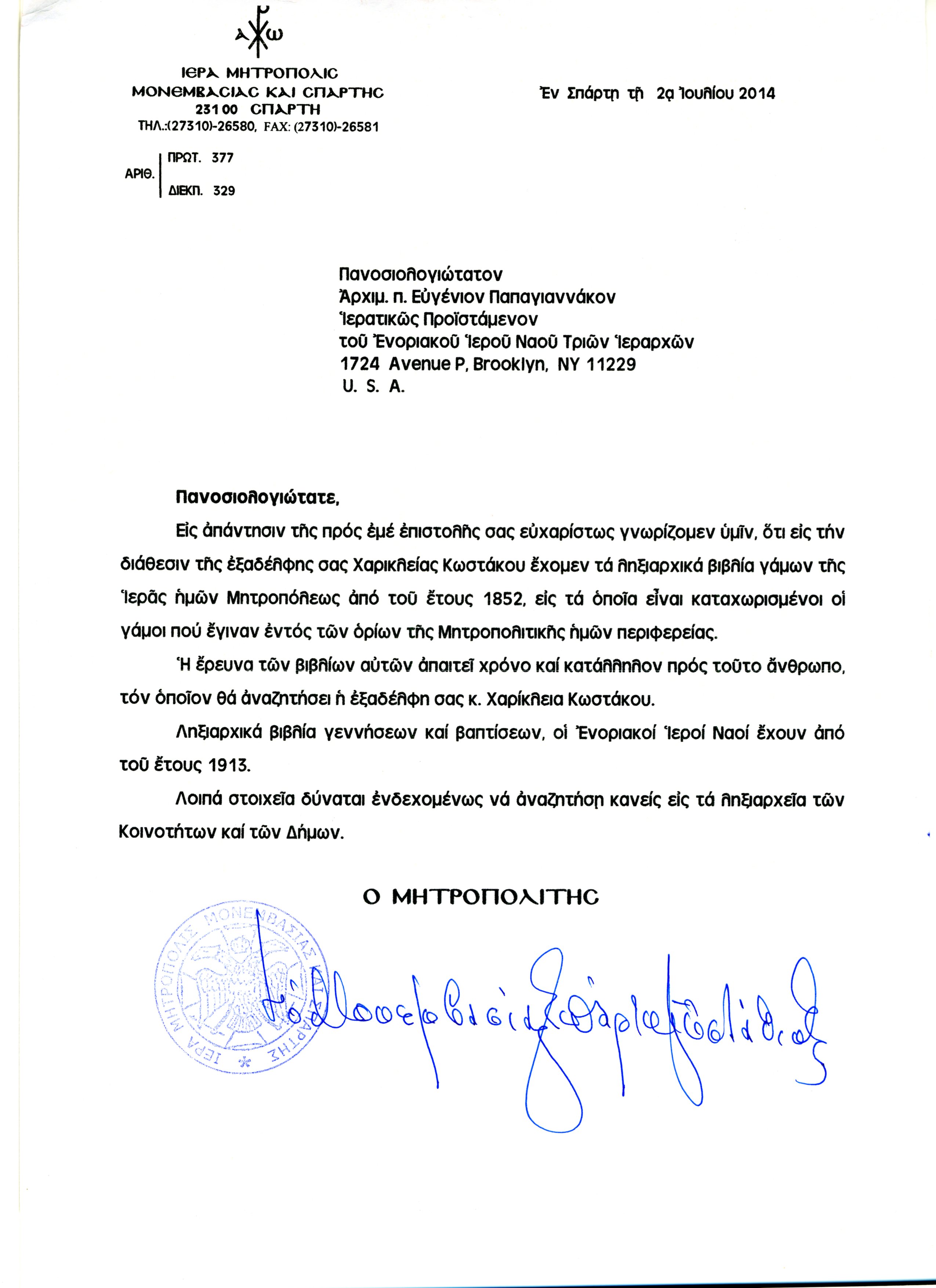
Shortly, we were cordially greeted by a man who told us that the Bishop had received Father Eugene’s letter and that we were welcome to review the records. He handed us the Bishop’s written response. It was both exciting and unsettling to have this document — just think, the Bishop now knows my name!

Letter from Bishop of Sparta-permission to view records 001

Letter from Bishop of Sparta giving us permission to view records

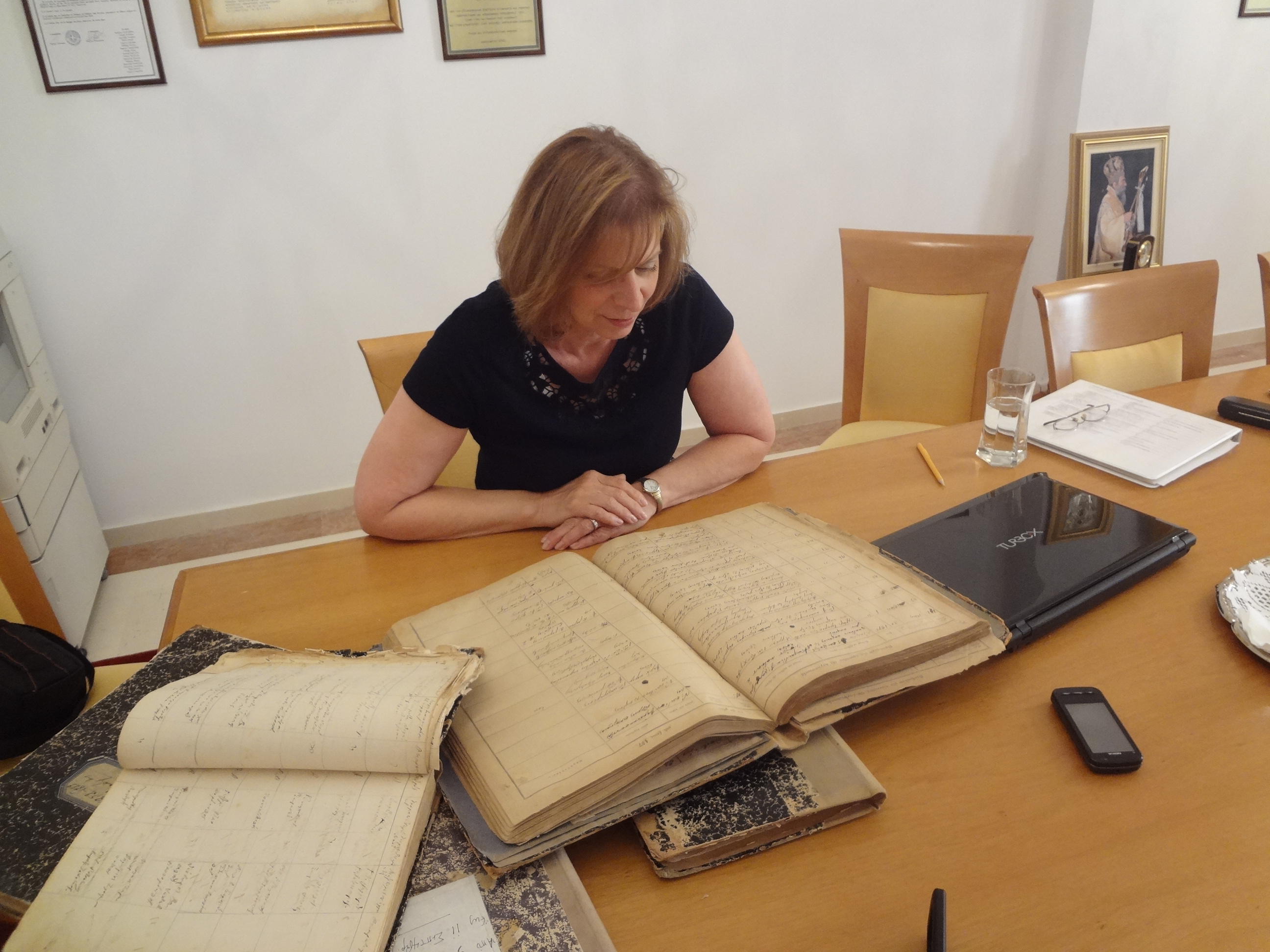
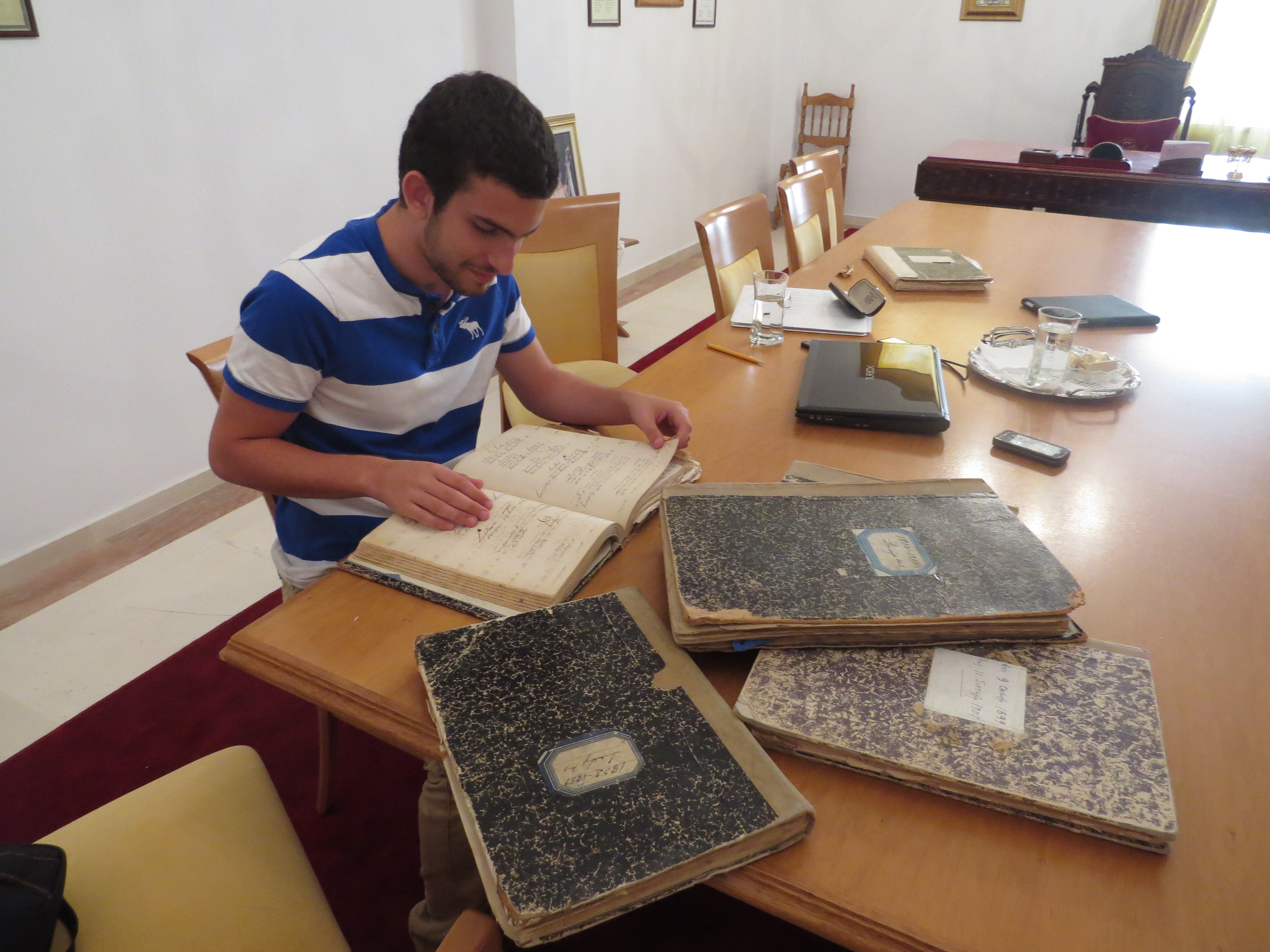
We were invited into a spacious, comfortable room with a large conference table. Our host brought us a plate of chocolates and water. He asked which books we wanted to review, and graciously brought us any that we asked for. The Mitropolis has books of marriage records, but not baptismal or death — those are kept by the local churches. Although I work with historical documents at the National Archives and the Maryland Archives, I was still awed to see these precious registers. Turning their fragile pages, I wished with all my heart that these records could be made available to the thousands of people who are seeking to their Spartan roots.

Mitropolis (4 Carol)

I wished I could have read these records! The old handwriting was just too difficult for me.

As hard as I tried, I was extremely disappointed that I could not read the old handwriting. I was occasionally able to decipher first names but the rest of the script was beyond my limited abilities. Realizing quickly that I would be of no use to Gregory, we came up with a plan. He would read the records and when he came to one I needed, I would take the digital photo. I gave him the names and approximate marriage dates for my great-grandparents. Because just a few first names were used in the late 1800’s (mostly the names of saints for males and a derivative for females) they were easy to recognize. Gregory found it was quicker to scan the pages by looking for first names.

Gregory finds the marriage record of my great-great grandparents, Panagiotis Nikolaos Papagiannakos and Aikaterini Eliopoulos.

Gregory finds the marriage record of my great-great grandparents.

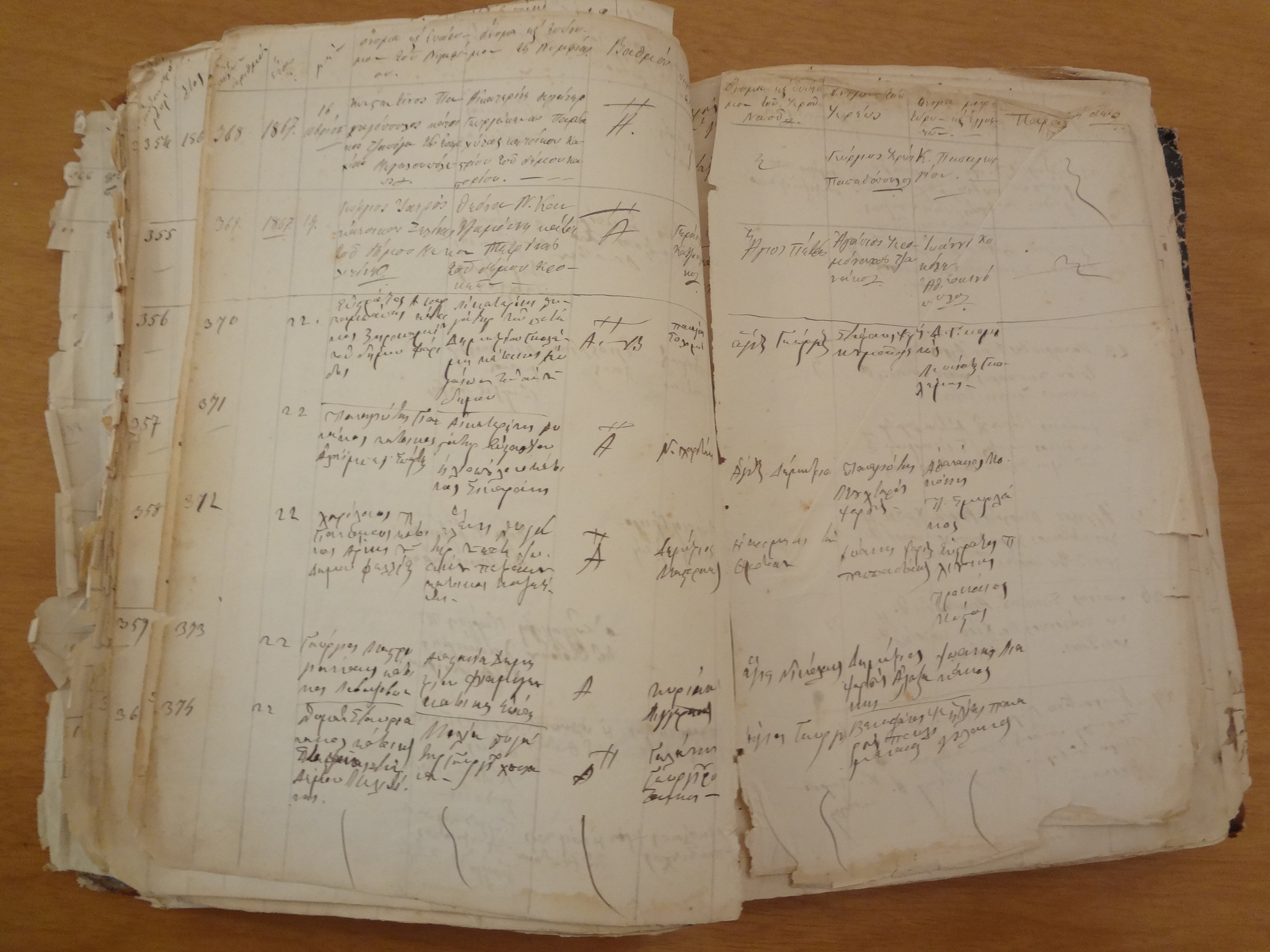
I was thrilled when he found the marriage record for my great grandparents, Panagiotis Nikolaos Papagiannakos and Aikaterini Eliopoulou, married December 22, 1867!

Line #371 – 1867, December 22. Panagiotis Giannakos, resident of Alaimbey, Sparta, married Aikaterini, daughter of Efstatios Eliopoulos of Sikaraki. Their first marriage. Agios Dimitrios Church. Priest: Panagiotis Mouhtaras. Witnesses: Athanasios Moukasis and P. Smyrlakos.

Line #371 – 1867, December 22. Panagiotis Giannakos, resident of Alaimbey, Sparta, married Aikaterini, daughter of Efstatios Eliopoulos of Sikaraki. Their first marriage. Agios Dimitrios Church. Priest: Panagiotis Mouhtaras. Witnesses: Athanasios Moukasis and P. Smyrlakos.

As you can see, the condition of these old registers is heartbreaking. The pages are crumbling and tattered. It truly frightens me to think that, without digital preservation,  the priceless information contained therein will be lost to future generations.

As we perused the registers, I concluded that they must be copies of originals because the same ink and handwriting would be found on several pages, then it would change. I wondered if the Mitropolis received records from the churches and then transcribed the information. These marriage registers listed the date of the marriage, name of groom, name of bride, occasionally the bride’s father’s name, the names of witnesses and the name of the priest. There was a column for notes, but it was usually blank. I also wondered if the original church records had more information, such as the names of the parents.

The books are kept chronologically by year and the data is not sorted by village. This is both good and bad:  good because if you don’t know the exact village of your ancestor, you can browse chronologically and look for your surnames; bad because if you do know the village but you’re not sure of the year, you have to read pages and pages of names until you find your ancestor.

Occasionally, a priest would stop in and ask how our work was going. When he saw the excitement in my face and voice as I said in my broken Greek that Gregory had found the marriage record for my great-grandparents, a smile crossed his face. After four hours, Gregory had found a few records with my surnames. Because we could not search a specific village, we realized that it would take many hours (perhaps days) to look through all the registers. We decided to leave, thanking our gracious guests for their help and cordiality.

I left with a deep appreciation for the kindness and respect that we were granted. The clergy allowed us to enter their hallowed building and trusted us with their books and records. I will be ever grateful to them.

Next… on to the Archives!