Two Marriages, or One?

What are the chances that there are two men named Ioannis Konstantinos Laliotis living in Magoula, both of whom married women named Georgitsa Giannakopooulos (father Paraskevas) living in Theologos? Although this seems improbable, the documents should answer the question. But in this case, it wasn’t that easy.

Let’s dig in.

In the Metropolis of Sparta Marriage Index Books, we find that a marriage license was issued on June 28,1898: Entry #237, Ioannis K. Laliotis of Magoula, Sparta; his first marriage (A) & Georgitsa Par. N. Giannakopoulos of Theologos, Sellasia; her first marriage (A).

Metropolis of Sparta Marriage Index Book 1894-1899; Page: 150; Year:1898, Entries: 234-246
Available on MyHeritage at this link.

There is additional documentation in the form of the priest’s letter to the bishop, requesting permission for the marriage. In this document, we see the groom was age 22 and the bride was age 19.

1898 Priest’s letter requesting permission for marriage; same URL as above

In books where both the license date and the marriage date are given, there is usually just a one or two day difference between the date the license was issued and the date of the marriage. In this case, there is no marriage date given. Possible reasons: (1) early books do not have a column for a marriage date to be written; (2) the bishop’s letter agreeing to the marriage, and the priest’s response giving the date of the ceremony have not survived; (3) the marriage never took place. In this last scenario, it is quite unusual for a license to be issued and a marriage not to occur.

Let’s look at the second set of documents. In the Metropolis of Sparta Marriage Index Books, we find that a marriage license was issued on April 20, 1900; Entry #105, Ioannis Laliotis of Magoula, Sparta, (no father given); his first marriage (A) & Georgitsa Par. Giannakopoulou of Theologos, Sellasia; her first marriage (A).

Metropolis of Sparta, Marriage Index Book: Sparta, Oct. 1899-Sept. 1907;  Year: 1900, Entries: 85-108
Available on MyHeritage at this link.

There is additional documentation in the form of the priest’s letter to the bishop, requesting permission for the marriage. In this document, we see the groom was age 25 and the bride was age 22. HOWEVER, there is an indexing error in this record on MyHeritage: Giannakopoulou was transcribed as Giannopoulou.

Priest’s letter dated April 16, 1900, requesting permission for marriage; same URL as above

Looking at the “bare bones” information in these documents, we can easily discern that:

  • The 1898 index book entry gives Ioannis’ father’s initial (K), and a fuller description of Georgitsa’s father as Par. N. The 1900 index book entry does not give Ioannis’ father’s initial or the initial “N” for Georgitsa’s father. And, Giannakopoulou was transcribed incorrectly as Giannopoulou. Without their father’s names or initials, and with the transcription error, these could easily be two different couples.
  • The 1898 index book entry shows this is the first marriage for both the groom and the bride.
  • The 1898 priest’s letter gives the groom’s age as 22 and the bride’s age as 19.
  • The 1900 index book entry shows this is the first marriage for both the groom and the bride.
  • The 1900 priest’s letter gives the groom’s age as 25 and the bride’s age as 22.

Thus far, it appears that these are, indeed, two different couples. BUT, my suspicions were raised because the difference in ages corresponds to the difference in the two license dates; and I know the demographics of the families in these villages.

  • I have the Town Registers for both villages. In Magoula, there is only one Laliotis family and only one Ioannis, born 1876, who is the son of Konstantinos.
  • In Theologos, there are many Giannakopoulos families; however, there is only one Paraskevas Nikolaos Giannakopoulos and only one Georgitsa Par. N.
  • The Sparta Town Register, Family #245, recorded the family of Ioannis and Georgitsa, and provided the marriage date of April 20, 1900  in Theologos. There is no other Laliotis-Giannakopoulos family named.

So, how could there possibly be two marriages?

I believed the answer lay in the priest’s letters. I cannot read old Greek script so I asked Gregory Kontos of GreekAncestry.net to review them. He said that the the priest’s letter dated 1900 contains unusual language: “this will be the first (or the second) marriage for the couple.” That’s strange wording! Although a license was issued in 1898, that marriage did not occur. Greg gave possible scenarios such as: an issue with the dowry, or possible migration if the groom left the area temporarily, with the marriage postponed until he returned in 1900. Anything could have happened to delay the nuptials.

Analyzing this situation led me to several conclusions:

  1. A marriage license does not equate to a marriage occurring.
  2. The documents associated with the marriages are important! If you cannot read them, ask Greg at Greek Ancestry, or find someone who can decipher the handwriting.
  3. Even though I can’t read all the words in the handwritten document, I must study it anyway. When I saw the bride’s name indexed as “Giannopoulou,” I looked for the name in the document to verify the transcription. To me, it looked like “Giannakopoulou.” I was right!
  4. I must find, and correlate, any and all possible records that exist for a family. A Male Register records how many men of the same name lived in the village, and their years of birth. A Town Register provides the names of the father, mother, and children. If I have a marriage license, is the couple found in the Town Register? This depends on the timeframe of the marriage, as Town Registers were created in the mid-1950s in Sparta; however, there are many fathers and mothers born in the late 1800s that are listed.
  5. You have to know your village and its families. I knew there was only one Laliotis in Magoula, and that raised “red flags” when I found two licenses for Ioannis Konstantinos.

Expect the unexpected! That’s the challenge of research–especially in Greece.

A Signature, An Ancestor

Letter of Consent to Marriage of Giannoula P. Zarafonitis and Dimitrios Nikolaos Zacharakis, April 18, 1869 in Sklavochori (now Amykles), Lakonia, Greece

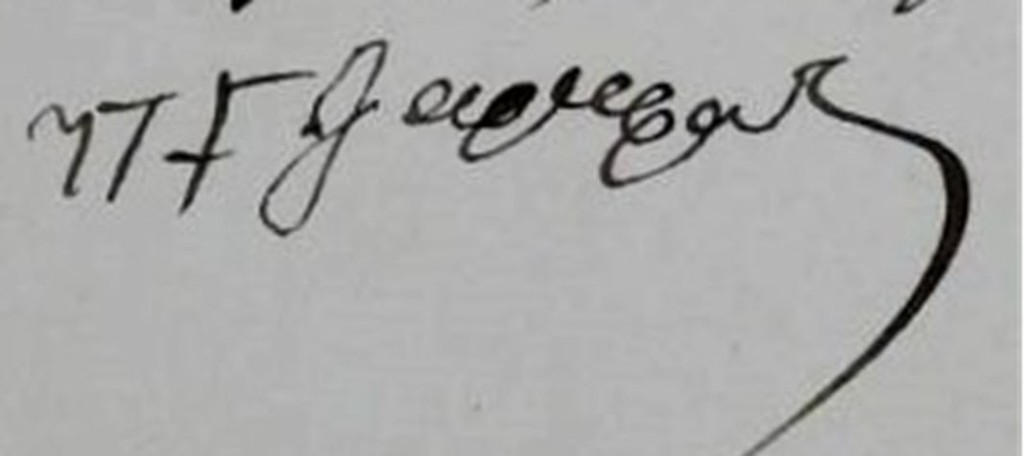
This letter granting permission for the marriage of my second great-grandparents, Giannoula Zarafonitis and Dimitrios N. Zacharakis, was signed by Giannoula’s father, Panagiotis G. Zarafonitis. By adding the “G” in his signature, Panagiotis (my third great-grandfather born 1821) provided the first initial of his father which took my lineage back one more generation to my fourth great-grandfather! In this area of Sparta and for my family, the initial “G” would most likely indicate the name of Georgios.

P. G. Zarafonitis

I am thrilled that this document –so meaningful to me–is one that I digitized with my own hands. During the summers of 2019, 2018 and 2017, I volunteered to work with Gregory Kontos of GreekAncestry.net to preserve, through the digitization process, marriage books and documents at the Metropolis of Sparta for the years 1835-1935.

It is incredibly emotional for me to see the signature of my third great-grandfather, Panagiotis, and to know that through my work, his handwriting and mark of mortality has been saved and is now viewable by his descendants. And I am especially grateful to him for choosing to include that most important initial of G.

Translation of marriage letter*:

Metropolis of Sparta and Monemvasia
Marrriage #89
The consent of the parents and other relatives of the future groom and bride, Dimitriou Zacharakis of the village, Theologos of Dimos Sellasias, and Giannoula daughter of Panagiotou Zarafonitou of the Dimos Sparta and village of Sklavochori, affirming that there is no kinship between the future couple nor any other impediment for them to join in matrimony, both for the first time, with the signature of two guarantors and two witnesses.

In Sklavochori on 18 April 1869

Signatures, left side:
Relatives of the groom:
N. Papastratis
Priest, S. Dimitropoulos
For the bride:
P. G. Zarafonitis

Signatures, right side:
Guarantors:
P. Anagnostakos
P. Iliopoulos
Witnesses:
M. Michalalopoulos
Ioannis Chatzikos

________
*Translation by Gregory Kontos, GreekAncestry.net

Beyond the Basics: Parish Voter Lists

The Orthodox Church is the state religion in Greece and, but for few exceptions, it is the faith of the people. Its records are kept in village churches, priests’ homes, monasteries and Metropolis (archdiocese) offices. This “covid summer” sadly put a halt to my digitization work in Sparta, but my colleague, Gregory Kontos of GreekAncestry, headed there in June to digitize yet another collection of church records, Parish Voter Lists of 100 Sparta villages.

Gregory’s detailed post about this collection explains that prior to 1967 when priests became state employees, each village was responsible for finding a priest for its church and paying his salary. Those eligible to vote were the heads of households–either men or widows–and a list of their names and ages was compiled. This specific collection spans the early to mid-1900’s and information includes:

  • name of head of household
  • father’s name
  • age
  • village
  • a column for notes

If there is a collection for your village (a list is at the end of this post), you are in luck! This name-indexed, online collection will help you find your ancestor in a specific village at a specific year, and provide his age and father’s name. This information is mandatory to access records such as Male Registers and Dimitologion/Town Registers from Archives and Town Halls, whether you go in person or write a letter.

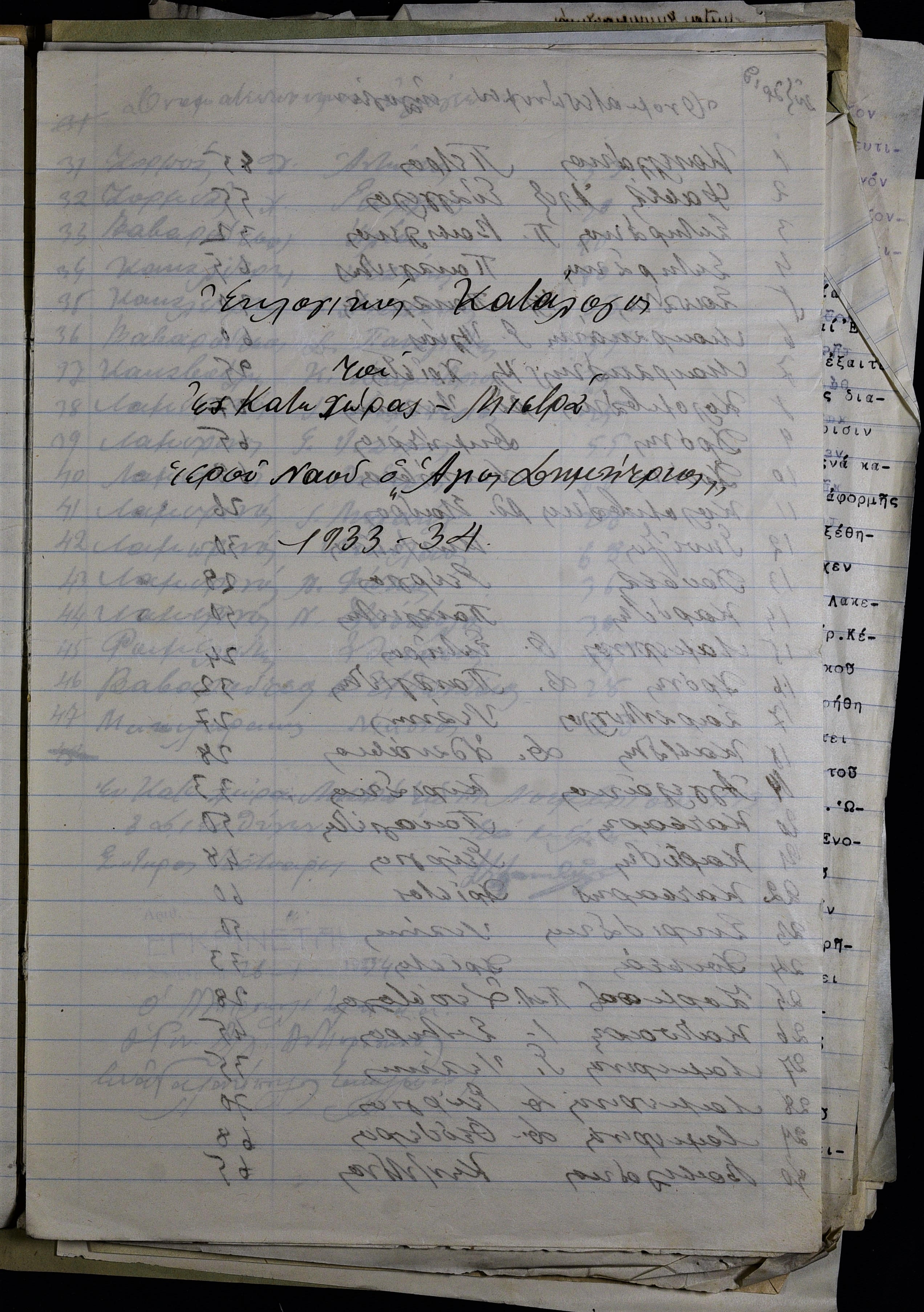
This image is the cover page of the 1933-34 Parish Voter List for Kato Chora, Mystras. It reads:  Eκλογικός Κατάλογος ((Electoral Catalog) Κάτω Χώρας-Μιστρά (Kato Chora-Mystra) Ίερου (Priest) Ναου ό Άγιος Δημήτριος (Temple of Agios Dimitrios), 1933-34.

(Click on any image to enlarge it)

Kato Chora, 1933 Parish Voter List, cover page

This is a page from the Kato Chora Parish Voter List. First column is the number of the voter, second column is voter’s surname and given name, third column is his age. Translation of line 1: Kanellakos, Petros age 85.

Kato Hora Parish Voter List, 1933

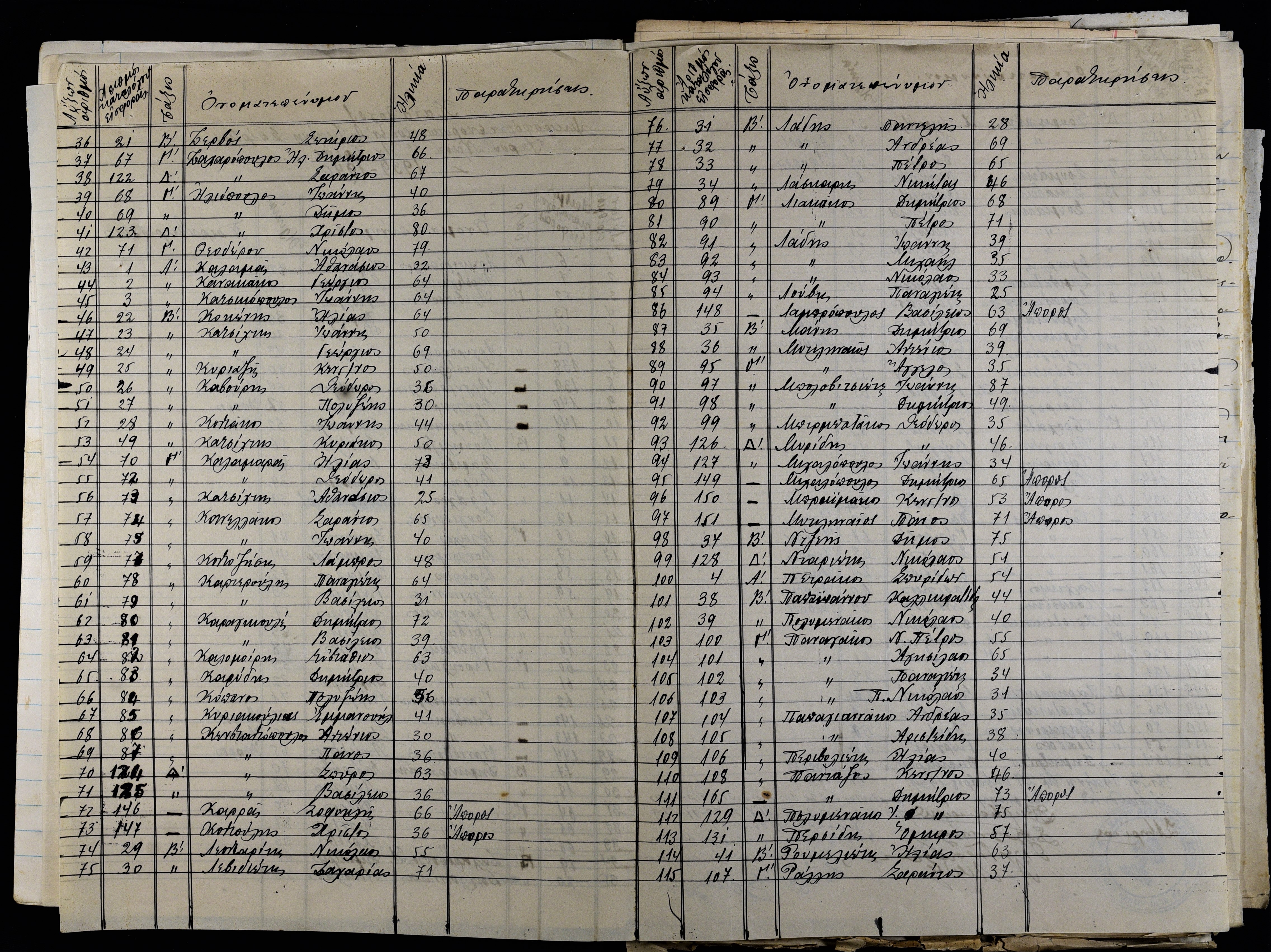
The page below is a 1939 Parish Voter List from Agios Ioannis, Sparta. It has two additional columns because it is a combination voter list and contribution list. Column one is the voter number, column two is the voter’s serial number in the contribution list,  column three is the grade/level of donation given, column four is the voter’s surname and given name, column five is notes.

Translation of line1:
Number 36, contributor number 21, contribution level B, contributor: Zervos, Sotirios, age 48.

1939 Parish Voter List, Agios Ioannis, Sparta

It is fascinating to look at the contribution levels of various families. This page shows four levels:  Α, Β, Γ, Δ (A, B, C, D). Those who could not donate have a horizontal line in the contribution level column, and are marked άωπρος (destitute) in the notes column. For example, see lines 72 and 73 on the left side, and several on the right side.

Important notes about these records:

  1. Whenever a new priest was needed, the village compiled a Voter List. Those which changed priests several times have a list for each election. Be sure to get all lists for your village. Look at the years and compare the names and ages to see who is in the village for each year.
  2. Many villages have undergone name changes between 1913 and today. The villages are listed by their names at the time the Voter List was created, NOT today’s name.  A quick search on Wikipedia reveals that 827 villages were renamed in the Peloponnese between 1913-1966, and that does not include additional changes made since then. Use the website Πανδέκτης to find the old and new village names; or, contact GreekAncestry.net.
  3.  When you research the old and new village names, you will learn such interesting history. For example, Κοντεβιάνικα (Kontevianika) which is the village name in the records, is now Άσωπος (Asopos). The first settlers of that area were the Conte family who originated in the village of Viani, Crete–thus,they named the settlement Kontevianika after themselves.
  4. To research old village names, copy the village name in Greek (as it is written below) and paste it into a search engine. A webpage will come up in Greek, then use Google translate to turn the page into English. In the example of Kontevianika, one “hit” was the website of the local government of Monemvasia (the village region) which provided the story of the naming of the village.
  5. Another example: I put the name Κουρτσούνα (Kourtsouna) in Google. The search went to the EETAA.gr website where the history of the village, from 1835 to present, was given as taken from notices in the ΦΕΚ (Government Gazette). It was renamed Βασιλική (Vasiliki) in 1955. That’s a recent change, so if you have cousins today living in Vasiliki, but your grandparents or great-grandparents came from Kourtsouna, the family remained in the same village.

As with any new record collection, there is so much to explore in these Parish Voter Lists. The list can be searched by name or village, in English or Greek, at the GreekAncestry website. If you search by village, you will get a list of all the names in that village in all collections current on the website.

This is a list of the villages and the years as found on GreekAncestry here.

Metropolis of Sparta, Parish Voter Lists by Village & Year
Ag. Kyriaki – Αγ. Κυριακή – 1913
Ag. Andreas – Άγ. Ανδρέας – 1935
Ag. Dimitrios Monemvasias – Άγ. Δημήτριος Μονεμβασίας – 1934
Ag. Dimitrios Zarakos – Άγ. Δημήτριος Ζάρακος – 1934
Ag. Ioannis – Άγ. Ιωάννης – 1934, 1939-40
Ag. Ioannis Theologos – Άγ. Ιωάννης Θεολόγος – 1932-33
Ag. Nikolaos – Άγ. Νικόλαος – 1934
Ag. Nikolaos Monemvasias – Άγ. Νικόλαος Μονεμβασίας – 1930
Ag. Nikolaos Voion – Άγ. Νικόλαος Βοιών – 1934-35
Ag. Vasileios – Άγ. Βασίλειος – 1927, 1933
Agoriani – Αγόριανη – 1936, 1938
Agrapidoula – Αγραπιδούλα – 1935
Agrianoi – Αγριάνοι – 1932-33
Alampei – Αλάμπεη – 1928
Alampei [Alaimpei] – Αλάμπεη [Αλαΐμπεη] – 1926, 1934
Alepochori – Αλεποχώρι – 1934-35
Alevrou – Αλευρού – 1934-35
Anavryti – Αναβρυτή – 1932-33, 1935
Angelona – Αγγελώνα – 1934-35
Anogeia – Ανώγεια – 1935
Apidea (Apidia) – Απηδέα (Απηδιά) – 1934-35
Apidia – Απηδιά – 1920
Arachova – Αράχωβα – 1915
Asteri (Vriniko) – Αστέρι (Βρίνικο) – 1920, 1933, 1936
Charakas – Χάρακας – 1915, 1934-35
Chatziaga – Χατζήαγα – 1912
Chrysafa – Χρύσαφα – 1934-35
Dafni – Δαφνί – 1931, 1933, 1938
Daimonia – Δαιμονιά – 1932-33
Elaia (Elia) – Ελαία (Ελιά) – 1932
Elia (Elaia) – Ελιά (Ελαία) – 1916
Elika – Ελίκα – 1926-29, 1932-33
Faraklo – Φαρακλό – 1927, 1930, 1935
Filisi – Φιλήσι – 1926, 1928-29
Foiniki – Φοινίκι – 1925-27, 1929, 1936
Foutia – Φούτια – 1933-34, 1936
Fregkra – Φρέγκρα – 1936
Georgitsi – Γεωργίτσι – 1926, 1929, 1934-35
Geraki – Γεράκι – 1926, 1929, 1935
Gkoritsa – Γκοριτσά – 1934-35
Godena – Γοδένα – 1939
Goranoi – Γοράνοι – 1934-35
Gounari (Gounari) – Γούναρι (Γούναρη) – 1935
Gouves – Γούβες – 1927-29, 1933-35
Grammousa – Γράμμουσα – 1925, 1933, 1935
Ierakas – Ιέρακας – 1932-33
Ierax (Ierakas) – Ιέραξ (Ιέρακας) – 1927
Kalogonia – Καλογωνιά – 1925-26, 1930, 1934-36
Kalyvia Sellasias – Καλύβια Σελλασίας – 1934
Kamaria – Καμάρια – 1935
Kaminia – Καμίνια – 1934-35
Kampos – Κάμπος – 1925,1934, 1936
Karitsa – Καρίτσα – 1925
Karotsa – Καρότσα – 1933
Karyes – Καρυές – 1934-35
Kastorio (Kastania) – Καστόριο (Καστανιά) – 1934-35, 1940
Katavothra (Metamorfosi) – Καταβόθρα (Μεταμόρφωση) – 1923-29, 1934
Kato Chora Mystra – Κάτω Χώρα Μυστρά – 1933
Katsarou – Κατσαρού – 1939
Katsoulaiika – Κατσουλαίικα – 1934-35
Kefalas – Κεφαλάς – 1929, 1934-35
Kladas – Κλαδάς – 1929, 1930, 1932-33, 1935
Kokkinorachi (Tsouni) – Κοκκινόραχη (Τσούνι) – 1926, 1929, 1935
Koniditsa – Κονιδίτσα – 1928-29, 1933-35
Kontevianika – Κοντεβιάνικα – 1924-25, 1929, 1934-35
Kotsatina – Κοτσατίνα – 1922
Koulentia (Elliniko) – Κουλέντια (Ελληνικό) – 1933, 1934, 1936
Kounoupia – Κουνουπιά – 1933, 1935
Koupia – Κουπιά – 1927-29
Kourtsouna (Vasiliki) – Κουρτσούνα (Βασιλική) – 19335, 1935-36
Kremasti – Κρεμαστή – 1915, 1933
Krokees – Κροκεές – 1934-35
Kyparissi – Κυπαρίσσι – 1931
Lachi – Λάχι – 1924, 1926-28
Lagia – Λάγια – 1917
Lagio – Λάγιο – 1936
Leimonas – Λεήμονας – 1919
Magoula – Μαγούλα – 1927-28
Mari – Μαρί – 1933
Molaoi – Μολάοι – 1927, 1929
Monemvasia – Μονεμβασία – 1913, 1915,1927, 1929, 1933
Mousga – Μούσγα – 1935
Myrtia – Μυρτιά – 1929-30
Mystras – Μυστράς – 1916
Niata – Νιάτα – 1924, 1929
Nomia – Νόμια – 1912
Pakia – Πάκια – 1916
Palaiochori – Παλαιοχώρι – 1934-35
Panigyristra – Πανηγυρίστρα – 1929
Pantanassa Monemvasias – Παντάνασσα Μονεμβασίας – 1928
Pardali – Παρδάλι – 1932
Parori [Parori] – Παρόρι [Παρώρι] – 1929-30
Pellana (Kalyvia) – Πελλάνα (Καλύβια) – 1934, 1936
Platana – Πλατάνα – 1921
Platanaki – Πλατανάκι – 1933
Polovitsa – Πολοβίτσα – 1928-29
Pritsa (Palaiovrysi) – Πρίτσα (Παλαιόβρυση) – 1915
Pyri – Πυρί – 1931
Sellasia – Σελλασία – 1935
Skala – Σκάλα – 1940
Sklavochori – Σκλαβοχώρι – 1939
Skoura – Σκούρα – 1912
Sparti – Σπάρτη – 1934
Syrkia – Σύρκια – 1912
Tarapsa – Τάραψα – 1917
Tsasi – Τσάσι – 1926, 1928-29, 1935
Varsiniko – Βαρσίνικο – 1932-33
Varsova – Βάρσοβα – 1934-35
Vassaras – Βασσαράς – 1932, 1935
Velanidia Voion – Βελανίδια Βοιών – 1932-34
Vergadeika (Bergadeika) – Βεργαδέικα (Μπεργαδέικα) – 1927, 1933
Vlachiotis – Βλαχιώτης – 1921, 1925, 1934-35
Vordonia (Vordonia) – Βορδώνια (Βορδόνια) – 1932, 1934, 1936
Voutianoi – Βουτιάνοι – 1925
Vresthena – Βρέσθενα – 1935
Vrontamas – Βρονταμάς – 1933-35
Vroulias (Sellasia) – Βρουλιάς (Σελλασία) – 1924-25
Xirokampi – Ξηροκάμπι – 1935
Zagana – Ζαγάνα – 1921
Zarafona – Ζαραφώνα – 1913, 1915, 1933
Zelina (Melitini) – Ζελίνα (Μελιτίνη) – 1933, 1939
Zoupaina (Ag. Anargyroi) – Ζούπαινα (Άγ. Ανάργυροι) – 1932-33