Visiting the Villages: Koumousta

Going back in my family research always leads to the mountains. The Spartan villages of my four grandparents, Agios Ioannis and Mystras, were nestled in the valley beneath the Taygetos range. This was the agricultural center of the region—fertile plains filled with citrus and olive trees, fruit and vegetable gardens. As I wrote previously, villages in the valleys became repopulated after the Ottomans were expelled in 1830 and people descended from the mountain tops to start a new life. Among them were my grandparents’ ancestors.

Prior to the Revolution of 1821, Koumousta was the populated village; Xirokampi was a small settlement with just a few families. In the book, Koumousta of Lacedaimonos, Theodore Katsoulakos and Panagiotis X. Stoumbos meticulously describe life in Koumousta prior to the residents’ leaving. Among them was the Christakos family, ancestors of my paternal great-grandmother, Politimi Christakos, who married Andreas Kostakos. Her father, Nikolaos, and her grandfather, Dimitrios, are named in this book. Finding this information was an enormous and important breakthrough in my research.

Koumousta of Lakedaimonos, Theodore S. Katsoulakos and Panagiotis X. Stoumbos, published 2012

The book describes the villagers: “Koumousta, from old times and until its desertion, was a very hospitable village. Everyone of Koumousta considered it an honor and pleasure to have someone under his roof. Work was stopped to settle the foreigners. Many people back then came to Koumousta from the plains and from surrounding villages. Relatives and friends were everywhere…Every Koumoustioti’s door was open to any foreigner that would knock on his door. The man who asked for hospitality was considered a “holy” [highly respected] person who should be treated with all arrangements of good relations. This treatment was highly characteristic and very good. Every good thing that there was in the house was offered with love and selflessness, and above all, food: cheese, bread, pork, eggs were the necessary and basic foods. Women put their hands deep into the barrels because there was where the best portions of pork meat lay after it was boiled. But it was not only the visitor that had to be treated well; even his mule had to be treated well. They took care to give the mule water and food, like their own animals.”1

This intrigued me. People would climb a steep mule trail to visit a village at the crest of a mountain? The villagers were known for their hospitality, despite living in an isolated area? I knew that Koumousta was situated on a high peak and that its access road was narrow and treacherous. But my ancestors were those described in the book, and I just had to go!

Leaving Xirokampi on the road to Koumousta

The journey seemed inoccuous at first. The road was paved, and a low stone wall provided a comforting border between the road and the ravine below. I felt reassured. But after a mile, the wall disappeared and the ravine’s treetops lined the side of the road. They were my guardrails throughout the four mile ascent.

The treetops on the left appear to be bushes, indicating the depth of the ravine.
The face of this mountain is particularly scary!

Partway up the mountain, I saw what appeared to be a lake on the right side of the road. But this is a man-made, rectangular basin. There are no structures adjacent to it, and I cannot imagine its purpose.

A pool of some type, constructed mid-mountain
The scenery is lovely, with bright spots of color accenting the rocks and greenery.

The road was extremely steep, and despite my growing fears, I had to keep my foot on the accelerator to keep the car moving upwards. Parts of the pavement were washed out, with evidence of small rockslides.

Seeing an isolated house, I wondered who would construct it mid-way up a mountain? It appeared to be abandoned, but at some point it was a home. How could one live so alone?

This house, although close to the road, was built in an isolated spot

The phrase, “are we there yet?” kept running through my mind. I knew that the closer I got to the top, the worse the road conditions would become. I felt relief when I came across this sign.

Koumousta 500 metres – almost there!

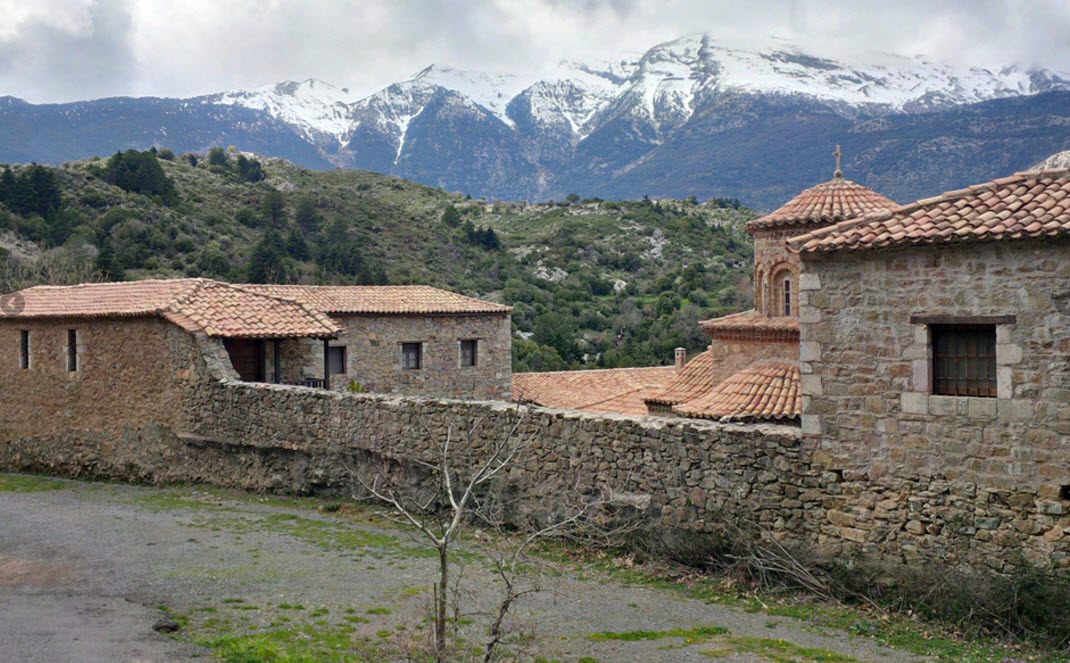
Rounding a curve, my breath stopped when I saw the village: perched on the mountains were beautiful stone houses with red tile roofs. This appeared to be a viable village; I had expected crumbling vestiges of bygone years.

Homes in beautiful condition, cut into the mountain

Driving onto the stone pavement of the plateia, I could not believe the scene before me. Koumousta was not a village in ruins. It was beautifully restored and utterly charming. I parked the car and in the town square; a black and white dog greeted and walked with me. The peace and beauty were almost magical.

The lovely plateia, impeccably clean and perfectly maintained
Pure mountain water gushes from the fountain and is channeled
The houses are traditional and charming. All appear to be renovated and in excellent condition.
One couple lives in Koumousta year-round; others come for holidays and vacations.
The inscription on the plaque mentions the restoration of the plateia in October 2000.

I can understand why my 3rd great-grandfather, Dimitrios, left and resettled in Xirokampi in the mid-1800s. I would bet, however, that if he were alive today, he would find a way to keep his mountain home. Although winter weather would make the road impassible and the cold intolerable (altitude of 2200 feet), this village remains a pristine oasis and a welcomed haven from contemporary life. Today, the village of Koumousta is also known as Pentavli.


1Koumousta of Lacedaimonos, page 213; translation by Giannis Michalakakos.

Solomos Family of Laconia

Author: Stratis A. Solomos

published in The Faris Newsletter, Issue 73, December 2020, pages 12-16

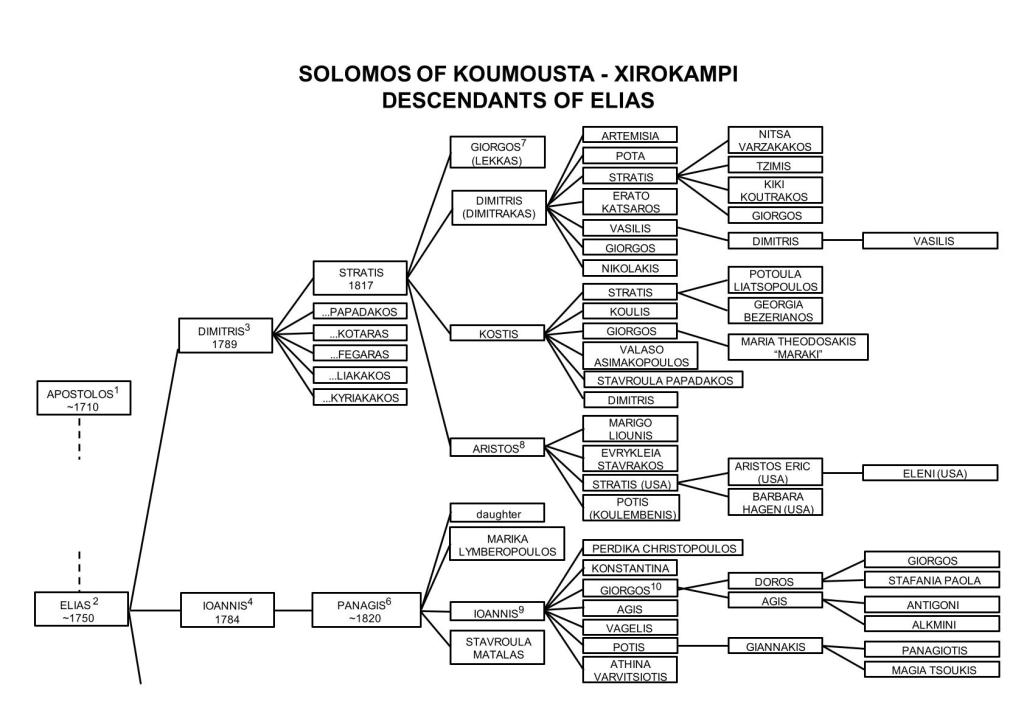
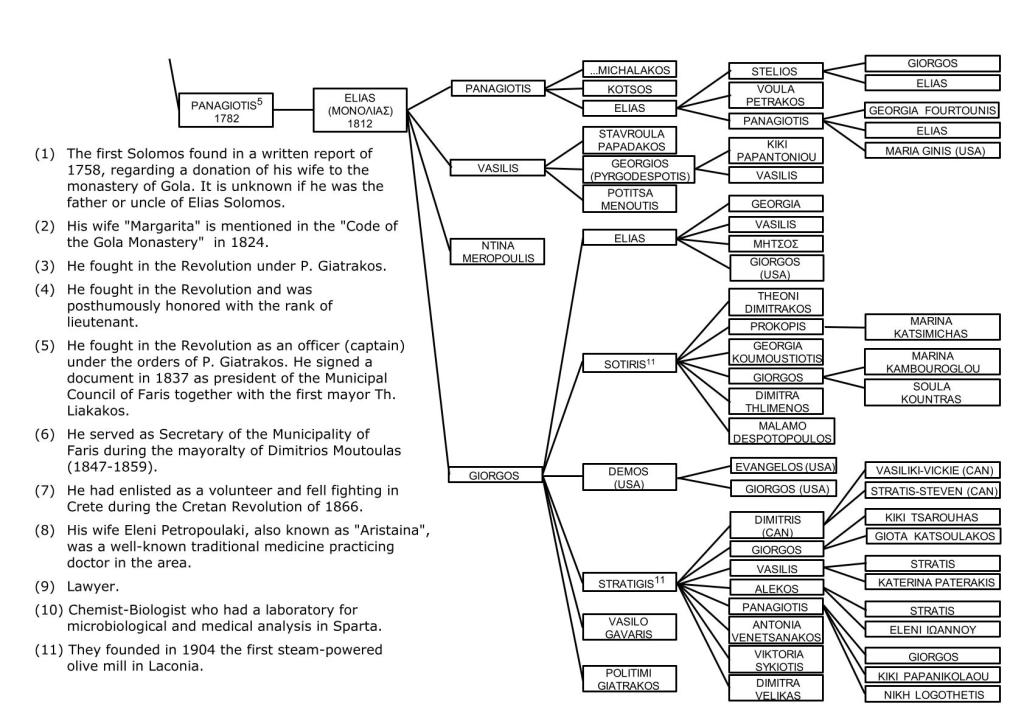
I am most pleased to receive permission from Stratis Solomos to share his genealogy of the Solomos Family of Koumousta and Xirokampi. Stratis wrote: “Last year I was asked by the chief editor [of the Faris newsletter] to write a genealogy on the Solomos family, one of the most important families of Koumousta-Xirokambi…For practical space reasons the family tree was confined to the generation of 1960-70.  By the same token, the few historical footnotes are limited to the older generations only.”

Publicizing and publishing our family history work is an unselfish and important act. It allows us to share what we learn with those who may not have the resources or abilities to conduct such research. They, too, want to know about their ancestors and connect with extended family worldwide. Thank you, Stratis, for your sharing your work with us and for providing this English translation.


The Solomos family of Laconia originates from Koumousta, a village in the Taygetos mountains, close to Sparta. In the 19th century, after the Greek War of independence, most family members moved gradually down to the flat land, to the newly founded village of Xirokampi. The origin of the Solomos family of Laconia is unclear and there is no oral tradition or myth related to the family history. In the 1950s-60s, the lawyer Georgios V. Solomos, known as “Pyrgodespotis” (Castle-Lord), was saying that he had done a bibliographic research that had allowed him to conclude that the family came from Crete in the middle of the 17th century, after the fall of Chandakas (Heraklion) in 1669 and its occupation by the Turks. More specifically, as it was narrated in the informal ‘kafenio’ gatherings, there were initially two brothers, one of whom stayed in Laconia and the other went to Zakynthos. The latter was the great-grandfather of the national poet of Greece Dionysios Solomos. Unfortunately Pyrgodespotis did not leave any written report and the above cannot be confirmed. His version may have been based only on various biographies of Dionysios Solomos.[1]

Nevertheless, the above hypothesis is not completely unfounded and can be based on the following arguments:

1) The family appears in the mountain village of Koumousta in the early 18th century, following the end of the Venetian domination over several Greek territories (and succeeded by the Ottomans).

2) It settles in an area where there are other well-known families, of established Venetian[2], Frankish and Byzantine origin. These families were living in the Laconia plains, but they moved to the mountains in 1715, when the Ottomans again conquered the Peloponnese.

3) More recent publications show that the great-grandfather of Dionysios Solomos, Nikolaos, did not go directly from Crete to Zakynthos, but to Kythira, where he married to Maria Durente[3], a woman from a “noble” family and with a large dowry. The Salamon-Solomos family, which is mentioned as important during the Venetian rule of Crete, had other members who settled in Kythira [4] and probably in the fertile Laconia, where the Venetians had provided them with arable land.

4) In addition, it was at this period that the Turks occupied Kythira for three years (1715-1718), for the island to be finally recaptured by the Venetians. It is possible that the move from Kythira to the neighboring Laconia happened at this time.

5) The wife of Elias Solomos of Koumousta (born around 1750) bears the name “Margarita”, which is not a usual name of Ottoman-occupied Greece. It is a “western” name mostly used in the Greek regions under Venetian rule.

Stratigis & Vasiliki Solomos,
courtesy of Stratis A. Solomos

The Solomos families of Xirokampi and Koumousta, which today number hundreds of descendants in many parts of the world, are divided into two branches which meet somewhere in the late 18th century.

The first and most numerous are the descendants of Elias Solomos. The other branch comprises the descendants of Georgakis Solomos and then Thanasis, who was nicknamed “Lales”, hence their identification as “Lalaioi” (pronounced “Lalei”). Because of this nickname there was a traditional rumor that this family branch came from “Lala” a village in northwestern Peloponnese. However, it is rather unlikely that part of the family, with the same rare surname, came to the isolated village of Koumousta from such a remote area, unless there were relatives with the already settled Solomos of Koumousta. Another rumor has it that one of them fought against the infamous Turcalbanian mercenaries “Lalaioi”.

The reconstruction of the two branches of the published genealogical tree is mainly based on earlier oral reports, but also on documented, written information from the book of Th. Katsoulakos and P. Stoumpos[5]. Some evidence was also found in a report of a court dispute of a certain Meropoulis or Myropoulis, against trespassers of his property[6]. Archival research done by the genealogy research company “”ΟΙ ΡΙΖΕΣ ” (THE ROOTS) [7] was also taken into account. Another source of information was the list of immigrants passed from Ellis Island[8], as several members of the family immigrated early to America, from 1896 to 1921. The internet site of the Ellis Island Foundation has provided precious information concerning marital status, name of spouse, fellow travelers, relatives left in Greece, relatives to be met in the US, previous travels and age. From the age declared we can we conclude the year of birth, although with caution, because they often deliberately changed their age depending on the immigration laws in force. Some of these Solomos came back; for those who remained, there is the indication (USA, CAN) next to their name in the tree.

It is expected that there will be shortcomings and mistakes, especially in the tree of “Lalaioi”, which was done with more recent and less credible present-day oral testimonies. Where there is doubt, this is stated in the footnotes and the parental relationship is drawn with dashed line – – – -. Also missing are members who died in infancy or childhood. A future digitization of the registry files of Xirokampi and additional genealogical surveys could substantially help to improve this two-branch tree.

Although there is still abundant material available on the recent family members, for practical space reasons the tree was confined to the generation of 1960-70. By the same token, the few historical footnotes are limited to the older generations only. The year of birth is only mentioned for the older ancestors. Where the year of birth could not be determined exactly, it was estimated and preceded by the symbol (~). The construction of a more complete family tree that could encompass current family data and include offspring of female members would require a greater research effort and special lnformation Technology tools.

Finally, I would like to thank for their substantial contribution:
1) George P. Solomos (Italy), who decades ago recorded his first family tree version of “Elias Solomos descendants branch” and now helped significantly in the historical research.
2) Doros G. Solomos (Italy), who years ago spent time and resources on additional research for the improvement of the above mentioned family tree.
3) Dimitris “Mitsos” Ath. Solomos (Xirokampi), Nikos El. Solomos (Kalamata) and Dimitra G. Solomos-Giangos (California USA) who helped making the first, integrated version of the genealogical tree of the “Lalaioi” branch.

Stratis A. Solomos
Geneva Switzerland stratis.solomos@bluewin.ch


[1] Ν. Τωμαδάκης: Οικογένειαι Salomon-Σολωμού εν Κρήτη, Επετηρίς Εταιρείας Βυζαντινών
Σπουδών, 1938, Έτος ΙΔ’, 163-181.
[2] Σ. Α. Σολωμός: Η ετυμολογία μια τοπικής λέξης και ήθη της Γαληνοτάτης Δημοκρατίας. Φάρις-Ξηροκάμπι, τεύχος 55, Δεκέμβριος 2011.
[3] Ελένη Χάρου: Μαρία Δουρέντε, η Κυθήρια πρόγονος του Διονύσιου Σολωμού, 27 Μαρ. 2016.
[4] Μπαλτά Ευαγγελία: Η οθωμανική απογραφή των Κυθήρων 1715, Ινστιτούτο Νεοελληνικών Ερευνών ΕΙΕ, Αθήνα 2009.
[5] Θ. Κατσουλάκου και Π. Στούμπου ‘η Κουμουστά της λακεδαίμονος’, 2012.
6] ΣΥΜΒΟΛΑΙΟΓΡΑΦΙΚΕΣ ΠΡΑΞΕΙΣ του «μνήμονος Λακεδαίμονος Κυρίου Γεωργίου
ΧΑΡΤΟΥΛΑΡΗ» 1833-1835.
[7] Γραφείο αρχειακών ερευνών «ΟΙ ΡΙΖΕΣ» ( http://www.oirizes.gr ) Άρης Πουλημενάκος,
[8] Ε. Α. Σολωμός: Μετανάστες των χωριών μας που πέρασαν από το Ellis Island. Φάρις-
Ξηροκάμπι (τεύχος 50, Δεκέμβριος 2009).

Koumousta: The Second Period of Ottoman Conquest 1715-1821

During Ottoman occupation, the region known as Koumousta[1] administratively belonged in the kaza  of Mystras. In each community, male adults elected one or two elders who managed the financial functions of the community, maintained the roads, tried to ease Turkish authority, and assumed other responsibilities. The elders came once a year to the capital of the kaza and elected their representatives (provincial elders) known as kazavatzis. The most well known elder of Mystras was Panagiotis Krevvatas. His will of 1819 bequeaths money to individuals and villages, including Koumousta to which he gave 750 and 200 grosia.

During the period of Ottoman conquest, Koumousta was known as Kato Riza. Generally, this included the villages south of Mystras between the east side of theTaygetos mountains and the Evrotas River. This area included a large section of plains, perfect for farming.

Evrotas River


In the early 1700’s, a series of disasters afflicted the region. The plague of 1719 decimated the population. An uncontrolled rise in food prices, especially wheat and grains, caused massive starvation and death. Crops failed, due to a lack of rain. In 1729, a great earthquake caused the demolition of many houses and the destruction of the roof of St. Konstandinos. Homes in Kato Chora and Plataniou were destroyed by rocks that fell on the roofs. As a result, that part of the area was abandoned and rebuilt, and renamed Panou Chora.

Before the 1821 Revolution, Koumousta’s borders extended south to the area of Vardounia which is located just north of the Mani Peninsula on the eastern slopes of Mt. Taygetos and housed the medieval Vardounia castle. Its citizens were predominantly Albanian Muslim mercenaries, hired by Turks and relocated there by M. Veziri Damad Ali Pasha after the recapture of Morea in 1715. The Ottomans designated Vardounia as a buffer zone to stop Maniots who had been leading raids and looting Ottoman-controlled territory. Thus, Vardounia was like a war zone populated with towers, arms and strategic positions manned by the Albanians.

The Koumoustiates survived by avoiding interactions with the people of Vardounia. They refused to leave the Monastery of Gola unprotected, even though Vardounians visited the monastery and occasionally participated in celebrations. However, tensions would flare. For example, Stratigis Stoumbo faced grave danger when he won a target shooting contest during a post-Easter celebration at the monastery. His life was saved only after he fled the area as a fugitive. Incidentally, the target shooting contest was maintained until the 1950s.

Another example is an incident which occurred after the death of a Muslim in 1795 near the monastery. Retribution followed, and damages to the monastery were huge. Vardounians stole the monastery’s flocks and looted houses. The monks scattered. Some fled to Koumousta and continued their monasteristic life after  building koinovio [shelters].

Zabetina Stathakou of Koumousta remembered people who had lived during Ottoman rule. She related the story of a band of Kelphts who killed Turks at Red Rock (located under the top of Taygetos) and in Kakochioni, and the Turks had buried them in Tourkokivoura. Other Turks had been killed in Spiliakakia and in Avarvaniti.

To avoid potentially dangerous interactions, Greeks preferred to travel to Mystras by taking  switchback roads through mountainous villages. They had an intense sense of insecurity and needed protection whenever they left their village. Going from one area to another required permission from the Vardounians who controlled the passages, or from the authorities of Mystras.

Albanians in Greece, 1833-1875.2

The Russian-Turkish wars of 1767-1774 and 1787-1792 and the relevant Orlov Revolt  (Russian-backed Greek rebellion against Ottoman rule) created great difficulties in the Peloponnese. Serious food shortages ensued, as noted in a document at the National Library of Greece in Code 1378:

“as above written by chief bishop of Holy Lacedaimonos, Mr.  Daniel, 1793 February 10, went wheat to the Morea:  13 grosia plus 18 parades; and corn 12 grosia and 15 parades. This hunger continued approximately until July and the unhappiness that happened in the world is impossible for the hand of man to describe, where people for two months had to eat bread and many ate acorns and small fruit of olive trees. This was written by Kostadopoulo of Lacedaimonos when the abbot was Mr. Dionysios, abbot of Katafigiotissas monastery (near Mystra).”

Albanian mercenaries remained in the Peloponnese for a decade (1770-1780) after the end of the revolt. Charged with restoring order, their governance was one of terror and repression. Slaughtering and persecution of Christians began and many villages were abandoned, such as Kourtsouna, Arna, Gorani, Bolovitsa, Palaiochori, Potamia. Tradition says that Koumousta was burned as a payback for the participation of its citizens in the Orlov Revolt.

At the end of this movement, the Ottoman administration settled Turks in Koumousta, and their presence is verified by documentation that was written after the destruction of the monastery of Gola. The Koumoustiotes expressed anguish at the fate of the monastery and by consensus, entrusted persons to manage its affairs, as noted in this document:

1796 April 25, Trinitza [a very small village in the borders of Mani]

With this document, we express for the Koumoustiotis all the village the acceptance of our bey, Belou bey and Tervisi bey and we beg the Masters Captain Dimitraki and Mr. Andoni and Mr. Theodoro and Mr. Andonako Ligorianos to take responsibility and become home makers of the monastery of Gola. In the monastery and in the fortune of the monasteries in Karydiotika and Vromolygia and the nobility made them to accept it for the mother of Christ and from today they are responsible and we give them this document in their hands in order to remember their honest and decent names in the monastery and help them wherever they like.
We guarantee with our own hands.
Papa-Vasilis, guarantee [elder of Koumousta]
Papa-Dimitrios, guarantee
Belos  bey and Tervis bey, we agree
Giorgakis Komanis, guarantee
Giorgis Konidis, guarantee
Dimitris Xathos, agree
Kiriakos Christakis, guarantee

To address this matter, Chrisantho, the bishop of Lacedaimonos, visited Koumousta in 1805. He appointed the abbot, Dionysios, to take responsibility to resolve this issue and Dimitris Mathaio and George Konidis to take charge of income and expenses. The monks returned to the monastery and began to rebuild it.

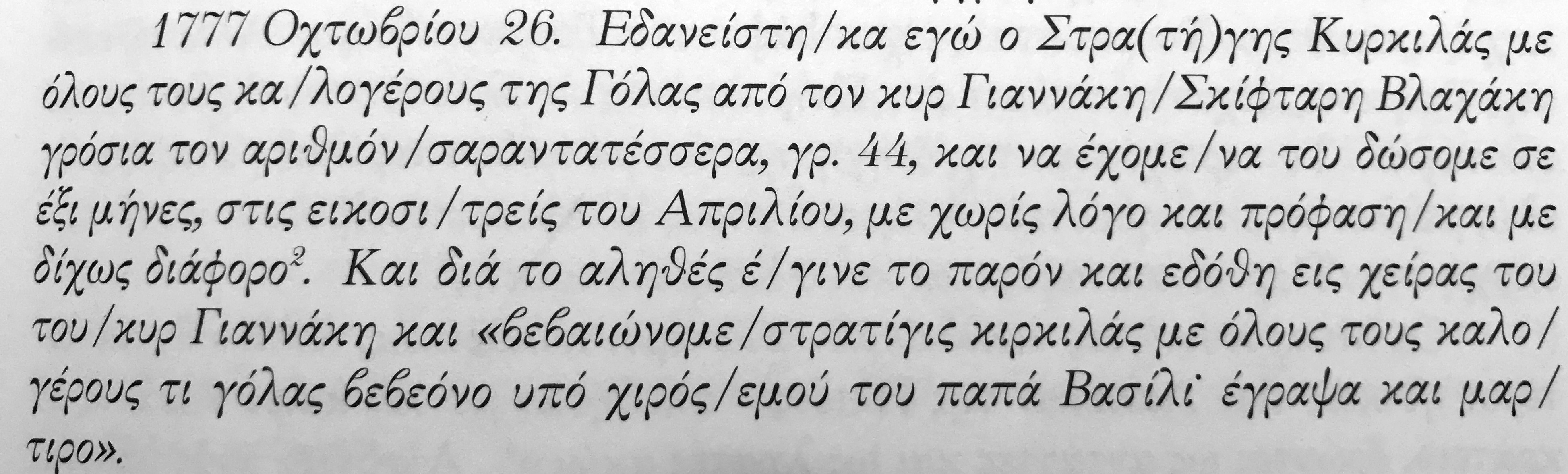
Ottoman authorities erected financial barriers to keep the Greek population in financial slavery. One such practice was to establish a minimal repayment time for term loans, which caused Greeks to lose their property. Such a loan was signed by the monks of the Monastery of Gola in Koumousta as found in the following document:

Koumousta of Lacedaimon, page 35.

Translation: 1777 October 26. I, Stratigis Kyrkilas with other monks of Gola, borrowed from Giannaki Vlachaki, Albanian, 44 grosia, to be repaid in 6 months on the 23 of April, with no reason and excuse / and without differentiation. And with truth, we make this document and we give it in the hands of Mr. Giannaki and we sign, Stratigis Kirkilas with all the monks of Gola. I ensure with my hand, Papa Vasili wrote and agreed. [Papa Vasili was a well known priest of Koumousta.]

Many people of Koumousta were in similar circumstances. In 1775, Zenelagas, a captain of Albanian mercenaries, demanded that the citizens of Paleochori give him 300 grosia as payment for the protection that he offered to them. People signed this document but they could not repay the money. Zenelagas forced many citizens to abandon the village; some went to Mani; some to the islands of the Aegean and others scattered throughout the world. Dimitrakis Skiadas and his mother, Konstandina, left Koumousta and went to Kythera. In 1780, the year that the monk of Zerbitsa, Gerasmimos Markakis of Paleochori, wrote his will, the situation had not changed.

Through the years, the Koumoustiotes kept alive a vivid recollection of the Vardounians. Even today, they give their dogs Vardounian names to indicate a ferocious wildness and, hopefully, to cause terror to thieves.

NOTE: This post is part of a series of translations and extractions of the book, Koumousta of Lacedaimon, authors: Theodore Katsoulakos, Pan. X. Stoumbos, with translation by Giannis Mihalakakos. Previous posts are Economics and Occupations of the Citizens; Christakos Family, Part 1 & Part 2; and The Rizos Clan of Koumousta, Laconia:  Christakos, Koumoustiotis, Kyriakakos.  I am grateful to Dimitris Katsoulakos for permission to cite passages from this book.

__________________________________

[1] Today, Koumousta is known as the village of Pentavli. The region formerly encompassed a wider area which includes  today’s villages of Xirokambi, Faris, Paleochori, Kaminia (Dafni), Kidonitsa, Anthochori, Paleopanagia, Trapezanti, Dipotama, and others.

[2] Attribution:  original uploader was Stupidus Maximus at English Wikipedia – Transferred from en.wikipedia to Commons by Sreejithk2000 using CommonsHelper., Public Domain, https://commons.wikimedia.org/w/index.php?curid=10525371


Economics and Occupations of the Citizens of Koumousta


As I wandered through villages in Laconia last summer, I tried to imagine the everyday lives of my ancestors. I knew their hours were labor intensive from dawn to dusk, with hardly a break except for holidays and feast days — but even these special occasions demanded additional work from the women. Thanks to the writings of Theodore Katsoulakos and Panagiotis Stoumbos in their book, Koumousta of Lacedaimonos, I now understand much more. My special gratitude to Giannis Michalakakos for translating the text and patiently explaining cultural and lifestyle patterns of the past.

Without a shred of doubt, the head of the household was the father whom everyone obeyed without question. If he was not there, perhaps due to sickness or death, the mother presided. During the evenings, they discussed the next day’s work, and at dawn, each child knew exactly what his or her tasks would be. There was work for everyone, big or small, boy or girl. “Small help, great savior,” the children were reminded.

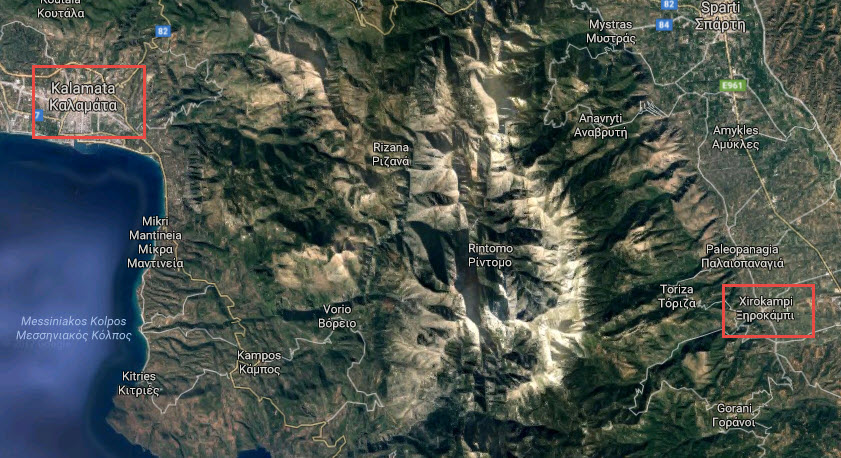
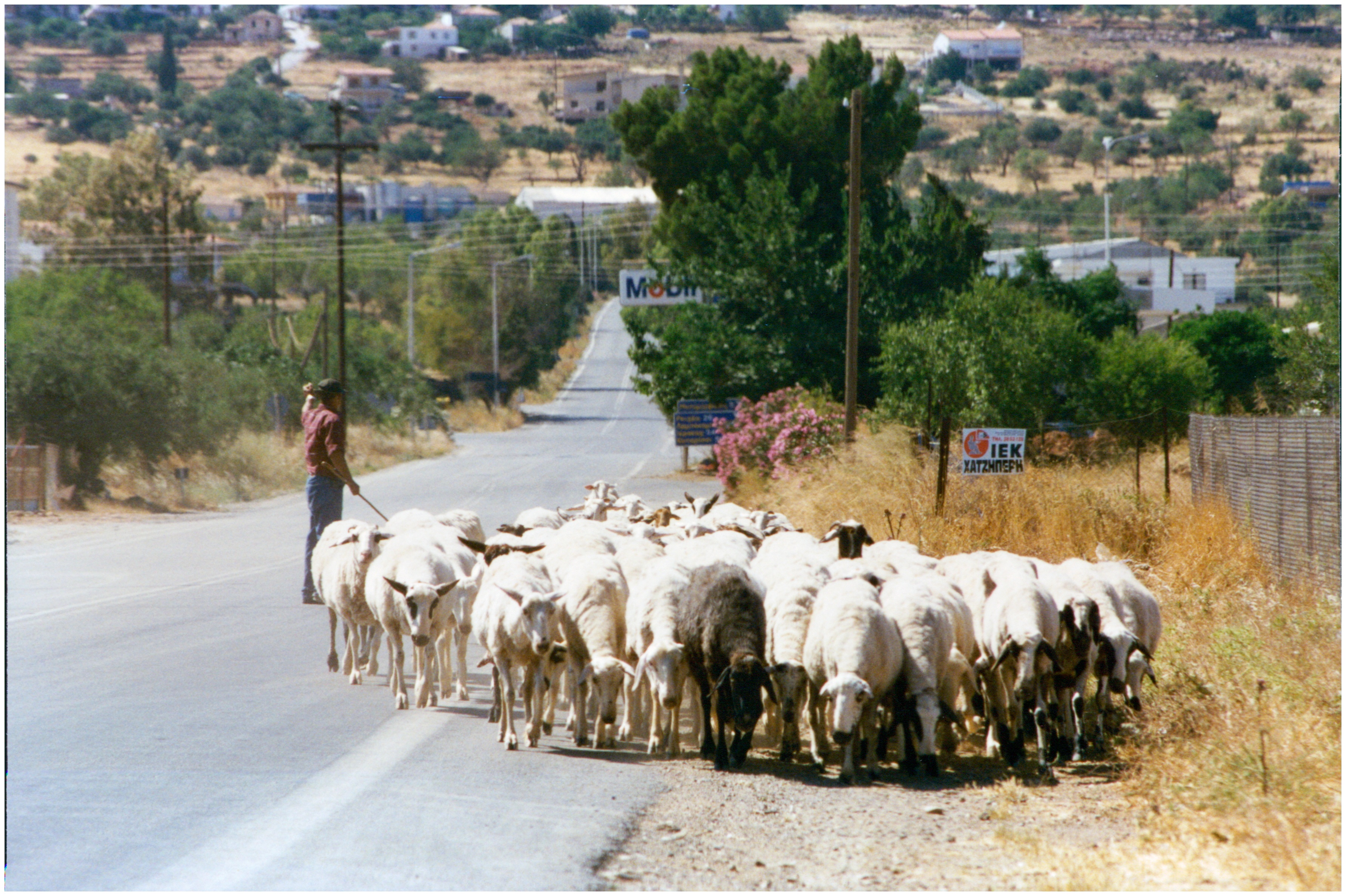
Although I do not know the occupation of my great-great grandfather, Nikolaos Christakos of Xirokambi, his fellow villagers were shepherds, farmers, woodworkers, silk producers. During 400 years of Ottoman and/or Venetian occupation, wool, cheese, silk and leather products were produced by the villagers and sold abroad. However, financial circumstances prior to 1900 were difficult. People herded their animals over towering mountains and difficult terrain to be sold in the city of Kalamata; but if demand was low, the animals accompanied their shepherds on the return trek home.

From Xirokambi to Kalamata


Because Koumousta is situated in a higher elevation, the climate and soil are not suitable for growing olive or citrus trees. However, hardwood and nut trees are plentiful. People planted various seeds to grow corn, beans, wheat, malt, tomatoes. Potato cultivation was introduced by Ioannis Kapodistrias, the first governor of Greece, during the transitional period after the Revolution. The first crops In Koumousta were cultivated around 1850. With plentiful water and rich soil, the potato plants thrived and production reached as high as 15 tons. Villagers became proficient growers and were known as “πατατάδες” (potato men). Pear trees were planted “from Koumousta to Penteli.” Mulberries were plentiful and aided in silk making, an important occupation of the people. Oral tradition relates that this business began with a man named Chatzi, who used the humid climate within a small cave to grow silkworms. There were only two or three beekeepers, and “old Giannos Orfanakos had around 150 honeycombs. During good years, he could produce 1,000 okades [1].” His supply was augmented when shepherds and wood collectors would find nests of wild bees and collect the honey. 

Stone grain mill

Half of the citizens were farmers with flocks of sheep and goats. These animals numbered over 7,000. Lias Mandrapilias related that two pens of his family were filled with 1,000 goats. Those who did not keep goats had sheep and oxen. Until 1940, there were 150 oxen in Koumousta.

Koumousta is surrounded by forests; therefore, wood was plentiful and woodworking was an important occupation. Oral tradition states that people created small crafts and their goods were sold in Mani and in Mystras. “Old George Mandrapilias” won first prize for one of his pots that was on display at an exhibition. Woodworkers made boxes to store cheese, butter, and seeds; they made a variety of tools, baskets, barrels for water and wine, washtubs, and kettles to hold goats’ milk. Among the most important tools were looms, used by women to weave wool into fabric. People would say, “we have oxen and so let the tools break” (meaning, their animals were more important because they could easily make new tools). Even small boys learned the art of using an ax. From a young age when they grazed their animals in the mountains, the boys passed woodcutters who told them stories such as: “Once there were two brothers who were shepherds, and they managed to make a pine tree fall down. But when they tried to chop the tree, the ax would not cut. One of them said that the ax wanted wine and food. The boys slaughtered a goat, brought the wine and again tried using the ax, but nothing happened. The ax needed not only to be strong, but also to have someone who knew how to cut.”

Although the poverty level was high, the people of Koumousta compensated by being economical. Old ladies did not leave one kernel of grain on the threshing floor. Animal dung was collected and used as fertilizer. Sheep’s wool was made into clothing. Old men patched their shoes with nails to avoid the expenses of the tsagaris (shoemaker). Interest levels on loans were very high — 30%, and it was said that people worked for the usurers. Those who owned land in the mountains had to work especially hard to repay their loan, as their land was not as fertile or yielding as that in the plains. And when money was low, families with single young women faced a difficult situation:  how would they provide a dowry? To cope with these difficulties, some people emigrated to America and sent money back to assist their families.

When a parcel of land was to be sold, the villagers purchased it to keep it from being owned by “foreigners” (people from other villages). Another loan meant further hardship, but to the villagers, this was necessary to avoid problems. Once, a man from Goranus bought land in Koumousta. He did not properly restrain his animals, and they trampled his neighbor’s fields, damaging corn and potato crops. The villagers were so angry that they killed the “foreigner’s” oxen and goats; but unfortunately, they paid heavily for their retaliation with fines and prison time.

Despite their poverty, people of Koumousta took pride in being self-sufficient. They could provide for their families and even guests with their own goods. Although many households were poor, the main reason was death or sickness, not laziness. The industry, resilience, and creativity of my ancestors from Koumousta and Xirokambi continue to inspire me. I am so very proud of them.

___________________________
[1] a unit of weight used in Turkey, equal to about 2.75 pounds or 1.24 kilograms; a unit of liquid measure used in Turkey, equal to about 1.3 pints or 0.75 litres.

Christakos Family of Koumousta/Xirokambi, Laconia. Part Two

Greeks embrace an expanded definition of the term “family” to include those who marry into one’s direct ancestral line, including koumbara (godparents). I take it one step further to include anyone whose origins are from the same clan. This second post (part one here) relates stories about the relatives of my great-great grandfather, Nikolaos Christakos, as written by Mr. Katsoulakos and Mr. Stoumbos in their book, Koumousta of Lacedaimonos.

One recurring theme is the importance of the local monastery of Gola.

Monastery of Gola

Monasteries were “rich” and were sources of life for the villagers. They provided steady employment for some and assistance to others. On March 1, 1828 the abbot of the monastery of Gola enumerated its holdings: vineyards and cultivated fields of berries, figs, and olive trees; cows, sheep and goats; and precious objects. People named in the Code of Gola were involved with the monastery. They may have worked as gardeners, keepers, or in the olive oil refineries, and they were paid for their labor. Monasteries often rented their land and sheep to villagers who did not have property or means to provide for themselves. The monastery also supported the local school in Koumousta; in fact, for a time during 1830, the school was located within the monastery. In the Code are these donations:  October 1829-33: 81, 150 and 114  grosia (Greek for qirsh, Ottoman currency). Vyssarion Tekosis (1827-1844), an abbot in the monastery, studied in this school.

Christakos Residents of Koumousta

Panagis is the oldest Christakos named in the book. He is not mentioned further, but we can estimate that, as the father of Kyriakos who was born about 1776, he was born in the early to mid-1700’s[1].

Kyriakos, the son of Panagis, was named in the first census taken in 1830. He was referenced in the Code of Gola in the year 1806, and additional documents indicate that his involvement with the monastery of Gola was ongoing:

  • On January 1, 1785, he signed a document as a witness that Christina Komni and her children sold a vineyard to the monastery for 38 grosia.
  • On April 25, 1796, he signed a letter requesting assistance from the Grigorakis family of Mani after Turks destroyed the monastery of Gola.
  • In 1806, he donated a field to the monastery in memory of his son, Panagis [this indicates that his son had died prior to 1806]

Thanasis is named in the Code of Gola as a laborer in the monastery, 1827-29.

Dimitris and other men from Koumousta fought in the Balkan Wars (1912-13). In the village of Koritsa (Albania) during a battle between Greeks and Turks, Dimitris was injured along with Vasilis Stoumbos, Mitsakis Mandrapilias and Christos Stoumbos. Dimitris, an artillery gun operator, totally lost his hearing and returned home, deaf. The state did not grant him a pension. His wife died, leaving him with six sons. He raised his sons and assumed the household chores of baking, cleaning, mending clothing. As the sons married and left the home, Dimitris remained alone until the end of his life.

St. B. (nickname: Kapodakis; St.B. most likely are initials for Stylianos Vasilios) died in an accident on July 21, 1943. At the end of the river Rasina is a small lake, Sgournitsa, where young men swam during hot summer days. The small cave of Komini, with green stalactites and impressive fossils, lured the bravest of them. It was there that St. B. lost his life.

Georgios is not mentioned by name but his three sons are listed in the Male Register (Mitroon Arrenon) of the Dimos (prefecture) Faridos. As such, we can estimate the birth year of Georgios as about 1845:

  • Aristomenis Georgios, born 1870
  • Dimitrios Georgios, born 1872
  • Grigorios Georgios, born 1876

The family of Dimitrios Georgios born 1872 is enumerated in the Town Register (Dimotologion):
Christakos, Dimitris G., born 1872
Christakos, Konstantinos Dimitriou, born 1915
Christakos, Antonios Dimitriou, born 1918
Christakos, Pantelis Dimitriou, born 1920
Christakos, Panagiotis Dimitriou, born 1923

These four sons of Dimitrios were among 28 young men from Koumousta who fought during World War II. The authors wrote:  The village at once became joyless [because the youth were gone.] The weather this morning was as if it was going to snow. The teacher left in the night. In the fields, no one went to work. A 10-year-old child, shocked by the events around him, listened to his mother’s voice, “Your sister is going to your uncle’s goats and you to ours” (children must now do the work since the men are off to war). From this time, the child was doomed to become a shepherd. He took bread and ran quickly to the point between the mountains. He wanted to see the men who had left to fight. He saw them when they reached Γλυστρωπές Πέτρες (slippery rocks). He shouted to tell them something he had heard early in his life, “come back victorious.” But they were far away and could not hear him.

The family of Konstandinos Dimitrios born 1915 (named above) is also in the Town Register:
Christakou, Antonia wife of Konstantinou 1922
Christakou, Pitsa (Panagiota) Konstantinou 1943
Christakos, Dimitrios Konstantinou 1946
Christakou, Stratigoula Konstantinou 1948
Christakou, Dimitra Konstantinou 1951
(Note: –ou ending denotes the feminine)

Konstandinos Dimitrios and Perikles D. are named in the School Register of 1921-22. The school archive was destroyed during the German occupation of WWII and the ensuing Civil War. Only two student lists were saved. The older list is from the school year 1921/22, indicating that there were 31 students in four classes, with the teacher Peter Dimitrakeas.

  • Konstandinos Dimitrios is referenced in an incident which occurred in Koumousta during the Greek Civil War (1946-49). A skirmish arose between rebels and paramilitary forces (Xites). The Xites accused Kosta of being a communist and threatened to execute him, but the situation dissipated and he was spared.
  • Konstandinos’ wife, Antonia Stavrogiannis Christakos, found the decapitated body of her brother, Dinakis, in the town square of Xirokambi (late 1940’s). There authors tell the story as follows: Dinakis Stavrogiannis lived in Paleochori. He was small in body but strong and quick. After some military operations of the army, a small stronghold of military police with help of local army men settled in the area. One night in Paliochori, Dinakis killed a military policeman who was guarding Sotiri Kakiousi and he fled. From this point, the future of Dinakis Stavrogiannis was written in black. The guards increased, and the control was extremely oppressive. In the middle of September below the Koumousta River , Dinakis fell into an ambush. Heavily injured, he tried to release a grenade but blew himself up. The next day the police cut off his head and took it into  Xirokambi where they put it on public view. Among the people of Koumousta who went there to collect nuts was his sister, Antonia Christakos who in front of this disgusting view screamed, “My brother.” However, she found the courage to go to and weep at the headless body of her brother. 
  • Konstandinos Dimitrios and his family left Koumousta after World War II, but there is no additional information regarding their final destination. The authors explained: The war and misery that followed, along with many other social reasons, forced people from Koumousta to abandon their village and take the road abroad. 

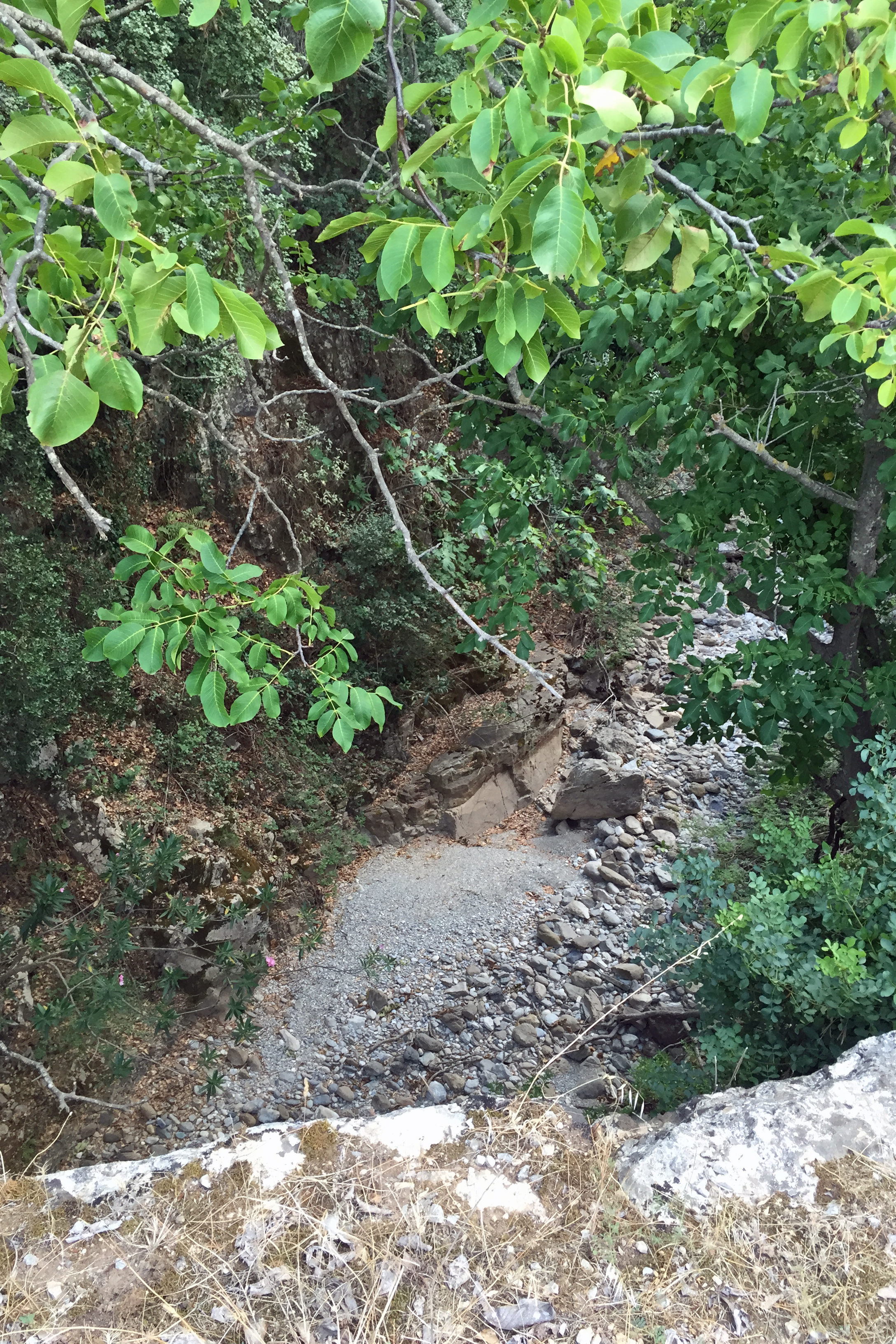
Xirokambi, river bed, July 2016

The men of Koumousta were tough. As they left their village to defend their country, their eyes were as brutal as slayers. They gathered in Megali Vrysi and departed, singing an old klepht song:  How many mountains I passed, I will tell them. Mountains, don’t get snow–fields, don’t get dusty. The meaning is deep and poignant: as mean leave their village, they send a message to the mountains and the fields–may the winter not be harsh, may the fields be well watered and produce a good harvest. My family will be alone and I will not be there to take care of them.


___________

[1]  Kyriakos was an adult, probably in his 30’s, when he is mentioned in the Code in 1806. Doing the math, his approximate birth year would be around 1776; if we use the estimation of 25 years to separate generations, then an approximate birth year for Panagis would be 1751 at the earliest.