How to Navigate the State General Archives of Greece Website for Digitized Images

The website of the General Archives of Greece has a specific area where digital images are being uploaded:  http://arxeiomnimon.gak.gr/index.html.  This site is not easy to navigate, but with patience and the help of an English translation button on the right side of the website, it can be done.

A pdf file with step-by-step directions can be accessed here.

As can be expected, most of the files are in Greek script. However, there is a valuable collection of Electoral Rolls from the late 1800’s which has been typewritten in Greek — and the names are easy to read. This collection contains lists of men who were eligible to vote. It is sorted by Nomos (County), then Districts and Municipalities. Instructions for accessing this collection titled “Election Materials from the Vlachogiannis Collection” is found at the end of the document. A direct link to this collection is: http://arxeiomnimon.gak.gr/browse/index.html?cid=586603

A sample page of the Election Rolls is below. The Nomos is Lakonia, the village is Agios Ioannis (Sparta). The columns are:  1: line number, 2: first and last name of the voter, 3: voter’s birth year, 4: name of voter’s father, 5: voter’s occupation.

My great-grandfather, Panagiotis Papagiannakos, is on line 1975.

1872 Electoral Rolls, Agios Ioannis, Papagiannakos

1872 Electoral Rolls, Agios Ioannis, Panagiotis Papagiannakos, line 1975


Surnames from the Mitroon Arrenon of Mystras, Laconia

I am researching several ancestral lines in Mystras, including that of my maternal grandmother, Aggeliki Eftaxias. During my visit to the General State Archives office in Sparta in July 2014, I digitized several pages of the Mitroon Arrenon (Male Register) for this city. The earliest year in these registers is 1824. Interestingly, this is right in the midst of the Greek War of Independence (1821-1829).

The surnames below are extracted from the pages that I obtained, which is not the complete record. Villages included in these records are: Mystras, Vlachohori, Varsinikos, Pikoulianika, Parori, Katochora, Diaselos.

The Sparta Archives office can assist you with further research. The email address is: mail@gak.lak.sch.gr. Maria Stellakou, Michalis Sovolos, and Pepi Gavala are exceptional archivists and dear friends.

Surnames from Mitroon Arrenon of Mystras

The Elementary School of Anavriti (municipality of Vryseon) in 1838

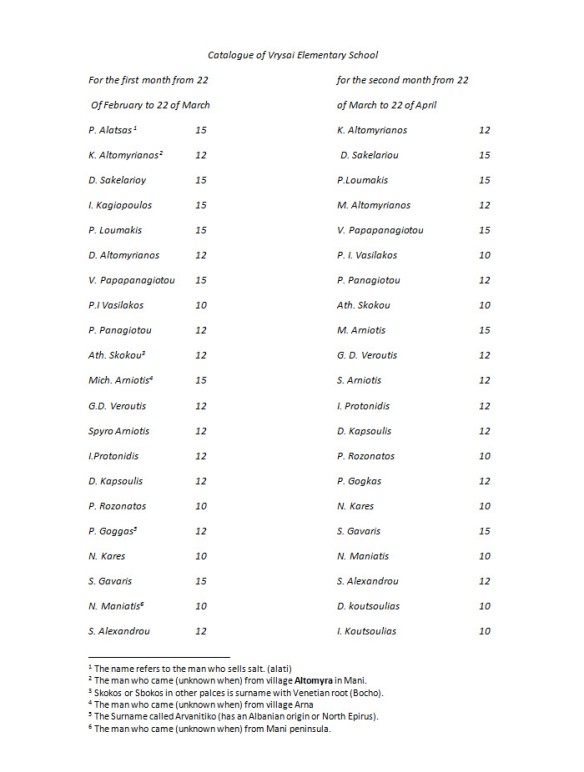
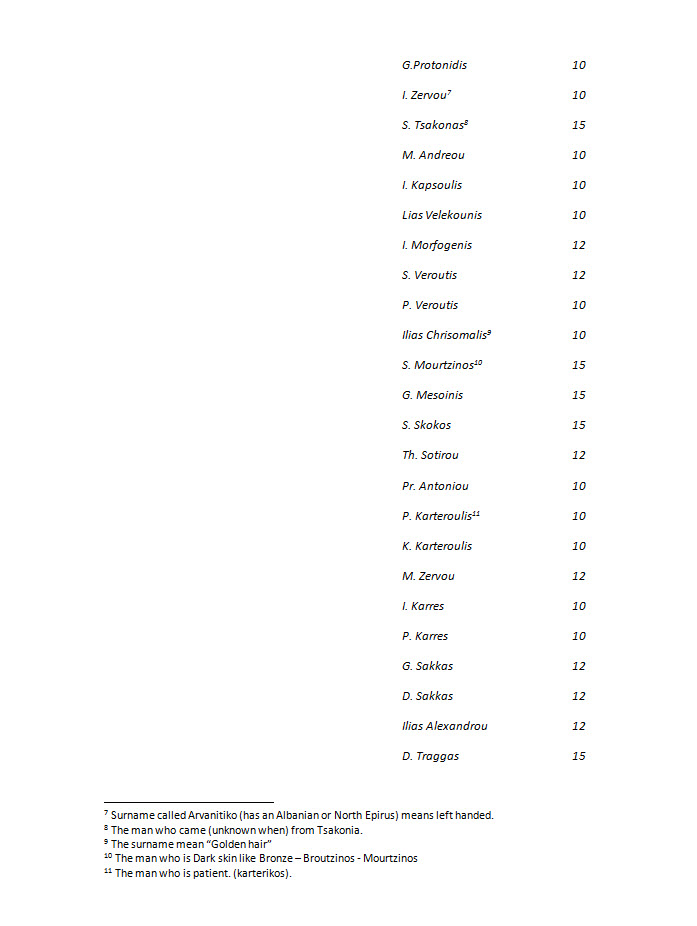
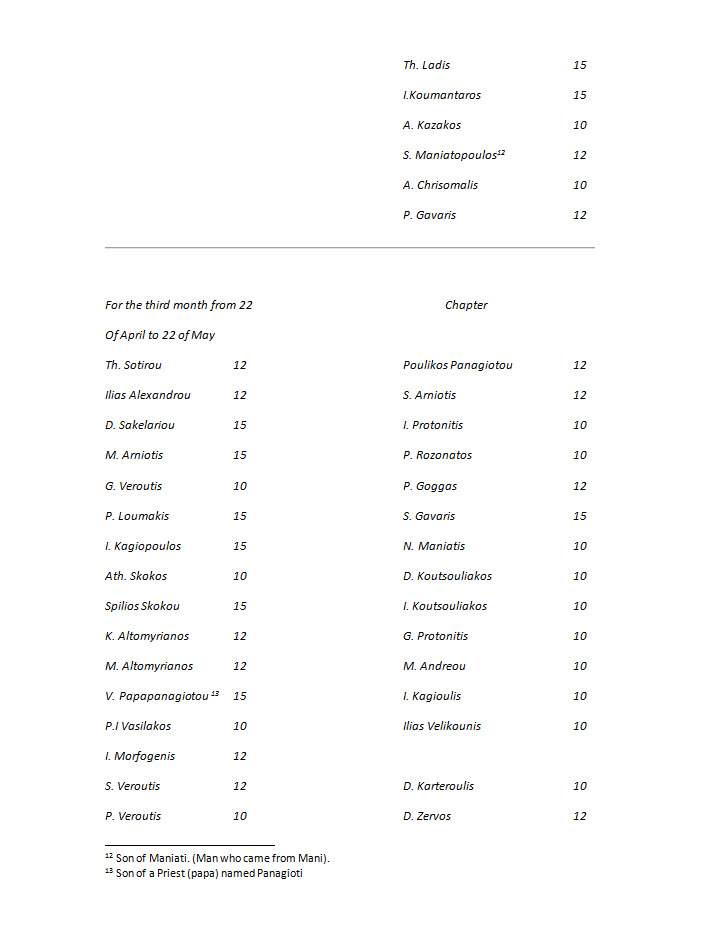
My friend, teacher, and historian, Giannis Michalakakos, has translated a list of children enrolled in school in Anavriti in 1838. The original digitized records can be found online at the General Archives of Greece (see source at end of document),  images 38, 39, 40.

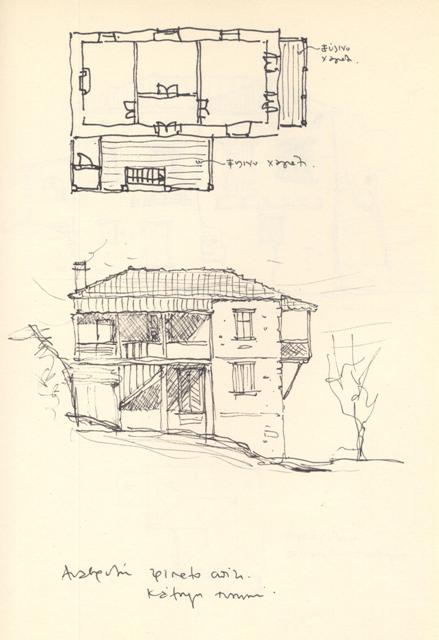
Giannis has added valuable information about the origin of many of the names in these records (look for a superscript number). He also provided links at the end of this document to the GAK Archives and to a blog dedicated to architecture in Sparta, and specifically to an article about Anavriti.

I extend to Giannis my deepest appreciation for his time and effort in finding and translating this list. The year 1838 predates many extant records (including Mitroon Arrenon); and as Giannis explained to me, if you calculate that the fathers of these children could be 30-40 years old, they would have fought in the Greek War of Independence in 1821!

To read more of Giannis’ writings about history, genealogy, and other issues concerning Mani, follow his bog, Maniatika.  Again, thank you so very much, Giannis!

Giannis Michalakakos


Written by Giannis Michalakakos
Teacher of Home Economics and Ecology
Email. gnifiatis@hotmail.com


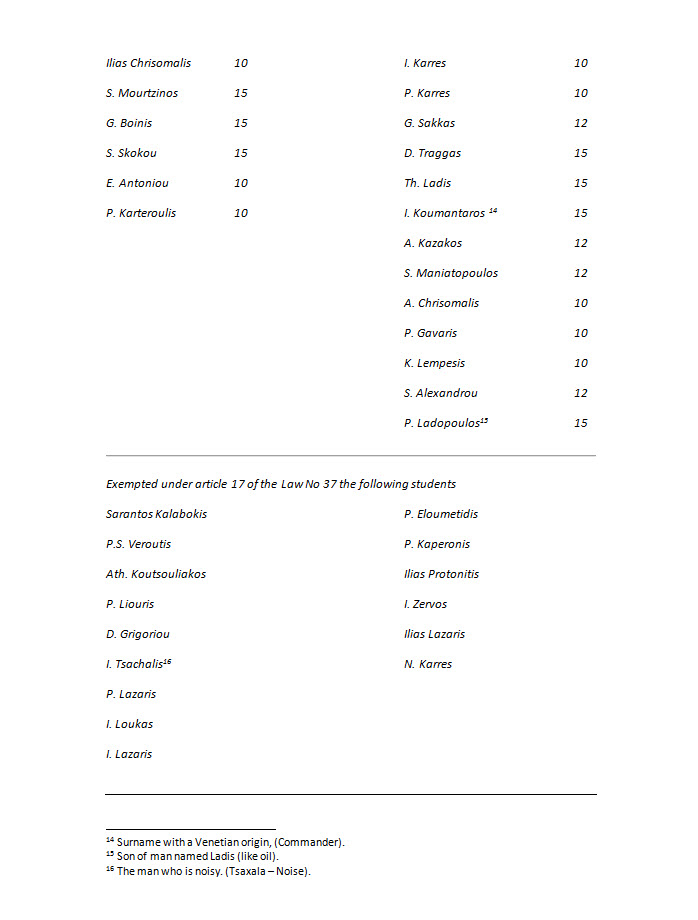
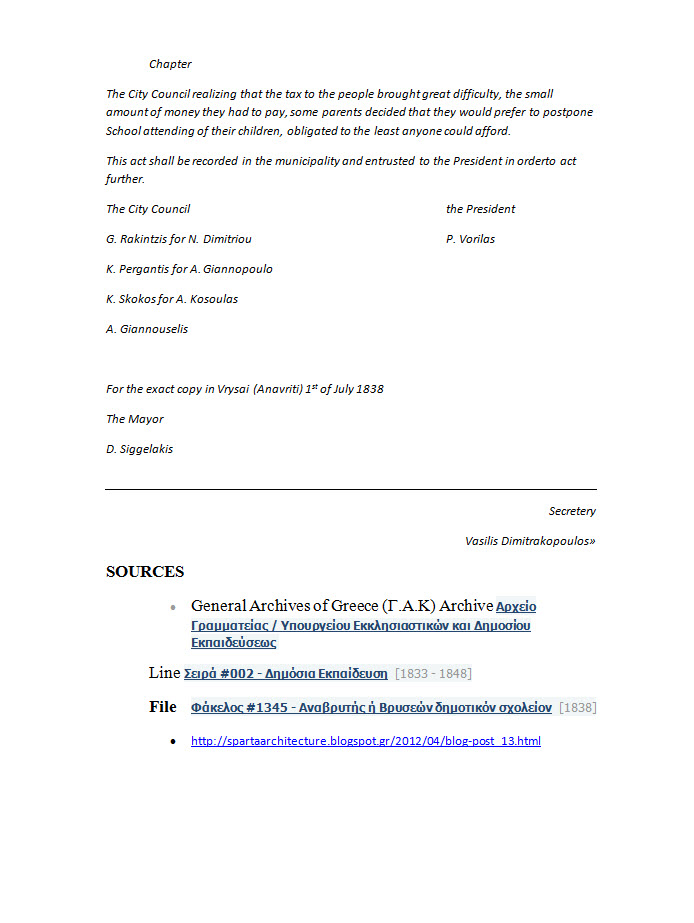
THE ELEMENTARY SCHOOL OF ANAVRITI 1838

Searching in the General State Archives for information about the Anavriti village (capital of Vrysai municipality) and the families who lived there I found a list of the students of the village’s elementary school. The following documents include the decision of the local council translated.

«The City Council gathered under president P. Vorilas and the rest members of the council G. Rakintzi, K. Perganti, K. Skokkou, Alex. Giannopoulou and A. Kousoula for meeting today 3rd of July in decision No. 2525 after the invitation of the Royal Command of Lacedaemon according to the article 26 of the Law Teaching to arrange the amount of money that monthly is paid by students parents and create a fund for the teacher. The council arranges the names from 29 of May and onwards.  

Anavriti School 1838 p1
Anavriti School 1838 p2 Anavriti School 1838 p3 Anavriti School 1838 p4 Anavriti School 1838 p5 Anavriti School 1838 p6


Research & Remembrances, Part 4

Research in the General Archives of Greece, Sparta office

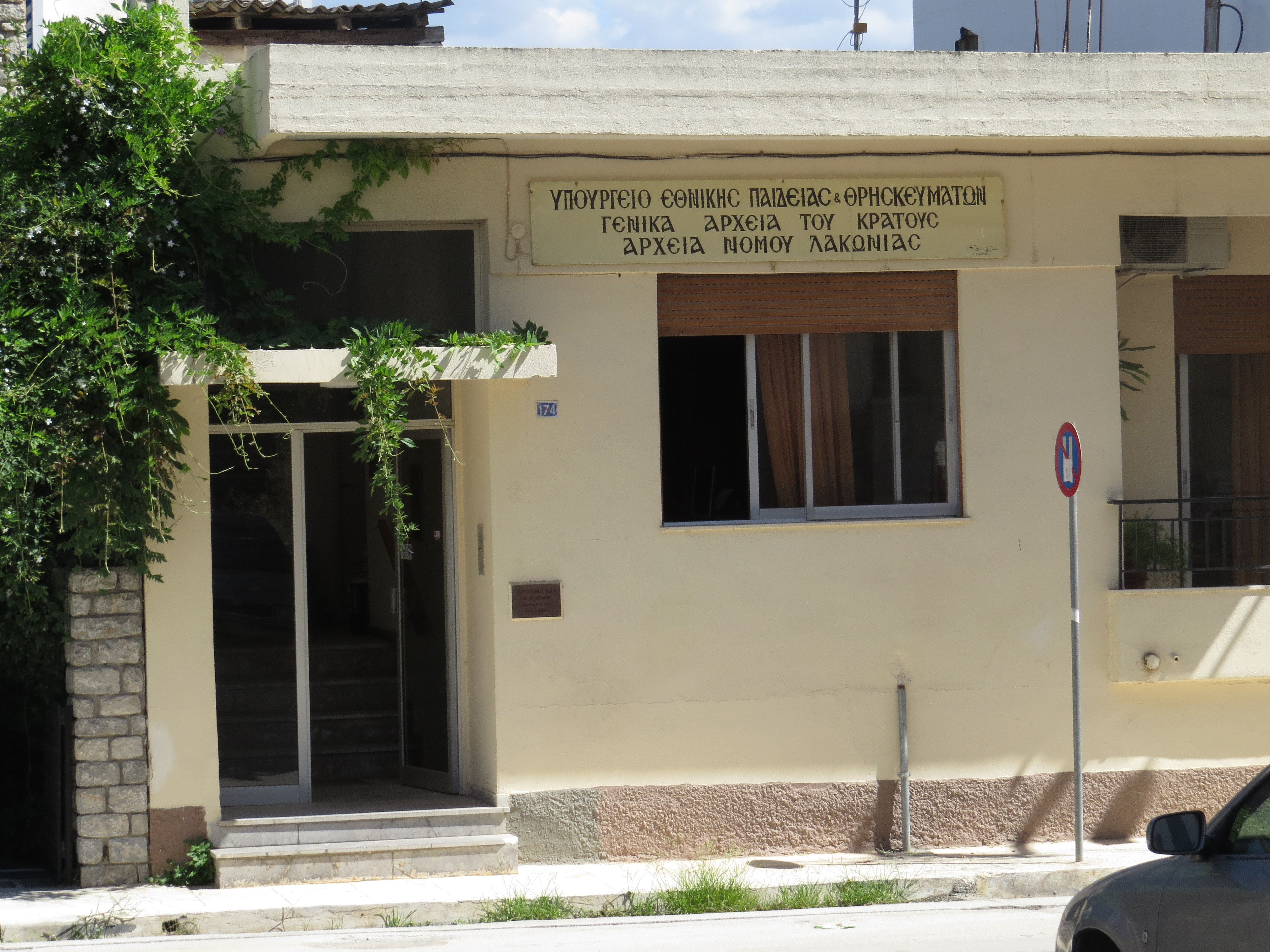
After months of preparation, I was so very excited to go in person to the General Archives of Greece office in Sparta! It located in a building on Vrasidou Street in the center of Sparta.

http://gkfamilytrees.wordpress.com/

General Archives of Greece, Sparta office

The Archives has offices for staff and a spacious research room. It also has off-site storage areas where most of the books and records are kept. Some records for Sparta which are listed at the GAK website may also be available. The research room has a large table, perfect for reviewing the oversized books and taking notes.
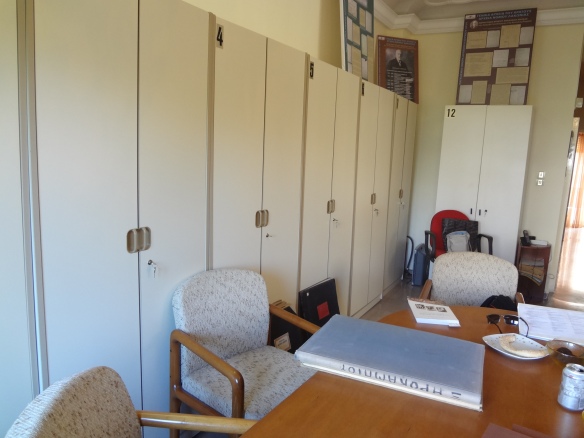
Research room, Archives office, Sparta

Research room, Archives office, Sparta

In the lobby, there are several  display cases featuring historic photos and documents.
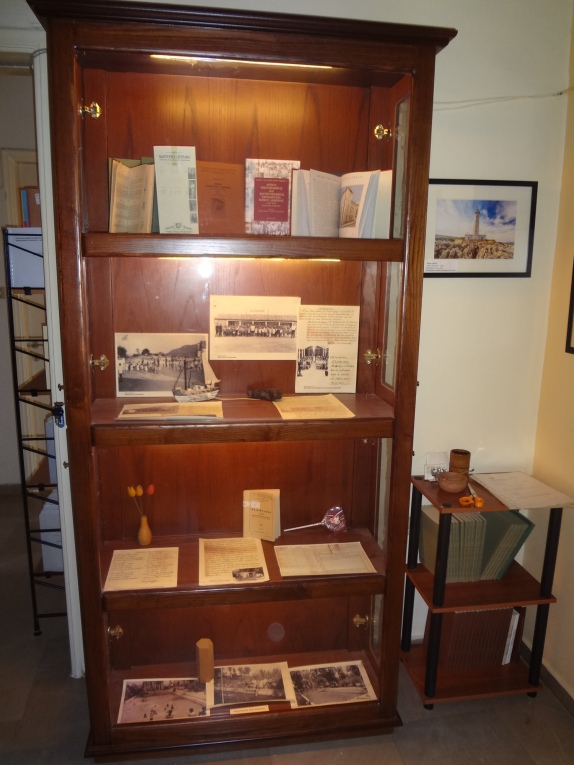
Display case, Archives office, Sparta

Precious documents and photos are on display at the Archives

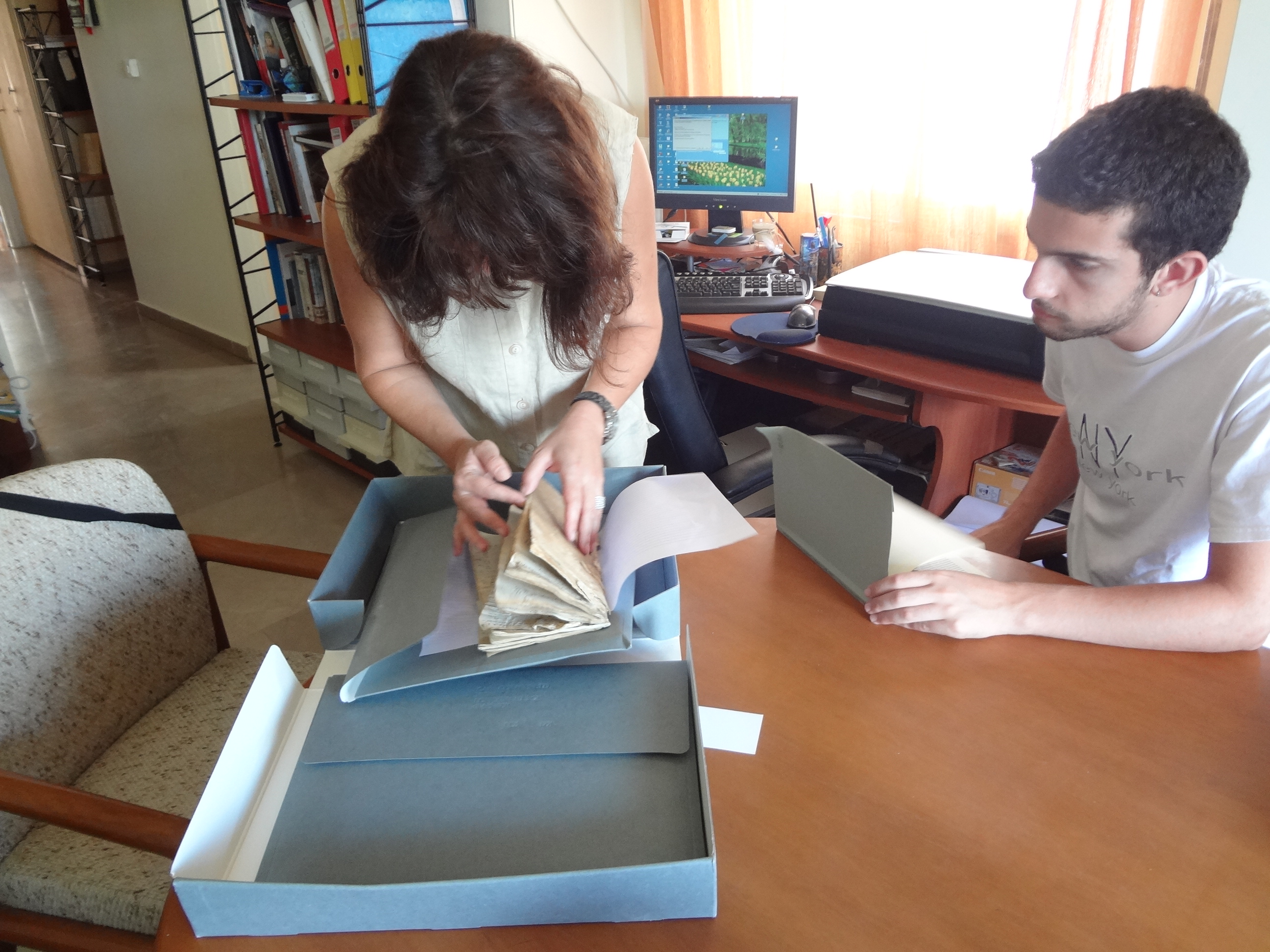
Gregory Kontos and I were finally able to meet our new archivist friends with whom we had connected through Greek genealogy Facebook groups — Maria Stellakou and Mihalis Sovolis. I had sent Maria an email in advance, letting her know exactly when we would be arriving. These dear people had offered to assist us in every possible way, and that is exactly what they did. They asked us which locations we were researching and what types of records we were seeking. They told us that they would have the appropriate books ready for us when we arrived the following morning.

Maria Stellakou looks for a record.

Maria Stellakou looks for a record.

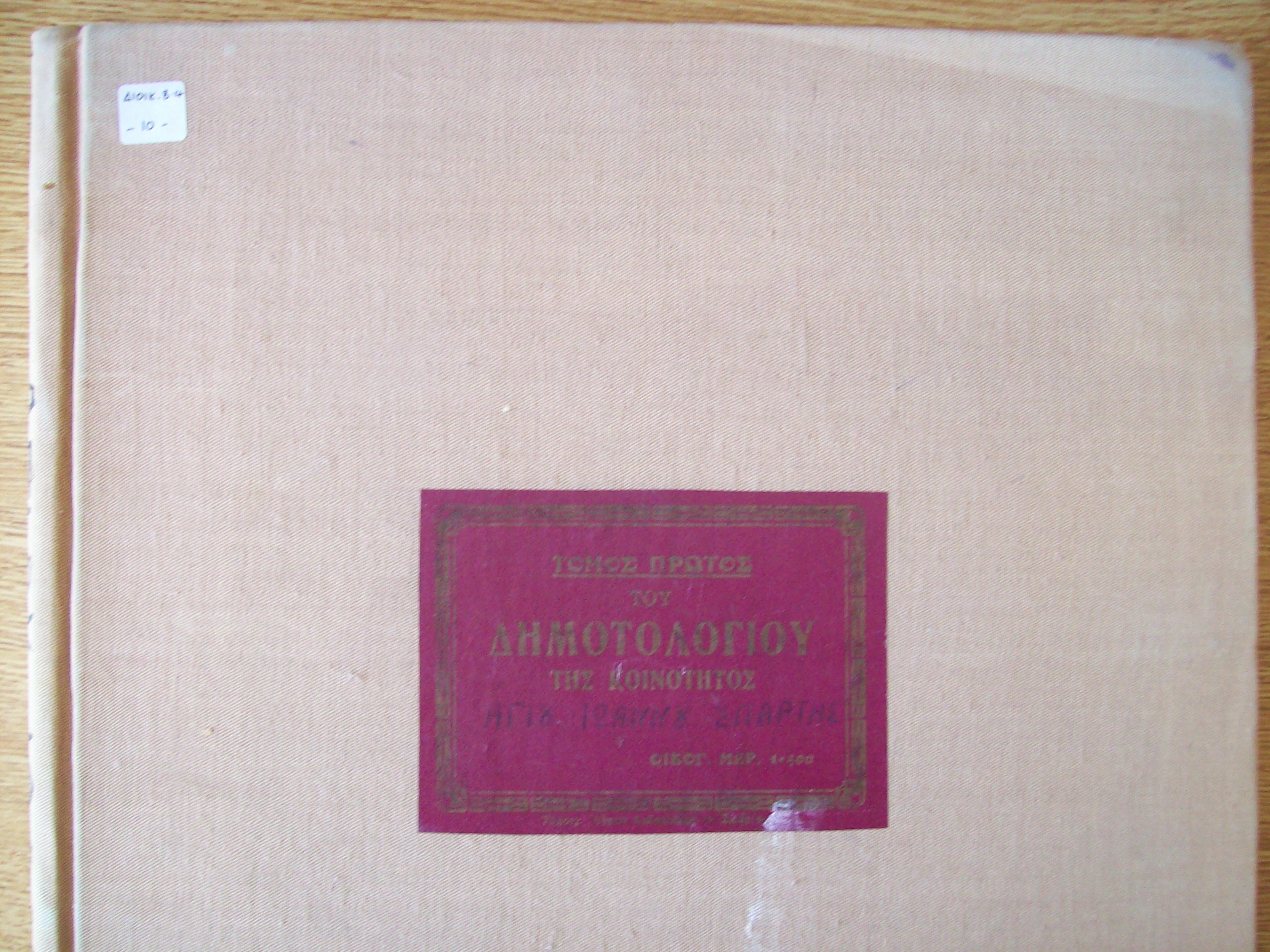
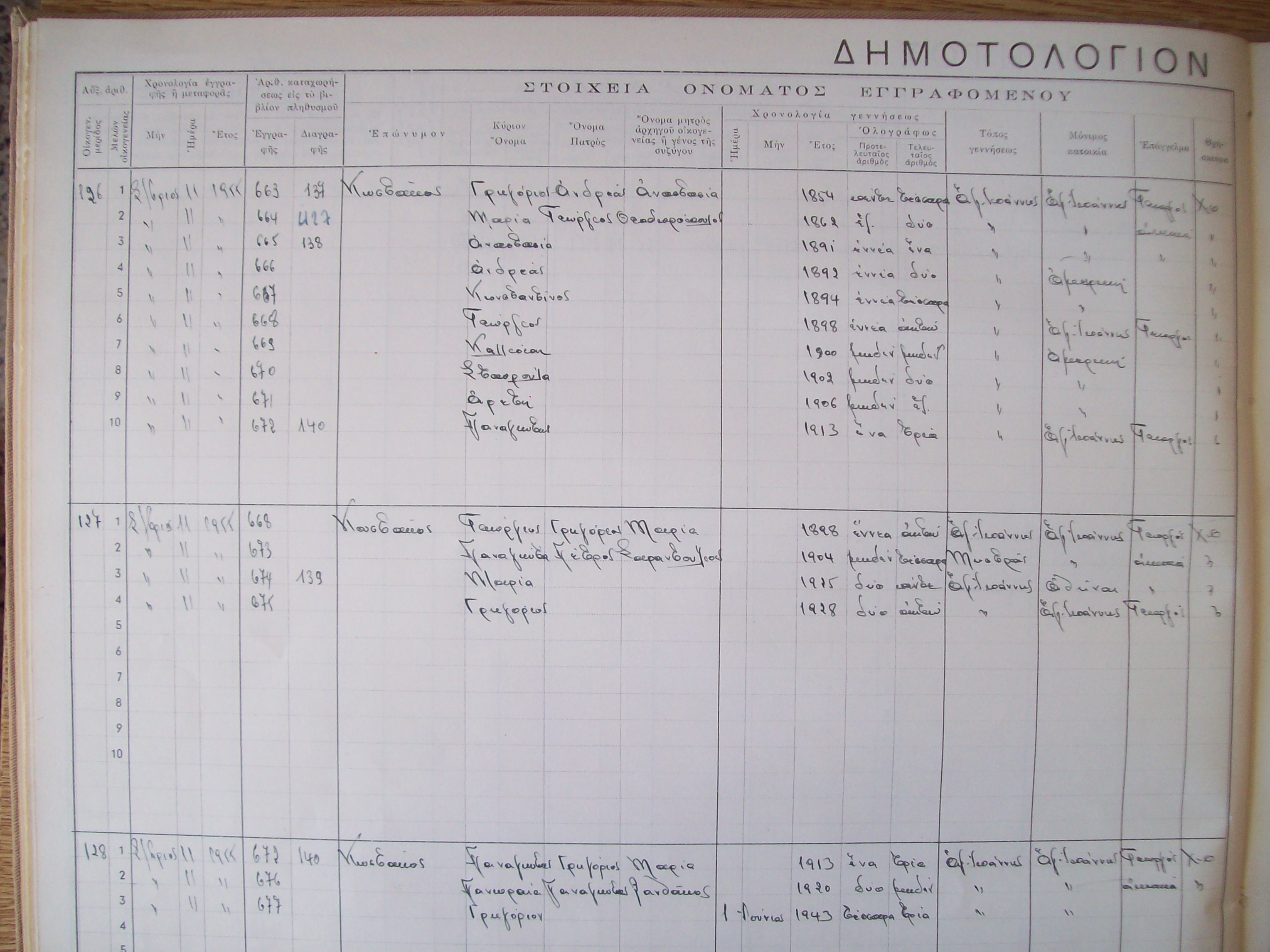
Can you imagine how thrilled I was to see the Dimotologion book for Agios Ioannis, the ancestral home of three of my grandparents? The Dimotologion is a register of families, listing husband, wife and children with their birth dates and other information. It is comparable to a U.S. census record.
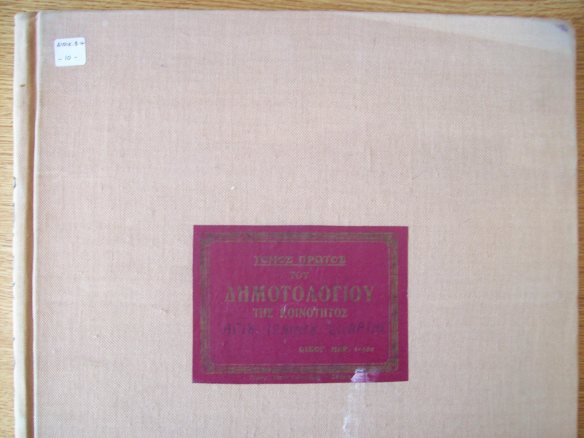
Dimotologion for Agios Ioannis, Sparta

Dimotologion for Agios Ioannis, Sparta

When I opened that book and turn the pages, I found three Kostakos families. These records appear to have been created in the 1900’s, as that is when most of the children were born. Unfortunately, there are no similar family records for the 1800s.

Kostakos families, Dimotologion

Kostakos families, Dimotologion

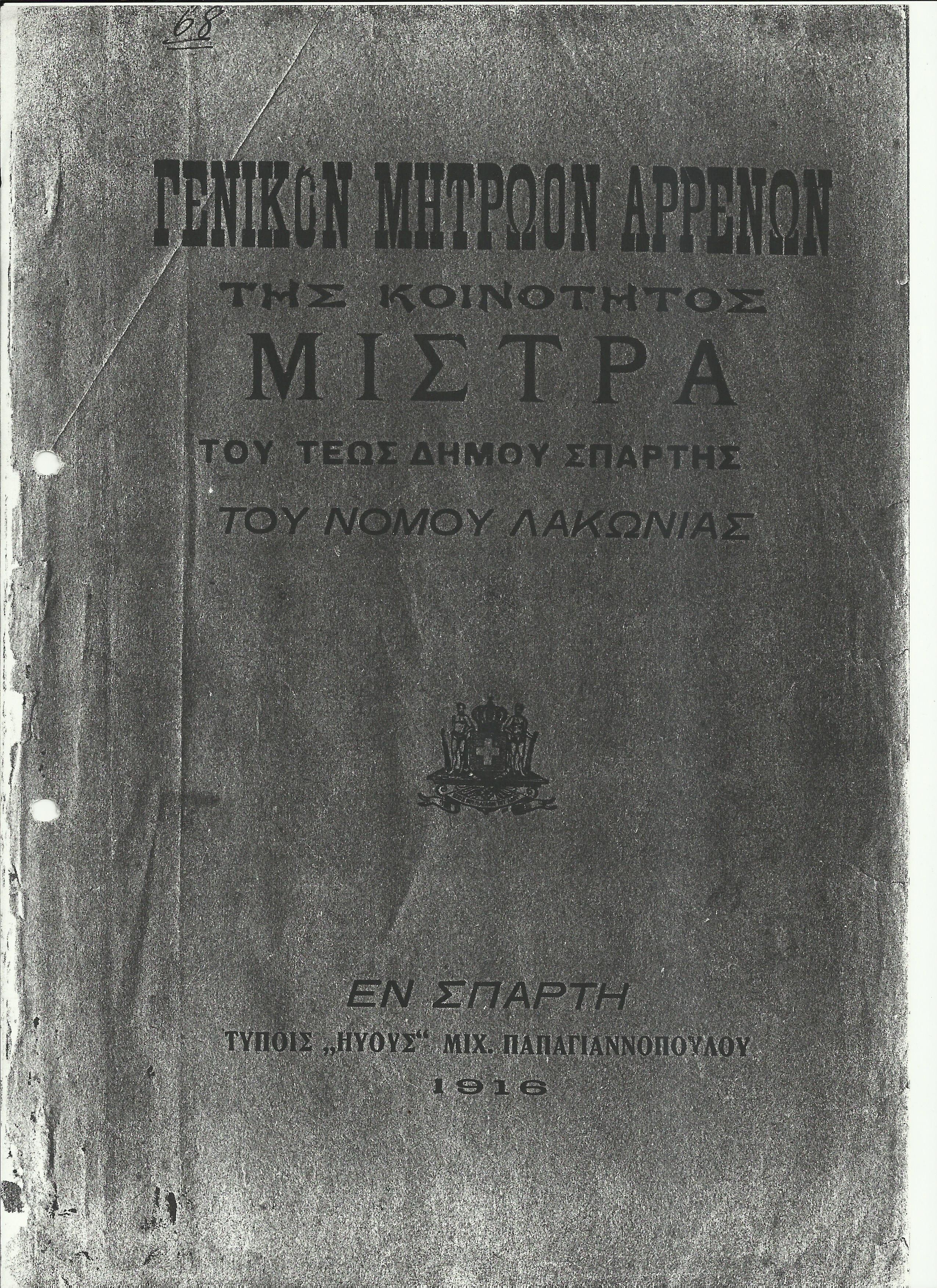
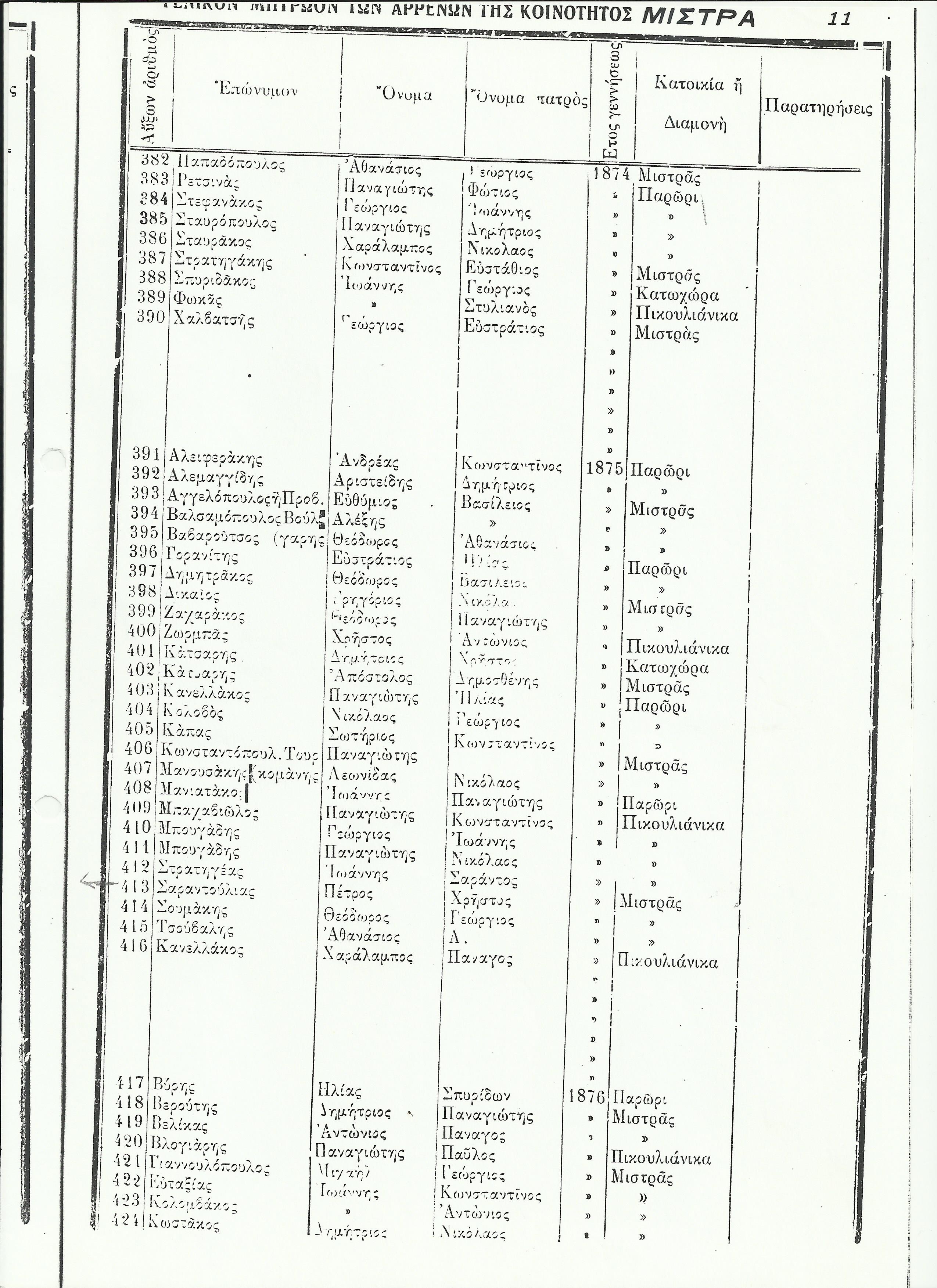
I looked at Mitroon Arrenon, Male Registers, for Agios Ioannis, Mystras, and other nearby villages.

Mitroon Arrenon (Male Register) for Mystras, Sparta

Mitroon Arrenon (Male Register) for Mystras, Sparta

In the book for Mystras, I found an entry for my granduncle, Ioannis Eftaxias born in 1876. Konstandinos, my great-grandfather, is named as Ioannis’ father. Gregory and I were given permission to use our cameras to take photographs of any pages containing my family names.

Line 122: Eftaxias, Ioannis; father Konstandinos; born 1876 in Mystras.

Line 422: Eftaxias, Ioannis; father Konstandinos; born 1876 in Mystras.

Maria has begun to digitize some of these books herself. That is quite an ambitious project! She uses a scanner and then uploads the images to the office computers. With digitization, the old books can be preserved. They can also be easily accessed by computer.

Gregory and I spent all day on Tuesday (July 15) and Wednesday morning at the Archives. We were delighted to meet Pepi Gavala, the archivist, on Wednesday. Over the years, I have come to know Ms. Gavala by name, as she signs letters that I have written to the Archives when I was requesting information. She is a delightful woman, dedicated to her job and sincerely wanting to assist researchers in every possible way.

Here is an example: when we arrived on Wednesday morning, I asked if the books for Vordonia and Kastania were available. These are the ancestral villages of my first husband, Peter Lynard (Linardakis). Although I had not planned to research those areas, I had a strong impression that I should do so. Mihalis was at one of the offsite storage areas, and Maria called to ask him if he would go to the building where the Vordonia and Kastania books were kept. He stopped what he was doing, found the books, and brought them to us as quickly as he could.

I left the Archives, thrilled to have digital copies of civil records that are helping me piece together the various branches of my family. I also left behind new friends: Maria, Mihalis and Ms. Gavala. They made this visit both pleasant and productive. I am ever grateful for their cheerful help and their sincere desire for my success in finding the records I was seeking. I hope that someday I will be able to return their kindness and be of help to them.
Papagiannakos in Lakonia

For the past month, I have been researching Papagiannakos records in preparation for a meeting with Father Eugene Pappas (Papagiannakos), priest at Three Hierarchs Church in Brooklyn, and a “cousin” to my mother. Both his family and mine descend from two different Nikolaos Papagiannakos’ from Agios Ioannis (born in the early 1800’s), but we have not yet been able to go back far enough to find our common ancestor.  Hurricane Sandy derailed my visit with Father Eugene as Brooklyn is now under water, but my research continues.

After extracting Papagiannakos names from villages around Sparta in Electoral Rolls of 1872, Mitroon Arrenon, and other documents, I found that prior to 1900 in Agios Ioannis, there were two Ioannis’ and at least five or possibly seven Nikolaos’. I also found Papagiannakos in Therapni, Tsintzina and Zoupena.

I plotted all these families on a Google map. I put purple pins in each of the villages where a Papagiannakos family lived. Click on the pin and you will see a pop-up window showing the families in that village: 

Here is a list of the families I have found so far:

AGIOS IOANNIS:  1815-1941

1815-1900: Families (fathers and sons)

1.  Ioannis 4 had 1 son, Georgios born either 1875 or 1880

2.  Ioannis 5 had 2 sons: Spyridon born 1890/91 and Evvagelos born 1895

Nikolaos – There were at least 5 and possibly 7 families with Nikolaos as father:

  1. Nikolaos 1 (may be same person as Nikolaos 4, as sons are 4 yrs apart). His son was Panagiotis born 1841 (this is my great-grandfather)
  2. Nikolaos 2, married to Georgia Piperis; they had 8  sons born 1889-1910  (this is Father Eugene’s ancestral family)
  3. Nikolaos 3, born 1815 (may be same person as Nikolaos 1, 6 or 7, as he is 20, 22, or 26 when the sons were born)
  4. Nikolaos 4 (may be same person as Nikolaos 1, as sons are 4 yrs apart); his son was Ioannis born 1845
  5. Nikolaos 5 had one son, Theodoros, born 1901
  6. Nikolaos 6 had one son, Ioannis 2, born 1837
  7. Nikolaos 7 had one son, Ioannis 1, born 1835

1901-1941: Families (fathers and sons)

  1. Andreas, with 6 children born 1931-1941
  2. Aristedes, with 4 children born 1929-1940
  3. Konstandinos, with 6 children born 1927-1935
  4. Christos, with 2 children born 1901-1904

THERAPNI: 1867

Father: no name, son Dimitrios b 1867 (source: School Archives)

TSINTZINA:  1830-1840

Dimitrios had 3 sons, Ioannis b 1830, Georgios b 1837, Panagiotis b 1840

ZOUPENA:  1886-1891

Father: G, had one son, Ilias b 1886

Father: P, had one son, Christofos b 1891

Although I am grateful for the records that exist and have allowed me to research to this point, I am anxiously awaiting more information. Using several sets of records allows me to compare and contrast dates, names and locations at different times. Church records would be the golden key that ties families together. Perhaps there will come a day when they will be readily available in Greece as they are in other countries.

Now that I have finished looking in the general area of Sparta, I will look farther south in Lakonia and perhaps into Messinia, into the Mani region, to see if, when and where the Papagiannakos name appears. I’m looking for migration patterns. Meanwhile, I will keep looking for additional records to help me sort out the Nikolaos’, and be able to go back another generation or two to find the common ancestor.

Then, I’ll start on another surname! This work is never done 🙂