(Note: this post, “Telephone” is the third of three parts describing the earliest modern developments in Xirokampi. Part 1: Light, can be read here; Part 2: Water, can be read here.)
The OTE telephone network entered the houses and shops of the village in the late 1960s and early 1970s. OTE, founded in 1949, succeeding the 3Ts (Post Office [“Tachidromio”] – Telephony – Telegraphy), then began to install telephones connected to automatic dialing systems. The systems for each rural area were operated in the, so-called, Rural Telephone Centers.
In Xirokampi the center was housed for a brief time in the post office that was installed on the ground floor of the house of Dimitris Xanthakos and was to serve the telephones of the inhabitants of the villages of the whole area. The first employee and supervisor was Georgios Evag. Karampelas, who took over all the operations related to telephone and telegraph communications. Then the center was relocated to the ground floor of Ilias Kapetanakos’ house. Panagiotis Il. Komninos and Vassilis Il. Christopoulos also worked at the center temporarily, before Efstratios Ioan. Kritikos was hired as a permanent employee.
In the past, telephones were operated by means of manual systems, whereby the selection of telephone connections was made by means of plugs that operators/answering staff inserted into holes in a panel. They measured with mechanical timers the duration of calls as well, while calls required the turning of a small ‘crank’.
Photo credit: Library of Congress. Kansas City, Missouri. Private branch exchange (PBX) operator at her switchboard in the freight depot, photographer: Jack Delano; created 1943. https://www.loc.gov/item/2017847312/; accessed March 16, 2023
The office of Xirokampi was connected through a telephone line to every neighboring village. Even earlier, communications were made from station to station by telegraph or teletype, which in Xirokampi were originally installed in the house of Sotiris Papadakos (or Kokkinos).
Automation, the expansion of the telephone network and the proliferation of telephones caused (also) in our villages, for some time, an upsurge in pranks among the residents. In Xirokampi, coffee shop waiters would move around with trays throughout the market after telephone orders turned out to be pranks. Also, some people woke up one night after a call from the headquarters – supposedly – of OTE and cut the wires of their phones when they were warned of an imminent explosion of their device (!). However, at the same time they enabled family members who were away – especially abroad – to talk more often and more privately (since the privacy of telephone conversations was not guaranteed by the – very little – soundproofed ‘booths’ in call centers). But they also reduced the frequency of the letters they exchanged, as the postal employees of the time (Dimitris Georgountzos, Georgios Katsaros and Kleomenis Anastasakos) found and claimed.
I am honored to receive permission from the Katsoulakos family to translate and share articles from The Faris. Translation verification and corrections have been made by GreekAncestry.net. This is the tenth article of the ongoing series. Previous articles can be viewed here.
In today’s world, a pair of shoes is a simple matter in terms of manufacturing. They are made in factories on mass production lines with the latest technology and sold en masse to the world. In the early decades of the 20th century, however, when technology and modern machinery were non-existent, there were a few cobblers, who at the bench and in their workshops, made custom-made leather shoes and repaired worn and punctured shoes. Due to poverty, making a new pair of shoes was a rare phenomenon. It was considered a luxury to have a second pair of shoes. For this reason, the craftsmen, the so-called shoemakers, made new shoes on demand only. They would usually set up their bench in the shoe shop and with the help of workers and apprentices, they would repair damaged shoes. How many times didn’t the cobblers return to the surrounding villages to repair people’s shoes?
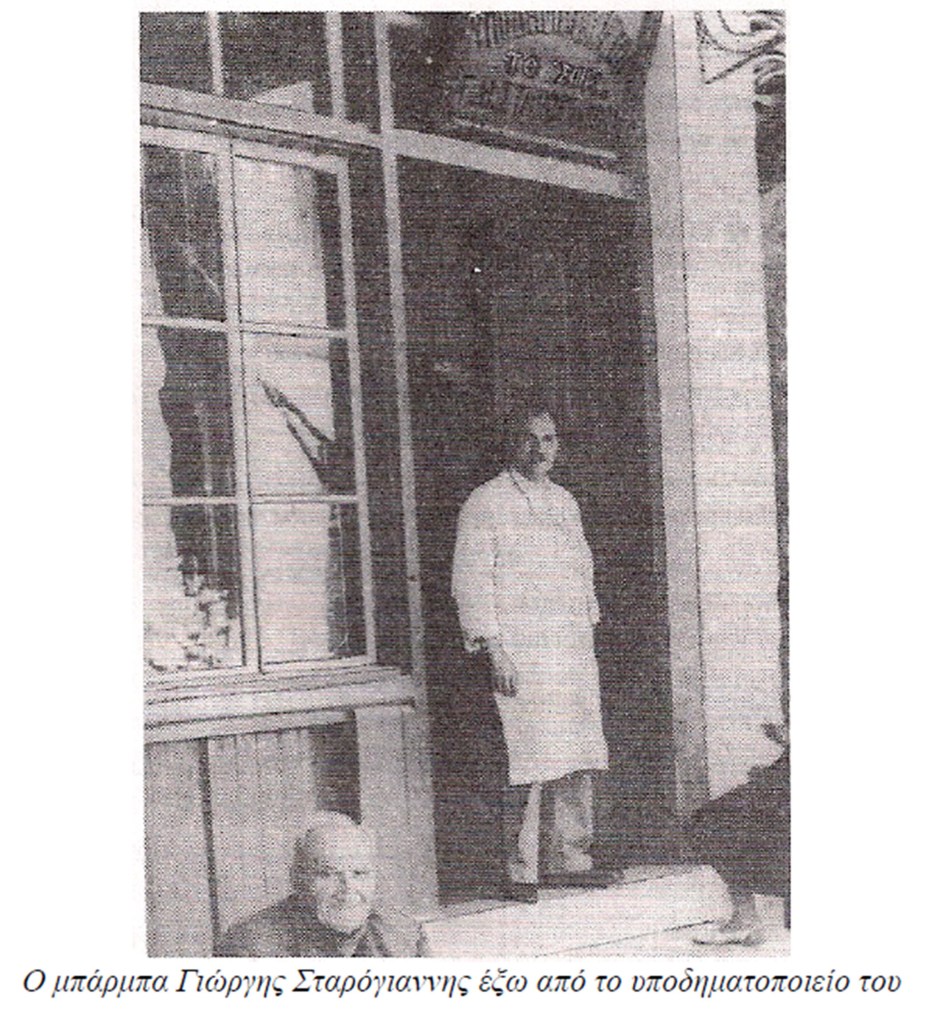
Every region of Greece had shoemakers and of course Xirokampi was not an exception. In Xirokampi, Ioannis Panageas had a shoemaker’s shop across the street from where Mr. Mandrapilia’s paint shop is today. The brothers Nikos and Argyris Kalianiotis had a shoemaker’s shop in the building that belonged to Panagiotis Kyriakakos. Later in the same place was the shoemaker’s shop of Yannis Alexakis, who had married the daughter of Argyris Kalianiotis. Panagiotis Christopoulos had a shoemaker’s shop in the building that belonged to Napoleon Andreakos. In Katsouleika was the shoemaker’s shop of Evangelos Kritikos, while Panagiotis Kalianiotis, who lives today in Sparta, had his shoemaker’s shop opposite the bakery of Nikolakakos. Finally, there is Georgios Starogiannis who is 96 years old today and lives in Xirokampi. His first shoemaker’s shop was in the house of Arachovitis. In 1933, having already been 10 years in the cobbler’s art, he went to the square and opened a shop next to Vangelis Liakakos’ house.
“Barba” Georgios Starogiannis retired when he completed 45 years of love for his craft. He is the only shoemaker along with “barba” Pantelis Skliros who now lives in Katsouleika. Like all shoemakers, he had several workers in his shop, around 20. He mentioned a few to me: Pantelis Skliros, Pantelis Frangis, Iraklis Komnenos, Konstantinos Chrysikos, Lias Chios, Yannis Filosofos who was also a good shoemaker, just like the aforementioned. There were of course many other cobblers who worked with diligence and craftsmanship in the shoe shops of Xirokampi. “Barba” Giorgis Starogiannis, during the occupation period, was the only one in Xirokampi who could manufacture the so-called German boots or vaketes (βακέτες).
The shoemakers made shoes on demand. They were made to fit the feet of the person who ordered them. At first, the cobblers took measurements with a tape measure. To give the shape of the shoe to the treated leathers and sole, they fitted them with a special shoe mold called kalapodi (καλαπόδι). Previously, of course, they had cut the leathers with a sharp blade, or if the skins were thin, with a cutter [similar to a wire cutter]. These two tools were sharpened with a special tool, called matsaki (ματσάκι). The pieces of leather were placed in the kalapodi and underneath was the vardoulo (βάρδουλο) [a strip of leather on the bottom of a shoe to which the sole is nailed or sewn]. Using small nails called spragges (σπράγγες), they nailed the sole to the skin.
After the whole construction took the shape of the shoe and the leather was repaired, they removed the nails and threw them away and where the nails had been, they sewed the skin with an awl. Then, to fasten the heels to the shoes, a hole was drilled to insert the wooden spike which was made from a piece of board. The tool which was used to drill the hole was called katsaproki (κατσαπρόκι). After affixing the heel with the wooden spike, they secured it with nails called telakia (τελάκια), which varied in size. To prevent the shoes and especially the boots from wearing out easily, two metal taps (or clips) were nailed, one on the toe and one on the back of the shoe. All around the shoe, where the leather meets the sole, the cobblers made various decorative stitches and engravings. The construction of the shoe was completed by polishing the sole, the heel and the bottom of the shoe with three smooth surface tools, the machineta (μακινέτα), the camareto (καμαρέτο) and the lampougio (λαμπούγιο). In particular, for polishing the heel, the cobbler would first heat the polishing tool over a fire in a small tin can. Such a pair of leather shoes needed a day to be made by an experienced craftsman.
Making a pair of shoes required great craftsmanship and artistry. An incident proves this: a customer from Potamia haggled with “barba” Giorgis Starogiannis for a pair. “Barba” Georgios, to show him the quality of the shoes he would buy, put the shoes on scales which balanced perfectly. The shoes were of equal weight, something difficult to do because they were handmade.
Of course, as we have already pointed out, the main work was repair. They patched full of holes and repaired damaged, worn out shoes. Every time there was a market, people from the surrounding villages and the mountains would come and have their shoes repaired by the shoemakers who set up their stalls in the square of Xirokampi. Often, the cobblers would go to villages and mend shoes on the spot. When the sole was punctured, they would patch it with a piece of leather. When the leather was punctured, they would put the shoe in the kalapodi and patch it with a piece of leather, called fola (φόλα).
At the beginning of the century, in the first decades, when there was no eight-hour work day, the shoemakers worked many hours a day (10 – 15) and sometimes stayed overnight at their work, without being paid extra wages and overtime by their bosses. The working conditions in the shoemaker’s shops were difficult, but they became more humane when the right to an eight-hour work week was secured, for which there had been many struggles all over the world.
Today, no one in Xirokampi follows the art of shoemaking. The old ones have either died or have now retired (G. Starogiannis, P. Skliros, P. Kalianiotis), while the younger ones do not have the passion to continue this profession. After all, there are now shoe industries that manufacture many pairs of shoes at low cost. Very soon, unfortunately, the shoemaker’s trade will be completely eliminated in all of Greece, as the last cobblers will also retire.
___
I am honored to receive permission from the Katsoulakos family to translate and share articles from The Faris. Translation verification and corrections have been made by GreekAncestry.net. This is the seventh article of the ongoing series. Previous articles can be viewed here.
I am most pleased to receive permission from Stratis Solomos to share his genealogy of the Solomos Family of Koumousta and Xirokampi.Stratis wrote: “Last year I was asked by the chief editor [of the Faris newsletter] to write a genealogy on the Solomos family, one of the most important families of Koumousta-Xirokambi…For practical space reasons the family tree was confined to the generation of 1960-70. By the same token, the few historical footnotes are limited to the older generations only.”
Publicizing and publishing our family history work is an unselfish and important act. It allows us to share what we learn with those who may not have the resources or abilities to conduct such research. They, too, want to know about their ancestors and connect with extended family worldwide. Thank you, Stratis, for your sharing your work with us and for providing this English translation.
The Solomos family of Laconia originates from Koumousta, a village in the Taygetos mountains, close to Sparta. In the 19th century, after the Greek War of independence, most family members moved gradually down to the flat land, to the newly founded village of Xirokampi. The origin of the Solomos family of Laconia is unclear and there is no oral tradition or myth related to the family history. In the 1950s-60s, the lawyer Georgios V. Solomos, known as “Pyrgodespotis” (Castle-Lord), was saying that he had done a bibliographic research that had allowed him to conclude that the family came from Crete in the middle of the 17th century, after the fall of Chandakas (Heraklion) in 1669 and its occupation by the Turks. More specifically, as it was narrated in the informal ‘kafenio’ gatherings, there were initially two brothers, one of whom stayed in Laconia and the other went to Zakynthos. The latter was the great-grandfather of the national poet of Greece Dionysios Solomos. Unfortunately Pyrgodespotis did not leave any written report and the above cannot be confirmed. His version may have been based only on various biographies of Dionysios Solomos.[1]
Nevertheless, the above hypothesis is not completely unfounded and can be based on the following arguments:
1) The family appears in the mountain village of Koumousta in the early 18th century, following the end of the Venetian domination over several Greek territories (and succeeded by the Ottomans).
2) It settles in an area where there are other well-known families, of established Venetian[2], Frankish and Byzantine origin. These families were living in the Laconia plains, but they moved to the mountains in 1715, when the Ottomans again conquered the Peloponnese.
3) More recent publications show that the great-grandfather of Dionysios Solomos, Nikolaos, did not go directly from Crete to Zakynthos, but to Kythira, where he married to Maria Durente[3], a woman from a “noble” family and with a large dowry. The Salamon-Solomos family, which is mentioned as important during the Venetian rule of Crete, had other members who settled in Kythira [4] and probably in the fertile Laconia, where the Venetians had provided them with arable land.
4) In addition, it was at this period that the Turks occupied Kythira for three years (1715-1718), for the island to be finally recaptured by the Venetians. It is possible that the move from Kythira to the neighboring Laconia happened at this time.
5) The wife of Elias Solomos of Koumousta (born around 1750) bears the name “Margarita”, which is not a usual name of Ottoman-occupied Greece. It is a “western” name mostly used in the Greek regions under Venetian rule.
Stratigis & Vasiliki Solomos, courtesy of Stratis A. Solomos
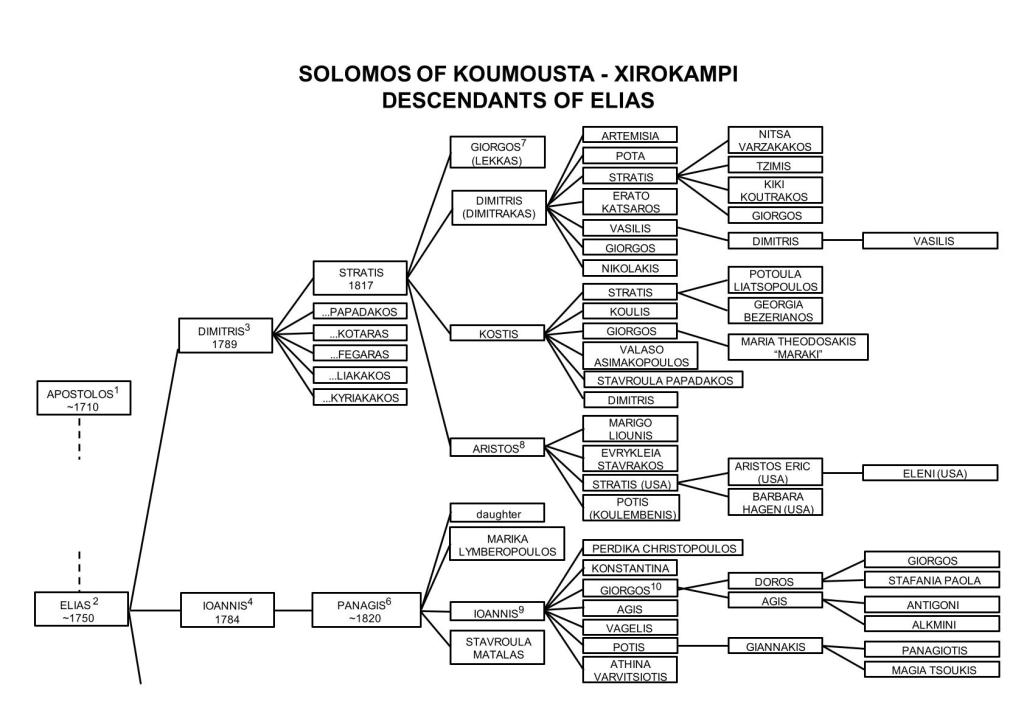
The Solomos families of Xirokampi and Koumousta, which today number hundreds of descendants in many parts of the world, are divided into two branches which meet somewhere in the late 18th century.
The first and most numerous are the descendants of Elias Solomos. The other branch comprises the descendants of Georgakis Solomos and then Thanasis, who was nicknamed “Lales”, hence their identification as “Lalaioi” (pronounced “Lalei”). Because of this nickname there was a traditional rumor that this family branch came from “Lala” a village in northwestern Peloponnese. However, it is rather unlikely that part of the family, with the same rare surname, came to the isolated village of Koumousta from such a remote area, unless there were relatives with the already settled Solomos of Koumousta. Another rumor has it that one of them fought against the infamous Turcalbanian mercenaries “Lalaioi”.
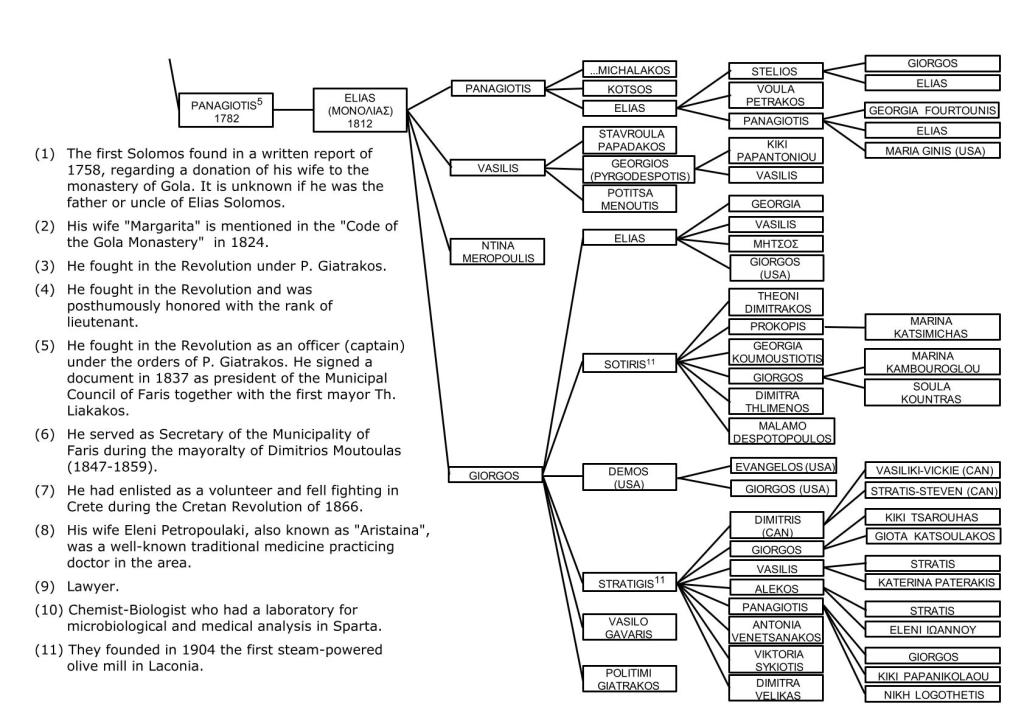
The reconstruction of the two branches of the published genealogical tree is mainly based on earlier oral reports, but also on documented, written information from the book of Th. Katsoulakos and P. Stoumpos[5]. Some evidence was also found in a report of a court dispute of a certain Meropoulis or Myropoulis, against trespassers of his property[6]. Archival research done by the genealogy research company “”ΟΙ ΡΙΖΕΣ ” (THE ROOTS) [7] was also taken into account. Another source of information was the list of immigrants passed from Ellis Island[8], as several members of the family immigrated early to America, from 1896 to 1921. The internet site of the Ellis Island Foundation has provided precious information concerning marital status, name of spouse, fellow travelers, relatives left in Greece, relatives to be met in the US, previous travels and age. From the age declared we can we conclude the year of birth, although with caution, because they often deliberately changed their age depending on the immigration laws in force. Some of these Solomos came back; for those who remained, there is the indication (USA, CAN) next to their name in the tree.
It is expected that there will be shortcomings and mistakes, especially in the tree of “Lalaioi”, which was done with more recent and less credible present-day oral testimonies. Where there is doubt, this is stated in the footnotes and the parental relationship is drawn with dashed line – – – -. Also missing are members who died in infancy or childhood. A future digitization of the registry files of Xirokampi and additional genealogical surveys could substantially help to improve this two-branch tree.
Although there is still abundant material available on the recent family members, for practical space reasons the tree was confined to the generation of 1960-70. By the same token, the few historical footnotes are limited to the older generations only. The year of birth is only mentioned for the older ancestors. Where the year of birth could not be determined exactly, it was estimated and preceded by the symbol (~). The construction of a more complete family tree that could encompass current family data and include offspring of female members would require a greater research effort and special lnformation Technology tools.
Finally, I would like to thank for their substantial contribution: 1) George P. Solomos (Italy), who decades ago recorded his first family tree version of “Elias Solomos descendants branch” and now helped significantly in the historical research. 2) Doros G. Solomos (Italy), who years ago spent time and resources on additional research for the improvement of the above mentioned family tree. 3) Dimitris “Mitsos” Ath. Solomos (Xirokampi), Nikos El. Solomos (Kalamata) and Dimitra G. Solomos-Giangos (California USA) who helped making the first, integrated version of the genealogical tree of the “Lalaioi” branch.
Stratis A. Solomos Geneva Switzerland stratis.solomos@bluewin.ch
[1] Ν. Τωμαδάκης: Οικογένειαι Salomon-Σολωμού εν Κρήτη, Επετηρίς Εταιρείας Βυζαντινών Σπουδών, 1938, Έτος ΙΔ’, 163-181. [2] Σ. Α. Σολωμός: Η ετυμολογία μια τοπικής λέξης και ήθη της Γαληνοτάτης Δημοκρατίας. Φάρις-Ξηροκάμπι, τεύχος 55, Δεκέμβριος 2011. [3] Ελένη Χάρου: Μαρία Δουρέντε, η Κυθήρια πρόγονος του Διονύσιου Σολωμού, 27 Μαρ. 2016. [4] Μπαλτά Ευαγγελία: Η οθωμανική απογραφή των Κυθήρων 1715, Ινστιτούτο Νεοελληνικών Ερευνών ΕΙΕ, Αθήνα 2009. [5] Θ. Κατσουλάκου και Π. Στούμπου ‘η Κουμουστά της λακεδαίμονος’, 2012. 6] ΣΥΜΒΟΛΑΙΟΓΡΑΦΙΚΕΣ ΠΡΑΞΕΙΣ του «μνήμονος Λακεδαίμονος Κυρίου Γεωργίου ΧΑΡΤΟΥΛΑΡΗ» 1833-1835. [7] Γραφείο αρχειακών ερευνών «ΟΙ ΡΙΖΕΣ» ( http://www.oirizes.gr ) Άρης Πουλημενάκος, [8] Ε. Α. Σολωμός: Μετανάστες των χωριών μας που πέρασαν από το Ellis Island. Φάρις- Ξηροκάμπι (τεύχος 50, Δεκέμβριος 2009).
Those with ancestral ties to the modern municipality of Farida, Lakonia (villages include Xirokampi, Palaiopanagia, Anogia and several others) are immeasurably enriched by the writings of scholars from the area. The publication, The Faris, History, Folklore, Archaeology (‘Η Φαρις), has been produced semi-annually since 1966 and contains many hundreds of articles about the people, history, folklore, archaeology and culture of the region. An appendix in each issue includes notices of births and deaths of local residents. The publication was initially known as The Xirokampi and maintained that title from 1966 to 1977, when the name The Faris was adopted.
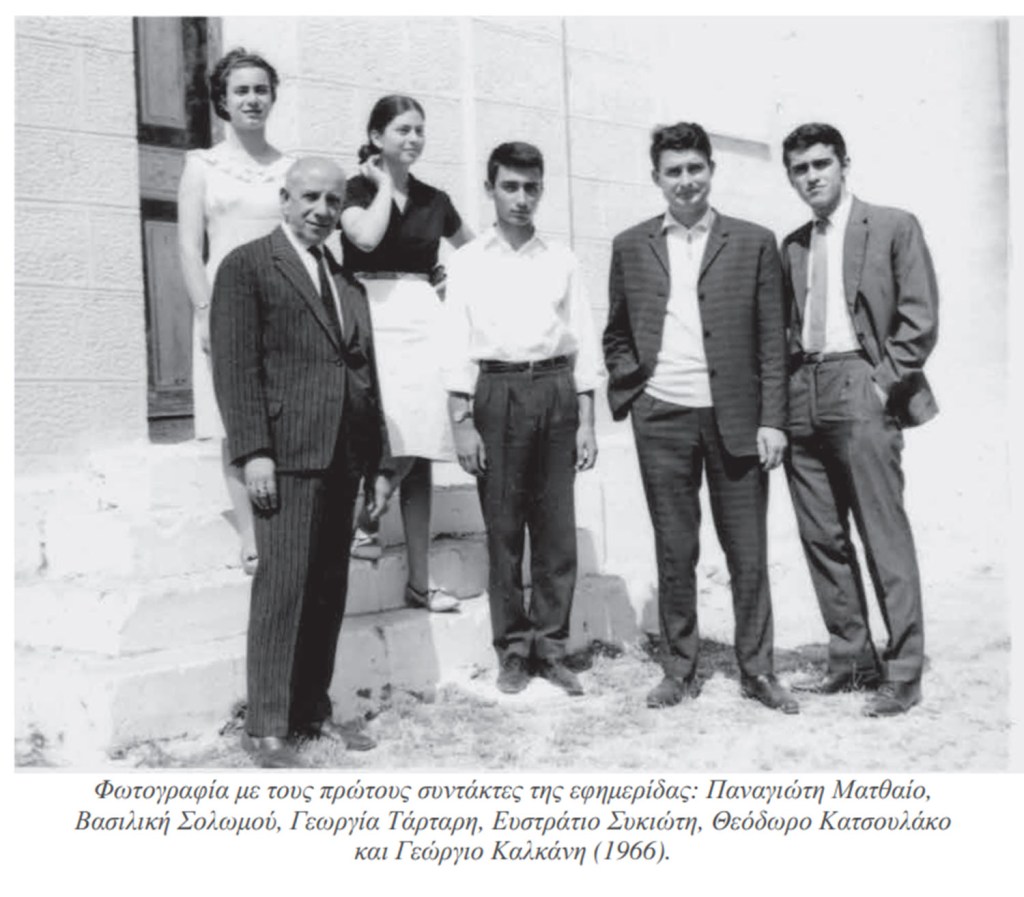
Those who write for The Faris descend from local ancestral families and know its past well. The founding editors, pictured below in 1966, were: Panagiotis Mathaio, Vasiliki Solomou, Georgia Tartari, Efstratios Sykiotis, Theodoros Katsoulakos, and Georgios Kalkanis. The current editorial committee is: Georgios Th. Kalkanis, Theodoros S. Katsoulakos, Panagiotis H. Komninos, and Ioannis Panagiotis Konidis. These, and dozens of other authors, have made Τhe Faris periodical a vital and unique resource to study the people and times of rural Lakonia.
The founding editors, from the 50th anniversary issue of The Faris, April 1996: left-right: Panagiotis Mathaio, Vasiliki Solomou, Georgia Tartari, Efstratios Sykiotis, Theodoros Katsoulakos, and Georgios Kalkanis
All issues of TheFaris can be accessed here. This link is to an index of articles from 1966-2001. This link is to the e.faris website.
I am honored and humbled to receive permission from the Katsoulakos family to translate and share articles from The Faris. Translation verification and corrections have been made by GreekAncestry.net. This is the first article of the ongoing series.
The Endings in -akis and -akos of the Surnames of our Region author: Theodoros S. Katsoulakos
The writing of a historical study presupposes the existence and substantial utilization of evidence and historical sources. However helpful the assumptions may be, if they are not supported and confirmed by direct or indirect evidence, no opinion can be substantiated or founded.
In our area, the wider region of the municipality of Farida, if one excludes a few monuments, remnants of the distant past, few writings have remained from the years of the four centuries of Turkish rule. The latter is explained if we take into account the low (intellectual) level of the Greeks of the time and the bloody struggle for the liberation of the country, during which everything that was left was destroyed.
Fortunately, the monasteries saved some written sources of the Turkish Occupation: their contribution in this field as well was undeniable. In particular, a number of documents from this era are preserved in the monastery of Zerbitsa. Some of them are from the 17th century and more from the 18th century. These are notarized sales, exchanges, wills of monks of Zerbitsa and Gola. The monastic zeal protected the assets from various schemes in moments especially of anarchy and fear. It is surprising and impressive, of course, how these historical documents reached us, while it is known that the monasteries of Zerbitsa and Gola were attacked, suffered disasters, and their administrative status changed.
The language in which these witnessed agreements are written is Greek, with a standard that is an amalgam of colloquial language and elements from the legal and religious tradition. This means that this bipartite contract concerned the Greeks and was of value only to them. From the study of many jurisprudential documents of the monasteries in the region, it emerges that there are very few Turkish words that had infiltrated and these concern terminology closely related to the financial interests of the conqueror, such as mulkia, from the Turkish mülk, meaning private property, lakas, possibly a Persian word (alaka), meaning share, and amanati (bequest), which survives to this day.
The documents and various records are reliable witnesses of the presence of the families in our place, such as: Komnenos (1465, 1762 onwards), Goranitis (1634), Laskari (1634, 1751 onwards), Aliferis (1698), Menouti and Sahla (1751), Meropoulis (1753), Karadontis (1754), Konidis (1754), Stoubou (1754), Koutsika (1757), Theofilakou (1757 and 1776), Tsaggari (1757), Niarchou (1759), Moutoula (1760), Rizou (1761), Papastrati (1764) Fragki (1764) Mathaiou (1769) Kalkani (1789) Vourazeli (1795), Psyllou (1796), etc.
Of great interest is the information provided by the documents regarding the diminutive endings in -akis, which are proportionally more than the corresponding endings in -akos.
After 1830, the ending of -akos began to prevail in the region. Useful conclusions are drawn from the study of the report of the local notables of the region to the Holy Synod (1835). It is noteworthy that only one surname was found ending in – æas (Niareas 1826).








 Spartan Roots (Σπαρτιατικές Ρίζες)