
by Eugenia Io. Konidi
published in The Faris Newsletter, November 1998, page 9
The birth of a child used to occur in the house in the presence of the midwife, a respectable person of the local community. In cases where labor presented difficulties, a doctor intervened and sometimes took the child with “spoons” [known as forceps].
The midwife, the mother-in-law, and the mother burned incense to icons so that God would help with the birth. Primarily, they invoked St. Stylianos, protector of children [paretymologically from stelos, (verb stelono), which is a strong pillar or beam]. They believed that the diet of the mother should be very light. She usually ate chicken soup with angel hair pasta and oregano or boiled greens.
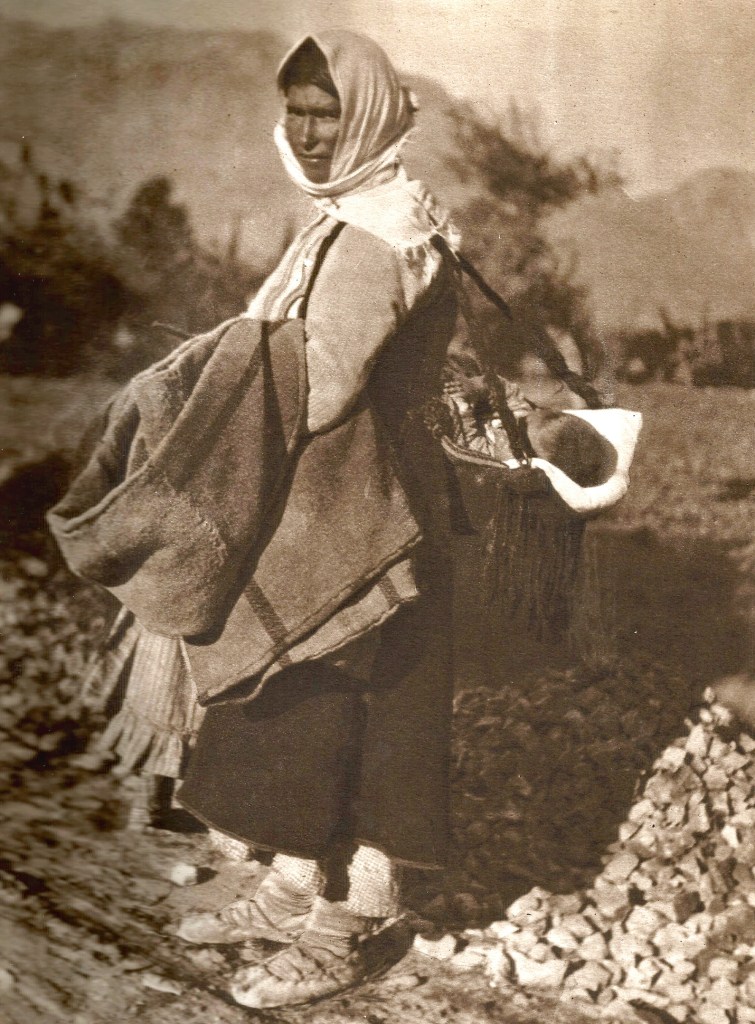
Wikimedia Commons and Lakoniki Bibliothiki
Χωρική της Σπάρτης 1929. Στον ώμο έχει την νάκα με το μωρό
Από το βιβλίο του Francesco Perilla, Mistra. Histoires franques-byzantines -catalanes en Grèce = notes d’art et de voyages (Athènes 1929)
Immediately after the birth they did not wash the baby, but cleaned it with cotton that was saturated with warm water and put powder on it. For the first bath of the baby, the midwife put salt in the water, so that the child would not become “unsalted”, meaning probably insipid, bland. The new mother was not supposed to left alone in the house, at least for three days, as it was believed that new mothers, because of the impurity of childbirth, were under the influence of demons.
It was believed that on the third day after the birth, the Fates would come to determine the child’s luck. In many places, in order to appease the Fates to predict a fate of good fortune for the child, a plate of bread, honey, nuts and sweets would be placed by the mother’s bedside so that the Fates could take it themselves. If it was necessary for the mother to be left alone, they would place under her pillow incense, bread, an icon, a cross, a holy flower, a bit of holy water or a little kid by her, because of the belief that small children have a deterrent power.
When the baby was forty days old, the midwife would take it together with a small child and they would go to the church to get blessed. If it was a boy, he would be taken to the chancel (the altar area). The baby was usually swaddled so it would not hunch and it could stand upright and strong. For the best wishes, they made sweets, diples if it was a boy, in order to double itself or kouriambiedes and ravani for the girls. Relatives brought sweets or a silver coin.
The couple usually preferred to give birth to boys, so that the family (soi) could continue (male preference). Instead, girls needed a dowry and a lot of attention during their upbringing, so they had to live with limitations so as not to be given a bad name.
Many customs are common in many regions of Greece and some of them have their roots in antiquity.
I am honored to receive permission from the Katsoulakos family to translate and share articles from The Faris. Translation verification and corrections have been made by GreekAncestry.net. This is the fourth article of the ongoing series. Previous articles can be viewed here.



 Spartan Roots (Σπαρτιατικές Ρίζες)