Free Access to MyHeritage Greek Records on Sunday, June 28 and Webinars

Tomorrow on June 28, 2020, MyHeritage is offering free access to its three Greek record collections which can be accessed at these links:

Sparta Marriages, 1835-1935

Vlachogiannis Election Rolls (complete collection) 1863-1924

Corfu Vital Records (Birth-Marriage-Death) 1841-1932

There will be two events where Gregory Kontos and I will discuss these records. Access to the events is free, and will be broadcast through the MyHeritage FB page. 

The first is Sunday, June 28, at 2:00 EDT. We will give a brief overview of the collections and answer questrions.  UPDATE:  This session was recorded and can be viewed here.

The second is Tuesday, June 30, where we will discuss these records in more depth. UPDATE: To view the webinar, click here.

EXAMPLES OF RECORDS

Sparta Marriages 1835-1935  includes images of the Marriage Index book of the Metropolis of Sparta, and any documents associated with the marriage. An example is below. Note that there are 5 documents for this marriage. Some marriages have more documents, some (especially ones in the 1800s) may have only the index book:
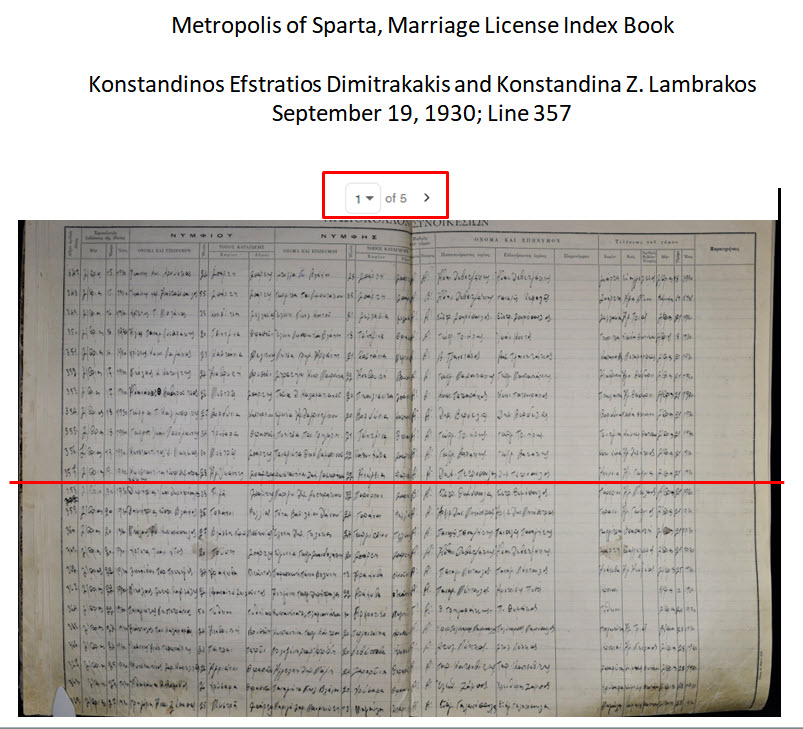
Page from Marriage Index book of the Metropolis of Sparta

Letters between village priest and bishop, requesting and approving marriage

Municipal record and marriage affidavit

Vlachogiannis Election Registers, 1863-1924   This collection comprises names of men eligible to vote in all areas of Greece. Sometimes, there are two lists for a village that are one or two years apart. This allows the researcher to compare information on an individual, as the example below shows.

1872, line 1975: Panag. Pappagiannakos, age 31, father: Nikolaos; occupation: landowner
1873, line 2146: Panag. Papagiannakos, age 32, father: Nikolaos; occupation: landowner

Corfu Vital Records, 1841-1932   Birth, marriage and death records are primary documents of crucial importance. This collection is comprised of civil records from the island of Corfu ( Kerkyra /Κέρκυρα).

Marriage and birth documents, Corfu

Finding Greek records on the MyHeritage website is exciting, but having a family tree on the site makes the hunt even easier–the algorithms of the website will provide record hints and do the research for you! As you confirm matches to records, the algorithm is refined and will become even more exact. Record matches can come from any collection in the MyHeritage database and from the millions of names in its family trees.


Take the opportunity to browse these records for free tomorrow, and to join Gregory and me for the webinars to better understand the important information in these rich collections.

How to Navigate the State General Archives of Greece Website for Digitized Images

The website of the General Archives of Greece has a specific area where digital images are being uploaded:  http://arxeiomnimon.gak.gr/index.html.  This site is not easy to navigate, but with patience and the help of an English translation button on the right side of the website, it can be done.

A pdf file with step-by-step directions can be accessed here.

As can be expected, most of the files are in Greek script. However, there is a valuable collection of Electoral Rolls from the late 1800’s which has been typewritten in Greek — and the names are easy to read. This collection contains lists of men who were eligible to vote. It is sorted by Nomos (County), then Districts and Municipalities. Instructions for accessing this collection titled “Election Materials from the Vlachogiannis Collection” is found at the end of the document. A direct link to this collection is: http://arxeiomnimon.gak.gr/browse/index.html?cid=586603

A sample page of the Election Rolls is below. The Nomos is Lakonia, the village is Agios Ioannis (Sparta). The columns are:  1: line number, 2: first and last name of the voter, 3: voter’s birth year, 4: name of voter’s father, 5: voter’s occupation.

My great-grandfather, Panagiotis Papagiannakos, is on line 1975.

1872 Electoral Rolls, Agios Ioannis, Papagiannakos

1872 Electoral Rolls, Agios Ioannis, Panagiotis Papagiannakos, line 1975


The Gift of Translation

My focus is laser-sharp and my time is impeccably calculated as I prepare for an upcoming research trip to Sparta, Greece. I’ll be joined by my daughter and granddaughters for a week of sightseeing in Athens, Sparta and Patras. When they return home, the serious part of my travel begins. With my colleague, Gregory Kontos, I will journey again to Sparta where we will spend several days at the Archives and Diocese, combing through aging records of old Greek script to find my people.

Reading foreign records is a barrier to most peoples’ research, and it surely is in mine. There are limited records available from Greece. Some are found on the website of the Greek General State Archives (GAK); some have been microfilmed by FamilySearch. When I first broached these documents, panic hit. I saw familiar letters formed into unfamiliar patterns—names, places, occupations and descriptions that I could not read, despite my elementary knowledge of the language.

General Archives of Greece, 1872 & 1873 Election Rolls, Lakonia 1872- File 25, Image 433, line #1975; 1873 - File 25, Image 483, line #2146 Panagiotis Papagiannakos, age 33/34, father: Nikolaos, landowner

General Archives of Greece, 1873 Election Rolls, Lakonia
1873 – File 25, Image 483, line #2146
Panagiotis Papagiannakos, age 32, father: Nikolaos, landowner

For a brief time, I turned away and focused on tracking my immigrant family in the U.S. Until…I picked up the scriptures and read the words of the Apostle Paul in 1 Corinthians 12:1-11:

Now concerning spiritual gifts….there are diversities of gifts, but the same Spirit….For to one is given by the Spirit… divers kinds of tongues; to another the interpretation of tongues….

I felt an instant uplift as these words registered in my mind:  because the “interpretation of tongues” is a gift given by the Spirit, I can choose to accept this spiritual gift and use it in the temporal work of genealogy research.

With renewed enthusiasm, I found my old Greek language books, downloaded a Rosetta Stone app, and went to work. Soon I was able to read the names on records that are typewritten:  Election Lists, Juror’s Lists, and Military Rolls. For those that are handwritten, I needed help and I found it online. Through Facebook, blogs and websites, I have connected with the Greek community and we assist each other. Gregory is helping me by reading the handwritten records I cannot interpret. As I look at his extractions and translations, I am slowly (very slowly) learning how my surnames are composed in script. I am hopeful that by the time I go to Sparta, I will be able to recognize these names in the old records.

Eftaxias, Ioannis

General Archives of Greece, 1843-44 & 1861-62 Election Rolls, Lakonia
File 22, Image 62, Line 239, Mystras
Ioannis Eftaxias, age 35, from Mystras, owns property; gardner

There will come a day when almost every researcher will need to access foreign records. Online help, both through social media and websites, is the key. Look for blogs and Facebook pages that are country-oriented:  FamilySearch has 106 community pages on Facebook, one for every U.S. state and 56 countries. There are handwriting guides and foreign language research outlines online at FamilySearch, Ancestry, and other websites.  MyHeritage.com supports 39 languages and is heavily used by people outside the U.S.

My first visit to Greece in 1996 was during the era when research was constrained by time and money. Now, the internet has brought records literally to my fingertips. As I use both temporal and spiritual resources, my family history success increases. With a combination of faith and fortitude, I am prepared for my upcoming trip in a way that was unthinkable fifteen years ago. I recognize that I have been given a spiritual gift to perform a temporal work that is important to the Lord and to my family. For this, I am eternally grateful.