Beyond the Basics: 1821 Aristeia Online Archive

The Revolution of 1821, or the Greek War of Independence1, ended 400 years of Ottoman rule and launched the democratic modern Greek state. Although there is not an exact count of the number of men who participated, we do know that the revolutionaries were organized into militias and guerilla groups which were organized at the local level.

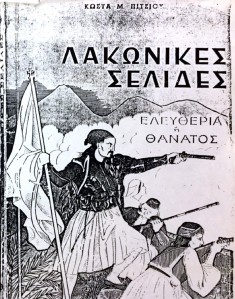
Those who fought came from all areas of Greece. They were shepherds and farmers, businessmen and professional men from all walks of life. These men were our ancestors. This book by Kostas M. Pitsiou is one example of an author’s attempt to document the fighters from Lakonia. It was published in Athens in 1971; most likely it can be found in Greece at libraries or bookstores that carry out-of-print books.

Fighters who exhibited excellence in service were elible to receive an award (see this post for details). There were three levels:
1st:  silver medal  — αργυρό μετάλιο
2nd:  bronze  medal —  χάλκινο μετάλιο
3rd:  iron medal  — σιδήρου μετάλλιο

The names of men who received an Aristeia Award for their service are preserved in many thousands of files held by the Greek government in Archives and the National Library. It is a daunting task for researchers to access these files and categorize their holdings. However, there is an online database with some Aristeia Award files that have been digitized. This database can be accessed at: https://1821.digitalarchive.gr/archive.2

A step-by-step guide on searching this 1821 Digital Archive follows.

  • Go to the website: https://1821.digitalarchive.gr/archive.
  • On the left side of the page, click on “Advanced Search.”
  • Check the box, “Documents,” and uncheck the boxes for Art, Songs, Books.
  • In the search box, type a surname in Greek. NOTE: The name must be spelled correctly or the search will yield no results. Example: the surname of Gritis–if spelled Γρίτις, there are no matches. It must have the correct spelling of Γρίτης.
  • Click on the magnifying glass icon to start the search.
  • If there is a result, the name will be in red on the right side.
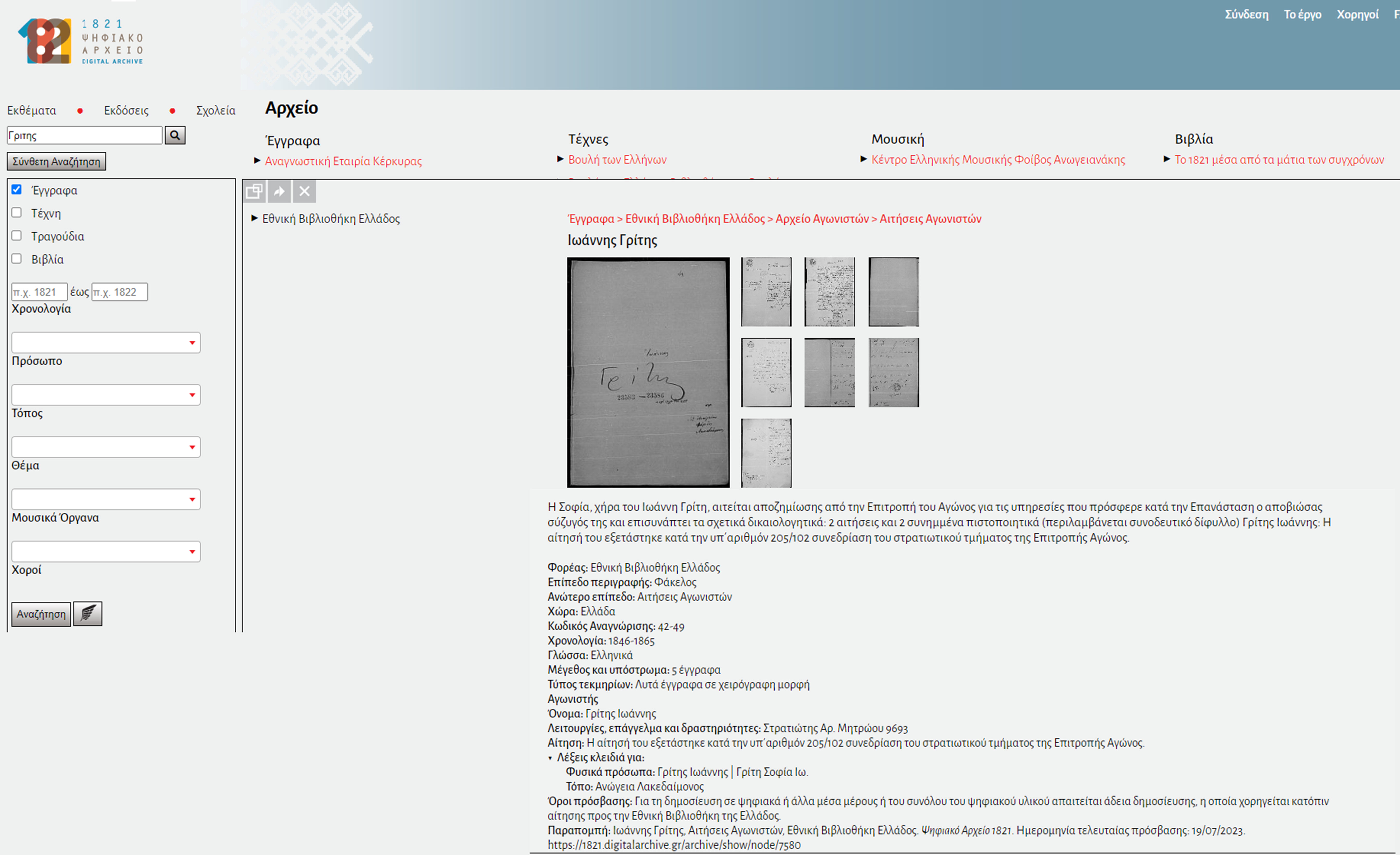
For the surname Gritis, there is one result, for an Ioannis Gritis.
  • Click on the name in red to open the file.
Record of Ioannis Gritis includes digital copies of the file and a description.
  • Use an onlineTranslate extension to copy the description in English (I have Google Translate installed as a browser extension; I also use DeepL).
  • Look carefully at the description. A synopsis of the file is at the top. Towards the bottom, you will see the word “Place”. This is critically important, as it gives the residence of the fighter so you can correctly identify if this person is the one of interest.
  • The very last line of the description gives a URL. This is the URL to this exact page. For Ioannis Gritis, the URL is: https://1821.digitalarchive.gr/archive/show/node/7580. Be sure to capture this in your notes.
The file for Ioannis Gritis, translated using Google Translate extension. Note the Description and the Place.
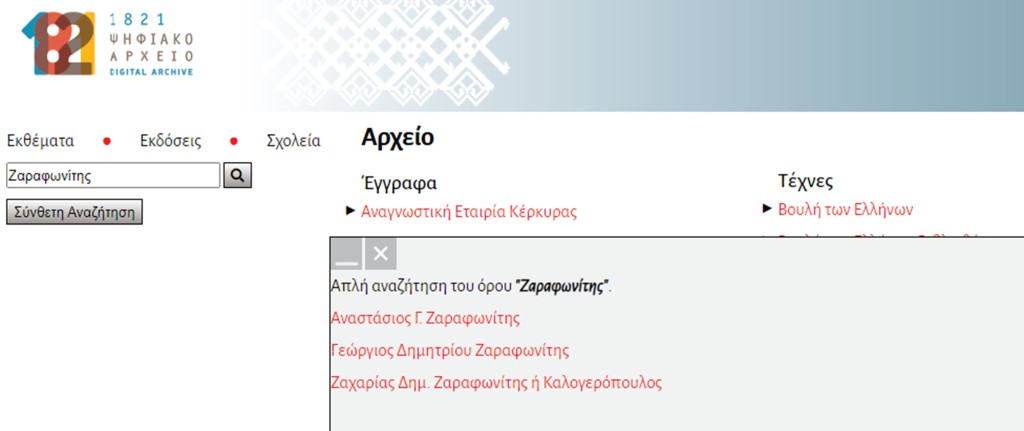
  • In a search on the surname of Zarafonitis / Ζαραφωνίτης, there are three results. I cannot assume that all three are people of interest to me. I must pull up each file and read the Description, then look at the Place, to determine if any of these are from my area.
Zarafonitis – 3 results: are any of them mine?
Anastasios Zarafonitis is from Hydra – no
Georgios Dimitrios Zarafonitis is from Sklavochori (Amykes) – this is mine!
Zacharias Dim. Zarafonitis or Kalogeropoulos is from Kranidi – no
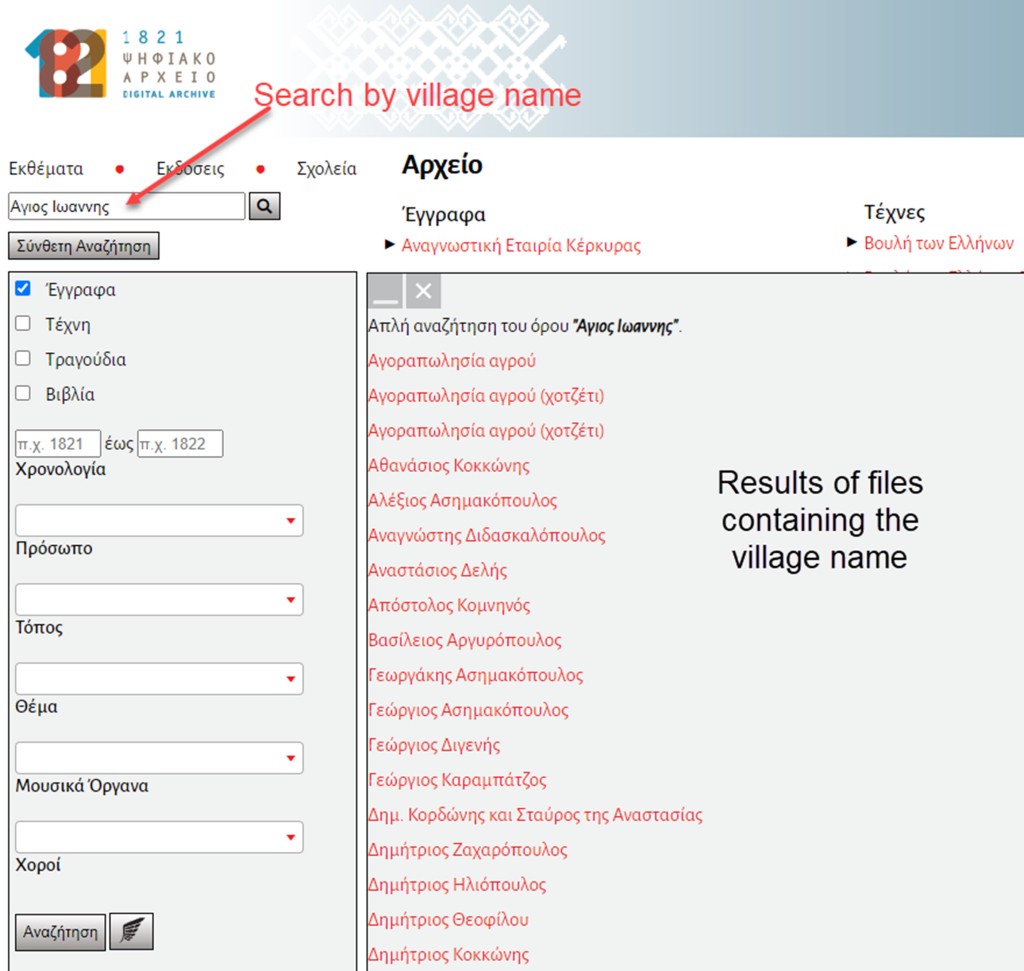
  • SEARCH BY VILLAGE: Another option in the “search” box is to type the name of a village, not a surname. If there are files for people from that village, they will appear in the results.
The village of Αγιος Ιωαννης is typed in the search box; results are in red on the right

When you find a file of interest, you must download the images. The URL at the top of the page will not take you back to this exact page.

In summary:

  • The files on this website are strictly for men who received an Aristeia Award. Not everyone who fought received an award.
  • Only some files are digitized. If you do not find a name, do not assume the person does not have a file.
  • Files can be accessed at the National Library, but you must have a researcher’s card and make an appointment to view the files. You must know the exact name and file number of the revolutionary to access his paper file.
  • Remember to download all images. Translate and copy the Description and keep it in the folder with your images.
  • If you know that a revolutionary received an Aristeia Award, keep checking the website. Hopefully the file you are seeking will eventually be digitized.


1Wikipedia, Greek War of Independence. An online search yields hundreds of articles and books on this subject.
2Many thanks to Gregory Kontos of Greek Ancestry for finding and sharing this link.

A Chance(?) Encounter in Lagia

What are the chances that a document which reveals an abstract branch of your family is given to you by a stranger? That’s exactly what happened to me on my recent journey to visit the ghost town of Vathia.

There is only one road that connects Sparta with Mani. Much of it follows the seaside of the Laconian Gulf, traversing through quaint villages and along scenic coastlines.This was the only way for me to reach my destination.

I stayed overnight in a lovely renovated tower house in Kokkala. The sea view was spectacular and the architecture and history of the towers always captivate me. This was the perfect place to stop on this journey, to rest and to soak in the beauty of Mani.

Charming Kokkala

The next morning, I hit the road and with my sights set on Vathia. No stops were planned, and no side trips were considered. My focus was to spend as much time as possible in the ghost village, then return that night to Sparta. But along the way, I got sidetracked. About 1/2 hour south of Kokkala, I rounded a corner and there appeared a charming tower village nestled in the mountains. Lagia.

Approaching Lagia

I hopped out to take photos, thinking that I would just breeze through the village and keep going. But when the road led into the plateia, there was something about the village that enticed me to stop. I parked the car and started walking.

Views from the plateia of Lagia

The streets were deserted and the quiet of the village exuded a sense of tranquility. The imposing stone houses were of traditional Maniate style.

As is customary, the church, Koimisi tis Theotokou, was situated adjacent to the plateia. I went inside.

Koimisi tis Theotokou Church on the plateia
Church interior. I lit a candle for my ancestors (lower right)

My heart was touched when I read a sign that was posted on the small icon stand situated at the entrance. It read:

Welcome to the Holy Temple of our village “Lagia.”
Look around you and visualize freely the hard efforts of our ancestors,
within a rough place with different values, principles and under adverse conditions,
who managed to complete the construction of this gorgeous Church.
This Temple was constructed before 200 years with the full participation of the local men and women, with building materials gathered from the surrounding mountains of the village and carried on their backs and shoulders.
It was built with main purpose the reconciliation and peace between the families of the village, as during that period of time confrontations, conflicts, frictions, disputes, and vendettas dominated the area.
It replaced and gathered under its protection all the local family churches, at about 30 small and picturesque, which were scattered all around between alleys, traditional towers and fields.
Support warmly the effort for the continuation, conservation, preservation, improvement and progression of this harbour of Love, Hope and Faith.

I became emotional, and I still don’t know why these words penetrated so deeply into my soul. Was it was the message of reconciliation and the fervent desire for peace? Was it the unity of 30 disparate church communities? Was it the sacrifices and the physical toil of the people to build this temple? Whatever it was, I was transfixed by Lagia.

Cafenion, at the plateia

I was not ready to leave the village. As I walked around the plateia, I noticed three men sitting at a table at the cafenion. Normally I don’t start conversations with strangers, but something prompted me to do so this time. I said, in my very broken Greek, “You live in a beautiful village.” Their faces lit up, and the questions came: What is your name? Are you Greek? Where are your people from? When I told them that my family was from Sparta, the discussion grew quite animated. They asked for my surnames and as I responded, they commented on each one.

Kostakos? That name is found farther south, in Pakia (I knew that, but it’s a different family with the same patronymic surname).
Papagiannakos? Not in this village.
Eftaxias? That is an old family name found here.

That stopped me. I recalled that some years ago, my Eftaxias cousin in Mystras mentioned that there was a branch of the family in Lagia. Was it true? As my mind debated a possible connection, one of the men said, “We have a book inside that you should see.” He disappeared, then returned and handed me a spiral bound notebook.

The Male Register (Μιτώον Αρρένον) of Lagia, 1839-1888

I couldn’t believe what I was holding. It was the Male Register of Lagia, a list of every man born in the village during the years 1839-1888. I was given permission to photograph it, and I have made it available in a pdf file which can be downloaded here: Male Register of Lagia 1839-1888.

Year 1882, line 124
Eftaxias, Michail, father: Panagiotis, born in Lagia.

My cousin was correct. It was our family that was in this village. There was only one Eftaxias listed; he was found in the year 1882, line 124: Michail Panagiotis Eftaxias born in Lagia.

I am now able to correlate this family with previous but uncorrelated information found: Michalis Eftaxias from Lagia fought in the Revolution of 1821. He had a son named Vrettos, and Vrettos had two sons: Michalis (born 1826) and Panagiotis (born in 1832).1 Panagiotis, named above as the father of Michail, was the right age to be the son of Vrettos. With only one Eftaxias in the village, it had to be the same family. When I returned to Sparta, the Archive office gave me the Town Register for Eftaxias in Lagia which further documented this line.

I know that serendipitous things happen when you travel to the land of your ancestors and follow your instincts. Yet, whenever they do, I marvel that people are prompted to be in certain places, at certain times, to fulfill certain reasons. It is my hope that chance encounters, such as this, will also happen to you.


11875 Election Register of Lagia

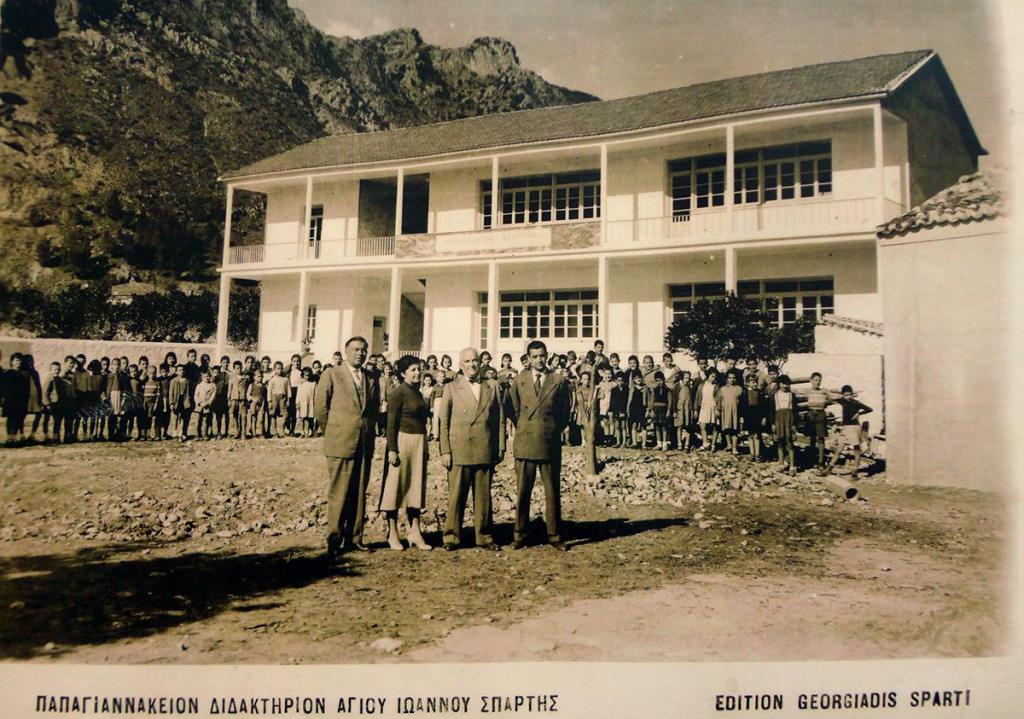
Papagiannakos School of Agios Ioannis, Sparta

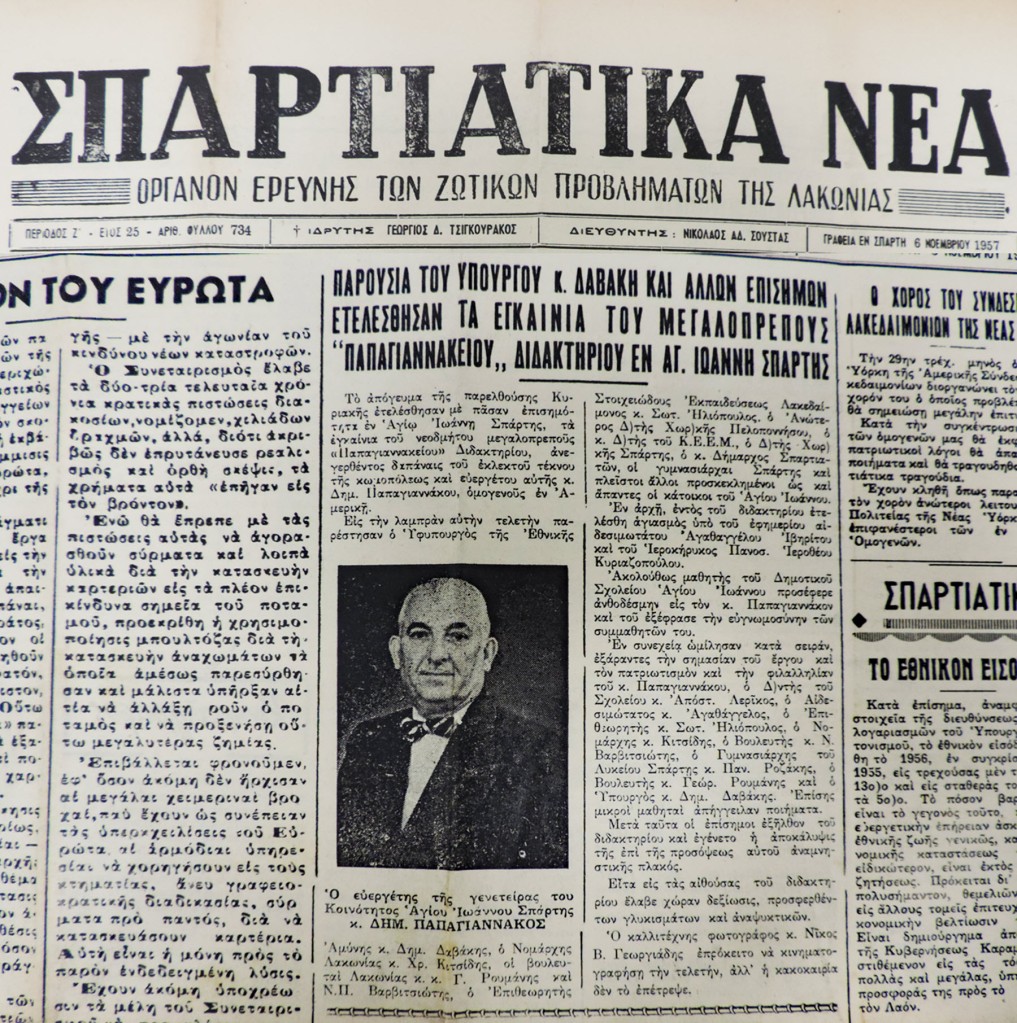
Spartiatika News, November 6, 1957

IN THE PRESENCE OF THE MINISTER MR. DAVAKIS AND OTHER DIGNITARIES, THE INAUGURATION OF THE MAGNIFICENT PAPAGIANNAKOU SCHOOL IN AGIOS IOANNIS SPARTIS WAS HELD

(Thank you to Panorea Kostakou of Agios Ioannis, who found this newspaper article)

(Online translation by Carol Kostakos Petranek. Please excuse errors)

On the afternoon of last Sunday the inauguration of the newly built magnificent Papagiannakos School was solemnly held in Agios Ioannis of Sparta, erected with the help of the chosen son of the town and benefactor Mr. Dim. Papagiannakos, an expatriate in America.

In attendance at this glorious ceremony were the Minister of National Defense Mr. Dim. Davakis, the Governor of Laconia Mr. Chr. Kitsidis, councilmen of Lakonia Messrs. G. Roumanis and N.P. Varvitsiotis, the Inspector of Elementary Education of Lacedaemon Mr. Sot. Iliopoulos, the Senior Director of the Peloponnese, the Director of the K.E.E.M., the Director of Sparta, the Mayor of Sparta, the high school students of Sparta and many other guests as well as the residents of Agios Ioannis.

At the beginning, holy water was administered inside the school by the Reverend Agathaggelou Ivyritou and the priest Panos. Ierotheou Kyriazopoulou.

Subsequently, a student of the Agios Ioannis Primary School offered a bouquet of flowers to Mr. Papagiannakos and expressed the gratitude of his classmates.

Then they spoke in turn, extolling the importance of the work and the patriotism and philanthropy of Mr. Papagiannakos. Afterwards, the Principal of the School, Mr. Apost. Lerikos, the Reverend Mr. Agathaggelos, the Inspector Mr. Sot. Iliopoulos, the Prefect Mr. Kitsidis, the Member of Parliament Mr. N. Varvitsiotis, the Head of the Spartan High School Mr. Pan. Rozakis, the Member of Parliament Mr. Ger. Roumanis and the Minister, Mr. Dim Davakis. Also young students recited poems.

After this the officials left the school and the unveiling of the commemorative plaque on the façade of the church took place.

Then a banquet took place in the halls of the school, with sweets and refreshments being offered.

The artist photographer Mr. Nikos V. Georgiadis was going to film the ceremony, but the bad weather did not allow it.

Postcard of Dedication of the Papagiannakos School; received from Tasos Papagiannakos
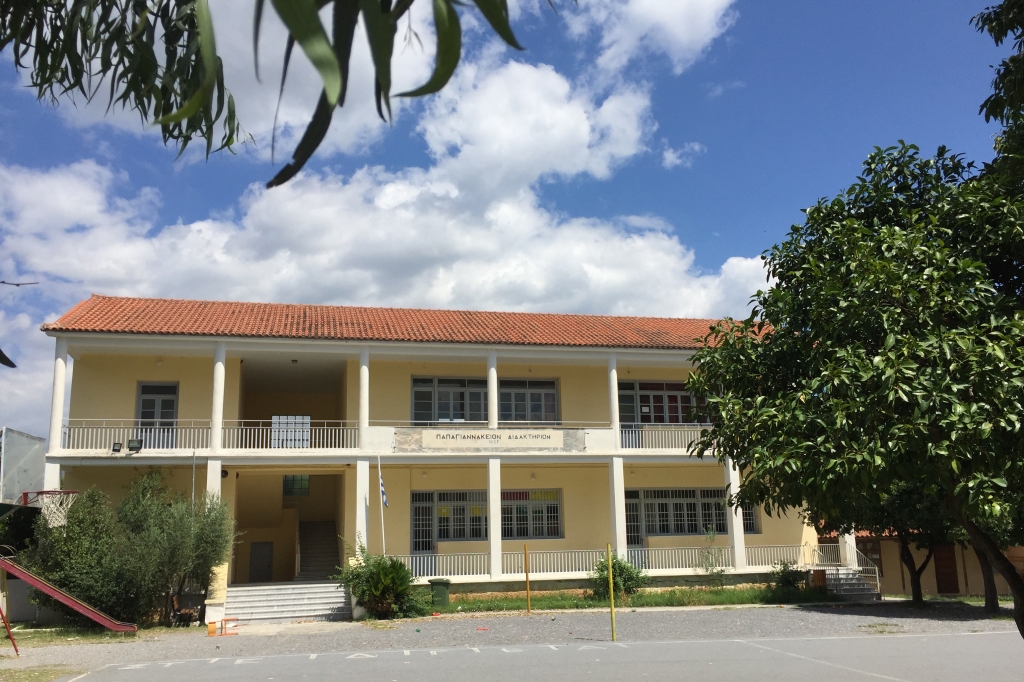
The Papagiannakos School, 2023

Visiting the Villages: Theologos and the Zacharakis Reunion

The road leading to Theologos winds around a verdant mountain, filled with thousands of olive trees. “The trees on this mountain belong to the families of the village,” my cousin, Nikos explains. “Years ago [around the early 1900s], just a few families owned all of these trees. Now, every family has an olive grove.” I stared out the car window, looking for a some type of sign or marker to delineate one owner’s property from another. I saw none. So I asked, “How do the families know which trees are theirs?” Nikos smiled. “Every family known how many trees they have, and exactly where they are.”

At one time, there were two olive processing plants in this small village. In recent years when stricter safety regulations were passed, the facilities closed and people now take their harvest to Sparta.

Left: a former oil processing plant in Theologos; upper right: mountainside with the olive groves of Theologos; center: Dimos Οinountos, Theologou; bottom right: stone used in olive press

The homes of the families are constructed of stone, and they are literally built into the mountainside. Houses remain in families for generations. They are beautifully maintained and constantly being updated with modern conveniences. Living on a mountain means that there are steps everywhere, and they are steep! You can’t leave your house, or enter another, without walking up a flight. The village roads are precipitous and narrow, yet people are adept at maneuvering and parking their cars and trucks. The plateia appears to have the only flat surface in the village.

Houses, steps, and the flat plateia

The village priest, “Papa” Panagiotis Kotsos, presides over the church of Agios Ioannis Theologos. It is incredibly beautiful and filled with historic icons. I was honored to be shown several holy relics, too sacred to photograph. It’s amazing that a small village church at the top of a mountain would have such treasures.

The Church of Agios Ioannis Theologos and its priest, “Papa” Panagiotis Kotsos

What I love most about returning to the village is to gather with my cousins of the Zacharakis family. My great-grandmother, Stathoula Zacharakis, was born in Theologos1. As I researched her lineage, I created a family tree which documents the various branches of the family. Whenever I visit, I bring the “updated” Zacharakis tree which is spread out along the benches at the perimeter of the plateia. People add and correct information, and we enjoy an evening of reunion and reminiscing. It has become a joyful tradition.

Checking out the family tree! June 23, 2023
Back left-right: Antonios Karagiannis, Aggelos Sarantakis, Niki Zacharakis Sarantakis, Asimina Zacharakis, Pepi Vartsaki Zacharakis, Nikos Zacharakis, Panagiota Zacharakis. Front left-right: Ioanna Karagiannis, Panagiotis Karagiannis, Argyro Bebetsos, Anthi Karagiannis, Lygeri Zacharakis Zacharakis, Anastasia Kantzioris, Rozi Kritsepis Zacharakis, John Rakis, Carol Kostakos Petranek, Alexandra Rakis, Konstantina Dariotis Zacharakis, Roula Zacharakis, Pavlos Zacharakis, Amalia Iliopoulos Zacharakis

I love these dear people and am so very grateful for their kinship and friendship. Being together in an ancestral village brings a feeling of generational connectedness. Our ancestors walked these streets, built the churches, and gathered in the plateia. Now it is our turn.


1Previous Spartan Roots posts about the Zacharakis family:
Stories from the Village: Theologos
Putting Together the Zacharakis Family Tree
The Zacharakis Family of Theologos
Greece 2017. Part Six: Theologos
Ioannis Zacharakis, Hero from Theologos

Visiting the Villages: Vathia

Pirates and invaders. Warring clans. Fortified towers. The legends of Vathia are captivating and plunge you into an era of the past. Vathia was built as a fortress to protect its families from hostile attacks. A sign in the midst of this “ghost village” alludes to its history:

My first introduction to the tower villages of Mani was in 2014 when Giannis Michalakakos took Gregory Kontos and me to Vathia. My fascination has not waned, but accelerated. It’s not only the architecture, but also the stories, myths, customs, and traditions of this land that captivate my imagination.

My ancestors were from Mani, as reflected in their surnames and in family stories. Their genesis in this region and their migration north began before the revolution of 1821, as they are in Agios Ioannis, Sparta in the 1844 Election Registers. Because records prior to the Revolution do not exist in the modern Greek state, I cannot trace where, in Mani, they originated. However, every time I come to this region, I feel a metaphysical connection to this land and to them.

The tower houses of Vathia are classic Maniot fortification architecture

These tower houses are owned by families. The size of the tower demonstrated the family’s wealth and standing in the community. They are built close to each other, with small alleys as separations. Most of them are square with two or three floors. The windows are just large enough for guns and armaments to protrude outwards in times of defense. The inhabitants of Mani are legendary for fiercely resisting foreign invasions. They maintained their independence for centuries.

The alleyways of Vathia

During the Ottoman period, Maniots continued to resist Ottoman rule. They preserved a degree of autonomy and the Ottoman beys (rulers) let them be. Maniots were known for their military acumen and martial skills, and their resistance played a significant role in the 1821 War of Independence. As with all Greek villages, monuments to the fallen are found in the plateia, across from the church.

Monument photos courtesy of Nick Santas, whose great-grandfather, Panagiotis Laos, is listed

Names on the War Monument
Top:
Georgakakos, Antonios
Georgakakos, Petros
Exarchakos, Panagiotis
Laos, Panagiotis
Kallidonis, Petros
Lagoudakos, Nikolaos
Feidopiastis, Fotios
Gerakakos, Stavros
Gerakakos, Nikolaos
Lagoudakos, Panagiotis
Syggikos, Petros
Bottom:
Anaroutsakos, Spyros
Mitsakos, Ioannis
Stravokefalos, Michail
Andreakos, Nikolaos
Xypolitos, Michail
Xypolitos, Panagiotis
Kallidonis, Leonidas
Aggelakos, Aristeidis
Xypolitos, Vasileios
Giannakakos, Panagiotis
Koutrigaros, Antonios

Maniot families evolved from clans which controlled various regions. There are many stories written about the loyalty and protection that clans provided for their families. Conflicts between clans were common, and some clan wars continued for years. This article provides historical background and names of the clans of Vathia.

Bright spots of color amidst the stone towers

After Greece gained independence from the Ottomans in 1830, Vathia, like other parts of Mani, experienced a decline in its strategic importance. The tower houses gradually lost their defensive purpose and many fell into disrepair. Around 1950, after World War II and the Greek Civil War, families left rural areas to reestablish themselves in urban areas where economic opportunities existed. People abadoned their tower homes for Kalamata, Sparta, and Piraeus. By 1960-1970, the village was deserted.

I asked my friend, Giannis Michalakakos, local historian and author of the Maniatika blog, if the tower houses would ever be restored, especially with the current surge in tourism that Mani is experiencing. His answers helped me understand both the complexities of this issue and the culture of the society.

Homes are primarily abandoned because of financial considerations:
• It was common for many members of a family (cousins) to have partial ownership in a tower; sometimes as many as 40!
• If many parties had an interest in a house, and one person wanted to be the sole owner, he would have to have enough money to buy out all the other parties.
• If a person wanted to restore an abandoned home, he may have to buy out others who would have to agree to sell it, AND spend a lot of money to refurbish the home. Therefore, if financial matters were a concern, it is easier to just abandon a home than to deal with ownership and renovation issues.
• To sell a house to an outsider of the family, a title is needed. Years ago, oral agreements were made within and among families when buying, selling or partitioning a house. In times past, a man’s word was his honor and official documents were not required, nor were they needed. Such transactions occurred in the local cafenion (coffee house), where witnesses would attest to the validity of the agreement and be called upon if there was ever a conflict.
• There may have been a past agreement, still in full force, that a house would never be sold.
• If a house was renovated strictly for tourism, that season is short and the family would need other sources of income. In the area of Vathia, that does not currently exist.

This explanation made sense, but it also made me sad. Such an area, so rich in history and so incredibly wild and beautiful, should be renovated and preserved. The complications above make this difficult now, but in the future there may be resolutions that are not currently available. It is my hope that this will be.