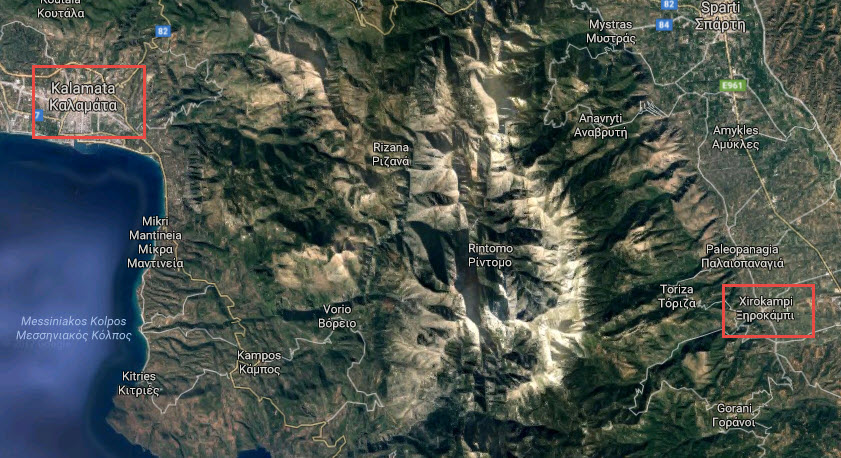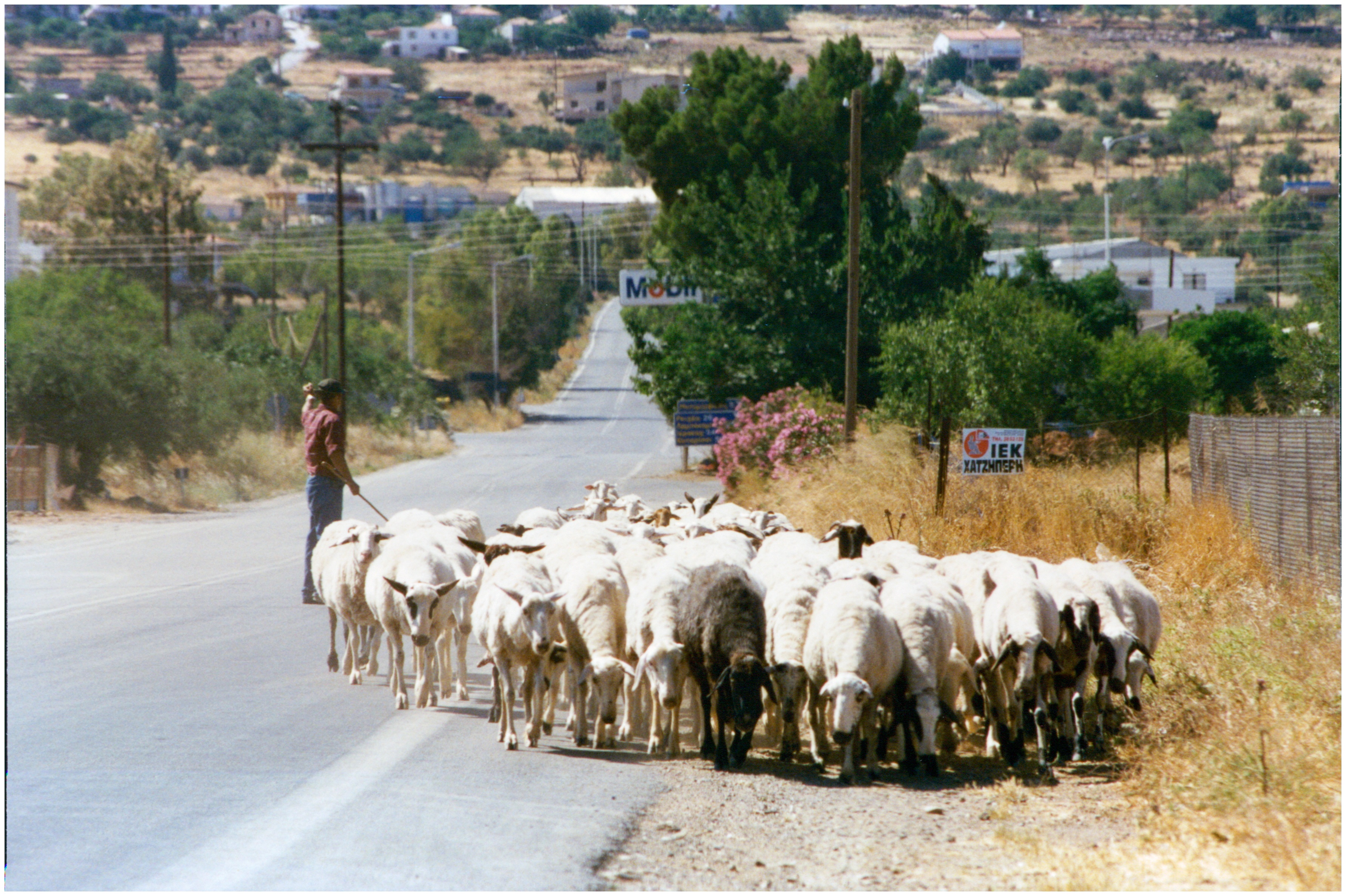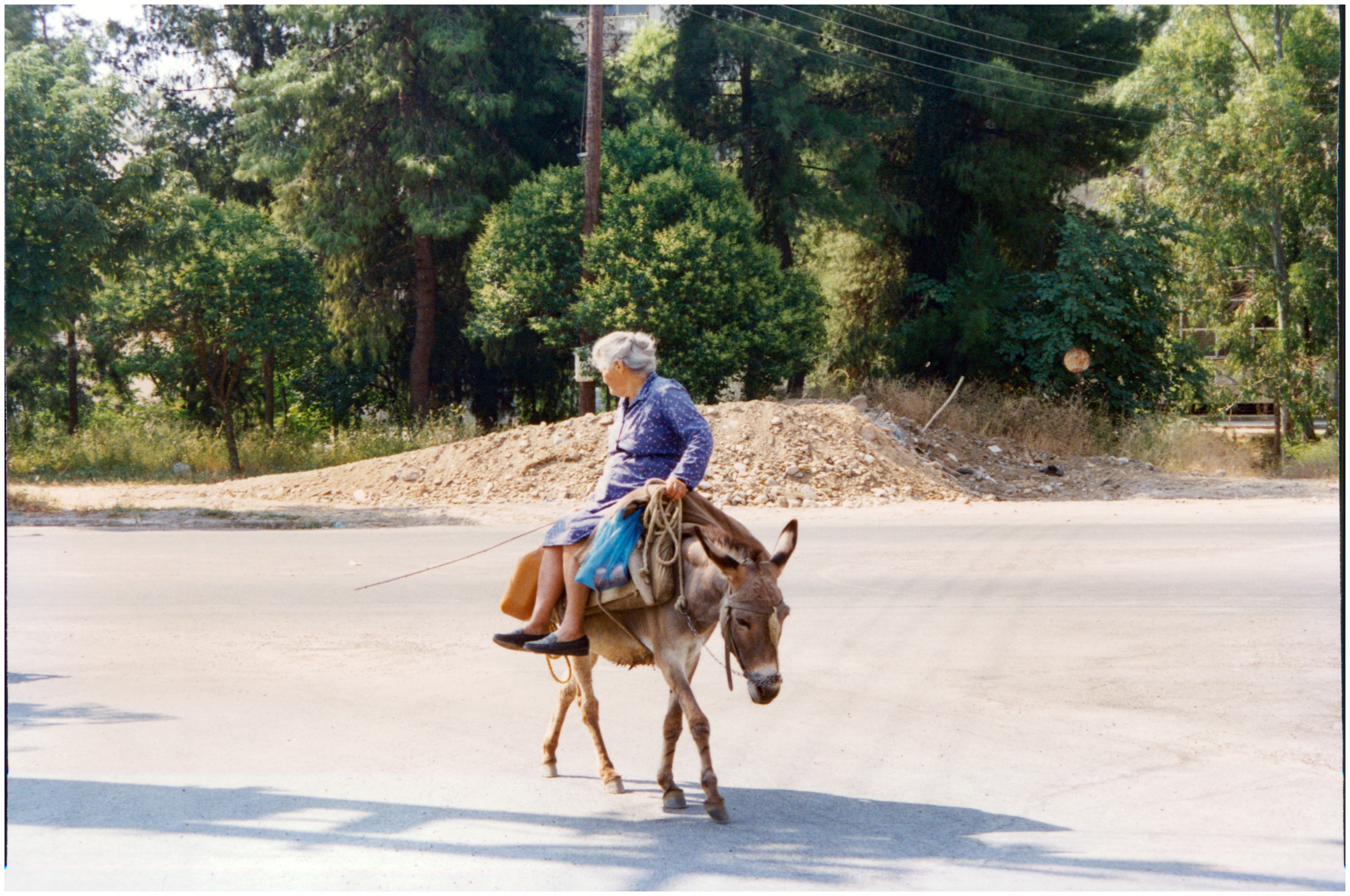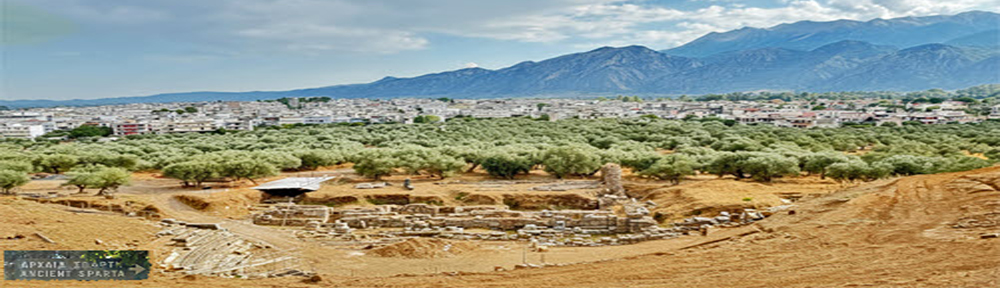
“Light-Water-Telephone” in Xirokampi; Part 2: Water

by George Theoph. Kalkanis
published in The Faris Newsletter, Issue 62, July 2015, pages 3-6

(Note: this post, “Water” is the second of three parts describing the earliest modern developments in Xirokampi. Part 1: Light, can be read here.)

The construction of a complete network of drinking, running water with pipes in the village was attempted and completed in the 1960s or even the early years of the 1970s, during the presidency, initially of Georgios Koumoustiotis and then of Nikolaos Koumoustiotis. It was preceded by the construction of a small stone tank, under the presidency of Ioannis Karambelas and Efstratios Skouriotis, at the highest point of the village, at the exit of the Anakolo gorge. There, the water was collected with metal pipes from many small springs – such as Sotiritsa – that were expropriated by the state.

Initially – in 1953 or 1954 – “public” taps with brass spigots were installed in central points and in the large neighborhoods of the village. The network, made of metal pipes, did not supply these taps with water around the clock, due to its inadequacy. Thus, the sight of long lines of women with buckets, jugs  or pitchers and wooden water barrels (. . . ) was a daily occurrence, from dawn. It was there that the women informed each other about the news of the village. 

However, the public water fountains made the life of the villagers so much easier, that today’s children cannot imagine. Until then, the transport of drinking water was carried out by springs [“αμπουλάδες”] which gushed with a natural flow in the banks of the Rassina, from a small spring on the right bank of the Anakolo – at the height of the “Komnini” small lake; but also (after the middle of the 19th century) from wells dug in the village, at a depth of 4 or 5 meters, in various places: Iatrideika, Feggareika (of Kalamvokis or Magganiaris), Volteika, Poulakeika, Rassina (of Aivaliotis), Liakeika … All of the wells were communal. Of course, with the operation of the wells, the springs gradually dried up, since the underground water level went down due to constantly increased consumption, especially during the 1960s.

With the completion of the network and the replenishment of the reservoir, water reached every house in 1961 and 1962. But the process was long, arduous and costly. Trenches in the streets had to be opened with a pickax and a shovel. Pipes had to be bought, transported, placed and connected together. Then, the local handymen worked as plumbers in the public network and in the networks inside the houses:  Giannis Chatzigeorgiou, Stavros Argyropoulos, Michalis Tsapogas and Elias Christopoulos. To deal with the large expenditure, the community rulers resorted to the then common measure of compulsory (co-)contribution from the inhabitants – alternatively or additionally – of money or oil, personal labor or the labor of their animals for the transport of the pipes and materials. Each family was estimated to bear the cost of 10 meters of the network.

The consequences of the construction of the water supply network were, of course, crucial for the quality of life of the inhabitants, but they also had secondary, controversial results. Horticultural production increased, but it was also necessary to transport water even from Taraila, bypassing the route of centuries and reducing the underground water. Undoubtedly, however, the project was large and innovative for its time, it improved the life of the inhabitants and attracted new residents from the surrounding villages, being one of the strongest incentives for them.

Part 3 of this series, The Telephone, will be published next.


I am honored to receive permission from the Katsoulakos family to translate and share articles from The Faris. Translation verification and corrections have been made by GreekAncestry.net. This is the ninth article of the ongoing series. Previous articles can be viewed here.

“Light-Water-Telephone” in Xirokampi

by George Theoph. Kalkani
published in The Faris Newsletter, Issue 62, July 2015, pages 3-6

(Note: this post, “Light” is the first of three parts describing the earliest modern developments in Xirokampi.)

The “Light-Water-Telephone” of the title of this article refers (as older people will remember) to the -advertised by the radio at that time – conditions that a region of the country in the 1960s and 1970s had to have for the arrival of new settlers. At that time, networks of electricity and water supply did not exist in all areas, let alone their coverage by the telephone network of the national telecommunications organization, OTE.

Of course, this article refers only to Xirokampi and in particular to the first supply of electricity and drinking water to its houses and shops through networks, as well as to the first connection of the houses and shops with the country’s telephone network. Previously, only one public telephone in each village was connected to the telephone network, or even formerly, a teletype or telegraph. It is noteworthy that light and water “arrived” at the houses and shops of our village much earlier than in other areas of our prefecture, thanks to the initiative of the residents and the progressive community leaders.

Electric light, running water in the houses, and the telephone were decisive factors in the development of our village (as well), but also in the improvement of the quality of life of its inhabitants (as well as all the villages in our region).

Part One: The Light

Xirokampi was illuminated for the first time with electric light in 1937. The direct electric current was provided by a 110-volt, diesel-powered electric generator. It was installed by Achilleas Galatis, after a bidding auction held by the community in 1936 during the presidency of Nikolaos Psyllakos, with a predetermined price ‘per Ω x B’ (Hour x Watt).

The generator was initially installed in a building of the sister of Tsigalis (next to the house of Nikolas Mavroidis) and later in a building of Solomos near the church of Agia Triada (where there is now the Hotel Taleton). At that time the operation of the generator was taken care of by the son of Achilles, Takis Galatis.

The “Galatis factory” – as we called it – operated for limited hours around the clock. The limited power of the electric generator as well allowed the lighting of only the square and some streets – mainly at intersections – in the evening hours. It also ensured the electric lighting of shops and houses, but not the operation of devices other than light bulbs. Of course, for several years there were also oil lamps in the shops and houses that were supplied with electricity from the Galatis factory, since the breakdowns of the generator were frequent and the intensity of the light was not constant.

The generator was initially installed in a building of the sister of Tsigalis (next to the house of Nikolas Mavroidis) and later in a building of Solomos near the church of Agia Triada (where there is now the Hotel Taleton). At that time the operation of the generator was taken care of by the son of Achilles, Takis Galatis.

In many shops—like my father’s pharmacy, I remember—there were for several years lux oil lamps with beck and “bubble” from asbestos—which they pumped up from time to time—since they gave off a strong white light and inspired more trust and confidence. On the contrary, many traders who set up their stalls in open spaces or shacks – as at the village “panegyri” – as well as the “karagiozis” puppeteers (καραγκιοζοπαίχτες) used burning acetylene (a flammable gas derived from the combination of water and the common mineral calcium carbonate) which gives a strong white light but also has a “pungent” smell. But for several years, common kerosene lamps and traditional oil lamps would continue to illuminate most homes with their “shimmering” but cozy light.

The time when the electric lights were switched on before dark was a milestone for life in the village. The instruction of mothers to children who played in the streets and “forgot” to return home was typical: “gather when the lights come on” … But also many things had to be finished “before the lights went out” around midnight. There were usually warning continuous and brief power outages. Sometimes not. Galatis, in addition to regulating our lives and our habits in the evening hours, had also created in his “factory” a “gathering place” for people of the neighborhood, with conversation and games until late at night.

It should be noted that diesel-powered electric generators were operating in Xirokampi even before 1937, supplying power to limited business units, such as the oil press and mill of Stratigis Solomos (near Agia Triada) and the Christakos brothers’ carpenter’s shop (in the village market).

The generator of Galatis supplied the village with electricity until the beginning of the 70’s – in 1963 – when Xirokampi joined the PPC network exclusively and the electricity came from far away – from Ladonas (!) as we used to say. Then many local and foreign crews, working for months, changed all the wires in the streets and houses, as imposed by the new voltage of the network (220V instead of 110V). The work was hurried and the laying of the new lines was done on the walls, without digging. Copper wires insulated with waxed cloth were passed through spiral tubes of thin sheets of lead or bakelite that were nailed to the walls. From the local crews who worked on the installation of the new lines, we remember those of Theodosis and Pantelis Giannakas, Christos Hadjigeorgiou (or Fouras) and Konstantinos Papadakos (or Paschalis). On the contrary, the PPC crews who transported and installed the wooden logs to replace the older small “columns” of the network were mainly composed of non-local workers. The porcelain current insulators that some people secured were used as decorations in their homes for many years and were—or still are—used in offices to hold papers with their great weight.

After Xirokambi, the electricity supply from the PPC network was gradually extended to the surrounding villages. The wait and longing for electric light was long, so the joy of the inhabitants was great. An incident told to me by my classmate at Xirokambi High School, Kostas Dim. Plagiannis from Goranοi, is characteristic. When his bedridden elderly grandmother saw the light bulb in her room turn on, she crossed herself and died.


Note: Part 2 of this series, Water, will be published next.


I (Carol Kostakos Petranek) am honored to receive permission from the Katsoulakos family to translate and share articles from The Faris. Translation verification and corrections have been made by GreekAncestry.net. This is the eighth article of the ongoing series. Previous articles can be viewed here.

The Shoemakers of Xirokampi

By Socrates P. Vafakos
published in The Faris Newsletter, Issue 33, January 2003, pages 19-21

In today’s world, a pair of shoes is a simple matter in terms of manufacturing. They are made in factories on mass production lines with the latest technology and sold en masse to the world. In the early decades of the 20th century, however, when technology and modern machinery were non-existent, there were a few cobblers, who at the bench and in their workshops, made custom-made leather shoes and repaired worn and punctured shoes. Due to poverty, making a new pair of shoes was a rare phenomenon. It was considered a luxury to have a second pair of shoes. For this reason, the craftsmen, the so-called shoemakers, made new shoes on demand only. They would usually set up their bench in the shoe shop and with the help of workers and apprentices, they would repair damaged shoes. How many times didn’t the cobblers return to the surrounding villages to repair people’s shoes?

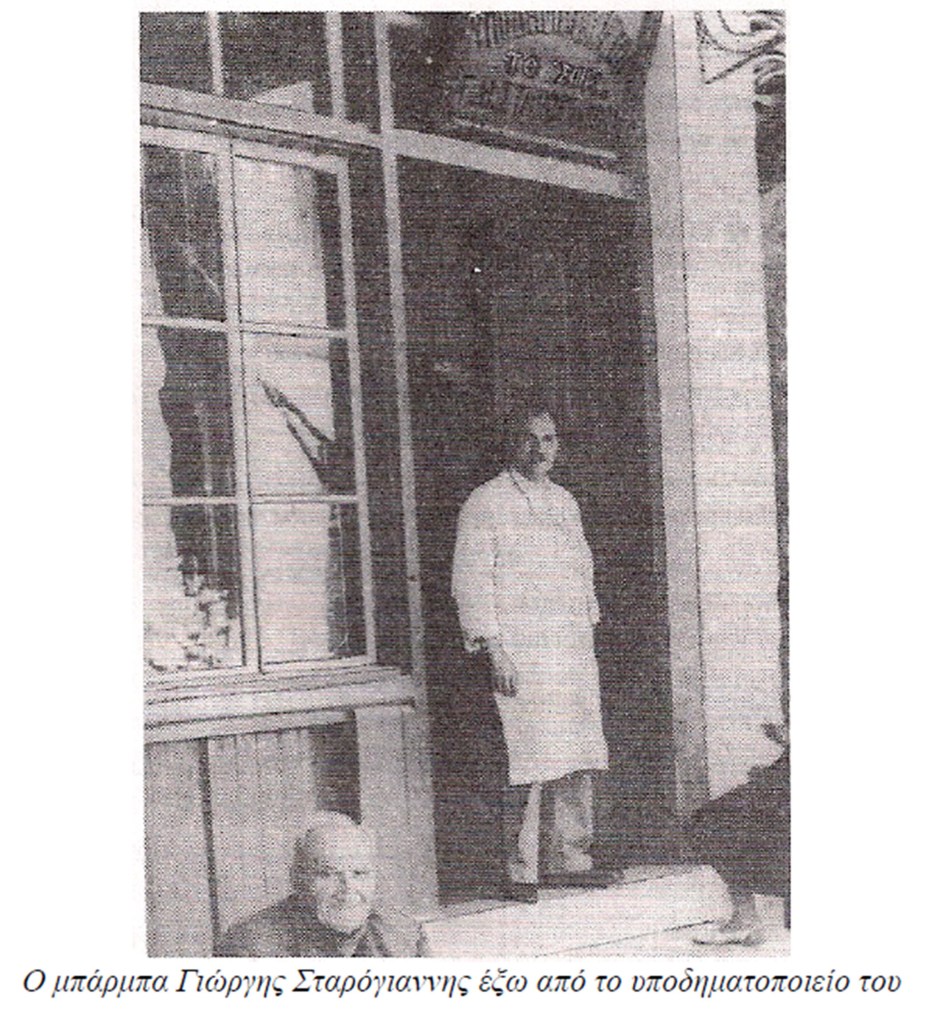
Every region of Greece had shoemakers and of course Xirokampi was not an exception. In Xirokampi, Ioannis Panageas had a shoemaker’s shop across the street from where Mr. Mandrapilia’s paint shop is today. The brothers Nikos and Argyris Kalianiotis had a shoemaker’s shop in the building that belonged to Panagiotis Kyriakakos. Later in the same place was the shoemaker’s shop of Yannis Alexakis, who had married the daughter of Argyris Kalianiotis. Panagiotis Christopoulos had a shoemaker’s shop in the building that belonged to Napoleon Andreakos. In Katsouleika was the shoemaker’s shop of Evangelos Kritikos, while Panagiotis Kalianiotis, who lives today in Sparta, had his shoemaker’s shop opposite the bakery of Nikolakakos. Finally, there is Georgios Starogiannis who is 96 years old today and lives in Xirokampi. His first shoemaker’s shop was in the house of Arachovitis. In 1933, having already been 10 years in the cobbler’s art, he went to the square and opened a shop next to Vangelis Liakakos’ house.

“Barba” Georgios Starogiannis retired when he completed 45 years of love for his craft. He is the only shoemaker along with “barba” Pantelis Skliros who now lives in Katsouleika. Like all shoemakers, he had several workers in his shop, around 20. He mentioned a few to me: Pantelis Skliros, Pantelis Frangis, Iraklis Komnenos, Konstantinos Chrysikos, Lias Chios, Yannis Filosofos who was also a good shoemaker, just like the aforementioned. There were of course many other cobblers who worked with diligence and craftsmanship in the shoe shops of Xirokampi. “Barba” Giorgis Starogiannis, during the occupation period, was the only one in Xirokampi who could manufacture the so-called German boots or vaketes (βακέτες).

The shoemakers made shoes on demand. They were made to fit the feet of the person who ordered them. At first, the cobblers took measurements with a tape measure. To give the shape of the shoe to the treated leathers and sole, they fitted them with a special shoe mold called kalapodi (καλαπόδι). Previously, of course, they had cut the leathers with a sharp blade, or if the skins were thin, with a cutter [similar to a wire cutter]. These two tools were sharpened with a special tool, called matsaki (ματσάκι). The pieces of leather were placed in the kalapodi and underneath was the vardoulo (βάρδουλο) [a strip of leather on the bottom of a shoe to which the sole is nailed or sewn].  Using small nails called spragges (σπράγγες), they nailed the sole to the skin.

After the whole construction took the shape of the shoe and the leather was repaired, they removed the nails and threw them away and where the nails had been, they sewed the skin with an awl. Then, to fasten the heels to the shoes, a hole was drilled to insert the wooden spike which was made from a piece of board. The tool which was used to drill the hole was called katsaproki (κατσαπρόκι). After affixing the heel with the wooden spike, they secured it with nails called telakia (τελάκια), which varied in size. To prevent the shoes and especially the boots from wearing out easily, two metal taps (or clips) were nailed, one on the toe and one on the back of the shoe. All around the shoe, where the leather meets the sole, the cobblers made various decorative stitches and engravings.  The construction of the shoe was completed by polishing the sole, the heel and the bottom of the shoe with three smooth surface tools, the machineta (μακινέτα), the camareto (καμαρέτο) and the lampougio (λαμπούγιο). In particular, for polishing the heel, the cobbler would first heat the polishing tool over a fire in a small tin can. Such a pair of leather shoes needed a day to be made by an experienced craftsman.

Making a pair of shoes required great craftsmanship and artistry. An incident proves this: a customer from Potamia haggled with “barba” Giorgis Starogiannis for a pair. “Barba” Georgios, to show him the quality of the shoes he would buy, put the shoes on scales which balanced perfectly. The shoes were of equal weight, something difficult to do because they were handmade.

Of course, as we have already pointed out, the main work was repair. They patched full of holes and repaired damaged, worn out shoes. Every time there was a market, people from the surrounding villages and the mountains would come and have their shoes repaired by the shoemakers who set up their stalls in the square of Xirokampi. Often, the cobblers would go to villages and mend shoes on the spot. When the sole was punctured, they would patch it with a piece of leather. When the leather was punctured, they would put the shoe in the kalapodi and patch it with a piece of leather, called fola (φόλα).

At the beginning of the century, in the first decades, when there was no eight-hour work day, the shoemakers worked many hours a day (10 – 15) and sometimes stayed overnight at their work, without being paid extra wages and overtime by their bosses. The working conditions in the shoemaker’s shops were difficult, but they became more humane when the right to an eight-hour work week was secured, for which there had been many struggles all over the world.

Today, no one in Xirokampi follows the art of shoemaking. The old ones have either died or have now retired (G. Starogiannis, P. Skliros, P. Kalianiotis), while the younger ones do not have the passion to continue this profession. After all, there are now shoe industries that manufacture many pairs of shoes at low cost. Very soon, unfortunately, the shoemaker’s trade will be completely eliminated in all of Greece, as the last cobblers will also retire.

___

I am honored to receive permission from the Katsoulakos family to translate and share articles from The Faris. Translation verification and corrections have been made by GreekAncestry.net. This is the seventh article of the ongoing series. Previous articles can be viewed here.
Women’s Costumes of the Old Times

by Georgia Th. Tartaris
published in The Faris Newsletter, December 2020, issue 73, pages 22-23
Note: Footnotes in the original publication have not been translated.

This photo is a little treasure. We are lucky when such small treasures come into our hands and connect us with loved ones and things of another era almost forgotten.

The person depicted in the photo is Emilia (Milia) Moutoula (1860-1940), wife of Vasileios Laskaris. She lived in the neighborhood of Laskaris, in Agia Lavra, Xirokampi. An unfortunate woman, she lost her husband early and was widowed, struggling under adverse conditions to raise her daughter Stavroula and her son Vassilis, who as a young child left for the USA, where he became successful. Later, she lost her daughter as well and supported her granddaughter Eugenia. She used to help people in need and was much loved by the villagers, who welcomed her into their homes to offer her coffee and to tell them stories about Koumousta and Xirokampi. Her name is engraved on the plaque of the benefactors of the Holy Trinity of Xirokampi, which has been posted in the narthex of the church. The photo was sent from Philadelphia, USA by her great-granddaughter Melissa Laskaris, daughter of Anastasios.

Emilia (Milia) Moutoula (1860-1940), wife of Vasileios Laskaris of Xirokampi. Photo courtesy of Melissa Laskaris Stolarcyz, Milia’s great-granddaughter.

The old woman Milia is wearing a headscarf, a sack jacket and a half-skirt (or petticoat), as worn by many women of our region. The headscarf was tied in various ways: sometimes in front of the neck, sometimes behind it and sometimes behind and tied high on the head, to the side.

On top they used to wear the sack jacket, which looked like a shirt. It had buttons on the front, usually covered by a small strip of fabric, known as “patileta” to make them invisible. Underneath they wore the half-skirt or petticoat. It had a pleated sash and was tied at the side of the waist. The more fabric a woman could afford to buy, the more pleats in her half-skirt. The sack jacket fell over the half-skirt and reached to the hips.

Stavroula and Polyxeni Laskari from my own neighborhood, but also my grandmother, Georgia Tartari, née Laskari, wore the same clothes except that their skirts had fewer pleats.

I remember most of them being dressed in black; elderly women, holding onto their mourning. I remember that relatives of my grandmother’s, who were not widows, were dressed in brown. Aunt Malamo from Koumousta, who was unmarried, wore brown, as well as my great-grandmother, Artemis Mandrapilia, née Kapakos from Paliochori, married in Koumousta, who died young when she fell from a mule. I did not meet the latter, but my mother, who used to sew, often mentioned her own grandmother’s clothes.

My grandmother’s clothes were sewn by my mother. Certain women sewed clothing by themselves; others used to go to the local seamstress. The fabrics were not woven. They were purchased from the village merchants. In Xirokampi there were commercial shops: the shops of Liakakos, Theofilopoulos, Stergianopoulos. Woven clothes were worn by the older women, that I did not have the chance to meet,  like my great-grandmother, and this was the difference that made my mother refer to her own grandmother’s clothes. One of the last women to keep this way of dressing was Aunt Liou Xiropodi and Panagiota Karkabasi (Karaskoutaina).

The changes in everyday life, the progress and evolution of society were factors that influenced the way people dressed. Over the years, women’s clothing changed drastically. The entry of women in a massive way into manufacturing in all sectors of the economy, the change in the family unit, and the release from prejudices and other forms of oppression fostered a new dress code for women, which was adapted to their needs.

The knowledge of the elders’ lifestyle and the transmission of this knowledge helps us to understand the evolution of society, but also the necessary changes to improve our own ways of life. All of us, more or less, have something that connects us with the past: a photograph, a piece of clothing, a tool, a piece of furniture. We are the bearers of history and its continuators. Let’s pass it on to the next generation.


I am honored and humbled to receive permission from the Katsoulakos family to translate and share articles from The FarisTranslation verification and corrections have been made by GreekAncestry.net.  This is the second article of the ongoing series.

Economics and Occupations of the Citizens of Koumousta


As I wandered through villages in Laconia last summer, I tried to imagine the everyday lives of my ancestors. I knew their hours were labor intensive from dawn to dusk, with hardly a break except for holidays and feast days — but even these special occasions demanded additional work from the women. Thanks to the writings of Theodore Katsoulakos and Panagiotis Stoumbos in their book, Koumousta of Lacedaimonos, I now understand much more. My special gratitude to Giannis Michalakakos for translating the text and patiently explaining cultural and lifestyle patterns of the past.

Without a shred of doubt, the head of the household was the father whom everyone obeyed without question. If he was not there, perhaps due to sickness or death, the mother presided. During the evenings, they discussed the next day’s work, and at dawn, each child knew exactly what his or her tasks would be. There was work for everyone, big or small, boy or girl. “Small help, great savior,” the children were reminded.

Although I do not know the occupation of my great-great grandfather, Nikolaos Christakos of Xirokambi, his fellow villagers were shepherds, farmers, woodworkers, silk producers. During 400 years of Ottoman and/or Venetian occupation, wool, cheese, silk and leather products were produced by the villagers and sold abroad. However, financial circumstances prior to 1900 were difficult. People herded their animals over towering mountains and difficult terrain to be sold in the city of Kalamata; but if demand was low, the animals accompanied their shepherds on the return trek home.

From Xirokambi to Kalamata


Because Koumousta is situated in a higher elevation, the climate and soil are not suitable for growing olive or citrus trees. However, hardwood and nut trees are plentiful. People planted various seeds to grow corn, beans, wheat, malt, tomatoes. Potato cultivation was introduced by Ioannis Kapodistrias, the first governor of Greece, during the transitional period after the Revolution. The first crops In Koumousta were cultivated around 1850. With plentiful water and rich soil, the potato plants thrived and production reached as high as 15 tons. Villagers became proficient growers and were known as “πατατάδες” (potato men). Pear trees were planted “from Koumousta to Penteli.” Mulberries were plentiful and aided in silk making, an important occupation of the people. Oral tradition relates that this business began with a man named Chatzi, who used the humid climate within a small cave to grow silkworms. There were only two or three beekeepers, and “old Giannos Orfanakos had around 150 honeycombs. During good years, he could produce 1,000 okades [1].” His supply was augmented when shepherds and wood collectors would find nests of wild bees and collect the honey. 

Stone grain mill

Half of the citizens were farmers with flocks of sheep and goats. These animals numbered over 7,000. Lias Mandrapilias related that two pens of his family were filled with 1,000 goats. Those who did not keep goats had sheep and oxen. Until 1940, there were 150 oxen in Koumousta.

Koumousta is surrounded by forests; therefore, wood was plentiful and woodworking was an important occupation. Oral tradition states that people created small crafts and their goods were sold in Mani and in Mystras. “Old George Mandrapilias” won first prize for one of his pots that was on display at an exhibition. Woodworkers made boxes to store cheese, butter, and seeds; they made a variety of tools, baskets, barrels for water and wine, washtubs, and kettles to hold goats’ milk. Among the most important tools were looms, used by women to weave wool into fabric. People would say, “we have oxen and so let the tools break” (meaning, their animals were more important because they could easily make new tools). Even small boys learned the art of using an ax. From a young age when they grazed their animals in the mountains, the boys passed woodcutters who told them stories such as: “Once there were two brothers who were shepherds, and they managed to make a pine tree fall down. But when they tried to chop the tree, the ax would not cut. One of them said that the ax wanted wine and food. The boys slaughtered a goat, brought the wine and again tried using the ax, but nothing happened. The ax needed not only to be strong, but also to have someone who knew how to cut.”

Although the poverty level was high, the people of Koumousta compensated by being economical. Old ladies did not leave one kernel of grain on the threshing floor. Animal dung was collected and used as fertilizer. Sheep’s wool was made into clothing. Old men patched their shoes with nails to avoid the expenses of the tsagaris (shoemaker). Interest levels on loans were very high — 30%, and it was said that people worked for the usurers. Those who owned land in the mountains had to work especially hard to repay their loan, as their land was not as fertile or yielding as that in the plains. And when money was low, families with single young women faced a difficult situation:  how would they provide a dowry? To cope with these difficulties, some people emigrated to America and sent money back to assist their families.

When a parcel of land was to be sold, the villagers purchased it to keep it from being owned by “foreigners” (people from other villages). Another loan meant further hardship, but to the villagers, this was necessary to avoid problems. Once, a man from Goranus bought land in Koumousta. He did not properly restrain his animals, and they trampled his neighbor’s fields, damaging corn and potato crops. The villagers were so angry that they killed the “foreigner’s” oxen and goats; but unfortunately, they paid heavily for their retaliation with fines and prison time.

Despite their poverty, people of Koumousta took pride in being self-sufficient. They could provide for their families and even guests with their own goods. Although many households were poor, the main reason was death or sickness, not laziness. The industry, resilience, and creativity of my ancestors from Koumousta and Xirokambi continue to inspire me. I am so very proud of them.

___________________________
[1] a unit of weight used in Turkey, equal to about 2.75 pounds or 1.24 kilograms; a unit of liquid measure used in Turkey, equal to about 1.3 pints or 0.75 litres.