Beyond the Basics: Juror’s Lists

Among the civic responsibilities assumed by some of our ancestors was the opportunity to serve on a jury in a court of law. The Φ.Ε.Κ. or Government Gazette (the Official Newspaper of the Government of Greece) publishes official laws, decrees and appointments (see this previous SpartanRoots post). Its supplemental issues includes names of men called into military duty and men who were qualified to serve as jurors.

In its Catalog under Greece, FamilySearch has digitized microfilms of early Φ.Ε.Κ. newspapers. Juror’s  lists are found in film numbers: 1038847  and  1039000  and  08053376 (viewable at a Family History Center or affiliate library near you). These lists were organized by region, then prefecture, then village, then men’s names.

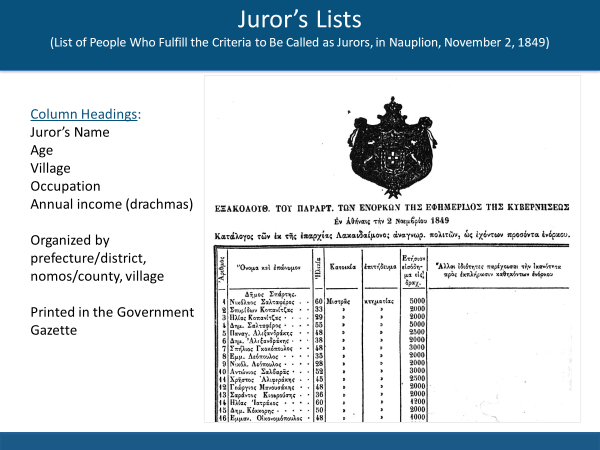
As noted above, men’s ages, annual incomes and occupations were given. Here is an example of a Juror’s List of men, predominantly from my village of Agios Ioannis, Sparta, in 1894:

1849 Jurors List, FamilySearch FIlm 08053376, Item 6, Image 266

FamilySearch has Jurors Lists from 1849-1860. I extracted the names of men from Agios Ioannis as noted below. It is interesting to look at the ages. From 1849-1857, the same age is given; it is not until 1858 that the age increases by one year during each succeeding year. Note the clerk’s error in the entry for Kokkonis, Dim. Th. who jumps from age 44 in 1860 to 55 in 1861.

The men listed above were estate owners with varying incomes ranging from 800-1,800 drachmas. If you would like the income of a specific person, contact me.

Any document, especially the earliest ones of the modern Greek state, can provide important information about our Agios Ioannis families. I am eager to see what new information will be forthcoming in the months and years ahead.

Beyond the Basics: City Directories

Do you know if your ancestor owned a business or was considered a “professional” in his village? Now there is a way to find out. The new City Directories series on Greek Ancestry is the very first digitized and name-searchable collection available for over 5,000 towns and cities in Greece.

The City Directory of 1934-1935 is a historical portrayal of Greece’s cities and communities immediately preceeding World War II. It is organized as follows: the first section lists businesses in the cities of Athens, Piraeus, Thessaloniki and Patras.  The second section lists select people in Athens and Piraeus. The third section lists, in alphabetical order, each prefecture with its capital and general information, then its primary towns and communities.  Unlike other Greek records, directories provide a snapshot of an entire town–not just an individual or a family. They also include business ads, which are so very interesting!

Ad for the Grand Bretagne Hotel in Athens, 1934

These City Directories are not the same as telephone books. They do not list every household found in the village; but they do list every business and professional enterprise and include the name of its owner.

The page below gives information for the Prefecture of Lakonia. Its number of residents is 144,336 and its capital is Sparta. The first paragraph is a brief historical background which reads: The present-day prefecture of Laconia occupies the ancient country of Laconia, inhabited by the Doric people of the Lacedaemonians, who were distinguished for their heroism and fighting ability and which they succeeded for many years in Greece. The most important center of this people was the city of Sparta. Following is a geographic description of the prefecture and the names of its four districts (Gytheio, Epidavrou Limiras, Lakedaimonos, Oitylo).

Below Lakonia is the entry for Sparta. It also provides a brief history and synopsis of the city, and lists its officials, municipal offices (post office, tax office, etc.), churches and monasteries, schools, charitable institutions and cultural associations. A list of the professionals and businesses is then presented.

This is page 2, Επαγγελματίαι (Professionals) for Sparta. It documents the professionals and business owners in these industries: midwifery, silk manufacturing, machinery, hotels for sleep, timber warehouse, carpentry, wine tavern, oxygen welding, gun shop, green grocer, ice shop, inn, grocery store, farrier, hat repair, bicycle repair, sewing machines, tailor, blacksmith, typography, bank, shoemaking, hydraulic (water) works, shoe sales, fabrics, pharmacy, drug warehouse, photography, stationery, dance school, sundries. Doesn’t this provide a fascinating insight into city life in 1934?

Business information for the various Communities of Lakonia follows. Highlighted in red is my community of Agios Ioannis.

The entry reads:

  • Capital of the community: Agios Ioannis, number of residents 914
  • Villages in the community: Agia Kyriaki (Tsaousi), Varika (Chaloulou), Kozi, Tseramio and Sinampei
  • Municipal offices:  post office, elementary school, farmers’ association, syllogos (cultural association)
  • Professionals and Businesses:
    • Colonial Products (items imported from European colonies such as coffee, tea, cocoa); proprietors: Kalama, K., Tsirigioti, Ilias.
    • Bakery: Papaioannou, K.
    • Lawyer: Kyriazis, Kon.
    • Doctors: Geroulakos, Dimit., Mitrakos, Dim.
    • Cafes:  Gianopoulou, Ad., Sampatakou, Dim.
    • Hotel: Christakakou, V.
    • Grocery: Vougioukli, El., Papaioannou, Kal.
    • Pharmacy: Theodorou, Dim.

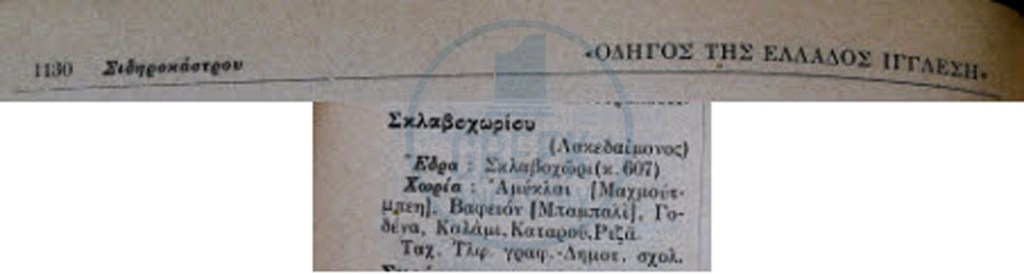
Some villages may not have resident professionals or businesses, but they are still listed in the directory with statistical data and other important information.  For example, this is the only information provided for the community of Sklavochori in 1934-35:

  • Capital of the community: Sklavochori, number of residents 607
  • Villages in the community: Amykles (Machmoutbei), Vafeion (Mpampali), Godena, Kalami, Katarou, Riza.
  • Municipal offices: post office, elementary school.

Although the information is scant, it reveals important historical data: 

  • As part of the Government reform to abolish names of Turkish, Slav or Albanian origin, thousands of Greek villages underwent name changes. In this 1934-35 directory, the community name is “Sklavochori.” Today, Sklavochori no longer exists. In 1940, that name was eliminated and the area was integrated into Amykles. Consequently, Amykles was then elevated from a village to a community (see this page and this issue of the ΦΕΚ / Government Gazette.)
  • Of significant importance, this City Directory reveals the “old” names of the villages which had been part of Sklavochori in 1934-35: Machmoutbei and Mpampali. Although those names no longer exist, they do exist in records created at the time the village bore that name. This explains why researchers are stumped when they cannot find, on today’s map, a village that had been listed in an early Voter List or a Male Register.

Tracking a Greek family’s change of residence be challenging. Greece does not have accessible census records which place people in a specific location for a specific time at specific intervals. Just as we relocate, so did our ancestors–especially upon marriage and for business opportunities.

By exploring City Directories, a researcher can see which villages have families with a surname of interest. I look at this map of Sparta and then search for ancestral names in surrounding villages.  However, I am super careful not to make assumptions. Patronymic naming conventions absolutely guarantee that all Apstolakos (son of Apostolos) families are not related. And, directories list only businesses and not households.

Despite these precautions, I have found many interesting patterns of family movement and new residences. I also learned which ancestor(s) were business owners or were employed in professional occupations.  

To learn more about the Greek Ancestry City Directory collection, click here: https://greekancestry.net/greek-ancestry-city-directories-collection/

To search the City Directories, click here: https://greekancestry.net/all-greece-discounted

Type a village name, then sort the list by “Prefecture” to group results in the region of interest, such as Messinia or Thessaloniki.

The City Directory Collection spans the years 1901-1947 with 200,000 names in 5,000 cities and towns. Some of these may be your villages! What relevant and historical information will you learn about your family?

Beyond the Basics: Parish Voter Lists

The Orthodox Church is the state religion in Greece and, but for few exceptions, it is the faith of the people. Its records are kept in village churches, priests’ homes, monasteries and Metropolis (archdiocese) offices. This “covid summer” sadly put a halt to my digitization work in Sparta, but my colleague, Gregory Kontos of GreekAncestry, headed there in June to digitize yet another collection of church records, Parish Voter Lists of 100 Sparta villages.

Gregory’s detailed post about this collection explains that prior to 1967 when priests became state employees, each village was responsible for finding a priest for its church and paying his salary. Those eligible to vote were the heads of households–either men or widows–and a list of their names and ages was compiled. This specific collection spans the early to mid-1900’s and information includes:

  • name of head of household
  • father’s name
  • age
  • village
  • a column for notes

If there is a collection for your village (a list is at the end of this post), you are in luck! This name-indexed, online collection will help you find your ancestor in a specific village at a specific year, and provide his age and father’s name. This information is mandatory to access records such as Male Registers and Dimitologion/Town Registers from Archives and Town Halls, whether you go in person or write a letter.

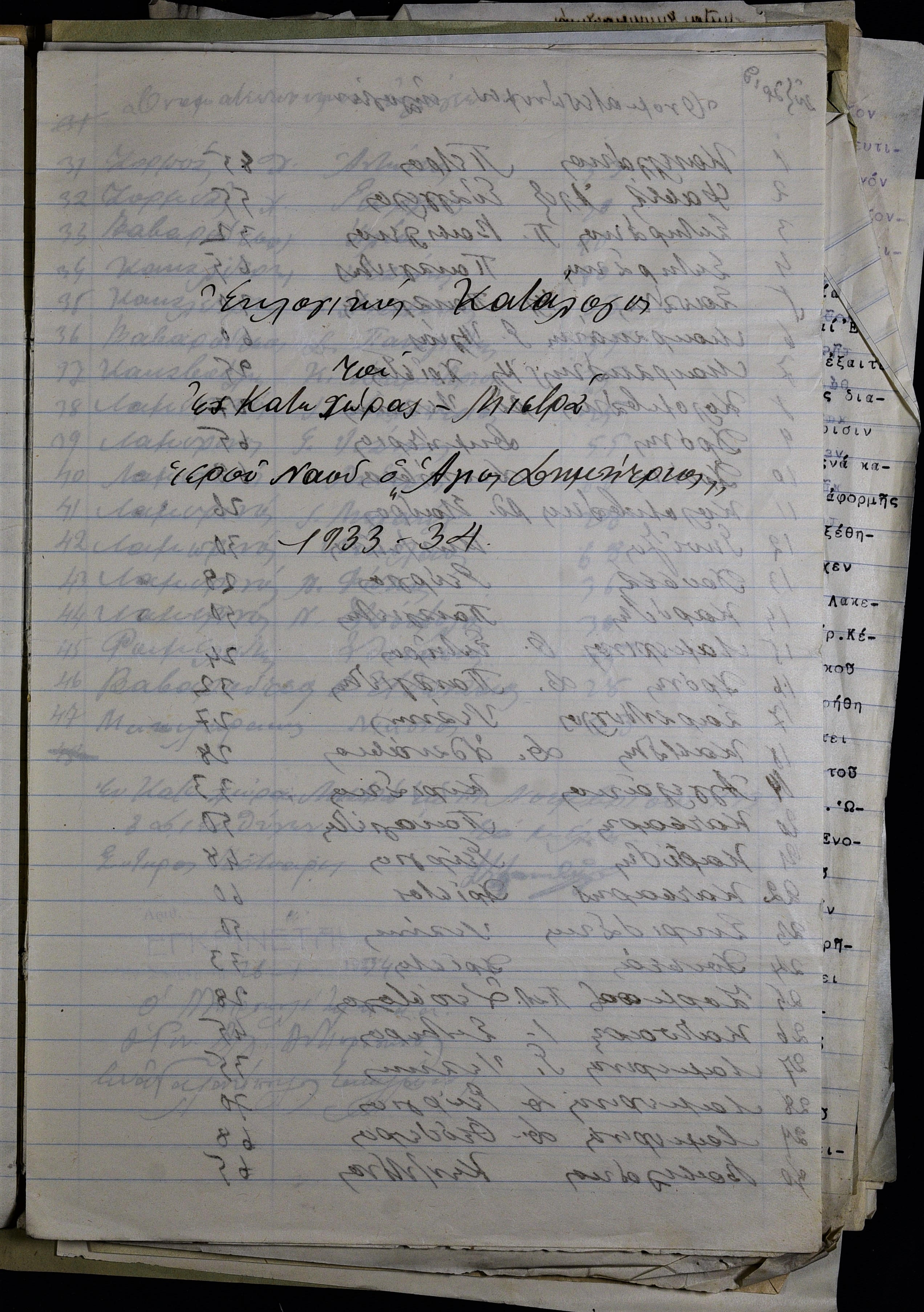
This image is the cover page of the 1933-34 Parish Voter List for Kato Chora, Mystras. It reads:  Eκλογικός Κατάλογος ((Electoral Catalog) Κάτω Χώρας-Μιστρά (Kato Chora-Mystra) Ίερου (Priest) Ναου ό Άγιος Δημήτριος (Temple of Agios Dimitrios), 1933-34.

(Click on any image to enlarge it)

Kato Chora, 1933 Parish Voter List, cover page

This is a page from the Kato Chora Parish Voter List. First column is the number of the voter, second column is voter’s surname and given name, third column is his age. Translation of line 1: Kanellakos, Petros age 85.

Kato Hora Parish Voter List, 1933

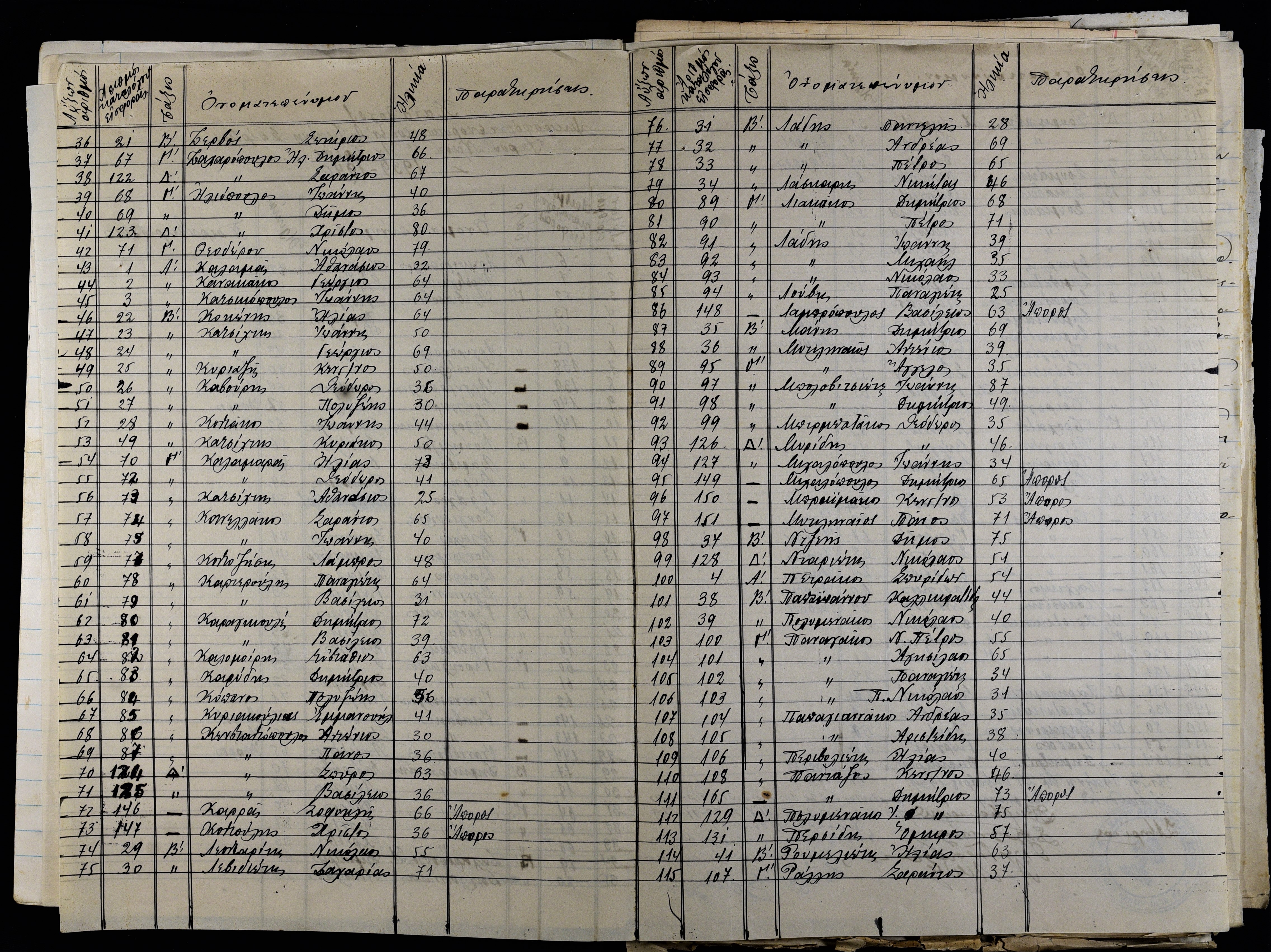
The page below is a 1939 Parish Voter List from Agios Ioannis, Sparta. It has two additional columns because it is a combination voter list and contribution list. Column one is the voter number, column two is the voter’s serial number in the contribution list,  column three is the grade/level of donation given, column four is the voter’s surname and given name, column five is notes.

Translation of line1:
Number 36, contributor number 21, contribution level B, contributor: Zervos, Sotirios, age 48.
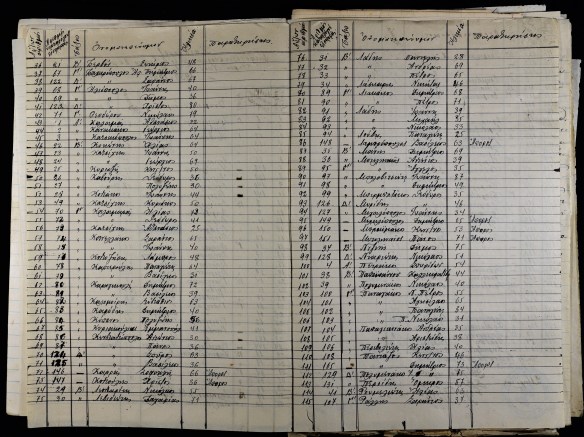
1939 Parish Voter List, Agios Ioannis, Sparta

It is fascinating to look at the contribution levels of various families. This page shows four levels:  Α, Β, Γ, Δ (A, B, C, D). Those who could not donate have a horizontal line in the contribution level column, and are marked άωπρος (destitute) in the notes column. For example, see lines 72 and 73 on the left side, and several on the right side.

Important notes about these records:

  1. Whenever a new priest was needed, the village compiled a Voter List. Those which changed priests several times have a list for each election. Be sure to get all lists for your village. Look at the years and compare the names and ages to see who is in the village for each year.
  2. Many villages have undergone name changes between 1913 and today. The villages are listed by their names at the time the Voter List was created, NOT today’s name.  A quick search on Wikipedia reveals that 827 villages were renamed in the Peloponnese between 1913-1966, and that does not include additional changes made since then. Use the website Πανδέκτης to find the old and new village names; or, contact GreekAncestry.net.
  3.  When you research the old and new village names, you will learn such interesting history. For example, Κοντεβιάνικα (Kontevianika) which is the village name in the records, is now Άσωπος (Asopos). The first settlers of that area were the Conte family who originated in the village of Viani, Crete–thus,they named the settlement Kontevianika after themselves.
  4. To research old village names, copy the village name in Greek (as it is written below) and paste it into a search engine. A webpage will come up in Greek, then use Google translate to turn the page into English. In the example of Kontevianika, one “hit” was the website of the local government of Monemvasia (the village region) which provided the story of the naming of the village.
  5. Another example: I put the name Κουρτσούνα (Kourtsouna) in Google. The search went to the EETAA.gr website where the history of the village, from 1835 to present, was given as taken from notices in the ΦΕΚ (Government Gazette). It was renamed Βασιλική (Vasiliki) in 1955. That’s a recent change, so if you have cousins today living in Vasiliki, but your grandparents or great-grandparents came from Kourtsouna, the family remained in the same village.

As with any new record collection, there is so much to explore in these Parish Voter Lists. The list can be searched by name or village, in English or Greek, at the GreekAncestry website. If you search by village, you will get a list of all the names in that village in all collections current on the website.

This is a list of the villages and the years as found on GreekAncestry here.

Metropolis of Sparta, Parish Voter Lists by Village & Year
Ag. Kyriaki – Αγ. Κυριακή – 1913
Ag. Andreas – Άγ. Ανδρέας – 1935
Ag. Dimitrios Monemvasias – Άγ. Δημήτριος Μονεμβασίας – 1934
Ag. Dimitrios Zarakos – Άγ. Δημήτριος Ζάρακος – 1934
Ag. Ioannis – Άγ. Ιωάννης – 1934, 1939-40
Ag. Ioannis Theologos – Άγ. Ιωάννης Θεολόγος – 1932-33
Ag. Nikolaos – Άγ. Νικόλαος – 1934
Ag. Nikolaos Monemvasias – Άγ. Νικόλαος Μονεμβασίας – 1930
Ag. Nikolaos Voion – Άγ. Νικόλαος Βοιών – 1934-35
Ag. Vasileios – Άγ. Βασίλειος – 1927, 1933
Agoriani – Αγόριανη – 1936, 1938
Agrapidoula – Αγραπιδούλα – 1935
Agrianoi – Αγριάνοι – 1932-33
Alampei – Αλάμπεη – 1928
Alampei [Alaimpei] – Αλάμπεη [Αλαΐμπεη] – 1926, 1934
Alepochori – Αλεποχώρι – 1934-35
Alevrou – Αλευρού – 1934-35
Anavryti – Αναβρυτή – 1932-33, 1935
Angelona – Αγγελώνα – 1934-35
Anogeia – Ανώγεια – 1935
Apidea (Apidia) – Απηδέα (Απηδιά) – 1934-35
Apidia – Απηδιά – 1920
Arachova – Αράχωβα – 1915
Asteri (Vriniko) – Αστέρι (Βρίνικο) – 1920, 1933, 1936
Charakas – Χάρακας – 1915, 1934-35
Chatziaga – Χατζήαγα – 1912
Chrysafa – Χρύσαφα – 1934-35
Dafni – Δαφνί – 1931, 1933, 1938
Daimonia – Δαιμονιά – 1932-33
Elaia (Elia) – Ελαία (Ελιά) – 1932
Elia (Elaia) – Ελιά (Ελαία) – 1916
Elika – Ελίκα – 1926-29, 1932-33
Faraklo – Φαρακλό – 1927, 1930, 1935
Filisi – Φιλήσι – 1926, 1928-29
Foiniki – Φοινίκι – 1925-27, 1929, 1936
Foutia – Φούτια – 1933-34, 1936
Fregkra – Φρέγκρα – 1936
Georgitsi – Γεωργίτσι – 1926, 1929, 1934-35
Geraki – Γεράκι – 1926, 1929, 1935
Gkoritsa – Γκοριτσά – 1934-35
Godena – Γοδένα – 1939
Goranoi – Γοράνοι – 1934-35
Gounari (Gounari) – Γούναρι (Γούναρη) – 1935
Gouves – Γούβες – 1927-29, 1933-35
Grammousa – Γράμμουσα – 1925, 1933, 1935
Ierakas – Ιέρακας – 1932-33
Ierax (Ierakas) – Ιέραξ (Ιέρακας) – 1927
Kalogonia – Καλογωνιά – 1925-26, 1930, 1934-36
Kalyvia Sellasias – Καλύβια Σελλασίας – 1934
Kamaria – Καμάρια – 1935
Kaminia – Καμίνια – 1934-35
Kampos – Κάμπος – 1925,1934, 1936
Karitsa – Καρίτσα – 1925
Karotsa – Καρότσα – 1933
Karyes – Καρυές – 1934-35
Kastorio (Kastania) – Καστόριο (Καστανιά) – 1934-35, 1940
Katavothra (Metamorfosi) – Καταβόθρα (Μεταμόρφωση) – 1923-29, 1934
Kato Chora Mystra – Κάτω Χώρα Μυστρά – 1933
Katsarou – Κατσαρού – 1939
Katsoulaiika – Κατσουλαίικα – 1934-35
Kefalas – Κεφαλάς – 1929, 1934-35
Kladas – Κλαδάς – 1929, 1930, 1932-33, 1935
Kokkinorachi (Tsouni) – Κοκκινόραχη (Τσούνι) – 1926, 1929, 1935
Koniditsa – Κονιδίτσα – 1928-29, 1933-35
Kontevianika – Κοντεβιάνικα – 1924-25, 1929, 1934-35
Kotsatina – Κοτσατίνα – 1922
Koulentia (Elliniko) – Κουλέντια (Ελληνικό) – 1933, 1934, 1936
Kounoupia – Κουνουπιά – 1933, 1935
Koupia – Κουπιά – 1927-29
Kourtsouna (Vasiliki) – Κουρτσούνα (Βασιλική) – 19335, 1935-36
Kremasti – Κρεμαστή – 1915, 1933
Krokees – Κροκεές – 1934-35
Kyparissi – Κυπαρίσσι – 1931
Lachi – Λάχι – 1924, 1926-28
Lagia – Λάγια – 1917
Lagio – Λάγιο – 1936
Leimonas – Λεήμονας – 1919
Magoula – Μαγούλα – 1927-28
Mari – Μαρί – 1933
Molaoi – Μολάοι – 1927, 1929
Monemvasia – Μονεμβασία – 1913, 1915,1927, 1929, 1933
Mousga – Μούσγα – 1935
Myrtia – Μυρτιά – 1929-30
Mystras – Μυστράς – 1916
Niata – Νιάτα – 1924, 1929
Nomia – Νόμια – 1912
Pakia – Πάκια – 1916
Palaiochori – Παλαιοχώρι – 1934-35
Panigyristra – Πανηγυρίστρα – 1929
Pantanassa Monemvasias – Παντάνασσα Μονεμβασίας – 1928
Pardali – Παρδάλι – 1932
Parori [Parori] – Παρόρι [Παρώρι] – 1929-30
Pellana (Kalyvia) – Πελλάνα (Καλύβια) – 1934, 1936
Platana – Πλατάνα – 1921
Platanaki – Πλατανάκι – 1933
Polovitsa – Πολοβίτσα – 1928-29
Pritsa (Palaiovrysi) – Πρίτσα (Παλαιόβρυση) – 1915
Pyri – Πυρί – 1931
Sellasia – Σελλασία – 1935
Skala – Σκάλα – 1940
Sklavochori – Σκλαβοχώρι – 1939
Skoura – Σκούρα – 1912
Sparti – Σπάρτη – 1934
Syrkia – Σύρκια – 1912
Tarapsa – Τάραψα – 1917
Tsasi – Τσάσι – 1926, 1928-29, 1935
Varsiniko – Βαρσίνικο – 1932-33
Varsova – Βάρσοβα – 1934-35
Vassaras – Βασσαράς – 1932, 1935
Velanidia Voion – Βελανίδια Βοιών – 1932-34
Vergadeika (Bergadeika) – Βεργαδέικα (Μπεργαδέικα) – 1927, 1933
Vlachiotis – Βλαχιώτης – 1921, 1925, 1934-35
Vordonia (Vordonia) – Βορδώνια (Βορδόνια) – 1932, 1934, 1936
Voutianoi – Βουτιάνοι – 1925
Vresthena – Βρέσθενα – 1935
Vrontamas – Βρονταμάς – 1933-35
Vroulias (Sellasia) – Βρουλιάς (Σελλασία) – 1924-25
Xirokampi – Ξηροκάμπι – 1935
Zagana – Ζαγάνα – 1921
Zarafona – Ζαραφώνα – 1913, 1915, 1933
Zelina (Melitini) – Ζελίνα (Μελιτίνη) – 1933, 1939
Zoupaina (Ag. Anargyroi) – Ζούπαινα (Άγ. Ανάργυροι) – 1932-33
Beyond the Basics: 1828 Census of Lakonia

Researching in pre-1830 Greece thrusts us into the Ottoman period (1453-1821), a time when neither a Greek government nor Greek records existed. From the start of the Revolution until 1827, the fledgling country adopted the Greek Constitution and fought its War of Independence under a federation of provisional governments, elected by people in various regions. A united Greek government, the Hellenic state, did not emerge until 1828 when Ioannis Kapodistrias was selected as the Governor of Greece, and the country was officially recognized on February 3, 1830.
 
Although various regions joined Greece at different times, Sparta went directly from Ottoman to Greek rule. Thus, any surviving records from the earliest Greek state may include villages around Sparta. Among the first records for Lakonia is the 1828 census.
 
The first census in Greece was conducted in 1828 by the government of Kapodistrias and it is digitized and online. According to Gregory Kontos of GreekAncestry, from 1861 onwards, a census was conducted every ten years and kept at the Archives of the Hellenic Statistical Authority, but they are classified and sealed to the public.
 
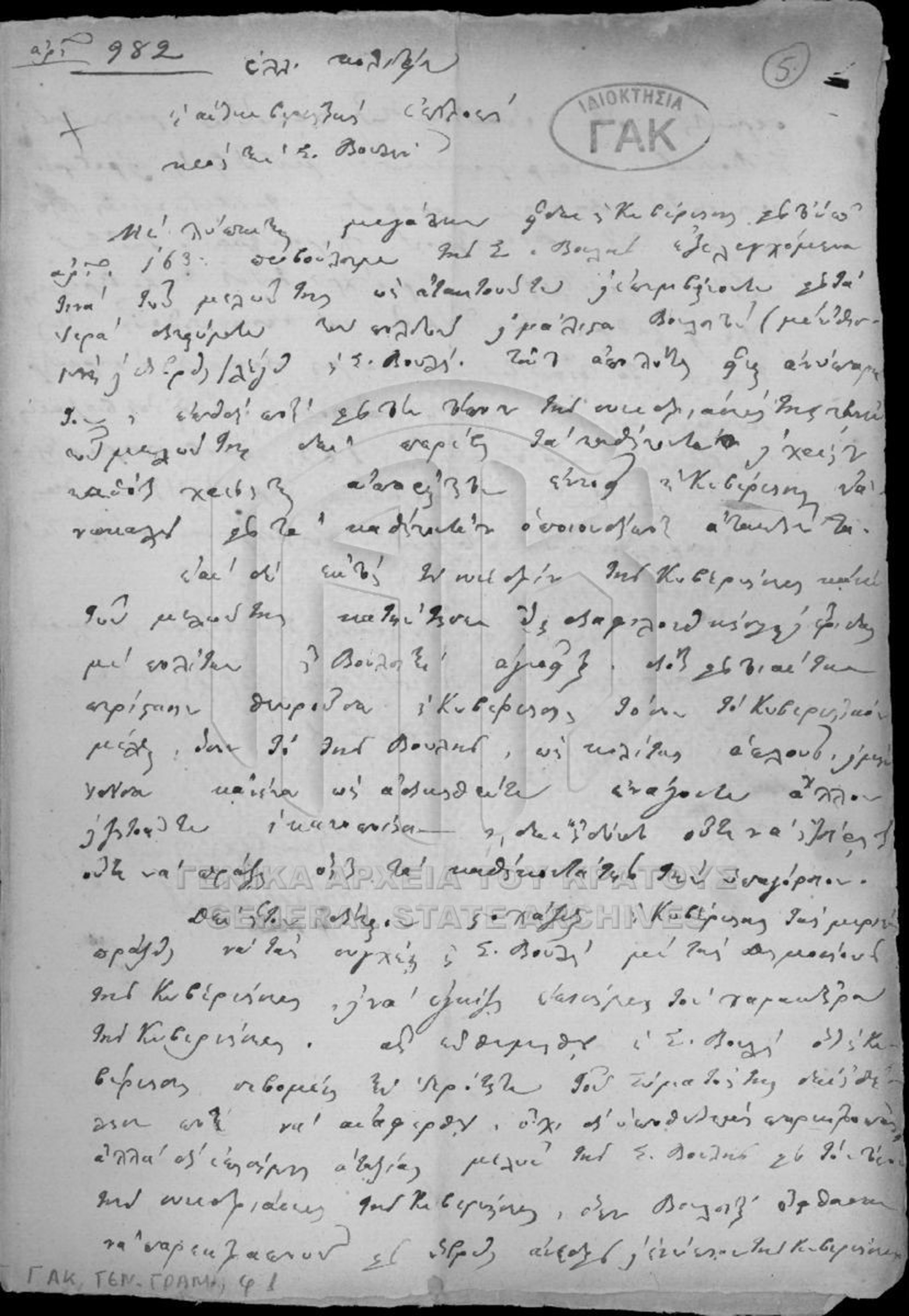
However, there are two collections available from the General State Archives of Greece: 1828 and 1850.2  Neither of these cover the entire country and there is no standard format; 1828 is digitized, but 1850 is not. The 1828 is somewhere in this collection on the General State Archive of Greece website, records of the General Secretariat, 1828-1833. The description is “letters, decisions, accounts, reports, receipts, lists, applications, decrees and various documents.” There are 300 folders with thousands of subfolders, and documents written in old Greek script.
 
GAK, General Secretariat, 1828, File 001, Take 009 http://arxeiomnimon.gak.gr/browse/resource.html?tab=tab02&id=2064
Thus, documents from this era are technically accessible but realistically unaccessible, as it is beyond my ability to locate or read these records. It’s time to turn to the experts.
 
GreekAncestry has census collections from Ermioni, Argolida 1829 and Kyklades 1829. All records are name-searchable in both English and Greek, and an image with English translation can be ordered.
 
Konstantinos Koutsodontis, Greek Genealogist, has access to the 1828 census of Lakonia and other regions. He conducts the research and provides images and translations. His research on my behalf yielded these records:
 
1828 Anvryti census
Christos Kostakos
 
1828 Sklavochori census
Demetrios Christakos
 
1828 Agios Ioannis census
Demetrios & Vasilis Maltziniotis (living together)
Nikolas groom of Maltziniotis
Nikolakis Michalakos
 
1828 Koumousta census
Demetrios Christakos
Thanasis and Nikolas Christakos (living together)
Michalakis Christakos
Konstantis Michalakos
Georgios Michalakos
Thanasis Michalakakis
 
Examples:
1828 Census, Agios Ioannis; 2 Dimitrios and Vasilis Maltziniotis; 1 Nikolaos groom of Maltziniotis
1828 Census Anavryti; Christos Kostakos

A few precautions when using these census records:

  1.  There is no identifying information such as age or father’s name, making it impossible to positively identify an individual. Remember that naming traditions ensure that several men with the same name can be in a village, and they can be differentiated only when the patronym (father’s name) is indicated.
  2. There were no “official” surnames during this time and they may or may not have been used in your family. For a man to distinguish himself from others with the same name, he might use a nickname, a patronymic, the name of his clan, tribe, or village of origin. Thus, a man listed as Petros Georgiou is:  Petros the son of Georgios — Georgiou is not his surname. To complicate matters, others in his bloodline may use a different appellation.
  3. Early records are notoriously incomplete, especially in rural Greece. Shepherds may be roaming the mountains with their flocks for months at a time. A lazy “census taker” may choose not to hike up a steep trail to a remote village. Pages of a document may be lost or destroyed.

Although pre-1830 records have acute limitations, they may be able to place a family in a specific village at a specific time. For such corroborating evidence, I am grateful.

__________

1https://en.wikipedia.org/wiki/Timeline_of_modern_Greek_history

2For more information, see this video from GreekAncestry.

Free Access to MyHeritage Greek Records on Sunday, June 28 and Webinars

Tomorrow on June 28, 2020, MyHeritage is offering free access to its three Greek record collections which can be accessed at these links:

Sparta Marriages, 1835-1935

Vlachogiannis Election Rolls (complete collection) 1863-1924

Corfu Vital Records (Birth-Marriage-Death) 1841-1932

There will be two events where Gregory Kontos and I will discuss these records. Access to the events is free, and will be broadcast through the MyHeritage FB page. 

The first is Sunday, June 28, at 2:00 EDT. We will give a brief overview of the collections and answer questrions.  UPDATE:  This session was recorded and can be viewed here.

The second is Tuesday, June 30, where we will discuss these records in more depth. UPDATE: To view the webinar, click here.

EXAMPLES OF RECORDS

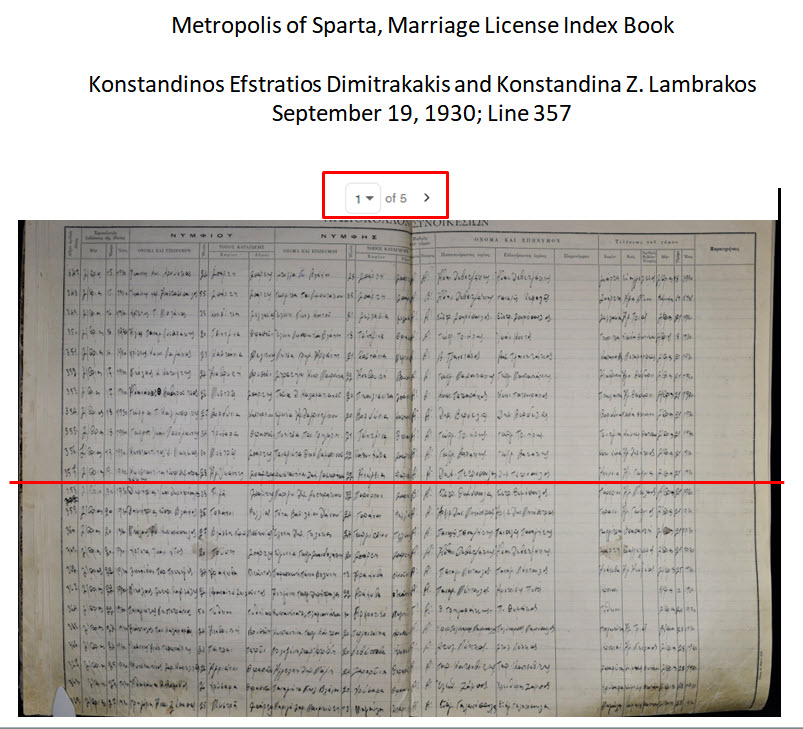
Sparta Marriages 1835-1935  includes images of the Marriage Index book of the Metropolis of Sparta, and any documents associated with the marriage. An example is below. Note that there are 5 documents for this marriage. Some marriages have more documents, some (especially ones in the 1800s) may have only the index book:

Page from Marriage Index book of the Metropolis of Sparta

Letters between village priest and bishop, requesting and approving marriage

Municipal record and marriage affidavit

Vlachogiannis Election Registers, 1863-1924   This collection comprises names of men eligible to vote in all areas of Greece. Sometimes, there are two lists for a village that are one or two years apart. This allows the researcher to compare information on an individual, as the example below shows.

1872, line 1975: Panag. Pappagiannakos, age 31, father: Nikolaos; occupation: landowner
1873, line 2146: Panag. Papagiannakos, age 32, father: Nikolaos; occupation: landowner

Corfu Vital Records, 1841-1932   Birth, marriage and death records are primary documents of crucial importance. This collection is comprised of civil records from the island of Corfu ( Kerkyra /Κέρκυρα).

Marriage and birth documents, Corfu

Finding Greek records on the MyHeritage website is exciting, but having a family tree on the site makes the hunt even easier–the algorithms of the website will provide record hints and do the research for you! As you confirm matches to records, the algorithm is refined and will become even more exact. Record matches can come from any collection in the MyHeritage database and from the millions of names in its family trees.


Take the opportunity to browse these records for free tomorrow, and to join Gregory and me for the webinars to better understand the important information in these rich collections.