It Started with a Forgotten Name

by Carol Kostakos Petranek: Interview with Tom Frangoulis

How does a village history project evolve? In Egklouvi, Lefkada, it began with the name, “Polito.” When neither Tom Frangoulis nor his brothers could remember their grandmother’s given name, Tom embarked on a quest. He knew there had to be a record somewhere. “I was born in Egklouvi,” he explained, “and everyone in my father’s family was born, married and died there.”

Examining books at the archives and churches, Tom discovered that his grandmother’s given name was Polito. He also noticed that the Frangoulis name was written on page after page, year after year, going back in time. Way back– to 1760! “When I started building the family tree, all the branches were other families that also lived in Egklouvi,” Tom said. “The village didn’t have that many people, so everyone is related.” As Tom expanded his research into his mother’s family from another village, he concluded that “all of Lefkas is related to me!”

Tom’s passion for documenting his family’s history meant that his summertime visits to Egklouvi became research trips. “Starting in 2010, I would go to the archives for three to four hours a day, five days a week, for several weeks,” he stated. “I told the people there that I was interested only in my family research. I was not interested in making money or publishing a book – only my family history. After three years, they realized that I was not lying and they began to trust me.”

Tom Frangoulis

That trust, built carefully and honestly over the ensuing years, has enabled Tom to access records and documents not only at the archives, but also in municipal offices and city halls. Notary books on the island of Lefkada go back to 1760 and church records to 1770. At one point, the Greek government required priests to turn their church books over to the archive offices where they remain to this day. There are hundreds of books – civil and church – dating from 1750 to the early 1800s, and the late 1800s to early 1900s; however, there is little in between. “From 1840-1890, books are difficult to find or they don’t exist,” Tom observed. “The bridge for information in this timeframe is the Male Registers and Election Registers.”

Another dilemma arose. “The books are fragile, and the ink has eaten the paper. I want the information, but I don’t want to destroy the books,” Tom remarked. He developed a two-part method to both preserve the records and extract the vital data.

First, he uses a camera to take digital copies of the original books. He then uses Photoshop to crop and straighten every photo, and to play with the brightness and contrast to ensure the image is the best quality possible.

Second, he transcribes notary documents word for word. He reviews the pages and enters every name into an Excel spreadsheet. With church books that are names only, he types every name for every entry into a spreadsheet. He described his process: “I read the baptism book and create a line for the child — the date he was born and baptized; his name; the godparent; the father and the grandfather, and the mother (in later records). The forms are in alphabetical order. I analyze the records. Some books I analyze a little more to put together families.”

Tom transcribes the records into Greek, not English, because the villagers are then able to read his works, ask questions, and provide additional information. In turn, Tom helps them. “All I need is someone’s name, and I can take their family back to the 1700s,” he says with modest pride.

Reading the old, handwritten records—especially those from the 1700s—did not come easily. Tom explained, “In the 1700s there were very few people who could read and write, and that included the priests who were illiterate. When you read these books, you see that there were no rules in writing: one page is written as one long paragraph; there is no separation of words, no punctuation, no paragraphs, no periods, no capitalization. You must learn to decipher the handwriting of the person and then separate the words into sentences and paragraphs, so they make sense.”
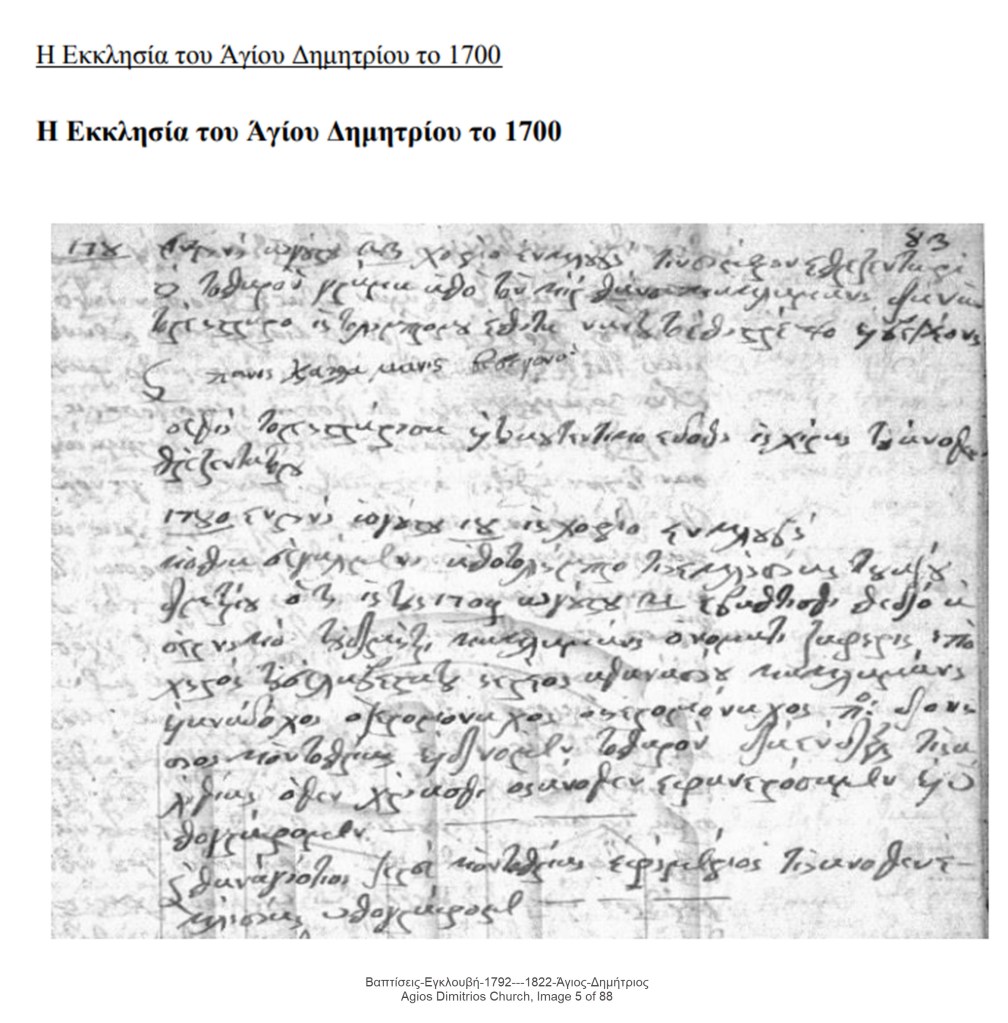


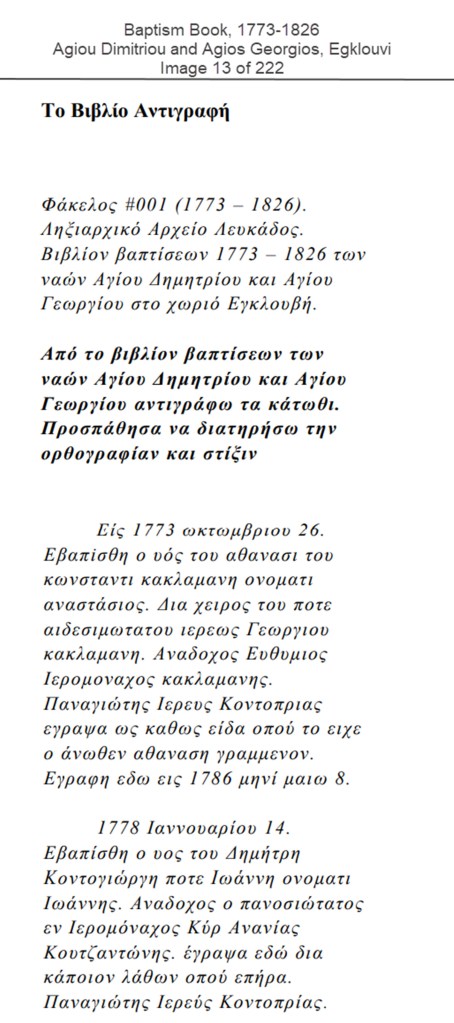
Church records in the mid-1700s were written differently than today. In baptismal records, the name of the mother was generally omitted. Why? “Back then, people knew who the mother was because everyone knew all the families in the village,” Tom answered. “Sometimes not even a last name was written.” Also, priests recorded the names by which people were known. Since villagers used nicknames (paratsoukli) interchangeably with surnames, the priest could use either name in the record. Thus, correctly identifying families was a challenge. Tom learned that by comparing the given names of family members and parents, he could identify the family whether it used a nickname or a baptismal surname.

“After 1820, priests began writing both fathers’ and mothers’ names because there were several families with the exact surname in the village,” Tom commented. “Then, when there became too many with the name, paratsoukli were given as a way to differentiate the various families. My great-grandfather’s uncle got the paratsoukli, “PentEkotis (Πεντεκότης)” because he owned five chickens!”


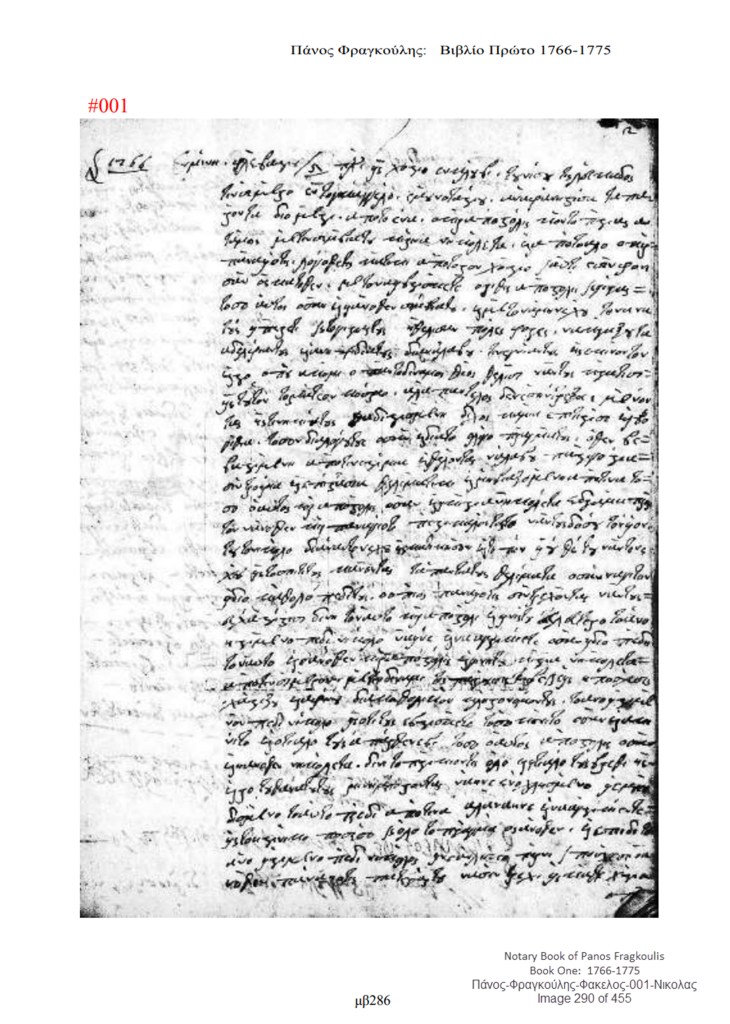
Notary records—rich in facts about families and customs of the times—are an incredibly important resource for both historians and genealogists. Wills, dowries, real estate transactions, business agreements and sales of animals are written in exact detail, providing an intimate glimpse into the personal lives of villagers. “When you read them, you cannot separate yourself from the life that people lived. There were surprising things they did,” Tom said as he described a couple of examples:

1) “The general belief is that a dowry belongs to a man. Not correct. The dowry agreement is between the father and the mother of the bride and their son-in-law (the wife is not involved). There are three parts to a dowry agreement. First, the three parties go to the notary and the father and mother present a list of dowry items which could include trees, animals, land, household goods. All three agree on the list. Second, before the wedding, the son-in-law writes down everything he received so far – maybe three cows were promised but he only received two, and his father in law owes him one more. Third, the dowry belongs to the wife. If the husband mishandles one of the items from his wife’s dowry, he has to replace it.

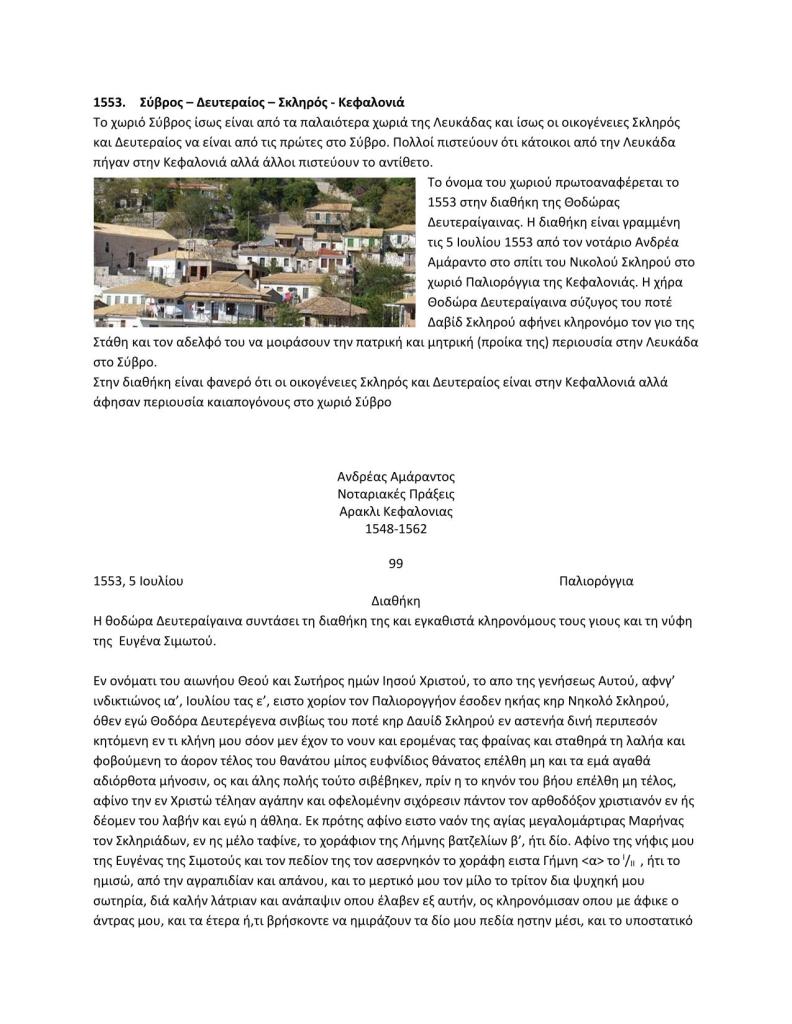
2) “A husband and wife can write separate wills. A will written in 1550 in Kefalonia proves this point. Both the husband and wife were from Lefkada but ended up in Kefalonia. The husband wrote one will, and his wife wrote her own will, leaving her property in Lefkada to her children.” At the end of this post is an article that Tom wrote which proves this point, and verifies that the families Deftereos and Skliros lived in the village of Sibros in Lefkada in 1550!

3) “If I was selling a house and you wanted to buy it, how would we agree on a fair price? There were no appraisers back then and no one wanted to be cheated. The notary books explain how this is done. Both the buyer and the seller choose three people from the village whom they trust. One person from the buyer and one from the seller go to the house together, look at it, and decide on a price. Then, the next couple do the same thing, and then the third. When all three couples have decided on their prices (which could be very different), the sums are averaged and that becomes the sale price. Thus, there are no allegations of cheating after people from both sides agreed on a price.”

4) “You can feel the pain of the people in those records. In a will written in 1789, two brothers inherited their father’s property. The father had only one donkey and one cow. In the will, he leaves half of the cow and half of the donkey to each brother. The boys now have to decide how to split these assets. Both need the cow to plow, and both need the donkey for transportation. They find a way to share the animals equitably.

5) “These people were very religious. There is no will where they do not write where they want to be buried, and what they leave to the church. They would write that a specific property or item is to be sold “for the good of my soul” and the proceeds used to pay for the burial and as a donation to the church. In 1770 Egklouvi had seven churches and eleven priests. The churches were started by small groups of families, maybe three or four, with a congregation of 100-150 people. Then several families would start another church. If families could not maintain the church, they gave it to the metropolis.”

When Tom began researching his own family, he had no conception that it would eventually expand to a village (and possibly now, an island) history project. He started as each of us does—one person at a time. He emphasizes the importance of doing something, anything, no matter how seemingly small it may be: “Start with yourself. Get a folder and in it put your birth certificate, diploma, marriage certificate and important documents. It doesn’t take long to write a few lines; on one page, you can write the main events of your life. Then start a folder for your father with his documents, and one for your mother. When you get married start a folder for your spouse and children.

“People don’t realize how much information we have in our own hands. I used to talk to my mother all the time but I was not smart enough to write down at least the main stories she told. My parents were not educated and if someone doesn’t know how to write and read, they develop the skill of storytelling. My mother would present a story in a way that was better than any in a written document, but I didn’t write it down.”

Tom’s years of preserving, cataloging, and creating family histories are culminating into several written books. When the President of the village of Egklouvi learned of Tom’s work, he was very impressed and was instrumental in getting the books published on the official government website of Lefkada. Currently, four of Tom’s books are online and the government is waiting for additional volumes. Tom is now working on 30 additional books. “What is on the website is just a small portion of what I have,” Tom said. “If I can get a couple of people to help me, much more work can be done.”

Tom’s books can be found at https://lefkada.gov.gr/books/ebooks/. The books are in pdf format and free to download.

In summary, although Tom’s work is extensive, his philosophy is simple: “What is important is what you leave behind. We are living here for just a few years. Maybe our children are not interested in their past, but someday, someone will want to know ‘where did I come from? How did they live in the villages of my grandfather, my great-grandfather?’ You don’t have to go as far as me, but we all need to write something about our family.”

Below is the article about wills in the year 1550, referenced above:
MyHeritage Releases Three Greek Record Collections

I am thrilled to announce that today, MyHeritage has published three Greek genealogical collections which will be of inestimable value to researchers. Descriptive information about the collections below is taken from the official press release which can be found here.

These collections are name indexed and searchable in both Greek and English. MyHeritage employs automatic translation, which means you can type a name in English and the Greek record will be found.

Click on the record title below to go directly to that collection.

Sparta Marriages, 1835-1935

This consists of 179,411 records which include images of the couple’s marriage license and their listing in the marriage register. The records in this collection list the full names of the bride and groom, the date of marriage, their fathers’ names, the birthplace of the bride and groom, and occasionally the names of witnesses to the marriage. The images in this collection were photographed, digitized, and indexed by MyHeritage from the original paper documents, in cooperation with the Metropolis of Monemvasia and Sparta.

Example:  A search in English for Panagiotis Iliopoulos, marriage to Maria Minakaki:

Marriage Sep 13 1925
Sparta, Greece (Σπάρτα, Ελλάδα)
Groom Name: Παναγιώτης Ηλιόπουλος (Panagiotis Iliopoulos)
Birth: Μαχμούμπεϊ (Machmoumpei)
Father: Ηλίας Ηλιόπουλος (Ilias Iliopoulos)
Bride Name: Μαρία Μηνακάκη (Maria Minakaki)
Birth: Σοχά (Socha)
Father: Ευστράτιος Μηνακάκη (Eystratios Minakaki)
Ordinal Number 436
Church Εισόδια της Θεοτόκου (Eisodia Tis Theotokou)

Iliopoulos-Minakaki marriage, 1925

Corfu Vital Records, 1841-1932

This consist of 646,807 birth, marriage, and death records. The records were collected by the civil authorities in Corfu and document the life events of all residents of the island regardless of their ethnicity or religion. Birth records from this collection may contain the child’s given name and surname, birthdate and place of birth, name and age of both parents, and the given names of the child’s grandfathers. A marriage record from this collection may include the date of marriage, groom’s given name and surname, age, place of birth, residence, and his father’s name. Similar information is recorded about the bride and her father. Death records in this collection may include the name of the deceased, date of death, age at death, place of birth, residence, and parents’ names. The indexed collection of Corfu Vital Records includes scans of the original documents and is available exclusively on MyHeritage.

Example:  A search in English for a death record for Georgios Milou:

Name Γεώργιος Μήλου (Georgios Milou)
Record type Death
Birth Κέρκυρα (Kerkyra)
Death Jan 13 1921
Κέρκυρα, Ελλάδα (Corfu, Greece)
Residence Ορφανοτροφείο, Ελλάδα (Orfanotrofeio, Greece)
Father άγνωστος (Agnostos)
Mother άγνωστη (Agnosti)

Civil death record for Γεώργιος Μήλου (Georgios Milou)

Election Registers from the Vlachogiannis collection, 1863-1924

This consists of 1,006,594 records and provide nationwide coverage of males ages 21 and up who were eligible to vote. They list the voter’s given name, surname, father’s name, age, and occupation. Each record includes the individual’s name in Greek, and a Latinized transliteration of the name that follows the standard adopted by the Greek government. MyHeritage translated many of the occupations from Greek to English and expanded many given names, which are often abbreviated in the original records. This new collection includes scans of the original documents and is the most extensive index of Greek electoral rolls currently available anywhere.

Example:  A search in English for Georgios Gritis:

Name Γεώργιος Γρίτης (Georgios Gritis)
Age 47
Birth (implied) Circa 1825
Occupation Κτηματίας (Landowner)
Voter registration
Year: 1872
Residence: Άγιος Ιωάννης, Σπάρτης, Λακεδαίμονος, Ελλάδα (Agios Ioannis, Spartis, Lakedaimonos, Greece)
Serial #: 1733

Georgios Gritis, line 1733


For the past five summers, I have worked at the Metropolis of Sparta to digitize these Sparta marriage index books and marriage documents, as well as the village church books of Lakonia. Now that these records are beginning to come online, I am thrilled beyond words, knowing that they will help countless people in years to come. Finding one’s ancestors and learning more about our family history brings joy and meaning to us and our families. I wish you success in your research!

Celebrating Ten Years of Greek Genealogy

This post was written by my colleague, Gregory Kontos, founder of GreekAncestry.net. I am both proud and honored to be part of this 10-year movement in Greek genealogy. It is the capstone of my life to honor my ancestors, participate in Greek record preservation, and to help others.

Gregory Kontos and me, preparing to digitize Lakonia village church books at the Metropolis of Sparta, 2019

Below is a list of some of the events highlighted. Please read the full article here.

Ten years Hellenic Genealogy Geek:
An assessment of last ten-year developments

In a few days, on April 16th, Hellenic Genealogy Geek celebrates its anniversary. When it was created ten years ago, in 2010, no one would have imagined the developments that were to follow in the field of Greek genealogy. Feeling blessed to have participated in some of them, I decided to list those which I consider the most emblematic and add my own testimony. It is a story of people sharing their passion and joining forces to advance Greek genealogy.

  • April 2010 – Foundation of the Hellenic Genealogy Geek
  • 2011 – The Family Trees of Southern Parnon
  • November 2014 – “Ancient Roots”, the Greek episode of “Finding your Roots”
  • April 2015 – The First National Hellenic American Genealogy Conference
  • September 2015 –A Hellenic Genealogy Conference in Salt Lake City
  • December 2016 – MyHeritage gets interested in Greece
  • 2020 is the year of triple success: Greek genealogy session at RootsTech; launch of GreekAncestry; forthcoming release of MyHeritage Greek records collection

In the final paragraph, Gregory invites us all to join in this exciting and groundbreaking movement:  Co-operations are deemed necessary, and, for this reason, as Greek Ancestry’s founder, I would like to make an open call to whoever is interested in the advancement of the field.

You can read the full article here.

On the Air

My cousin, Father Eugene Pappas, is the priest at Three Hierarchs Church in Brooklyn, New York. He is also the host of a weekly radio show, “Matters of Conscience” which airs on Saturdays at 1:00 p.m. eastern time at CosmosFM – Hellenic Radio in New York City. He invited me to speak about my experiences this past summer in digitizing the church books in 140 villages in Lakonia, and that interview was held yesterday.

The URL to listen to the broadcast is here.

I had written about Father Eugene in 2016 when he was honored for serving 50 years as a Greek Orthodox priest, and 35 years at Three Hierarchs Church (see this post).  He is a man of boundless energy, and is committed to serving his community as an activist and a teacher, along with his countless hours of priesthood duty. I have great admiration and respect for him.

We are related through the Papagiannakos (Pappas) line — my mother was a Papagiannakos. Many years ago when I was first inquiring about my family roots, my relatives encouraged me to contact Father Eugene because “he is the only one in the family who knows our history.” Now there are two of us! His enthusiasm for this topic has encouraged me to keep digging.

Our discussion yesterday covered many topics such as:

  • How did this project get started, and why are you doing this work?
  • What is the condition of the books and records in the villages and at the Metropolis?
  • How far back do the church books go? What type of information do they contain?
  • What type of support do you have from Bishop Efstathios and the local priests?
  • Why is MyHeritage sponsoring this work?
  • Is anything like this being done in the U.S.? If not, why?

Our conversation was lively and punctuated with Father’s insights and memories. He thanked me for digitizing the books at Three Hierarchs Church, and expressed gratitude and admiration for our team which is advancing the preservation work in Greece.

When I was at the Metropolis, sitting alone at a desk for hours on end, “flipping and clicking” (flipping pages and clicking the camera), I maintained my enthusiasm by thinking of the many people who would benefit from having access to these images. I so appreciate yesterday’s opportunity to inform people of the work we are doing and the opportunities they will soon have to review records that were previously inaccessible.

Again, the URL to the radio broadcast is here, and “Matters of Conscience” begins at the 1:16:53 mark.


Greece 2019 – If These Books Could Talk

Every one of the 715 village church books in Laconia which I digitized this summer tells a story. From the earliest books dated 1860 to those of today, a panoply of human milestones unfold. From celebratory births, baptisms and marriages to somber funerals, the vital events of many thousands of Laconians are documented and now preserved.

These extant volumes have experienced the horrors of wars, the uncertainties of occupations, and the debacles of natural disasters. Their pages have managed to withstand insect infestations, water damage, mold on covers and on pages, ink spills and human neglect. Honestly, it is a miracle that so many survived.

There was mold throughout this book

Birth-Marriage-Death Book 1913-52

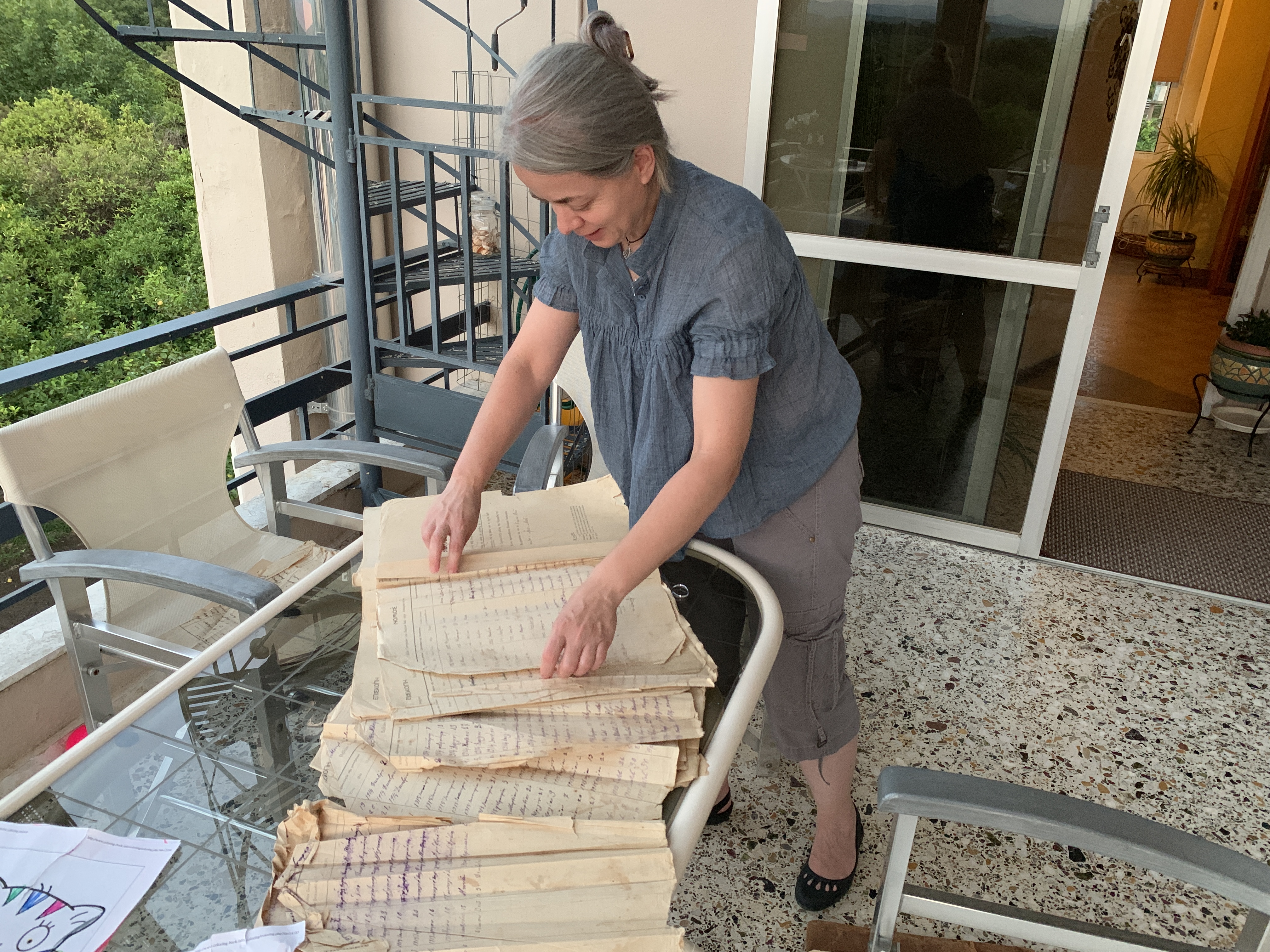
Birth-Marriage-Death Book 1913-52. Flattening the pages of this book to enable digitization took hours, and was done with the assistance of my cousin, Panorea Kostakos (see photo below).

My cousin, Panorea Kostakos, helps to sort and then flatten pages.

But these books reveal much more–the sagas of their villages. They are pieces of history, chronicling the demise of picturesque mountain villages and revealing the growth of places in the fertile Spartan valley. I can see which villages are dying and which are thriving. When I visit uninhabited villages high in the Taygetos, the death versus birth entries reveal the exact timeline of decline with statistical accuracy.

School house in the now uninhabited village of Barsinikos/Taygeti, atop the Taygetos mountains. The school closed in the 1950s due to lack of students.

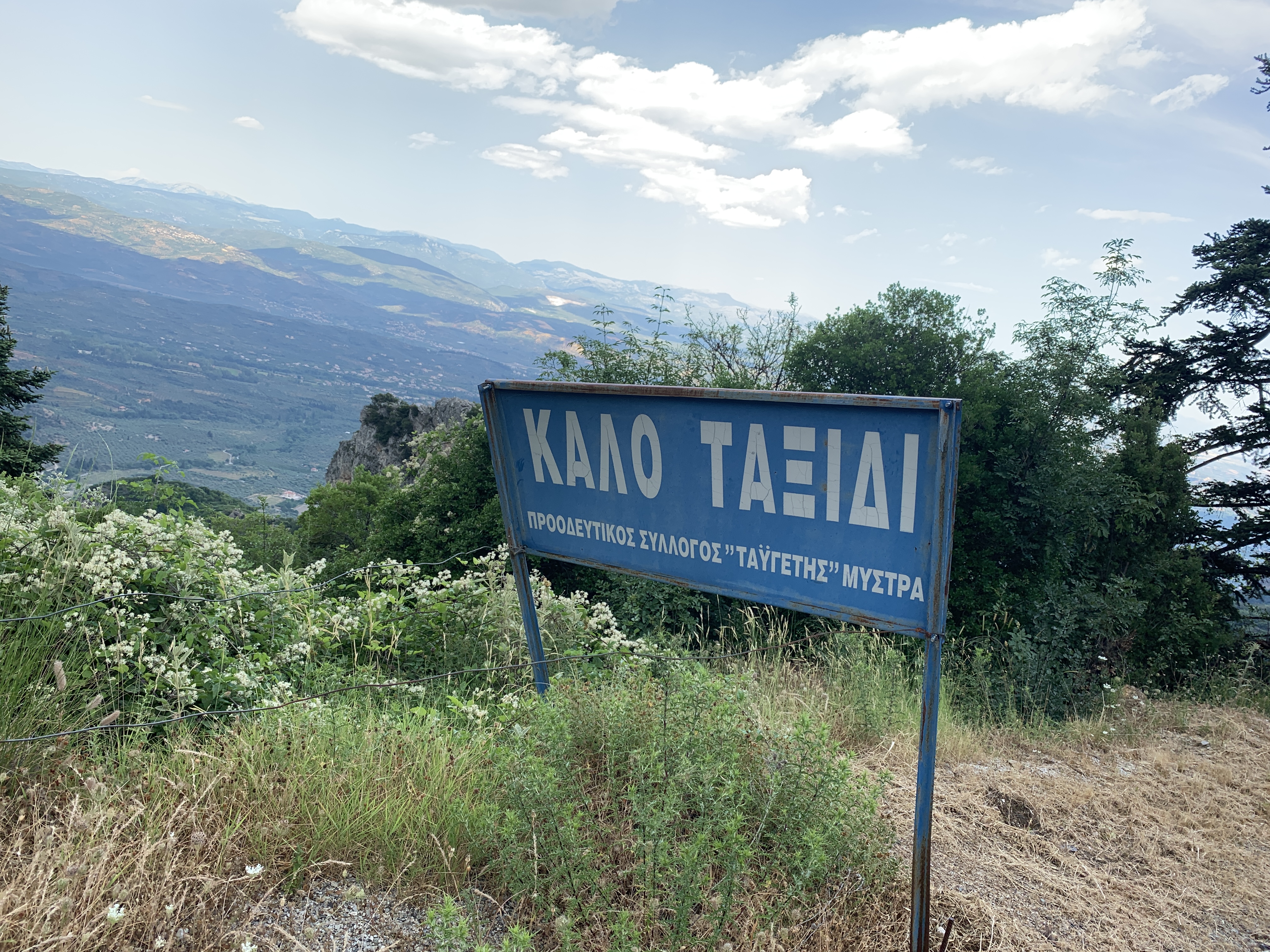
This sign, “Kalo Taxidi” bids visitors a “good trip” as they leave the high mountain village of Barsinikos/Taygeti.

Village churches do not have “offices” or clerical staff. The priest does everything. Some churches may have a storage area with a desk where books are kept, but many priests keep books in their own homes.

A priest’s desk in a church “office.”

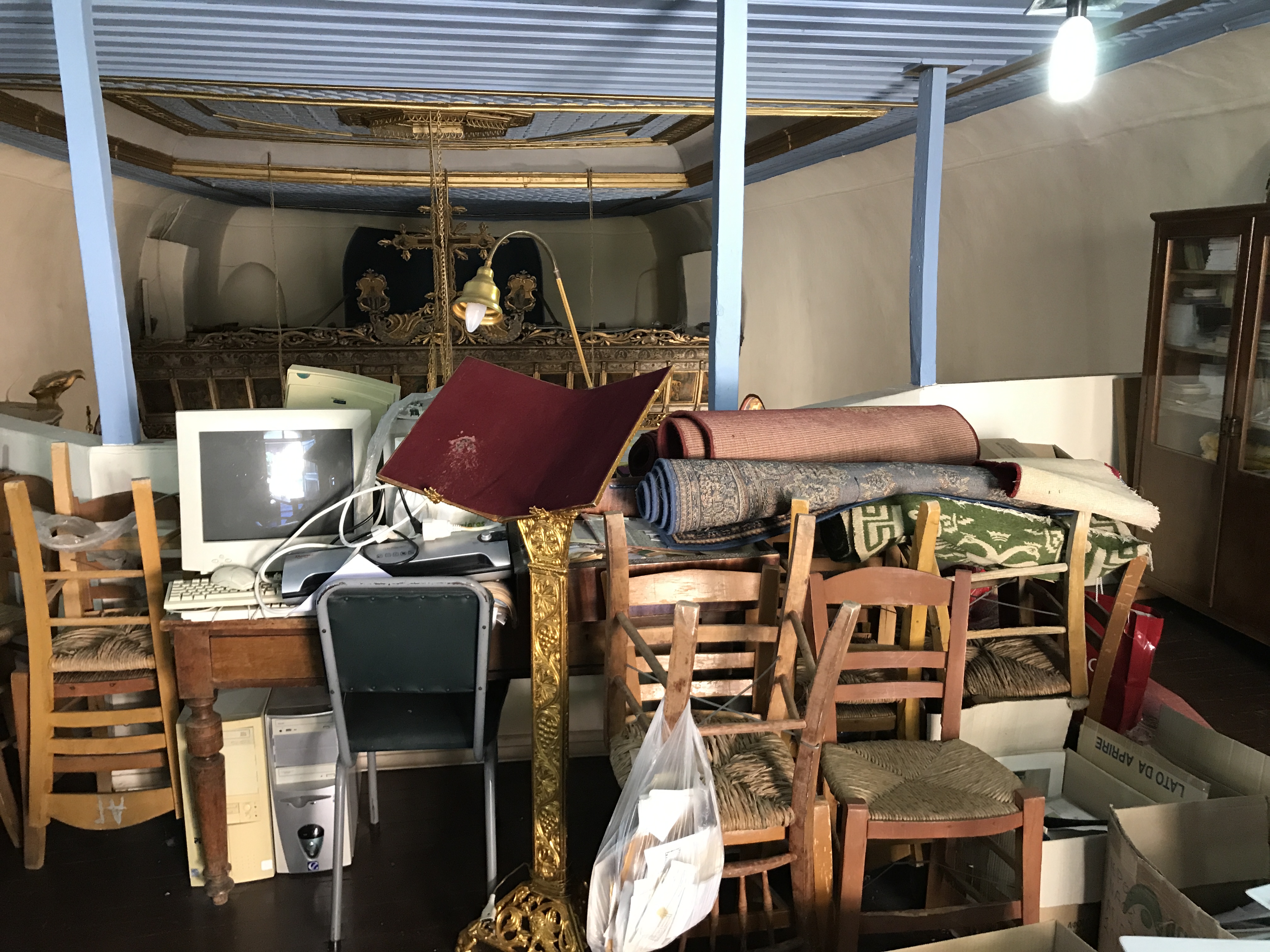
Storage area in a village church

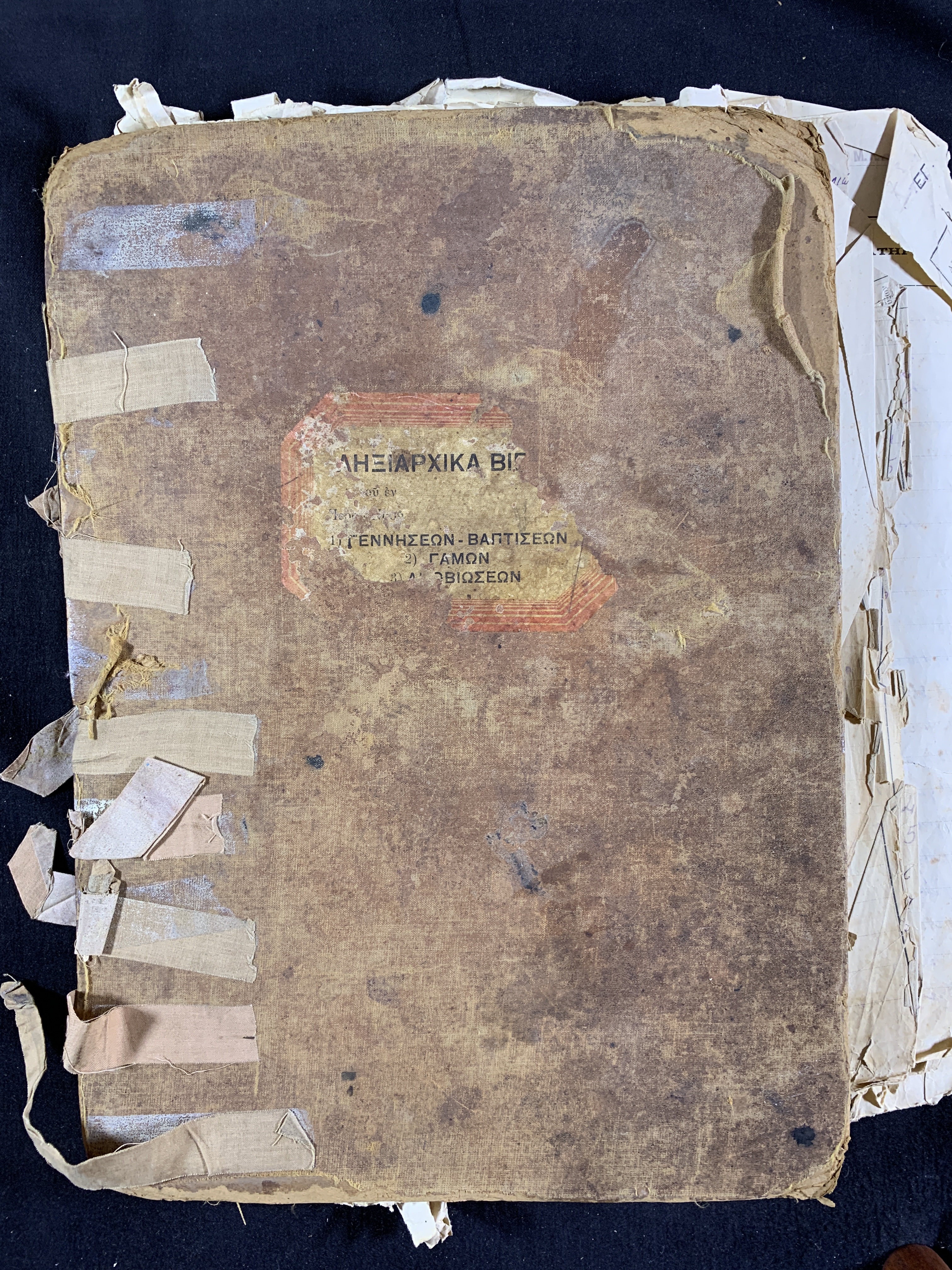
There were times I was saddened by the condition of the books, and times when I marveled at the ingenuity of the priests in their efforts to maintain them. I saw some very creative (although definitely non-archival) restorative measures.

Newspaper book cover

Flowered contact paper used to repair binding

Packing tape was used throughout this book to keep it together

This book is held together with string and metal wire

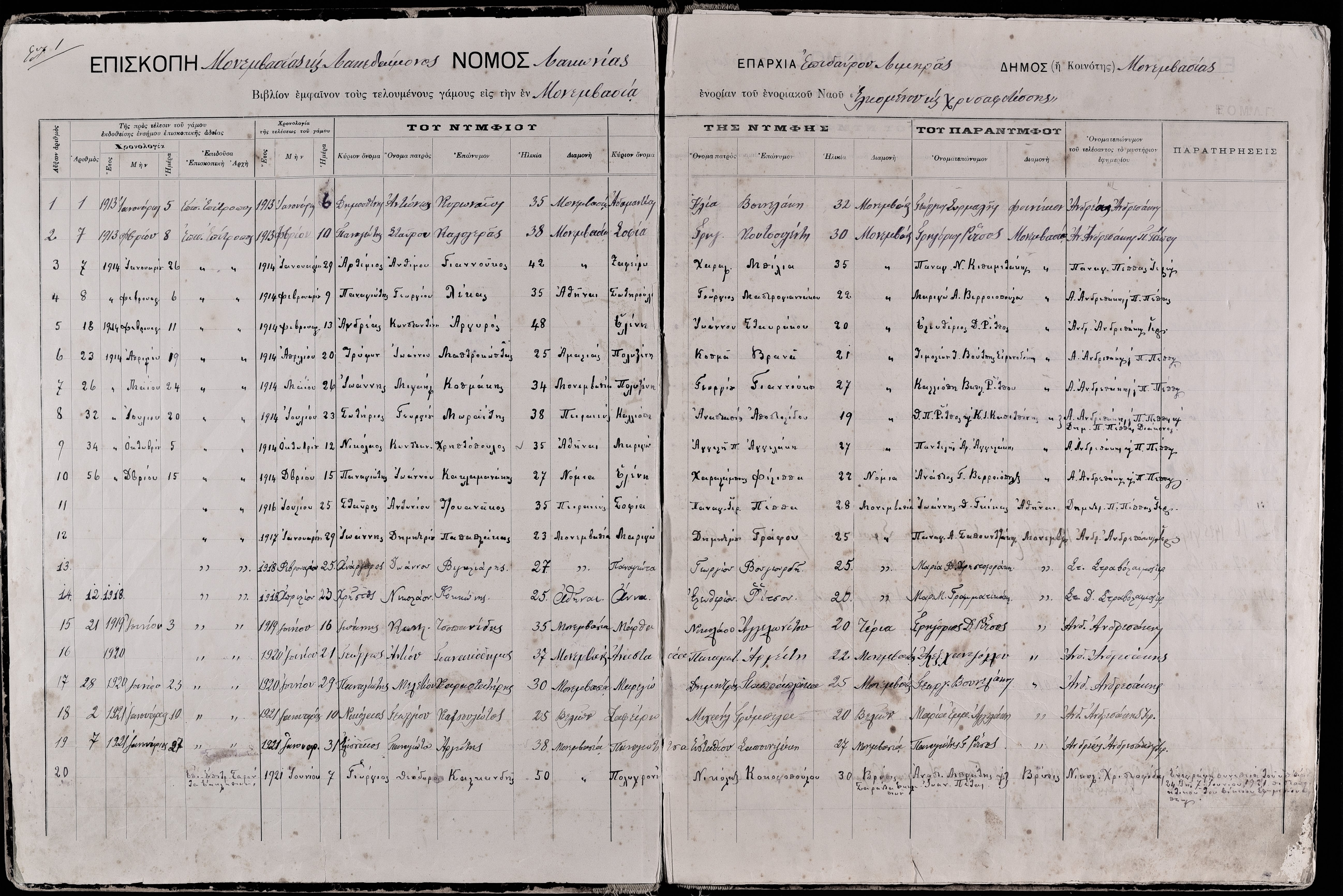
The photos below show examples of pages from birth, marriage and death books. In 1912, the Orthodox Church standardized book formats, and all priests were to use these new books. I was stunned to find that many priests are still recording entries in books which began in 1912–that means they are using books that are 107 years old!

Magoula, Sparta. Births, Baptisms 1908-1934

Vamvakou,  Deaths 1914-2004

Monemvasia, Marriages 1913-1997

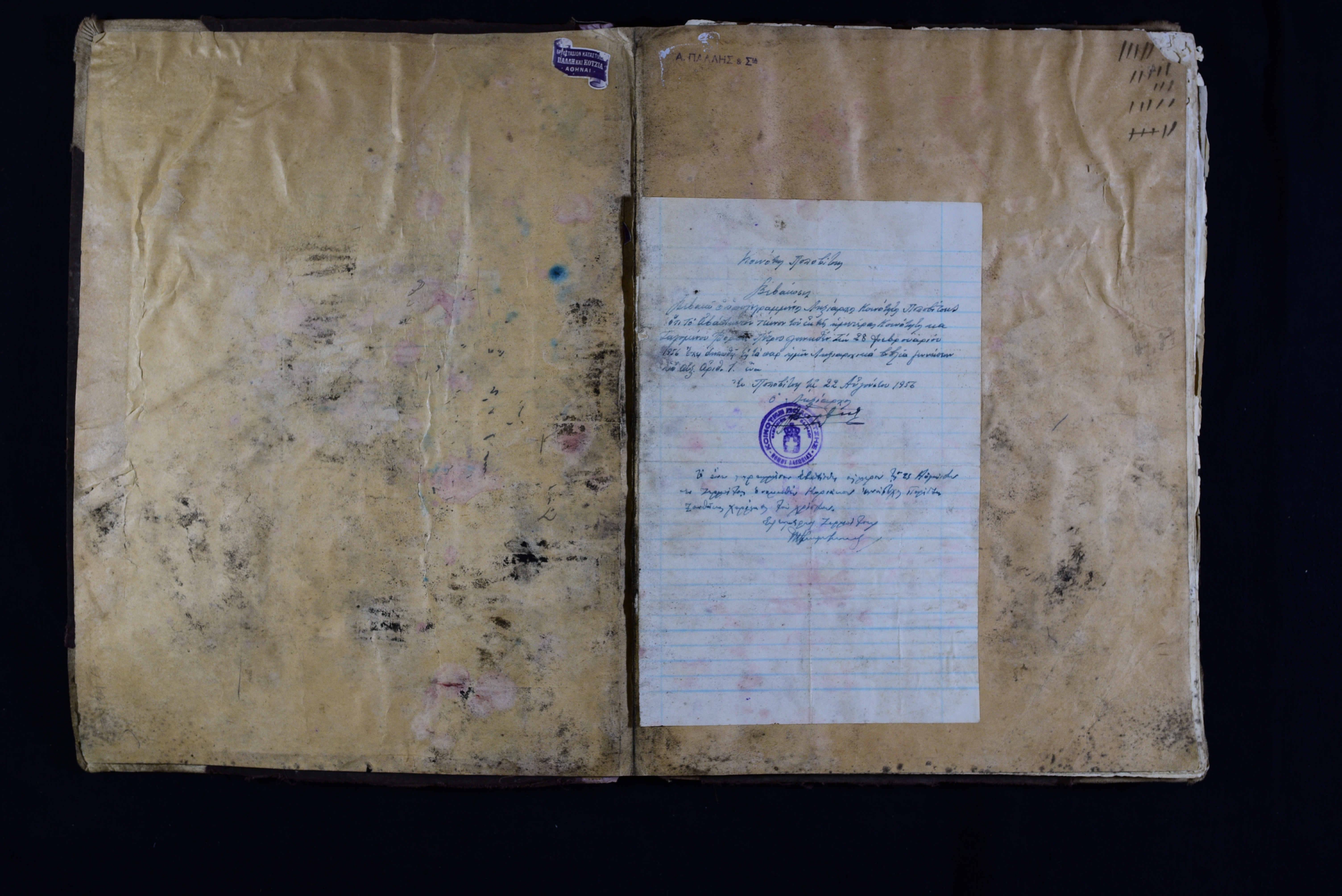
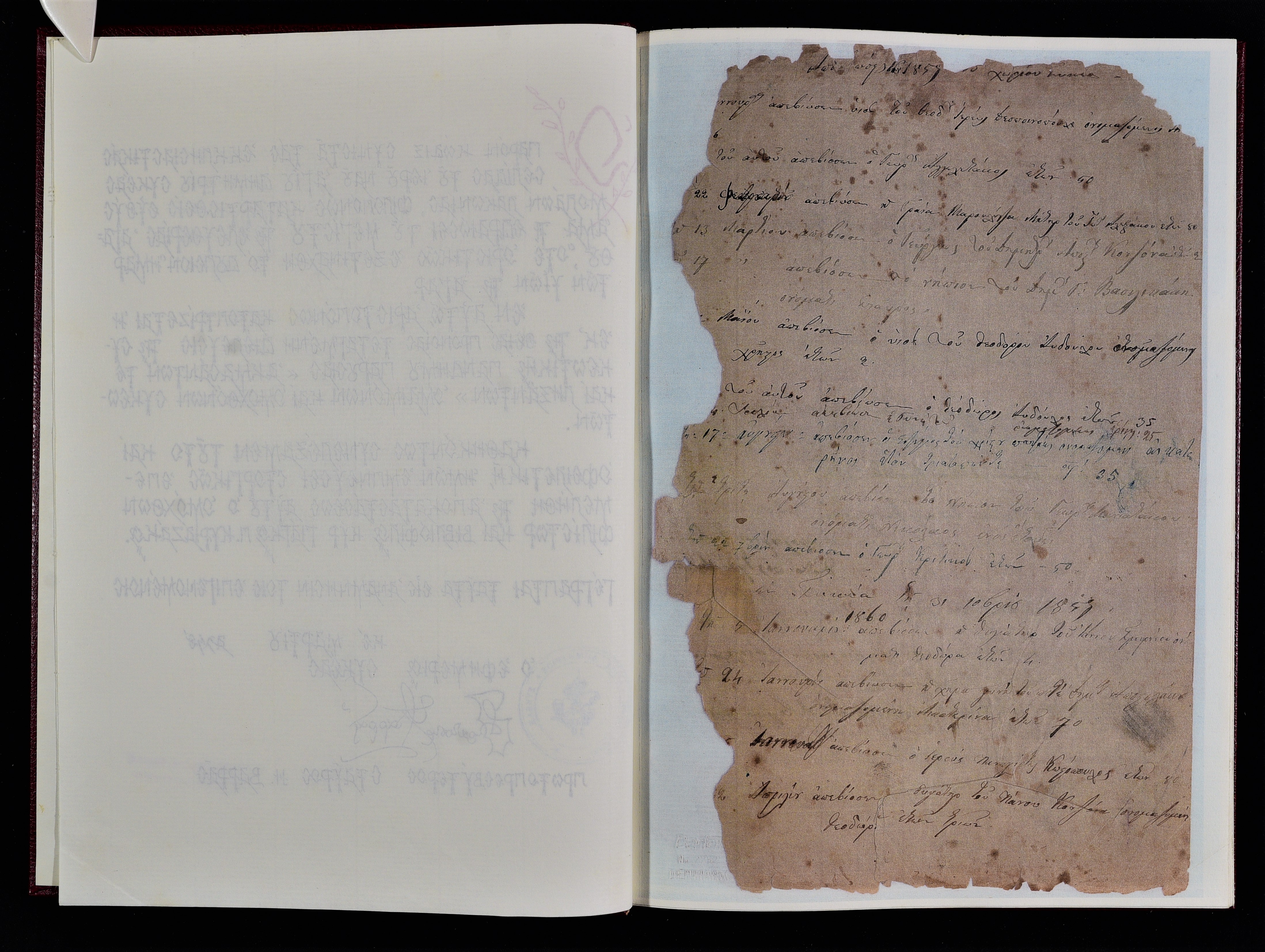
Books from the 1800’s are either faded, almost to the point of non-readability, or in fragments.

Mystras, Births 1860-1885. Although the book is in remarkably good condition, the ink has faded, making it difficult to read the entries

Sykea, Death 1859-1913. The priest had the fragmented pages preserved on rice paper, and the book was rebound

This book of deaths has been rebound and digitized on a CD.

Vlachioti, Deaths 1912-1978. Rebound and digitized, with pages preserved on rice paper

At the start of this project, I was anticipating that most Laconian villages had books dating pre-1900. After all, these villages are hundreds of years old and survived Ottoman, Venetian and Nazi occupation. Sadly, only 11 villages (under the jurisdiction of the Metropolis of Sparta and Monemvasia) have at least one book which has entries from the 1860’s or later: Anogeia, Agios Ioannis (Sparta), Geraki, Mystras, Krokees, Koulentia (Ellinikou), Perivolia, Sykea, Voutiani, Vroulia (now Sellasia), Xirokambi. Sadly, so much of our history has already been lost. But we now have “put our finger in the dike” by preserving what does exist and having back-up copies at the Metropolis.

This work could not be done without the support of Gilad Japeth, CEO of MyHeritage.com. His company will host these digital images and foster the acquisition of additional Greek record collections.This will help meet the increasing demand for vital records from Greece:  over 22,600 people are members of the Hellenic Genealogy Geek Facebook page with many new additions daily. We are riding a tsunami of interest and the wave continues to increase.

It is a privilege for me to have the opportunity to preserve the records of my ancestral homeland. I am grateful for the trust of Bishop Efstathios, who embraced the idea of record preservation with great enthusiasm and sincerity, and allowed me to handle these volumes. As a volunteer, this is one small way I can “give back” to the community which gave my family life.

Working in the Metropolis conference room to digitize the village church books