Beyond the Basics: The EETAA Website – Nuggets of Important Information

Have you ever wondered why you cannot find your ancestor’s village on a Google map? Do you need to find the email or phone number of a community to request a record or ask for information? The EETAA website (Greek Society of Local Development and Self Government) has these answers. But, it takes some digging to find them. I hope this guide will help you.

NOTE: There are links to specific pages in this guide to help you navigate. It takes time to maneuver to the exact page you want. When you find your pages, bookmark them for easy access.

First and very important — if you do not read Greek, install a translate extension (such as Google Translate) which will enable you to click on “translate this page” so it can be read in English. As you explore this website, you will use this browser extension.  Note:  the example below is how it looks on Chrome, it will look different on other browsers i.e. Microsoft Edge, etc.

Second, understand the structure of Greece’s Levels of Administration (as organized under the Kallikratis Plan of 2011). Note that the designations of Nomos and Prefecture were eliminated under the Kallikratis Plan, but these terms continue to be used.

The “official” levels of administration:

Level 1:  7 Administrative Districts (Αποκεντρωμένη Διοίκηση).

Level 2:  13 Regional Units (Περιφέρεια)  

Level 3:  325 Municipalities (Dimos – Δήμος). These are further divided into municipal units (Δημοτική ενότητα). The municipal units are then divided into:  (1) municipal communities  (Δημοτική κοινότητα) and (2) local communities  (Τοπική κοινότητα).

The EETAA website is a gateway to contact information for these three levels.  

This is the homepage.

Remember, this is a government website with a myriad of information. To dig into what is needed by family historians, focus on the left column. Ignore the top of the column, and scroll down almost to the bottom where you will see the categories described below.  


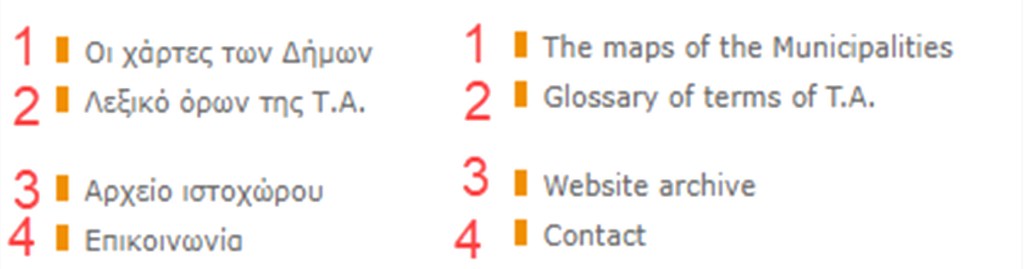
The images below show the categories as they appear in Greek (on the left). I have added the English translation (on the right). I have also inserted numbers which correspond to detailed information and links below the image.

The first category of interest is Local Government Today (Η Αυτοδιοίκηση Σήμερα). This is where you will find contact information for each administrative level.
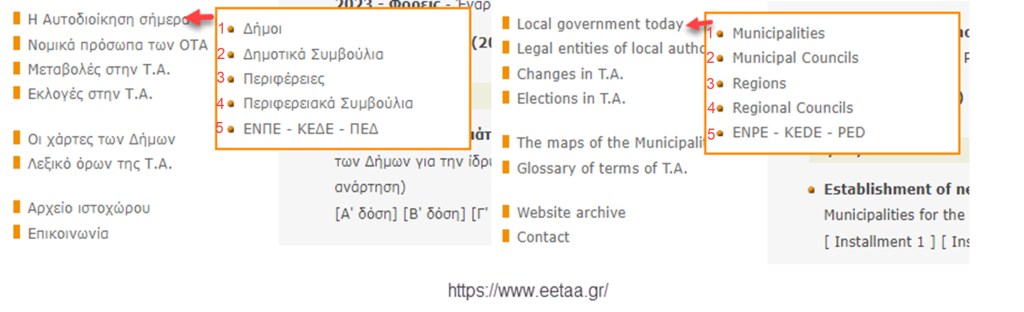
#1: Dimos or Municipalities – contact info; emails, websites. Use page numbers at bottom to jump ahead: https://www.eetaa.gr/foreis/dhmoi.php

#2: Municipal Councils – click on the name of the municipality for names of mayor, deputy mayors, board members and municipal councilors. Use the alpha list at the top to find your area and page numbers at bottom to jump ahead: https://www.eetaa.gr/foreis/ds_select.php

#3: Regional Units – name of governor, address, phone number, email, website. Go to the regional website to drill down into municipal units:  https://www.eetaa.gr/foreis/perifereies.php

#4: Regional Councils – click on name of region for names of district governor, deputy governors, regional council members: https://www.eetaa.gr/foreis/ps_select.php

#5: Local government today / ENPE – KEDE – PED. Regions listed with contact information, website and email. Click on the region name for names of officials. https://www.eetaa.gr/foreis/enpe_kede_ped.php


The next links of interest are Changes in T.A.
These show the administrative changes of municipalities and their communities. This is where you can find the history of a municipality or a community, and you will learn what happened to the “old settlements” that no longer exist.
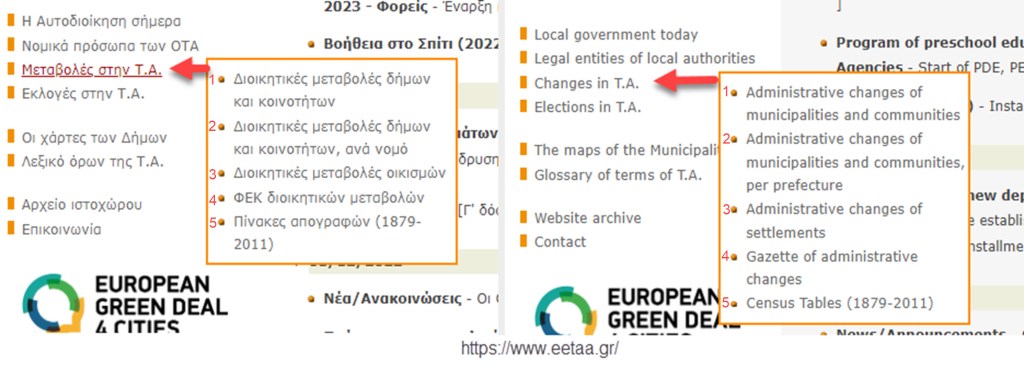
#1.  Administrative Changes of Municipalities and Communities: https://www.eetaa.gr/metaboles/dk_metaboles.php
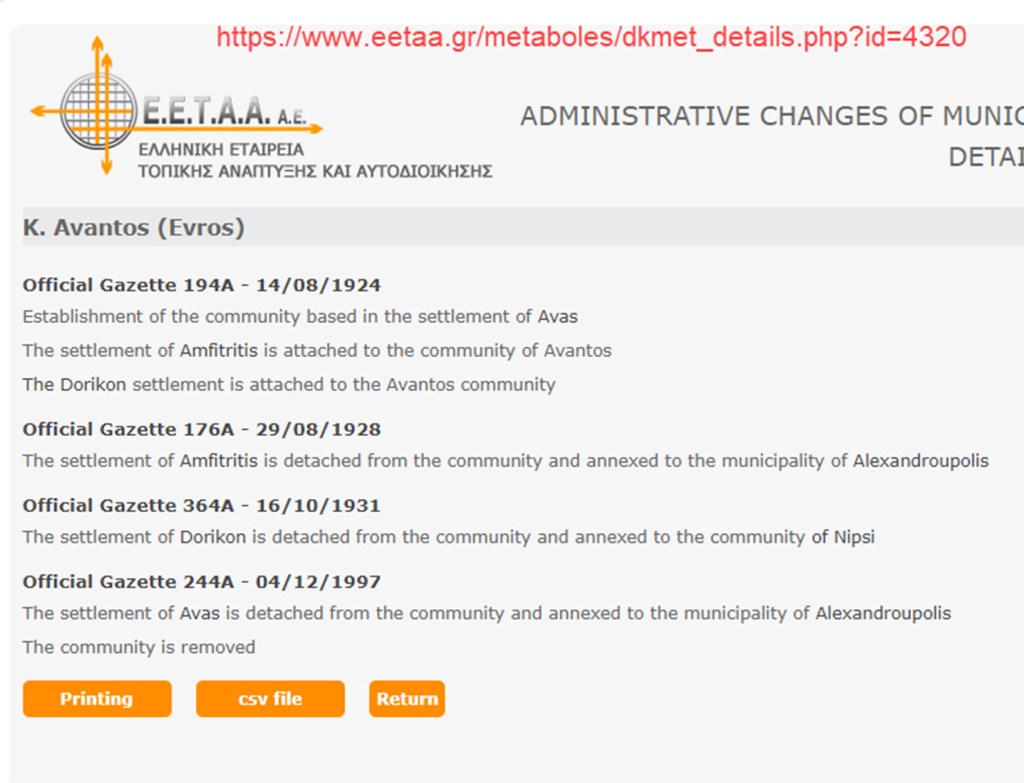
Every municipality and community is listed. Use the alpha list at the top to find your municipality and page numbers at bottom to jump ahead. Click on the name of the municipality or community to see its history. There is a link to the issue of the ΦΕΚ which decreed the change. Click on the ΦΕΚ line to see a digital issue of the newspaper.

Example: Avantos (Evros)
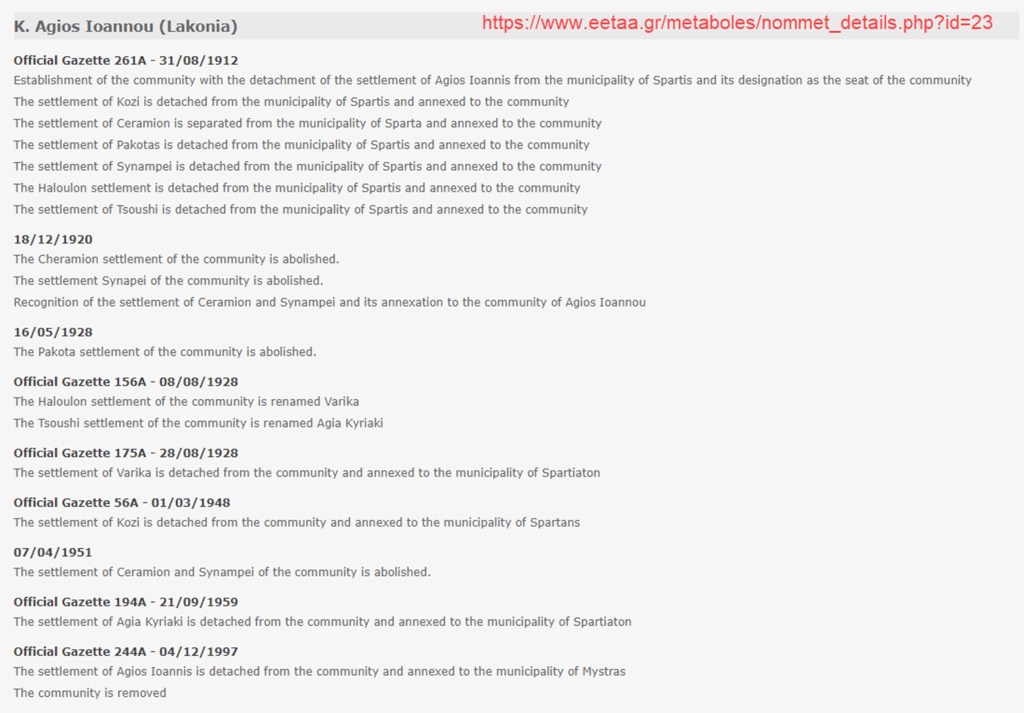
#2. Administrative Changes of Municipalities and Communities by Law: https://www.eetaa.gr/metaboles/nom_metaboles.php
This section gives details on which settlements or neighborhoods were dissolved or incorporated into a larger community. First, find your region (the website uses the outdated word nomos). Click on its name, and the next page lists municipalities and their histories. Scroll until you find one of interest. As of the date of this post, the link to the issue of the ΦΕΚ does not work.

Example: Agios Ioannis Sparta, Lakonia
#3. Administrative Changes of Settlements: https://www.eetaa.gr/metaboles/oik_metaboles.php
Settlements are listed in alphabetical order. Use the alpha list at the top to navigate to a settlement, and the numbers at the bottom to jump ahead. Click on the name of the settlement to access its history and ΦΕΚ links.

#4. ΦΕΚ issues:   https://www.eetaa.gr/metaboles/fek_year.php
The official government gazette has been published since 1833. Use the drop down menu to find a year of interest and to access digital images.

#5.  Census Gazette: https://www.eetaa.gr/metaboles/apografes.html
Population censuses do not list names, but they do give the number of inhabitants in municipalities. These statistics can help you track the influx and outflow of people in your village. Digitized copies are viewable for the following years: 1879, 1889, 1896, 1907, 1913, 1920, 1928, 1940, 1951, 1961, 1971, 1981, 1991, 2001, 2011.


This section has regional maps.
#1. Maps of Greece: https://eetaa.maps.arcgis.com/apps/webappviewer/index.html?id=6501bf4632f24f608a20101faaca205c
The map shows administrative boundaries for municipalities, regions and prefectures, etc. Use the zoom tools on the lower left to drill into your area of interest. Use the Legend and Layers icons on the top right of the page to choose exactly what you want to view on the map.

#2. Glossary of Local Government Terms: https://www.eetaa.gr/lexikon/list_words.php?task_id=71
Click on a word to see a translation of its meaning in English, French and German.

#3. Website Archive: https://www.eetaa.gr/index.php?tag=arxeio

#4. Contact: https://www.eetaa.gr/index.php?tag=contact_eetaa
Contact information for the EETAA offices in Athens, Brussels, Central Macedonia and Thessaly.

This is a complex website, and this post has examined only the areas of interest to genealogy researchers. If there is something else that would be helpful to our community, please send an email to Carol Kostakos Petranek at spartanroots1@gmail.com and I will update the post.

Good luck as you dig further into these government resources to help you learn more about your community and to contact those who can provide further information.

In Family Tree Magazine!

I appreciate the mention of this Spartan Roots blog in the recent issue of Family Tree magaine, an excellent resource for genealogical research. Thank you, Sunny Jane Morton for the endorsement, and to Georgia Stryker Keilman, founder of the Hellenic Genealogy Geek website and Facebook page, for alerting me to this post! The full article, Genealogy Blogs from Around the World (and Why They’re Valuable), can be accessed here.

The Faris: The Endings in -akis and -akos of the Surnames of our Region

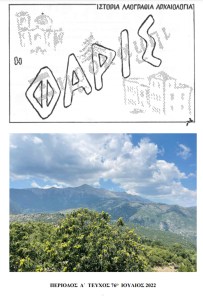
Those with ancestral ties to the modern municipality of Farida, Lakonia (villages include Xirokampi, Palaiopanagia, Anogia and several others) are immeasurably enriched by the writings of scholars from the area. The publication, The Faris, History, Folklore, Archaeology (‘Η Φαρις), has been produced semi-annually since 1966 and contains many hundreds of articles about the people, history, folklore, archaeology and culture of the region.  An appendix in each issue includes notices of births and deaths of local residents. The publication was initially known as The Xirokampi and maintained that title from 1966 to 1977, when the name The Faris was adopted.

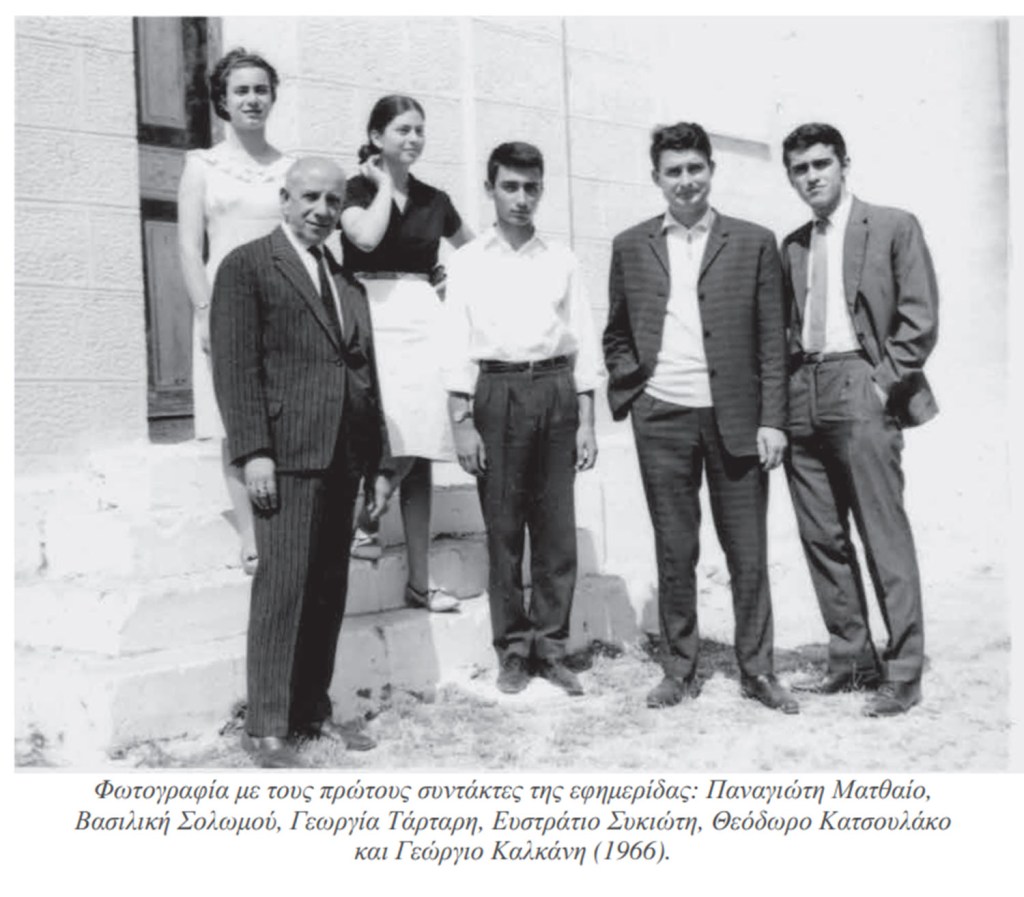
Those who write for The Faris descend from local ancestral families and know its past well. The founding editors, pictured below in 1966, were: Panagiotis Mathaio, Vasiliki Solomou, Georgia Tartari, Efstratios Sykiotis, Theodoros Katsoulakos, and Georgios Kalkanis. The current editorial committee is: Georgios Th. Kalkanis, Theodoros S. Katsoulakos, Panagiotis H. Komninos, and Ioannis Panagiotis Konidis. These, and dozens of other authors, have made Τhe Faris periodical a vital and unique resource to study the people and times of rural Lakonia. 

The founding editors, from the 50th anniversary issue of The Faris, April 1996: left-right: Panagiotis Mathaio, Vasiliki Solomou, Georgia Tartari, Efstratios Sykiotis, Theodoros Katsoulakos, and Georgios Kalkanis

All issues of The Faris can be accessed here. This link is to an index of articles from 1966-2001. This link is to the  e.faris website.

I am honored and humbled to receive permission from the Katsoulakos family to translate and share articles from The Faris. Translation verification and corrections have been made by GreekAncestry.net.  This is the first article of the ongoing series.


The Endings in -akis and -akos of the Surnames of our Region
author: Theodoros S. Katsoulakos

published in The Faris, History Folklore Archaeology, March 2007, Issue 42, pages 3-6
URL: http://micro-kosmos.uoa.gr/faris/pdf/faris_42_mar_2007.pdf. Note: Footnotes in the original publication have not been translated.

The writing of a historical study presupposes the existence and substantial utilization of evidence and historical sources. However helpful the assumptions may be, if they are not supported and confirmed by direct or indirect evidence, no opinion can be substantiated or founded.

In our area, the wider region of ​​the municipality of Farida, if one excludes a few monuments, remnants of the distant past, few writings have remained from the years of the four centuries of Turkish rule. The latter is explained if we take into account the low (intellectual) level of the Greeks of the time and the bloody struggle for the liberation of the country, during which everything that was left was destroyed.

Fortunately, the monasteries saved some written sources of the Turkish Occupation: their contribution in this field as well was undeniable. In particular, a number of documents from this era are preserved in the monastery of Zerbitsa. Some of them are from the 17th century and more from the 18th century. These are notarized sales, exchanges, wills of monks of Zerbitsa and Gola. The monastic zeal protected the assets from various schemes in moments especially of anarchy and fear. It is surprising and impressive, of course, how these historical documents reached us, while it is known that the monasteries of Zerbitsa and Gola were attacked, suffered disasters, and their administrative status changed.

The language in which these witnessed agreements are written is Greek, with a standard that is an amalgam of colloquial language and elements from the legal and religious tradition.  This means that this bipartite contract concerned the Greeks and was of value only to them.  From the study of many jurisprudential documents of the monasteries in the region, it emerges that there are very few Turkish words that had infiltrated and these concern terminology closely related to the financial interests of the conqueror, such as mulkia, from the Turkish mülk, meaning private property, lakas, possibly a Persian word (al­aka), meaning share, and amanati (bequest), which survives to this day.

The documents and various records are reliable witnesses of the presence of the families in our place, such as: Komnenos (1465, 1762 onwards), Goranitis (1634), Laskari (1634, 1751 onwards), Aliferis (1698),  Menouti and Sahla (1751), Meropoulis (1753), Karadontis (1754), Konidis (1754), Stoubou (1754), Koutsika (1757), Theofilakou (1757 and 1776), Tsaggari (1757), Niarchou (1759), Moutoula (1760), Rizou (1761), Papastrati (1764) Fragki (1764) Mathaiou (1769) Kalkani (1789) Vourazeli (1795), Psyllou (1796), etc.

Of great interest is the information provided by the documents regarding the diminutive endings in -akis, which are proportionally more than the corresponding endings in -akos.

  1. –akis: Angelakis (1826?), Athinakis (1757), Aleiferakis (1752) and Aleiferis (1698), Anagnostakis (1829), Anastakis (1757), Antritzakis (1680), Venetzianakis (1769), Giannakis (1755), Grammatikakis (1769), Dimitrakakis (1788), Zoulakis (1751), Konakis (1818), Kanellakis (1757), Kapetanakis (1763) and Kapetanakis-Venetsanakis (1830), Karkampasakis (1766?), and Karkampasis (1815), Kom(n)inakis (1755) and Kom(n)ynos (1763), Konomakis (1752), Krotakis (1784), Lamprinakis (1764), Lygorakis (Grigorakis) 1793, Liampakis (1813), Mathaiakis (1769), Markakis (1780), Markoulakis (1680), Meropoulakis and Meropoulis (1744?), Nikolakakis (1824), Xanthakakis (1826?); Panagakis (1744?); Papadakis (1698), Patrikakis (1752), Petrakakis (1779?), Posinakis (1680), Rigakis (1832), Rizakis (1749?), Rozakakis (1762?), Stathakis (in an undated document), Stamatakis (1751), Stamatelakis (1698), Stampolakis (1759), Stratigakis (1751), Tarsinakis (1755), Tzakonakis (1830), Feggarakis (1755), Fragkakis (1812) and Fragkis (1764), Chaidemenakis (1805), Chelakis (1793), Christakis (1773).
  2. -akos: Anagnostakos (1800), Anastasakos (1830), Andreakos (1766), Antreakos (1766?), Apostolakos (1816), Armpouzakos (1819), Vatikiotakos and Vatikiotis (1798), Giannitzarakos (1832), Grigorakos (1784), Thanasakos (1763), Kavourothodorakos (1815), Karadontakos and Karadontis (1754), Katsoulakos (1825), Kostakos (1830), Lamprinakos (1764), Liakakos (1789), Maniatakos (1789), Marinakos (1823), Menoutakos (1751), Xepapadakos (1788), Panagakos (1830), Papastratakos (1826), Solomakos (1788), Stathakos (1824), Stratakos (1826), Tzolakos (1786), Christakos (1789).

After 1830, the ending of -akos began to prevail in the region. Useful conclusions are drawn from the study of the report of the local notables of the region to the Holy Synod (1835). It is noteworthy that only one surname was found ending in – æas (Niareas 1826).

Family History Book: John Andrew Kostakos and Harikleia Aridas

In October 2012, Hurricane Sandy flooded the streets of Brooklyn, New York. Among the damaged homes was that of my Aunt Alice Kostakos. Two of my cousins rescued hundreds of photos and many albums which were floating in the mucky water. In 2016, my cousins and I digitized these photographs, which I described in this post.

These pictures formed the basics of this family history book which documents the lives of my paternal grandparents, Ioannis Andreas Kostakos and Harikleia Aridas, both of Agios Ioannis, Sparta. Combined with family stories and many documents from the U.S. and Agios Ioannis, the book came together easily.

I loved every minute of working on this project. It enabled me to better understand the lives of our grandparents and their ancestors, and to truly appreciate my heritage. A pdf version of this book can be accessed here.

It is time to get information out of my computer and into the hands of family and relatives. With the multitude of documents I have accessed during my research trips to Greece, there are many more books to write about all of my family lines in various villages of Sparta. I have only just begun.

Papou was Robbed!

My friend Debbie, who reads old Greek newspapers as part of her research strategy, recently sent me a gem. As she was looking at a New York City Greek-American newspaper from 1917, an article mentioning Papagiannakos from Hoboken caught her eye. Incredibly, she remembered this was my grandfather’s surname, and she sent me the following newspaper page with this message:  “didn’t know if you would need this, but maybe?”

September 22, 1917; Ethniko Kirika

Maybe? Good heavens, YES! This is about my maternal grandfather, Ilias Papagiannakos.

News clipping about Ilias Papagiannakos, September 19, 1917, Ethniko Kirika

The article states that because he did not trust banks, he hid his money in an old shoe which was kept in the back of his clothes closet. A thief stole the fruits of eight years’ hard work and sacrifice, and now the money was gone.

The translation reads:

In Hoboken, N.J.

He doesn’t trust banks – They stole savings of eight years of toil and sacrifice

(Special Correspondent)

HOBOKEN, N.J., September 19 [1917] – A victim of his mistrust of banks was the local restaurant owner Elias Papagiannakos, originally from Agios Ioannis, Sparta. Mr. Papagiannakos, distrusting banks, had been saving his money and kept it inside an old shoe, which he hid behind a box in his room.

The day before yesterday, however, while his wife went out to buy some household goods, unknown individuals entered the room and stole the precious old shoe containing all the savings from eight years of toil and sacrifice — amounting to $900 in cash and $300 worth of jewelry.

Mr. Papagiannakos reported the incident to the police and suspects the perpetrator is someone familiar to him, possibly even a household acquaintance, since they found the well-hidden shoe without any difficulty.

My first reaction was shock, then sadness. An inflation calculator estimates that in today’s dollars, the sum of my grandfather’s loss would be $25,502.48, a significant amount of money! Ilias immigrated at age 15-17 under an alias to avoid conscription into the Greek army. He had no money and worked hard to accumulate enough funds to purchase a small restaurant in Hoboken. To save $1200 after eight years’ labor was quite a feat.

At first I wondered why my mother (Catherine) and her sister (Bertha) never told me this story; then I realized that they may not have ever known this happened. My mother, the oldest living child, was 6 months old in September 1917. When my grandmother went shopping on the day of the robbery, she would have taken my infamt mother with her. Many years later when my mother was an adult, they may have forgotten or chosen not to mention this unfortunate event.

There are many questions that will forever remain unanswered. Who could possibly have known where my grandparents stashed their money? If it was someone close to them, how could he/she have perpetrated such a breach of trust? How did my grandparents cope with the loss of their savings? My grandmother had $300 worth of jewelry — that is significant for immigrants! Were they wedding gifts?

I am so grateful to Debbie for finding and sending this article, which gives me insight into a difficult event in the lives of my grandparents. It is said that we can gain strength from learning how our ancestors met and overcame challenges. Knowing that yiayia and papou weathered this setback and continued on to financial freedom is encouraging and inspiring to me.

(My appreciation to Giannis Michalakakos for translating the news article)