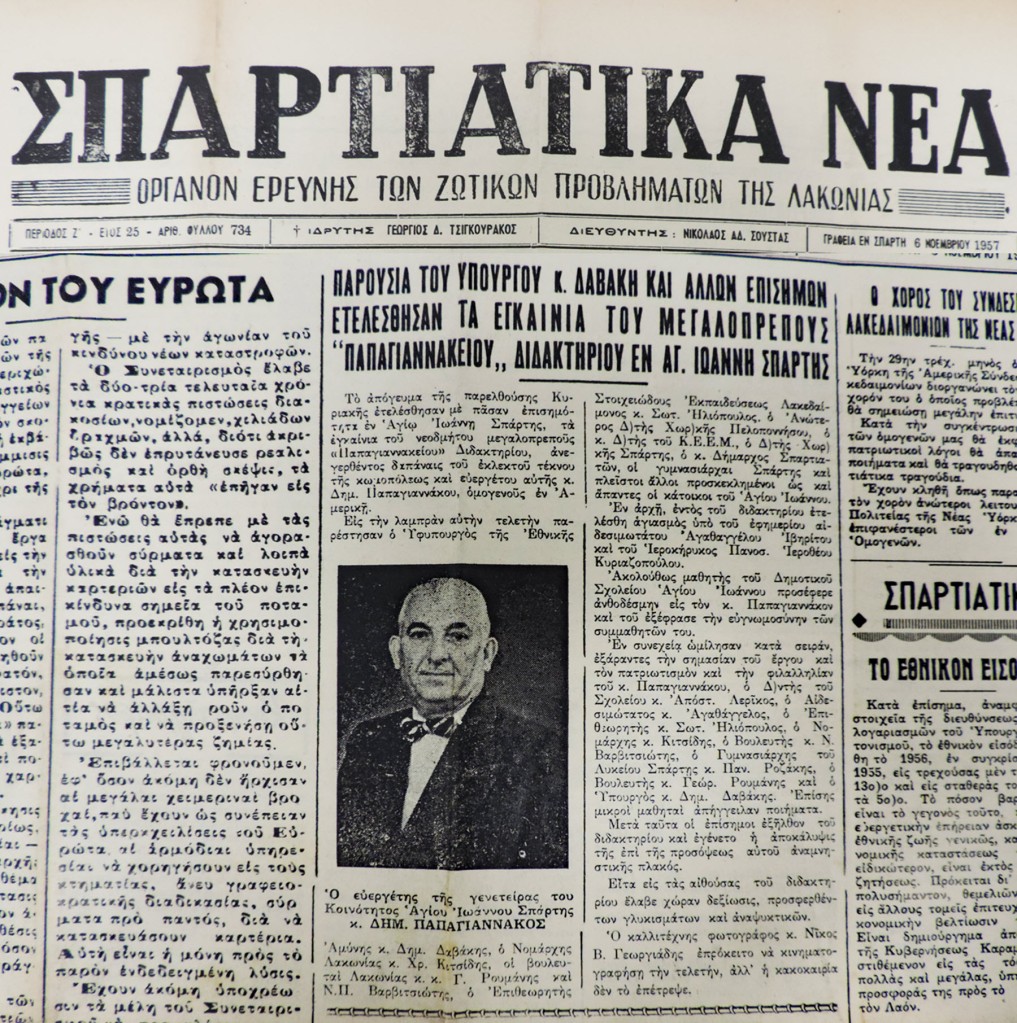
IN THE PRESENCE OF THE MINISTER MR. DAVAKIS AND OTHER DIGNITARIES, THE INAUGURATION OF THE MAGNIFICENT PAPAGIANNAKOU SCHOOL IN AGIOS IOANNIS SPARTIS WAS HELD
(Thank you to Panorea Kostakou of Agios Ioannis, who found this newspaper article)
(Online translation by Carol Kostakos Petranek. Please excuse errors)
On the afternoon of last Sunday the inauguration of the newly built magnificent Papagiannakos School was solemnly held in Agios Ioannis of Sparta, erected with the help of the chosen son of the town and benefactor Mr. Dim. Papagiannakos, an expatriate in America.
In attendance at this glorious ceremony were the Minister of National Defense Mr. Dim. Davakis, the Governor of Laconia Mr. Chr. Kitsidis, councilmen of Lakonia Messrs. G. Roumanis and N.P. Varvitsiotis, the Inspector of Elementary Education of Lacedaemon Mr. Sot. Iliopoulos, the Senior Director of the Peloponnese, the Director of the K.E.E.M., the Director of Sparta, the Mayor of Sparta, the high school students of Sparta and many other guests as well as the residents of Agios Ioannis.
At the beginning, holy water was administered inside the school by the Reverend Agathaggelou Ivyritou and the priest Panos. Ierotheou Kyriazopoulou.
Subsequently, a student of the Agios Ioannis Primary School offered a bouquet of flowers to Mr. Papagiannakos and expressed the gratitude of his classmates.
Then they spoke in turn, extolling the importance of the work and the patriotism and philanthropy of Mr. Papagiannakos. Afterwards, the Principal of the School, Mr. Apost. Lerikos, the Reverend Mr. Agathaggelos, the Inspector Mr. Sot. Iliopoulos, the Prefect Mr. Kitsidis, the Member of Parliament Mr. N. Varvitsiotis, the Head of the Spartan High School Mr. Pan. Rozakis, the Member of Parliament Mr. Ger. Roumanis and the Minister, Mr. Dim Davakis. Also young students recited poems.
After this the officials left the school and the unveiling of the commemorative plaque on the façade of the church took place.
Then a banquet took place in the halls of the school, with sweets and refreshments being offered.
The artist photographer Mr. Nikos V. Georgiadis was going to film the ceremony, but the bad weather did not allow it.
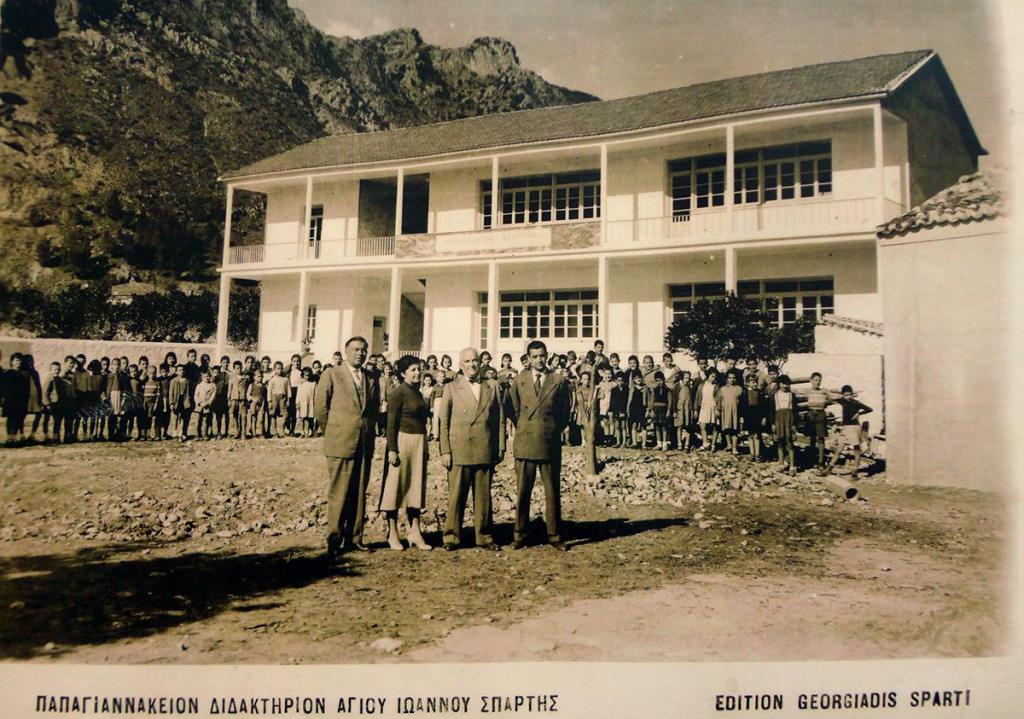
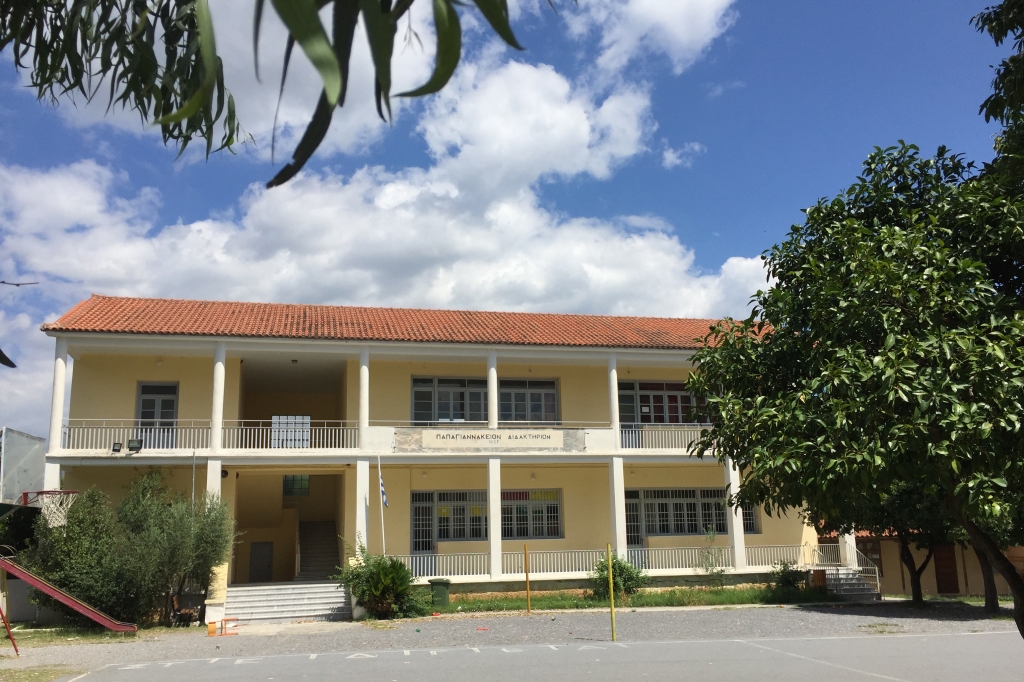
Postcard of Dedication of the Papagiannakos School; received from Tasos PapagiannakosThe Papagiannakos School, 2023
It is the bane of every family historian: sorting out men with the same name who lived in the same location at the same time, and sometimes married women who had the same given names. For Greek researchers, this issue is exacerbated due to naming traditions which almost always ensure that several men in a village—because they are named after their grandfather–have the identical baptismal name and surname. Fortunately, our naming traditions usually provide the father’s given name as well. Examples: Nikolaos Stamatakis, of Georgios (Νικολάος Σταματάκης του Γεώργιου) and Nikolaos Stamatakis, of John (Νικολάος Σταματάκης του Ιώαννου). We now know that the father of the first Nikolaos is Georgios and the second is John.
But what happens when we are searching in records where the father’s name is not given? This usually is the case in older documents, such as 1844 or 1872 Voting Lists. One research strategy is to look at the ages of the men as a means of differentiation, but we already know that Greek ages can be notoriously inaccurate and many years off. Another strategy is to pinpoint an exact location, but what about families who moved between villages? Or the cases when a man married a woman, moved to her village and took HER surname thus losing his surname and becoming a “xxx…gamvros” (unusual, but we do see this in names like Stratigamvros). And to all this, let’s throw in the real possibility of clerical errors—or even misinformation given by the informant.
What then?
I was faced with this exact situation. My research question was: Which Nikolaos Papagiannakos in Agios Ioannis, Sparta, was the father of my great-grandfather, Panagiotis Nikolaos Papagiannakos?
I consulted several sets of records (Mitroon Arrenon, Voter Lists, Town Registers, Marriage Records) and documented every Nikolaos Papagiannakos, giving each a unique identification number. And I paid careful attention to the names of their sons.
Preliminary Analysis of Papagiannakos Name in Agios Ioannis Records
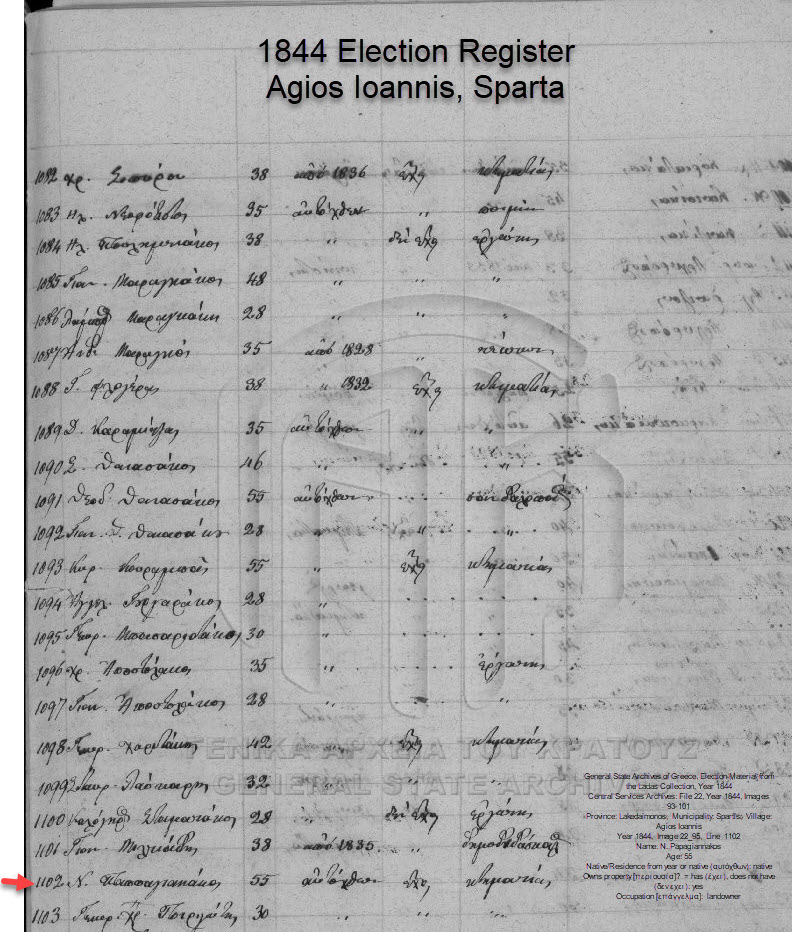
#1783 Nikolaos, born 1789 Source: 1844 Voter List: N. Papagiannakos, age 55, native, landowner
#862 Nikolaos born 1815; his son was Panagiotis Nikolaos GIANNAKOS (as given in Sparta marriage record) b 1841. Source: 1872 & 1873 Voter List
#2798 Nikolaos born bef 1820; son was Ioannis #2797, b 1845 Source: Estimated birth year as 25 years before birth of son in 1845
#2796 Nikolaos born bef 1812; son was Ioannis #2795, b 1837 in 1872 Voter list, age 28, Source: Estimated birth year as 25 years before birth of son in 1837
#2792 Nikolaos born bef 1810; son was Ioannis #2791 b 1835 in 1872 Voter List age 37, in 1873 Voter List age 38 Source: Estimated birth year as 25 years before birth of son in 1835
#348 Nikolaos Panagiotis, b. 1872; son: Panagiotis Source: 1898 marriage record; he was age 26
#104 Nikolaos Ioannis, born 1867 Source: Male Register: Year: 1867; Line 8: Papagianakos, Nikolaos; father: Ioannis; born 1867
That’s a total of 7 Nikolaos Papagiannakos’ in Agios Ioannis born between 1789-1867:
Only two have fathers identified: line 7 has Ioannis; line 6 has Panagiotis
Lines 3, 4, 5 have sons named Ioannis
Lines 2 & 6 have sons named Panagiotis
My research question: which Nikolaos is my great-great grandfather, was answered: it is line 2, Nikolaos born 1815.
But I got caught up in the records and kept going. I suspected a possible duplication of Ioannis #2797 & Ioannis #2795 in the 1872 & 1873 Voter Lists. Both have Nikolaos as their father; however, the ages were not one year apart. I wondered whether there was a clerical or typographical error in the ages as follows:
Ioannis #2795 , worker: in year 1872 he is age 35 BUT there no Ioannis age 36 in year 1873
Ioannis #2797, farmer: in year 1873 he is age 28 BUT there is no Ioannis age 27 in year 1872
Assuming these were the same person, then Ioannis Nikolaos Papagiannakos in 1872 was either 27 or 35, and in 1873 he was either 28 or 36.
A cousin in Agios Ioannis told me that there were two Papagiannakos families, but no one knew how they were related. I wondered if this was true, and the records proved that theory to be correct. As much as I wanted to sort out the two families, I simply could not do it. I was too invested in trying to “have it all make sense” and I doubted my ability to make correct assumptions. That’s when I asked Greg Kontos to help.
In one hour, he did what I was unable to do: examine the records with a critical eye in a dispassionate manner. He created a chart and allowed the data to reveal the answers:
Gregory Kontos of Greek Ancestry.net; March 14, 2022, page 1Gregory Kontos of Greek Ancestry.net; March 14, 2022, page 2
Greg came to these conclusions (see detailed analysis below):
The two Ioannis’ above (#2795 and 2797) were the same person; therefore, their fathers were the same Nikolaos.
Thus, the Nikolaos’ on lines 1-5 above were merged appropriately, giving us two Nikolaos Papagiannakos’ living in Agios Ioannis during that earlier period, both with sons named Ioannis:
1) Nikolaos, born 1789 and died by the time the 1872-73 Voter Lists were compiled (found in the 1844 Voter List, line 1102)
2) Nikolaos, born 1815 (found in the 1872 Voter List, line 1925)
Naming patterns raise the possibility that these Nikolaos’ had the same grandfather, Ioannis, but without documentation we cannot make that assertion.
The Nikolaos’ in lines 6 and 7 above were a later generation.
Through this experience, I learned:
Follow the records and carefully evaluate every piece of evidence
Remove emotion from your analysis!
It’s okay to make educated guesses and careful assumptions, but clearly label them as such
Know when it’s time to call in the experts, then do it!
Gregory Kontos, GreekAncestry: Analysis of Nikolaos & Ioannis Nikolaos Papagiannakos Names in Agios Ioannis in 1800’s; March 14, 2022
1844 & 1873/73 Voter List Records Show:
There are two Ioannis Papagiannakos’, sons of a Nikolaos, living in Agios Ioannis in 1872 and 1873 Voter Lists.
There were 2 Nikolaos Papagiannakos’ in Agios Ioannis, both with sons named Ioannis. One Nikolaos appears in the 1844 and the other in the 1872 Voter Lists.
In the 1872/3 Voter Lists, there was only one Nikolaos Papagiannakos (birth 1815 according to Voter List) currently living in Agios Ioannis and being eligible to vote. If there had been another Nikolaos Papagiannakos, he was either:
(1) dead by 1872; or
(2) born after 1851; meaning he was too young to be recorded in the 1872 Voter List, as a man had to be 21 years old to vote in 1872.
In the 1844 Voter List, 28 years earlier, there was only one Nikolaos Papagiannakos (born abt 1789) living then in Agios Ioannis and being eligible to vote. Since he does not appear in the 1873/3 Lists, we can assume he had died by then.
Conclusion: there were 2 Nikolaos Papagiannakos branches (not more).
The 1872 & 1873 Voter Lists have 2 Ioannis Nikolaos Papagiannakos’ of Agios Ioannis but there was a typographical error:
Ioannis #2795 , worker: Yr. 1872, image 431, line 1874 is age 35 BUT no Ioannis age 36 in Yr 1873
Ioannis #2797, farmer: Yr 1873, image 481, line 2061 is age 28 BUT no Ioannis age 27 in Yr 1872
Based on the information provided, we can assume that these two men were the same person. I merged these 2 into one, #2797, and amended birth year to: between 1837 and 1845.
Supposition: the 1844 Voter List Nikolaos, #1793, born abt 1789 and died before 1872 could be the father of Ioannis #2791, b. 1835, and Konstantinos #2799, b. 1838.
Supposition: the 1872-73 Voter List Nikolaos, #862, born about 1815 could be the father of Ioannis #2797, b. 1837; Panagiotis #9, b. 1841, and Panagiota #5511, b. 1853.
CONCLUSION:
The two Nikolaos Papagiannakos’ are:
1. Nikolaos #1793, born 1789 died by 1872/3 (the one in 1844 Voter List) 2. Nikolaos #862, born 1815 (the one in 1872 Voter List)
March 25 is a day of celebration and pride for Hellenes throughout the world, as we celebrate the commencement of the War of Independence from 400 hundred years of Ottoman rule. Men throughout Greece banded as brothers to battle for the freedom of their homeland. Those who fought with exemplary actions and bravery were awarded an aristeia (αριστείο). The word άριστος (aristos) means excellence; and the award is one of great prestige and distinction.* Men who received an aristeia displayed exceptional bravery in battle and were considered heroes.
There are three levels of Aristeia awards: silver, iron, and bronze. These are on display at the War Museum in Athens, which I visited in 2017 with my friend and guide, Giannis Mihalakakos. (Take a virtual tour of the museum here.)
War of Independence Awards, display of Aristeia awards
Many fighters of the Revolution received aristeia awards from the Government of Greece. Among them are members of my extended family. In a previous post, I wrote about Ioannis Zaharakis, born circa 1798 in Theologos, who received an Aristeia for his service. I have since learned of others, and on this commemorative day, I recognize these men of my family with honor and pride:
Mihail Aridakos / Aridas of Agios Ioannis
Efstratios and Dimitrios Iliopoulos of Agios Ioannis
Christos Kostakos of Anavryti
Georgios Christakos of Agios Ioannis
Christos Lerikos of Agios Ioannis
Dimitrios, Vasileios and Nikolaos Maltziniotis of Agios Ioannis
Kalogeros Papagiannakos of Agios Ioannis
Ioannis Zaharakis of Sellasia/Theologos
Dimitrios, Ioannis and Georgios Zarafonitis of Sklavohori
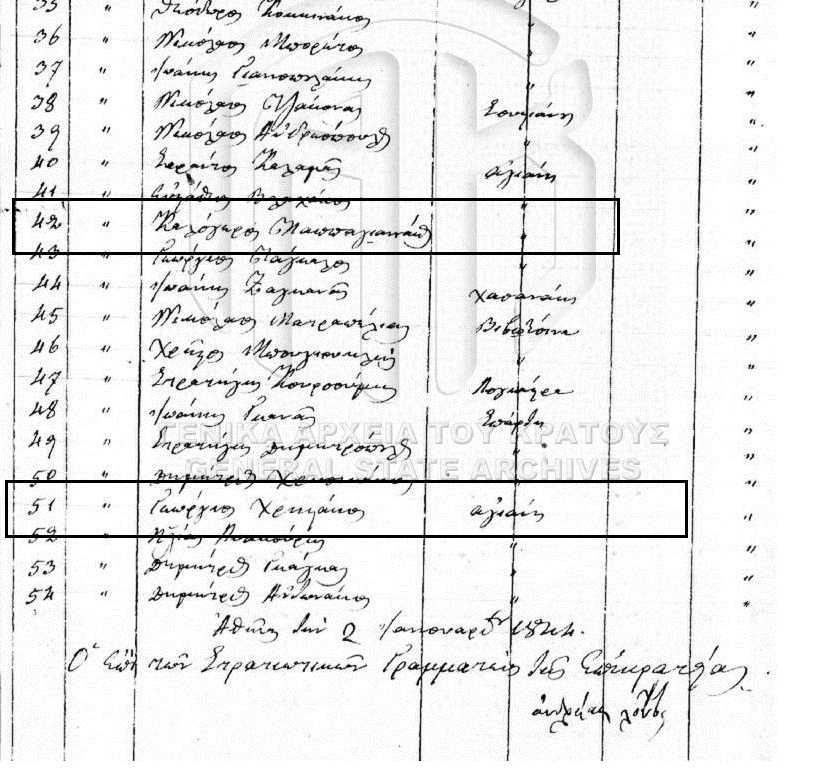
This image shows recipients Kalogeros Papagiannakos (line 42) and Georgios Christakos (line 51) of Agios Ioannis who received the Iron Medal.
Aristeia Awards, Line 42: Kalogeros Pappagiannakis; Line 51: Georgios Christakos, both of Agios Ioannis, Sparta. Research by Konstandinos Koutsodontis, 2020
The General State Archives of Greece is the repository for Aristeia Records. It has thousands of lists, each filled with thousands of names. There are files online at the GAK , but working through them to locate villages and names is beyond my ability. Researching in this collection is best left to Greek genealogy professionals. Those who have examined these archives for me are: Gregory Kontos of GreekAncestry.net, Konstandinos Koutsodontis of Greek Genealogist, and Giannis Mihalakakos of Maniatika. I am grateful to each of them, my colleagues and friends. 🙂
Next year on March 25, 2021, and throughout the year, the 200th anniversary of the Revolution will be celebrated. Konstandinos, Gregory and Giannis will be writing about the men who freed Greece from captivity. Use their resources to find the heroes in your family, and contact them for research help. Gregory Kontos’ “Tracing Freedom: 1821” collection has just launched with searchable lists of captives from Lakonia.
Your ancestors fought and secured the freedom of Greece, thus securing a sovereign nation for the birth of your family. They deserve to be recognized and honored.
*A Hellenic historian shared the following: Aristeia is an ancient Greek word meaning “prize for excellence, prowess, the best and the bravest.”
My friend Debbie, who reads old Greek newspapers as part of her research strategy, recently sent me a gem. As she was looking at a New York City Greek-American newspaper from 1917, an article mentioning Papagiannakos from Hoboken caught her eye. Incredibly, she remembered this was my grandfather’s surname, and she sent me the following newspaper page with this message: “didn’t know if you would need this, but maybe?”
September 22, 1917; Ethniko Kirika
Maybe? Good heavens, YES! This is about my maternal grandfather, Ilias Papagiannakos.
News clipping about Ilias Papagiannakos, September 19, 1917, Ethniko Kirika
The article states that because he did not trust banks, he hid his money in an old shoe which was kept in the back of his clothes closet. A thief stole the fruits of eight years’ hard work and sacrifice, and now the money was gone.
The translation reads:
In Hoboken, N.J.
He doesn’t trust banks – They stole savings of eight years of toil and sacrifice
(Special Correspondent)
HOBOKEN, N.J., September 19 [1917] – A victim of his mistrust of banks was the local restaurant owner Elias Papagiannakos, originally from Agios Ioannis, Sparta. Mr. Papagiannakos, distrusting banks, had been saving his money and kept it inside an old shoe, which he hid behind a box in his room.
The day before yesterday, however, while his wife went out to buy some household goods, unknown individuals entered the room and stole the precious old shoe containing all the savings from eight years of toil and sacrifice — amounting to $900 in cash and $300 worth of jewelry.
Mr. Papagiannakos reported the incident to the police and suspects the perpetrator is someone familiar to him, possibly even a household acquaintance, since they found the well-hidden shoe without any difficulty.
My first reaction was shock, then sadness. An inflation calculator estimates that in today’s dollars, the sum of my grandfather’s loss would be $25,502.48, a significant amount of money! Ilias immigrated at age 15-17 under an alias to avoid conscription into the Greek army. He had no money and worked hard to accumulate enough funds to purchase a small restaurant in Hoboken. To save $1200 after eight years’ labor was quite a feat.
At first I wondered why my mother (Catherine) and her sister (Bertha) never told me this story; then I realized that they may not have ever known this happened. My mother, the oldest living child, was 6 months old in September 1917. When my grandmother went shopping on the day of the robbery, she would have taken my infamt mother with her. Many years later when my mother was an adult, they may have forgotten or chosen not to mention this unfortunate event.
There are many questions that will forever remain unanswered. Who could possibly have known where my grandparents stashed their money? If it was someone close to them, how could he/she have perpetrated such a breach of trust? How did my grandparents cope with the loss of their savings? My grandmother had $300 worth of jewelry — that is significant for immigrants! Were they wedding gifts?
I am so grateful to Debbie for finding and sending this article, which gives me insight into a difficult event in the lives of my grandparents. It is said that we can gain strength from learning how our ancestors met and overcame challenges. Knowing that yiayia and papou weathered this setback and continued on to financial freedom is encouraging and inspiring to me.
There’s nothing that compares to a Brooklyn, New York gala — live band, gourmet food, beautiful venue — everything needed for a first-class celebration. On December 2, my cousin, The Very Reverend Father Eugene Pappas, Archimandrite, was honored at an elaborate and festive gala held in commemoration of his 50 years of service as a Greek Orthodox priest, and 35 years as priest at Three Hierarchs Church in Brooklyn. To say that I was delighted to be there is an understatement; this was an event to be long-remembered and I was thrilled to be part of it.
Father Eugene Pappas
Nicholas Leon Pappas (Father Eugene) is the son of Pauline Drivas and Leon Pappas (Papagiannakos). He and his siblings, Konstandinos and Georgeanne, were born and raised in the Sheepshead Bay area of Brooklyn, in the center of a thriving Greek-American community. Although he studied law, Father Eugene had deep desires to become a priest. The family name “Papagiannakos” indicates that in the past, a man in the Giannakos family became a priest (παππάς – papa) — thus, forever changing the surname to indicate this honor. Father Eugene told me that he felt, from childhood, that he was destined to be a priest and to carry on the tradition initiated by our ancestor. He was ordained into the priesthood in 1965.
Father Eugene began his ministry in South Korea as the First Foreign Missionary of the Holy Archdiocese of Archbishop Iakovos. In 1969, he opened an orphanage and worked in a boys’ home. His service in South Korea helped pave the way for the Orthodox Christian Mission Center of the USA. Along with South Korea, Father Eugene served in many foreign posts including Japan, the Philippines, Switzerland and Greece. Upon returning to the United States, he became pastor in the faith community where he was baptized, raised and educated.
Father Eugene preaching the gospel at Three Hierarchs Church, Brooklyn, NY
Father Eugene’s service is not confined to either religious causes or his parish. He is a renowned civic activist and public speaker and is esteemed by civic and faith leaders of all political affiliations and religions. As scholar educator, he has taught Orthodox Theology in the Roman Catholic Diocese of Brooklyn/Queens, and a special commemoration was held for him by the Catholic community. He is lauded for his leadership and participation in public causes and numerous community initiatives. The walls of his office are lined with plaques, degrees, and honorary citations.
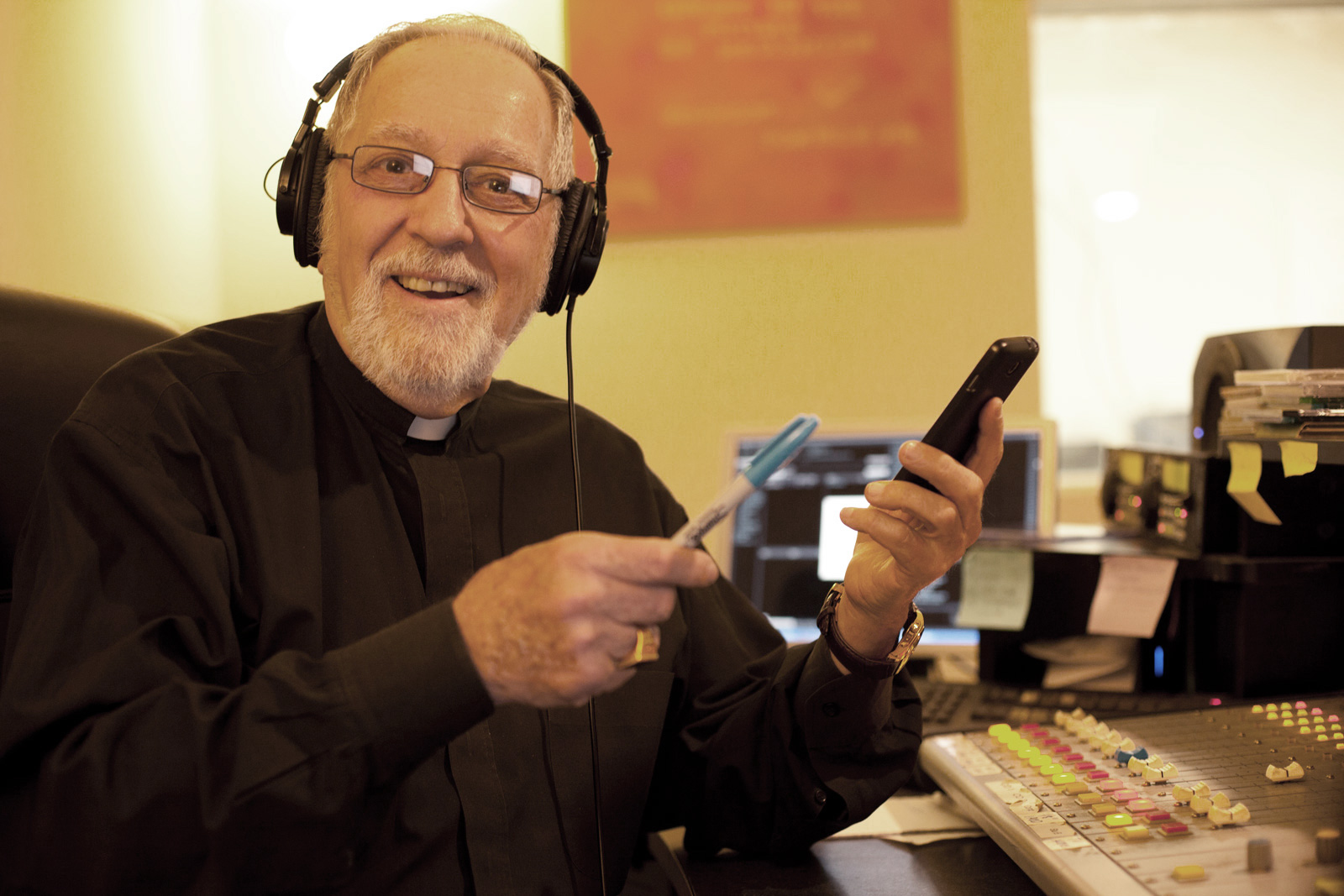
As a man of the times, Father Eugene uses today’s media to exhort and educate audiences far beyond Brooklyn. For the past 18 years, he has hosted a radio program, “Matters of Conscience” on COSMOS FM every Saturday from 1 to 2 P.M.
Father Eugene broadcasting at Cosmos-FM studios. His radio program, Matters of Conscience, has aired for 18 years.
He also has a presence on YouTube. This interview gives a brief perspective of his influence in the community:
Despite a schedule that would wilt an ordinary man his age, Father Eugene takes time for the individual. During a recent visit to his office, he paused our discussion to minister to a stranger who walked in off the street and asked for a blessing. His love of family has broadened to a passion for learning about his family history. We have shared many stories, photos, and discussions of our ancestry–much to our mutual delight.
This Saturday, I will be Father Eugene’s guest on Cosmos FM, and we will be discussing Hellenic genealogy–the rewards, the challenges, and how to get started. The radio show will be broadcast at this link, beginning at 1:10 PM Eastern time: http://www.cosmosfm.org/podcast/.
Along with the many religious and civic dignitaries who have honored this man, I add my voice–thank you, Father, for your faith, your service, and the honor you have brought to our Papagiannakos/Pappas family.
A few photos from Father Eugene’s 50th Gala Celebration.
Father Eugene and his family, Brooklyn, NY, December 2, 2016
Georgeanne Conis, Carol Kostakos Petranek, Father Eugene Pappas; Brooklyn, NY, December 2, 2016
Father Eugene and his siblings: Konstandinos (Dino) and Georgeanne Pappas Conis; Brooklyn, NY, December 2, 2016
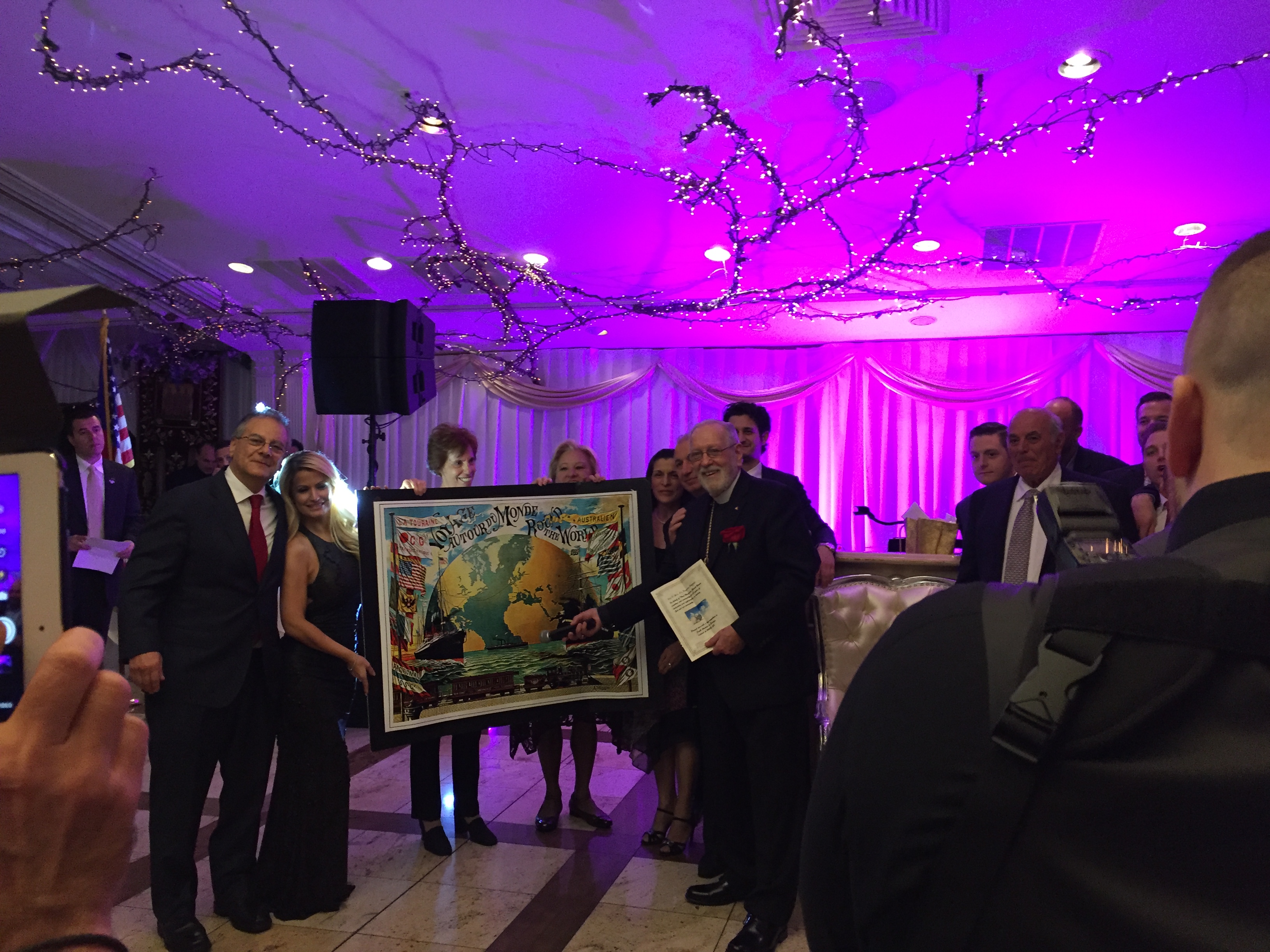
Father Eugene receives a gift from the parishioners of Three Hierarchs Church — a trip to anyplace in the world he wants to go! Brooklyn, NY, December 2, 2016









 Spartan Roots (Σπαρτιατικές Ρίζες)