Birpatakos (Μπιρμπατάκος) Mitroon Arrenon

Recently, I purchased a Flip-Pal scanner which has been a terrific tool for digitally scanning the over-sized pages which I received from the Greek Archives office in Sparta. As I began to scan the Mitroon Arrenon (Male Registers), I reviewed each page to see if I had missed any surnames that are in my family line. As I looked at each line in the image below, I was aghast to find that I had overlooked this name on line 7:  Μπιρμπατακος, Νικολαος (Birpatakos, Nikolaos), born 1879, father’s name Emmanouel.

This is the husband of Tasoula Kostakos, my grandaunt and the sister of my paternal grandfather! Furthermore, Nikolaos is listed immediately below my grandfather, John Andew Kostakos (on line 6)!
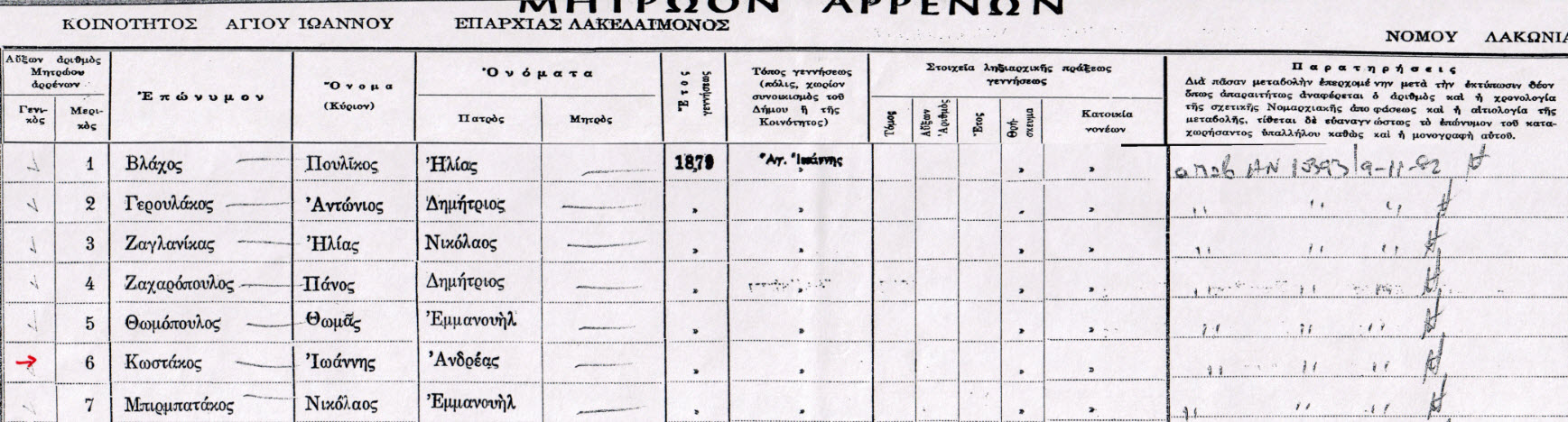
Birpatakos, Nikolaos m Tasoula Kostakos, Mitroon Arrenon

As I thought about how I could have possibly overlooked this initially, two things came to mind.  First, I was so excited to find my grandfather’s name that I mentally “checked out” of everything else on that page. Second, the English letter, “B”, is spelled “Mp” in Greek (this is because the Greek letter “B” is translated into the English letter “V” — totally confusing!). My mind knew I did not have any names starting with “M” in this village, so when I saw the “Mp” on line 7, I didn’t even bother to read the surname.

As soon as I caught this oversight, I went through every other Mitroon Arrenon that I had received, and sure enough, I found some other surnames that I had missed the first time around.

Lesson learned — read everything at least twice when you first receive it. Then, a few months later, read it all again!

This is proof that sometimes we create our own “brick walls” because we don’t review our prior research. We are continually learning and building upon new information that we receive, and going back to see what we have can reveal new insights and unearth valuable clues.

In this case, I “found” someone’s record that I already had!

Papagiannakos in Lakonia

For the past month, I have been researching Papagiannakos records in preparation for a meeting with Father Eugene Pappas (Papagiannakos), priest at Three Hierarchs Church in Brooklyn, and a “cousin” to my mother. Both his family and mine descend from two different Nikolaos Papagiannakos’ from Agios Ioannis (born in the early 1800’s), but we have not yet been able to go back far enough to find our common ancestor.  Hurricane Sandy derailed my visit with Father Eugene as Brooklyn is now under water, but my research continues.

After extracting Papagiannakos names from villages around Sparta in Electoral Rolls of 1872, Mitroon Arrenon, and other documents, I found that prior to 1900 in Agios Ioannis, there were two Ioannis’ and at least five or possibly seven Nikolaos’. I also found Papagiannakos in Therapni, Tsintzina and Zoupena.

I plotted all these families on a Google map. I put purple pins in each of the villages where a Papagiannakos family lived. Click on the pin and you will see a pop-up window showing the families in that village: 

Here is a list of the families I have found so far:

AGIOS IOANNIS:  1815-1941

1815-1900: Families (fathers and sons)

1.  Ioannis 4 had 1 son, Georgios born either 1875 or 1880

2.  Ioannis 5 had 2 sons: Spyridon born 1890/91 and Evvagelos born 1895

Nikolaos – There were at least 5 and possibly 7 families with Nikolaos as father:

  1. Nikolaos 1 (may be same person as Nikolaos 4, as sons are 4 yrs apart). His son was Panagiotis born 1841 (this is my great-grandfather)
  2. Nikolaos 2, married to Georgia Piperis; they had 8  sons born 1889-1910  (this is Father Eugene’s ancestral family)
  3. Nikolaos 3, born 1815 (may be same person as Nikolaos 1, 6 or 7, as he is 20, 22, or 26 when the sons were born)
  4. Nikolaos 4 (may be same person as Nikolaos 1, as sons are 4 yrs apart); his son was Ioannis born 1845
  5. Nikolaos 5 had one son, Theodoros, born 1901
  6. Nikolaos 6 had one son, Ioannis 2, born 1837
  7. Nikolaos 7 had one son, Ioannis 1, born 1835

1901-1941: Families (fathers and sons)

  1. Andreas, with 6 children born 1931-1941
  2. Aristedes, with 4 children born 1929-1940
  3. Konstandinos, with 6 children born 1927-1935
  4. Christos, with 2 children born 1901-1904

THERAPNI: 1867

Father: no name, son Dimitrios b 1867 (source: School Archives)

TSINTZINA:  1830-1840

Dimitrios had 3 sons, Ioannis b 1830, Georgios b 1837, Panagiotis b 1840

ZOUPENA:  1886-1891

Father: G, had one son, Ilias b 1886

Father: P, had one son, Christofos b 1891

Although I am grateful for the records that exist and have allowed me to research to this point, I am anxiously awaiting more information. Using several sets of records allows me to compare and contrast dates, names and locations at different times. Church records would be the golden key that ties families together. Perhaps there will come a day when they will be readily available in Greece as they are in other countries.

Now that I have finished looking in the general area of Sparta, I will look farther south in Lakonia and perhaps into Messinia, into the Mani region, to see if, when and where the Papagiannakos name appears. I’m looking for migration patterns. Meanwhile, I will keep looking for additional records to help me sort out the Nikolaos’, and be able to go back another generation or two to find the common ancestor.

Then, I’ll start on another surname! This work is never done 🙂


Kostakos in the 1940 Census

The release of the 1940 U.S. Census yesterday is a huge boost for genealogy research. I am very excited to be able to learn more about my family by finding my grandparents and extended family members. Over the years, I’ve heard my parents talk about cousins, aunts and uncles with whom they had lost touch and whom I never had the opportunity to meet. I know that I as I find them in the census, I will come to love them and feel the special ties that they had with my parents. This the joy of genealogy research — an extension of love and family.

Because there is no name index for this census yet, I cannot go to a website, type in a name, and have my ancestors’ names pop up. In a few months, I will be able to do so. But for now, I need to have an Enumeration District (ED) number, which I obtained by getting my family’s address on April 1, 1940, then using an online tool developed by Steve Morse (found here) to obtain the ED.

Dad had told me that his parents lived 292 Broadway, Brooklyn, New York. I found Papou’s World War II Draft Registration card which verified that was his address.

John Kostakos, World War II Draft Registration Card

John Kostakos, World War II Draft Registration Card

Using Steve Morse’s tool, I learned that the ED for yiayia and papou’s address was 24-551. I then went to http://1940census.archives.gov, looked up the ED and found their census record:

1940 US Census, John Kostakos & Family

1940 US Census, John Kostakos & Family

My grandparents are found on lines 65-71, and on line 72 is my grandfather’s brother, Bill, whom Dad fondly called “Uncle Bill.” Living two houses away on lines 56-57 is the Semetis family. Aspasia, wife of Peter, is my grandmother’s sister. If you look at the very bottom of the census page, you will see that Dad’s sister, Pauline, answered some additional questions as did her cousin, Harry Semetis.

As I look through more census records in the weeks ahead, I will use the 1940 New York Telephone Directory to help me locate specific addresses. I was elated to see this link on a blogpost today.

Wishing you much success as you hunt for your family treasure in the 1940 Census!

Greek Genealogy Toolkit

I’m delighted that Family Tree Magazine will be publishing an article on Greek Genealogy, written by Thomas MacEntee, in its forthcoming April/May issue. They have released a section of that article, labeled the “Toolkit,” which provides links to some important resources for Greek research:

Web Sites

Books

  • Carved in Stone: The Greek Heritage by Basil S. Douros (Five and Dot Corp)
  • Family History Research in Greece by Lica Catsakis (self-published, www.licacatsakis.com)
  • The Genealogy of Greek Mythology by Vanessa James (Penguin)
  • The Greek Americans (Immigrant Experience) by Dimitris Monos (Chelsea House Publications)
  • Greek Gazetteer, 2 volumes, by Lica Catsakis (self-published, www.licacatsakis.com)
  • The Greeks in the United States by Theodore Saloutos (Harvard University Press)
  • A Guide to Greek Traditions and Customs in America by Marilyn Rouvelas (Nea Attiki Press, www.greektraditions.org)
  • A History of the Greeks in the Americas, 1453-1938 by Paul Koken (First Page Publications)
  • The Muslim and Christian Calendars : being tables for the conversion of Muslim and Christian dates from the Hijra to the year A.D. 2000, Part 2000, by Freeman-Grenville, GSP (Bellew Publishing Co Ltd)
  • Studies in Greek Genealogy by Molly Broadbent (E.J. Brill)
  • Tracing Your Greek Ancestry by Antonia S. Mattheou (self-published)

Organizations

American Hellenic Educational Progressive Association
1909 Q St. NW, Suite 500
Washington, DC 20009
(202) 232-6300

Church of Greece
Aghias Filotheis 21
10566 Athens, Greece

Embassy of Greece
2221 Massachusetts Ave. NW
Washington, DC 20008
(202) 939-1300

General State Archives of Greece
Theatrou 6
10552 Athens, Greece

Greek Orthodox Archdiocese of America
8 East 79th St.
New York, NY 10075

(212) 570-3500
Hellenic Historical and Genealogical Association 
Box 710
Rye Beach, NH 03871
(603) 379-8140

The Hellenic Literary and Historical Archive
Aghiou Andreou 5
10556 Athens, Greece

Hellenic Museum and Cultural Center
801 W. Adams
Chicago, IL 60607
(312) 665-1234

Historical Archives of Crete
I. Sfakianaki 20
73134 Chania, Crete

+30 28 210 52606
National Hellenic Museum
333 South Halsted St.
Chicago IL, 60661

(312) 655-1234
National Hellenic Research Foundation
48 Vassileos Constantinou Ave.
11635 Athens, Greece
+30 21 0 727 3700

National Statistical Service
Evaggelistrias 2
10563 Athens, Greece

Easter in Heaven

I came across this photo last weekend as I was scanning  pictures from my mother’s album. It was Easter, 1981, and our extended family had congregated at my parents’ home for a traditional Greek Easter dinner.

Easter 1981

l-r: Uncle Nick Pouletsos, Uncle Peter Connell, Aunt Pauline Connell, Aunt Frieda Stakis

This photo has unleashed a plethora of memories for me — a lifetime of family gatherings and activities. While my Easter table will be bereft of these and other elders, my grandparents’ will now be complete; brothers and sisters reunited; cousins together. A loving family on earth now together in heaven.

It is tempting to speculate on how my parents and relatives will celebrate Easter in heaven. One thing I believe is that they will:  “Now if we be dead with Christ, we believe that we shall also live with him.” (Romans 6:8)

As I prepare for this most holy of holidays, I cling to familial and cultural patterns as my anchor of tradition, and to the Savior as my anchor of faith.

Our traditional Easter dinner of roast lamb symbolizes the Lamb of God, our Redeemer.

  • Our recitation of “Christos Anesti,” (Christ has Risen) attests to the reality of the resurrection.
  • Bright red eggs “kokkina avga” on the table symbolize the blood of Christ that was shed for each of us.
  • The breaking of eggs symbolizes Christ breaking the bands of death and coming forth from the tomb. Each person takes a red egg and cracks the ends with another person. This proceeds around the table until one individual is left with an unbroken egg, and he/she can expect to have good luck throughout the year.
  • Partaking of the “tsoureki,” or Easter bread, reminds us that Jesus Christ is the Bread of Life. (John 6:48: “I am that bread of life.”)

On Easter Sunday, my husband and I will travel to our son’s home to celebrate with his family. On Greek Easter, which falls the following weekend, we will travel to my cousin’s home to celebrate again — this time, with our extended family. As my parents and their siblings traveled to be together on holidays, now it is my turn to visit my cousins and continue the good traditions which have united our family for generations.

As I read the words of the Apostle Paul this Easter season, I truly believe my family in heaven will unite with me in rejoicing: “Blessed be the God and Father of our Lord Jesus Christ, which according to his abundant mercy hath begotten to us again unto a lively hope by the resurrection of Jesus Christ from the dead.” (1 Peter 1:3).

Christos Anesti to you and your family!

(this article was published in Meridian Magazine, March 16, 2012; a link can also be found here on my blog)