FamilySearch and Greek Records

I have been helping organize the Hellenic Genealogy Conference which will be held in Salt Lake City, Utah, on September 26 — just a couple of weeks away. I am looking forward to seeing old friends, meeting new ones, and helping people understand the resources available for research.

Among these resources are the Family History Library (also known as the FamilySearch Library). I will be at the Library to work with people, showing them the books, maps, and microfilms at the Library. Besides the website of the General State Archives of GreeceFamilySearch is the only other resource for microfilms of official Greek documents (to my knowledge). Most of these records were filmed in the 1980’s. FamilySearch is in the process of digitizing their microfilm collection, and I hope it not be too much longer before the Greek films are uploaded. When they are online, they will be viewable free of charge.

Recently, I was invited to participate in a genealogy television show and to discuss FamilySearch, its free website and its many resources including the Wiki (here is a link to the page for Greece). Here is a link to that broadcast found on YouTube.


Panagiotis Eliopoulos in Machmoutbei (now Amykles)

My friend and historian/genealogist, Gregory Kontos, recently translated an interesting document for me. Written in 1864, it is a contract for Panagiotis Eliopoulos to purchase land in Machmoutbei, which is now the town of Amykles, Laconia. I am researching the Eliopoulos name in the Sparta area, as my great-grandmother was Aikaterini Eliopoulou.

Aikaterini and her father, Efstathios, were from the village of Sikaraki located on the outskirts of Agios Ioannis, Sparta. Although the distance between Amykles and Sikaraki is 5 kilometers or a 10-minute car ride today, that was a long donkey ride in the mid 1800’s. However, in my relentless hunt for family, I leave no stones unturned so I am researching the Eliopoulos family in Machmoutbei.
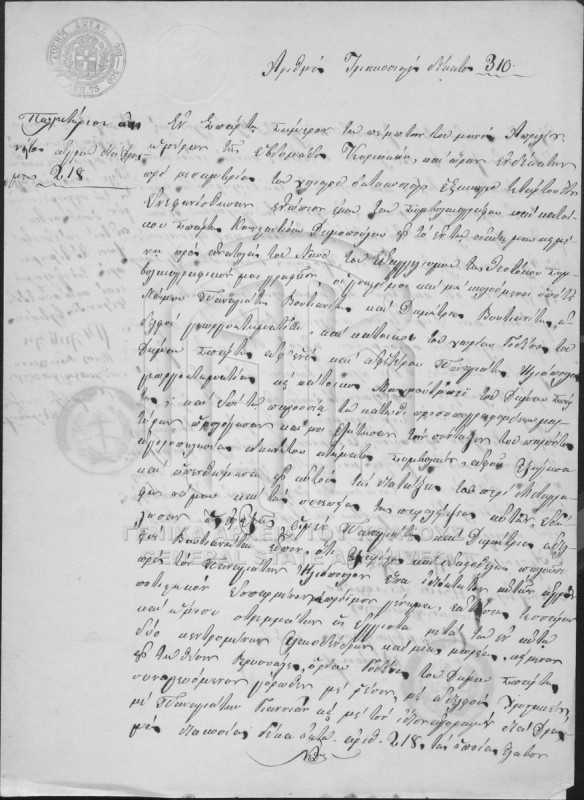
Eliopoulos, Panagiotis Contract April 5th 1864 p.1

Panagiotis Eliopoulos, Contract April 5th 1864 p.1

Eliopoulos, Panagiotis Contract April 5th 1864, p.2

Panagiotis Eliopoulos, Contract April 5th 1864, p.2
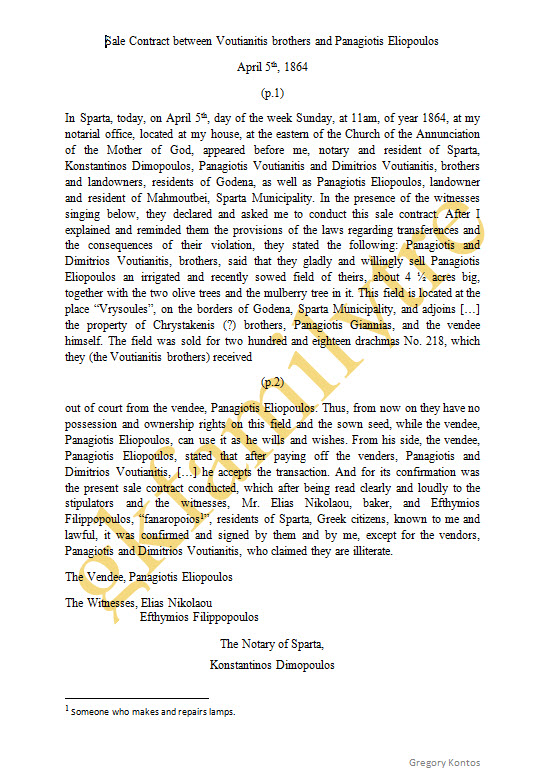
Panagiotis Eliopoulos, Sale Contract, April 5th 1864

Contract Translation by Gregory Kontos

There can be hidden clues in these documents. For example, the trees are specifically listed which indicates their value. The contract was read aloud to ensure all understood its terms, and the Voutianitis brothers claimed they were illiterate.

In the Electoral Rolls of Lakedaimonos (Laconia) 1843-1873 (File #22), there is a P. Eliopoulos who signed the rolls as the assistant mayor (παρέδος) of Machmoutbei. When I compared his signature on the election record and this contract signed in Machmoutbei, this indicates that they are the same person and that Panagiotis was literate:
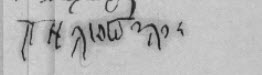
Panagiotis Eliopoulos signature 1864 contract

P. Eliopoulos signature 1864 contract
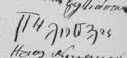
Panagiotis Eliopoulos signature on electoral rolls

P. Eliopoulos signature on electoral rolls

These documents are a fascinating glimpse into the everyday lives of our ancestors. It is painstaking work to piece together fragments of information from any source, but especially so when researching in Greek records where the handwriting stumps all but the experts. When I get frustrated, I remind myself to be grateful, instead, that these records have survived through the wars and occupations, and that I have friends to help me navigate through them.

Although I do not yet know if Panagiotis Eliopoulos is related to me, I am thrilled to have this document and to bring his life into the 21st century.

Addendum to this post: After looking at another contract for Panagiotis Eliopoulos of Lele, Agios Ioannis (village of my ancestors), Gregory informed me that Panagiotis Eliopoulos of Machmoutbei and Panagiotis Eliopoulos of Lele are two different people. Panagiotis from Machmoutbei  signs the contracts but Panagiotis from Lele is illiterate.
Virtual Trip through Agios Ioannis (Sparta)

My friend, Georgia Stryker Keilman, found a Google car trip through our ancestral village of Agios Ioannis. Her post on her blog, HellenicGenealogyGeek, reads as follows:

Follow this link to view the TRIP THROUGH AGIOS IOANNIS.  This is a car driving through the village’s main road with a 360 degree camera mounted on the top of the car.  You can view this in several different ways: 1) the bottom strip of photographs are highlights from the video;  2)  on the lower right side of the main picture you will see “backward and forward” symbols < > which will allow you to move forward on the road incrementally;  3) you can place your cursor on the road and drag your way forward;  4) on the bottom right side of the main picture is a red and white pointer surrounded by circular arrows which will allow you to look at a 360 degree view from any point on the road.

Georgia’s connection to Agios Ioannis is her ancestor, George Stratigakos (1859-1921). I just love to think that our families must have known each other as this is not a big village, and that our grandfathers must have passed many hours in the local kafenio talking politics and other topics. Here we are, 100 years later, reconnected in a new land. It’s all so exciting!

Georgia’s HellenicGenealogyGeek Facebook page is the go-to place for online Greek genealogy collaboration with over 6,500 members.

Thank you, Georgia, for finding and posting this virtual tour and for all you do to connect Greek researchers online!

Greek Microfilms at the FamilySearch Library

Various record collections from areas in Greece have been microfilmed and are available to the public through the FamilySearch Library and its more than 4,700 Family History Centers throughout the world. To locate the one closest to you, click here.

To find a Greek microfilm,  you will need to know the village, district, and county of your ancestor. The following explains the geographic divisions in Greece:

Greece is divided geographically into 9 main regions:
1.  Central Greece and Euvoia
2.  Peloponnese
3.  Ionian islands
4.  Thessaly
5.  Epirus
6.  Macedonia
7.  Thrace
8.  Aegean Islands
9.  Crete

Each of these 9 main regions is divided into “Counties” called Nomos.

Each of the nomos is divided into “Districts” called Eparhia.

Each Eparhia is divided into “Municipalities” called Dimos. A Dimos may include surrounding villages.

Prior to 1999, there was a division called “Community” or Koinotis. In 1999, all “communities” were dissolved and incorporated into the larger “Municipalities” or Dimos.

In order to determine if the FamilySearch Library has a Greek film of interest to you, you will need to identify the following information:

1.  The village
2.  The Dimos (municipality) to which the village belonged when the record was created
3.  The Eparhia (district) to which the Dimos belonged when the record was created.
4.  The Nomos (county) to which the Eparhia (municipality) belonged when the record was created.

You must also know the full, original Greek surname; for example: not Pappas, but Papadopoulos.

Records That May Give You Name & Village

  • Census (1900, 1910, 1920, 1930 ask specific immigration & naturalization questions)
  • Marriage (U.S. and Greek Church)
  • Baptismal Records (Greek Church)
  • Immigration (Passenger Ship)
  • Naturalization (Declaration of Intention & Petition for Naturalization)
  • Social Security Application (original and computerized)
  • World War I & II registration cards
  • Death Certificate (beware of informant’s possible misinformation)
  • Obituary
  • Tombstones
  • Photographs

After you have determined the original Greek surname and village, check to see if FamilySearch has a digitized microfilm for your location. Check the FamilySearch catalog for Greece.

Digital images can be viewed at any FamilySearch Center. Find the one closest to you at this link.

Surnames from the Mitroon Arrenon of Mystras, Laconia

I am researching several ancestral lines in Mystras, including that of my maternal grandmother, Aggeliki Eftaxias. During my visit to the General State Archives office in Sparta in July 2014, I digitized several pages of the Mitroon Arrenon (Male Register) for this city. The earliest year in these registers is 1824. Interestingly, this is right in the midst of the Greek War of Independence (1821-1829).

The surnames below are extracted from the pages that I obtained, which is not the complete record. Villages included in these records are: Mystras, Vlachohori, Varsinikos, Pikoulianika, Parori, Katochora, Diaselos.

The Sparta Archives office can assist you with further research. The email address is: mail@gak.lak.sch.gr. Maria Stellakou, Michalis Sovolos, and Pepi Gavala are exceptional archivists and dear friends.

Surnames from Mitroon Arrenon of Mystras