Verify All the Names: A Case Study

The church marriage record was clear: Theodoros Dimitrios Kouris married Dimitroula Chatzakou, daughter of Ioannis, first marriage for both, on April 24, 1875:
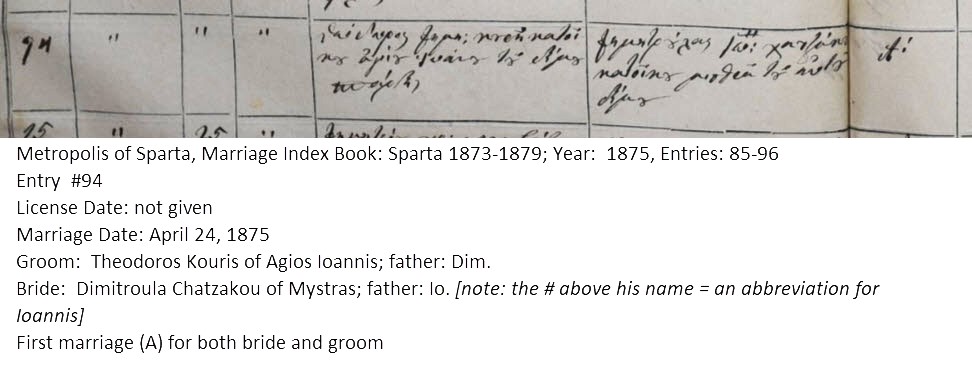
Finding this record [1] for one of my Agios Ioannis families meant that I now had the name of Theodoros’ wife and the mother of his children. Everything seemed to line up:  the wedding was in 1875 and the first child was born in October 1878, although the birth (if it was a first birth) was a tad late for that time period. I entered the information in my database and to online trees at FamilySearch, Ancestry and MyHeritage. Almost immediately, hints for records in Massachusetts popped up for the children. Not unusual – many families immigrated to America in the early 1900s. I checked one of the hints, a marriage record for son Apostolos, and noted with curiosity that his mother’s name was written not as Chatzakou, but as Pantazou.
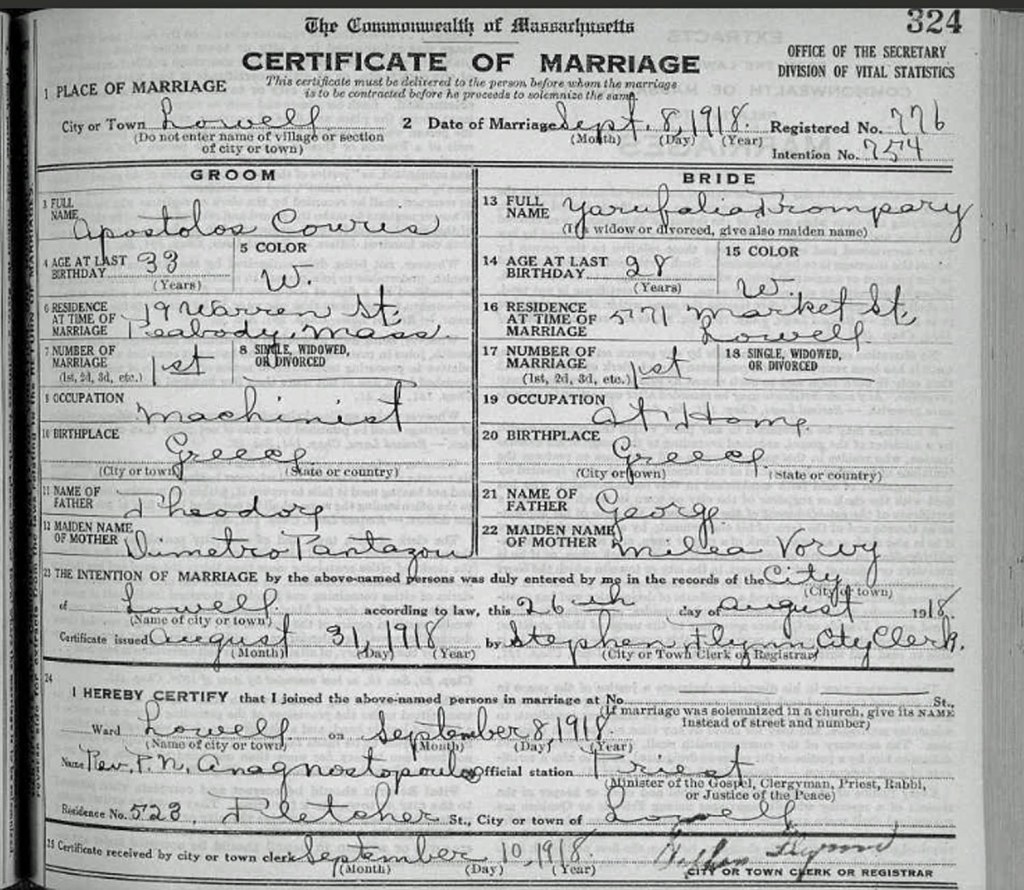
Well, the two surnames sort of sound alike. I wondered if this was a clerical error (misunderstood the name?) or a mistake on the part of the child (some are unsure of their mother’s maiden name!).

Checking further, I saw that the Pantazou surname in U.S. records was found for other children in the family. Clearly, there was a disconnect somewhere.

Because this family is not related to me, I was not planning to research this line further. (My goal is to get the Greek records online so that descendants can make the leap from the U.S. to Greece). But I felt it was important to alert other researchers to the discrepancy, so I added this note in the profiles for both Theodoros and Dimitroula: Dimitroula’s surname, according to her Sparta marriage record, is Chatzakou. However, there are records in the U.S. giving her surname as Pantazou. Either there are two Theodoros Kouris’ in Massachusetts — one married to Chatzakou and one to Pantazou, OR her surname changed in the U.S.

Before moving on to extract another family name from Agios Ioannis records, I did make one additional entry for Theodoros: I marked him as deceased and in the place field, I put “Of Massachusetts, United States.” The word “of” signifies that this was a guess, as I did not have proof of the fact.

This entry proved to be a mistake for me and a red flag for Theodoros’ geat-granddaughter , Niki, who had been researching her family and found my note in an online tree. In an email to me, she wrote:

I want to clarify another piece that you aren’t aware of. Theodore never came to the US. His wife and all of their children came around 1909….except for Nikoletta, who stayed back to care for her father, Theodore, who was blind, and unable to travel at that time. In 1920, Dimitroula returned to Agios Ioannis and planned to travel with Theodore and Nikoletta back to Boston, to join the rest of the family…However, Theodore died unexpectedly, very shortly before they were scheduled to sail. Dimitroula and Nikoletta came without him, in the summer of 1920. The ship record shows only their two names. So you might want to modify your note about Dimitroula’s surname discrepancy since Theodore was never in the United States.

Oh my! Grateful for this clarification, I quickly corrected Theodoros’ death place to Agios Ioannis.

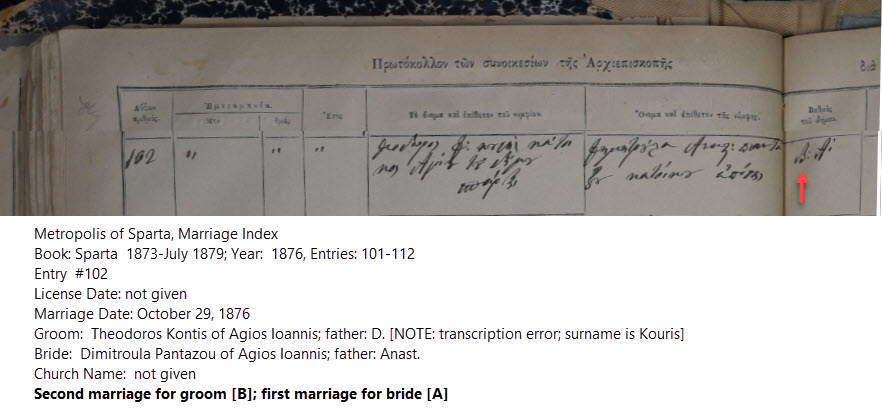
Niki had initially contacted me a few weeks ago when she found the marriage for Theodoros and Dimitroula Chatzakou online at MyHeritage[1]. She knew her great-grandmother was Dimitroula Pantazos, and the record naming Chatzakou was mystifying. Looking further and searching on “Pantazos,” she found and then sent me another marriage record which was indexed as: Theodoros D. Kontis and Dimitroula Pantazos, daughter of Anast., married October 29, 1876. She commented: “Could it be that the handwritten record from 1876 was translated incorrectly, into Kontis instead of Kouris?”
We outlined the issues:

  1. The handwritten Greek in both marriage records was too scribbly for either of us to clarify whether the name was Kouris or Kontis.
  2. This second marriage record shows it was Theodoros’ second marriage [B] and Dimitroula Pantazou’s first marriage [A].
  3. Their marriage occurred in October 1876, exactly 18 months after Theodoros’ marriage in April 1875.
  4. If this record was indeed for Theodoros Kouris, then his first wife [Chatzakou] would have died shortly after marriage [perhaps in childbirth?].
  5. With Georgios born in October 1878, he and his siblings would be the children of Theodoros’ second wife, Pantazou–making the 1878, exactly two years aftermarriage, birth more realistic for the times.

Clearly, the answer lay in the clarification of Theodoros’ surname. A quick message to Gregory Kontos at GreekAncestry resolved the mystery: both marriage records were for Theodoros Kouris; the second record was transcribed incorrectly.

A few points to consider from this case study:

  1. NEVER trust a name index!
  2. ALWAYS review the original record. If it’s in Greek and unreadable to you, someone else can help. Upload to the Hellenic Genealogy Geek Facebook page or send to Greg Kontos at GreekAncestry.
  3. Search a variety of records to verify information. In this situation, looking at U.S. records for several of Theodoros’ children revealed the same mother’s name. This raised the chances that the children were correct, and the possibility that there was either an error in the marriage record or a second marriage for Theodore.
  4. Document facts that don’t correlate, and make sure those notes are attached to each individual that is affected.
  5. If you are making an assumption, state what the assumption is and why you are making it. I did not do this for Theodoros’ death place when I listed it as Massachusetts.
  6. Theodoros had two wives with the same first name, which caused incorrect assumptions. The children’s baptismal records in the village church book gave their mother’s name as only Dimitroula (no surname) which caused me to assume that the Chatzakou record was correct.
  7. Niki kept looking for information and changed her search terms to “Pantazos” which led her to finding her great-grandparents’ marriage record and the incorrect transcription of Theodoros’ surname. If she had not kept looking, the mystery would have remained.
  8. Just because “this is the way it was” don’t assume that is true in your situation. I assumed that Theodoros had come to the U.S. with (or before) his children, which was the pattern for Greek men at the turn of the century. In this case, that was not the case. The mother came with the children, and the father remained in the village–a complete reversal of the norm.
Family of Theodoros Kouris and Dimitroula Pantazou, about 1902
Anna, Theodoros, possibly Anastasios (standing), Nikoletta, Dimitroula Pantazou, possibly Harry


[1] See Sparta Marriages 1835-1935 online at MyHeritage.com

Mystras – 1872 Election Registers

Among the oldest records of genealogical value in the modern Greek state are the Election Registers of 1844 and 1872, which are lists of men eligible to vote. These records are now name indexed and available online (1844 at GreekAncestry.net; 1872-3 at MyHeritage). These Registers are critical for identifying which families resided in specific villages at specific points in time. In 2012, long before these records were name indexed and posted online, Georgia Stryker Keilman undertook the task of translating these registers from many villages in the Peloponnese, and her work can be found here.

I have Eftaxias ancestors from Mystras, which sent me to the 1872 Election Registers for that village. Mystras had been the seat of Byzantium in the Peloponnese until overtaken by Ottoman Rule. After the Greek Revolution for Independence, the population of Mystras began to decline as people descended from the castle area on the mountain top. Some formed the village of Mystras in the valley while others relocated to the emerging city of modern Sparta.

Mystras, Looking Towards Sparta, ca. 1890-1910. Library of Congress

When the Election Registers of 1872 were created, a man had to be at least 21 years old to vote. The number of men in Mystras on the election list was 268 and their average age was 38 years.

The “new” village of Mystras needed a mix of tradesmen, laborers, landowners and professionals to meet the needs of its population. The chart below, which lists the occupations of the voters, reveals that the village had the requisite composition to support its residents.

occupationnumber
Baker7
Bailiff17
Bricklayer1
Butcher4
Clerk3
Coachman/driver1
Cobbler4
Coffee seller2
Court official1
Doctor2
Farmer27
Farrier1
Gardener10
Gendarme4
Grocer12
Laborer30
Landowner53
Lawyer1
Magistrate2
Mason2
Mayor1
Merchant3
Mule driver7
Unemployed2
Official / Clerk3
Pharmacist1
Police Inspector1
Quilt Maker1
Rag Seller2
Retailer1
Sandal Maker3
Servant7
Shepherd23
Shoemaker1
Soldier7
Student10
Superintendent1
Surgeon1
Tailor4
Trader1
Veteran1
Wine Sales2

Which families are found in the village during this time? This chart lists the names of the voters, their ages and occupations in alphabetical order. Some surnames have “disappeared” over time, but many are found in Mystras today.

1872 Election Register, Mystras

This is the Register in Greek.

1872 Election Register, Mystras, in Greek

My great-grandfather, Konstantinos Eftaxias, is found on line 573. This Register gave me his father’s name, Ioannis, and his occupation as a shepherd. Also listed are Georgios, who were identified in the 1873 Election Register as being the son of Ioannis.

1873: Line 537, Georg. Eftaxias, age 25, father: Ioannis; occupation: student
1873: Line 597, Dimitr. Eftaxias, age 27, no father listed; occupation: shepherd

Although the father of Dimitrios is not listed, further research indicated that there was only one Eftaxias family in Mystras during this period.These Eftaxias examples show the importance of trying to find your ancestors in every available record. 

An Unusual Town Register

Town Registers (Dimotologion Koinointos) are among the most important documents we can find for our families. A Dimotologion lists the parents and children in a family and includes for each person: birthdate and birthplace, permanent residence, occupation, religion, citizenship status and municipal registration. In villages surrounding Sparta, these Town Registers were compiled in 1955. Details can be found at this post.

As exciting as it is to find a Dimotologion, we have to remember that it may be incomplete. And never forget that any record can be inaccurate.

The example below is the Town Register for my great-grandparents, Georgios Michail Aridas and his wife, Afroditi Lerikou, of Agios Ioannis, Sparta. They had five children: Aspasia born 1886; Dimitra born 1891; Harikleia (my grandmother) born 1893; Michail born 1894; Aristedes born 1905. However, only Dimitra appears in this record.

Family of Georgios & Afroditi Aridas of Agios Ioannis; of five children born, only Dimitra is recorded

Why are the other children not listed? In 1955, Aristedes appears in the Dimotologion with his own family, so he is not shown with his parents. All of the others had emigrated to America long before 1955. There are many entries which retain the names of children living in Canada, the U.S., and other countries. So the answer is: there is no logical explanation as to why only Dimitra appears on this record. But the more important point is that this record is not complete.

I recently found a different example of an incomplete Dimotologion record. It does not include the names of the parents! The Town Register below lists five sons of Efstratios Goranitis from the village of Parori, Lakonia: Ilias born 1911, Damaskinos born 1912, Georgios born 1914, Christos born 1916, Nikolaos born 1919. No parents. No sisters.

Goranitis sons listed without parents’ names

I sent this to Gregory Kontos of GreekAncestry who confirmed they would be brothers. I inquired if perhaps both parents were deceased by 1955 which is why they were not listed, but we don’t know for sure. Gregory related that some older municipal registers simply listed the people, often siblings only.

Another fact which intrigued me was that no daughters of Efstratios were listed. Perhaps the record is incomplete; or, there were no daughters in the family; or if there were, the daughters had married and were living in other households. However, there are Dimotologion entries which list daughters in the family and provide the household registry number where they were living at the time the Dimotologion was compiled. So again, the answer is: there is no logical explanation as to why the record is incomplete.

These examples show the importance of researching every available record for your family so you can correlate information. That includes finding records for the children and siblings.

  • In the Sparta Archives is the Male Register for Parori. I found Efstratios, the father of the five boys: Efstratios Ilias Goranitis born 1875 in Parori.
  • The Sparta Marriage collection on MyHeritage has the marriage record of Efstratios:
    Metropolis of Sparta, Marriage Index
    Book: Sparta, 1907-1921; Page:  16; Year: 1908, Entries: 363-385
    Entry  #384
    License Date: November 8, 1908
    Marriage Date: November 9, 1908
    Groom:  Efstratios Goranitis of Parori
    Bride:  Aikaterini Mavroukakis of Kato Chora [Mystras], father: Georgios, Priest
    Church Name:  Agios Dimitrios
    First marriage for both bride and groom

Interestingly, the Goranitis boys’ maternal grandfather, Georgios Mavroukakis, was a priest in Kato Chora (Mystras) and both Damaskinos and Christos also became priests.

I will expand my research of the Goranitis family of Parori, because Efstratos’ father, Ilias Stratigis Goranitis, married my great grandaunt, Panagiota Papagiannakos.

Two Marriages, or One?

What are the chances that there are two men named Ioannis Konstantinos Laliotis living in Magoula, both of whom married women named Georgitsa Giannakopooulos (father Paraskevas) living in Theologos? Although this seems improbable, the documents should answer the question. But in this case, it wasn’t that easy.

Let’s dig in.

In the Metropolis of Sparta Marriage Index Books, we find that a marriage license was issued on June 28,1898: Entry #237, Ioannis K. Laliotis of Magoula, Sparta; his first marriage (A) & Georgitsa Par. N. Giannakopoulos of Theologos, Sellasia; her first marriage (A).

Metropolis of Sparta Marriage Index Book 1894-1899; Page: 150; Year:1898, Entries: 234-246
Available on MyHeritage at this link.

There is additional documentation in the form of the priest’s letter to the bishop, requesting permission for the marriage. In this document, we see the groom was age 22 and the bride was age 19.

1898 Priest’s letter requesting permission for marriage; same URL as above

In books where both the license date and the marriage date are given, there is usually just a one or two day difference between the date the license was issued and the date of the marriage. In this case, there is no marriage date given. Possible reasons: (1) early books do not have a column for a marriage date to be written; (2) the bishop’s letter agreeing to the marriage, and the priest’s response giving the date of the ceremony have not survived; (3) the marriage never took place. In this last scenario, it is quite unusual for a license to be issued and a marriage not to occur.

Let’s look at the second set of documents. In the Metropolis of Sparta Marriage Index Books, we find that a marriage license was issued on April 20, 1900; Entry #105, Ioannis Laliotis of Magoula, Sparta, (no father given); his first marriage (A) & Georgitsa Par. Giannakopoulou of Theologos, Sellasia; her first marriage (A).

Metropolis of Sparta, Marriage Index Book: Sparta, Oct. 1899-Sept. 1907;  Year: 1900, Entries: 85-108
Available on MyHeritage at this link.

There is additional documentation in the form of the priest’s letter to the bishop, requesting permission for the marriage. In this document, we see the groom was age 25 and the bride was age 22. HOWEVER, there is an indexing error in this record on MyHeritage: Giannakopoulou was transcribed as Giannopoulou.

Priest’s letter dated April 16, 1900, requesting permission for marriage; same URL as above

Looking at the “bare bones” information in these documents, we can easily discern that:

  • The 1898 index book entry gives Ioannis’ father’s initial (K), and a fuller description of Georgitsa’s father as Par. N. The 1900 index book entry does not give Ioannis’ father’s initial or the initial “N” for Georgitsa’s father. And, Giannakopoulou was transcribed incorrectly as Giannopoulou. Without their father’s names or initials, and with the transcription error, these could easily be two different couples.
  • The 1898 index book entry shows this is the first marriage for both the groom and the bride.
  • The 1898 priest’s letter gives the groom’s age as 22 and the bride’s age as 19.
  • The 1900 index book entry shows this is the first marriage for both the groom and the bride.
  • The 1900 priest’s letter gives the groom’s age as 25 and the bride’s age as 22.

Thus far, it appears that these are, indeed, two different couples. BUT, my suspicions were raised because the difference in ages corresponds to the difference in the two license dates; and I know the demographics of the families in these villages.

  • I have the Town Registers for both villages. In Magoula, there is only one Laliotis family and only one Ioannis, born 1876, who is the son of Konstantinos.
  • In Theologos, there are many Giannakopoulos families; however, there is only one Paraskevas Nikolaos Giannakopoulos and only one Georgitsa Par. N.
  • The Sparta Town Register, Family #245, recorded the family of Ioannis and Georgitsa, and provided the marriage date of April 20, 1900  in Theologos. There is no other Laliotis-Giannakopoulos family named.

So, how could there possibly be two marriages?

I believed the answer lay in the priest’s letters. I cannot read old Greek script so I asked Gregory Kontos of GreekAncestry.net to review them. He said that the the priest’s letter dated 1900 contains unusual language: “this will be the first (or the second) marriage for the couple.” That’s strange wording! Although a license was issued in 1898, that marriage did not occur. Greg gave possible scenarios such as: an issue with the dowry, or possible migration if the groom left the area temporarily, with the marriage postponed until he returned in 1900. Anything could have happened to delay the nuptials.

Analyzing this situation led me to several conclusions:

  1. A marriage license does not equate to a marriage occurring.
  2. The documents associated with the marriages are important! If you cannot read them, ask Greg at Greek Ancestry, or find someone who can decipher the handwriting.
  3. Even though I can’t read all the words in the handwritten document, I must study it anyway. When I saw the bride’s name indexed as “Giannopoulou,” I looked for the name in the document to verify the transcription. To me, it looked like “Giannakopoulou.” I was right!
  4. I must find, and correlate, any and all possible records that exist for a family. A Male Register records how many men of the same name lived in the village, and their years of birth. A Town Register provides the names of the father, mother, and children. If I have a marriage license, is the couple found in the Town Register? This depends on the timeframe of the marriage, as Town Registers were created in the mid-1950s in Sparta; however, there are many fathers and mothers born in the late 1800s that are listed.
  5. You have to know your village and its families. I knew there was only one Laliotis in Magoula, and that raised “red flags” when I found two licenses for Ioannis Konstantinos.

Expect the unexpected! That’s the challenge of research–especially in Greece.

The Smells of Parcels from America

written and translated by Stratis A. Solomos
published in The Faris Newsletter, Issue 77, December 2022, page 6

During the 1950s and early 1960s, immigrants to America and Canada wanted to help Greece, which was poor at the time. They sent, especially to their relatives, parcels containing various useful items, generally clothes. It is not certain whether this aid was essential to the then rapidly economically developing petty-bourgeois society, but it was certainly welcomed by the poorest. These parcels mainly contained clothes and objects that had new and rather pleasant smells.

The strongest smell was that of clothes. The explanation for most was that they had been disinfected, which reassured those who feared germs. But the reality was that this smell was due to the synthetic fragrance of modern detergent powders, which had been used to wash them. They were still unknown in Greece. They did not arrive until the end of the 1950s. The first and most widespread was the American Tide. Along with this powdered “soap” also came the American “soap-opera,” a long-running sentimental radio and later TV series. The first such Greek soap opera was “Πικρή μικρή μου αγάπη” (My Bitter Little Love), the endless sentimental story of Alexis and Vana, played by Stefanos Linaios and Elli Fotiou.

The parcels were usually sent by relatives. In addition to clothing, they also contained other items, often unknown in the villages. Chewing gum with new flavors and aromas. Toothpastes which it is said that some people, who did not know their use, tried to eat!

My father and teacher Alexander Solomos, who also did educational research, received beautifully bound American elementary school books. With these books, he taught me my first English lessons. These books also had a particular smell, which has since remained an indelible and pleasant memory. I don’t know what caused that smell, perhaps the binding glue used. I rediscovered this smell in my teenage years when I frequented the American Library of Athens and later read American science books.

Sometimes there were also more valuable items like watches, which after consultation were carefully hidden in certain pockets, but most of the contents were clothes of all kinds. Taffeta ball gowns and hats for women. Suits for men. Colorful Hawaiian shirts and plaid pants. Belts with large cowboy buckles. Jackets that featured monstrous comic book characters on the back. With the exception of a few young people from the big cities, American fashion had not yet reached the conservative Greek society of these times. Few dared to wear them, except perhaps during Carnival. T-shirts with visible inscriptions and brands were only seen in the cinema. So it was very funny to see a Greek peasant picking olives wearing a Harvard University t-shirt.

The skillful seamstresses and several equally competent housewives did wonders to transform the eccentric American gowns into dresses compatible with the European fashions of the time propagated by the women’s magazines Ρομάντζο (Romance), Θησαυρός (Treasure) and Γυναίκα (Woman) . The men’s suits, those whose fabric was not too colorful, were transformed by our local Xirokambi tailor Charalambos Arabatzidis. These clothes weren’t worn very much. They were often new. But they were still deliberately wrinkled and a few buttons were removed to make them look second-hand. It seems that there were special customs exemptions for these aid parcels with used clothes. Later, when American jeans, jackets and cowboy boots became fashionable, some shrewd traders devised the ploy of passing off imported goods as packages of “gifts from America’s uncle “.

___

I (Carol Kostakos Petranek) am honored to receive permission from the Katsoulakos family to translate and share articles from The Faris. Translation verification and corrections have been made by GreekAncestry.net. This is the twelfth article of the ongoing series. Previous articles can be viewed here.

