Beyond the Basics: 1856 Parish Census

There comes a point in any genealogical research where we finish examining the “basic” record sets. To the Greek genealogist, these are:

We have extracted relevant data, entered information into our research databases, saved original images (digitizing any paper copies) and written exact source citations. After evaluating what was found, we decide if we want to go further. Most of us do, but we don’t know how to proceed.

  • What additional records are available?
  • Where are they kept?
  • How can we access them?

To add to our confusion and frustration, we face the language issue. Old documents are generally handwritten and even our familiar surnames can be difficult to decipher. See this 1844 Voter List for my great-grandfather, Andreas Kostakos / Ανδρέας Κωστάκος:  [click on any images in this post to make them larger]

1844 Election Register, Line 1205; Andreas Kostakos, age 35

The first name looks like “Μαθ” not “Ανδ”. The first two and last two letters of the surname, “Κω” and “ος” are easy to read, but I struggled to decipher “στακ” in the middle.

Despite this somewhat daunting scenario of finding and reading records, there is hope! Last month, Gregory Kontos, established a name-searchable website, GreekAncestry.net. His goal is to preserve and make accessible records from Greece.  I went to the search page, clicked on Lakonia, and began entering surnames in English. (Searches are bi-lingual and can be done in Greek or English).

In July 2017, I had found the marriage record of my 2nd great-grandmother, Eleni G. Dimitrakakis, at the Metropolis of Sparta, which named her father as Giannakis from Mystras.

Mitropolis of Sparta, Marriage Index Book
Book: Sparta, 1852-1859
Entry #524
License Date: February 13, 1859
Marriage Date: not given
Groom: Panagiotis Lerikos, no father listed; residence: Agios Ioannis
Bride: Eleni Dimitrakakis, father: Giannakis; residence: Mystras
Church: Agios Georgios
First marriage for both bride and groom
Image DSC_0182
Photographed by Carol Kostakos Petranek, July 2017

I wondered if there could be any records for that family, so I typed Dimitrakakis (Δημητρακάκης) and the following results appeared:
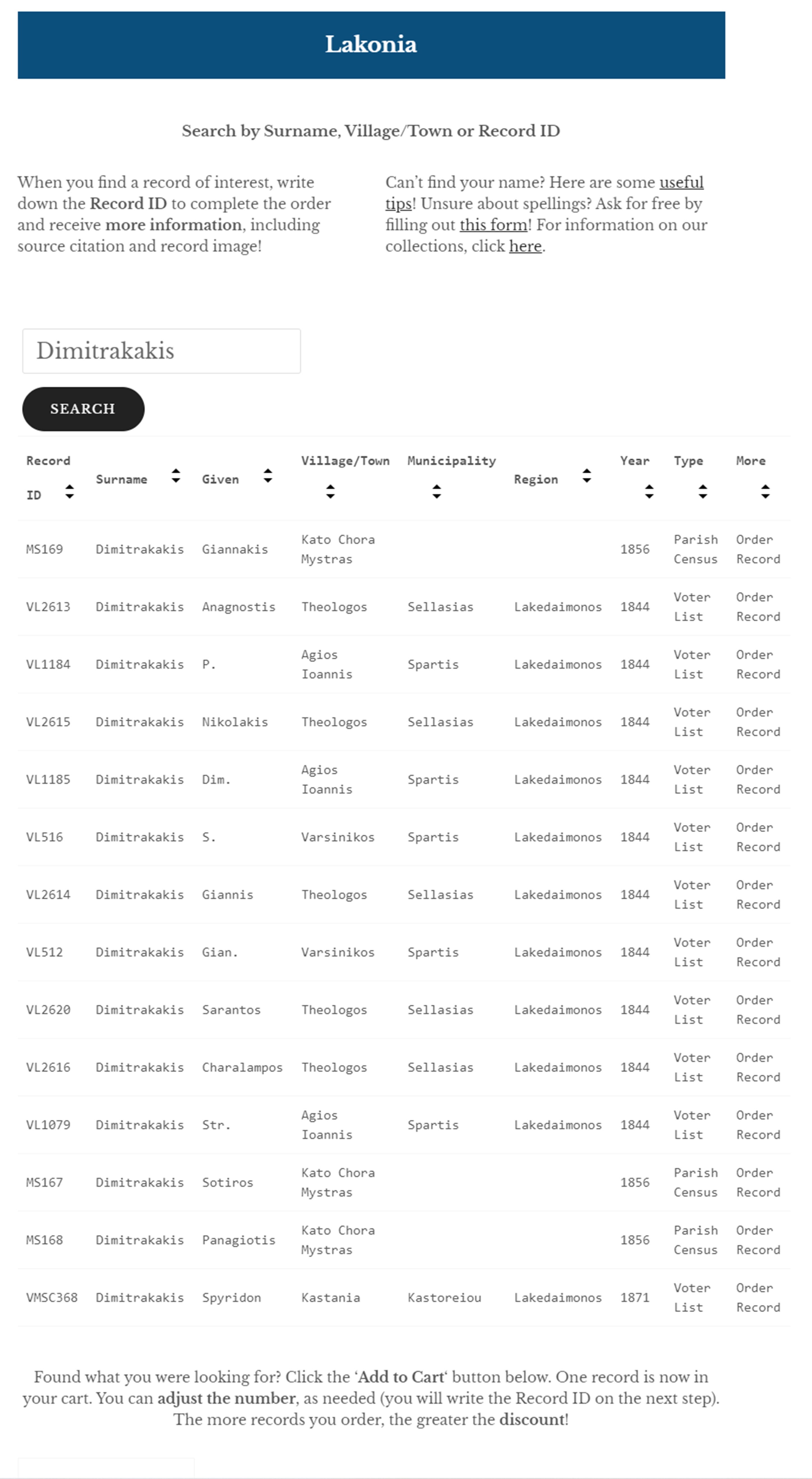
Dimitrakakis surname in Lakonia, GreekAncestry.net

The right hand columns give the record collection name and date. Besides the 1844 and 1871 Voter List, there is an 1856 Parish Census. The first entry is for Giannakis Dimitrakakis, my 3rd great-grandfather and his wife, Politimi!

I ordered the record and received the following original image and translation with full source citation. Giannakis Dimitrakakis is on line 67:
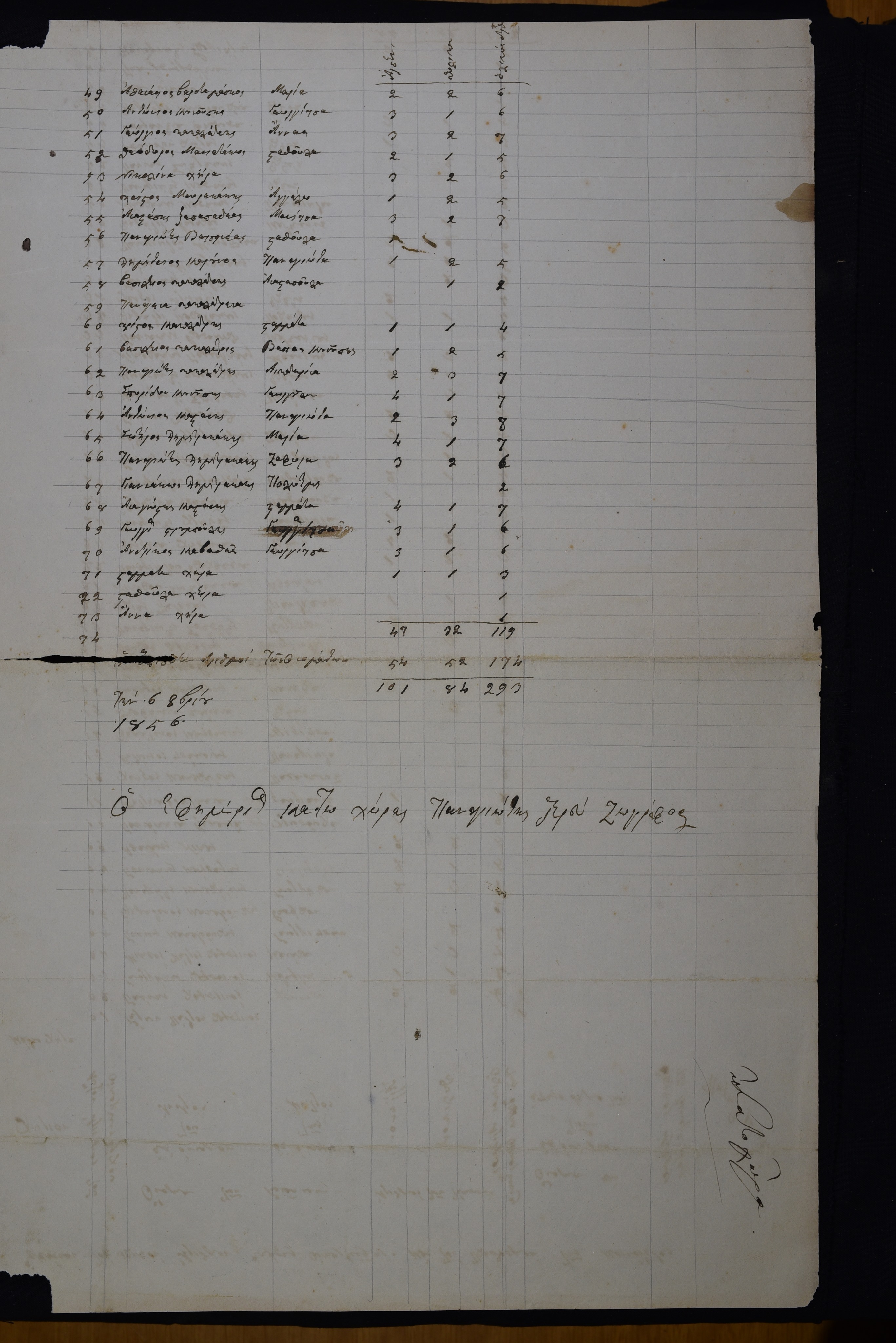
1856 Parish Census, Mystras / Kato Chora
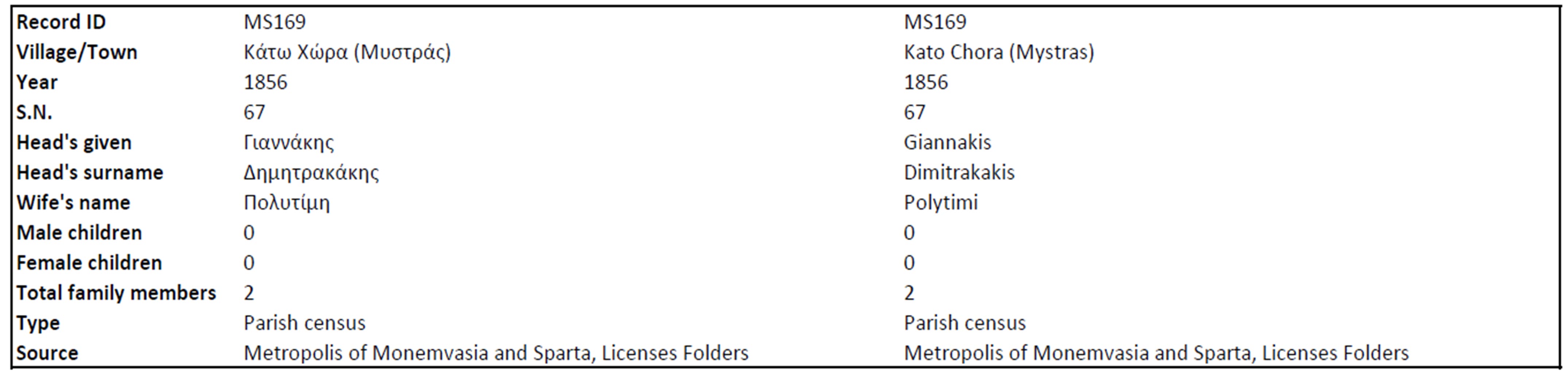
1856 Kato Chora Parish Census Transcription

I am so grateful to have this translation! Although the priest’s writing is neat, it is still a challenge to read and I may not have been able to identify my Dimitrakakis name.

Clicking on the “Collections” page of GreekAncestry provides information about this record set (available for the villages of Kato Chora-Mystras, Parori, and Oitylo) and other collections available on the website:

Parish censuses were censuses of all the families of a parish conducted by the local priest. They were important for church organization reasons. A parish census includes the name of the head of the family (which, in some cases, were widows), his wife’s name, as well as the number of their children, male and female.

It’s hard to describe my excitement at learning the name of my 3rd-great grandmother, Politimi, in this document! Finding the names of women in Greek records is especially challenging, which is why this collection is especially important. To learn more, see “Women in Greek Archives – Missing Half of Us.”

I will be sharing any additional “beyond the basics” information that I become aware of  through GreekAncestry and other sources. Stay tuned and stay hopeful–our research can and will move forward!

RootsTech 2020: A Time for Greeks to Shine

RootsTech, the largest genealogy conference in the world, took center stage in my life this past week. This massive event is known for hosting 25,000+ attendees, hosting a myriad of vendors, and providing hundreds of sessions.

Although I attend every year,  this one was especially meaningful. For the first time at any major genealogical conference, a class on Greek genealogy was held. Presented by professional genealogist Kathleen Doherty Kaldis, the session focused on the essentials of beginning Greek family history research.

Kathleen Doherty Kaldis presents, “Opa! It’s All Greek to Me.”

Using the metaphor of a Greek dance where the circle begins small and gradually expands until all participate, Kathleen described the importance of utilizing all resources available and working within our Hellenic community. Her family is Scottish/Irish, but her husband’s family is from Xirokambi, Lakonia and Pyrgos, Messinia. She used examples from her Kaldis family research to demonstrate the research methodology needed for success. There was a warm feeling of community in the lecture room. We are all in the same position, seeking information as to how we can learn more about our families. It was heartwarming to see people gather at the conclusion of the lecture to compare information. Bringing our community into the national spotlight is a HUGE step forward–thank you, Kathleen 🙂

Gathering and sharing information at the end of the lecture

I was very happy to spend time with Greek friends who also came to RootsTech, as well as Dawn and Trisha who work at the Family History Library. Dawn is a volunteer on Wednesday mornings and she has roots in Argolidis. Trisha is an employee who is at the Library daily and her roots are in Chios. They provide an invaluable service of having the knowledge to help anyone who needs assistance with Greek research.

Trisha, Carol and Dawn at the Family History Library, International Section

As I visited vendors in the Expo Hall, I asked several who focused on European research if they had inquiries about Greek genealogy. The answer was yes and the majority either had a Greek grandparent or great-grandparent; or, they had taken a DNA test and found they had Greek ancestry. In both cases, they were new researchers. There is much we can do to help our beginners: provide encouragement, teach practical “first steps” and share resources.

I met with people at FamilySearch and MyHeritage to discuss ways to make more Greek records available. It is a challenging task due to the contractual negotiations required between Greek repositories and the genealogy companies, but I am confident that the increased surge of interest and the public’s sincere desire will yield positive results.

MyHeritage has launched a truly amazing photo colorization program, which will automatically colorize black and white photos. Their booth featured a magnet board where people uploaded photos which had been colorized through their process and in turn, received a magnet. I am holding a picture of “poker night” at my papou Kostakos’ home in Brooklyn (sorry, it’s upside down!).

My Heritage Photo Colorization

People who are not members of MyHeritage can colorize ten photos at no charge; members can colorize an unlimited number of photos.
Try it here: https://www.myheritage.com/incolor

There are many facets of family history research. Finding our ancestors is one, but so is capturing the memories of the ancestors that we do know, or whose stories have been passed down by our elders. This conference theme was “The Story of You,” and many sessions were held which described ways to save and record memories. One of my favorite sessions was “Five Simple Steps for Writing the Story of You” [or, a loved one]. Presenter Devon Noel Lee championed the use of photos as writing prompts. Her suggestion is to take a photo and write about it:  who is in the photo? where did the event occur? why is it significant? After doing this for a series of photos, the basis of a personal history is established and it is easy to add details. I am inspired to do this, starting with the photos from my grandparents’ album such as the one I am holding above.

I attended many sessions this week, including several on DNA. One of my favorites was a class with an important but under-discussed topic, “The Circular Flow: Researching Return Migrants.” I learned about immigrants who came to the U.S., but then returned to their homelands and perhaps back to the U.S. again. I will be writing a post about this, as there is much to share.

Conferences are an excellent way to learn and connect. I appreciate FamilySearch for sponsoring RootsTech for 10 years. Please join me in Salt Lake City next February!


Kosta’s Map

I love speaking with the villagers in Sparta. They know their land with a level of intimacy that astonishes me:  every hiding place in the Taygetos mountains, every olive tree on their land, every goat trail that leads to an abandoned kalivia (shepherd’s hut), and the origins of every family in the village. Last summer, simply by hearing the surname, Christos told me that my great-grandfather, Andreas Kostakos, was from the now-abandoned village of Perganteika (read that post here).

The Kostakos family origins have mystified me for years and have morphed into my never-ending quest. The -akos suffix designates the Mani region, but I can’t find the family in any records outside of the Sparta area before 1844. The reason? Greece became an independent country on February 3,1830, after 400 years of Ottoman rule. It took time for the new government to begin record keeping; not much exists prior to 1840. Thus, all Greeks have the proverbial brick-wall during this timeframe.

Christos’ insistence that the Kostakos family was first in Perganteika, then in Anavryti, then in Agios Ioannis after the War of Independence (about 1835-40) has not satisfied my desire for proof. (An elusive commodity in Greek research). So, I pester anyone whom I meet with many questions. In return, I get bits and pieces, and sometimes a treasure like the one below (click on image to enlarge it).

Last July at the home of Peter Adamis in Pellana, I received an exensive history-geography lesson from Peter’s friend, Kostas Sgourdas. A native of the area and a renowned stone and marble mason, Kosta’s artisan work is found in government buildings, churches and homes throughout Lakonia. He has a comprehensive knowledge of the region and its people. And he shared much with me.

Kosta explained what I heard many times:  people fled to the towering Taygetos mountains to escape Ottoman dominion; after 1830 they started their descent into the valleys to begin a life of freedom. Kosta patiently and carefully sketched the map above to depict “layers of villages,” beginning at the top of the Taygetos range and descending into the plains of Sparta. I could now plainly see how the villages were staggered and, at times, stacked upon each other. As his pen moved down the page, I could almost visualize people moving down, incrementally, from the peaks. It was a logical movement of humanity and a powerful moment of clarity.

Kosta’s stories mesmerized me. These people–my people–were resilient, tough, inventive, smart, and scrappy survivors. The more I hear about village life in the 1800’s, the more I want to learn. I love Kosta’s map. It has not solved the Kostakos origin mystery, but it has enhanced my understanding. My respect for my ancestors grows with each fact I learn, and I am proud to be their descendant.

New Greek Genealogy Website Has Launched!

Launching today is a powerful new tool for Greek genealogists, the website, GreekAncestry.net. This is the first digital platform created to meet the needs of people who are researching their families in Greece. The site is bi-lingual, and people can search by name or village, in either English or Greek. For those who struggle to read Greek script, this feature is priceless.

The website hosts over 100,000 images from the following regions in Greece:  Arcadia (Tripolis), Crete (Chania), Lakonia (Sparta) and Messinia (Kalamata). Types of records include: voting lists, military lists, male registers, census records, and many more. The  databases will be updated on a monthly basis.

To assist with navigating the site and ordering records, video tutorials are available:

How to Navigate the Website

How to Search and Order Records

In searching the site for Lakonia, I found the name of my great-grandfather, Andreas Kostakos, in a list of men eligible to vote in 1844 in Sparta. I am so very excited to find many of my Spartan surnames. My research will leap forward now that I can look for specific people in specific villages.

As records from additional areas in Greece are indexed and made available, I know that regular users of GreekAncestry.net will be able to find information previously “hidden” to them. Many people will now be able to link the present to past, and share copies of original records with their families.

Every record that is ordered will come with an English translation, a full source citation, and a digital image. The cost for one record is $8.99, and the price decreases the more records that are ordered. Such a small price to pay for having the luxury of conducting a name-search in Greek records, especially those that are handwritten in old script!

GreekAncestry.net is founded by historian and professional Hellenic genealogist, Gregory Kontos. An expert in Greek migration history, Gregory is a leader in the Greek genealogy community. He pioneers digitization projects, supervises indexing teams, and conducts research for people worldwide. I have worked with Greg and have full confidence in his knowledge and trust in his honesty. I wish my friend great success, and thank him for making this service available.

I Sign, Therefore I Am

A signature is a personal stamp of existence. Whether a simple “x” or an embellished autograph, each mark is the creation of its maker and documents his/her presence on earth.

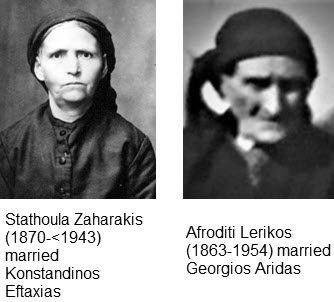
Sadly, I do not have pictures of my Spartan ancestors. Cameras were simply not part of a village household in the early-mid 1900’s. I have only photos of my two great-grandmothers: Stathoula Zaharakis Eftaxias and Afroditi Lerikou Aridas.

But, thanks to my research trips, I do have photos of documents. And some of those documents have signatures of the men in my family.

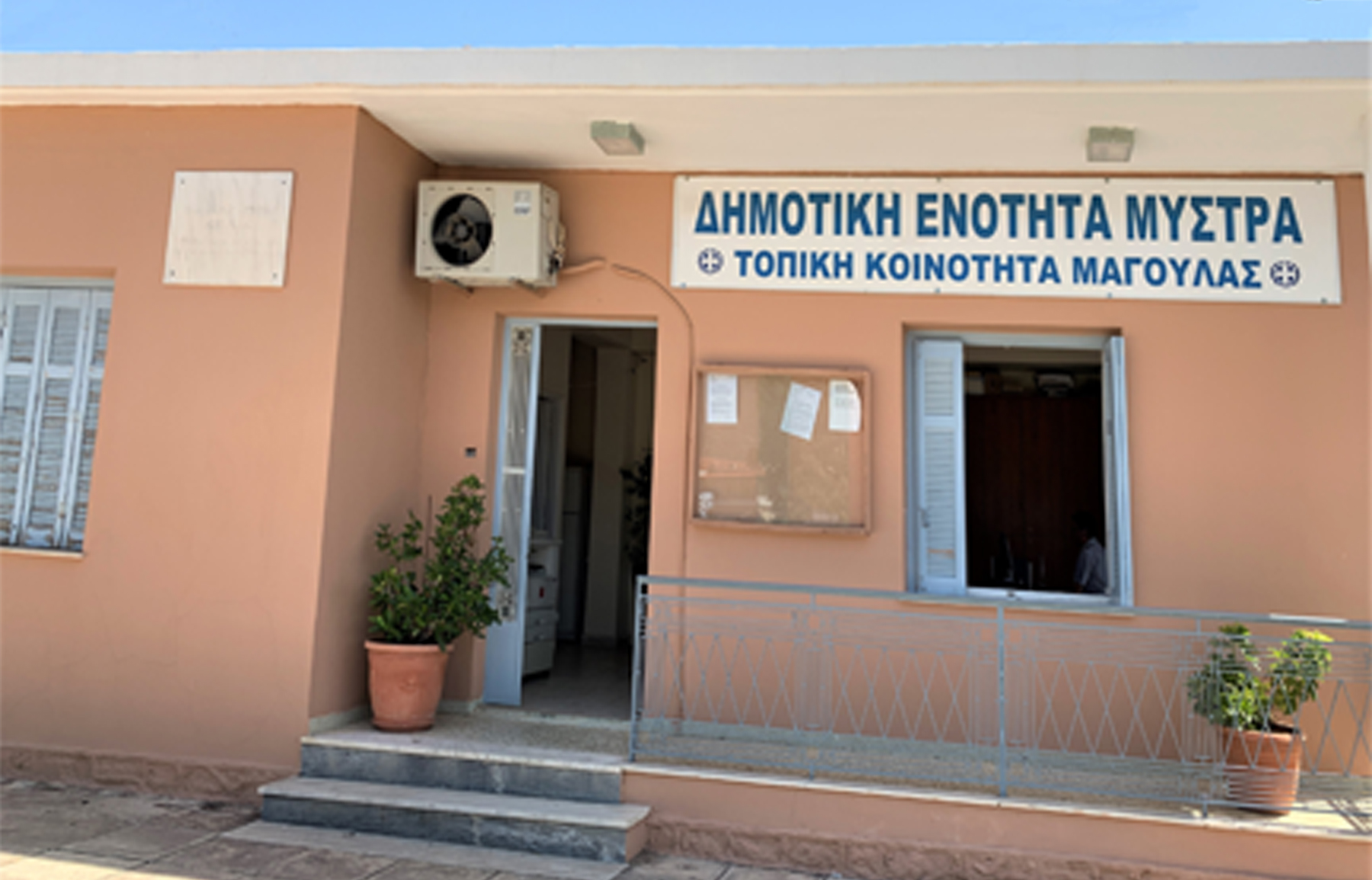
I am spending hours extracting information from civil birth and death records which I obtained from the Lixarheion in Magoula in July 2019. Lixarheion offices were created in the 1920’s as the repositories of civil records of birth, marriage and death. As men came to this office and registered the vital events of their families’ lives, their names were recorded as the declarant, and they signed each document to witness that the information they provided was correct.

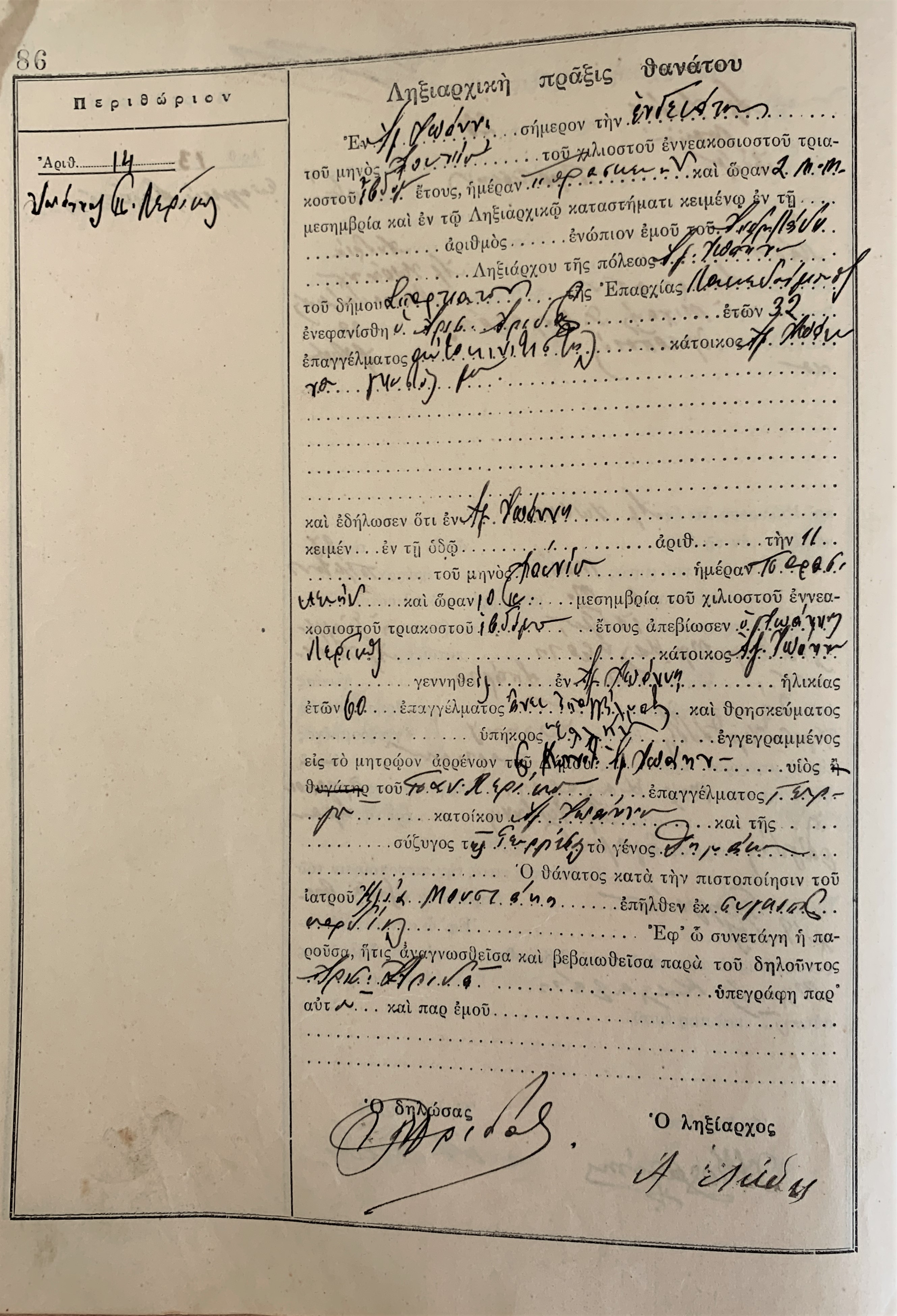
This is the death record for Ioannis Panagiotis Lerikos, who is Afroditi’s brother and my great granduncle. His Male Register (Mitroon Arrenon) gives his birth year as 1875; and his civil death record, below, gives his death date as June 11, 1937. The declarer is his uncle, Aristedes Aridas, whose signature is on the bottom left.

Ioannis Panagiotis Lerikos, died June 11, 1937 in Agios Ioannis

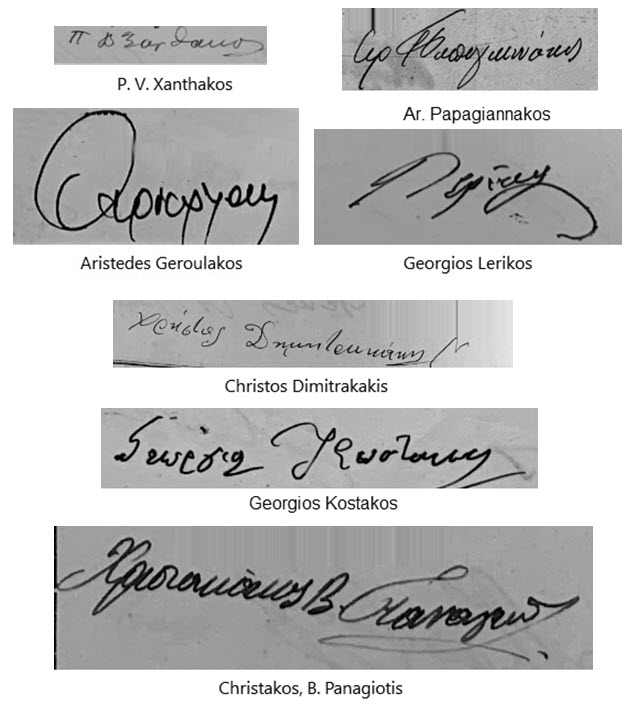
As I work my way through civil birth and death records, I use Snag-It, a snipping tool, to capture signatures which become substitutes for photos. Although they are not portraits, they are valid representations of each person. Every autograph is as unique as its author.

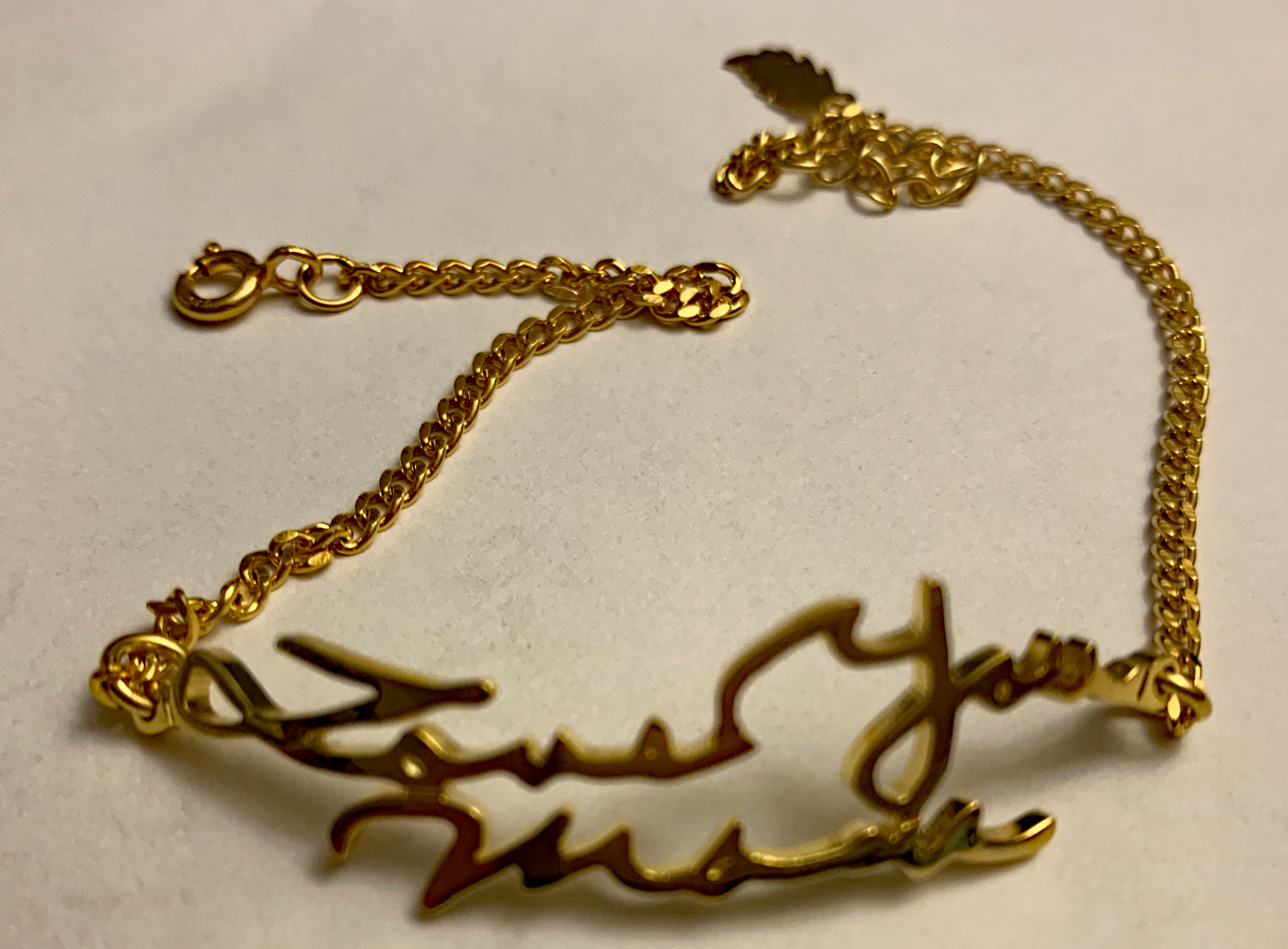
As a Christmas gift, my nieces gave me this unique bracelet. It is my mother’s handwriting. Look closely and you can read “Love You, Mom.”

Our signatures may not be famous, but they are uniquely ours and wise genealogists use them to distinguish people of the same name. When we sign, we attest that we lived. And sometimes in our research, that’s as close as we can get to visualizing those who came before us.