(Note: this post, “Water” is the second of three parts describing the earliest modern developments in Xirokampi. Part 1: Light, can be read here.)
The construction of a complete network of drinking, running water with pipes in the village was attempted and completed in the 1960s or even the early years of the 1970s, during the presidency, initially of Georgios Koumoustiotis and then of Nikolaos Koumoustiotis. It was preceded by the construction of a small stone tank, under the presidency of Ioannis Karambelas and Efstratios Skouriotis, at the highest point of the village, at the exit of the Anakolo gorge. There, the water was collected with metal pipes from many small springs – such as Sotiritsa – that were expropriated by the state.
Initially – in 1953 or 1954 – “public” taps with brass spigots were installed in central points and in the large neighborhoods of the village. The network, made of metal pipes, did not supply these taps with water around the clock, due to its inadequacy. Thus, the sight of long lines of women with buckets, jugs or pitchers and wooden water barrels (. . . ) was a daily occurrence, from dawn. It was there that the women informed each other about the news of the village.
However, the public water fountains made the life of the villagers so much easier, that today’s children cannot imagine. Until then, the transport of drinking water was carried out by springs [“αμπουλάδες”] which gushed with a natural flow in the banks of the Rassina, from a small spring on the right bank of the Anakolo – at the height of the “Komnini” small lake; but also (after the middle of the 19th century) from wells dug in the village, at a depth of 4 or 5 meters, in various places: Iatrideika, Feggareika (of Kalamvokis or Magganiaris), Volteika, Poulakeika, Rassina (of Aivaliotis), Liakeika … All of the wells were communal. Of course, with the operation of the wells, the springs gradually dried up, since the underground water level went down due to constantly increased consumption, especially during the 1960s.
With the completion of the network and the replenishment of the reservoir, water reached every house in 1961 and 1962. But the process was long, arduous and costly. Trenches in the streets had to be opened with a pickax and a shovel. Pipes had to be bought, transported, placed and connected together. Then, the local handymen worked as plumbers in the public network and in the networks inside the houses: Giannis Chatzigeorgiou, Stavros Argyropoulos, Michalis Tsapogas and Elias Christopoulos. To deal with the large expenditure, the community rulers resorted to the then common measure of compulsory (co-)contribution from the inhabitants – alternatively or additionally – of money or oil, personal labor or the labor of their animals for the transport of the pipes and materials. Each family was estimated to bear the cost of 10 meters of the network.
The consequences of the construction of the water supply network were, of course, crucial for the quality of life of the inhabitants, but they also had secondary, controversial results. Horticultural production increased, but it was also necessary to transport water even from Taraila, bypassing the route of centuries and reducing the underground water. Undoubtedly, however, the project was large and innovative for its time, it improved the life of the inhabitants and attracted new residents from the surrounding villages, being one of the strongest incentives for them.
Part 3 of this series, The Telephone, will be published next.
I am honored to receive permission from the Katsoulakos family to translate and share articles from The Faris. Translation verification and corrections have been made by GreekAncestry.net. This is the ninth article of the ongoing series. Previous articles can be viewed here.
(Note: this post, “Light” is the first of three parts describing the earliest modern developments in Xirokampi.)
The “Light-Water-Telephone” of the title of this article refers (as older people will remember) to the -advertised by the radio at that time – conditions that a region of the country in the 1960s and 1970s had to have for the arrival of new settlers. At that time, networks of electricity and water supply did not exist in all areas, let alone their coverage by the telephone network of the national telecommunications organization, OTE.
Of course, this article refers only to Xirokampi and in particular to the first supply of electricity and drinking water to its houses and shops through networks, as well as to the first connection of the houses and shops with the country’s telephone network. Previously, only one public telephone in each village was connected to the telephone network, or even formerly, a teletype or telegraph. It is noteworthy that light and water “arrived” at the houses and shops of our village much earlier than in other areas of our prefecture, thanks to the initiative of the residents and the progressive community leaders.
Electric light, running water in the houses, and the telephone were decisive factors in the development of our village (as well), but also in the improvement of the quality of life of its inhabitants (as well as all the villages in our region).
Part One:The Light
Xirokampi was illuminated for the first time with electric light in 1937. The direct electric current was provided by a 110-volt, diesel-powered electric generator. It was installed by Achilleas Galatis, after a bidding auction held by the community in 1936 during the presidency of Nikolaos Psyllakos, with a predetermined price ‘per Ω x B’ (Hour x Watt).
The generator was initially installed in a building of the sister of Tsigalis (next to the house of Nikolas Mavroidis) and later in a building of Solomos near the church of Agia Triada (where there is now the Hotel Taleton). At that time the operation of the generator was taken care of by the son of Achilles, Takis Galatis.
The “Galatis factory” – as we called it – operated for limited hours around the clock. The limited power of the electric generator as well allowed the lighting of only the square and some streets – mainly at intersections – in the evening hours. It also ensured the electric lighting of shops and houses, but not the operation of devices other than light bulbs. Of course, for several years there were also oil lamps in the shops and houses that were supplied with electricity from the Galatis factory, since the breakdowns of the generator were frequent and the intensity of the light was not constant.
The generator was initially installed in a building of the sister of Tsigalis (next to the house of Nikolas Mavroidis) and later in a building of Solomos near the church of Agia Triada (where there is now the Hotel Taleton). At that time the operation of the generator was taken care of by the son of Achilles, Takis Galatis.
In many shops—like my father’s pharmacy, I remember—there were for several years lux oil lamps with beck and “bubble” from asbestos—which they pumped up from time to time—since they gave off a strong white light and inspired more trust and confidence. On the contrary, many traders who set up their stalls in open spaces or shacks – as at the village “panegyri” – as well as the “karagiozis” puppeteers (καραγκιοζοπαίχτες) used burning acetylene (a flammable gas derived from the combination of water and the common mineral calcium carbonate) which gives a strong white light but also has a “pungent” smell. But for several years, common kerosene lamps and traditional oil lamps would continue to illuminate most homes with their “shimmering” but cozy light.
The time when the electric lights were switched on before dark was a milestone for life in the village. The instruction of mothers to children who played in the streets and “forgot” to return home was typical: “gather when the lights come on” … But also many things had to be finished “before the lights went out” around midnight. There were usually warning continuous and brief power outages. Sometimes not. Galatis, in addition to regulating our lives and our habits in the evening hours, had also created in his “factory” a “gathering place” for people of the neighborhood, with conversation and games until late at night.
It should be noted that diesel-powered electric generators were operating in Xirokampi even before 1937, supplying power to limited business units, such as the oil press and mill of Stratigis Solomos (near Agia Triada) and the Christakos brothers’ carpenter’s shop (in the village market).
The generator of Galatis supplied the village with electricity until the beginning of the 70’s – in 1963 – when Xirokampi joined the PPC network exclusively and the electricity came from far away – from Ladonas (!) as we used to say. Then many local and foreign crews, working for months, changed all the wires in the streets and houses, as imposed by the new voltage of the network (220V instead of 110V). The work was hurried and the laying of the new lines was done on the walls, without digging. Copper wires insulated with waxed cloth were passed through spiral tubes of thin sheets of lead or bakelite that were nailed to the walls. From the local crews who worked on the installation of the new lines, we remember those of Theodosis and Pantelis Giannakas, Christos Hadjigeorgiou (or Fouras) and Konstantinos Papadakos (or Paschalis). On the contrary, the PPC crews who transported and installed the wooden logs to replace the older small “columns” of the network were mainly composed of non-local workers. The porcelain current insulators that some people secured were used as decorations in their homes for many years and were—or still are—used in offices to hold papers with their great weight.
After Xirokambi, the electricity supply from the PPC network was gradually extended to the surrounding villages. The wait and longing for electric light was long, so the joy of the inhabitants was great. An incident told to me by my classmate at Xirokambi High School, Kostas Dim. Plagiannis from Goranοi, is characteristic. When his bedridden elderly grandmother saw the light bulb in her room turn on, she crossed herself and died.
Note: Part 2 of this series, Water, will be published next.
I (Carol Kostakos Petranek) am honored to receive permission from the Katsoulakos family to translate and share articles from The Faris. Translation verification and corrections have been made by GreekAncestry.net. This is the eighth article of the ongoing series. Previous articles can be viewed here.
In today’s world, a pair of shoes is a simple matter in terms of manufacturing. They are made in factories on mass production lines with the latest technology and sold en masse to the world. In the early decades of the 20th century, however, when technology and modern machinery were non-existent, there were a few cobblers, who at the bench and in their workshops, made custom-made leather shoes and repaired worn and punctured shoes. Due to poverty, making a new pair of shoes was a rare phenomenon. It was considered a luxury to have a second pair of shoes. For this reason, the craftsmen, the so-called shoemakers, made new shoes on demand only. They would usually set up their bench in the shoe shop and with the help of workers and apprentices, they would repair damaged shoes. How many times didn’t the cobblers return to the surrounding villages to repair people’s shoes?
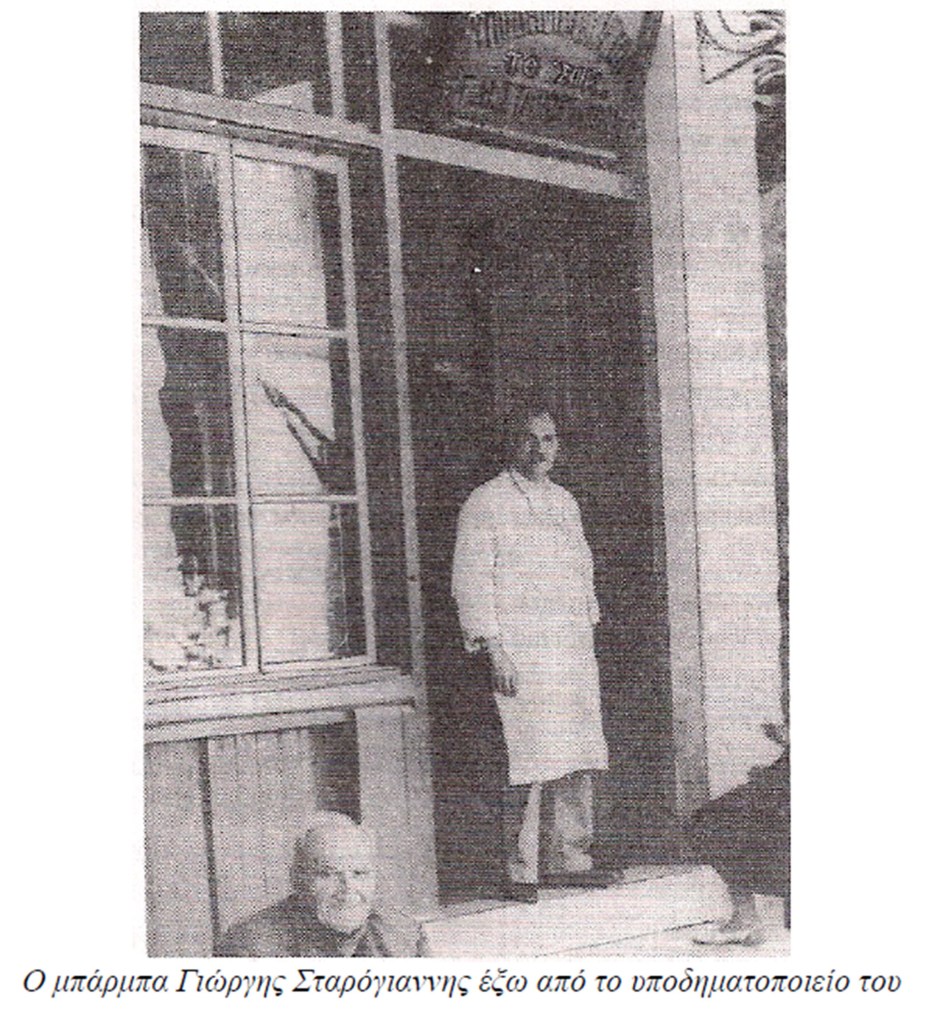
Every region of Greece had shoemakers and of course Xirokampi was not an exception. In Xirokampi, Ioannis Panageas had a shoemaker’s shop across the street from where Mr. Mandrapilia’s paint shop is today. The brothers Nikos and Argyris Kalianiotis had a shoemaker’s shop in the building that belonged to Panagiotis Kyriakakos. Later in the same place was the shoemaker’s shop of Yannis Alexakis, who had married the daughter of Argyris Kalianiotis. Panagiotis Christopoulos had a shoemaker’s shop in the building that belonged to Napoleon Andreakos. In Katsouleika was the shoemaker’s shop of Evangelos Kritikos, while Panagiotis Kalianiotis, who lives today in Sparta, had his shoemaker’s shop opposite the bakery of Nikolakakos. Finally, there is Georgios Starogiannis who is 96 years old today and lives in Xirokampi. His first shoemaker’s shop was in the house of Arachovitis. In 1933, having already been 10 years in the cobbler’s art, he went to the square and opened a shop next to Vangelis Liakakos’ house.
“Barba” Georgios Starogiannis retired when he completed 45 years of love for his craft. He is the only shoemaker along with “barba” Pantelis Skliros who now lives in Katsouleika. Like all shoemakers, he had several workers in his shop, around 20. He mentioned a few to me: Pantelis Skliros, Pantelis Frangis, Iraklis Komnenos, Konstantinos Chrysikos, Lias Chios, Yannis Filosofos who was also a good shoemaker, just like the aforementioned. There were of course many other cobblers who worked with diligence and craftsmanship in the shoe shops of Xirokampi. “Barba” Giorgis Starogiannis, during the occupation period, was the only one in Xirokampi who could manufacture the so-called German boots or vaketes (βακέτες).
The shoemakers made shoes on demand. They were made to fit the feet of the person who ordered them. At first, the cobblers took measurements with a tape measure. To give the shape of the shoe to the treated leathers and sole, they fitted them with a special shoe mold called kalapodi (καλαπόδι). Previously, of course, they had cut the leathers with a sharp blade, or if the skins were thin, with a cutter [similar to a wire cutter]. These two tools were sharpened with a special tool, called matsaki (ματσάκι). The pieces of leather were placed in the kalapodi and underneath was the vardoulo (βάρδουλο) [a strip of leather on the bottom of a shoe to which the sole is nailed or sewn]. Using small nails called spragges (σπράγγες), they nailed the sole to the skin.
After the whole construction took the shape of the shoe and the leather was repaired, they removed the nails and threw them away and where the nails had been, they sewed the skin with an awl. Then, to fasten the heels to the shoes, a hole was drilled to insert the wooden spike which was made from a piece of board. The tool which was used to drill the hole was called katsaproki (κατσαπρόκι). After affixing the heel with the wooden spike, they secured it with nails called telakia (τελάκια), which varied in size. To prevent the shoes and especially the boots from wearing out easily, two metal taps (or clips) were nailed, one on the toe and one on the back of the shoe. All around the shoe, where the leather meets the sole, the cobblers made various decorative stitches and engravings. The construction of the shoe was completed by polishing the sole, the heel and the bottom of the shoe with three smooth surface tools, the machineta (μακινέτα), the camareto (καμαρέτο) and the lampougio (λαμπούγιο). In particular, for polishing the heel, the cobbler would first heat the polishing tool over a fire in a small tin can. Such a pair of leather shoes needed a day to be made by an experienced craftsman.
Making a pair of shoes required great craftsmanship and artistry. An incident proves this: a customer from Potamia haggled with “barba” Giorgis Starogiannis for a pair. “Barba” Georgios, to show him the quality of the shoes he would buy, put the shoes on scales which balanced perfectly. The shoes were of equal weight, something difficult to do because they were handmade.
Of course, as we have already pointed out, the main work was repair. They patched full of holes and repaired damaged, worn out shoes. Every time there was a market, people from the surrounding villages and the mountains would come and have their shoes repaired by the shoemakers who set up their stalls in the square of Xirokampi. Often, the cobblers would go to villages and mend shoes on the spot. When the sole was punctured, they would patch it with a piece of leather. When the leather was punctured, they would put the shoe in the kalapodi and patch it with a piece of leather, called fola (φόλα).
At the beginning of the century, in the first decades, when there was no eight-hour work day, the shoemakers worked many hours a day (10 – 15) and sometimes stayed overnight at their work, without being paid extra wages and overtime by their bosses. The working conditions in the shoemaker’s shops were difficult, but they became more humane when the right to an eight-hour work week was secured, for which there had been many struggles all over the world.
Today, no one in Xirokampi follows the art of shoemaking. The old ones have either died or have now retired (G. Starogiannis, P. Skliros, P. Kalianiotis), while the younger ones do not have the passion to continue this profession. After all, there are now shoe industries that manufacture many pairs of shoes at low cost. Very soon, unfortunately, the shoemaker’s trade will be completely eliminated in all of Greece, as the last cobblers will also retire.
___
I am honored to receive permission from the Katsoulakos family to translate and share articles from The Faris. Translation verification and corrections have been made by GreekAncestry.net. This is the seventh article of the ongoing series. Previous articles can be viewed here.
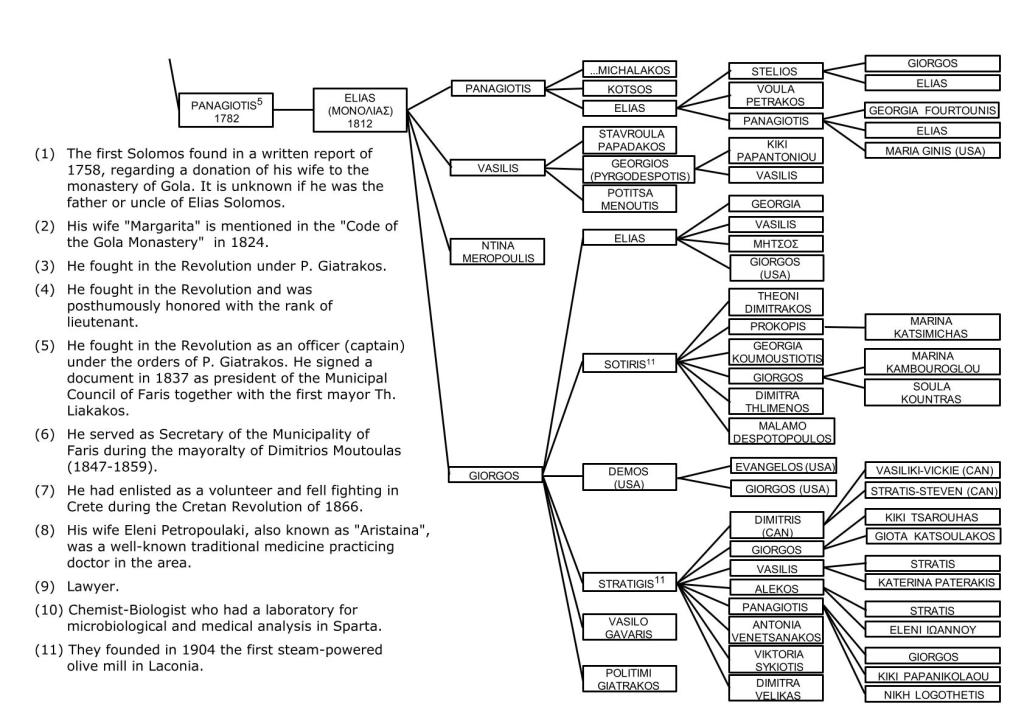
I am most pleased to receive permission from Stratis Solomos to share his genealogy of the Solomos Family of Koumousta and Xirokampi.Stratis wrote: “Last year I was asked by the chief editor [of the Faris newsletter] to write a genealogy on the Solomos family, one of the most important families of Koumousta-Xirokambi…For practical space reasons the family tree was confined to the generation of 1960-70. By the same token, the few historical footnotes are limited to the older generations only.”
Publicizing and publishing our family history work is an unselfish and important act. It allows us to share what we learn with those who may not have the resources or abilities to conduct such research. They, too, want to know about their ancestors and connect with extended family worldwide. Thank you, Stratis, for your sharing your work with us and for providing this English translation.
The Solomos family of Laconia originates from Koumousta, a village in the Taygetos mountains, close to Sparta. In the 19th century, after the Greek War of independence, most family members moved gradually down to the flat land, to the newly founded village of Xirokampi. The origin of the Solomos family of Laconia is unclear and there is no oral tradition or myth related to the family history. In the 1950s-60s, the lawyer Georgios V. Solomos, known as “Pyrgodespotis” (Castle-Lord), was saying that he had done a bibliographic research that had allowed him to conclude that the family came from Crete in the middle of the 17th century, after the fall of Chandakas (Heraklion) in 1669 and its occupation by the Turks. More specifically, as it was narrated in the informal ‘kafenio’ gatherings, there were initially two brothers, one of whom stayed in Laconia and the other went to Zakynthos. The latter was the great-grandfather of the national poet of Greece Dionysios Solomos. Unfortunately Pyrgodespotis did not leave any written report and the above cannot be confirmed. His version may have been based only on various biographies of Dionysios Solomos.[1]
Nevertheless, the above hypothesis is not completely unfounded and can be based on the following arguments:
1) The family appears in the mountain village of Koumousta in the early 18th century, following the end of the Venetian domination over several Greek territories (and succeeded by the Ottomans).
2) It settles in an area where there are other well-known families, of established Venetian[2], Frankish and Byzantine origin. These families were living in the Laconia plains, but they moved to the mountains in 1715, when the Ottomans again conquered the Peloponnese.
3) More recent publications show that the great-grandfather of Dionysios Solomos, Nikolaos, did not go directly from Crete to Zakynthos, but to Kythira, where he married to Maria Durente[3], a woman from a “noble” family and with a large dowry. The Salamon-Solomos family, which is mentioned as important during the Venetian rule of Crete, had other members who settled in Kythira [4] and probably in the fertile Laconia, where the Venetians had provided them with arable land.
4) In addition, it was at this period that the Turks occupied Kythira for three years (1715-1718), for the island to be finally recaptured by the Venetians. It is possible that the move from Kythira to the neighboring Laconia happened at this time.
5) The wife of Elias Solomos of Koumousta (born around 1750) bears the name “Margarita”, which is not a usual name of Ottoman-occupied Greece. It is a “western” name mostly used in the Greek regions under Venetian rule.
Stratigis & Vasiliki Solomos, courtesy of Stratis A. Solomos
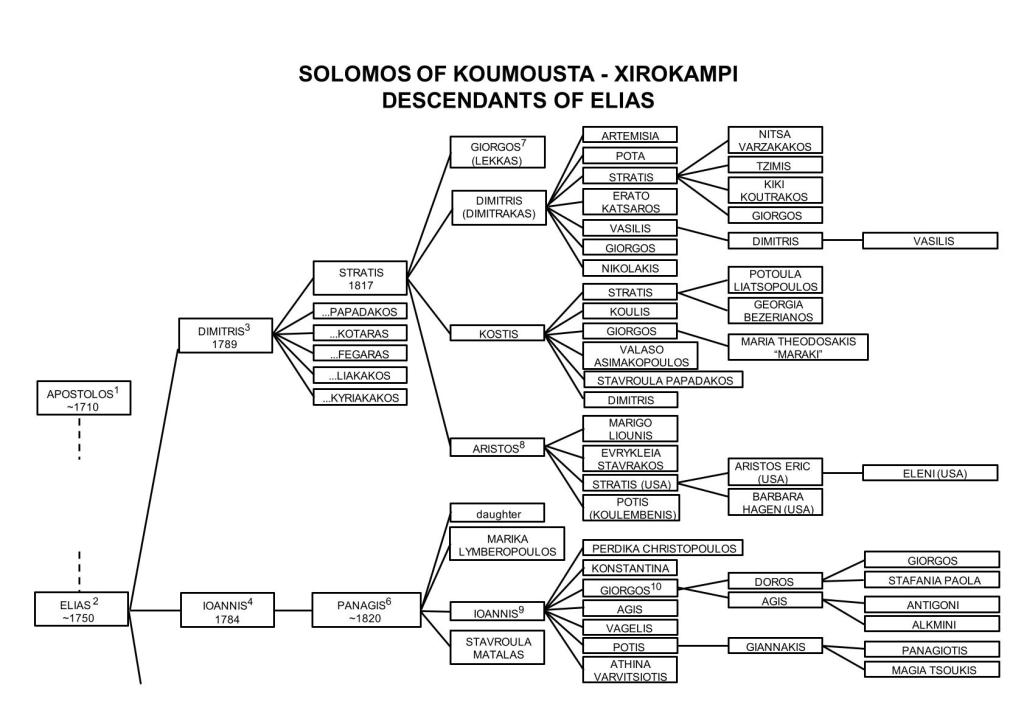
The Solomos families of Xirokampi and Koumousta, which today number hundreds of descendants in many parts of the world, are divided into two branches which meet somewhere in the late 18th century.
The first and most numerous are the descendants of Elias Solomos. The other branch comprises the descendants of Georgakis Solomos and then Thanasis, who was nicknamed “Lales”, hence their identification as “Lalaioi” (pronounced “Lalei”). Because of this nickname there was a traditional rumor that this family branch came from “Lala” a village in northwestern Peloponnese. However, it is rather unlikely that part of the family, with the same rare surname, came to the isolated village of Koumousta from such a remote area, unless there were relatives with the already settled Solomos of Koumousta. Another rumor has it that one of them fought against the infamous Turcalbanian mercenaries “Lalaioi”.
The reconstruction of the two branches of the published genealogical tree is mainly based on earlier oral reports, but also on documented, written information from the book of Th. Katsoulakos and P. Stoumpos[5]. Some evidence was also found in a report of a court dispute of a certain Meropoulis or Myropoulis, against trespassers of his property[6]. Archival research done by the genealogy research company “”ΟΙ ΡΙΖΕΣ ” (THE ROOTS) [7] was also taken into account. Another source of information was the list of immigrants passed from Ellis Island[8], as several members of the family immigrated early to America, from 1896 to 1921. The internet site of the Ellis Island Foundation has provided precious information concerning marital status, name of spouse, fellow travelers, relatives left in Greece, relatives to be met in the US, previous travels and age. From the age declared we can we conclude the year of birth, although with caution, because they often deliberately changed their age depending on the immigration laws in force. Some of these Solomos came back; for those who remained, there is the indication (USA, CAN) next to their name in the tree.
It is expected that there will be shortcomings and mistakes, especially in the tree of “Lalaioi”, which was done with more recent and less credible present-day oral testimonies. Where there is doubt, this is stated in the footnotes and the parental relationship is drawn with dashed line – – – -. Also missing are members who died in infancy or childhood. A future digitization of the registry files of Xirokampi and additional genealogical surveys could substantially help to improve this two-branch tree.
Although there is still abundant material available on the recent family members, for practical space reasons the tree was confined to the generation of 1960-70. By the same token, the few historical footnotes are limited to the older generations only. The year of birth is only mentioned for the older ancestors. Where the year of birth could not be determined exactly, it was estimated and preceded by the symbol (~). The construction of a more complete family tree that could encompass current family data and include offspring of female members would require a greater research effort and special lnformation Technology tools.
Finally, I would like to thank for their substantial contribution: 1) George P. Solomos (Italy), who decades ago recorded his first family tree version of “Elias Solomos descendants branch” and now helped significantly in the historical research. 2) Doros G. Solomos (Italy), who years ago spent time and resources on additional research for the improvement of the above mentioned family tree. 3) Dimitris “Mitsos” Ath. Solomos (Xirokampi), Nikos El. Solomos (Kalamata) and Dimitra G. Solomos-Giangos (California USA) who helped making the first, integrated version of the genealogical tree of the “Lalaioi” branch.
Stratis A. Solomos Geneva Switzerland stratis.solomos@bluewin.ch
[1] Ν. Τωμαδάκης: Οικογένειαι Salomon-Σολωμού εν Κρήτη, Επετηρίς Εταιρείας Βυζαντινών Σπουδών, 1938, Έτος ΙΔ’, 163-181. [2] Σ. Α. Σολωμός: Η ετυμολογία μια τοπικής λέξης και ήθη της Γαληνοτάτης Δημοκρατίας. Φάρις-Ξηροκάμπι, τεύχος 55, Δεκέμβριος 2011. [3] Ελένη Χάρου: Μαρία Δουρέντε, η Κυθήρια πρόγονος του Διονύσιου Σολωμού, 27 Μαρ. 2016. [4] Μπαλτά Ευαγγελία: Η οθωμανική απογραφή των Κυθήρων 1715, Ινστιτούτο Νεοελληνικών Ερευνών ΕΙΕ, Αθήνα 2009. [5] Θ. Κατσουλάκου και Π. Στούμπου ‘η Κουμουστά της λακεδαίμονος’, 2012. 6] ΣΥΜΒΟΛΑΙΟΓΡΑΦΙΚΕΣ ΠΡΑΞΕΙΣ του «μνήμονος Λακεδαίμονος Κυρίου Γεωργίου ΧΑΡΤΟΥΛΑΡΗ» 1833-1835. [7] Γραφείο αρχειακών ερευνών «ΟΙ ΡΙΖΕΣ» ( http://www.oirizes.gr ) Άρης Πουλημενάκος, [8] Ε. Α. Σολωμός: Μετανάστες των χωριών μας που πέρασαν από το Ellis Island. Φάρις- Ξηροκάμπι (τεύχος 50, Δεκέμβριος 2009).
The first wheeled vehicles appeared in our region just 50 to 60 years ago. Before that, in the villages for their travels but also for the transport of things, they mainly used animals. They had mules, donkeys and the more privileged ones, horses.
So, the first wheeled vehicle that made its appearance was a cart. It was two-wheeled and drawn by horses. Its base was in Kaminia. Its original owner was Menis Theofilopoulos who then sold it to Georgios Politis, to whom it remained for many years. For a period of three to four years it was the only one in the area and served not only Kaminia but also all the surrounding villages. Therefore, that period was a good time for the owner, as it was in high demand and had no competition. As mentioned above, it was a two-wheeler and was pulled by one or two horses, which were also owned by the same one. He usually used one of them, depending on the load. If the load was heavy or the road was bumpy, he yoked both of the horses to it. He moved people or carried things, such as wood or olives at a price, which depended on various factors, such as the type of cargo and the distance it covered. To transport people, he charged about 100 drachmas per head and, if the distance increased, the cost varied slightly. Often, as he says, he would put several women together in the cart to take them to the fields to work, and on the way he got teased by everyone he met. From the west, he could go as far as Polovitsa and more rarely to Gorani and from the other side as far as Anogia. Kaminia – Xirocampi was one of the most common routes.
The best period in terms of work was the winter months, during the “olive season”. It was the golden period, as he transported workers to the fields for the harvesting olives, olives from the fields to the factories, and then the barrels with the oil from the factories to the houses. The cart could carry up to 500 kg of load. Exceptionally, when it carried olives, the price was not money, but for each 100 kilos of olives carried, he got 1 kilo of oil. An incident that he himself mentions is that one year, there was such a big quantity of oil, that he was constantly unloading olives of various people at the factory of Stratigis, as he was called. At one point, he saw Stratigis coming towards him in a rage, and cursing and shouting, he kicked him out of the factory, telling him among other things “…you, the way you’re going, you’ll take the factory from me…”, as he was working hard and with so many olives he had brought in, he was entitled to a large amount of oil.
Finally, his contribution to the creation of local roads in Kaminia and the surrounding villages, as well as to the reconstruction of the Kolopanas bridge, was also great. I got the information from the owner of the cart himself, Georgios Politis, son of Evangalos, 87 years old today.
I am honored to receive permission from the Katsoulakos family to translate and share articles from The Faris. Translation verification and corrections have been made by GreekAncestry.net. This is the fifth article of the ongoing series. Previous articles can be viewed here.







 Spartan Roots (Σπαρτιατικές Ρίζες)