My ancestral village, Agios Ioannis Sparta, has the distinction of being the first village in all of Lakonia to erect a Ηρώο (war monument), in 1930. These memorials are found in every village in Greece, usually at the plateia or near the church. They memorialize the men who were killed while fighting to defend our country.
I wrote a detailed post about this for the Agios Ioannis website, which can be found here. Photos of the monument and transcriptions of the fallen are included.
No written history of Agios Ioannis exists, and sharing facts such as this help to raise awareness of the village. I am proud!
With three of my four grandparents born in Agios Ioannis (Aridas, Kostakos, Papagiannakos), I am related to almost every family in our village. My desire to understand our family connections both intrigues and entices me to document how we all interconnect.
I have spent several summers at the Archives of Sparta, the Lixarcheion office and the Municipal Office (KEP), researching our families. I have gathered information from primary sources: the Dimotologion Koinotitos, Mitroon Arrenon, School Archives, Church Books, Election Registers of 1844 and 1872, and Marriage Records from the Metropolis of Sparta. To complete the project, I must extract additional names from marriage, church and school records, but the basic family structure of the village is now documented.
This data has now been compiled into a website, Spartan Roots Family Trees, which can be accessed here. As I continue to add information, the website will automatically update.
Important: Only people who are deceased are in this website!
To use the site, click on the home page, then on the left menu, click on “name index“. Using the alphabetical letters at the top of the page, click on the letter of a surname. A list of surnames will appear and the number next to each name indicates how many people with that spelling are in the database. Click on the letter of interest. Name spellings vary a lot and some begin with two-letter consonants (see Notes below). Alternately, type a surname in the search box. If a name does not appear, then click on the first letter of the name and scroll until you find it.
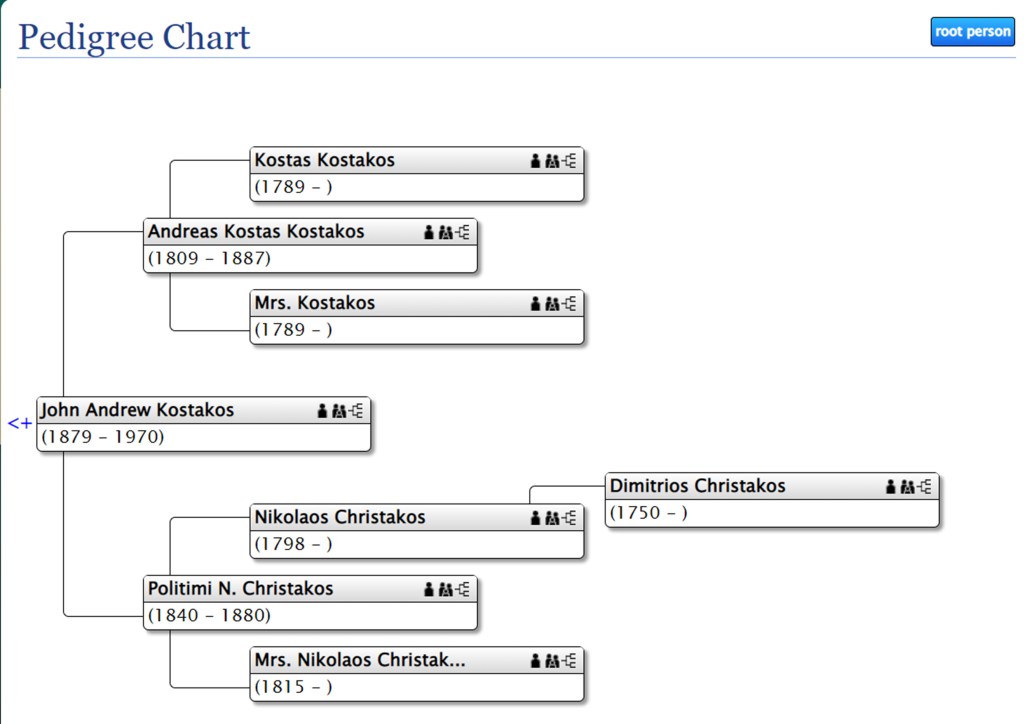
For example, I am looking for my grandfather, John Andrew Kostakos.
When you find a name of interest, you will see three icons on the right. Each takes you to a page with additional information about that person.
Number 1 is the Individual Page, with vital statistics, facts and notes about that person.
Number 2 is a Family Group Sheet. You can choose whether to view that person as a parent with his/her spouse and children; or as a child in the household of his/her parents.
Number 3 shows the person in a Pedigree view. He is the first person on the left, with his ancestors on the right.
Notes:
(1) to navigate, use the left and right arrows at the top of your browser to go one page back or forward.
(2) Be alert for names which begin with two-letter consonants. These are: μπ = b or mb; ντ = d or nd; γκ = g or ng; γγ = g or ng; τσ = ts; τζ = dz.
These two-letter consonants could be translated more than one way; e.g., Bolovitsiotis in English is spelled Μπολοβιτσιώτης in Greek, so it could begin with either a B or an Mp.
(3) If you know of a name that is not on the site, please contact me so we can determine why it is missing.
It is my deepest hope that this website will help you to trace your family back through time. Some men in the Election Register of 1844 were born in the late 1700’s! Our families have a deep and proud heritage, and I am so honored to have roots in our beautiful village!
I am so pleased that this initiative has been accepted into the Greek Ancestry Village History Project Initiative, which is explained here.
It is the bane of every family historian: sorting out men with the same name who lived in the same location at the same time, and sometimes married women who had the same given names. For Greek researchers, this issue is exacerbated due to naming traditions which almost always ensure that several men in a village—because they are named after their grandfather–have the identical baptismal name and surname. Fortunately, our naming traditions usually provide the father’s given name as well. Examples: Nikolaos Stamatakis, of Georgios (Νικολάος Σταματάκης του Γεώργιου) and Nikolaos Stamatakis, of John (Νικολάος Σταματάκης του Ιώαννου). We now know that the father of the first Nikolaos is Georgios and the second is John.
But what happens when we are searching in records where the father’s name is not given? This usually is the case in older documents, such as 1844 or 1872 Voting Lists. One research strategy is to look at the ages of the men as a means of differentiation, but we already know that Greek ages can be notoriously inaccurate and many years off. Another strategy is to pinpoint an exact location, but what about families who moved between villages? Or the cases when a man married a woman, moved to her village and took HER surname thus losing his surname and becoming a “xxx…gamvros” (unusual, but we do see this in names like Stratigamvros). And to all this, let’s throw in the real possibility of clerical errors—or even misinformation given by the informant.
What then?
I was faced with this exact situation. My research question was: Which Nikolaos Papagiannakos in Agios Ioannis, Sparta, was the father of my great-grandfather, Panagiotis Nikolaos Papagiannakos?
I consulted several sets of records (Mitroon Arrenon, Voter Lists, Town Registers, Marriage Records) and documented every Nikolaos Papagiannakos, giving each a unique identification number. And I paid careful attention to the names of their sons.
Preliminary Analysis of Papagiannakos Name in Agios Ioannis Records
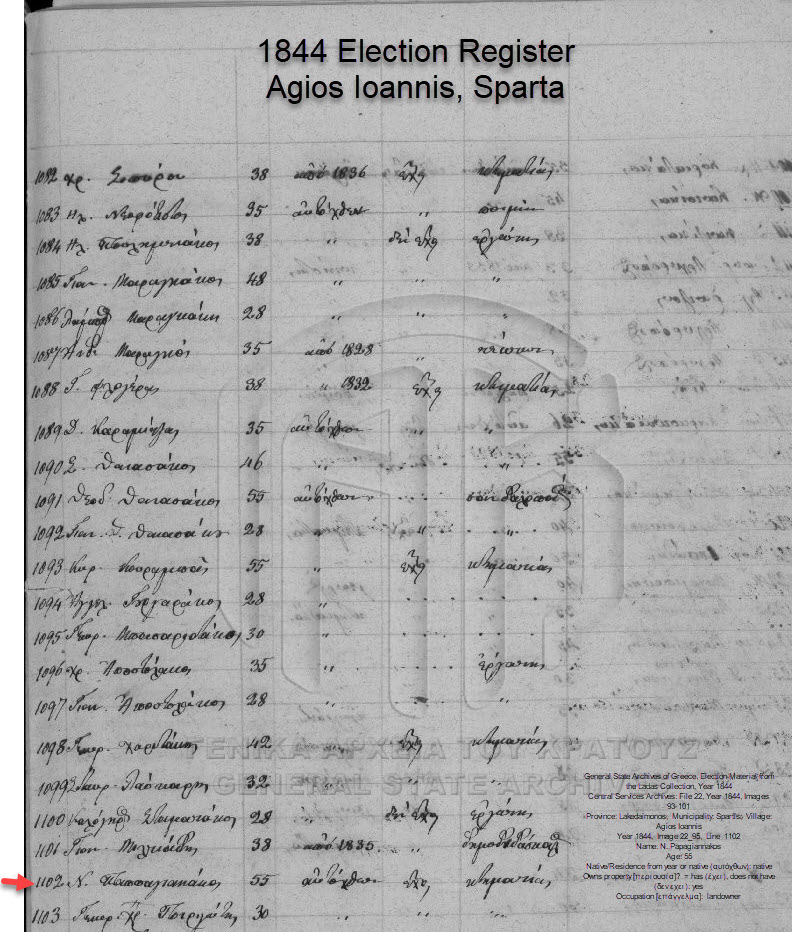
#1783 Nikolaos, born 1789 Source: 1844 Voter List: N. Papagiannakos, age 55, native, landowner
#862 Nikolaos born 1815; his son was Panagiotis Nikolaos GIANNAKOS (as given in Sparta marriage record) b 1841. Source: 1872 & 1873 Voter List
#2798 Nikolaos born bef 1820; son was Ioannis #2797, b 1845 Source: Estimated birth year as 25 years before birth of son in 1845
#2796 Nikolaos born bef 1812; son was Ioannis #2795, b 1837 in 1872 Voter list, age 28, Source: Estimated birth year as 25 years before birth of son in 1837
#2792 Nikolaos born bef 1810; son was Ioannis #2791 b 1835 in 1872 Voter List age 37, in 1873 Voter List age 38 Source: Estimated birth year as 25 years before birth of son in 1835
#348 Nikolaos Panagiotis, b. 1872; son: Panagiotis Source: 1898 marriage record; he was age 26
#104 Nikolaos Ioannis, born 1867 Source: Male Register: Year: 1867; Line 8: Papagianakos, Nikolaos; father: Ioannis; born 1867
That’s a total of 7 Nikolaos Papagiannakos’ in Agios Ioannis born between 1789-1867:
Only two have fathers identified: line 7 has Ioannis; line 6 has Panagiotis
Lines 3, 4, 5 have sons named Ioannis
Lines 2 & 6 have sons named Panagiotis
My research question: which Nikolaos is my great-great grandfather, was answered: it is line 2, Nikolaos born 1815.
But I got caught up in the records and kept going. I suspected a possible duplication of Ioannis #2797 & Ioannis #2795 in the 1872 & 1873 Voter Lists. Both have Nikolaos as their father; however, the ages were not one year apart. I wondered whether there was a clerical or typographical error in the ages as follows:
Ioannis #2795 , worker: in year 1872 he is age 35 BUT there no Ioannis age 36 in year 1873
Ioannis #2797, farmer: in year 1873 he is age 28 BUT there is no Ioannis age 27 in year 1872
Assuming these were the same person, then Ioannis Nikolaos Papagiannakos in 1872 was either 27 or 35, and in 1873 he was either 28 or 36.
A cousin in Agios Ioannis told me that there were two Papagiannakos families, but no one knew how they were related. I wondered if this was true, and the records proved that theory to be correct. As much as I wanted to sort out the two families, I simply could not do it. I was too invested in trying to “have it all make sense” and I doubted my ability to make correct assumptions. That’s when I asked Greg Kontos to help.
In one hour, he did what I was unable to do: examine the records with a critical eye in a dispassionate manner. He created a chart and allowed the data to reveal the answers:
Gregory Kontos of Greek Ancestry.net; March 14, 2022, page 1Gregory Kontos of Greek Ancestry.net; March 14, 2022, page 2
Greg came to these conclusions (see detailed analysis below):
The two Ioannis’ above (#2795 and 2797) were the same person; therefore, their fathers were the same Nikolaos.
Thus, the Nikolaos’ on lines 1-5 above were merged appropriately, giving us two Nikolaos Papagiannakos’ living in Agios Ioannis during that earlier period, both with sons named Ioannis:
1) Nikolaos, born 1789 and died by the time the 1872-73 Voter Lists were compiled (found in the 1844 Voter List, line 1102)
2) Nikolaos, born 1815 (found in the 1872 Voter List, line 1925)
Naming patterns raise the possibility that these Nikolaos’ had the same grandfather, Ioannis, but without documentation we cannot make that assertion.
The Nikolaos’ in lines 6 and 7 above were a later generation.
Through this experience, I learned:
Follow the records and carefully evaluate every piece of evidence
Remove emotion from your analysis!
It’s okay to make educated guesses and careful assumptions, but clearly label them as such
Know when it’s time to call in the experts, then do it!
Gregory Kontos, GreekAncestry: Analysis of Nikolaos & Ioannis Nikolaos Papagiannakos Names in Agios Ioannis in 1800’s; March 14, 2022
1844 & 1873/73 Voter List Records Show:
There are two Ioannis Papagiannakos’, sons of a Nikolaos, living in Agios Ioannis in 1872 and 1873 Voter Lists.
There were 2 Nikolaos Papagiannakos’ in Agios Ioannis, both with sons named Ioannis. One Nikolaos appears in the 1844 and the other in the 1872 Voter Lists.
In the 1872/3 Voter Lists, there was only one Nikolaos Papagiannakos (birth 1815 according to Voter List) currently living in Agios Ioannis and being eligible to vote. If there had been another Nikolaos Papagiannakos, he was either:
(1) dead by 1872; or
(2) born after 1851; meaning he was too young to be recorded in the 1872 Voter List, as a man had to be 21 years old to vote in 1872.
In the 1844 Voter List, 28 years earlier, there was only one Nikolaos Papagiannakos (born abt 1789) living then in Agios Ioannis and being eligible to vote. Since he does not appear in the 1873/3 Lists, we can assume he had died by then.
Conclusion: there were 2 Nikolaos Papagiannakos branches (not more).
The 1872 & 1873 Voter Lists have 2 Ioannis Nikolaos Papagiannakos’ of Agios Ioannis but there was a typographical error:
Ioannis #2795 , worker: Yr. 1872, image 431, line 1874 is age 35 BUT no Ioannis age 36 in Yr 1873
Ioannis #2797, farmer: Yr 1873, image 481, line 2061 is age 28 BUT no Ioannis age 27 in Yr 1872
Based on the information provided, we can assume that these two men were the same person. I merged these 2 into one, #2797, and amended birth year to: between 1837 and 1845.
Supposition: the 1844 Voter List Nikolaos, #1793, born abt 1789 and died before 1872 could be the father of Ioannis #2791, b. 1835, and Konstantinos #2799, b. 1838.
Supposition: the 1872-73 Voter List Nikolaos, #862, born about 1815 could be the father of Ioannis #2797, b. 1837; Panagiotis #9, b. 1841, and Panagiota #5511, b. 1853.
CONCLUSION:
The two Nikolaos Papagiannakos’ are:
1. Nikolaos #1793, born 1789 died by 1872/3 (the one in 1844 Voter List) 2. Nikolaos #862, born 1815 (the one in 1872 Voter List)
When not living through tumultuous times such as war and famine, my town (Agios Ioannis) was a close-knit, loving community where everyone cared about each other and their neighbours. There were many well educated families. There were doctors, army officers, and many Sparti government employees.
The town was full of children. The boys would go swimming at the river or on hot scorching days we would venture to a neighbour’s property in Agios Ioannis. The neighbour was Nikitaras Varvitsioti. He was a prosperous farmer who had a man-made pond full of water for irrigation purposes. We boys spent many days swimming and enjoying themselves there. My dad would usually go with his brothers or his friends. This wasn’t anything that the girls participated in.
I remember the town fondly.
Parents of Ioannis: Paraskevas Alevetsovitis and Vasiliki Kokkoros Alevetsovitis (standing) with Vasiliki’s mother, Politimi Porentas Alevetsovitis seated in front, 1930, Agios Ioannis
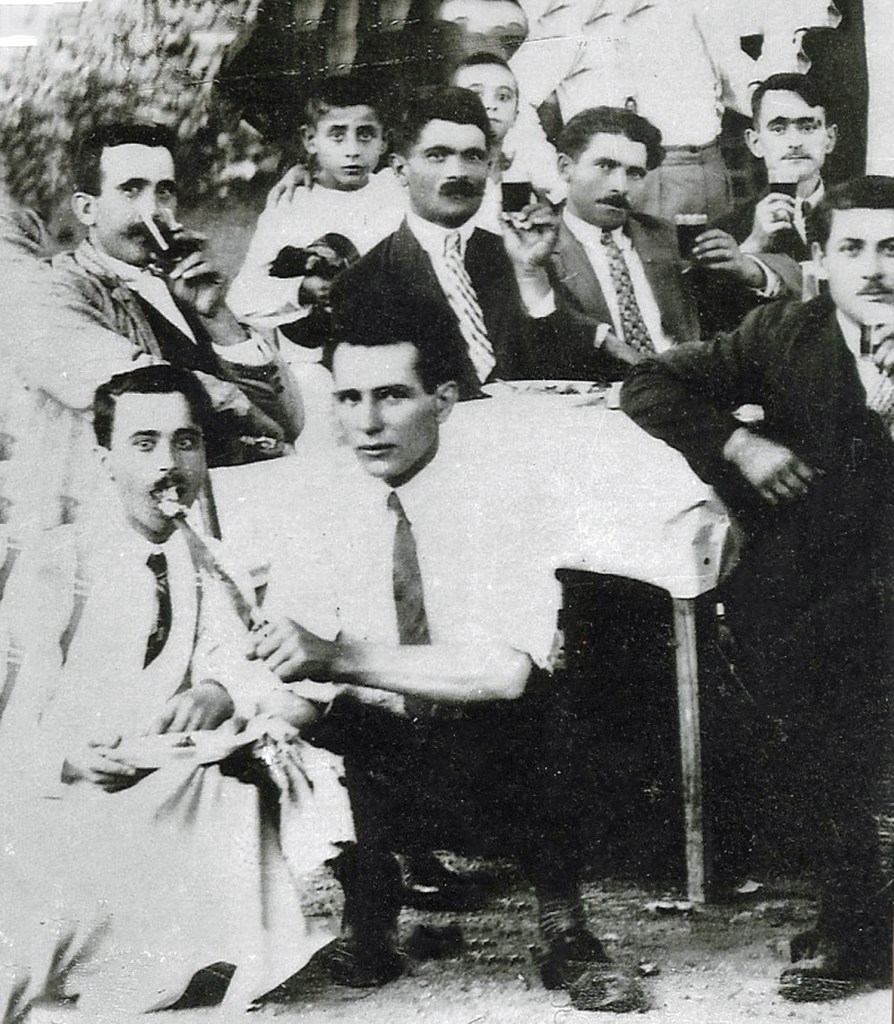
This photo is of the ” Horeftiko Sigkrotima to Agiou Ioannou “. They were an all male Agios Ioannis dance troupe that performed during that period at church functions, holidays and Panigyria. They were the community dance group, made up of young men in their late teens. Paraskevas Alevetsovitis (Ioannis’ father) is front and centre. About 1913 in Agios Ioannis.
Although Greece currently is, and has historically been, a Christian Orthodox country, Jewish and Muslim communities have existed within its borders for centuries. Scholars have written extensively about Greek conversions to Islam during the Ottoman occupation, but the same level of study has not been given to Muslims who converted to Christianity. Although not common, it did happen, especially during and after the Revolution of 1821.
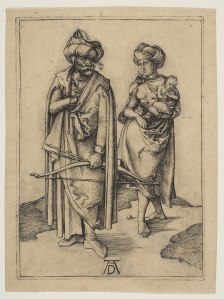
Turkish Family, circa 1500 Metropolitan Museum of Art, New York City
Why would a Muslim, living in a Greek village, voluntarily change religions? “Muslim converts to Christianity were ready to compromise their Islamic faith in exchange for security, social status, and well-being in the changed political and social environment created by Greek nationalism, with a view to advancing their professional opportunities and material interests in the new state.”[1]
Abandoning their faith and adopting a new identity, some converts retained their names; others either took the name, or were given the nickname, of Neofotistos (Νεοφώτιστος), loosely translated as “new light.” Converts, particularly females, who were ostracized by their families found safety through conversion and marriage, and easily assimilated into village life.
In his essay, Neophotisti and Apostates: Greece and Conversion in the Nineteenth Century,[2] Evdoxios Doxiadis, through his study of notarial and court records, found that “their [Muslim converts] numbers may have been more significant than previously thought.” He writes, “although the evidence presented here is sporadic, it is also indicative of a noteworthy presence of converts, and especially female converts, in the early decades of the modern Greek state and their integration into Greek society as wives and property owners.”
In 2014, historian Giannis Michalakakos gave me a copy of the Periodical Study of the Society of Lakonian Studies, Volume 9. Comprised of essays and documents retrieved from the Venetian Archives (Archivio di Stato), it includes a “list of Turks who became Christians, with their women and children, who are inhabitants of the respective places of the province of Mystras.”[3] The document is dated 1689, and the statistical information was obtained during the Second Venetian rule in the Peloponnese. The villages listed in the document are: Mystras, Agios Ioannis Sparta, Sklavochori, Arkasa, Lopesi, Floka, Kastri and Voaria.
In my ancestral village of Agios Ioannis Sparta, the following converts from Islam to Christianity are named:
Theodoris Bettiafaci, age 40 years Giannoula, his wife Panagiota, his daughter Giannoula, his other daughter
Ilias Papoutsis, age 45 years Kanella, his wife Panagiota, his daughter, age 18 years
Ilias Papoutsis, age 45 years Kanella, his wife Panagiota, his daughter, age 18 years Nikolaos, his son, age 11 years
Panagiotis Zalamachera, age 32 years Panoria, his wife Baroloni, his son
Ilias Chortatzis, age 20 years Pagona, his wife Panagiotis, his son
Giannis Krevelis, age 30 years Pagona, his wife Garoufalia, his daughter Panagiota, his other daughter
Giannis Tsakalis, age 45 years Maroula, his wife Kontylo, his daughter
Dimitrios Karas, age 40 years Panagiota, his wife
Panagiotis Vlachakis, age 28 years Venetia, his wife
Giannakis Staveris, age 32 years Paraskevi, his wife Giorgios, his adopted son
Panagiotis Thereianos, age 39 years Panoria, his wife Maria, his daughter Venetsiana, his sister Giannis, his son Dimitrios, his other son The female, Kanella Achmetitsa Dominikos, her son The female, Maroulla Paina The female, Maroula Koutsevaina The female, Maria Katanaina
Widow Magio (Maro) Karamenmetaina Nikolaos, her son
Alexandros Mpanamakis, age 25 years Chrysafo, his wife
Giorgios Kazakis, age 30 years Isabeta, his wife
The majority of these surnames are Greek, leading me to wonder if the Muslim convert was the wife who took a Greek given name after marriage. Unfortunately, the document does not provide further details. I find it interesting that none of the names are “Neofotistos;” however, I have found that name many times in the Μιτρόον Αρρένον (Male Register) and Δημοτολόγιον Κοινότητος (Dimotologion Koinotitos) documents from the Archives of Sparta, which were created in the mid-late 1800s.
“The idea that Greece emerged [from the Revolution] as a solidly homogenous Christian state is rarely challenged,” Doxiadis concludes.[4] Yet the records prove that a rich kaleidoscope of ethnicities have melded over the centuries to forge the modern Greek people of today.
[1] Katsikas, Stefanos and Dimitriadis, Sakis, *Muslim Converts to Orthodox Christianity during the Greek War of Independence, 1821–1832,” European History Quarterly, Vol 51, Issue 3, 2021, page(s): 299-323. SAGE Publications: 07/01/2021. https://journals.sagepub.com/doi/full/10.1177/02656914211025378
[2] Doxiadis, E. (2022). Neophotistoi and Apostates: Greece and Conversion in the Nineteenth Century. Historein, 20(1). https://doi.org/10.12681/historein.24980. paragraphs 16 and 19.
[3] Lakonian Studies, Periodical Study of the Society of Lakonian Studies, Volume 9, page 272. Athens: 1988. Mystras, 20 September 1689, Document Number 21








 Spartan Roots (Σπαρτιατικές Ρίζες)