Once a year on August 15–and only on that day–the doors of the historic church of Agios Ioannis, Sparta, Koimisi tis Theotokou, are opened to commemorate the Dormition of Theotokos. Second only to Easter in the Orthodox Church, this national and religious holiday is a time of joy, not mourning, as it marks the “falling asleep” and taking into heaven of Mary, the mother of Jesus Christ.1
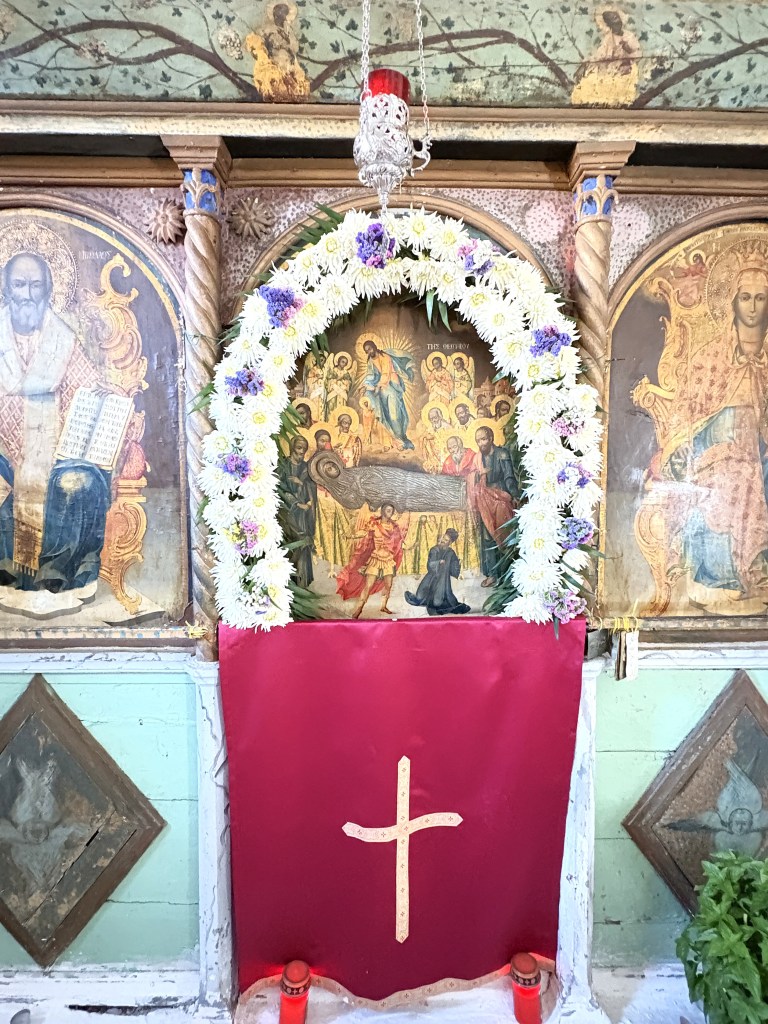
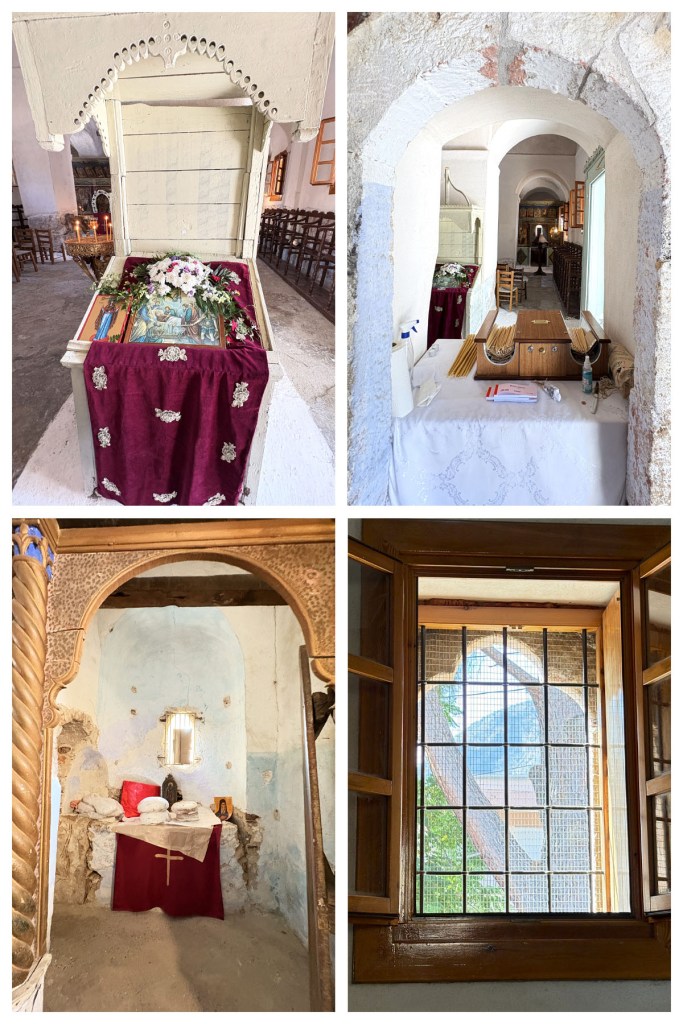
Icon depicting the Dormition of Theotokou. Note the flowers around the perimeter, the red cloth indicating it is the focus of the service, and the candles on the floor.
Known as Dekapentavgoustos (the literal translation is 15 of August), priests conclude two weeks of fasting by conducting a special service. In churches that are named Koimisi tis Theotokou (or Church of the Assumption), the liturgy is conducted there which makes this worship especially meaningful.
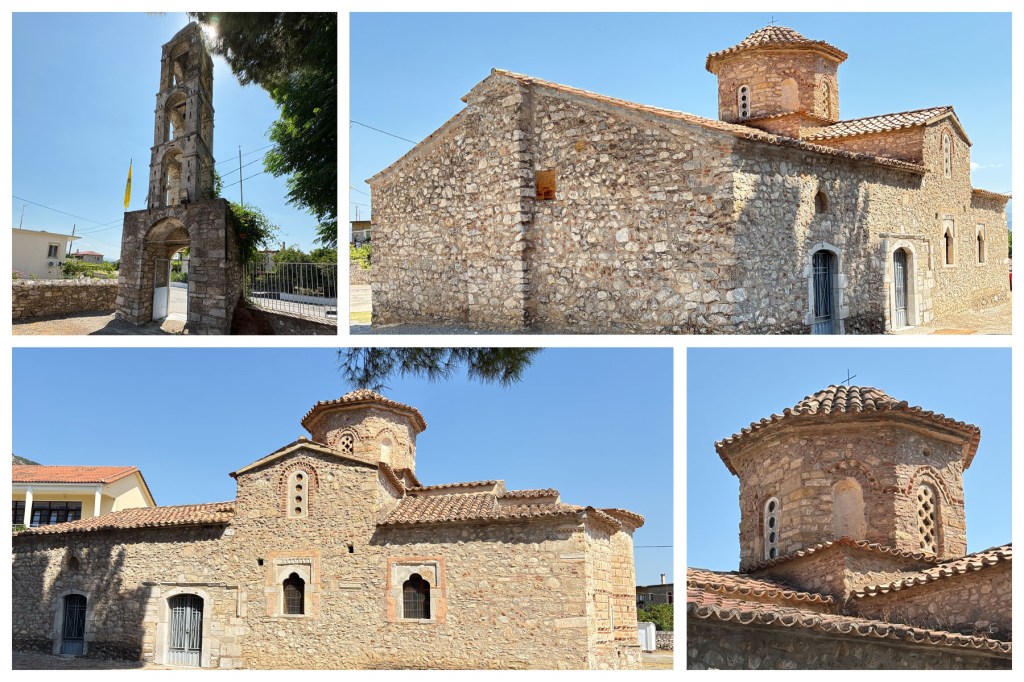
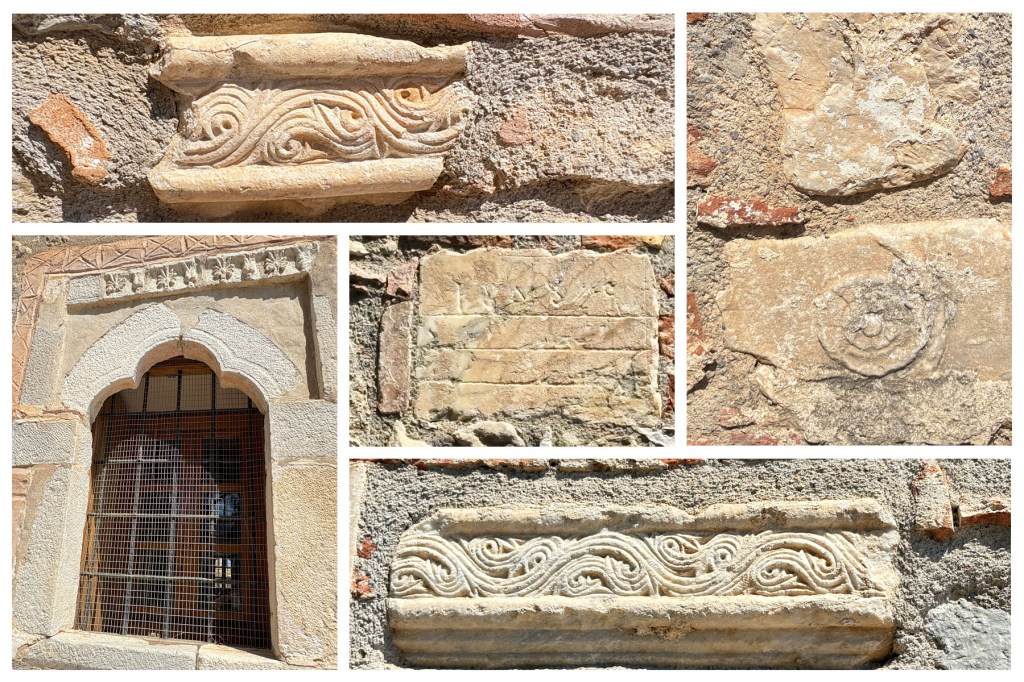
Koimisi tis Theotokou of Agios Ioannis with bell tower (upper left)Note the ancient stones and pillar fragments that were incorporated into the exterior stonework of the church. The small frieze over the window was carefully placed to accentuate its opening.
Marriage and baptism records prove that Koimsis tis Theotokou was the early church of our village, hosting joyous celebrations of life and sorrowful goodbys. It was the center of our ancestors’ world. For many years, I desired to see the inside of this church in Agios Ioannis. This year, that wish came true.
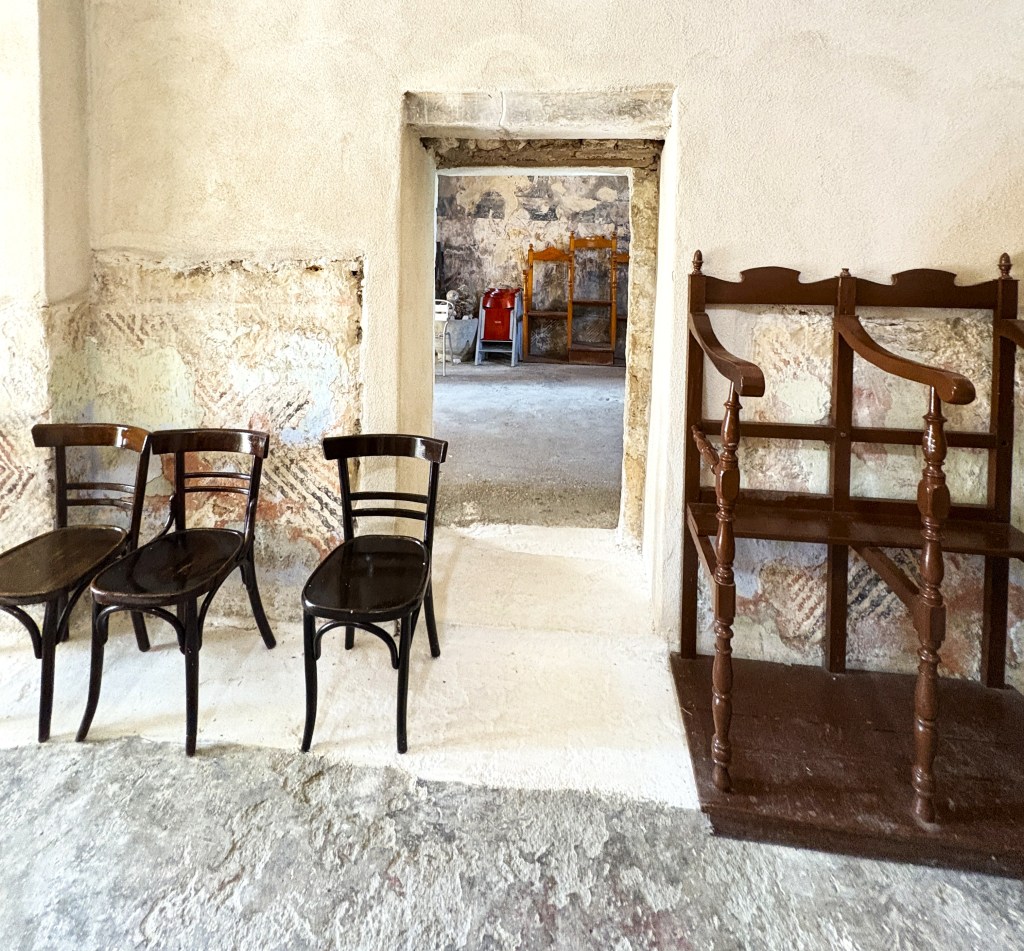
Interior with its whitewashed walls
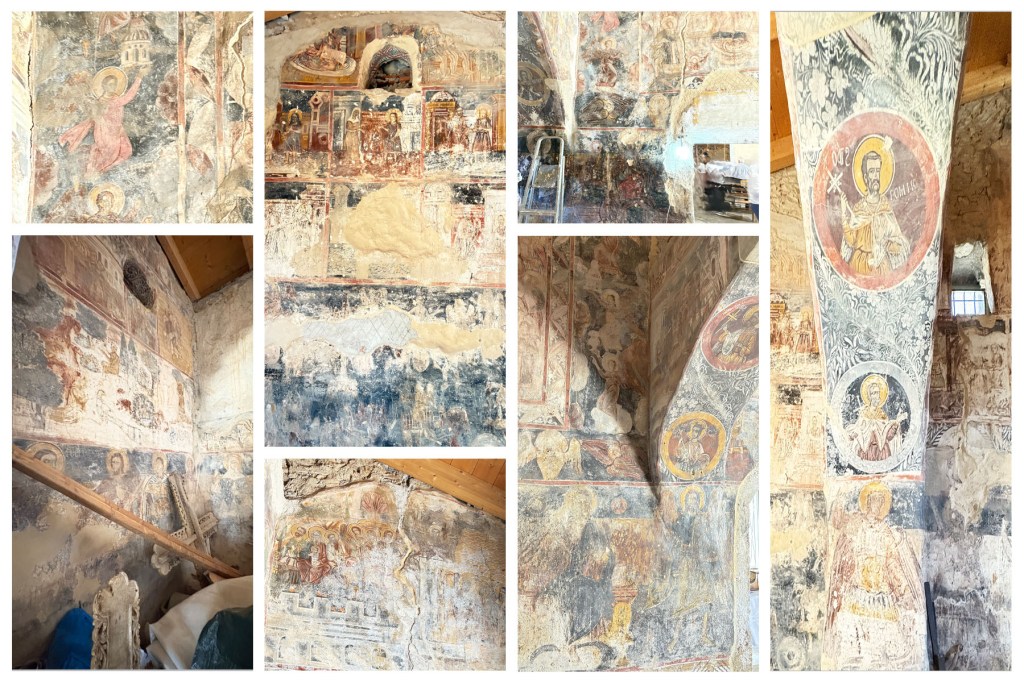
My family had told me that many years ago, the inside of the church was whitewashed, thus covering the historic frescoes. However, a small antechamber at the back remained untouched which enabled us to see the types of images that had once adorned the walls of the church.
Looking into the antechamber with its frescoes from the main hall of the church
It is my hope that these photos will enable you to picture your predecessors gathering for Sunday liturgies and rites of passage. There was a distinctive spirit present as I gratefully celebrated this special holiday in this special church.
Looking into the church from the antechamber
Although the interior walls are whitewashed, the iconostasis retains its spectacular icons which serve as the focal point of the interior.
IconostasisThe icons across the topCloser view of the larger iconsViews of the interior
Looking from the church into the antechamber at the back, we see the frescoes that remained untouched.
Looking into the antechamberThe amazing and historic frescoes in the antechamber
For those of you who may not be able to go to a Byzantine church in Greece for an August 15 holiday, I hope these photos will enable you to feel the essence of this holy house.
The concept of “chain migration” was firmly established during the great wave of immigration in the early 1900s. In a post which I wrote for the website of my village, Agios Ioannis, Sparta, many villagers traveled together on the S.S. Themistokles from Piraeus to Ellis Island.
Among the emigrants were my paternal grandmother, Harikleia Arida. Please read the post here.
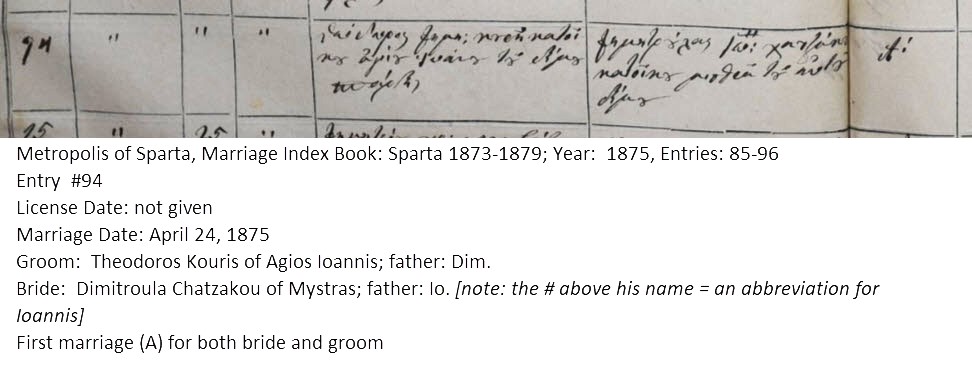
The church marriage record was clear: Theodoros Dimitrios Kouris married Dimitroula Chatzakou, daughter of Ioannis, first marriage for both, on April 24, 1875:
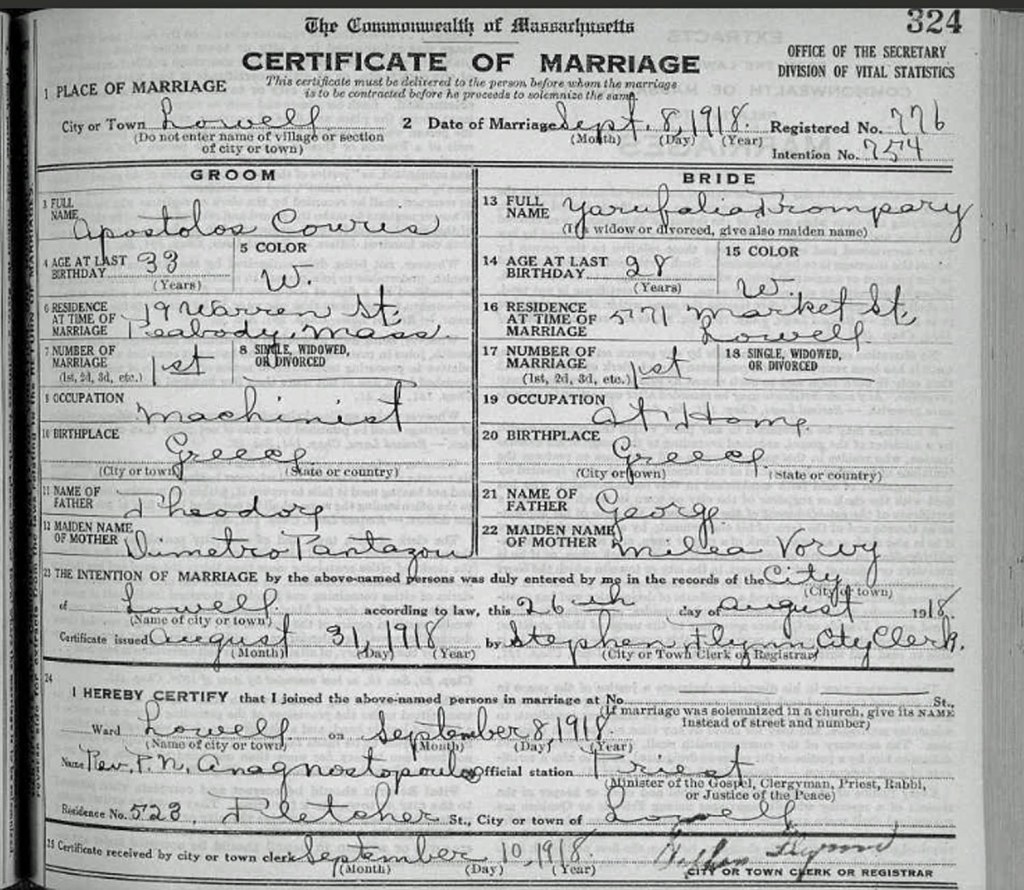
Finding this record [1] for one of my Agios Ioannis families meant that I now had the name of Theodoros’ wife and the mother of his children. Everything seemed to line up: the wedding was in 1875 and the first child was born in October 1878, although the birth (if it was a first birth) was a tad late for that time period. I entered the information in my database and to online trees at FamilySearch, Ancestry and MyHeritage. Almost immediately, hints for records in Massachusetts popped up for the children. Not unusual – many families immigrated to America in the early 1900s. I checked one of the hints, a marriage record for son Apostolos, and noted with curiosity that his mother’s name was written not as Chatzakou, but as Pantazou.
Well, the two surnames sort of sound alike. I wondered if this was a clerical error (misunderstood the name?) or a mistake on the part of the child (some are unsure of their mother’s maiden name!).
Checking further, I saw that the Pantazou surname in U.S. records was found for other children in the family. Clearly, there was a disconnect somewhere.
Because this family is not related to me, I was not planning to research this line further. (My goal is to get the Greek records online so that descendants can make the leap from the U.S. to Greece). But I felt it was important to alert other researchers to the discrepancy, so I added this note in the profiles for both Theodoros and Dimitroula: Dimitroula’s surname, according to her Sparta marriage record, is Chatzakou. However, there are records in the U.S. giving her surname as Pantazou. Either there are two Theodoros Kouris’ in Massachusetts — one married to Chatzakou and one to Pantazou, OR her surname changed in the U.S.
Before moving on to extract another family name from Agios Ioannis records, I did make one additional entry for Theodoros: I marked him as deceased and in the place field, I put “Of Massachusetts, United States.” The word “of” signifies that this was a guess, as I did not have proof of the fact.
This entry proved to be a mistake for me and a red flag for Theodoros’ geat-granddaughter , Niki, who had been researching her family and found my note in an online tree. In an email to me, she wrote:
I want to clarify another piece that you aren’t aware of. Theodore never came to the US. His wife and all of their children came around 1909….except for Nikoletta, who stayed back to care for her father, Theodore, who was blind, and unable to travel at that time. In 1920, Dimitroula returned to Agios Ioannis and planned to travel with Theodore and Nikoletta back to Boston, to join the rest of the family…However, Theodore died unexpectedly, very shortly before they were scheduled to sail. Dimitroula and Nikoletta came without him, in the summer of 1920. The ship record shows only their two names. So you might want to modify your note about Dimitroula’s surname discrepancy since Theodore was never in the United States.
Oh my! Grateful for this clarification, I quickly corrected Theodoros’ death place to Agios Ioannis.
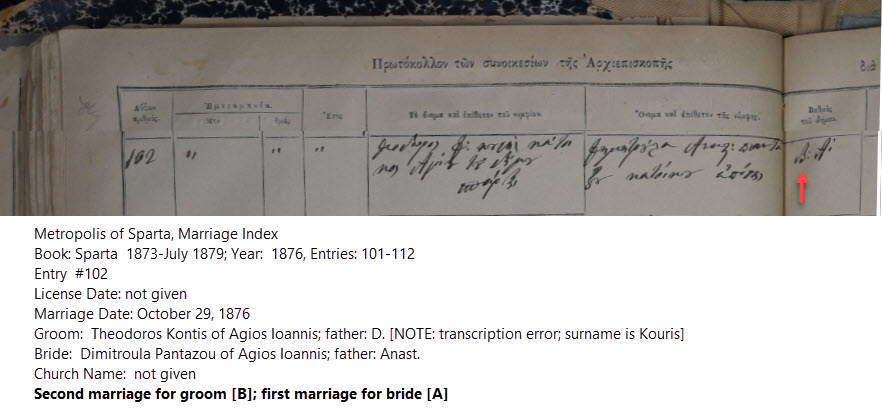
Niki had initially contacted me a few weeks ago when she found the marriage for Theodoros and Dimitroula Chatzakou online at MyHeritage[1]. She knew her great-grandmother was Dimitroula Pantazos, and the record naming Chatzakou was mystifying. Looking further and searching on “Pantazos,” she found and then sent me another marriage record which was indexed as: Theodoros D. Kontis and Dimitroula Pantazos, daughter of Anast., married October 29, 1876. She commented: “Could it be that the handwritten record from 1876 was translated incorrectly, into Kontis instead of Kouris?”
We outlined the issues:
The handwritten Greek in both marriage records was too scribbly for either of us to clarify whether the name was Kouris or Kontis.
This second marriage record shows it was Theodoros’ second marriage [B] and Dimitroula Pantazou’s first marriage [A].
Their marriage occurred in October 1876, exactly 18 months after Theodoros’ marriage in April 1875.
If this record was indeed for Theodoros Kouris, then his first wife [Chatzakou] would have died shortly after marriage [perhaps in childbirth?].
With Georgios born in October 1878, he and his siblings would be the children of Theodoros’ second wife, Pantazou–making the 1878, exactly two years aftermarriage, birth more realistic for the times.
Clearly, the answer lay in the clarification of Theodoros’ surname. A quick message to Gregory Kontos at GreekAncestry resolved the mystery: both marriage records were for Theodoros Kouris; the second record was transcribed incorrectly.
A few points to consider from this case study:
NEVER trust a name index!
ALWAYS review the original record. If it’s in Greek and unreadable to you, someone else can help. Upload to the Hellenic Genealogy Geek Facebook page or send to Greg Kontos at GreekAncestry.
Search a variety of records to verify information. In this situation, looking at U.S. records for several of Theodoros’ children revealed the same mother’s name. This raised the chances that the children were correct, and the possibility that there was either an error in the marriage record or a second marriage for Theodore.
Document facts that don’t correlate, and make sure those notes are attached to each individual that is affected.
If you are making an assumption, state what the assumption is and why you are making it. I did not do this for Theodoros’ death place when I listed it as Massachusetts.
Theodoros had two wives with the same first name, which caused incorrect assumptions. The children’s baptismal records in the village church book gave their mother’s name as only Dimitroula (no surname) which caused me to assume that the Chatzakou record was correct.
Niki kept looking for information and changed her search terms to “Pantazos” which led her to finding her great-grandparents’ marriage record and the incorrect transcription of Theodoros’ surname. If she had not kept looking, the mystery would have remained.
Just because “this is the way it was” don’t assume that is true in your situation. I assumed that Theodoros had come to the U.S. with (or before) his children, which was the pattern for Greek men at the turn of the century. In this case, that was not the case. The mother came with the children, and the father remained in the village–a complete reversal of the norm.
Family of Theodoros Kouris and Dimitroula Pantazou, about 1902 Anna, Theodoros, possibly Anastasios (standing), Nikoletta, Dimitroula Pantazou, possibly Harry
The transient nature of rural Spartans in the mid-late 1800s is widely understood. After the Revolution of 1821, people “came down from the mountains” where they had been hiding to start new lives in a more hospitable climate and in a more verdant and productive agricultural area. (This fascinating topic is addressed in this post.) Some immediately found what they were seeking and put down roots. Others may have stayed for a while, then moved on.
Agios Ioannis, Sparta, is blessed with soil and weather that produce bounteous harvests of citrus, olives and vegetables. In the mid-1800s, numerous families who had lived in rustic settlements and small villages high in the Taygetos Mountains moved to the valley below. Many settled in Agios Ioannis.
The 1844 and 1872 Election Registers are among the earliest records created by the modern Greek state. They provides names of men eligible to vote in elections–an important privilege in the newly created country. In the 1840’s, a man had to be age 25 and older to vote; by 1870, the age dropped to 21.
I have entered the names of all men, from both the 1844 and 1872 registers, into the Spartan Roots Family Tree, accessible here. While a majority of those names can be found in later records of Agios Ioannis, almost 90 cannot. What happened to these men? Did they relocate to other villages? Change their names or adopt a nickname (paratsoukli)? Die without descendants?
I have compiled a list of these “one and only” names for two reasons: 1. These men were definitely residents of the village and should be remembered. 2. To learn if any of these names had been altered or modified; if so, what is the current name and does the family still live in Agios Ioannis or a surrounding village? I would so appreciate receiving any information by email about these families.
Voter List
Line#
Surname EN
Name EN
Surname GR
Age
1844
1219
Aivaliotis
N.
Αϊβαλιώτης, Ν.
40
1844
1141
Alexakis
Giannakis
Αλεξάκης, Γιαννάκης
25
1872
2015
Athanasakos
Spyr
Σπυρ Αθανασάκος
67
1872
1677
Balkanas
Aggel
Αγγελ Μπαλκανας
37
1844
1065
Banakos
Geor.
Μπανάκος, Γεωρ.
32
1872
1721
Banopoulos
Geor
Γεωρ Μπανόπουλος
62
1872
1966
Bantavas
Petr
Πέτρ Μπανταβας
57
1844
1095
Basaridakos
Geor.
Μπασαριδάκος, Γεωρ.
30
1844
1244
Batavas
D.
Μπαταβάς, Δ.
46
1872
2021
Bikrakos
Sarant
Σαραντ Μπ?κράκος
57
1844
1256
Bouzantakis
Anas.
Μπουζαντάκης, Ανασ.
30
1872
1806
Brakoulas
Dim
Δημ Μπράκουλας
34
1872
1816
Chantzipetrakos
Emm Tzanetos
Εμμ Χαντζηπετράκος
32
1872
2017
Christou
Spyr
Σπυρ Χρήστου
35
1872
1992
Diakakos
Panos Nikolaos
Πάνος Διακάκος
35
1844
1193
Ekklisiastikos
P.
Εκκλησιαστικός, Π.
70
1844
1258
Feggaras
Io.
Φεγγαράς, Ιω.
58
1844
1217
Fotakos
Kyr.
Φωτάκος, Κυρ.
50
1844
1119
Georgarakos
Str.
Γεωργαράκος, Στρ.
32
1844/1872
1246/1934
Giannias / Giannios
Nikol
Νικολ Γιαννιας
67/45
1872
1750
Giannouris
Geor
Γεωρ Γιαννούρης
28
1872
1839
Glitzos
Theod
Θεοδ Γλιτζός
51
1844
1094
Gourgarakos
Angel.
Γουργαράκος, Αγγελ.
28
1844
1218
Grilitos
D.
Γριλιτός, Δ.
40
1844
1252
Ioannou
Sp.
Ιωάννου, Σπ.
35
1844/1872
1089/1770
Karamitzas
D.
Καραμίτζας,
35/46
1844
1139
Katergarakos
P.
Κατεργαράκος, Π.
26
1844
1259
Kerasiotis
D.
Κερασιώτης, Δ.
27
1844
1255
Koliopoulos
Char.
Κολιόπουλος, Χαρ.
38
1872
1699
Konstantinou
Vasil
Βασιλ Κωνσταντίνου
33
1844
1247
Kontogeorgogamvros
N.
Κοντογεωργόγαμβρος, Ν.
38
1844
1132
Kosmakos
Anag.
Κοσμάκος, Αναγ.
60
1872
1910
Kotstantakos
Konst
Κωνστ Κωτσταντάκος
28
1844
4291
Kourampas
Kyr.
Κουραμπάς, Κυρ.
55
1872
1880
Kourkoulis
Ioan
Ιωαν Κουρκούλης
34
1844
1074
Koutoupis
Chr.
Κουτούπης, Χρ.
38
1844
1063
Krekakos
Kyr.
Κρεκάκος, Κυρ.
35
1844
1116
Kris
Antonios
Κρης, Αντώνιος
25
1872
1946
Lagkas
Nikol Dimitrios
Νικολ Λάγκας
30
1844
1188
Langitzos
Geor.
Λαγγίτζος, Γεωρ.
32
1844
1054
Leonardou
Pan.
Λεωνάρδου, Παν.
53
1872
1701
Liakeas
Vasil Stavros
Βασιλ Λιακέας
47
1844
1159
Limperakos
D.
Λιμπεράκος, Δ.
30
1844
11221
Loumakos
M.
Λουμάκος, Μ.
65
1872
1900
Magkanopoulos
Konst
Κωνστ Μαγκανόπουλος
52
1844
1233
Makrakis
S.
Μακράκης, Σ.
33
1872
1688
Makrakos
Anast
Αναστ Μακράκος
31
1872
1893
Mamis
Kyriak
Κυριακ Μαμης
57
1844
1073
Manolakos
Dim.
Μανολάκος, Δημ.
50
1844
1061
Markakos
Theod.
Μαρκάκος, Θεοδ.
28
1872
1916
Mavrikiotis
Leonidas
Λεωνιδας Μαυρικιωτης
37
1844
1171
Mavrikiotis
P.
Μαυρικιώτης, Π.
28
1844/1872
1101/1863
Miltiadis
Gian./Ioan.
Μιλτιάδης, Γιαν.
38/57
1872
1696
Mytilinaios
Anton
Αντων Μητηλιναιος
47
1872
1731
Mourampas
Geor
Γεωρ Μουραμπας
37
1844
1240
Mylonakos
K.
Μυλωνάκος, Κ.
35
1872
1753
Nanes
Geor
Γεωρ Νανές
25
1872
1884
Nikitopoulos
Ioan
Ιωαν Νικητόπουλος
27
1844/1872
1081/1909
Palestras/Palaistras
Konst
Κωνστ Παλαίστρας
32/56
1872
2035
Pinelis
Christos
Χρηστος Πινελης
47
1844
1226
Poulakos
Anast.
Πουλάκος, Αναστ.
45
1872
1902
Psarakos
Konst
Κωνστ Ψαράκος
42
1844
1113
Ratzous
Ang.
Ρατζους, Αγγ.
32
1872
1757
Rousakis
Geor
Γεωρ Ρουσάκης
35
1872
2024
Sakellariou
Spyr
Σπυρ Σακελλαρίου
57
1872
1898
Sambroulakos
Kalog
Καλογ Σαμπρουλάκος
57
1844
1185
Sgatzikos
Dim.
Σγατζίκος, Δημ.
38
1844
1236
Skouzakos
P.
Σκουζάκος, Π.
36
1872
1970
Sougleris
Panag
Παναγ Σούγλερης
42
1844
1257
Spyliotakis
Σ. A.
Σπυλιωτάκης, Σ. Α.
35
1844
1237
Stathakos OR Stratakos
Kyr.
Σταθάκος, Κυρ.
45
1872
1883
Stathopoulos or Loum.
Io.
Ιω. Σταθόπουλος η Λουμ.
65
1844
1169
Stefanakos
Grigoris
Στεφανάκος, Γλ.
40
1872
1812
Stoatakos or Vasileiou
D.
Δ. Στοατάκος η Βασιλείου
35
1844
1076
Stratigogamvros
Chr.
Στρατηγόγαμβρος, Χρ.
28
1872
1994
Trakogamvros or Sacham
P.
Π. Τρακόγαμβρος η Σαχάμ
32
1844
1241
Tratis
Dim.
Τρατής, Δημ.
56
1844
1211
Triantafylakos
P.
Τριανταφυλάκος, Π.
35
1844
1184
Trimountzos
G.
Τριμούντζος, Γ.
40
1844
1243
Tsagkakis
D.
Τσαγκάκης, Δ.
40
1872
1853
Tzakamankas
Theod
Θεοδ Τζακαμάγκας
36
1844
1138
Valiotis
M.
Βαλιότης, Μ.
50
1844
1118
Varouchas
D.
Βάρουχας, Δ.
55
1872
1892
Vasileiou
Konst
Κωνστ Βασιλείου
37
1844
1148
Vourgarakos
P.
Βουργαράκος, Π.
28
1872
1922
Xilopodis
Michail
Μιχαήλ Ξηλοπόδης
37
Chart created from 1844 and 1872 Election Registers for Agios Ioannis, Sparta
Update: I received some comments about this post:
Aivaliotis is definitely a name found on Ikaria. If they came down from the mountains it is likely that many travelled further afield.
Valiotis is a different surname (from Aivaliotis).
There is another reason why they would have disappeared from the voting register, although the constitution of 1844 was the most liberal in the world regarding voting rights, there were still stipulations regarding ownership of property, or moneys or being in independent employment, so in those difficult times it wouldn’t have been very difficult for someone to “fall off” the qualifying requirements.
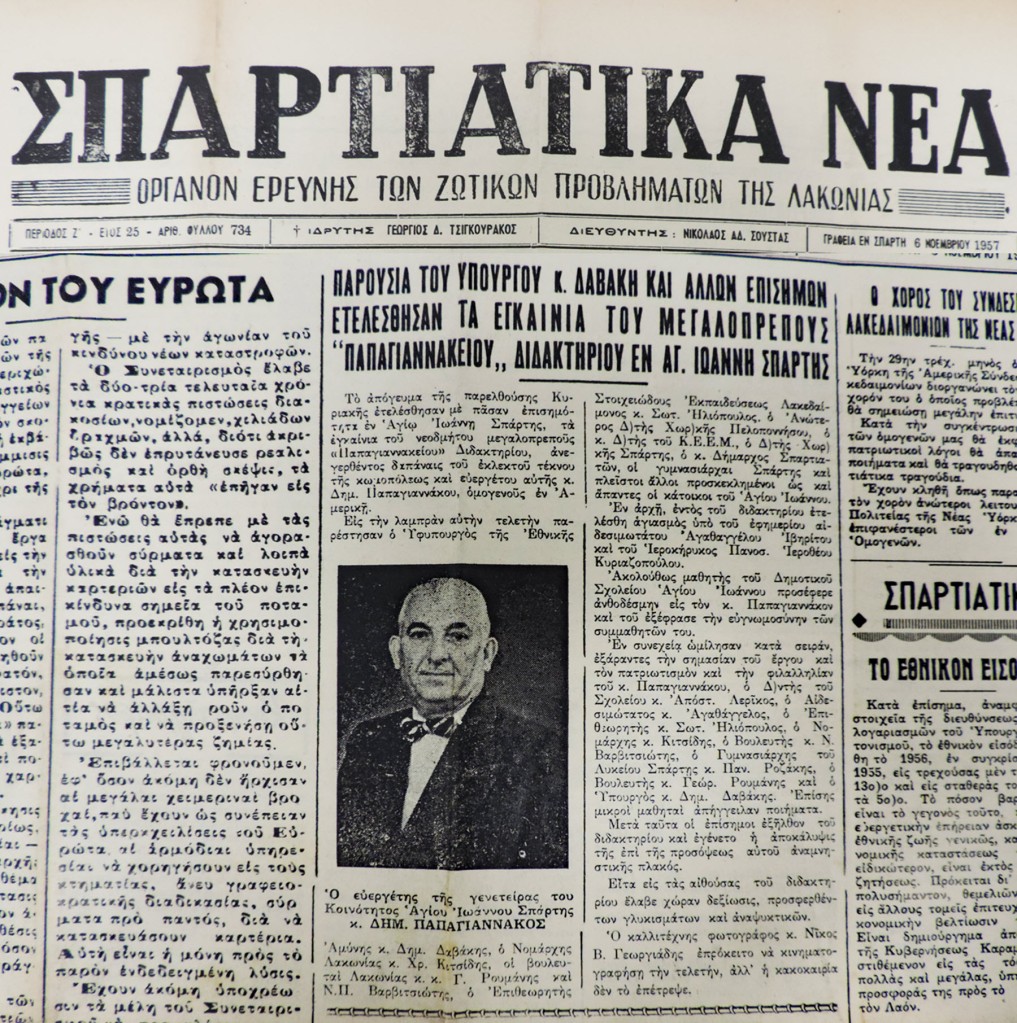
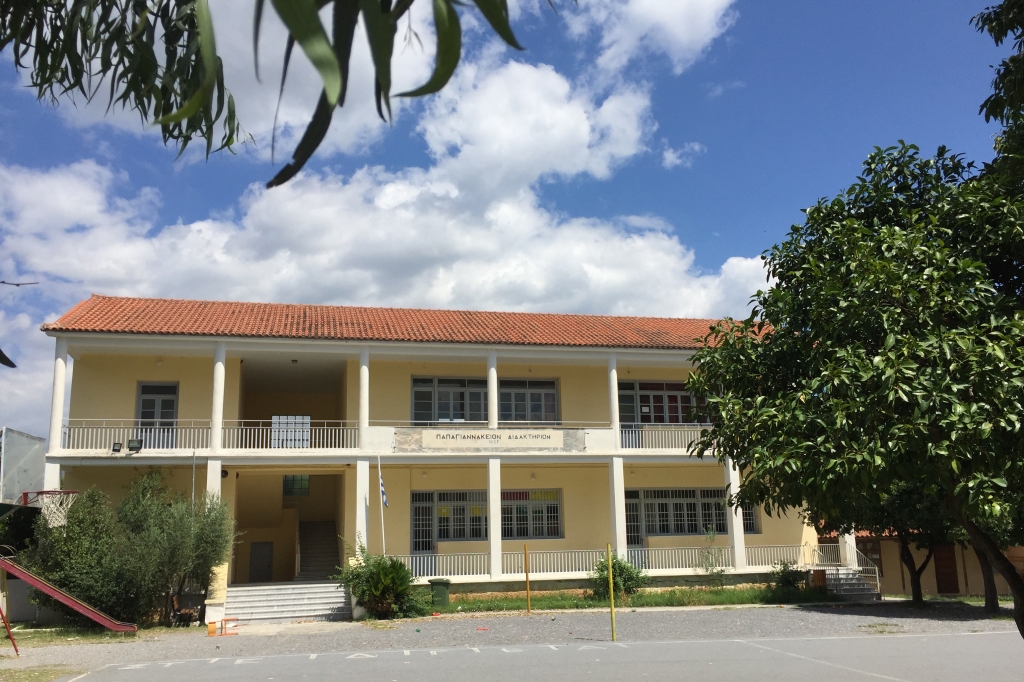
IN THE PRESENCE OF THE MINISTER MR. DAVAKIS AND OTHER DIGNITARIES, THE INAUGURATION OF THE MAGNIFICENT PAPAGIANNAKOU SCHOOL IN AGIOS IOANNIS SPARTIS WAS HELD
(Thank you to Panorea Kostakou of Agios Ioannis, who found this newspaper article)
(Online translation by Carol Kostakos Petranek. Please excuse errors)
On the afternoon of last Sunday the inauguration of the newly built magnificent Papagiannakos School was solemnly held in Agios Ioannis of Sparta, erected with the help of the chosen son of the town and benefactor Mr. Dim. Papagiannakos, an expatriate in America.
In attendance at this glorious ceremony were the Minister of National Defense Mr. Dim. Davakis, the Governor of Laconia Mr. Chr. Kitsidis, councilmen of Lakonia Messrs. G. Roumanis and N.P. Varvitsiotis, the Inspector of Elementary Education of Lacedaemon Mr. Sot. Iliopoulos, the Senior Director of the Peloponnese, the Director of the K.E.E.M., the Director of Sparta, the Mayor of Sparta, the high school students of Sparta and many other guests as well as the residents of Agios Ioannis.
At the beginning, holy water was administered inside the school by the Reverend Agathaggelou Ivyritou and the priest Panos. Ierotheou Kyriazopoulou.
Subsequently, a student of the Agios Ioannis Primary School offered a bouquet of flowers to Mr. Papagiannakos and expressed the gratitude of his classmates.
Then they spoke in turn, extolling the importance of the work and the patriotism and philanthropy of Mr. Papagiannakos. Afterwards, the Principal of the School, Mr. Apost. Lerikos, the Reverend Mr. Agathaggelos, the Inspector Mr. Sot. Iliopoulos, the Prefect Mr. Kitsidis, the Member of Parliament Mr. N. Varvitsiotis, the Head of the Spartan High School Mr. Pan. Rozakis, the Member of Parliament Mr. Ger. Roumanis and the Minister, Mr. Dim Davakis. Also young students recited poems.
After this the officials left the school and the unveiling of the commemorative plaque on the façade of the church took place.
Then a banquet took place in the halls of the school, with sweets and refreshments being offered.
The artist photographer Mr. Nikos V. Georgiadis was going to film the ceremony, but the bad weather did not allow it.
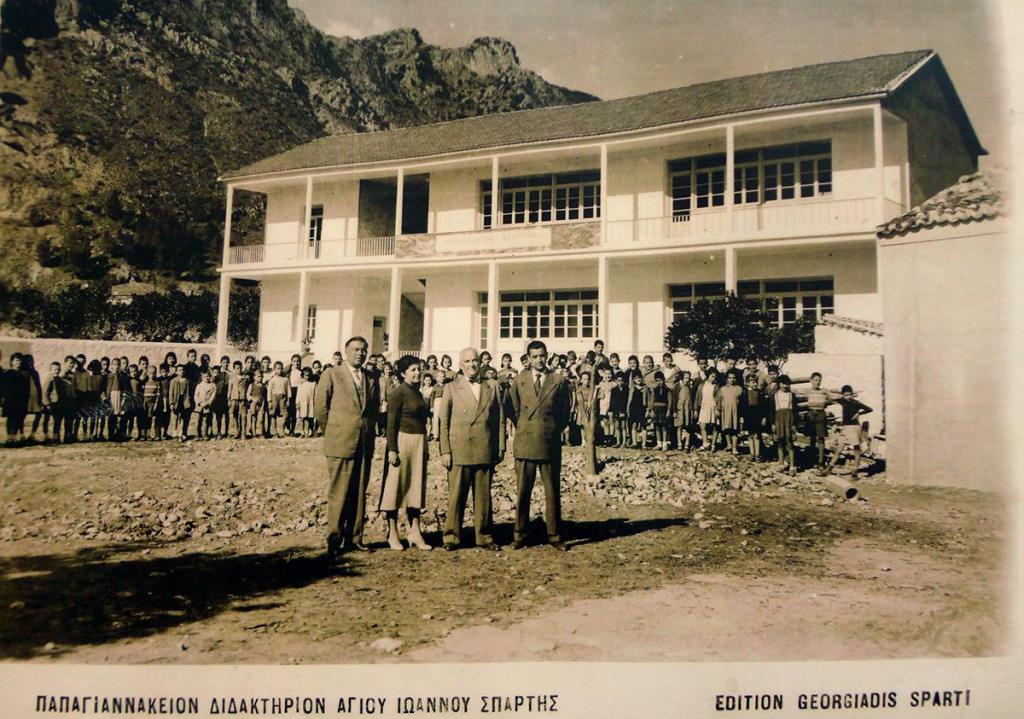
Postcard of Dedication of the Papagiannakos School; received from Tasos PapagiannakosThe Papagiannakos School, 2023







 Spartan Roots (Σπαρτιατικές Ρίζες)