Unknown's avatar

About Spartan Roots

I am of Greek ancestry with roots in villages near Sparta. My paternal grandparents and maternal grandfather were born in Agios Ioannis (St. Johns), and my maternal grandmother was born in Mystras. I love family history research and have been tracing my roots for many years. I was born in Brooklyn, New York and was raised in a predominantly Greek neighborhood close to extended family. I live in the Washington D.C. metropolitan area and work as a volunteer Co-Director of the Washington, D.C. Family History Center and a genealogy aide/project aide at the National Archives in Washington, D.C. I am always updating and adding new information. Please contact me - I would love to hear from you!

Kostas – Kostakos: Is This My Family?

Many years ago, my aunt Areti Kostakos Lambrinos said that my great-grandfather, Andreas Kostakos, came to Agios Ioannis (a village near Sparta) “from Pyrgos, over the mountains.” That comment sent me on a hunt for records in the Pyrgos area.

I was excited when a historian and friend in southern Peloponnese sent me a map showing a trail from Pyrgos to Sparta. The Taygetus mountains are steep, treacherous and almost impassable!
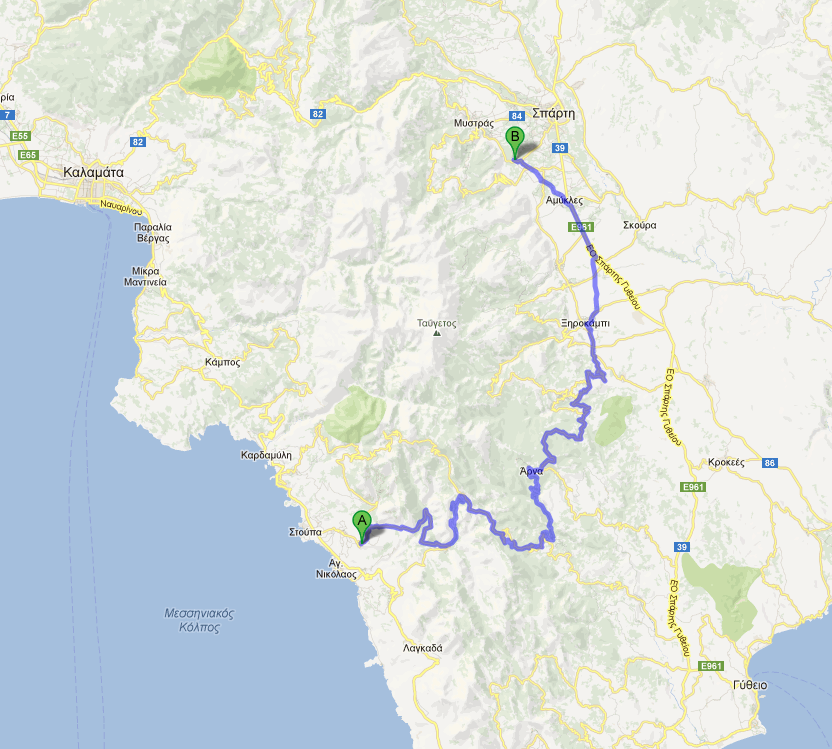
Pyrgos - Agios Ioannis

This appears to be one of the only trails to get over the towering mountains that separate Pyrgos in Messinia from Sparta in Lakonia .

I have been looking at names of men who were eligible to vote in 1865, 1867, 1871.  Election Lists are digitized on the website of the General Archives of Greece. In examining surnames in the Pyrgos area, I have not found KOSTAKOS but I have found KOSTAS in the village of Βαρυμπóπι [Varibopi, now known as Monastiri, Tripyli, Trifylia]*. Is this my family? It is a common practice to add a suffix to a name to indicate “son of,” such as -opoulos and -akos. Thus, a male in this Kostas family may have added -akos to his name, thus creating my KOSTAKOS surname.

So far, I have identified three Kostas families in Βαρυμπóπι: (1) father: X (Christos?) and son, Georgios X; (2) father: A (Anastasios?) and sons Georgios A. and Christos A; (3) father: G (Gregorios?) and son, Georgios G. Here is the entry for two of the families:

Lines 310 & 313.

Trifylia, File, 52, page 154, lines 310 & 313.

I don’t know if these are my people, but I am hopeful that I have found a clue to support the oral history given by Aunt Areti. This research is like looking for the proverbial “needle in a haystack,” but it is exciting, challenging, and rewarding!

________

*General Archives of Greece, Electoral Rolls, Region of Trifylia, File 52

Seek and Remember

My friend and fellow genealogist, Gregory Kontos, created this moving video, encouraging us to keep looking for those who gave us life. It may be hard, but every name we find is one more ancestor who is remembered and retrieved from the annals of the forgotten.

Shifting Gears

My last post about our family reunion caused me to reconsider my perspective on family history research. I write a monthly genealogy column, “Turning Hearts” for Meridian Magazine online, and used my last post as the basis for an article published October 18, 2013, which is reproduced below.

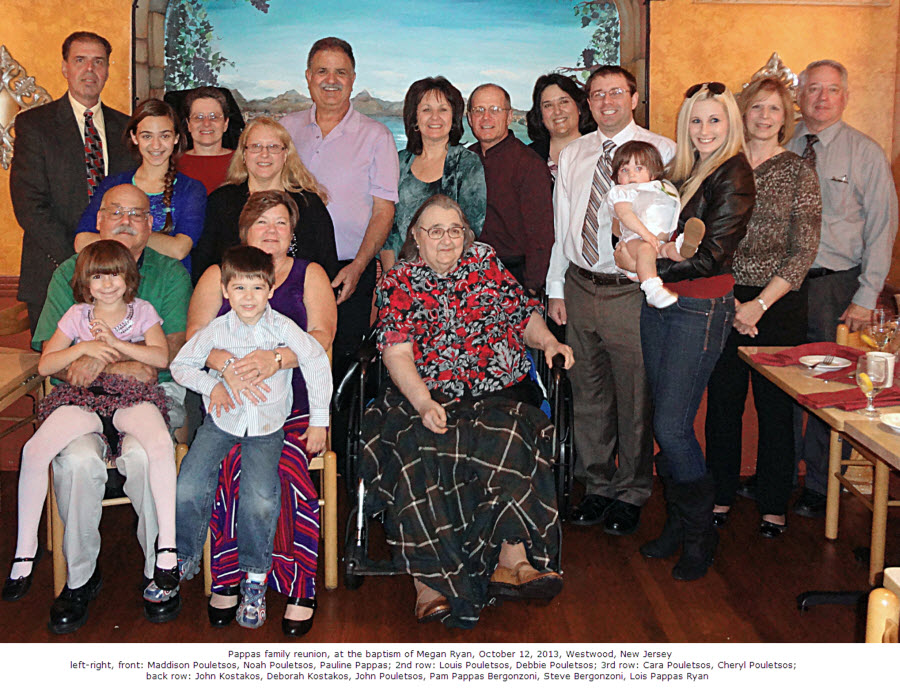
Last weekend, my “East Coast” cousins gathered for a joyous occasion – the baptism of the newest member of our family, Megan Ryan, at St. Andrews Catholic Church in Westwood, New Jersey. We are the grandchildren of Louis Pappas (Ilias Papagiannakos) and Angelina Eftaxias Pappas.

Family gatherings were central to the lives of our grandparents. As immigrants from Sparta in the early 1900’s, they settled in Hoboken, New Jersey. They traveled regularly to Brooklyn, New York, to be with family and friends from their homeland. These associations  brought them a sense of comfort and security in their new and very different country.

Our parents – Catherine, Bertha, William, and Nicholas – also treasured “family time.” All four families lived in neighboring towns in northern New Jersey. We cousins grew up together until the scattering began. Job opportunities took our fathers to Long Island, California, and Maryland. Only Uncle Bill remained in Westwood. There were occasional visits, but as cousins married and children arrived, we spun into differing orbits.

Except for Aunt Pauline, Bill’s wife who just turned 90, our parents have passed into a new realm of family relationships in the spirit world, unencumbered by worldly travails and earthly distances. This has engendered a new realization into all of us: We are now our parents’ generation; we are the ones to keep family traditions and maintain family ties. Our first reunion in July 2012 reinforced our longings to be together. The more we meet, the more precious these events become. We miss our  four “West Coast” cousins in California, the children of Nick, and we hope to be together with them soon.

Our renewed cousin reunions have changed my perspective on family history work. I have spent untold hours reading obscure documents from Greece with the hopes of finding one of my surnames. Although I now have a spreadsheet with several hundred names, I can’t go back far enough to find a common ancestor and to determine how these people are related to me (I know they are, as they hail from my grandparents’ ancestral villages). At times I become frustrated and am tempted to “throw in the towel” and wait for the Millenium to continue my research. But in my heart, I know that is not right. I must do what I can with what I have.

Our cousins reunions have caused me to pause and reconsider that I should reallocate some of my time from searching for the dead to reconnecting with the living. There are photos of my living relatives to be obtained and attached to our online tree. There are stories to gather from my cousins, so our collective family memories can be memorialized for future generations. There is research to be done on our parents’ cousins who came to the U.S., but whom we never had the opportunity to meet.

Shifting gears is not easy, as I am driven to probe deeper into my pedigree line. But it is essential to do so:  someday, our children will be us. If we do not capture our own family stories – and those of our parents and grandparents – we will leave them an empty legacy.


A Joyful Family Reunion

On October 12, 2013, the “East Coast” descendants of my grandparents, Louis Pappas (Ilias Papagiannakos) and Angelina Eftaxias Pappas, gathered in Westwood, New Jersey to celebrate the baptism of Megan Sophia Ryan, the great-granddaughter of Louis and Angelina, and daughter of Lois (Pappas) and Bobby Ryan.

Group with caption

Our grandparents had four children: Catherine, Bertha, William and Nicholas. Those of us in the photo above are the families of Catherine (Carol Petranek & John Kostakos), Bertha (Louis & John Pouletsos), and William (Lois Ryan & Pam Bergonzoni). Pauline Pappas, center front in wheelchair, is the wife of William and the only one of our parents who is living. She turned 90 years old in July and was thrilled to be with her family. We miss our “West Coast” California cousins who descend from Nicholas:  Louis, Nick, Paula and Vincent. We hope that someday soon, all of us can be together.

I am sure that our parents were smiling down at us as we gathered for such a happy event. Family activities were such an important part of their lives, and I am happy to say, they are for us as well.

Mani: My Grandparents’ Ancestral Homeland

Lately, I have been reading about the history of Mani, an area in the far southern Peloponnese now shared by Laconia and Messinia. The Maniates were known to be strong, resilient, clan-oriented people, indomitable in war and ferocious in defending family honor. When I was last in Greece, at the Archives in Sparta, I asked an archivist about the origins of my four grandparents’ surnames: Kostakos, Papagiannakos, Aridas (possibly Mihalakakos) and Eftaxias. He responded that those names most likely originated in Mani, and he proceeded to explain the reputation and temperament of the Maniates.

A chord of pride struck my soul — these are my people! This is the blood that flows in my genes. I, too, can face life’s challenges and overcome obstacles. I am a Maniate.

Reading this book, Mani and the Maniates by Dimos N. Mexis, has led me to further research on the internet. A friend referred me to the blog, Maniatika, hosted by Giannis Mihalakakos and George Athanasakos. This is an outstanding source of history, genealogy, village information and current news. These men are devoted to keeping  alive the traditions of their ancestors and the spirit of their land. They are passionate about this mission and it is evident in the time they devote to their blog and their interest in helping others.

I am so impressed with the commitment of these young men, as well as my friend, Gregory Kontos  (http://gkfamilytrees.wordpress.com/). Their generation will ensure that the glory of Greece is not only remembered, but carried forth.