Unknown's avatar

About Spartan Roots

I am of Greek ancestry with roots in villages near Sparta. My paternal grandparents and maternal grandfather were born in Agios Ioannis (St. Johns), and my maternal grandmother was born in Mystras. I love family history research and have been tracing my roots for many years. I was born in Brooklyn, New York and was raised in a predominantly Greek neighborhood close to extended family. I live in the Washington D.C. metropolitan area and work as a volunteer Co-Director of the Washington, D.C. Family History Center and a genealogy aide/project aide at the National Archives in Washington, D.C. I am always updating and adding new information. Please contact me - I would love to hear from you!

Church Records in Greek Villages

Civil records are the first collections perused by researchers. They are (relatively) easy to access at the Archive offices and Town Halls (Dimarheion): Male Registers, Town Registers, School Records. Election Registers (lists of men eligible to vote in the late 1800’s) are online. I am grateful that so many have survived invasions, occupations, natural disasters and civil war.

Fortunately, these records do exist.  Unfortunately, they primarily enumerate males. Daughters, wives and sisters are almost invisible. Young girls may be found in school records (only if they attended), and Town Registers which list entire families.

There is one compendium, however, that is an “equal opportunity” collection: church records. Women as well as men were baptized, married, and died. Their footprints are in tandem with men’s as they walked the path of life. Thus, records in churches hold priceless information and that will fill in the gaps of a family structure.

Interior of church at Charisio, Laconia

Village Churches

During my trip to Sparta this July, I was finally — after three previous attempts — able to access and view the Birth, Marriage and Death books in churches of three villages. The doors were opened in various ways:

  1. a friend, who is a psaltis (cantor) in one church introduced me to the priest, explained what I was seeking and why, and arranged a meeting
  2. a newly-found cousin was friends with the priest of another church and made an a appointment for us to meet;
  3. one priest whom I had visited called another and asked him to allow me to view his church books.

Local people are the key to obtaining access to village church records!

A stranger who walks into a church and asks to look at old books may be dismissed with the wave of a hand and the words, “we do not have any.” They were [pick one] burned, or destroyed by the Nazis, or lost in a flood, etc. Priests are very protective of these records and rightly so — they have information about the living as well as the dead, and it is their responsibility to ensure that their parishioners and their families are not compromised in any way. However, that does not mean that you cannot access them. It does mean that you need someone to pave the way for you — someone whom the priest knows and trusts.

Every village in Greece has at least one church. When villages were settled, the first building erected was the church, as it is the focal point of every community. Most villages, even the smallest ones, have several churches; my ancestral village of Agios Ioannis, Sparta, has eight! However, only one or two are used for Sunday worship. Others were constructed to honor a patron saint, or as family chapels. A village priest will officiate at all the churches in his parish, holding services in each on alternate Sundays or on a rotating basis.

To commemorate a Saint’s Day, a special liturgy is held in a church that bears that Saint’s name. For example, on July 26, I attended a service in honor of Agia Paraskevi in the church which bears that name, located in Theologos, Laconia. This Saint’s Day is the only time that services are held in the Agia Paraskevi Church.

Agia Paraskevi, Theologos, Laconia, July 26, 2017. Interior of church, Saint Paraskevi, a delightful visit with my Zaharakis cousins of Theologos.

What Can You Expect to Find? Examples of Village Church Books

Each church is different. There is no uniform date of genesis for any records. In the books I examined, most started in the early 1900’s; however, one baptismal book had a few entries from 1868! Generally, people will be able to find records for their grandparents’ or possibly great-grandparents’ generation.

This book of baptisms begins in 1913; column headings are date of baptism, name of infant, name of father, maiden name of mother; name of godfather and residence; place of baptism; name of priest.

Baptismal Record


This book of marriages begins in 1913; column headings are date of marriage; name, age and residence of groom and his father’s name; name, age residence of bride and her father’s name; name and residence of best man/bridesmaid; name of priest.

Marriage Book

This book of deaths also begins in 1912; columns include the date of funeral; name, age, residence and occupation of deceased; name of priest.

Book of Deaths

The priests whom I visited allowed me to look at the church books and take digital images of some pages where my family name appeared. This meant that I had to be able to read my surnames in old Greek script!

How to Prepare for a Visit

This may be a once-in-a-lifetime opportunity to visit your ancestral village and be able to view church records. Be prepared! Priests may be busy and your time may be limited.

  1. Make a list of every surname in your family who was born, married, or died in the village.
  2. Ask someone to write these surnames in Greek script — then to write them again in “sloppy” handwriting. You need to be able to recognize the names you are seeking.
  3. If you know a relative in the village, advise him/her of the dates you will be visiting and request that they contact the priest in advance to ask his permission for you to view the books, and to give him the exact day you will be there.
  4. If you do not have a relative in the village, find one when you arrive. It’s easy! Greeks are very communal and everyone knows everybody else in the village. Just go to the platea (village square) and ask the locals where the “Papageorgakos” family lives. If you ask in a kind manner, someone may offer to take you to the house and even introduce you. Be sure you have candy or cookies to bring — a sweet offering that will touch the hearts of your relatives.
  5. Bring a letter of introduction from your local priest. It will open doors for you. My cousin, Father Eugene Pappas, is the Priest at Three Hierarchs Church in Brooklyn, New York. He wrote a letter on official church stationary, introducing me, explaining that he and I were working together on our family history, and asking permission to view the books. I brought several copies of this letter, and gave one to every priest. Each of them read it carefully (sometimes twice!) and they asked to keep a copy for their Archives. After reviewing the letter, they had no hesitation in showing me the books.

Letter of Introduction, Father Eugene Pappas

I understand that accessing village church records is not easy. There is a trip to take, connections to make, a language barrier to overcome, and luck to be had. However, it is doable. I wrote above that I had tried three times to gain access to these books but, until this year, I had been unsuccessful. The keys to success are preparation and persistence, and–you must have a local contact who can introduce you to the priest.

The rewards are worth the effort. Seeing the baptismal record for your grandparent, or the marriage record of your great-grandparents, will leave you speechless. You will be ever grateful, and your confidence level will soar. If you can do this, you can do anything!

Archives of Sparta: Mitroon Arrenon (Male Registers)

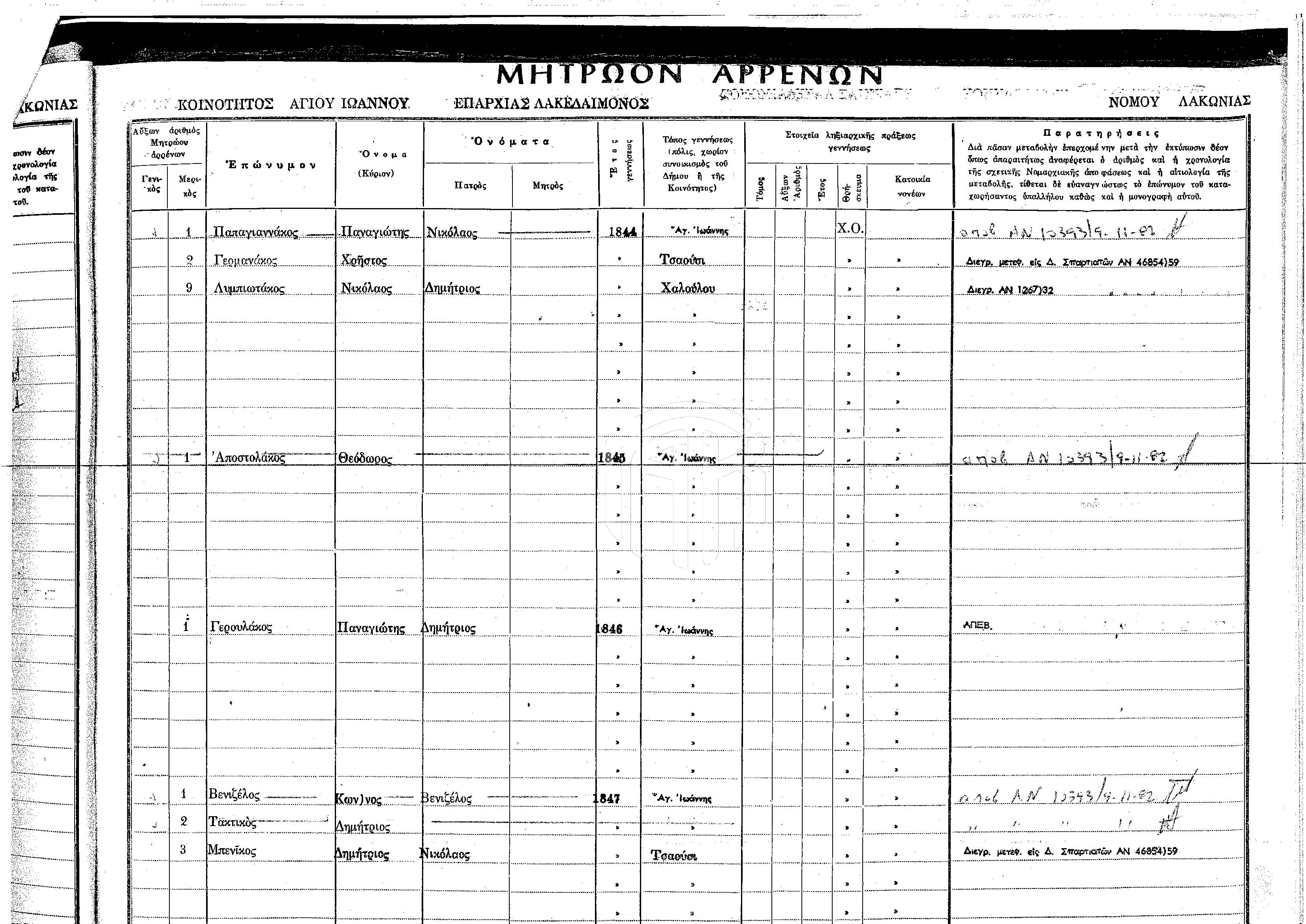
After the Revolution of 1821 when the land of Hellas victoriously overthrew 400 years of Ottoman Rule, the “new” country of Greece began to form a central government. As a means of enumerating males who would pay taxes and serve in the military, the Mitroon Arrenon or Male Register was instituted. Every village was required to maintain a list of male births, the year and place of birth, father’s name and father’s occupation. Over time, these official government registers have also substituted as official birth records.

They are a most valuable and very important genealogical resource.

Mitroon Arrenon, Agios Ioannis, Sparta: 1844-1847

Mitroon Arrenon can be found in the Dimarheion (Town Hall) of the municipality in which the village is located. Some regional offices of the General Archives of Greece may also have copies for villages in their area of jurisdiction. If you are taking a research trip, you must locate these records because, except for rare cases, they are not digitized or found online in the regional Archive offices mentioned above, or at the Dimarheion websites.

My previous post, Reading a Town Register and a Male Register, gives further information on how to read a Male Register.

The Sparta office of the General Archives of Greece has some Mitroon Arrenon in their collection. They can be contacted at:  mail@gak.lak.sch.gr. The staff can read and speak English. Be sure that you include an approximate birth year of your male ancestor, along with his original surname and exact village of birth. Remember that records are created in specific villages, as shown by the list below.

Mitroon Arrenon Records in the Sparta Archive Office
(Note: smaller villages, hamlets and neighborhoods will be found in the record of the larger, closest town)
Anavryti:  1839-1923
Agios Ioannis: 1835-1930
Alepochori, Geronthon: 1830-1950
Alikon, Messi: 1845-1915
Ano Volarion: 1865-early 1900’s
Aeropoli: 1837-1915
Archontikou, Melitinis: 1844-1915
Vatheia, Messi: 1836-1914
Vachou, Laconia: 1839-1915
Vresthena: 1831-1924 and 1925-1939
Geraki, Geronthron: 1826-1914
Germas, Teos: 1836-1915
Gerolimenos, Teos: 1845-1914
Gytheio: 1836-1915
Dafni: 1837-1935
Exo Nyfi: 1841-1915
Karitsa, Geronthron: 1841-1914
Karvela, Teos: 1814-1913
Kelefas, Teos: 1830-1915
Konakion, Teos: 1829-1914
Kotronos: 1831-1914
Kittas, Messi: 1845-1913
Kounou, Teos: 1831-1915
Kryoneriou, Oitylo: 1846-1913
Mystra: 1824-1915
Pyrgos, Oitylo: 1845-1914
Lymperdou, Malevriou: 1842-1915
Minas, Oitylo: 1845-1915
Neo Oitylo: 1834-1915
Neohori, Gytheio: 1840-1915
Dritsis: 1865-1901
Oitylo: 1840-1915
Sidokastron: 1845-1915
Skamnaki: 1825-1915
Sparta: currently not available
Trachilas: 1830-1915
Tzerovas: 1839-1912

If you need a village that is not on this list, or a different year range for a village that is on this list, you will need to visit the Dimarheion (Town Hall) that houses the records for that village.

Archives of Sparta: Dimotologion (Town Register) Records

I have returned from month-long productive (and exhausting!) research trip to Sparta and there are many posts to write about the resources I have consulted and the records I have obtained.

However, I am starting with the Dimotologion (Town Register) Records that are found at the General Archives of Greece, Sparta office.

Sparta Office, General Archives of Greece

One of the most helpful record collections to help identify families are these Town Registers. They are similar to a U.S. Census record, as they list the husband, wife, and children of each family in a village, the parents’ names of the husband and wife; years and places of birth, occupation, citizenship and other information. These records were created in the mid-1950’s. I find that the birth years of the parents were in the late 1800’s, and the children’s births were in the early-mid 1900’s. If you can find your grand or great-grandparents in a Dimotologion, you will have much information to proceed on your research.

My previous post which gives examples of Dimotologion records, and explains how to read and interpret them, can be found here.

During the two week period that I spent in the Sparta Archives, I made a list of all of the Town Registers that are available in their office. These records are created and kept by village. Therefore, you must know the original name of your family and the exact village of origin.  Researchers can send a request to the Archive Office (mail@gak.lak.sch.gr) to ask if their family is found in the Dimotologion; however, do not submit a request unless you have this specific information. Oftentimes, immigrants would give the nearest large city as their place of origin when in actuality they were from a small village near the city. If you see “Sparta” as the place of origin, keep digging until you have the exact village and original surname! The list  below will help you further understand the importance of knowing the village name.

Village List of Dimotologion (Town Registers) in the Sparta Archives Office
(Note: smaller villages, hamlets and neighborhoods will be found in the record of the larger, closest town)
Aggelona
Agias Eirinis
Agios Vasileios
Agios Georgios
Agios DImitrios
Agios Ioannis Monemvasia
Agios Ioannis Sparta
Agios Konstantinos
Agios Nikolaos
Agios Anavrgiron
Agios Apostolon
Agorianis
Agrianos
Agia (Chania Koutoumous)
Alepochori
Aleirous
Alikon
Ampelochorio
Amykles
Anavryti
Ano Kastanias Voion
Ano Boularion
Anogeion
Apidias
Areopoli
Arna
Archontiko
Asteriou
Asopou
Afissiou
Chrisafo
Chosiari
Daimonias
Dafnis – Kaminion
Dafniou
Drosopigis
Drialou
Drimou
Elaias
Ellinikou Koulentia
Exo Nyfi
Foinikiou
Geraki
Germas
Gerolimena
Georgitsi
Gkoritsa
Glikorvisis
Gorani
Gouvon
Gytheion
Kareas
Karitsa
Kastoriou
Kelefas
Kefala
Kozi-Kokkinorrachi-Riviotissa, Sykaraki, Charision
Konakion
Koniditsa
Kounou
Kremasti
Krinis
Krokeion
Lagia
Lagiou
Lachiou Voion
Leimona
Leikochomatos
Logkaniko
Logkastra
Magoula
Melissas
Melitinis (Zelinas)
Metamorfosis
Minas
Molaoi
Monembasia
Myrteas
Mystras
Neapolis
Neo Oitylo
Neochori
Niaton
Nomion
Oitylo
Pakia
Palaiopanagia
Paliovrisis
Panitsas (Myrsini)
Pantanassas
Papadianiko
Parori
Pellana
Perivolion
Peristeriou (Tsasi)
Perpainis (Kaloni)
Petrina
Platana
Potamia
Prosilio
Pyrgos Dirou
Selegoudiou
Sellasias
Skamnaki
Skouras
Skoutari
Soustiani
Sparta
Spartias
Tsikalion
Vatheia
Vamvakou
Varvitsa
Vasilakiou
Vassara
Vachou
Velanidion
Velion
Vlachioti
Vordonia
Voutiani
Vresthena
Vrontama
Xirokambi


School Records from Sparta: Finding Your Ancestors as Children

I love old photos–a moment frozen in time, an instant transport into the past. One collection that is especially endearing to me is the work of Swiss photographer, Fred Boissonnas, who traveled throughout Greece in the early 1900’s and photographed everyday life (see more photos here).

Edessa [Greece], 1908. by Frédéric Boissonnas, Public Domain, https://commons.wikimedia.org/w/index.php?curid=16659783


Seeing his photos of children and families fills me with curiosity about the early years of my grandparents, born in the late 1800’s. Last summer, I found School Records for their village of Agios Ioannis (St. Johns, Sparta) at the General Archives of Greece, Sparta office.

Mathitologion, Agios Ioannis, Volume E.K.P. 2.1.1

With gratitude to the kind and helpful staff who encouraged me to take digital images, I now have photos of some pages where members of my ancestral family are recorded. These documents are replete with insights into the families of the village in the early 1900’s.

Mathitologion, Agios Ioannis, School Year 1908-1909; page 11; Volume E.K.P. 21.1.

In this image, page 11 lists students for the school year 1908-1909. Because my great-grandmother, Afroditi Lerikos, was born in Agios Ioannis, I was looking for members of the Lerikos family. I found one on line 103: student: Lerikos, Anastasios, father: Dimitrios; age 7; born: Alaimbey; residence: Alaimbey; religion: Orthodox; father’s occupation: worker; student in class B. (Click on image to enlarge.)

Along with information about Anastasios such as his age and place of birth, this entry verifies that his father’s name was Dimitrios whose occupation was a “worker.” It also proves that the Lerikos family lived in Alaimbey which is a neighborhood or small hamlet of Agios Ioannis. This is an important fact when I am looking for records–I should be searching first and specifically for Alaimbey, and then for Agios Ioannis.

If a child attended school for more than one year, comparing his information in each successive school record helps me verify a specific birth year. In some books, the age of the child is given in years such as this example; in others, the birth year of the child is given. Either way, an exact birth year can be ascertained.

It’s All About Location!

Records in Greece are location-specific. My colleagues and I repeat, almost as a mantra, the following to new researchers: You have to know the original surname, and you have to know the village of origin.

In school records, I have found instances where children were born in one village, but resided and went to school in another. Knowing the exact birth location is critical. If I am looking for a baptismal record, I must look for a church in the village of birth. Looking for a church in the child’s village of residence will not yield the record. For records later in the child’s life, I would search his/her village of residence.

In the 1920’s, a new column with the heading “District Registered” was added. This signifies the district where boys only are registered in the Mitroon Arrenon (Male Register). This piece of data becomes critical in locating records, because I now know in which jurisdiction to look for information about the smaller villages. For example, Alaimbey is grouped with Agios Ioannis. However, records for the neighboring village, Sikaraki, are split:  some are found in Sparta books and some in Agios Ioannis books. (Confusing, I know! But important.)

The following record for Ilias Nikolaos Panagakos shows that he was born in Parori, resided in Kalami in 1932, but is registered in Mystra. This leads me to search in three villages! (Click on image to enlarge.)

About the Parents…

School records record the name of the student’s father (mothers are not named) and gives his occupation. These two facts are essential in being able to differentiate between “men of the same name.” Naming traditions dictate that there can be several boys, about the same age, with the same name, in the same village.

It is both helpful and revealing to compare a father’s occupational information given in school records to that found in a Dimotologion (Town Register). Following a student through several years of school records, one can see if the occupation of the father changes. It is not uncommon to see that some men have two or even three different occupations. In the agrarian society of early 1900’s Sparta, most men were workers, farmers, landowners, or shepherds. But school records have revealed innkeepers, chauffeurs, wine producers, merchants, grocers, basket makers, masons and muleteers (I had to look that one up; it is a person who drives mules). Now that I know the names and occupations of the village families, I can visualize these people buying, selling, and bargaining with each other. This brings the village to life!

There are two occupations that especially caught my attention:  “orphan” and “immigrant.”

When a father’s occupation was listed as orphan, it meant that the father of the student was deceased, but not necessarily the mother (remember, women are not named or categorized in these records; also, the column description specifically states “father’s occupation”). I have seen instances where, for example, in the school year 1908-1909 a child’s father’s occupation was landowner, but in the school year 1909-1910, the occupation was orphan. This gives me a year of death for the father, an important fact that can be difficult to find!

When a father’s occupation was listed as immigrant, this reveals that he is living overseas, most likely in the U.S. or Canada in the early 1900’s.  The records indicate which school year the father was working in the village, and which year(s) he was listed as an immigrant. This gives me a specific timeframe to look for passenger ship records, which document where he was going and whom he was “going to” on the other side of the Atlantic. Knowing this migratory pattern is critical to understanding if, or when, the family eventually left Greece.

When my paternal grandfather, John Kostakos (Ιωάννης Κωστάκος) emigrated to Brooklyn, New York, he settled near his relatives and compatriots. I was excited to find their names in the village school records. These people grew up together, went to school together, and reestablished old ties in a new land. Very often, men arranged for their sisters to marry their schoolmates from the χωριό. Their relationships, forged as children, supported them throughout life.

About the Girls

Searching for female ancestors in Greece is extremely difficult as there are few civil records where they are named. However, girls who attended school are in the school registers, and their information is just as detailed as that of the boys. Distinguishing a girl’s name is easy because of the diminutive which is used both in given names and surnames. For example, Vasileios for a male; Vasiliki for a female;  Lerikos for a male; Lerikou for a female.

Metsovo on Tap, 1913; photographer: Fred Boissonnas; http://www.lifo.gr/team/lola/34138

In the earlier school records, girls are listed together at the end of the roster so they are easy to find. As time went on their names were integrated within the roster, so looking at the diminutive is essential to correctly identify daughters and sons.

About the Family

Both boys and girls started school at age six or seven. It is interesting to see who attended for only one or two years; and who attended for several. How was it decided as to which child/children in a family went to school and which ones did not?  Girls are students, so it was not a matter of sex or preconceived assumptions that girls stayed home to work while boys received an education. It is essential to examine records of every available school year so as not to miss a child who attended sporadically or limitedly.

Scrolling through the school registers of a specific village, the number of families living in that village quickly becomes evident. As I extracted family names, I could easily put together families by looking at father’s name, child’s birth year and village. Below is an example from my spreadsheet–these children share the same surname but it is omitted for privacy.

School Record Spreadsheet

Through my searches in Male Registers, Town Registers and Election Lists, I thought that I had a fairly complete picture of my early 1900 ancestors from Agios Ioannis. However, I came across four children of the same father who was not in my database. Through school registers, I was able to discover and piece together a family that somehow had been omitted in other records.

Despite occupations, wars and tumultuous periods, children continued to go to school. School records prove that some forms of everyday live prevailed, even under a cloud of fear or foreboding. Village histories, as well as civil records, document that education–even in remote areas–was available and important. The information in school records brings a new and exciting dimension to understanding the lives of my ancestors.

General Tips for “Crossing the Pond”

My friend, Cheri Hudson Passey, invited me to submit an article with a few genealogy tips for her blog, Carolina Girl Genealogy. I was honored to be asked, and decided to share some suggestions for people who are embarking on research in a foreign country. I wrote the article to apply to a general audience.

It begins as follows:

Today’s tips come from Carol Kostakos Petranek of the Spartan Roots Blog. Although her research takes her to Greece, her tips will help those trying to locate ancestors in their native countries. 

My research is focused on a not-so-common area of the world: Sparta, Greece. However, as I made my way “across the pond,” I found that many of the steps I undertook are applicable to anyone researching in a foreign country. To be successful, you MUST know the original surname and village/place of birth. This means a thorough research process in the U.S. to find any and all documents that could possibly exist for your immigrant ancestor and his immediate family. Without these two pieces of information, your overseas research will not be successful.

  1. Connect with other researchers via social media.
  2. Conduct Google searches using the google country domain address for the foreign country, and typing the query using that country’s language.
  3. Explore U.S. record sets that may be especially helpful (and often overlooked).
  4. Use the White Pages on the Internet to find living people in the village where your ancestors originated.
  5. Learn the general history of your country of interest to understand where records may be.

The full article, with links and details, can be found here:  Carolina Girl Genealogy:  Tuesday’s Tip, Getting By With Help from Our Friends.