Unknown's avatar

About Spartan Roots

I am of Greek ancestry with roots in villages near Sparta. My paternal grandparents and maternal grandfather were born in Agios Ioannis (St. Johns), and my maternal grandmother was born in Mystras. I love family history research and have been tracing my roots for many years. I was born in Brooklyn, New York and was raised in a predominantly Greek neighborhood close to extended family. I live in the Washington D.C. metropolitan area and work as a volunteer Co-Director of the Washington, D.C. Family History Center and a genealogy aide/project aide at the National Archives in Washington, D.C. I am always updating and adding new information. Please contact me - I would love to hear from you!

Cool Documents in Marriage Records

Digitizing Greek Orthodox Church marriage records for the past six weeks has been a huge educational opportunity for me. I am learning about history, families, traditions. During the period of the Balkan Wars (October 1912-July 1913), marriages declined dramatically. Between 1835-1900, the average number of images (not marriages) that we digitized per year was about 1,900; in 1912 there were 1,653; and in 1913 there were only 981. But something happened in 1924–the images we captured for that year spiked to 3,978!

Greek marriage records contain two required documents. One is a letter from the village priest to the bishop, requesting permission for a couple to marry; the second is a letter of approval (or denial) from the bishop. If the groom and bride are from the same village, the letter from the priest has all the information required. However, if the groom is from a different village, then a third document (Pistokoipikon) must be included. It certifies that the groom is registered in the Mitroon Arrenon (Male Register) of his village of origin and that he is eligible to be married.

These documents follow a standard format and have general information about the prospective bride and groom: their full names and father’s name; ages; village of birth/residence; number of previous marriages (if any), occupations and perhaps other information. Prior to 1929, copies of marriage documents were not sent to any government office or to the Dimos (town hall); they were kept in village church or the Mitropolis.

Although I cannot read the old Greek script, occasionally something in a document will catch my attention. I then ask Dimitris (who has worked diligently with me since day one), what it is. That’s when we discover  “cool” documents! Here are a few.

The document below attests that the groom’s first wife died at age 28 of appendicitis.

1926 Sparta, marriage #164; first wife died at age 28 of appendicitis

In this document, pages 1 and 2, a mother gives permission for the bride to marry and go to America. The bride was 16; the age to marry without permission was 20.
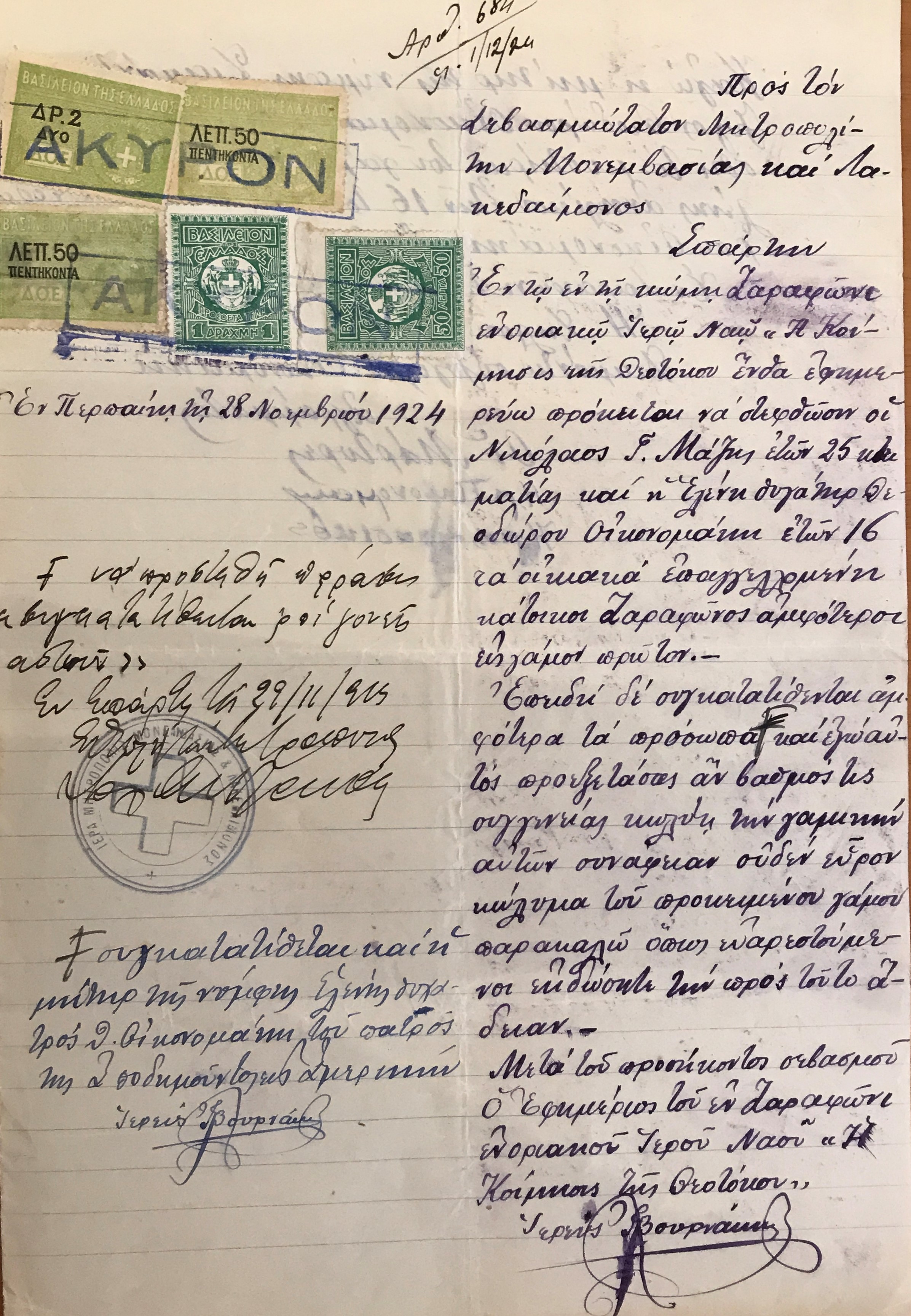
1924 Sparta, marriage #684; permission to marry is given by the bride’s mother

1924 Sparta, marriage #684, page 2; permission to marry is given by the bride’s mother

This is an official letter from the Greek military, giving permission for a soldier to marry.

1920; military document giving permission for a soldier to marry

The unusual black seal in the middle of the following document struck me as atypical. Dimitris explained that the seal is Turkish, not Greek. The groom lived in Ioannina, Epirus which, in 1912, was under Turkish rule. (Epirus was ceded to Greece in 1913.)
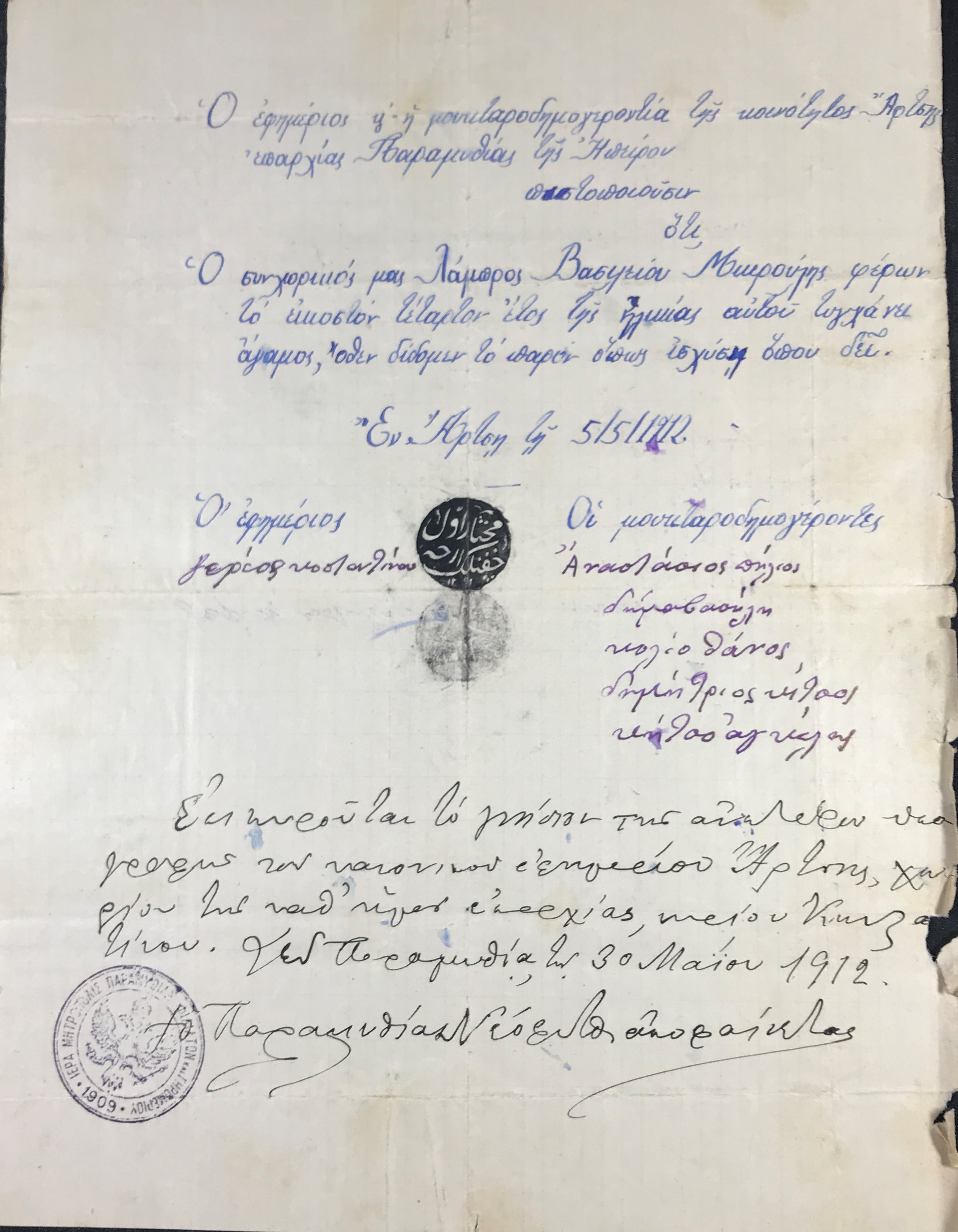
1912, the black seal is Turkish

This 1902 Pistokoipikon was signed by the Patriarch of Constantinople–a highly unusual occurrence and finding it generated a lot of excitement in the Mitropolis! The Patriarch’s signature is the tall writing on the top of the page.
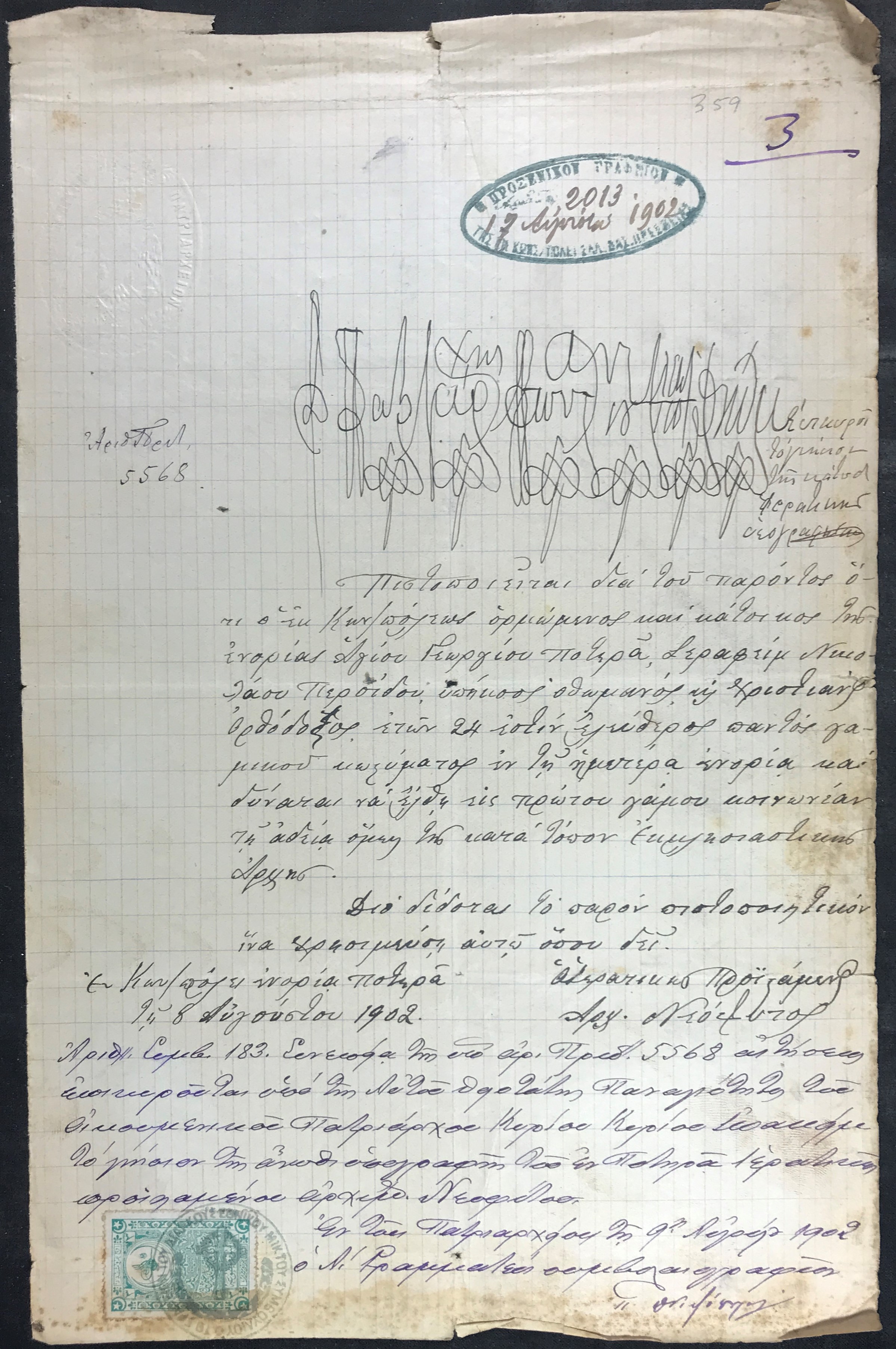
1902; the Patriarch of Constantinople signs this Pistokoipikon

We find many divorces which occurred both in Greece and in the United States, especially after the 1900’s. This 1918 document is a divorce decree from the state of Minnesota, and was translated into Greek.

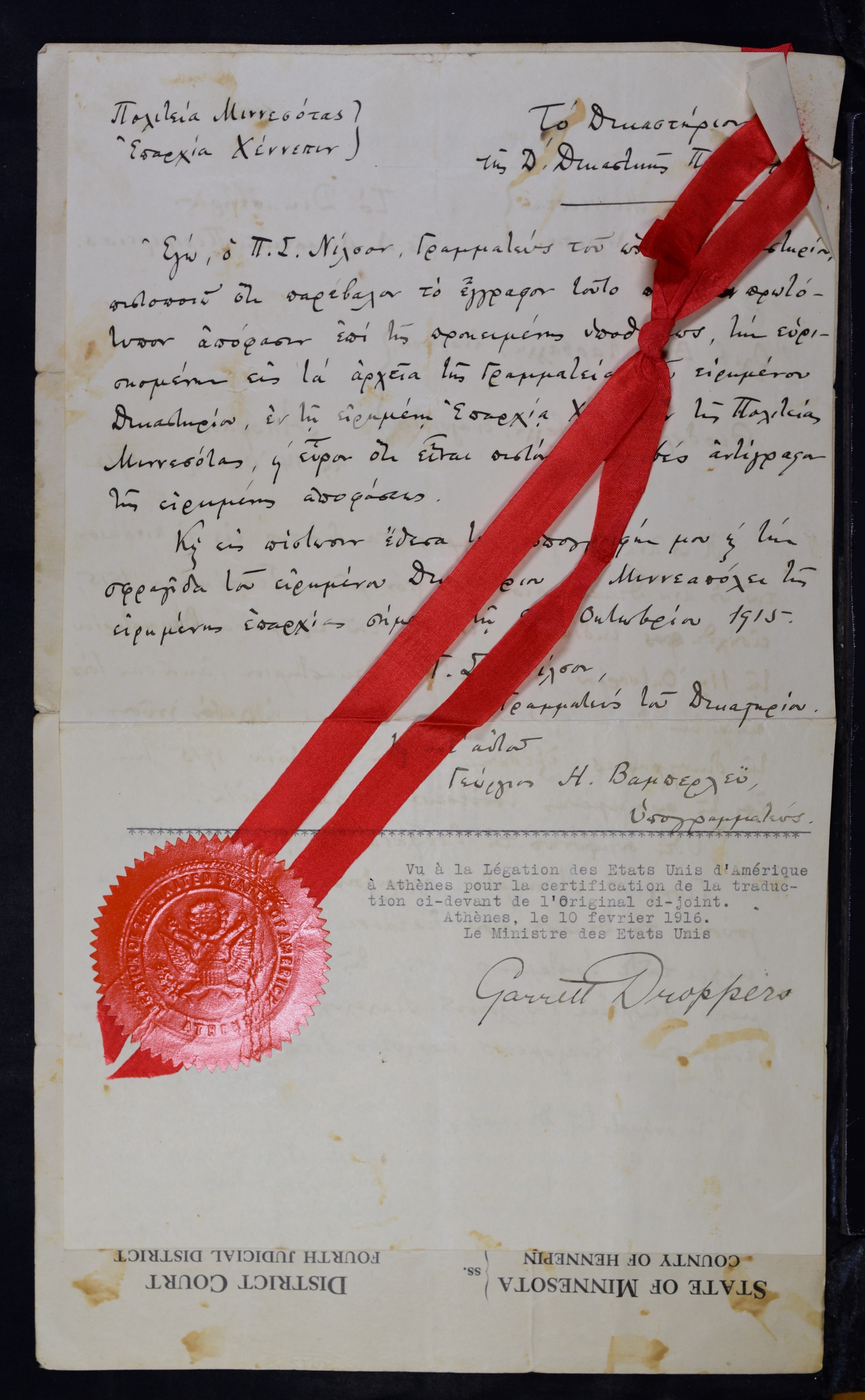
And then, there are cases where the marriage did not take place. We have to remember that just because a license was issued, that does not mean that the nuptials occurred! In the marriage files, there are simple one-line notes, signed by the priest, that state there was no marriage.

1922 Trinasos, “no marriage”

Digging into old records is like a treasure hunt — you never know what you will find!

Faneromeni Monastery: A Treasure in Stone

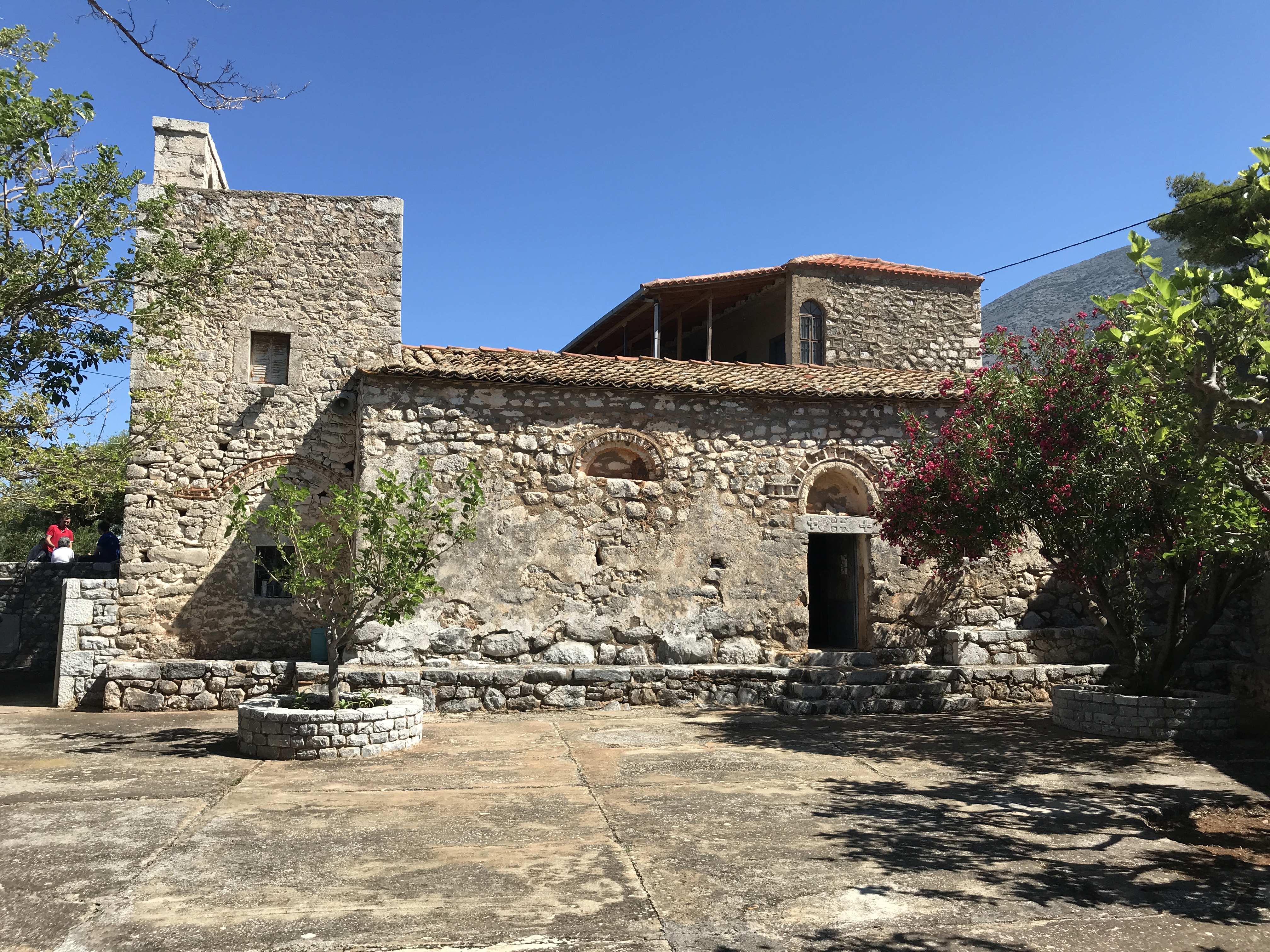
The southern Peloponnese is a study of construction by stone.The hardy people of this region took the least of God’s creations and formed uniquely beautiful edifices: churches, homes, buildings, wells, towers. Boxy and square, tall and narrow, the stone buildings of this region belie what may be inside. A perfect example is the Faneromeni Monastery, the first stop on a tour of Mani led by Papa Georgiou of Sparta last Saturday.

Without a road sign, one would never imagine that this unassuming building was a monastery.

Faneromenis Monastery, Mani

An inscription reveals that it was built in 1079 and dedicated to the Virgin Mary. It was  subsequently renovated in 1322-23 by Emperor Andronicus Palaeologus (Andronikos II Palaiologos). After the renovation, additional alterations were made which formed the building as it is seen today. The monastery was inhabited by nuns; the last one died a few years ago.

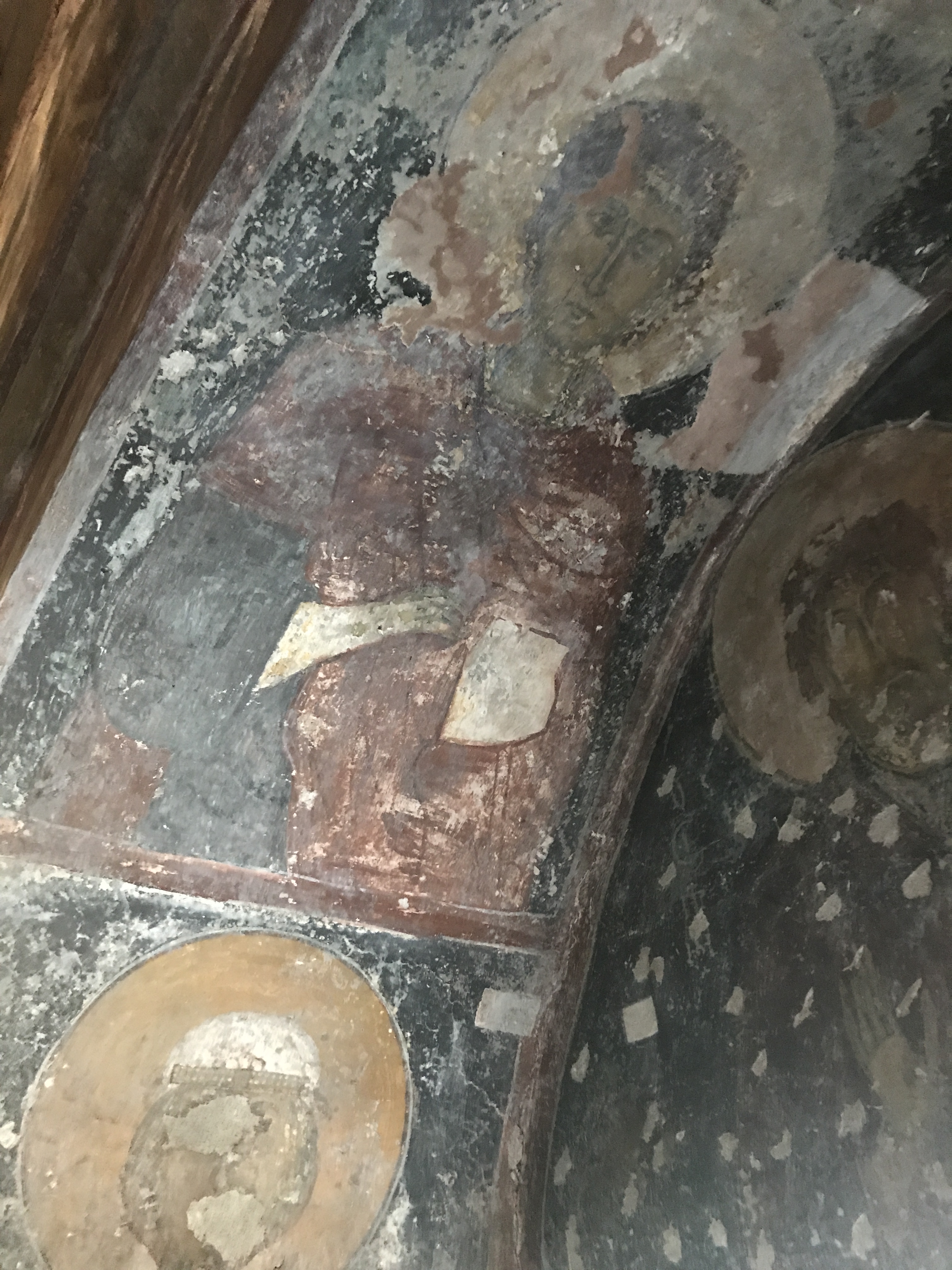
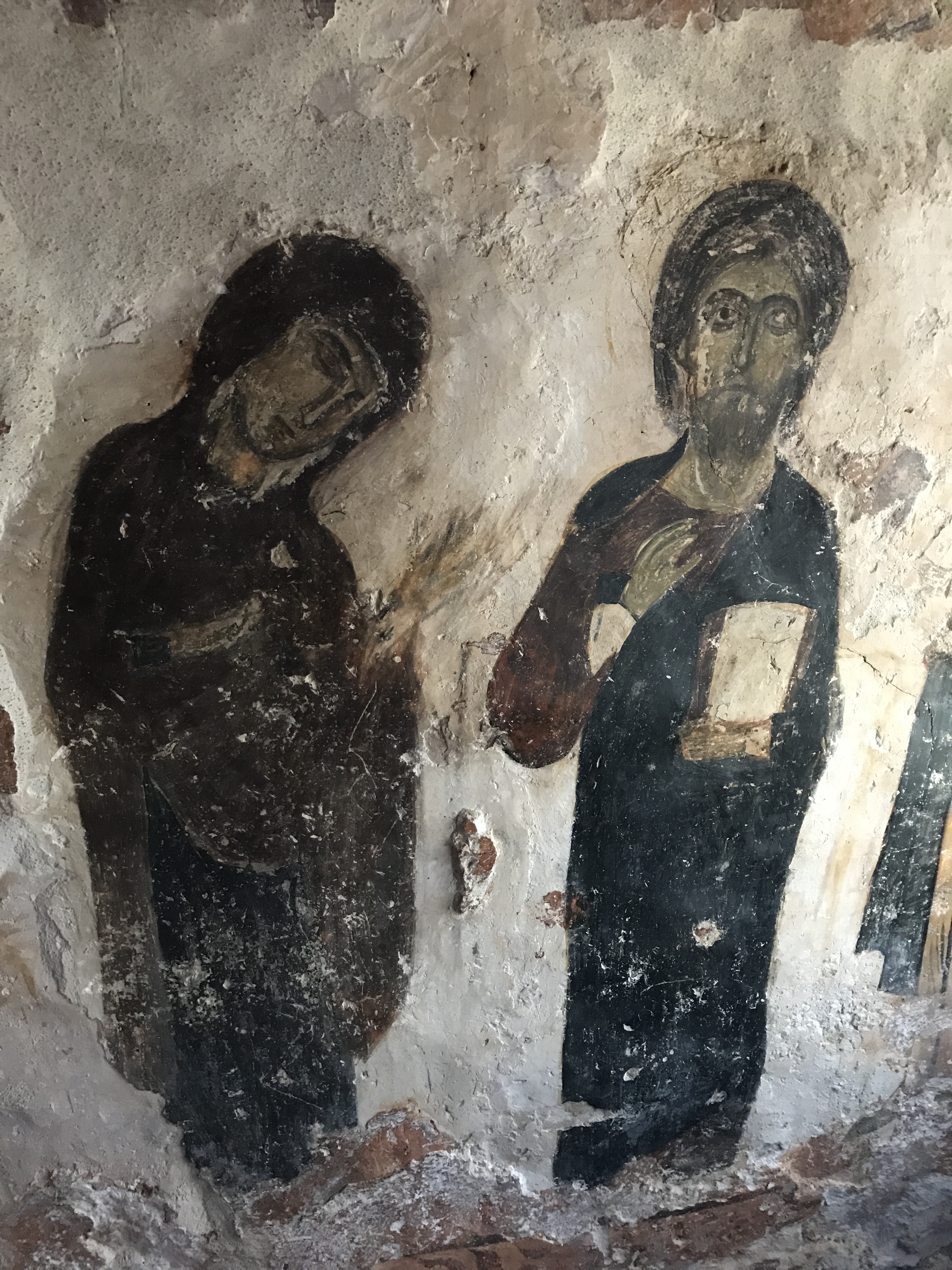
The interior of the church is stunning; the frescoes are captivating.

Interior of monastery church

The frescoes have been preserved from three different periods: 11th century, 1322-23 and early 17th century.

Papa Georgiou, accompanied by Father Konstandinos of Aeropolis, chanted a full liturgy service. Their voices sounded even more poignant when surrounded by the archaic faces on the walls.

Bread and wine at the conclusion of the liturgy

Having never been inside a monastery, I was curious and explored both inside and out. There is a central courtyard, a kitchen, dining area, and rooms for sleeping.

Looking down into the courtyard

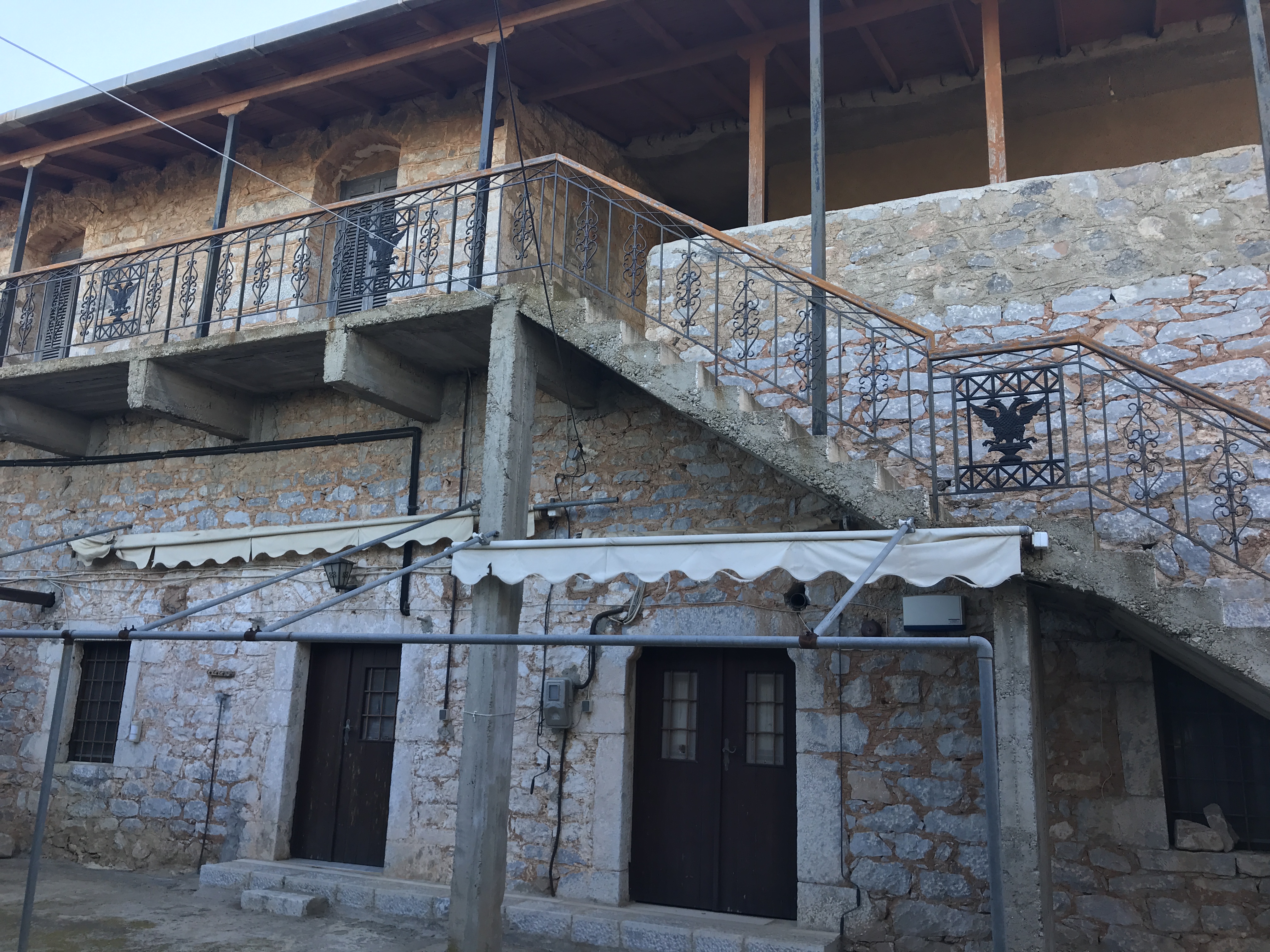
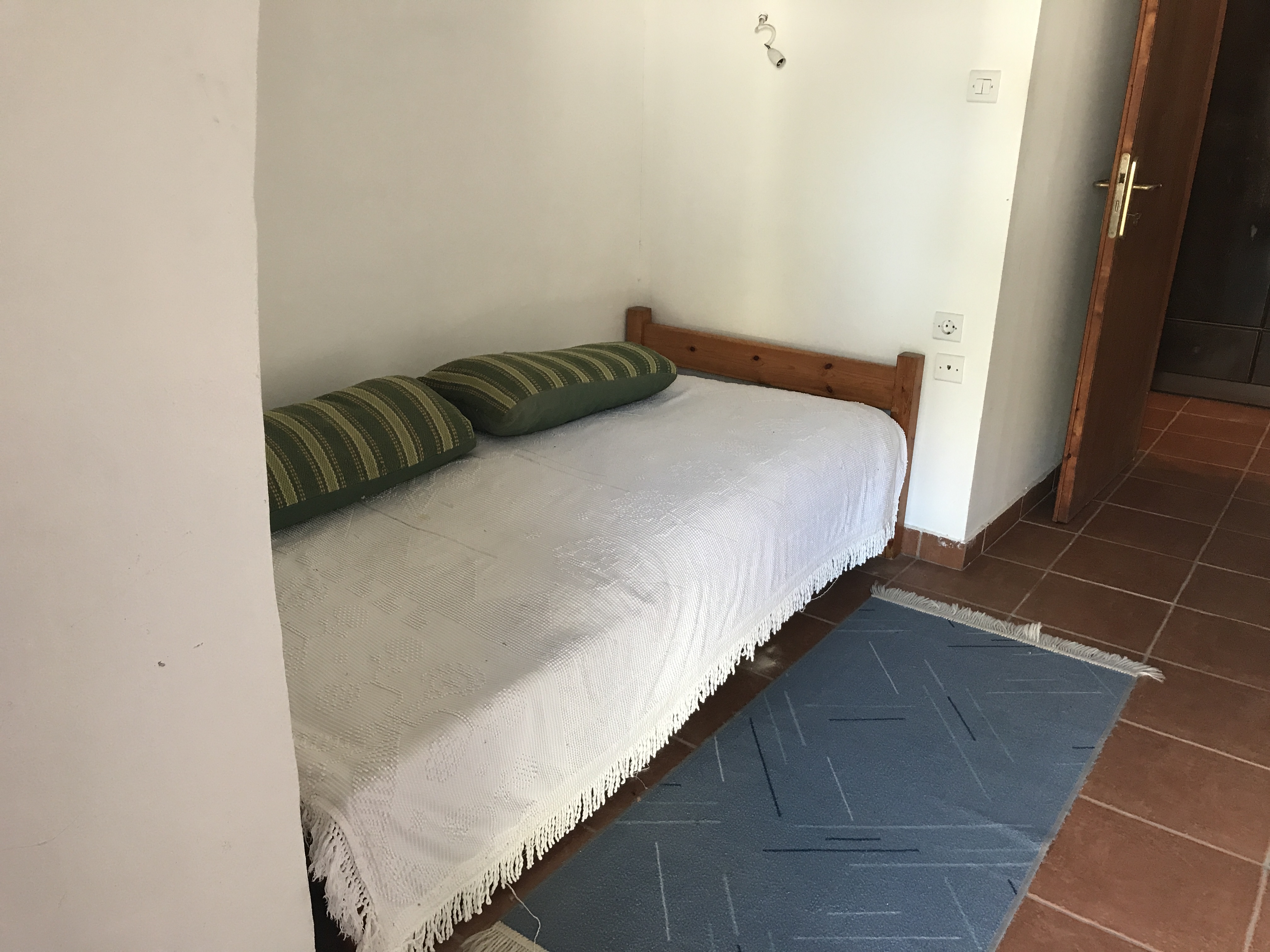
This is the building where the nuns lived. As expected, the interior was “spartan.” But there was a corner cabinet which housed unexpected worldly treasures.

Living quarters, exterior

Sleeping area, interior

Worldly treasures

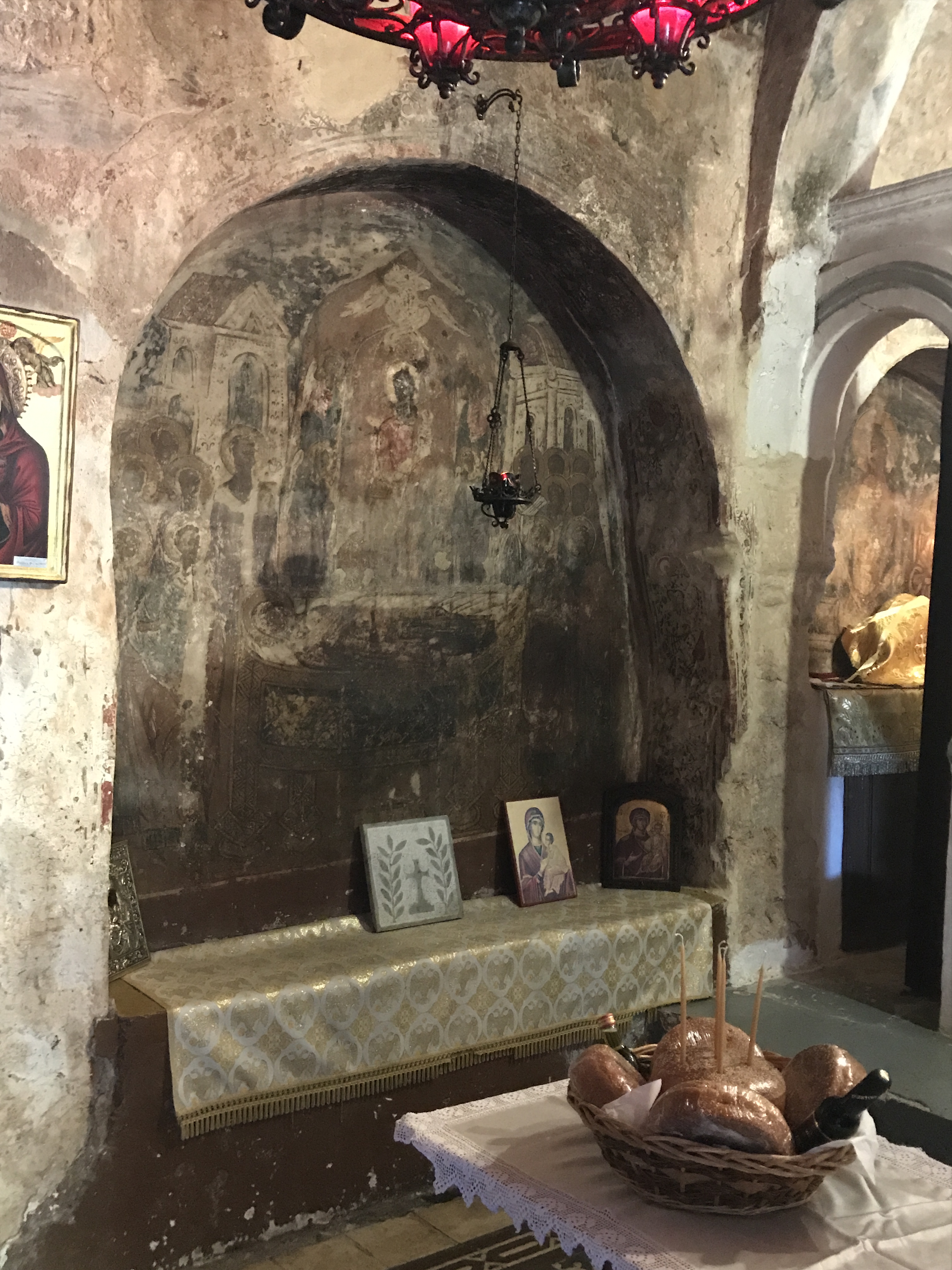
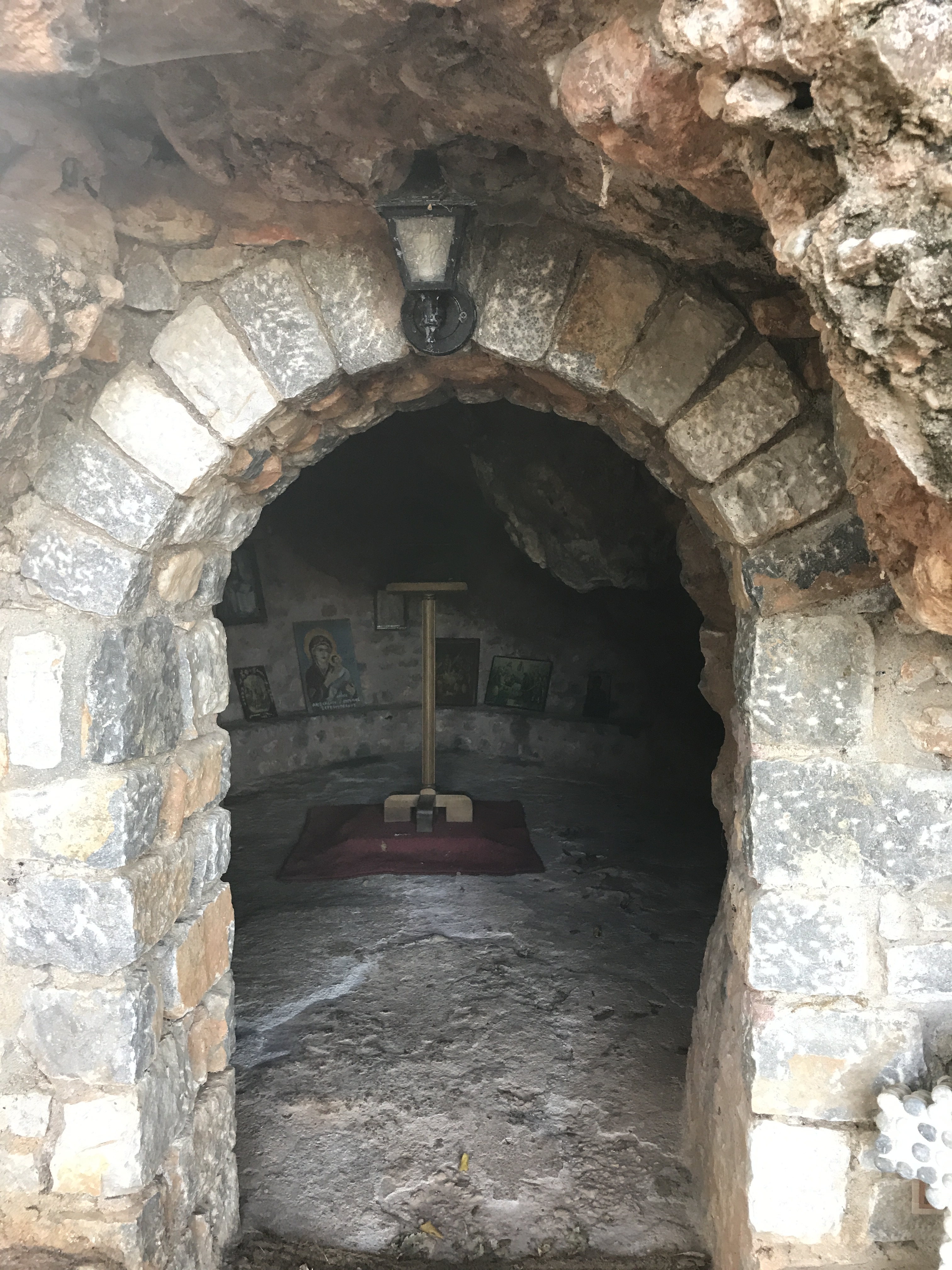
To me, the most amazing surprise of Faneromeni was its cave, situated to the left of the monastery, down a flight of stone steps.

Following the curve of the hill, I saw the opening, stepped inside and was stunned at what I saw–a mini-sanctuary complete with icons, candles and all required to hold an Orthodox service.

Church cave entrance

I marvel at the ingenuity and faith that created this sacred place! I stood inside for a long time, with so many questions and so many thoughts. It was the Orthodox Church which sustained the Greek peoples through 400 years of Ottoman rule. The astounding number of churches and monasteries in Greece is a testament to this fact.

The monastery grounds overlook the sea and provide a setting of tranquil beauty. It is easy to understand why this particular spot was chosen to house a building dedicated to God.


Cooking with Eleni

Greek food is the absolute best. Using the freshest of ingredients, locally-grown products, aromatic herbs and tangy spices, there is nothing that compares to this harbinger of the Mediterranean diet. Every Greek woman has her own way of making traditional recipes–those “secret” tips that make her cuisine unique.

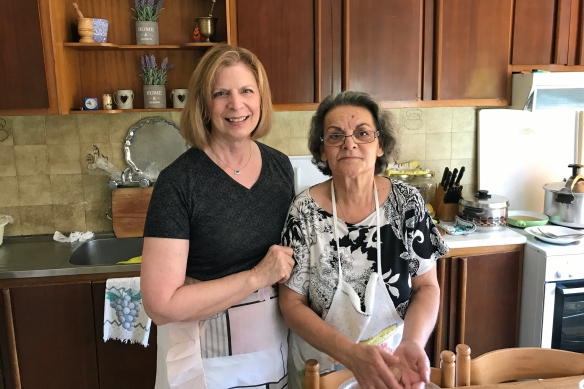
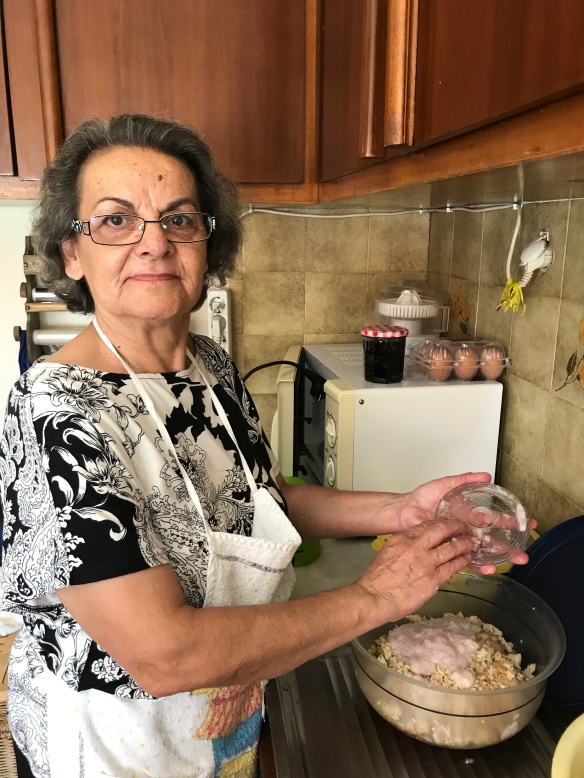
And this especially applies to my cousin, Eleni Koniditsiotis Kostakos, born in Amykles and now residing in Agios Ioannis. Because I offered to help one afternoon as she was preparing dinner, I finally, finally learned her secret to making meatballs that are soft yet firm.

The secret ingredient? Olive oil in the meat. It provides the “glue” to hold the meat, bread crumbs and other ingredients together and to keep the meatballs from falling apart.

Making the mixture; notice the puree of red onion and garlic

In this bowl are (no measurements): ground beef, dry bread crumbs as well as stale bread which has been rolled between our hands to make crumbs, a puree of garlic and red onions (this prevents chunks which cause the meatballs to crack), eggs, salt, pepper, basil and cumin. I was surprised that there was no oregano, but I might try adding some. And of course, olive oil. Lots of it! Squish everything together and start rolling the meatballs. I was surprised at how smooth they were, and that’s the secret to keep them from falling apart while cooking.

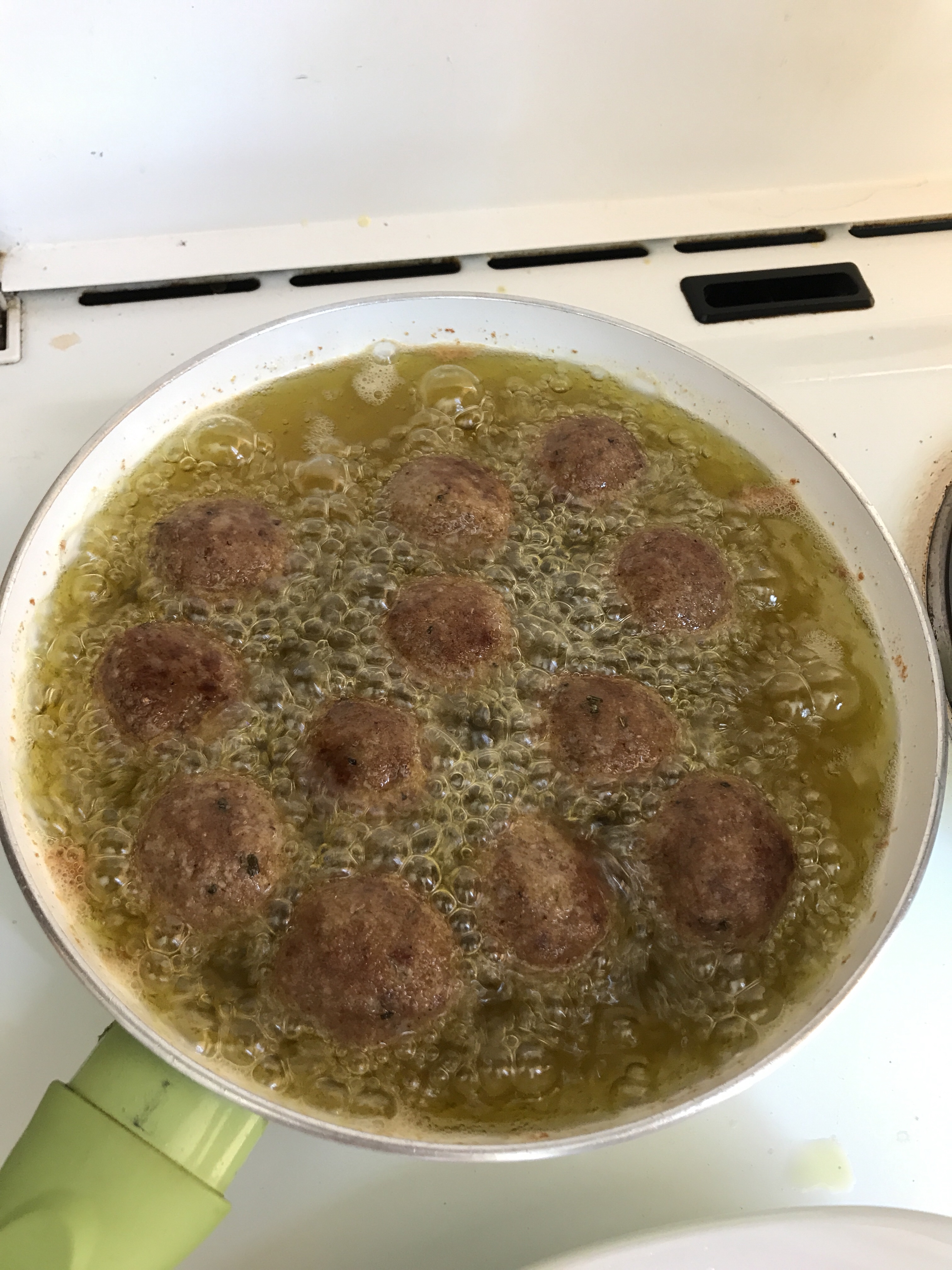
Next step: fry in lots of extra-virgin Greek olive oil! They are delicious served as-is, or in a homemade tomato sauce.

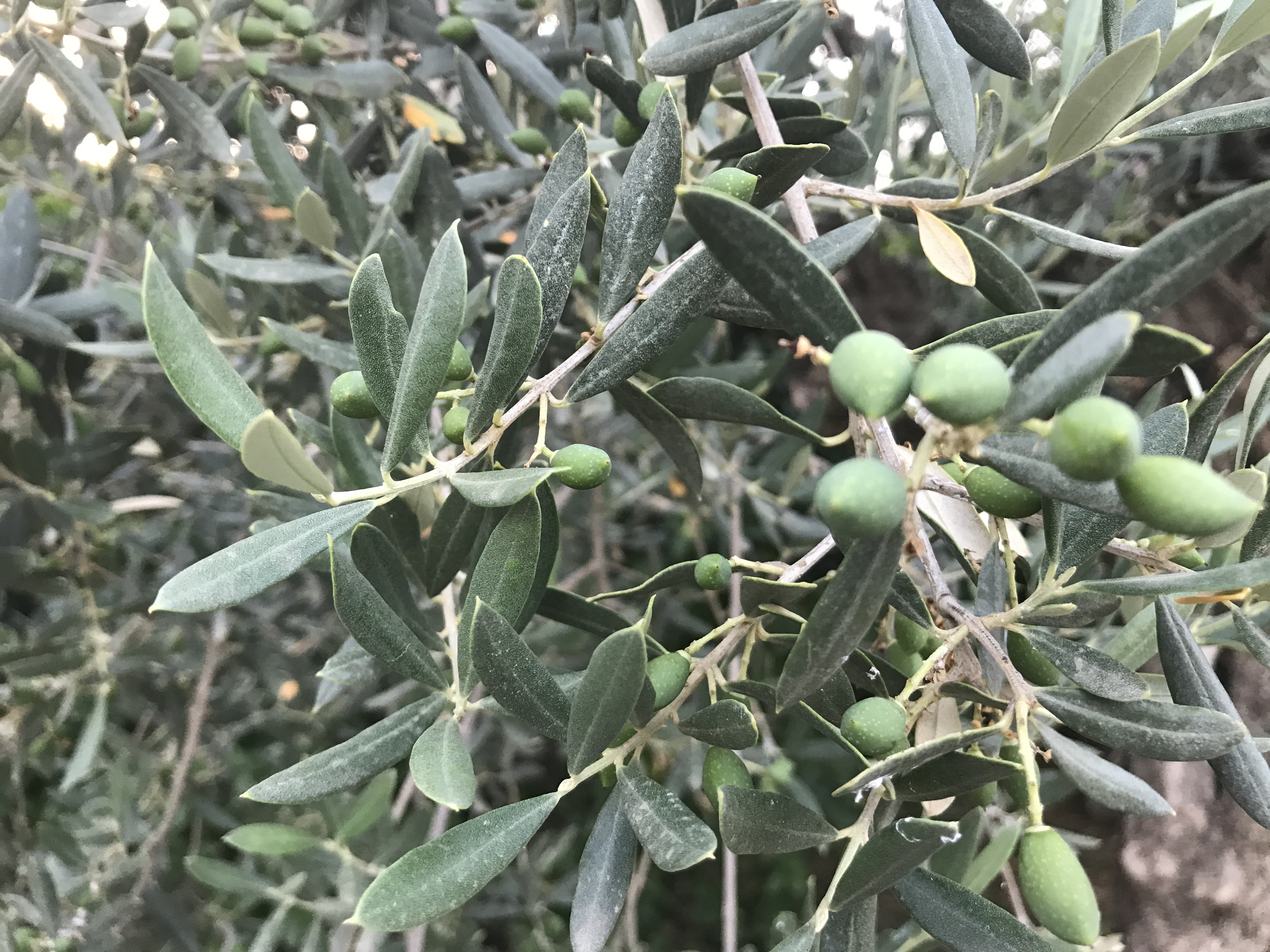
Speaking of olive oil, there is nothing like fresh-pressed oil found in every Greek home. Eleni’s family, like most in Sparta, have olive trees. The olives are beginning to grow now, and are harvested in early winter, November-December.

Baby olives

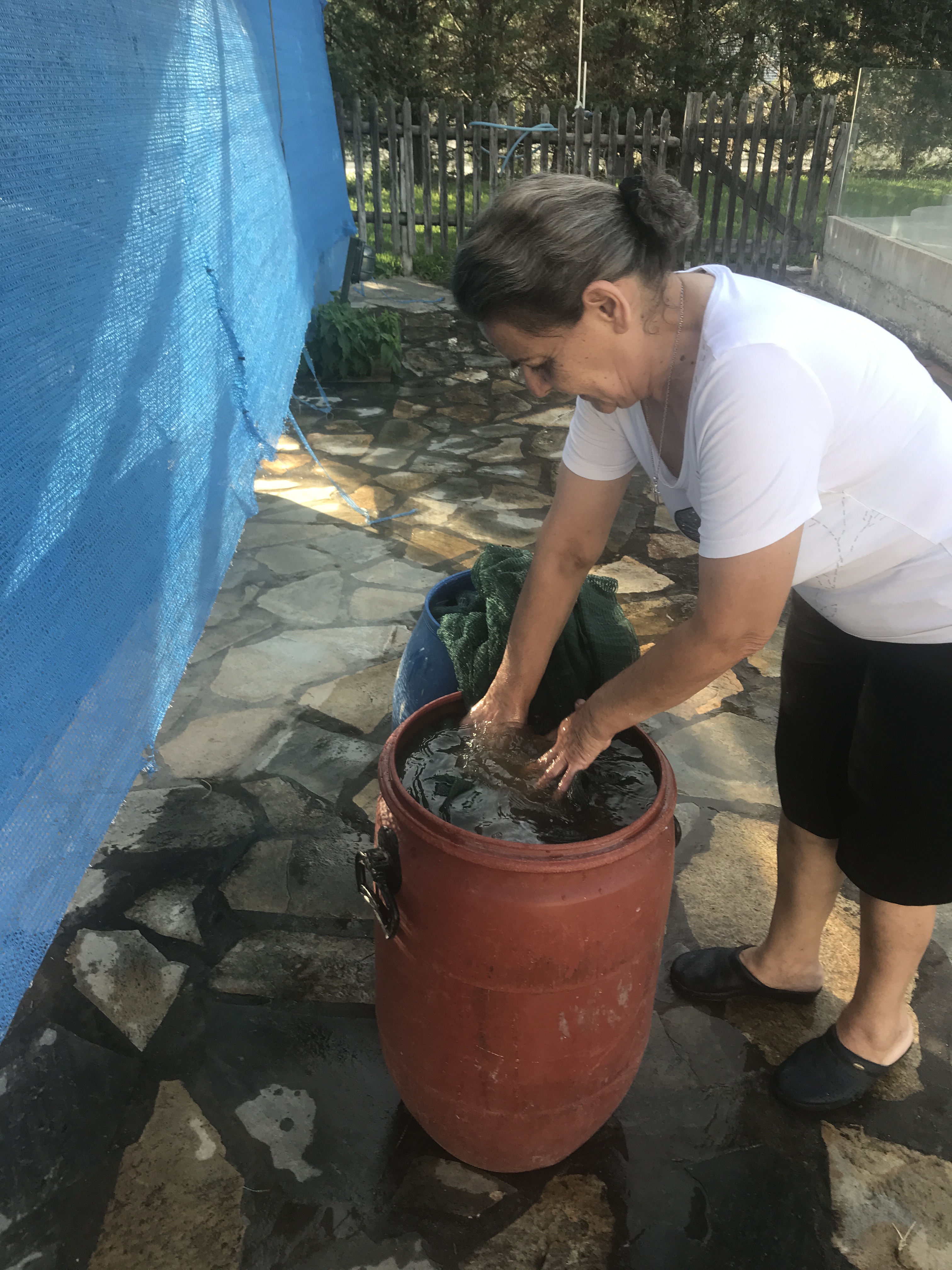
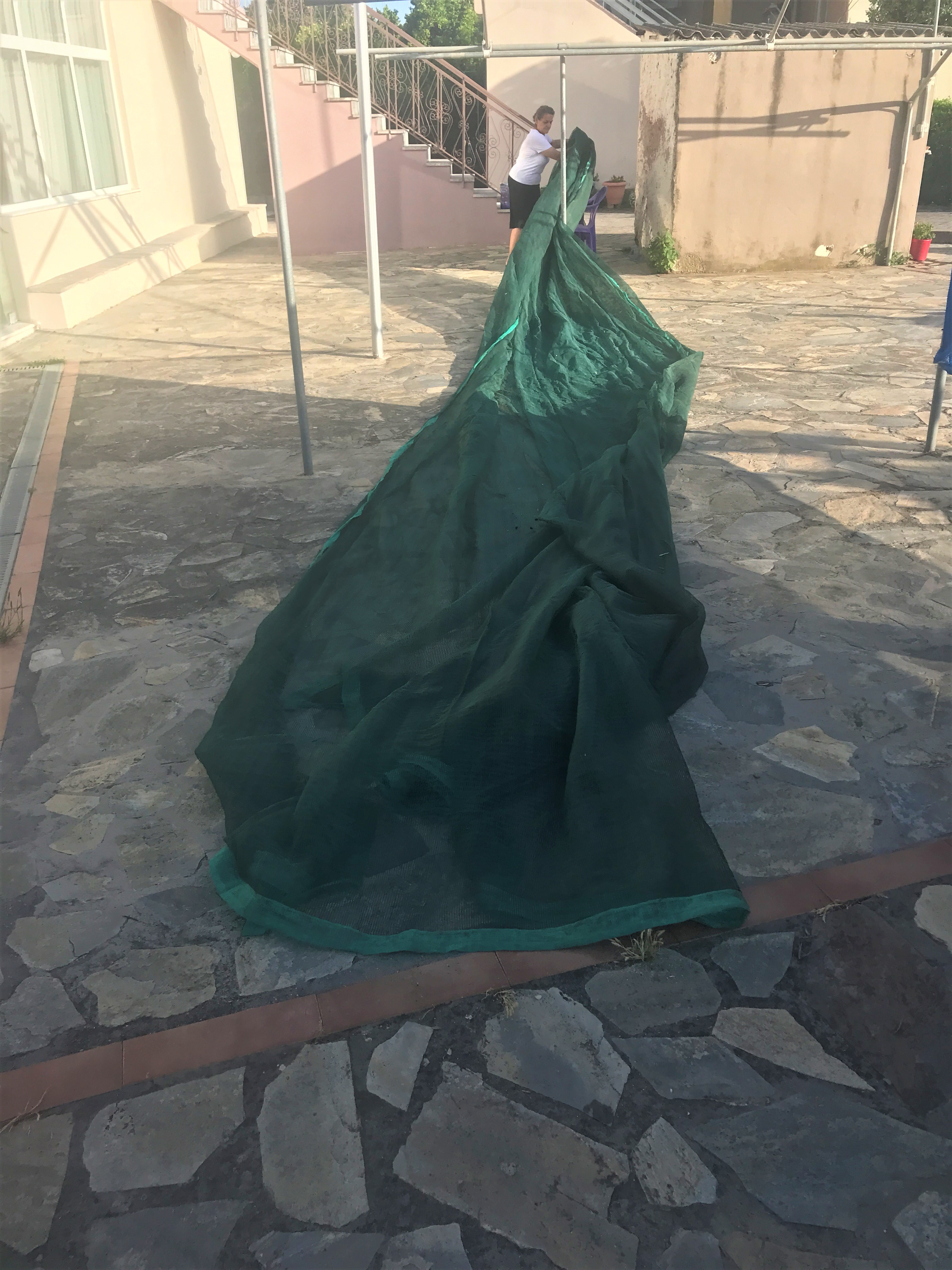
The harvest is a task that is done by hand, not machine, and the entire family works together. Preparation begins early. Last week, Eleni washed the nets which are spread under the trees to catch the fruit. She then stretched them out to dry.

Washing the olive nets


Drying the olive nets

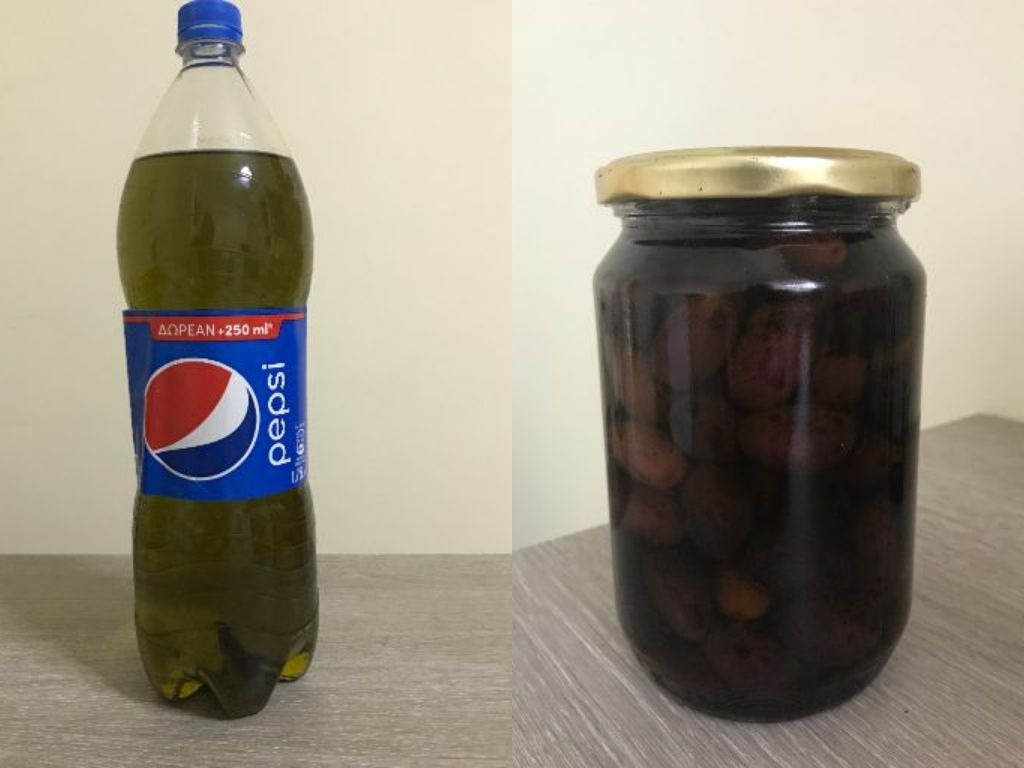
Every village has a processing plant where the oil is extracted; smaller settlements will bring their olives to the closest one. Families keep enough for their own use and may sell their surplus. I love Eleni’s olives. Unlike those sold in stores, hers are not kept in brine, but are packed in oil which makes them sweet, not bitter.

Eleni’s olives and oil. You can tell by the dark green color that this oil is the first-press, or extra virgin.

Now I have to figure out how to get bottles like these home!

Papa Georgiou’s Family Tree

I always enjoy talking with the priests who pop in and out of the room where I am working. Many are young and will spend a couple of years at the Sparta Mitropolis before they are assigned to a church. Others may spend a lifetime in service there. One of the longest serving priests in the Mitropolis is Papa Georgiou. For 50 years, he has daily and faithfully fulfilled his responsibilities and served five different Bishops. His eyes are kind, he is gentle, and he has maintained the Orthodox tradition of not cutting his hair or beard after being ordained a priest (today, priests can choose whether or not to follow this pattern).

One day when Papa Georgiou stopped by to say hello, we talked (using lots of hand gestures due to my broken Greek) about the importance of the digitization project — to preserve marriage records and eventually make them available to researchers around the world. Amazingly, my message was understood and his eyes lit up. With much enthusiasm, he began talking rapidly about his family and the research he had done. I had a hard time following him and must have looked a bit confused. He said he had something to show me.

He left the room, and returned with a scroll. As he began to unroll it, I could see he needed help. I held one end and continued to move backwards until it was fully unwound. I was truly speechless when I realized the scroll documented his family history research, and it stretched about 20 feet!

Papa Georgiou unrolls his family tree scroll, June 2018

Papa Georgiou has worked on his family history throughout his life. Yet, even though he has access to any and all records that are available in Sparta, he could go back no further than his great-grandfather, Konstandinos Blathras born 1790, died 1881. That’s about the time frame where most of us are brick-walled as well.

Papa Georgiou did not limit his research to Greece. He has family in America and traveled there many times to visit and gather the names of his kin. I was surprised to see that the data was typed in English. He explained that his nephew in America entered all his research into a computer and had the scroll printed. A perfect blend of old and new (a pattern I see everywhere around me in Greece).

To say that Papa Georgiou is proud of his family history research is an understatement. This is one of his crowning achievements. Just look at the joy in his face! My goal is to follow his example and leave such a legacy for my posterity.

Family history brings us joy!

R&R: Gytheio

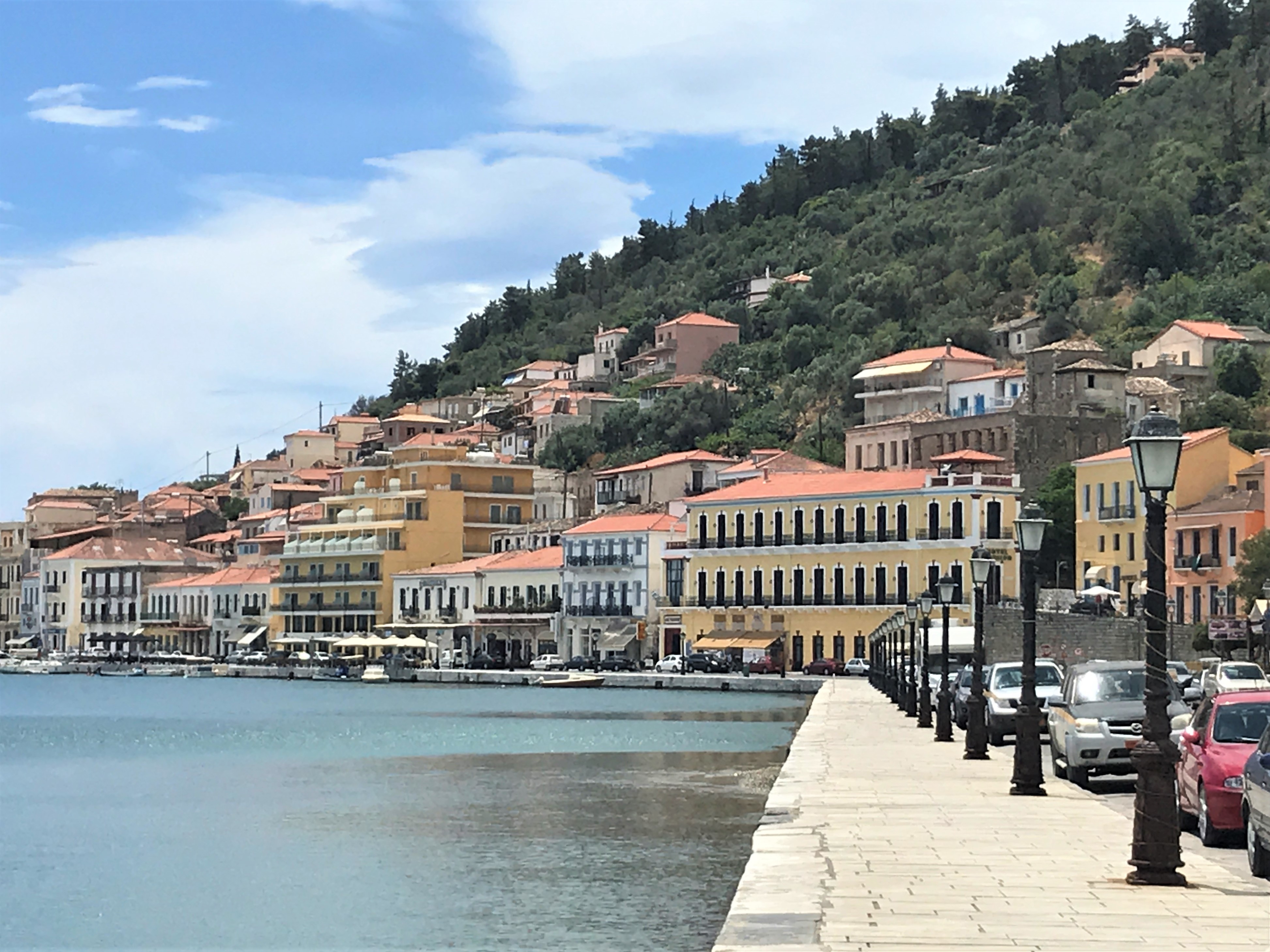
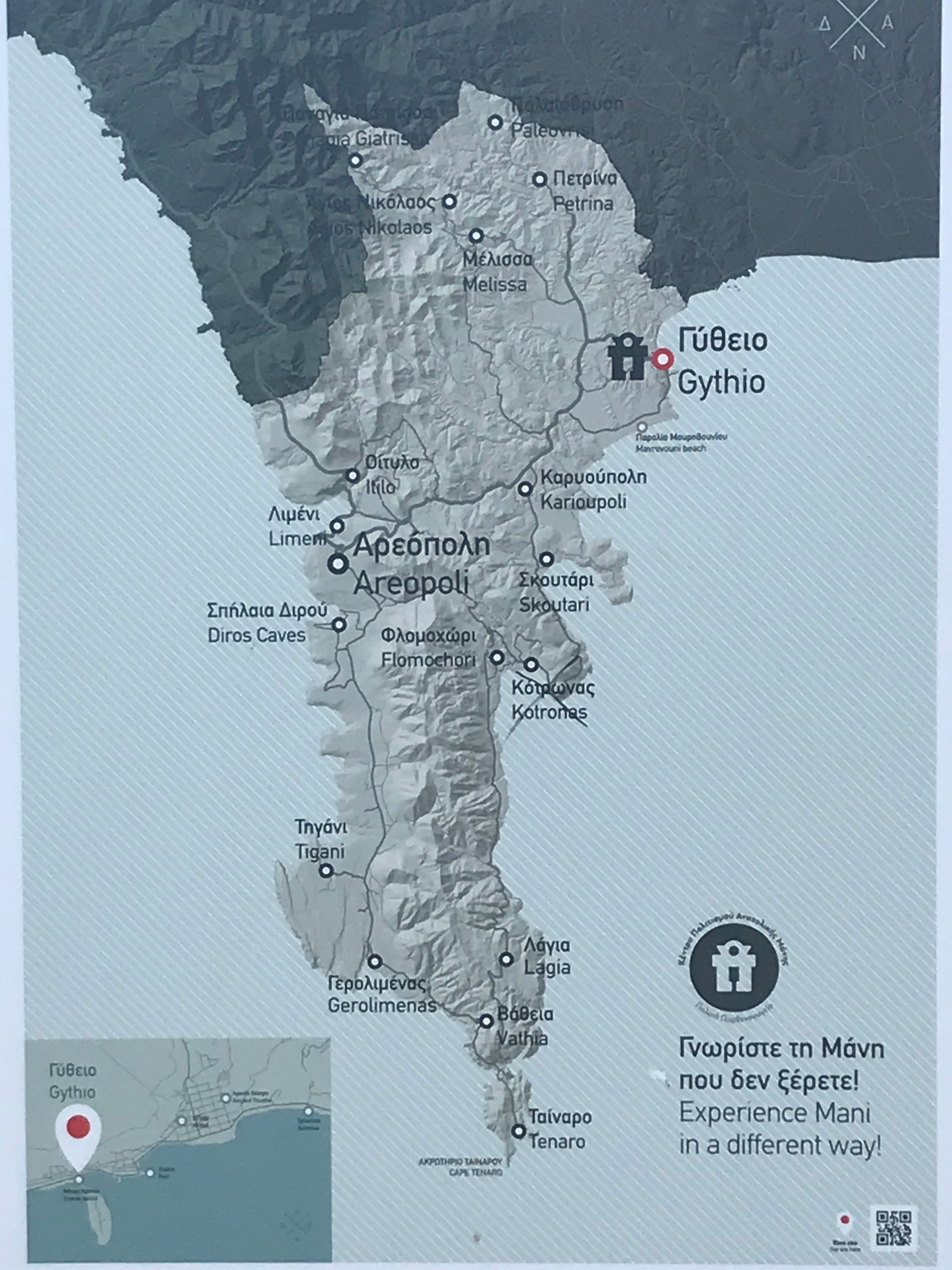
Rest and relaxation — time to get out of Sparta! After 2-1/2 weeks of long and tedious days handling dirty and moldy old documents, my body screamed for sun and surf. So I went where the locals go, south to Gytheio. It’s only 40 kilometers but a world away.

Homes on the hillside overlook the harbor, Gytheio, June 2018

Gytheio is the capital of Mani and the second largest city in Laconia.

Archaeological findings date Gytheio to ancient, even prehistoric, times. It has served as an important port for Sparta and the entire southern Peloponnese. Merchant ships bring in goods from foreign lands and take out olive oil and other products.

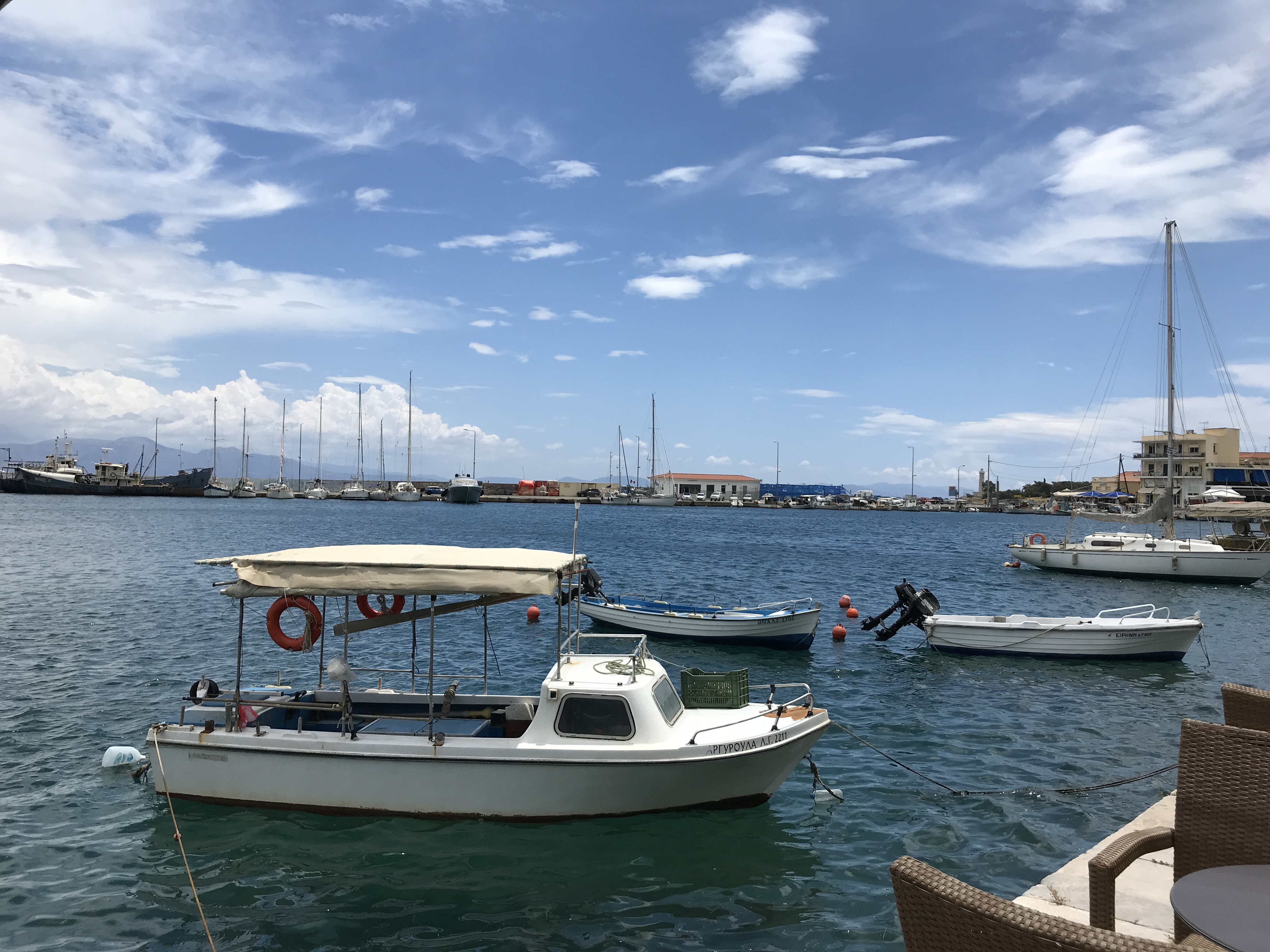
Boats moored in the harbor of Gytheio, June 2018

This city is a haven for tourists. I met people from the Netherlands and Germany, and I spotted several Americans. Sometimes when I speak Greek in public, people answer me in English. I once asked my friend, Giannis, why is it that people don’t think I am Greek–after all, I am a full-blooded Spartan and I was speaking the language. He replied that it is obvious that I am American. I thought that was an odd response until today, when it was easy to pick out Americans among native Greeks and Europeans, and they were not wearing jeans, white sneakers or tee shirts! Maybe we emanate a certain aura?

This is a fish-lovers’ haven, and fresh octopus was hanging everywhere, but not for me.

Not for me!

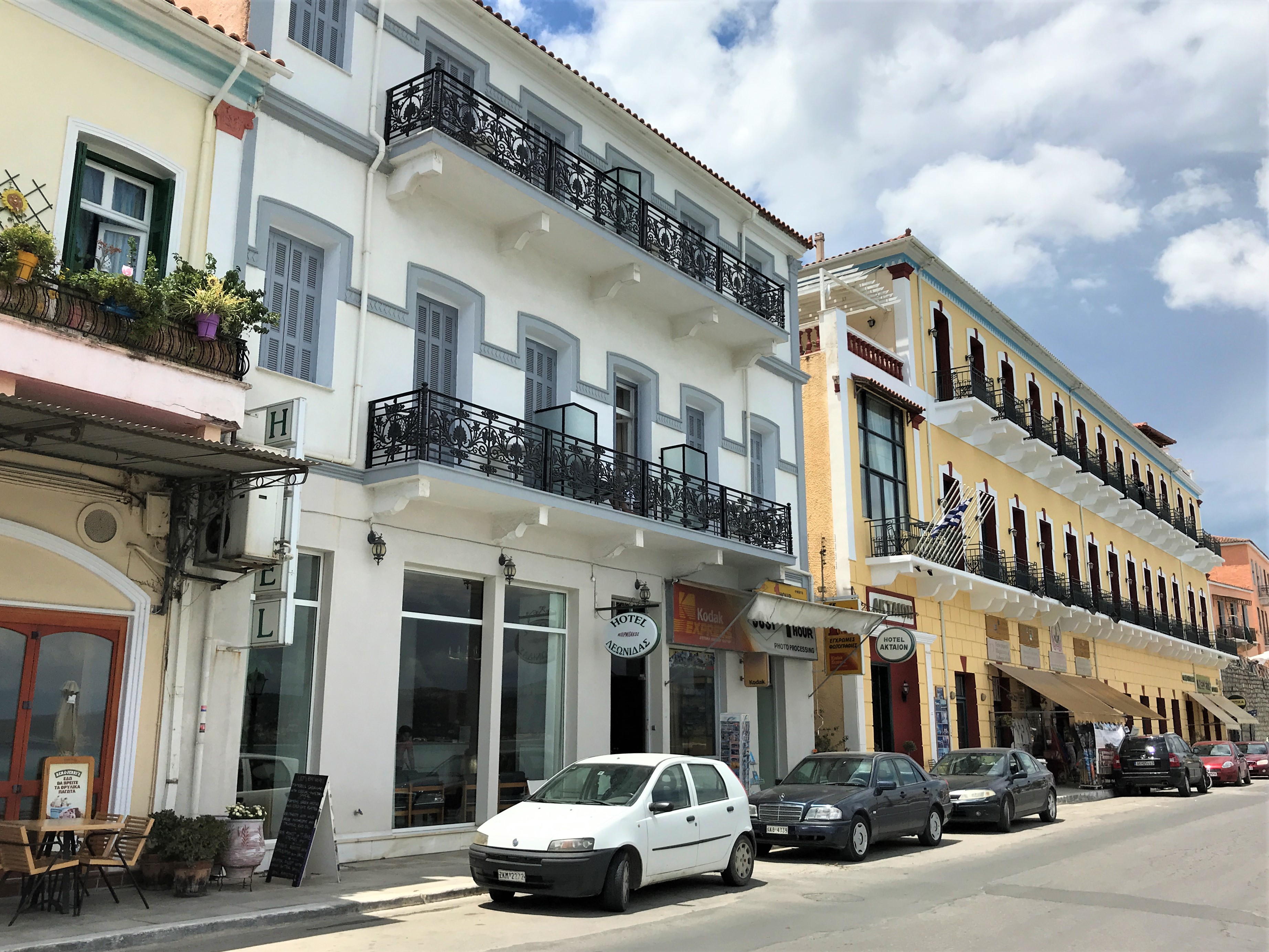
The city’s neoclassical buildings provide charming sophistication. Each one is distinct and different. The colors blend beautifully and give Gytheio its distinct look.  A lover of architecture could spend days here.

Each building is charming and unique.

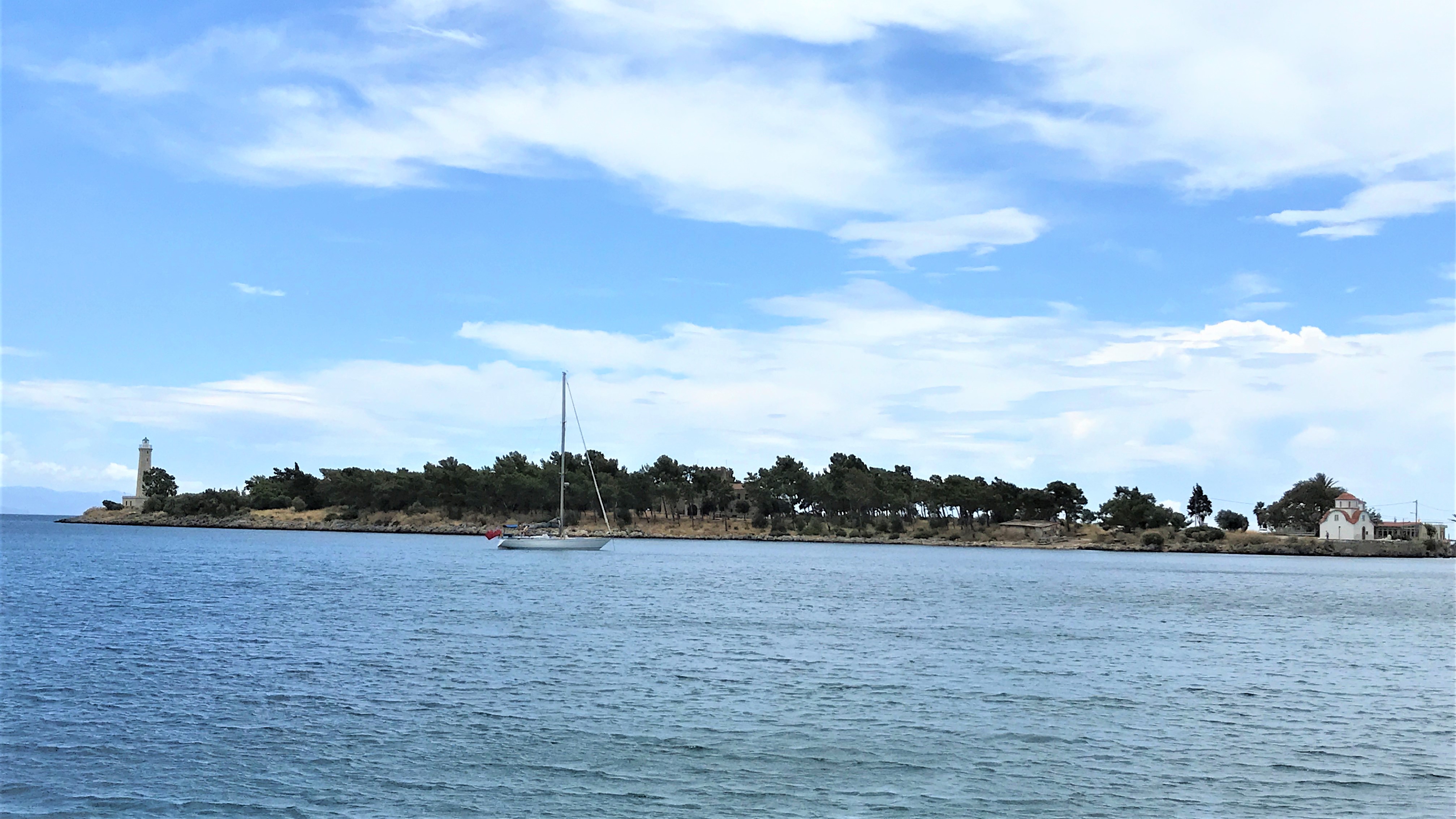
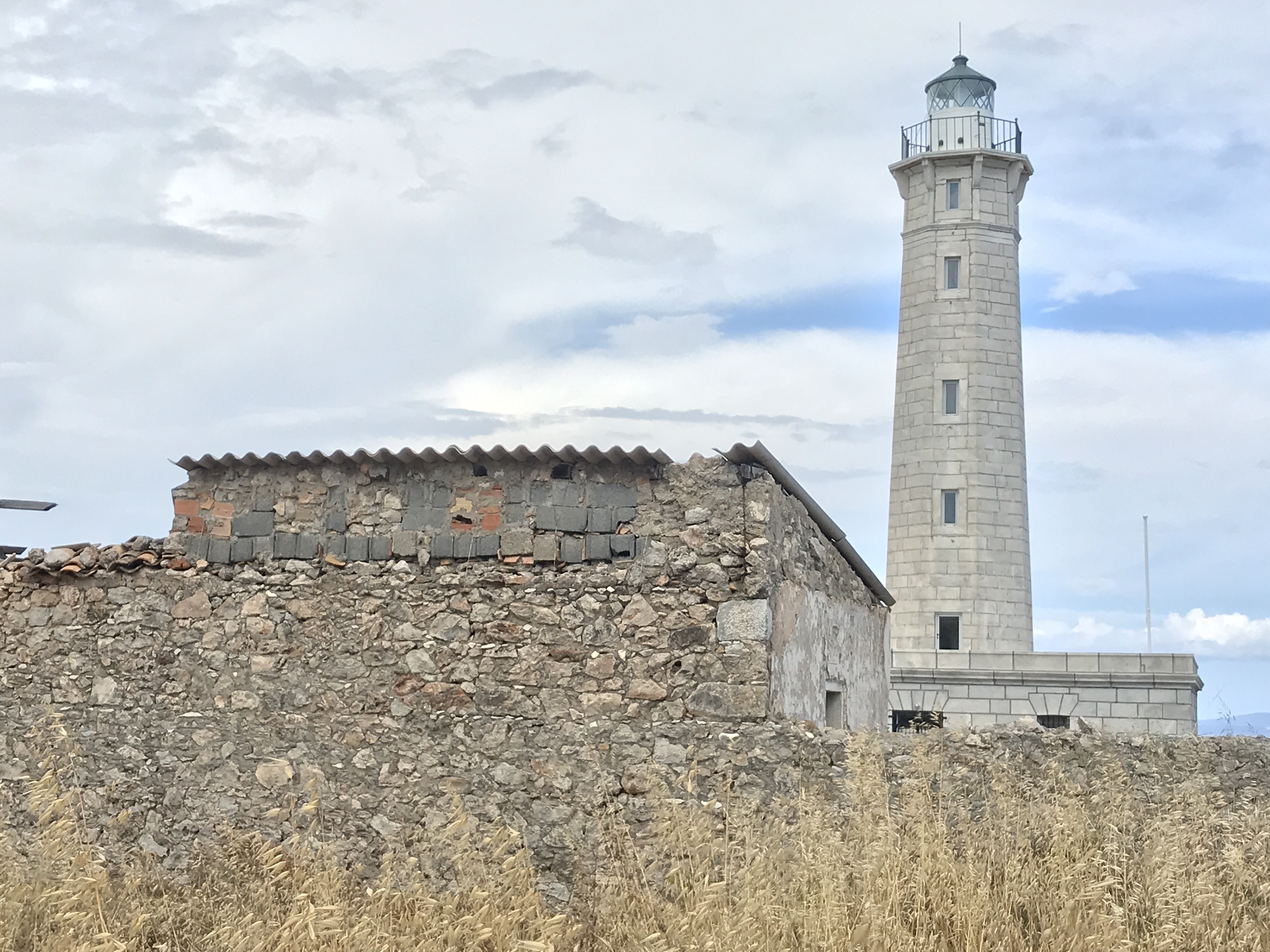
As I wandered along the waterfront, I noticed a lighthouse situated on a promontory.

This point of land is actually the Kranai islet, connected to the city by a concrete walkway. It led to beautiful and surprising things!

A tiny church (of course!)

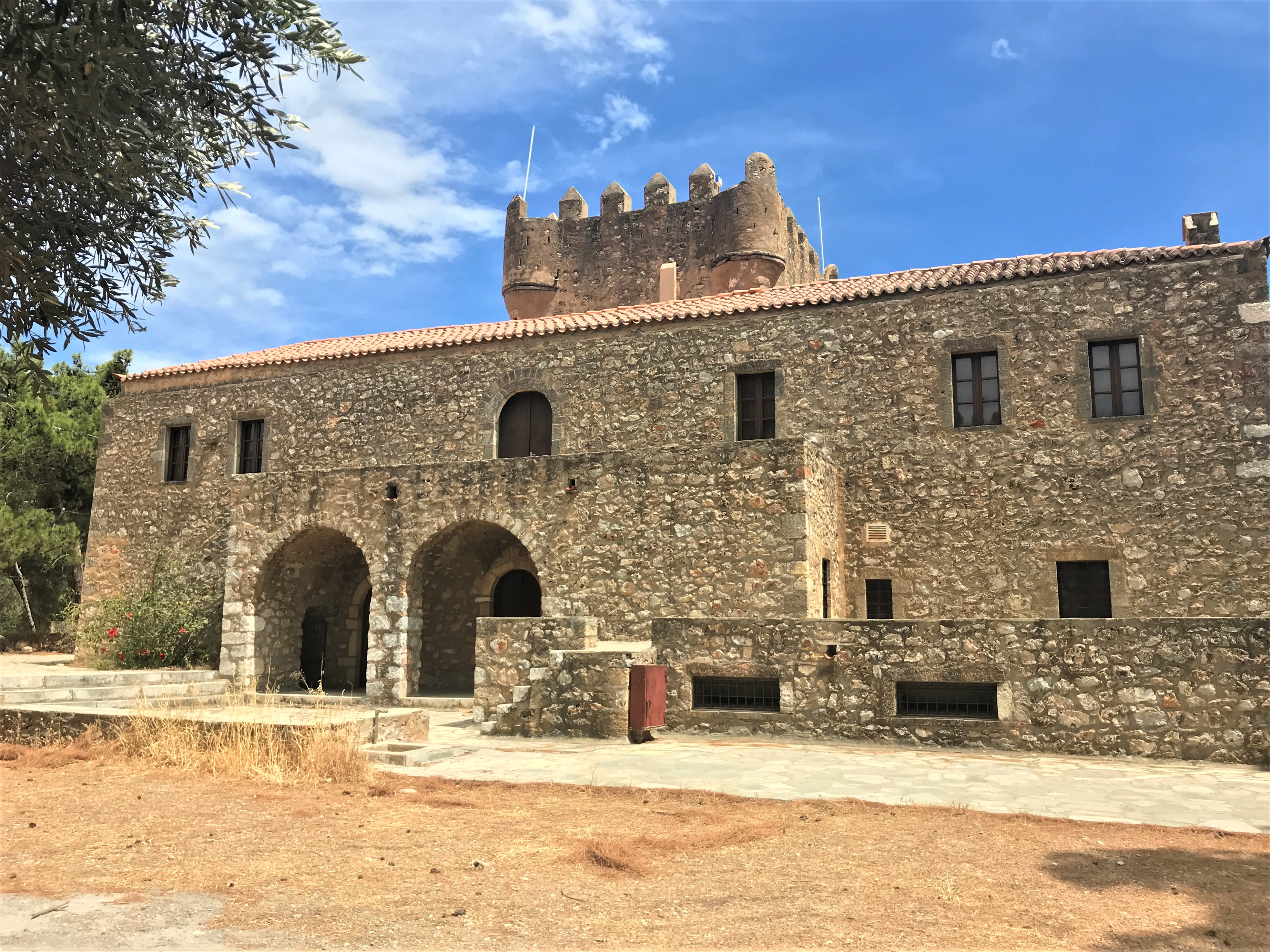
A fortress / castle / tower! This is the Tzanetakis Tower, built in 1829 by General Tzanetakis Grigorakis, who was one of the leading figures of the Grigorakis family of Eastern (Lower) Mani and a hero of the 1821 Revolution. One can only imagine what this building has witnessed. Its position on the island gives it a perfect view of the harbor and the city. The family continues to be prominent in contemporary Greece, and donated this tower to the government. It is now a museum but unfortunately was not open.

Tzanetakis Tower, Gytheio, June 2018

The tower commands a perfect view of the harbor and city.

The lighthouse looks fairly new, but the structures adjacent to it testify that a look-out building on this point has been in place for centuries.

Old and new, standing as sentinels to the harbor

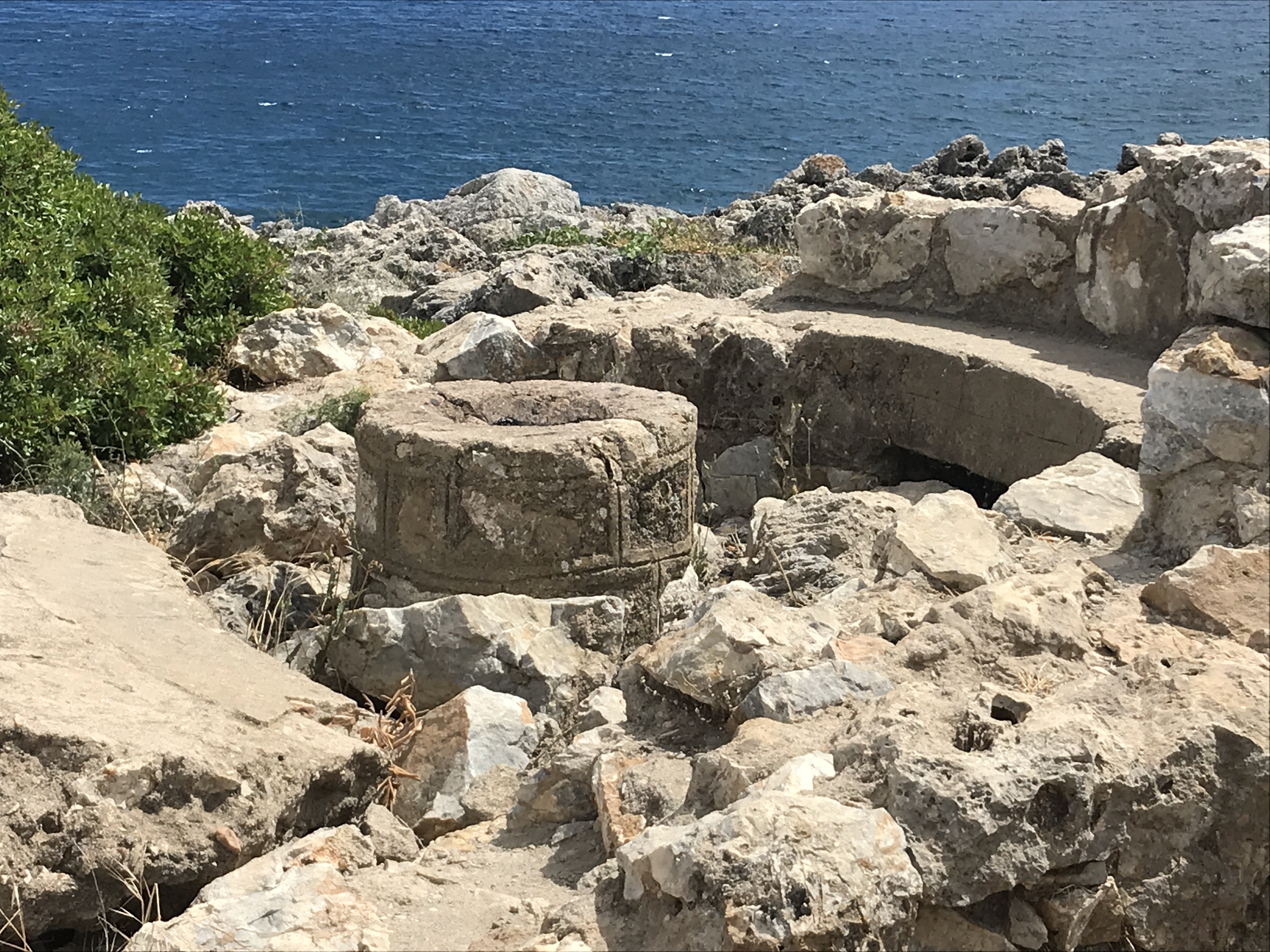
As I sat on a rock and absorbed the spirit of this place, I noticed an unusual round, stone circular structure at the edge of the water–obviously historic and meaningful, but unknown.

Ancient, but unknown – obviously important

I sat for a long time, taking in the sea, the view and the history. I wonder: what was life like for people living here in the 1700’s, 1800’s and even before. This is a land of rock and stone. There were pirates patrolling the seas, invasions by Turks, Venetians and others; there were vendettas among families and wars among clans. And of course, there were other harsh realities of life and the forces of nature–all combined to make Mani a very difficult place in which to exist.

But countering all this is the sea. And today, Mani’s beaches draw people worldwide who seek respite from the challenges of their own lives. Spending an afternoon in this environment of serenity and beauty is rejuvenating and refreshing.

Mavrovouni Beach

This day was so very needed by my body and soul. A dip into history and a dip into the sea. I’m now ready to get back to work next week!