Unknown's avatar

About Spartan Roots

I am of Greek ancestry with roots in villages near Sparta. My paternal grandparents and maternal grandfather were born in Agios Ioannis (St. Johns), and my maternal grandmother was born in Mystras. I love family history research and have been tracing my roots for many years. I was born in Brooklyn, New York and was raised in a predominantly Greek neighborhood close to extended family. I live in the Washington D.C. metropolitan area and work as a volunteer Co-Director of the Washington, D.C. Family History Center and a genealogy aide/project aide at the National Archives in Washington, D.C. I am always updating and adding new information. Please contact me - I would love to hear from you!

The Times of Our Ancestors’ Lives: Part Two, Home & Family

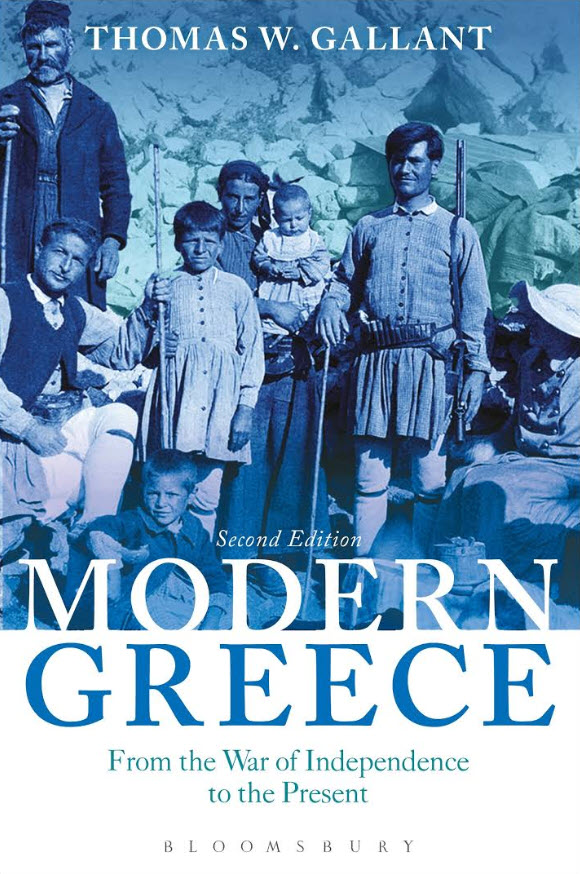
This post and part one examine the everyday life of our Spartan ancestors from the mid-1800’s to mid-1900’s, and draws upon Thomas W. Gallant’s book, Modern Greece From the War of Independence to the Present.

in the years after the 1821 Revolution, the majority of Spartans  lived, worked, married and settled within a few kilometers of their place of birth. Marriages occurred among couples living in close proximity–usually within one day’s walk or donkey ride from each other. Women married in their early twenties, and men by their late  twenties. Almost all Greek men and women married; they married somewhat younger and lived longer than their forebears; and they produced more children who survived into adulthood.[1]

Households were a mix of nuclear (parents and children), extended  (nuclear plus one or more relatives, often a widowed parent) and joint (one or more married siblings, usually brothers, with their families residing together). Sometimes, the family occupation determined which type was most beneficial; for example, “more complex households were better able to pool resources and manage labor in a way better suited to the needs of shepherding, especially where transhumance was involved.”[2]

Herding goats in Vathia, 2014

Newlywed Spartans followed a common pattern found throughout southern Europe:  their new household was formed by “combining the land that the husband received as his inheritance with the property that the woman brought through her dowry.”[3] Young girls worked for years preparing their dowries, which consisted of linens, clothing, jewelry, household utensils and often land. (See this post about dowries.) Thus, the contributions of both men and women were equally important in creating a fully and mutually supportive household.

The Men

The σπίτι (literally “house” but used to designate the household) was the primary unit of society and family, and it was the man who was its primary protector. Gallant explains:

A man’s overarching obligation was to protect and further the interests of his household, his σπίτι, and after that, it was to the extended network of men to whom he was related by blood. Should a conflict arise between household and community, between kin and non-kin, the former always took precedence. Household interests come before all others.[4]

Interwoven with responsibility for the σπίτι  is the concept of τίμι or honor. This was of  paramount importance in the Greek community. A man of τίμι commanded respect by maintaining firm control of his land, property, animals and family. As such, he could deploy any means to defend and protect them. In 19th century peasant society, if a man or his family was insulted, injured or wronged in any way, “he had to respond with aggression or risk seeing his reputation diminished.”[5] The result was often manifested in a vendetta, a form of honor-related violence. Any threat, implied or real, to the σπίτι justified a man’s need to defend his family and thus, his own character. Of the highest priority was protecting the reputation of women. If confronted with “any imputation that the women of his household were anything less than chaste, a man had either to rise to the challenge and fight, or be humiliated. This form of violence was socially sanctioned and accepted.”[6] While many vendettas became feuds ending in death, others were resolved by arbitration sealed with the payment of “blood money” and even marriages between the dueling parties.
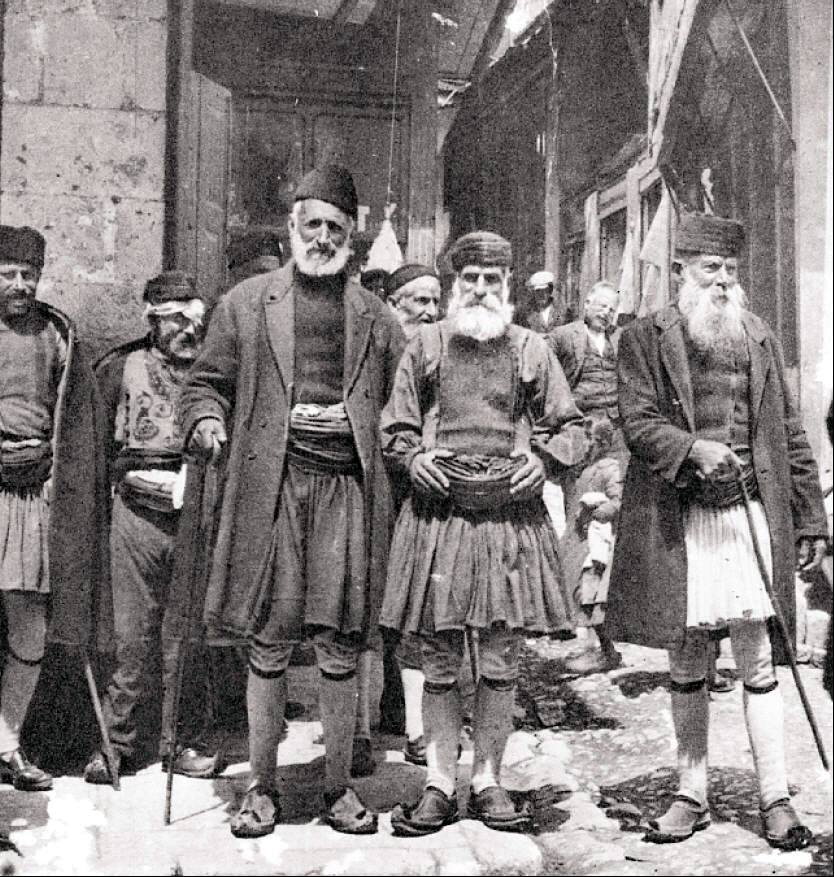
Elder Tripolitsiotis with fusanelles, c. 1900. Archive of N. Grigorakis. From the tribute to Kathimerini on 4/6/1995 “Tripoli the heart of the Peloponnese.” Appreciation is given to Giannis Mihalakakos for sharing this photo.

The strata of Spartan society, even in rural villages, reveals a variety of levels tied to men’s occupations. Some households were larger and wealthier than others, employing laborers to work their fields and shepherds to tend their flocks. Men’s  occupations included: shepherds, goatherds, farmers, landowners, laborers, traders, grocers, butchers, bakers, tobacconists. Some learned trades and hand crafts, working with leather, wood or stone; these men became sandal makers, rope makers, cobblers, masons, carpenters. Schooling, if it existed, was rudimentary and most adults were illiterate.

The Women

“In many ways, a woman’s life only began when she got married. Marriage signified not just her transformation from child to woman but it also marked the union between two households and between two sets of kinsmen…Once a wife, a woman had to conform to roles society defined for her.”[7] These roles were paradoxically simple yet complex. The house was her domain; modesty was her virtue. From bread for the stomach to prayers for the soul, a woman provided both physical and spiritual nourishment to those within her σπίτι.

Her life was dominated by food preparation, fetching water, and the care and nurture of children. Women spun and wove cloth, and produced clothing. In the early-mid 1900’s, many Spartan families owned silkworms and it was the women who tended them, spun the silk and created intricate embroidery. They also worked the fields, threshed grain, tended animals and assisted during the harvest.

Cornelia Themistocles, baking bread in her outdoor oven, c. 1930; photo courtesy of Theodore Papaloizos

Like men, women defended their own reputations and that of and their family members. Unlike men, they did not resort to violence, but to words. Gallant wrote:

“There was an ethical code for women similar to men’s honor and, like men, women engaged in contests over reputations…If a woman did not contest malicious gossip about sexual comportment, the cleanliness of her house or her devotion to the church, her sons might have a harder time to find a good match, her daughters might require a much larger dowry to secure a husband, or her spouse might find himself drawing the blade to defend her and his reputation.”[8]

.Although men and women’s lives were segregated by custom and tradition, they were united in one common purpose: to prosper the household and protect those within it. That tradition remains paramount in Greek families through today and throughout the diaspora, and is a hallmark of our Hellenic heritage.


____________

[1] Gallant, Thomas. Modern Greece, New York: Bloomsbury Academic, 2016. p.121.[2] Ibid., p. 122.
[3] Ibid., p. 125.
[4] Ibid, p. 124.
[5] Ibid., p. 143.
[6] Ibid., p. 145.
[7] Ibid., p. 148.
[8] Ibid., p. 150.

 

The Times of Our Ancestors’ Lives: Part One

Who we are is a product of multiple factors:  genetics, environment, and opportunities (or lack thereof). So it was with our ancestors. Where they lived and how they lived framed their mortal existence; but it was their personalities which molded their lives.From the villages of Sparta and the southern Peloponnese came a great exodus of young men in the 1880’s to mid-1900’s. Seeking relief from poverty and focusing on a new world, the majority were from Laconia, perhaps as many as 3/4 of its adult males (ages 18-35) eventually left. They embarked as pioneers and emerged as prototypes, paving the way for the thousands who followed.

Knowing their environment is critical to understanding the choices our ancestors made. I am finding that Thomas W. Gallant’s Modern Greece is an excellent resource, and its chapter, “Society and Economy” describes the everyday world of a rural Greek village and home. In this post, I have extracted information from Gallant’s book to help us understand the times of our ancestors’ lives.

Although over 50% of the Greek population today resides in the Athens metropolitan area, this was not the case 100 years ago and before. The 1861 census revealed that 74% of adult men were farmers or sharecroppers; by 1920, this barely dropped to 70%. [i] Thus, the majority of families’ financial securities were tied to crops, a variable commodity. The demise of the current crop caused a revenue crisis in the 1890’s which, in turn, was a major factor in the earliest wave of emigration.

The typical village had a population of 200-300, or 600-700 people. In 1920, almost 52% of the population of Greece lived in villages of less than 1,000 people, and about 35% of people lived in villages of less than 500 people.[ii]

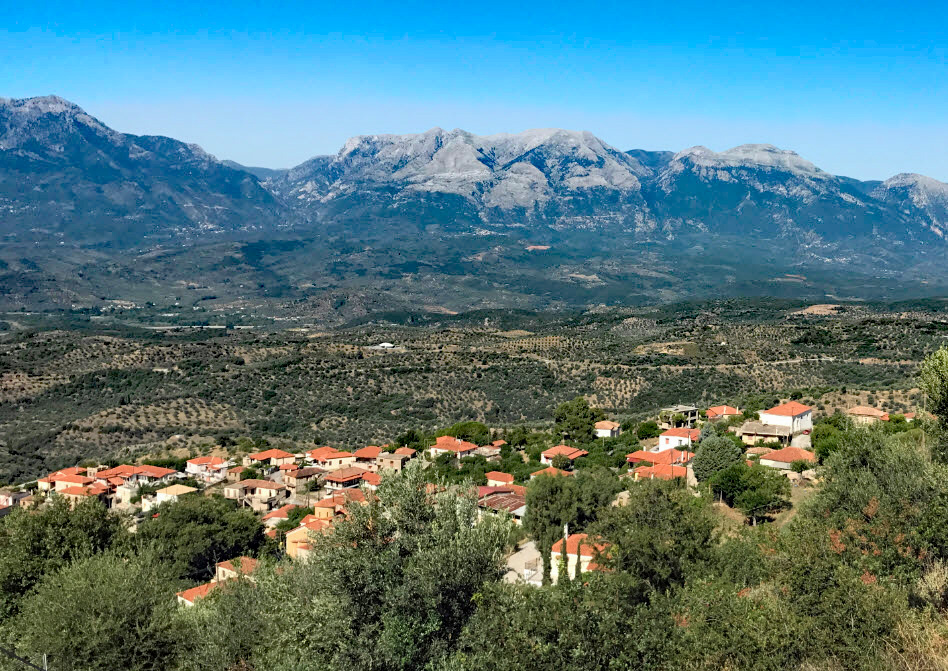
Theologos, Oinountos, Laconia, 2017. This village is 6 km straight up a mountain, and is the home of my great-grandmother, Stathoula Zaharakis

Villages around Sparta are nestled in majestic mountains, and until the mid-1900’s many were accessible only by foot or donkey. Building in the foothills and even atop mountains was a necessity, as flat, arable land was scarce and designated for farming. Space in the center of the village was reserved for the church and the town square or platea, the hub of social life.

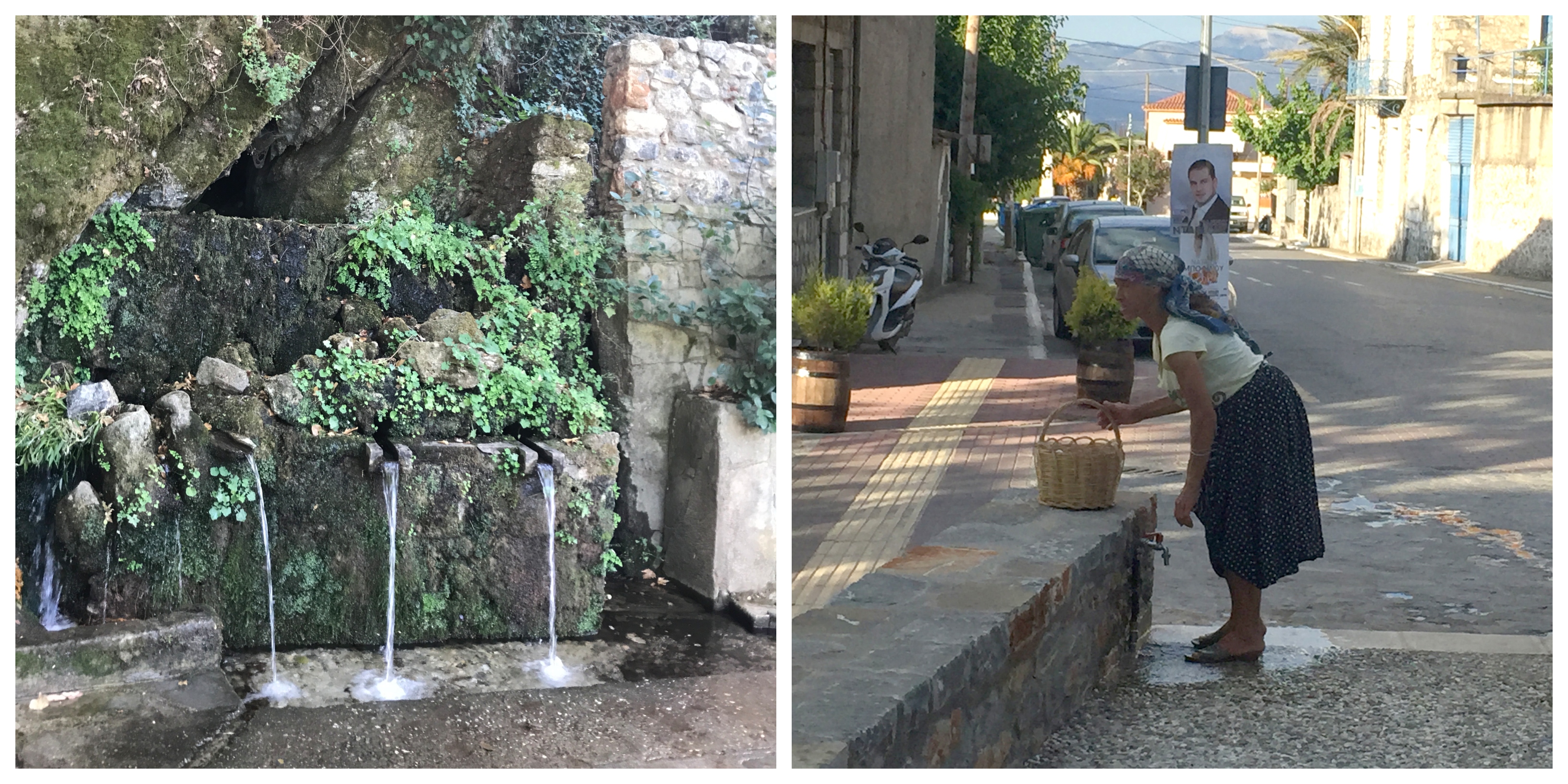
The arid climate and hot, dry summers required a source of water, and villages were settled near rivers or streams. Even today after hundreds of years, pure mountain water gushes freely from rocks and every village has fountains which are in constant use.

left: water gushes from the mountain in Pikoulianika; right: a fountain in the platea of Xirokambi.

In the summer, shepherds took their flocks of goats and lambs to graze high in the verdant hillsides, several kilometers from their home. There, they lived in small huts known as kalyva. A settlement of several huts occupied by shepherds of the same village could get its own name. For example, a group of huts occupied by shepherds from the village of Soha would be given the name Kalyvia Soha. During winter, the shepherds would leave the mountains to reside in their primary home in the village.

Most farms were single-family peasant households. The father was the primary laborer, with his sons assisting as they grew old enough to work in the fields. Women also helped by weeding (considered to be “woman’s work”) and on a seasonal basis during harvests. The primary focus was to provide enough food for the family; therefore, a variety of small crops would be planted:  wheat, barley, maize, legumes with some olive and fruit trees, and vines. Tools were wooden and rudimentary. Livestock would include a donkey; sheep and goats for milk, cheese, hides and wool; and chickens for eggs and meat.[iv]

Despite its self-sufficiency, every Spartan family needed cash. Goods such as salt, tea, coffee, gunpowder, and metal had to be purchased. Dowries had to be provided. Funerals and weddings necessitated money, as did medical and other family expenses. Thus, a means of generating cash income was required. Many families grew a “cash crop” which could be sold locally, such as tobacco, grapes, or cotton. Some produced extra olive oil or wheat. In other cases, groups of male kinsmen (brothers, fathers and cousins) or entire families would work as seasonal wage laborers harvesting grain or picking grapes. Or, men might acquire skills such as smiths, knife sharpeners, carpenters and masons. They would travel the countryside, offering their skills in small villages that could not support a full-time artisan on their own.[v]

Our Spartan ancestors would have encountered a “myriad of movement across the countryside” of ξένοι (foreigners) whose livelihoods necessitated being on the move:  transhumant  shepherds of certain ethnic groups who specialized in large-scale animal husbandry, or itinerant merchants who transported goods over land on donkeys.[vi] “The image of the nineteenth-century Greek villagers as ensconsed in their little villages, isolated from and ignorant of the wider world, is grossly inaccurate. No village was an island unto itself. The Greek countryside was a fairly dynamic place characterized by a relatively constant movement of people across it and periodically punctuated by the larger-scale arrival and departure of work gangs, itinerant merchants and artisans, donkey caravans, shepherds with their families and flocks, and of course, the dreaded bandit gangs which continued to be a menace to society until late in the century.”[vii]

Thus, despite the relative isolation of many villages, people were exposed to news, ideas, and customs which expanded the microcosm of their world.

[Part Two will cover the social world of men and women, and the home.]

____________
[i] Gallant, Thomas. Modern Greece, New York: Bloomsbury Academic, 2016. p.127.
[ii] ibid., pg. 128.
[iii] ibid., pg. 129.
[iv] ibid., pg. 135.
[v] ibid., pg. 140.
[vi] ibid., pg. 140.
[vii] ibid., pg. 141.


Beyond the Basics: Φ.Ε.Κ. The Official Newspaper of the Government of Greece

[Note: this article has been updated from a previous version published on Spartan Roots on November 3, 2018.]

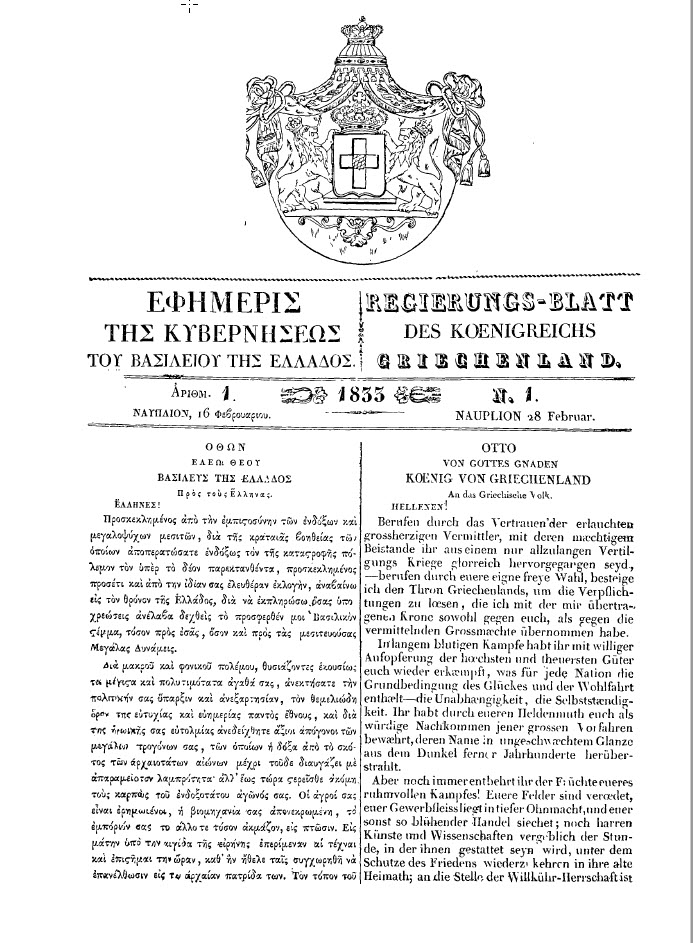
Φ.Ε.Κ. or the Government Gazette, is the official newspaper of the Greek Government, and as such, is recognized as the only governmental form through which all laws, decrees, appointments and judgments are published. The first issue was printed on February 16, 1833 and was called the Newspaper of the Government of the Kingdom of Greece  (at that time, Greece was ruled by King Otto). Until June 1835 the paper was published in two columns; the left in Greek and the right in German. Some issues after 1835 are in Greek and French.

The newspaper has been published weekly from1833 to present. The website of the National Printing Office of Greece has digitized and uploaded Φ.Ε.Κ. issues at http://www.et.gr.  This link will take you to the search page:  http://www.et.gr/SearchFek.

Following are instructions to access this site. NOTE: I have used a Google Chrome browser extension to translate these pages into English. If you do not use a translating extension, the pages will be in Greek.

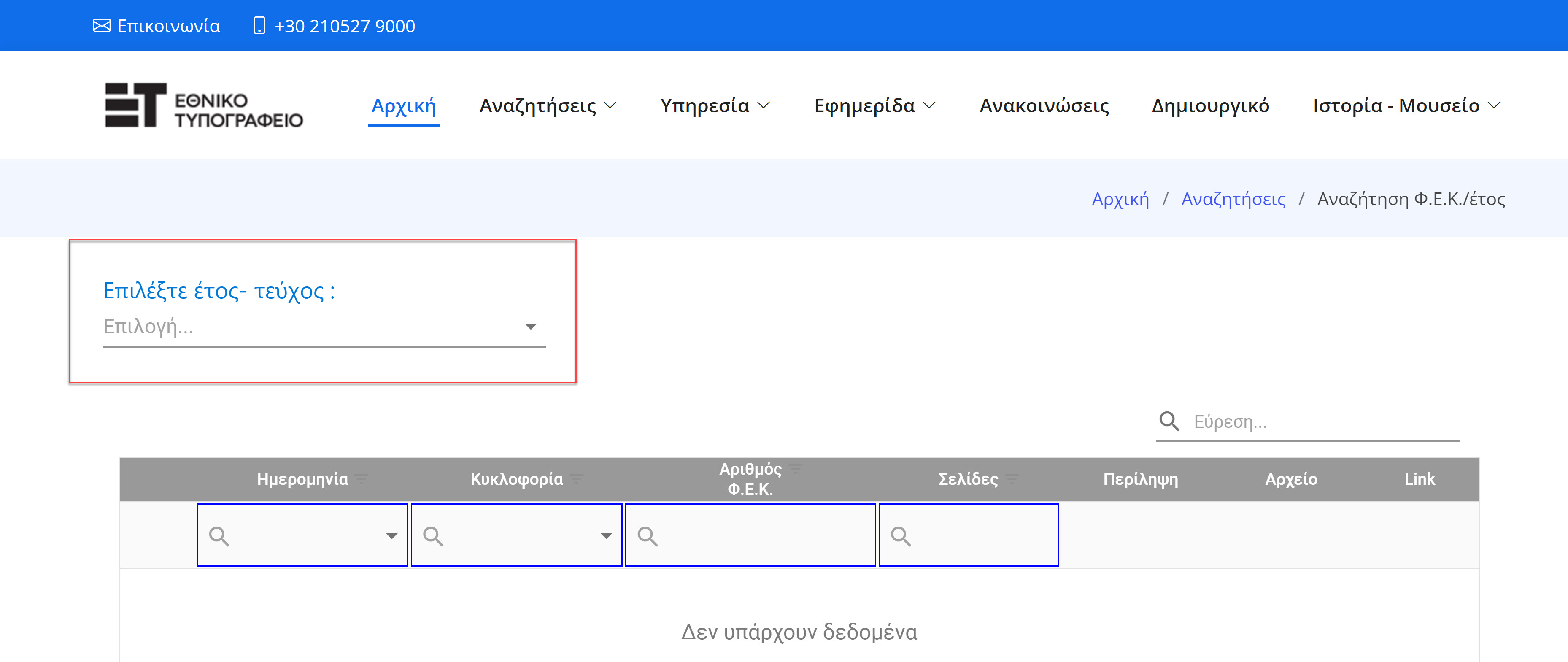
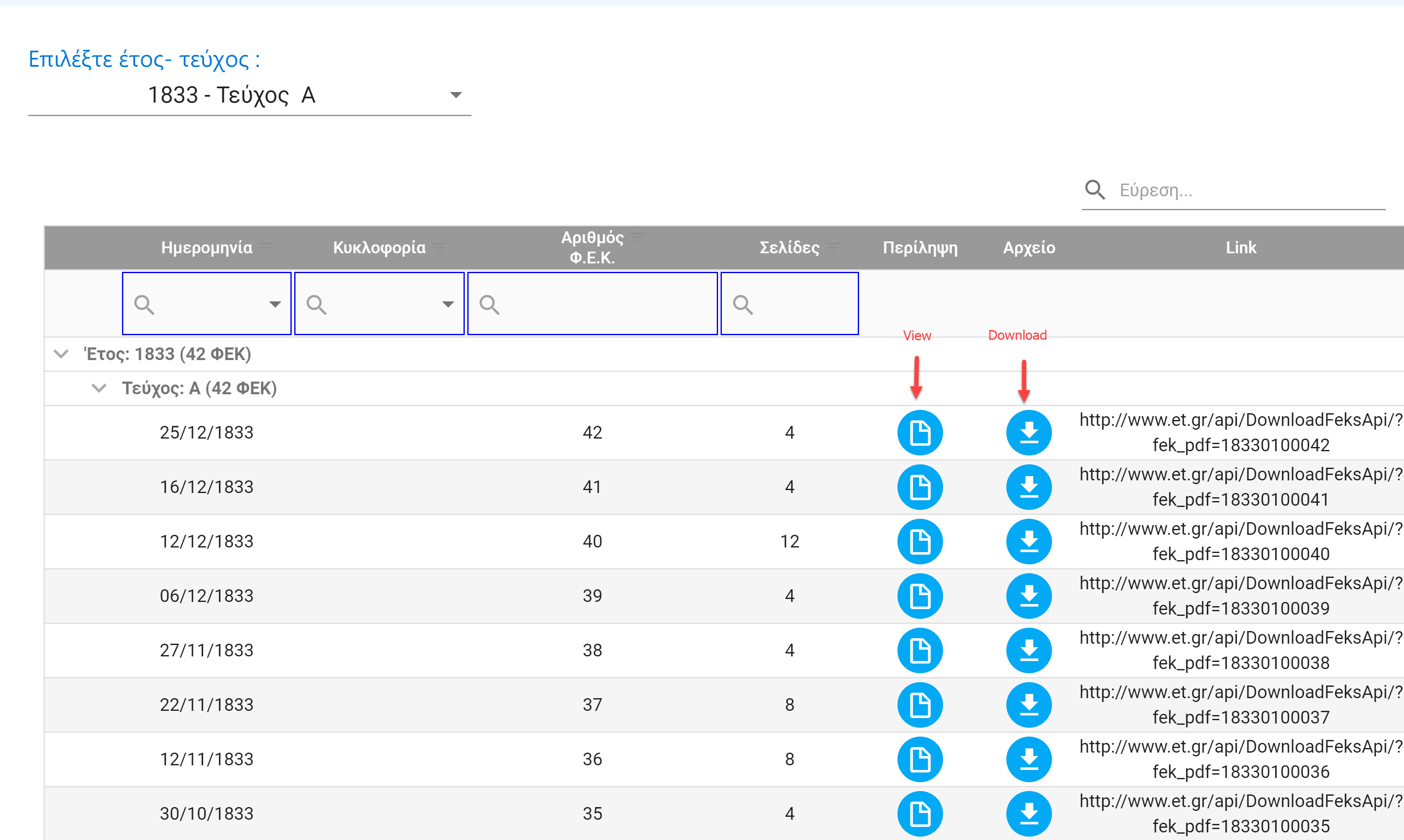
The URL http://www.et.gr/SearchFek will take you to the following page. Click on the down arrow next to: Επιλέξτε έτος- τεύχος (select year – issue).  (outlined in red below)

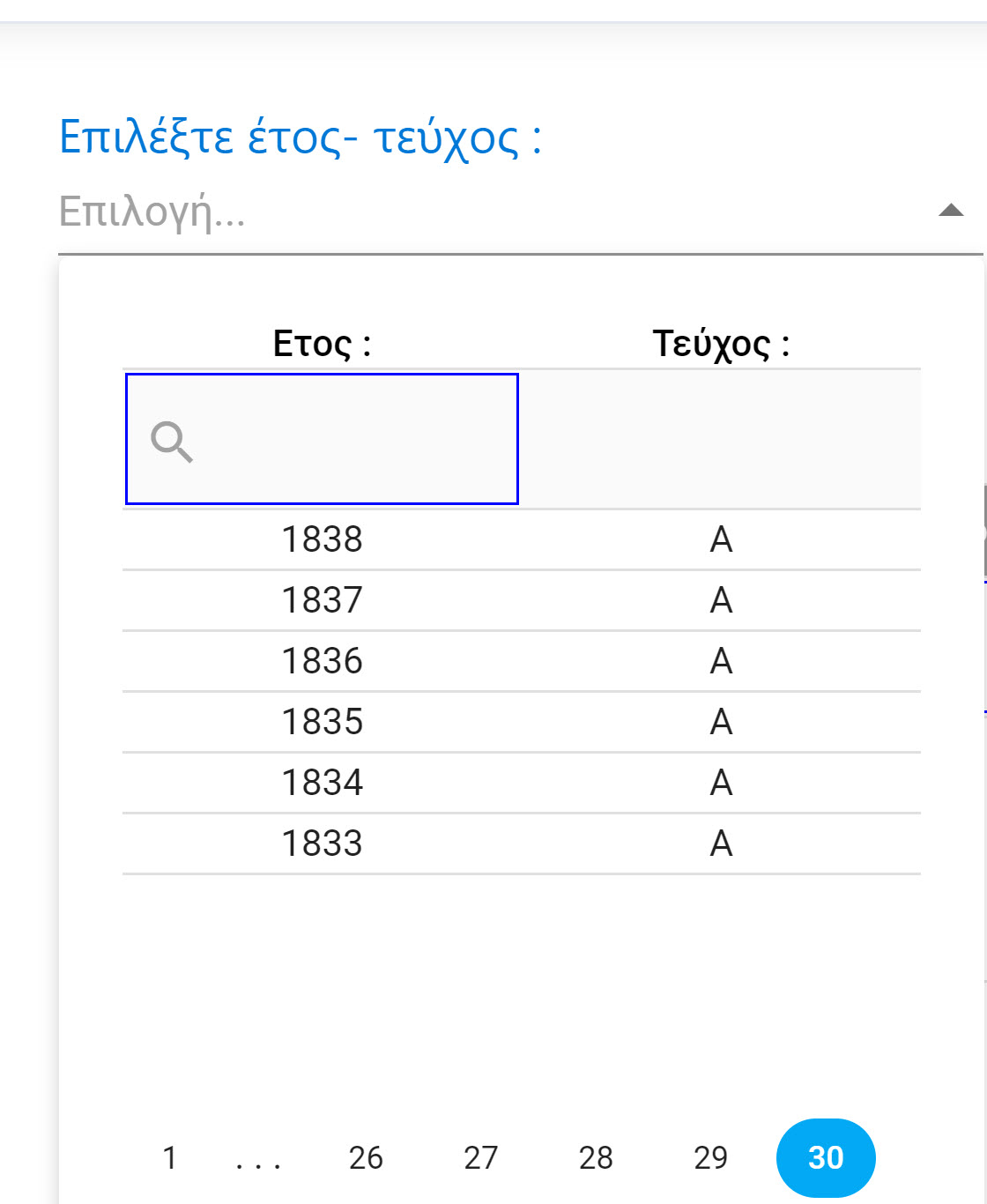
A drop down box will list the years of the newspaper, beginning with the current year. Clicking on the down arrow will reveal all years that the paper was published. To access the earliest issues, click on the number 30 at the bottom which will take you to the first year of publication in 1833. 
The issues of the year chosen will be listed (in this example, the year is 1833). You can click on the paper icon to view the first page only, or click on the arrow to download the entire issue to your computer.The number to the left of the paper icon indicates the number of pages in that issue.

The letters A, B, etc. next to each year designate various issues of the newspaper. From 1833-1930, there is only the letter “A.” After 1930, additional letters appear. This link goes to the page which explains the various letters and what they mean.

Below is page one of the first issue, dated February 16, 1833. There are four pages of this issue. Start on page one and scroll through, to understand the layout of the newspaper.

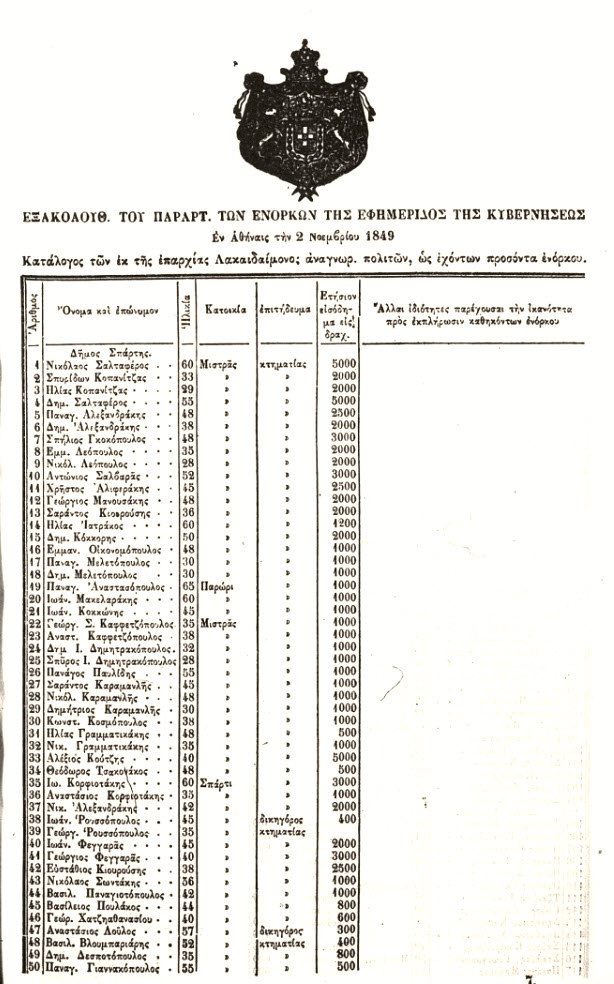
I initially became interested in exploring the Φ.Ε.Κ. when I found FamilySearch microfilms  which had  lists of men being called for military duty or appointed as jurors.* These lists were printed by region, then prefecture, then village, then men’s names. The following image is an 1849 list of men from Sparta who were called as jurors. 

FamilySearch microfilm #1038846, item 6, image 27: 2 November 1849 Sparta list of jurors

When I went to the Φ.Ε.Κ. website to look for this issue (2 November 1849), I could not understand why the online issue for that date did not contain this information. I learned that these lists were supplements to the newspaper and were published separately at later dates. 

Another source to find issues for the years 1826-1864 can be found online at Google Books. The Bavarian State Library had bound volumes of Φ.Ε.Κ. under the title Ephēmeris tēs Kybernēseōs tu Basileiu tēs Hellados. All of the issues for an individual year were bound into one volume for that year. Click on this link for free access.You will need to be logged into Google to add the books to your Google Play library. 

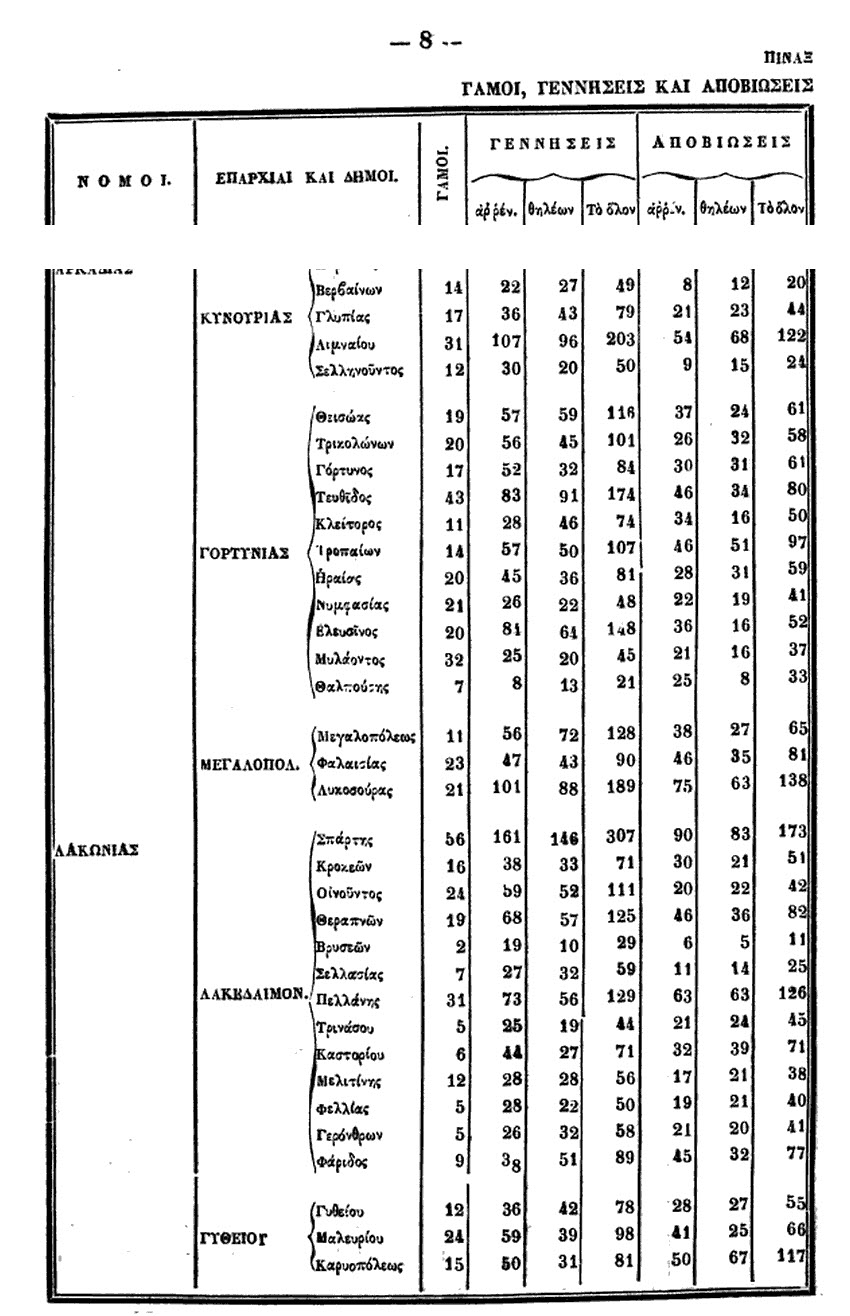
You never know what you will find. Here is a page from the Google Book Φ.Ε.Κ. series, volume 1860, 1862 which has numerous charts for all the prefectures of Greece with a variety of data. This is a chart of marriages, births and deaths for four villages in Lakonia.

Statistics of Hellas, 1860 (1862), page 8

Searching through issues of Φ.Ε.Κ. can be tedious, but consider it a treasure hunt. You may find new and interesting information which will make it worthwhile!


*In the 1980’s, FamilySeach filmed over 5,000 thousand rolls of microfilm under a contract signed with the General State Archives of Greece (GAK).  A list is found in the FamilySearch Catalog under Greek microfilms. In addition, a pdf document listing all Greek films can be downloaded here. I found Juror’s  lists from Laconia in film numbers:  1038847 and 1039000 and 08053376. I found Military Lists for Laconia-Messinia in film number 1462001 and 1462002. Although these microfilms are now digitized, contractual restrictions do not allow them to be openly published on the internet. They can, however, be viewed at any Family History Center or affiliate library.

Starting Anew: A New Citizen in a New Land

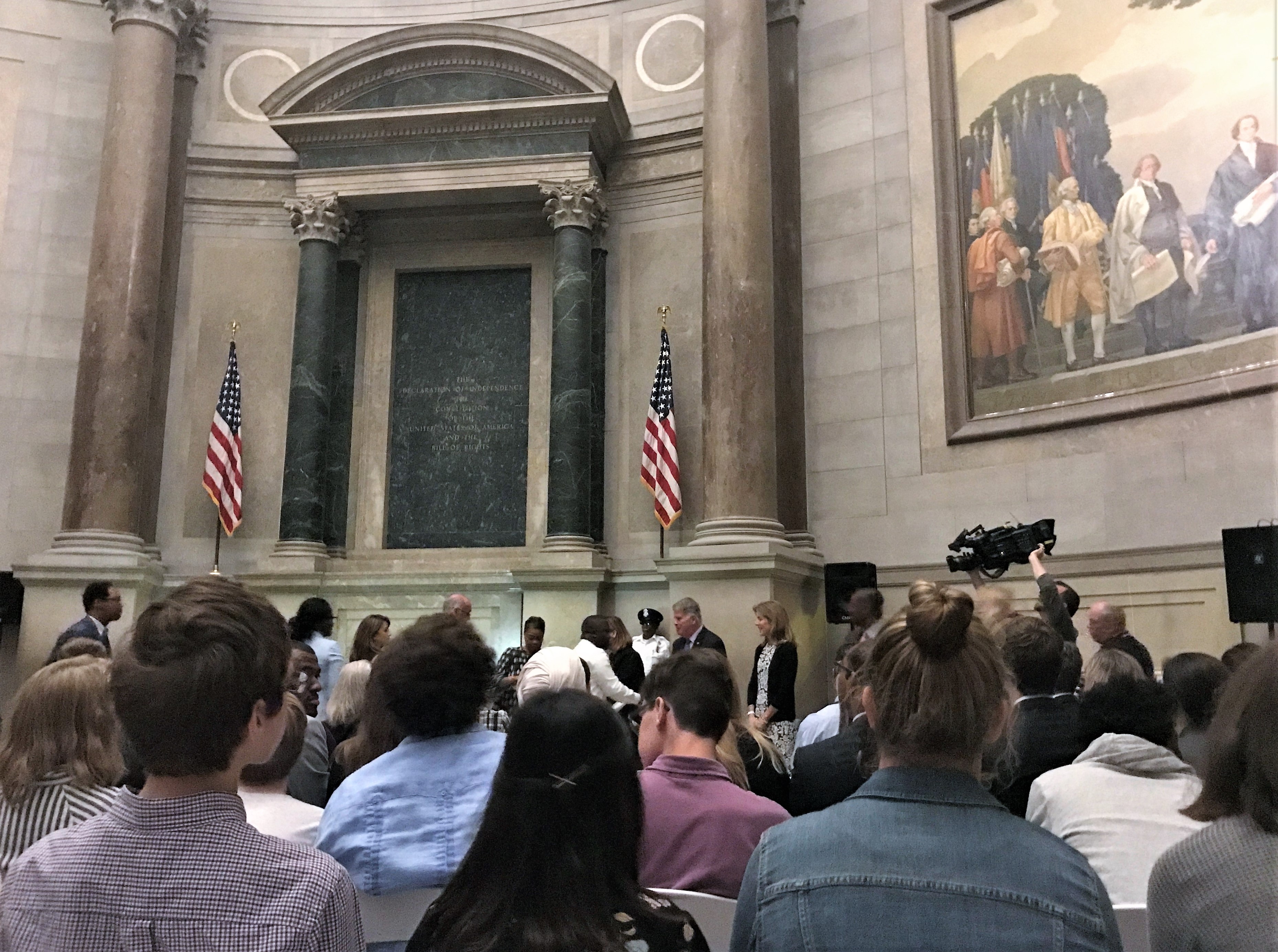
Becoming a citizen of a new country is an emotional and life-altering event. I saw this first hand on September 17, 2018 when I worked as a volunteer at a Naturalization Ceremony held at the National Archives in Washington. Thirty one new citizens from twenty-five countries renounced allegiance to their former homelands and pledged allegiance to the United States.

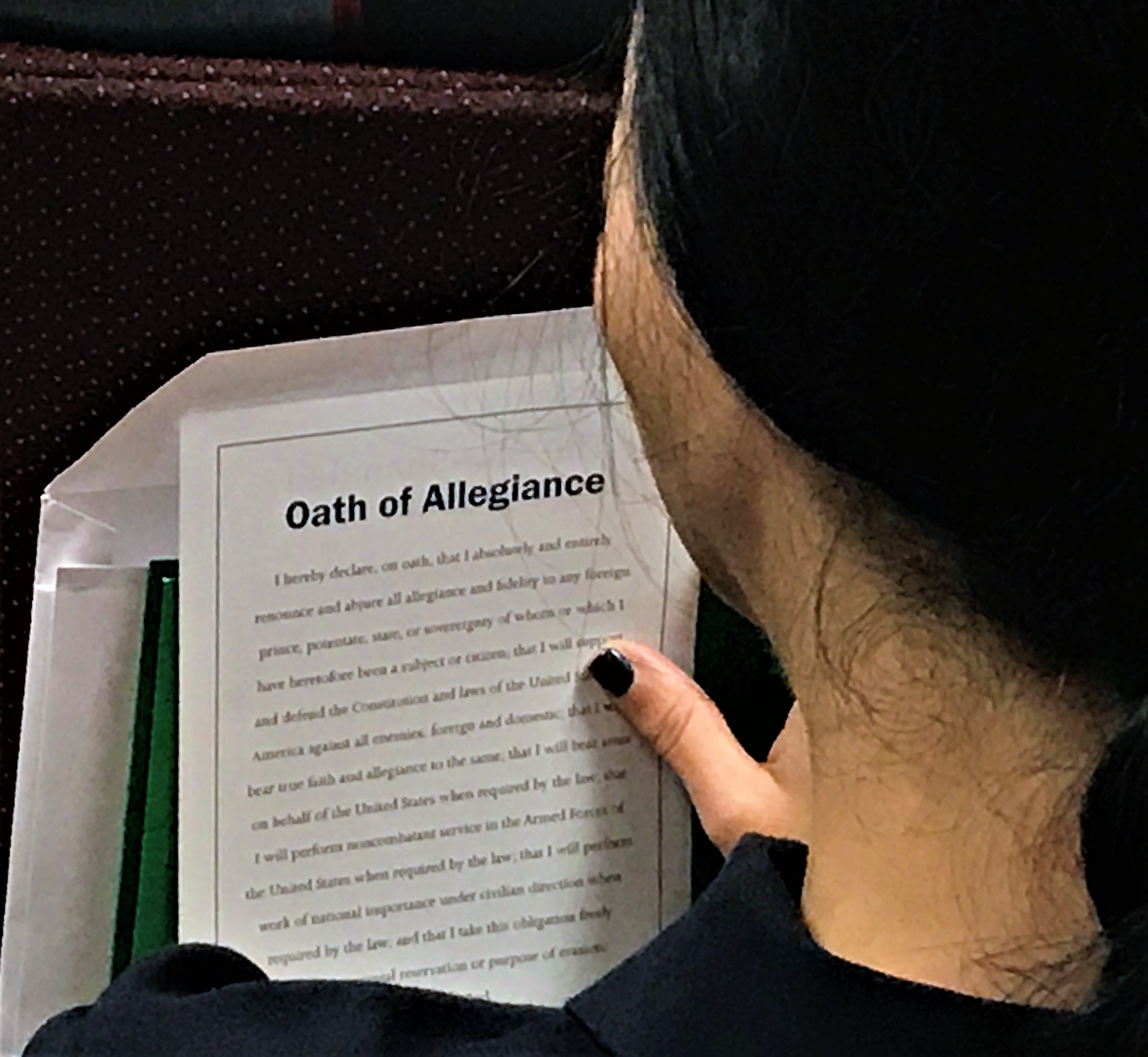
A new US citizen reviews the Oath of Allegiance she will recite

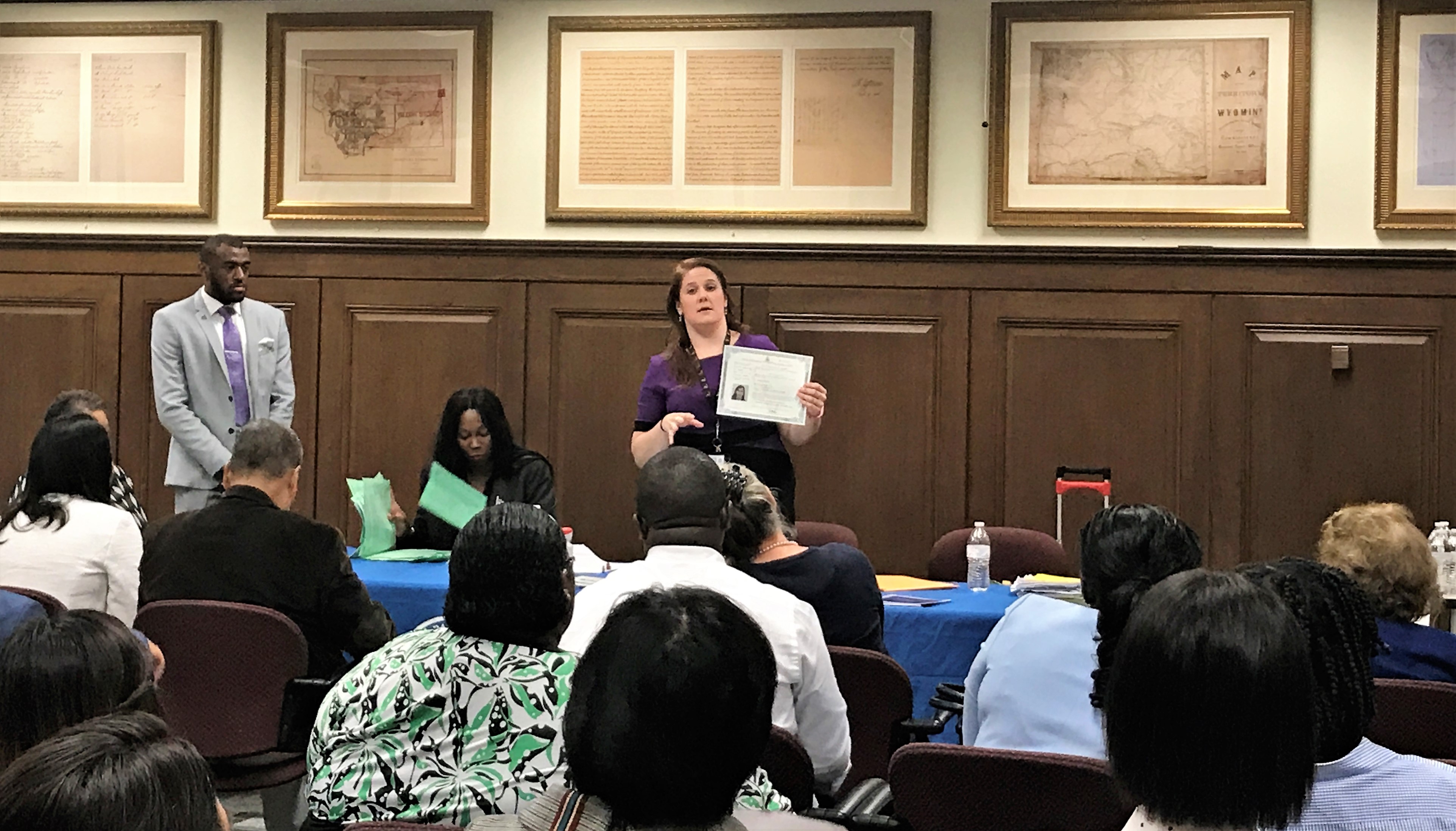
Prior to the ceremony, candidates met with officials of USCIS (U.S. Citizenship and Immigration Services) to complete final paperwork and receive instructions on caring for their new Naturalization Certificate.

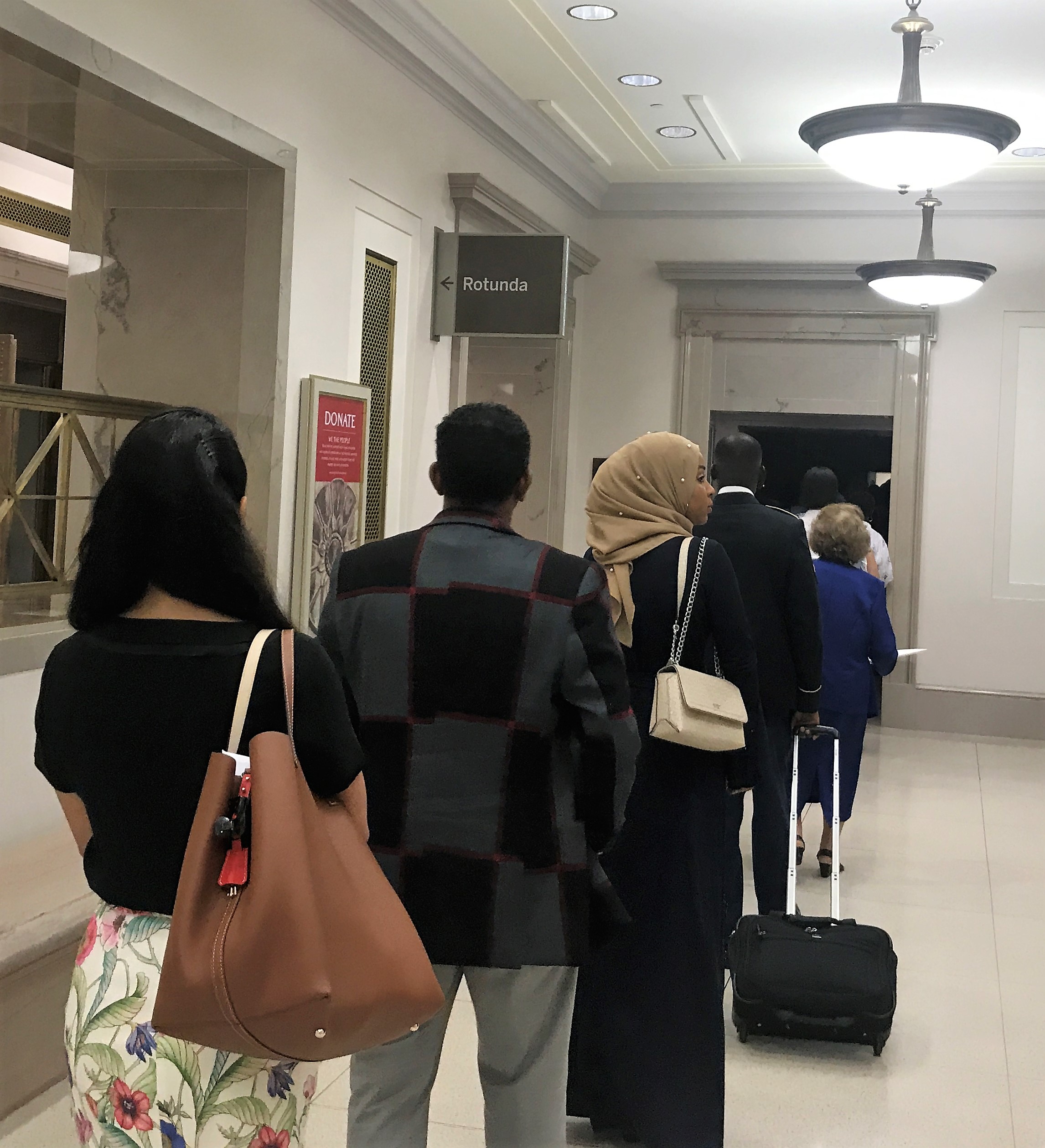
As we walked from the waiting room to the Archives Rotunda,  I sensed their anticipation as the end of a long process had finally arrived. I wondered what they were thinking–their thoughts for a new future here, their memories of their homeland and those left behind?

The Rotunda is ahead, and the end is near

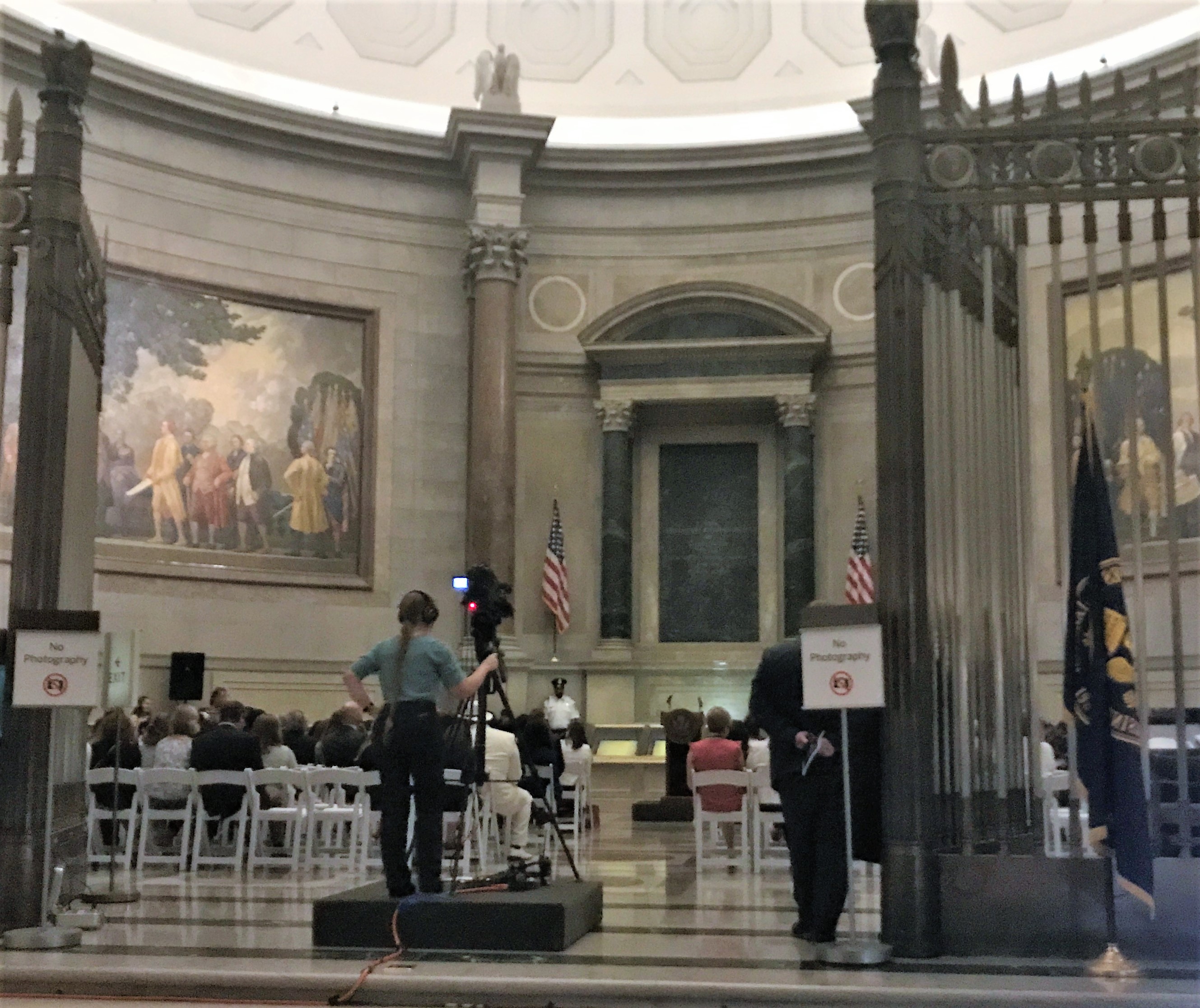
The impressive Rotunda, home to our Charters of Freedom

Archivist David Ferreio and former ambassador to Japan, Caroline Kennedy, greet the new citizens

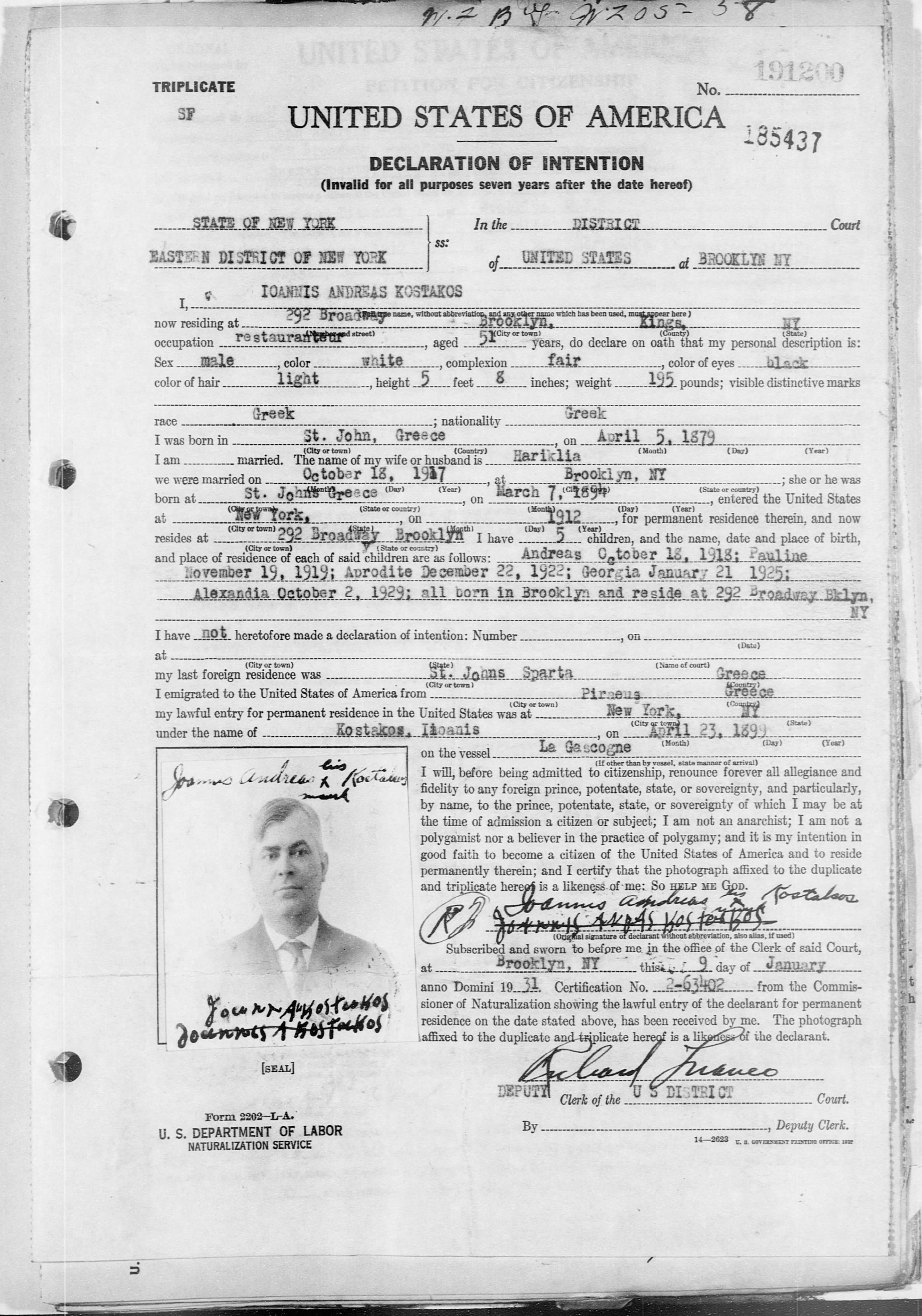
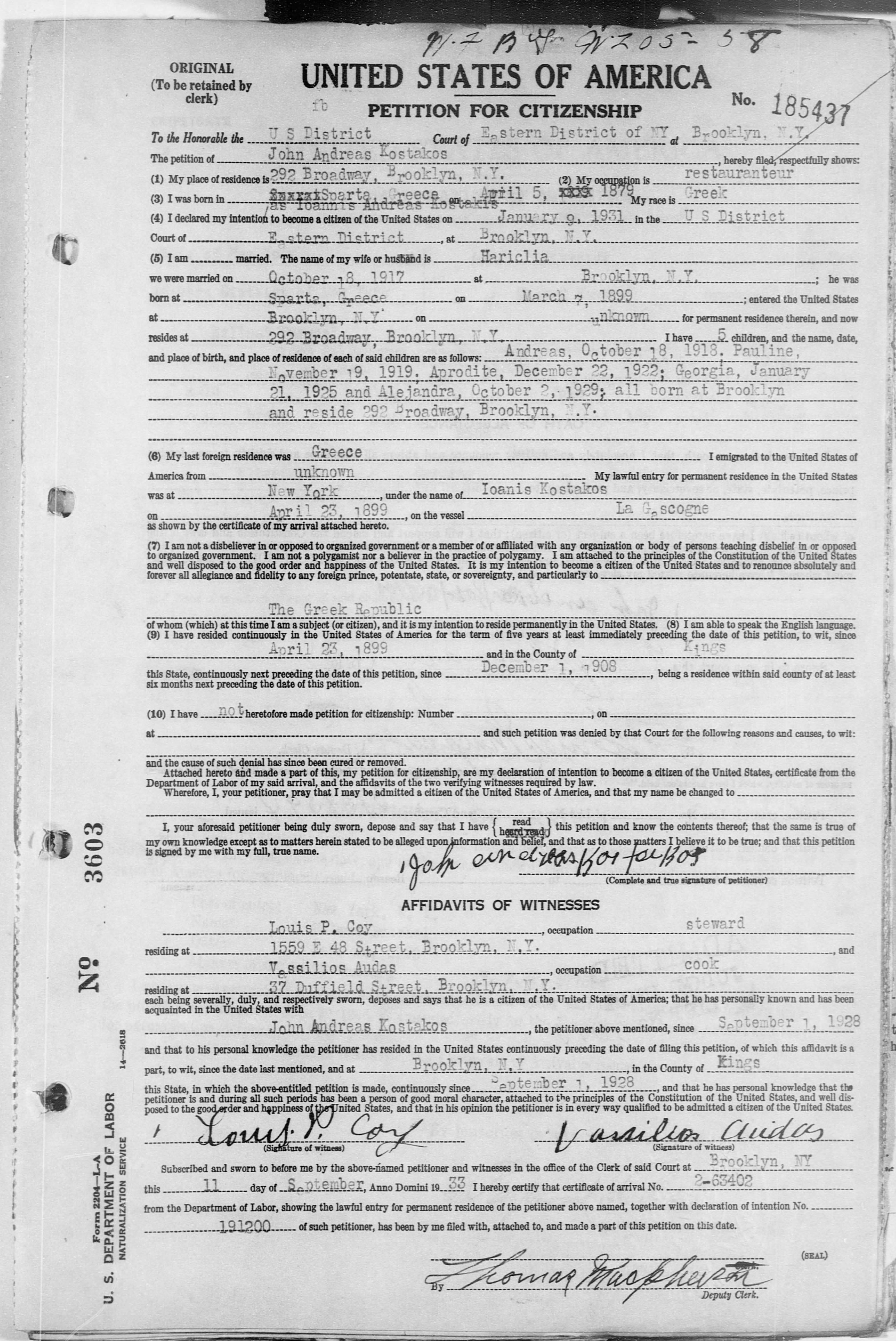
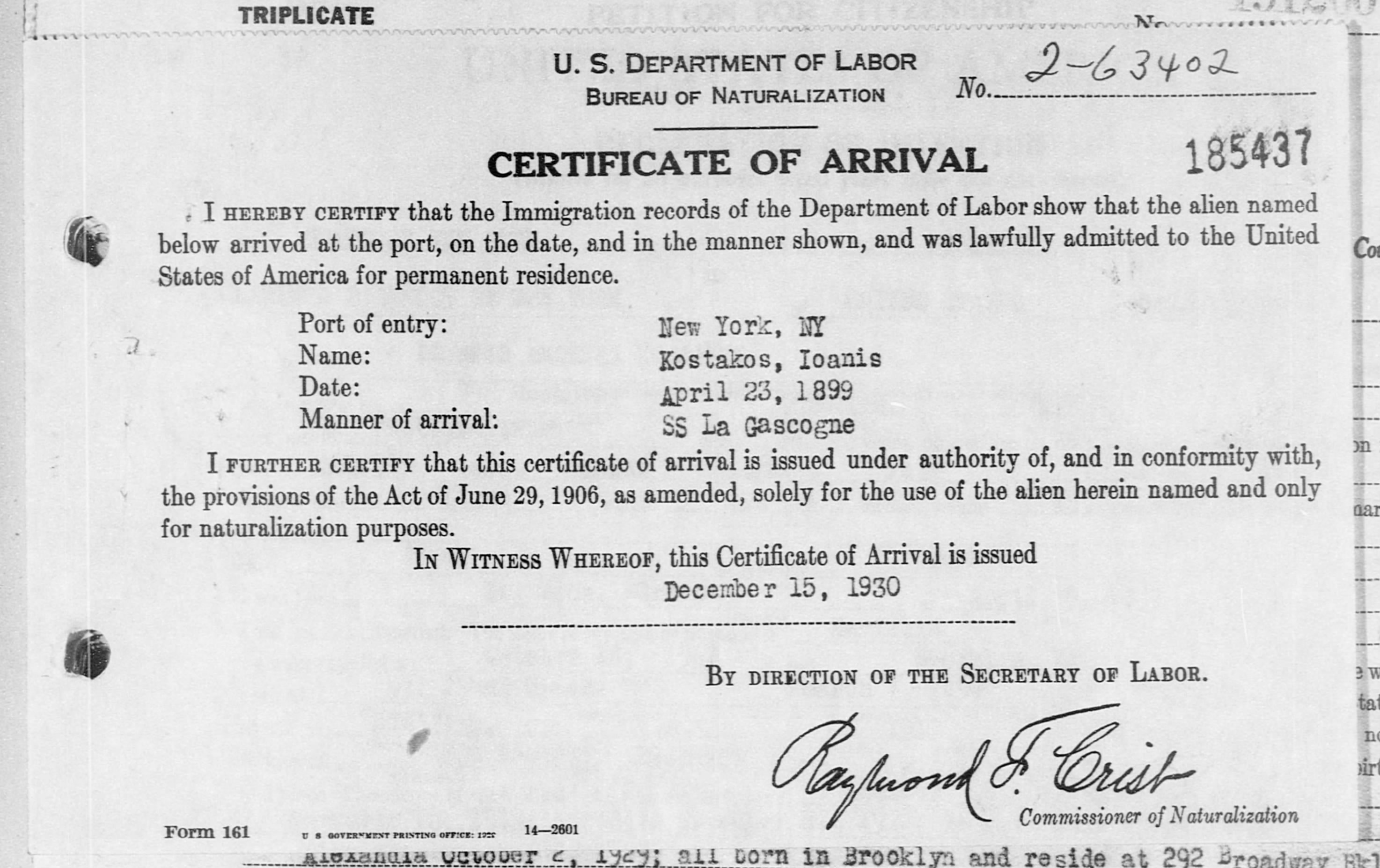
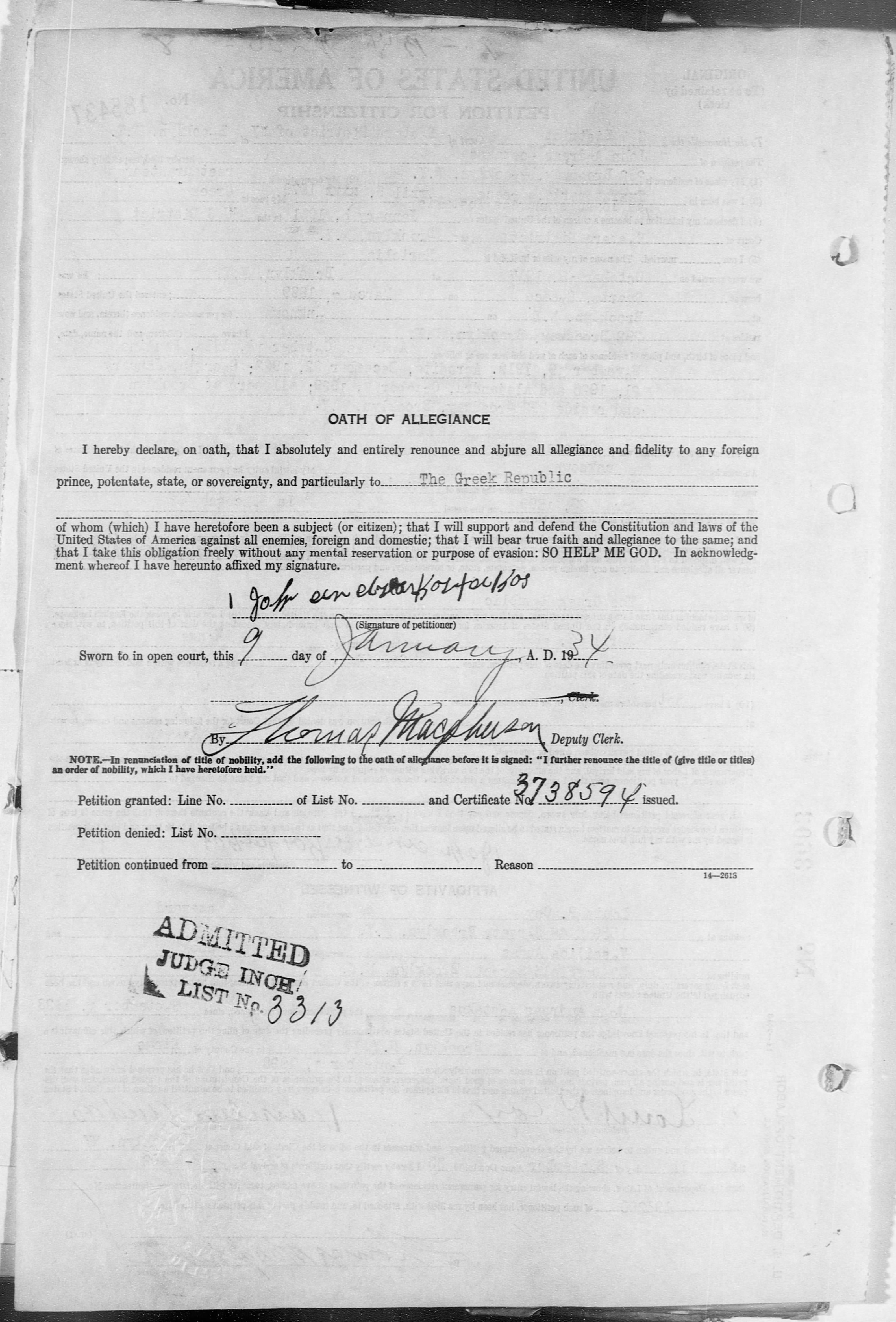
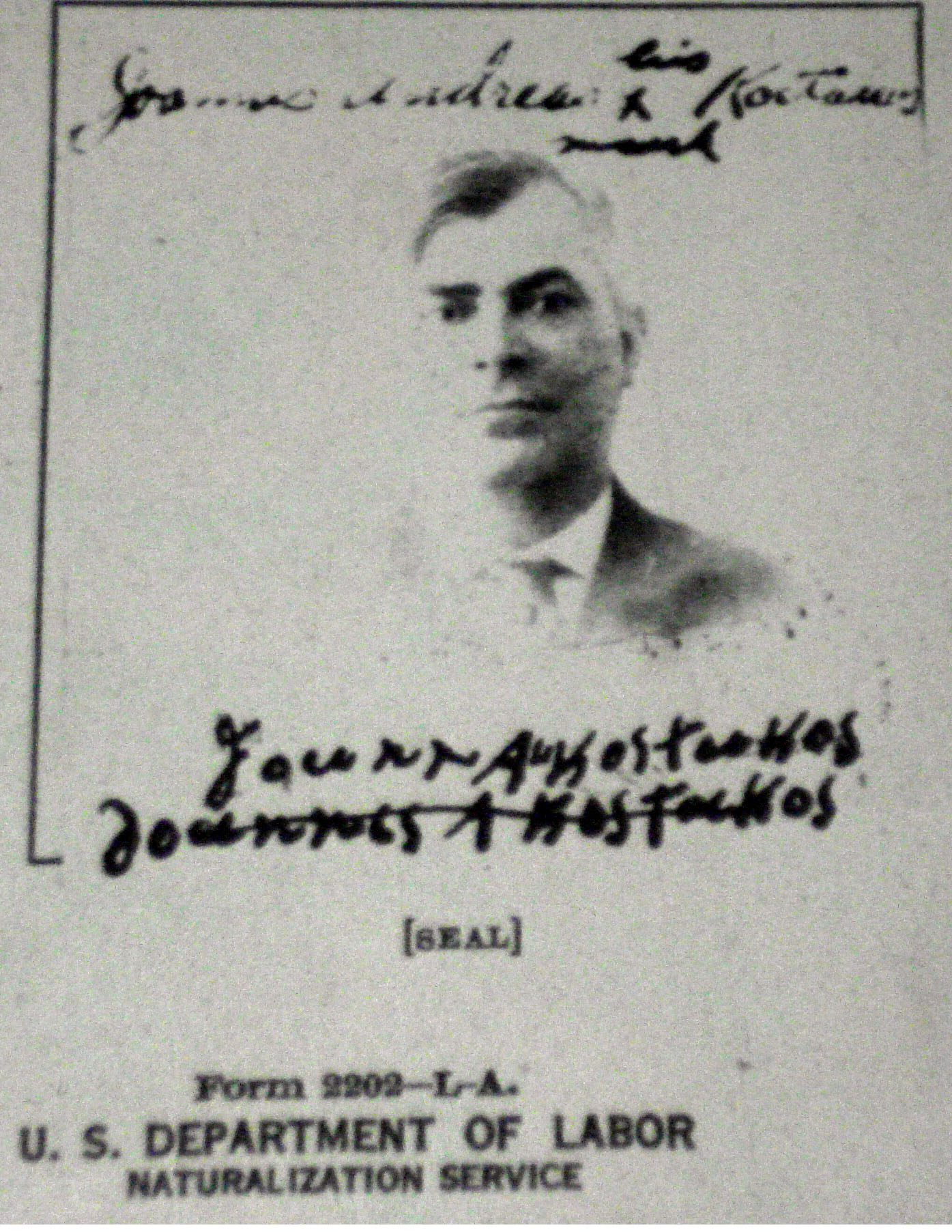
Throughout this ceremony, I kept thinking of my grandfather, John Andrew Kostakos, and many others in my family who strode the path of citizenship. Although 84 years has passed since my grandfather took the Oath of Allegiance, I imagine that his feelings and experiences were similar to these new citizens. I know my grandfather took great pride in his citizenship. He rose from being a peasant orphan to becoming a restauranteur, real estate owner, and successful businessman.

John Andrew Kostakos, Declaration of Intention, 1931

John Andrew Kostakos, Petition for Citizenship 1933

John Andrew Kostakos, Certificate of Arrival, 1930


John Andrew Kostakos, Oath of Allegiance, 1934

John Andrew Kostakos, proud citizen of the USA

We who are native citizens simply cannot comprehend the impact of this experience and all that preceded it:  saying goodbye to loved ones; leaving the village (often for the first time) and traveling to a port (by walking? donkey ride?); perhaps working for a few months at the port city to obtain funds for the journey and to have enough money to enter the U.S. (at least $50); the boat ride across the Atlantic; the Ellis Island arrival experience; connecting with friends and/or family in the U.S., finding work; deciding to become a citizen; going through the vigorous process of paperwork and exams; and finally raising the right hand to swear allegiance to a new land.

Whether then or now, the process requires grit and determination. Those who embark upon and complete this task exhibit strength and fortitude. They do this not only to  improve their own lives, but also to  ensure that their posterity will reap the blessings of their decision. Thank you, papou.

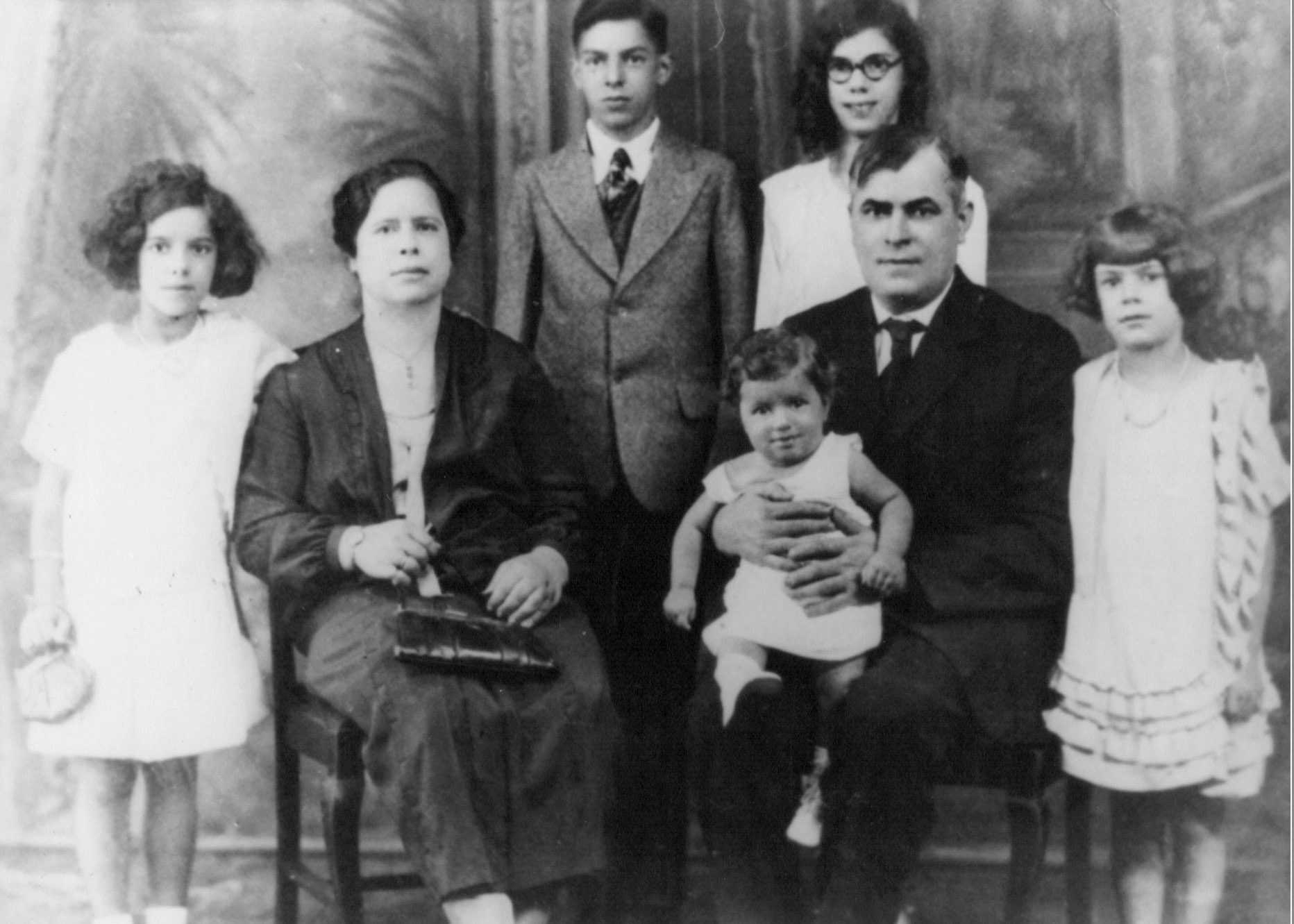
Family of John and Hariklia Aridas Kostakos, 1930. l-r standing: Frieda, Andrew, Pauline, Georgia. Seated: Hariklia, Alice, John


Upcoming Webinar

October is conference month! I have presented at Greek genealogy conferences in Baltimore and Philadelphia the last two Saturdays.

My next presentation will be a one-hour webinar on Friday, October 19 at 9:00 p.m. eastern time:  “It’s All Greek to Me: Genealogy Research in Greece.” This will be an abbreviated overview of civil and church records available in Greece.  You will see examples of records and the information they contain, and how to access them. Handouts will be available upon registration. I hope you can attend!

Information and registration is here:
https://zoom.us/webinar/register/WN_lixNswdsSTWCYSGDeJwZLQ

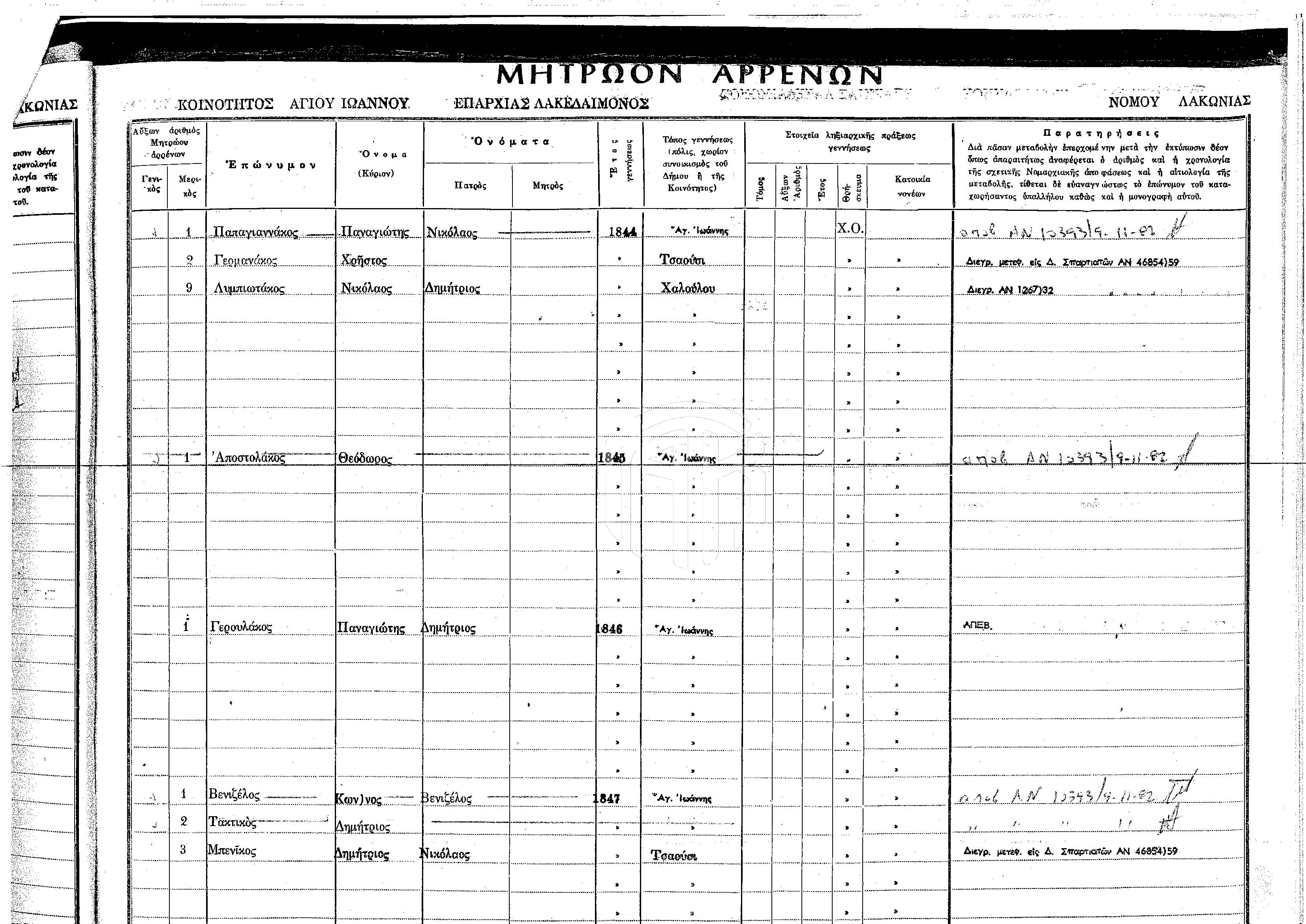
Mitroon Arrenon, Agios Ioannis, Sparta: 1844-1847