Unknown's avatar

About Spartan Roots

I am of Greek ancestry with roots in villages near Sparta. My paternal grandparents and maternal grandfather were born in Agios Ioannis (St. Johns), and my maternal grandmother was born in Mystras. I love family history research and have been tracing my roots for many years. I was born in Brooklyn, New York and was raised in a predominantly Greek neighborhood close to extended family. I live in the Washington D.C. metropolitan area and work as a volunteer Co-Director of the Washington, D.C. Family History Center and a genealogy aide/project aide at the National Archives in Washington, D.C. I am always updating and adding new information. Please contact me - I would love to hear from you!

Women’s Costumes of the Old Times

by Georgia Th. Tartaris
published in The Faris Newsletter, December 2020, issue 73, pages 22-23
Note: Footnotes in the original publication have not been translated.

This photo is a little treasure. We are lucky when such small treasures come into our hands and connect us with loved ones and things of another era almost forgotten.

The person depicted in the photo is Emilia (Milia) Moutoula (1860-1940), wife of Vasileios Laskaris. She lived in the neighborhood of Laskaris, in Agia Lavra, Xirokampi. An unfortunate woman, she lost her husband early and was widowed, struggling under adverse conditions to raise her daughter Stavroula and her son Vassilis, who as a young child left for the USA, where he became successful. Later, she lost her daughter as well and supported her granddaughter Eugenia. She used to help people in need and was much loved by the villagers, who welcomed her into their homes to offer her coffee and to tell them stories about Koumousta and Xirokampi. Her name is engraved on the plaque of the benefactors of the Holy Trinity of Xirokampi, which has been posted in the narthex of the church. The photo was sent from Philadelphia, USA by her great-granddaughter Melissa Laskaris, daughter of Anastasios.

Emilia (Milia) Moutoula (1860-1940), wife of Vasileios Laskaris of Xirokampi. Photo courtesy of Melissa Laskaris Stolarcyz, Milia’s great-granddaughter.

The old woman Milia is wearing a headscarf, a sack jacket and a half-skirt (or petticoat), as worn by many women of our region. The headscarf was tied in various ways: sometimes in front of the neck, sometimes behind it and sometimes behind and tied high on the head, to the side.

On top they used to wear the sack jacket, which looked like a shirt. It had buttons on the front, usually covered by a small strip of fabric, known as “patileta” to make them invisible. Underneath they wore the half-skirt or petticoat. It had a pleated sash and was tied at the side of the waist. The more fabric a woman could afford to buy, the more pleats in her half-skirt. The sack jacket fell over the half-skirt and reached to the hips.

Stavroula and Polyxeni Laskari from my own neighborhood, but also my grandmother, Georgia Tartari, née Laskari, wore the same clothes except that their skirts had fewer pleats.

I remember most of them being dressed in black; elderly women, holding onto their mourning. I remember that relatives of my grandmother’s, who were not widows, were dressed in brown. Aunt Malamo from Koumousta, who was unmarried, wore brown, as well as my great-grandmother, Artemis Mandrapilia, née Kapakos from Paliochori, married in Koumousta, who died young when she fell from a mule. I did not meet the latter, but my mother, who used to sew, often mentioned her own grandmother’s clothes.

My grandmother’s clothes were sewn by my mother. Certain women sewed clothing by themselves; others used to go to the local seamstress. The fabrics were not woven. They were purchased from the village merchants. In Xirokampi there were commercial shops: the shops of Liakakos, Theofilopoulos, Stergianopoulos. Woven clothes were worn by the older women, that I did not have the chance to meet,  like my great-grandmother, and this was the difference that made my mother refer to her own grandmother’s clothes. One of the last women to keep this way of dressing was Aunt Liou Xiropodi and Panagiota Karkabasi (Karaskoutaina).

The changes in everyday life, the progress and evolution of society were factors that influenced the way people dressed. Over the years, women’s clothing changed drastically. The entry of women in a massive way into manufacturing in all sectors of the economy, the change in the family unit, and the release from prejudices and other forms of oppression fostered a new dress code for women, which was adapted to their needs.

The knowledge of the elders’ lifestyle and the transmission of this knowledge helps us to understand the evolution of society, but also the necessary changes to improve our own ways of life. All of us, more or less, have something that connects us with the past: a photograph, a piece of clothing, a tool, a piece of furniture. We are the bearers of history and its continuators. Let’s pass it on to the next generation.


I am honored and humbled to receive permission from the Katsoulakos family to translate and share articles from The FarisTranslation verification and corrections have been made by GreekAncestry.net.  This is the second article of the ongoing series.

From Sparta to Chicago: A Case Study of Families Intertwined

by: Georgia Stryker Keilman and Carol Kostakos Petranek

Greeks, like most ethnic groups, engaged in “chain migration” upon leaving their homelands. A man or a family would follow others who left their village and settle near—or even with—them in their new country. By associating at church, work, or in Greek organizations, immigrant families would form tightly knit groups, celebrating namedays, holidays and other traditions together. An important component of these immigrant communities was to bring young couples together to form new families. Whether by formal matchmaking or simple introductions, it was ensured that the next generation was able to meet and marry compatriots.

Georgia Stryker Keilman’s immigrant grandmother, Georgia Bebetsos and her three brothers, Sam, James and Tom were all living at 355 Chicago Avenue (Source: 1920 Census). This address was located just outside of the old “Greek Delta” area of Chicago where thousands of Greek immigrants settled. While recently reviewing the record again Georgia realized that she knew of marriages between members of some of the families living in the buildings at 353 and 355 Chicago Avenue.

Families in 1920 census; color-coded to show intermarriages

Was there a previous connection between these families? 

The families were from various villages in the Sparta area and one from the Arcadia Region.

               Bebetsos – Theologos
               Magoulias – Loggastra
               Dounias – Soustiani
               Pleotis – Arcadia Region

Georgia noticed that the 1920 Census documented that all the men in these families were working in the restaurant business; 1 assistant manager of a restaurant, 4 waiters, and 1 cook.

Could that be the connection?

Georgia researched the World War I Draft Registration forms or Naturalization applications to identify where they worked in 1917.

NameHome AddressEmployer
George P. Dounias?Charles Pappas, 344 W. Chicago Ave
John Magoulias344 W. Chicago Aven/a – assume same as above
James Bebetsos744 W. Division StChas. Papas, 744 W. Division St
Thomas Bebetsos2510 Blue Island AveCharles Pappas, 2510 Blue Island Ave
George Magoulias161 Hill StreetMitchell Bros, 316 W. Division St
Angelo Pleotis859 Sedgwick CtHotel Green Mills Garden, Broadway & Lawrence

Notice that the first 4 people shown in the chart are associated with an employer named Charles Pappas. Also, they list their residence as the same address as their employment.  We are assuming that they lived in rooms above the restaurant.

For example, in the 1920 Census, Charles Pappas was living at 744 W. Division Street.  His occupation was proprietor of a restaurant.  He was living with his wife and son, two brothers who were working as waiters and two roomers who were working as a waiter and a dishwasher.  It is most likely that the restaurant was on the ground floor with apartments above.

Also note that the 344 W. Chicago Avenue address referenced in the above chart is about 1 block from the apartments at 353 and 355 W. Chicago Avenue. If the men referenced in the 1920 Census at this address were working for Charles Pappas at the 344 W. Chicago Avenue address, they could have walked to work.

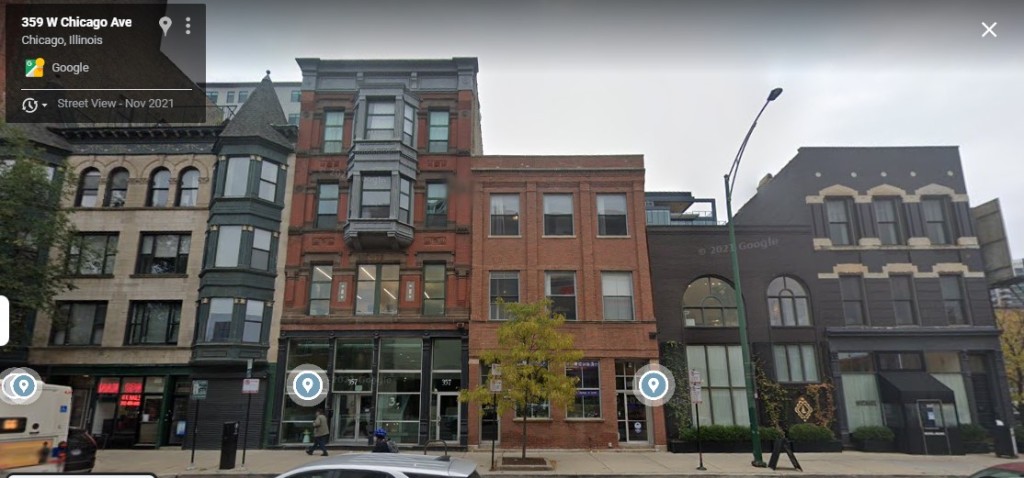
 Although the 353-355 W. Chicago Ave. apartments were demolished, some buildings from that era are still standing across the street. Below is a photo which shows that many of the buildings in this area had a “store front” on the bottom floor and apartments above.  The idea that the waiters, etc. could be living above the restaurant is a reasonable conclusion.

359 West Chicago Avenue, 2022 Google map

Naturally, questions arose:
• How did these people from neighboring villages end up in the same building?
• What are the connections? Or, who instigated the connections?
• The men who lived in the same buildings worked in restaurants. How did they know each other? What was Charles Pappas’ connection to them?
• How did these couples, living in the same building, become introduced and get married?
• How did so many apartments become available at the same time to provide housing for all these people?

We can hypothesize answers based on our understanding of the Greek immigrant community:  chain migration; connections through the church and associations; matchmaking; business owners hiring fellow compatriots. But the details, which add to the richness of the human story, remain unknown. How important it is to get our family stories documented by those who know the specific facts!

In our 21st century society, it may seem like an anomaly to have this level of intertwining among unrelated people. But as we study the village records of our families, it is readily apparent that such connections were not only common, but were the very fabric of village life. Our ancestors were simply duplicating these intricate, woven relationships in their new lands.

The Faris: The Endings in -akis and -akos of the Surnames of our Region

Those with ancestral ties to the modern municipality of Farida, Lakonia (villages include Xirokampi, Palaiopanagia, Anogia and several others) are immeasurably enriched by the writings of scholars from the area. The publication, The Faris, History, Folklore, Archaeology (‘Η Φαρις), has been produced semi-annually since 1966 and contains many hundreds of articles about the people, history, folklore, archaeology and culture of the region.  An appendix in each issue includes notices of births and deaths of local residents. The publication was initially known as The Xirokampi and maintained that title from 1966 to 1977, when the name The Faris was adopted.

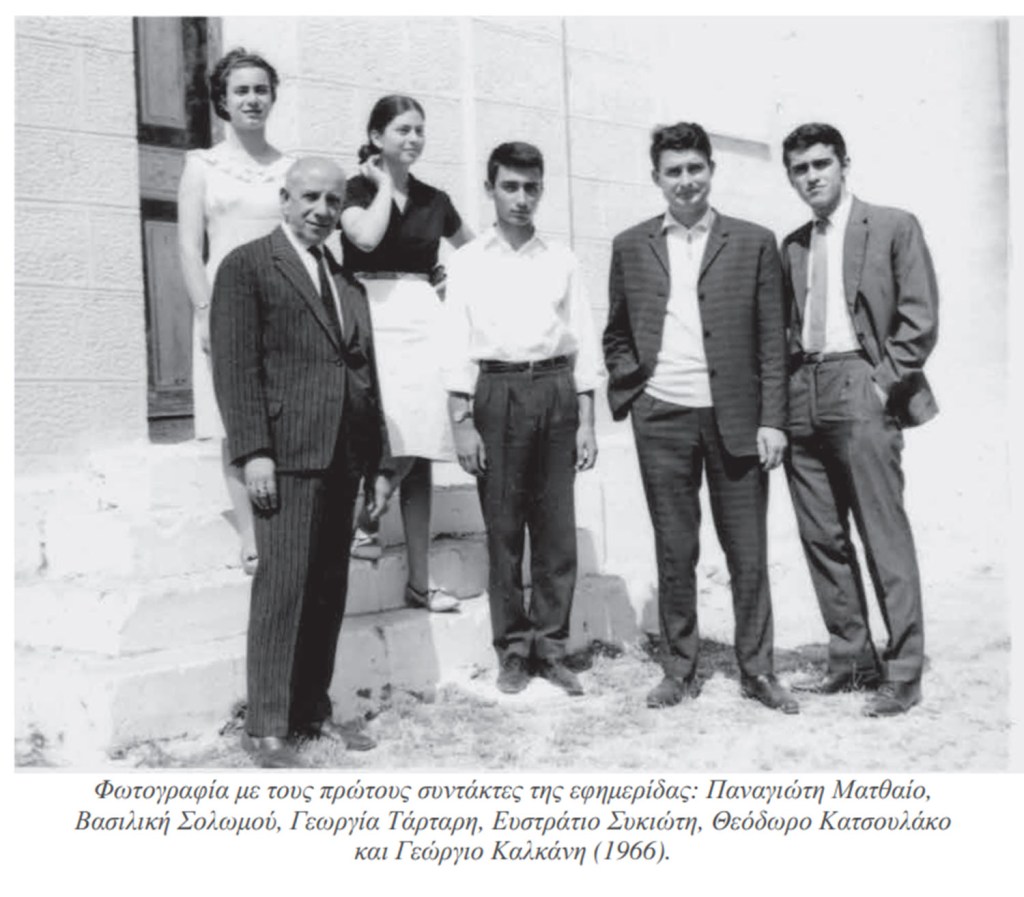
Those who write for The Faris descend from local ancestral families and know its past well. The founding editors, pictured below in 1966, were: Panagiotis Mathaio, Vasiliki Solomou, Georgia Tartari, Efstratios Sykiotis, Theodoros Katsoulakos, and Georgios Kalkanis. The current editorial committee is: Georgios Th. Kalkanis, Theodoros S. Katsoulakos, Panagiotis H. Komninos, and Ioannis Panagiotis Konidis. These, and dozens of other authors, have made Τhe Faris periodical a vital and unique resource to study the people and times of rural Lakonia. 

The founding editors, from the 50th anniversary issue of The Faris, April 1996: left-right: Panagiotis Mathaio, Vasiliki Solomou, Georgia Tartari, Efstratios Sykiotis, Theodoros Katsoulakos, and Georgios Kalkanis

All issues of The Faris can be accessed here. This link is to an index of articles from 1966-2001. This link is to the  e.faris website.

I am honored and humbled to receive permission from the Katsoulakos family to translate and share articles from The Faris. Translation verification and corrections have been made by GreekAncestry.net.  This is the first article of the ongoing series.


The Endings in -akis and -akos of the Surnames of our Region
author: Theodoros S. Katsoulakos

published in The Faris, History Folklore Archaeology, March 2007, Issue 42, pages 3-6
URL: http://micro-kosmos.uoa.gr/faris/pdf/faris_42_mar_2007.pdf. Note: Footnotes in the original publication have not been translated.

The writing of a historical study presupposes the existence and substantial utilization of evidence and historical sources. However helpful the assumptions may be, if they are not supported and confirmed by direct or indirect evidence, no opinion can be substantiated or founded.

In our area, the wider region of ​​the municipality of Farida, if one excludes a few monuments, remnants of the distant past, few writings have remained from the years of the four centuries of Turkish rule. The latter is explained if we take into account the low (intellectual) level of the Greeks of the time and the bloody struggle for the liberation of the country, during which everything that was left was destroyed.

Fortunately, the monasteries saved some written sources of the Turkish Occupation: their contribution in this field as well was undeniable. In particular, a number of documents from this era are preserved in the monastery of Zerbitsa. Some of them are from the 17th century and more from the 18th century. These are notarized sales, exchanges, wills of monks of Zerbitsa and Gola. The monastic zeal protected the assets from various schemes in moments especially of anarchy and fear. It is surprising and impressive, of course, how these historical documents reached us, while it is known that the monasteries of Zerbitsa and Gola were attacked, suffered disasters, and their administrative status changed.

The language in which these witnessed agreements are written is Greek, with a standard that is an amalgam of colloquial language and elements from the legal and religious tradition.  This means that this bipartite contract concerned the Greeks and was of value only to them.  From the study of many jurisprudential documents of the monasteries in the region, it emerges that there are very few Turkish words that had infiltrated and these concern terminology closely related to the financial interests of the conqueror, such as mulkia, from the Turkish mülk, meaning private property, lakas, possibly a Persian word (al­aka), meaning share, and amanati (bequest), which survives to this day.

The documents and various records are reliable witnesses of the presence of the families in our place, such as: Komnenos (1465, 1762 onwards), Goranitis (1634), Laskari (1634, 1751 onwards), Aliferis (1698),  Menouti and Sahla (1751), Meropoulis (1753), Karadontis (1754), Konidis (1754), Stoubou (1754), Koutsika (1757), Theofilakou (1757 and 1776), Tsaggari (1757), Niarchou (1759), Moutoula (1760), Rizou (1761), Papastrati (1764) Fragki (1764) Mathaiou (1769) Kalkani (1789) Vourazeli (1795), Psyllou (1796), etc.

Of great interest is the information provided by the documents regarding the diminutive endings in -akis, which are proportionally more than the corresponding endings in -akos.

  1. –akis: Angelakis (1826?), Athinakis (1757), Aleiferakis (1752) and Aleiferis (1698), Anagnostakis (1829), Anastakis (1757), Antritzakis (1680), Venetzianakis (1769), Giannakis (1755), Grammatikakis (1769), Dimitrakakis (1788), Zoulakis (1751), Konakis (1818), Kanellakis (1757), Kapetanakis (1763) and Kapetanakis-Venetsanakis (1830), Karkampasakis (1766?), and Karkampasis (1815), Kom(n)inakis (1755) and Kom(n)ynos (1763), Konomakis (1752), Krotakis (1784), Lamprinakis (1764), Lygorakis (Grigorakis) 1793, Liampakis (1813), Mathaiakis (1769), Markakis (1780), Markoulakis (1680), Meropoulakis and Meropoulis (1744?), Nikolakakis (1824), Xanthakakis (1826?); Panagakis (1744?); Papadakis (1698), Patrikakis (1752), Petrakakis (1779?), Posinakis (1680), Rigakis (1832), Rizakis (1749?), Rozakakis (1762?), Stathakis (in an undated document), Stamatakis (1751), Stamatelakis (1698), Stampolakis (1759), Stratigakis (1751), Tarsinakis (1755), Tzakonakis (1830), Feggarakis (1755), Fragkakis (1812) and Fragkis (1764), Chaidemenakis (1805), Chelakis (1793), Christakis (1773).
  2. -akos: Anagnostakos (1800), Anastasakos (1830), Andreakos (1766), Antreakos (1766?), Apostolakos (1816), Armpouzakos (1819), Vatikiotakos and Vatikiotis (1798), Giannitzarakos (1832), Grigorakos (1784), Thanasakos (1763), Kavourothodorakos (1815), Karadontakos and Karadontis (1754), Katsoulakos (1825), Kostakos (1830), Lamprinakos (1764), Liakakos (1789), Maniatakos (1789), Marinakos (1823), Menoutakos (1751), Xepapadakos (1788), Panagakos (1830), Papastratakos (1826), Solomakos (1788), Stathakos (1824), Stratakos (1826), Tzolakos (1786), Christakos (1789).

After 1830, the ending of -akos began to prevail in the region. Useful conclusions are drawn from the study of the report of the local notables of the region to the Holy Synod (1835). It is noteworthy that only one surname was found ending in – æas (Niareas 1826).

Follow the Records, Part 3: Men With the Same Name

It is the bane of every family historian:  sorting out men with the same name who lived in the same location at the same time, and sometimes married women who had the same given names. For Greek researchers, this issue is exacerbated due to naming traditions which almost always ensure that several men in a village—because they are named after their grandfather–have the identical baptismal name and surname. Fortunately, our naming traditions usually provide the father’s given name as well. Examples:  Nikolaos Stamatakis, of Georgios (Νικολάος Σταματάκης του Γεώργιου) and Nikolaos Stamatakis, of John (Νικολάος Σταματάκης του Ιώαννου). We now know that the father of the first Nikolaos is Georgios and the second is John.

But what happens when we are searching in records where the father’s name is not given? This usually is the case in older documents, such as 1844 or 1872 Voting Lists. One research strategy is to look at the ages of the men as a means of differentiation, but we already know that Greek ages can be notoriously inaccurate and many years off. Another strategy is to pinpoint an exact location, but what about families who moved between villages? Or the cases when a man married a woman, moved to her village and took HER surname thus losing his surname and becoming a “xxx…gamvros” (unusual, but we do see this in names like Stratigamvros). And  to all this, let’s throw in the real possibility of clerical errors—or even misinformation given by the informant.

What then?

I was faced with this exact situation. My research question was:  Which Nikolaos Papagiannakos in Agios Ioannis, Sparta, was the father of my great-grandfather, Panagiotis Nikolaos Papagiannakos?

I consulted several sets of records (Mitroon Arrenon, Voter Lists, Town Registers, Marriage Records) and documented every Nikolaos Papagiannakos, giving each a unique identification number. And I paid careful attention to the names of their sons.

Preliminary Analysis of Papagiannakos Name in Agios Ioannis Records

  1. #1783 Nikolaos, born 1789
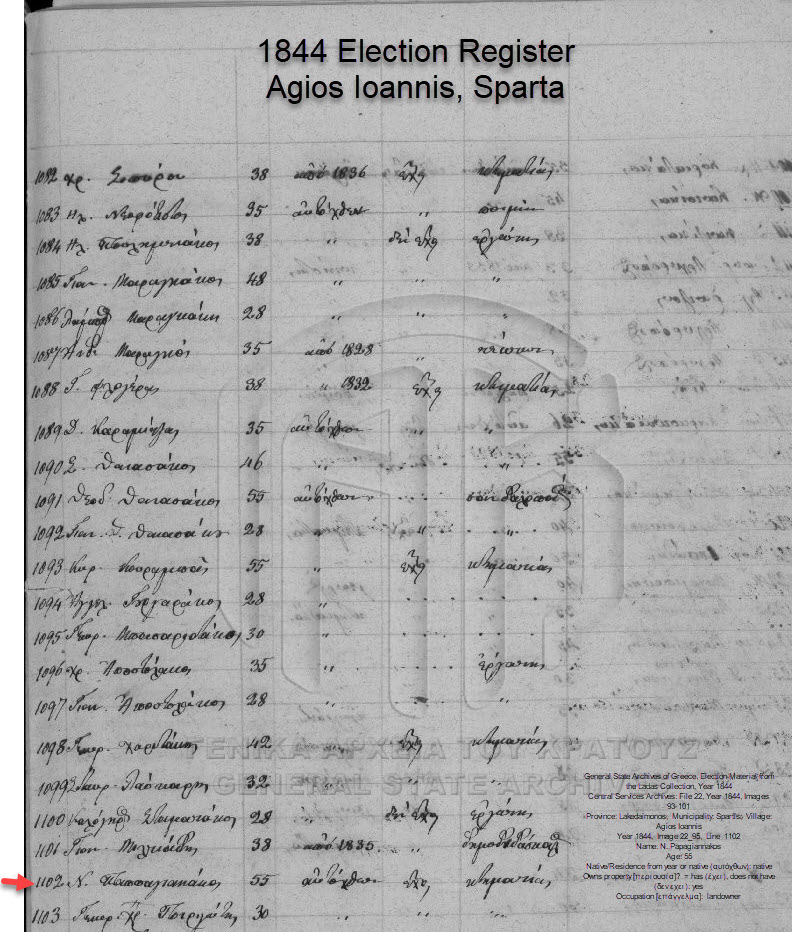
    Source: 1844 Voter List: N. Papagiannakos, age 55, native, landowner
  1. #862  Nikolaos born 1815; his son was Panagiotis Nikolaos GIANNAKOS (as given in Sparta marriage record) b 1841. Source:  1872 & 1873 Voter List  
  1. #2798 Nikolaos  born bef 1820; son was Ioannis #2797, b 1845
    Source: Estimated birth year as 25 years before birth of son in 1845
  1. #2796 Nikolaos  born bef 1812; son was Ioannis #2795, b 1837 in 1872 Voter list, age 28,
    Source: Estimated birth year as 25 years before birth of son in 1837
  1. #2792 Nikolaos born bef 1810; son was Ioannis #2791 b 1835 in 1872 Voter List age 37, in 1873 Voter List age 38
    Source: Estimated birth year as 25 years before birth of son in 1835
  1. #348 Nikolaos Panagiotis, b. 1872; son: Panagiotis
    Source: 1898 marriage record; he was age 26
  1. #104 Nikolaos  Ioannis, born 1867
    Source: Male Register:  Year: 1867; Line 8: Papagianakos, Nikolaos; father: Ioannis; born 1867  

That’s a total of 7 Nikolaos Papagiannakos’ in Agios Ioannis born between 1789-1867:

  • Only two have fathers identified: line 7 has Ioannis; line 6 has Panagiotis 
  • Lines 3, 4, 5 have sons named Ioannis
  • Lines 2 & 6 have sons named Panagiotis

My research question: which Nikolaos is my great-great grandfather, was answered:  it is line 2, Nikolaos born 1815.

But I got caught up in the records and kept going. I suspected a possible duplication of Ioannis #2797 & Ioannis #2795 in the 1872 & 1873 Voter Lists. Both have Nikolaos as their father; however, the ages were not one year apart. I wondered whether there was a clerical or typographical error in the ages as follows: 

  • Ioannis #2795 , worker:  in year 1872 he is age 35 BUT there no Ioannis age 36 in year 1873
  • Ioannis #2797, farmer:  in year 1873 he is age 28 BUT there is no Ioannis  age 27 in year 1872

Assuming these were the same person, then Ioannis Nikolaos Papagiannakos in 1872 was either 27 or 35, and in 1873 he was either 28 or 36.

A cousin in Agios Ioannis told me that there were two Papagiannakos families, but no one knew how they were related. I wondered if this was true, and the records proved that theory to be correct. As much as I wanted to sort out the two families, I simply could not do it. I was too invested in trying to “have it all make sense” and I doubted my ability to make correct assumptions. That’s when I asked Greg Kontos to help.

In one hour, he did what I was unable to do: examine the records with a critical eye in a dispassionate manner. He created a chart and allowed the data to reveal the answers:

Gregory Kontos of Greek Ancestry.net; March 14, 2022, page 1
Gregory Kontos of Greek Ancestry.net; March 14, 2022, page 2

Greg came to these conclusions (see detailed analysis below): 

  • The two Ioannis’ above (#2795 and 2797) were the same person; therefore, their fathers were the same Nikolaos.
  • Thus, the Nikolaos’ on lines 1-5 above were merged appropriately, giving us two Nikolaos Papagiannakos’ living in Agios Ioannis during that earlier period, both with sons named Ioannis:

1) Nikolaos, born 1789 and died by the time the 1872-73 Voter Lists were compiled
(found in the 1844 Voter List, line 1102)


2) Nikolaos, born 1815 (found in the 1872 Voter List, line 1925)

Naming patterns raise the possibility that these Nikolaos’ had the same grandfather, Ioannis, but without documentation we cannot make that assertion.

The Nikolaos’ in lines 6 and 7 above were a later generation.

Through this experience, I learned:

  1. Follow the records and carefully evaluate every piece of evidence
  2. Remove emotion from your analysis!
  3. It’s okay to make educated guesses and careful assumptions, but clearly label them as such
  4. Know when it’s time to call in the experts, then do it!

Gregory Kontos, GreekAncestry: Analysis of Nikolaos & Ioannis Nikolaos Papagiannakos Names in Agios Ioannis in 1800’s; March 14, 2022

1844 & 1873/73 Voter List Records Show:

  • There are two Ioannis Papagiannakos’, sons of a Nikolaos, living in Agios Ioannis in 1872 and 1873 Voter Lists.
  • There were 2 Nikolaos Papagiannakos’ in Agios Ioannis, both with sons named Ioannis. One Nikolaos appears in the 1844 and the other in the 1872 Voter Lists.

In the 1872/3 Voter Lists, there was only one Nikolaos Papagiannakos (birth 1815 according to Voter List) currently living in Agios Ioannis and being eligible to vote.   If there had been another Nikolaos Papagiannakos, he was either:

(1) dead by 1872; or

(2) born after 1851; meaning he was too young to be recorded in the 1872 Voter List, as a man had to be 21 years old to vote in 1872.  

In the 1844 Voter List, 28 years earlier, there was only one Nikolaos Papagiannakos (born abt 1789) living then in Agios Ioannis and being eligible to vote. Since he does not appear in the 1873/3 Lists, we can assume he had died by then.

Conclusion: there were 2 Nikolaos Papagiannakos branches (not more).

The 1872 & 1873 Voter Lists have 2 Ioannis Nikolaos Papagiannakos’ of Agios Ioannis but there was a typographical error:

Ioannis #2795 , worker:  Yr. 1872, image 431, line 1874 is  age 35 BUT no Ioannis  age 36 in Yr 1873

Ioannis #2797, farmer:  Yr 1873, image 481,  line 2061 is age 28 BUT no Ioannis  age 27 in Yr 1872

Based on the information provided, we can assume that these two men were the same person.   I merged these 2 into one, #2797, and amended birth year to: between 1837 and 1845.

Supposition: the 1844 Voter List Nikolaos, #1793, born abt 1789 and died before 1872 could be the father of Ioannis #2791, b. 1835, and Konstantinos #2799, b. 1838.

Supposition: the 1872-73 Voter List Nikolaos, #862, born about 1815 could be the father of Ioannis #2797, b. 1837; Panagiotis #9, b. 1841, and Panagiota #5511, b. 1853.

CONCLUSION:

The two Nikolaos Papagiannakos’ are:

1.            Nikolaos #1793, born 1789 died by 1872/3 (the one in 1844 Voter List)
2.            Nikolaos #862, born 1815 (the one in 1872 Voter List)

Proving or Disproving a Family Story: Follow the Records

Guest post by Georgia Stryker Keilman, founder, Hellenic Genealogy Geek website and Facebook group

For years, I was focused on proving a family story which prevented me from considering other options and records to understand the history of my maternal great-great grandmother, Marigo Fousketakis (maiden name unknown).  

Ioannis and Marigo Fousketakis

This is the story as told to me by my mother in the 1980s.  My great-great grandfather, Ioannis Fousketakis, was from Hania, Crete.  He was conscripted into the Ottoman Empire military.  During his service, in what is currently Turkey, he met a young woman and fell in love.  She sewed gold coins into the hems of her clothing and ran off to be married.  They ended up in Sparta, Greece and had four sons. 

My mother heard this story for the first time after her mother’s death in 1967 (over 100 years after the event).  My grandfather was visiting us and, over a cup of coffee, told my mother the story.  Why hadn’t her mother ever told her this?  My grandfather supposedly indicated it was because Marigo was “Turkish,” and my grandmother was ashamed to have this “Turkish” intermarriage in the family history.  My mother assumed that being Turkish meant that she was Muslim and had converted to Greek Orthodox to marry. 

Based on my mother’s assumptions, I made another assumption, that my great-great grandparents had fled from Turkey (Ottoman Empire) and went directly to Sparta.  This was based on the fact a Muslim woman could not marry a Greek Orthodox male in the Ottoman Empire. It was against the law, and she would have been executed.  I hoped I would be able to find some documentation regarding her conversion to the Greek Orthodox religion and a marriage record.  I was unsure of the approximate date.

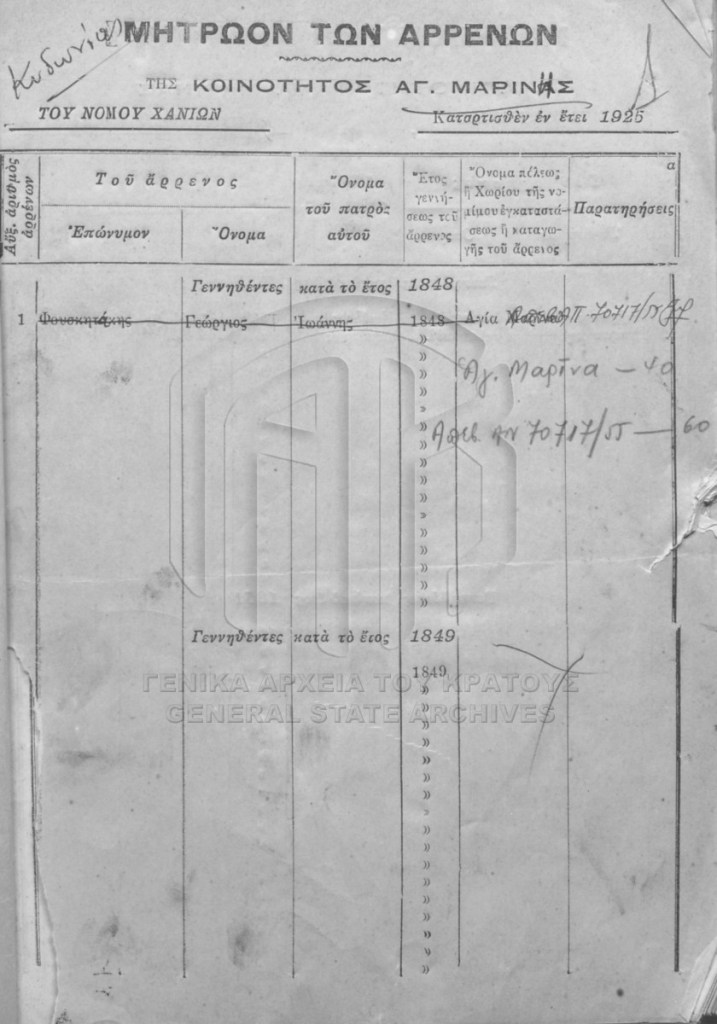
I reviewed the Mitroon Arrenon (Male Registers) for Crete on the GAK website, looking for a birth record for Ioannis Fousketakis, and then did further research in the archives in Sparta.

Male Register (Mitroon Arrenon), Georgis Ioannis Fousketakis

·         Did not locate a record for the birth of Ioannis Fousketakis

·         Located Mitroon Arrenon for GEORGIOS, son of Ioannis – born 1848 in Agios Marinas, Crete (village near Hania).

·         Located Mitroon Arrenon for NIKOLAOS, son of Ioannis – born 1857 in Sparta, Greece

·         Located Mitroon Arrenon for my great-grandfather, ANASTASIOS Fousketakis, son of Ioannis – born 1874 in Sparta, Greece.

·         I also located the 1897 Sparta marriage record for EMMANOUIL Fousketakis, son of Ioannis – no birth date indicated.

There are 26 years between the births of Anastasios in 1874 and Georgios in 1848.

Based on this age difference I didn’t think that Georgios was in my direct family. Instead, becauseGreek male names can repeat, generation after generation, I assumed these records referred to a different branch of the family.  I totally ignored the Crete records that referenced Ioannis Fousketakis from Crete for years as not being “my Ioannis Fousketakis” because a child born in Crete didn’t fit into my family story. 

If Ioannis and Marigo had a son born in Crete, that would mean that the family story of the couple running away and going directly to Sparta from Turkey to marry would be incorrect.

Instead, if they came back to Crete, which was part of the Ottoman Empire, Marigo must have been from a family who was Greek Orthodox living in current Turkey which was also part of the Ottoman Empire. 

Lessons learned:

  • Consider the source of your family story.  My source was my mother, who heard the story from her father, who heard the story from his wife who was the granddaughter of Ioannis Fousketakis.  On reflection, it is not hard to believe that my grandfather could have embellished the story.
  • Follow the records, not the story.  I totally dismissed records that didn’t fit the scenario I was trying to prove.

NOTE: This is the second in a three-part series, Follow the Records. Read Part One here.