Unknown's avatar

About Spartan Roots

I am of Greek ancestry with roots in villages near Sparta. My paternal grandparents and maternal grandfather were born in Agios Ioannis (St. Johns), and my maternal grandmother was born in Mystras. I love family history research and have been tracing my roots for many years. I was born in Brooklyn, New York and was raised in a predominantly Greek neighborhood close to extended family. I live in the Washington D.C. metropolitan area and work as a volunteer Co-Director of the Washington, D.C. Family History Center and a genealogy aide/project aide at the National Archives in Washington, D.C. I am always updating and adding new information. Please contact me - I would love to hear from you!

Stories from the village: Theologos

Around the time of the Greek Revolution of 1821, seven brothers left Crete and traveled to the Peloponnese. They scattered and settled in various areas. Three found their new home in a village 7 km north of Sparta, and the Zacharakis family of Theologos was formed. Theologos is situated 5 km straight up to the top of a mountain. Due to its height and spectacular views, the village is known as “the balcony of Lakonia.”

View of Theologos from the home of Georgia Zacharakis Dariotis

My great-great grandfather, Dimitrios Zacharakis, was among the earliest born in the village, circa1832. What type of life did he and his descendants experience? What were their occupations and their traditions? I asked my cousins to introduce me to the oldest member of the family, Georgia Zacharakis. At 93 years old, she is strong, sharp and sprightly. She continues to maintain the sprawling 100-year-old stone house that she shared with her husband (now deceased), Ioannis Athanasios Dariotis.
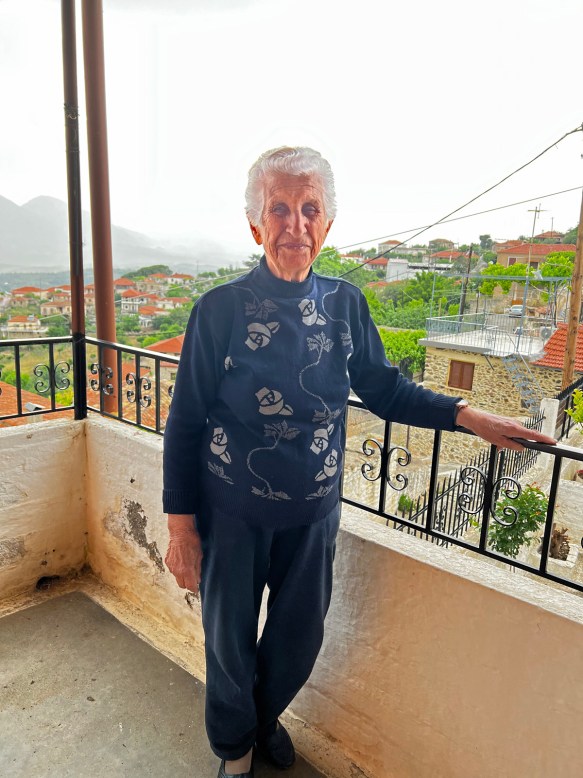
Georgia Zacharakis Dariotis on the balcony of her home
Theologos, June 1, 2023

Through her reminisces, Georgia brought the past into the present. Village life was as rugged as its mountain. Transportation was by horse or donkey. It was not until 1970 that a narrow, switchback, paved road to Theologos was constructed. Prior to then, people rode animals or walked 4 km over winding mountain paths to the nearby village of Voutiani which had the only road on the mountain. It led to the city of Sparta where people could shop, conduct business, and access doctors or government facilities. There, horses and donkeys were kept in a χάνι (chani), a house with a large inner courtyard, where travelers and their animals camped and spent the night.1 After returning to Voutiani, people walked the 4 km back to Theologos, and this time their animals — or their arms — were laden with the goods and items purchased. The return trip was all uphill and done barefoot. Shoes were a luxury, not a necessity.
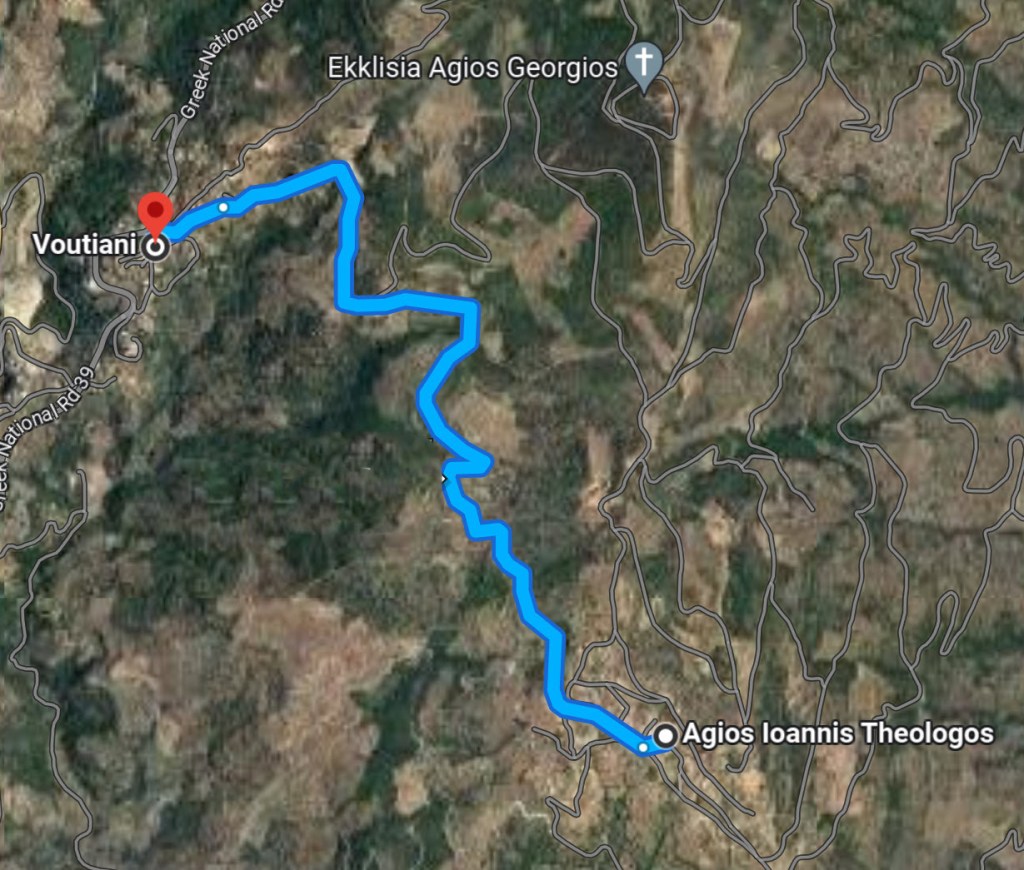
The mountain path from Theologos to Voutiani

Homes were built of stone and, until recently, had no modern conveniences. Nestled in the cliffs, steep steps led to every house.
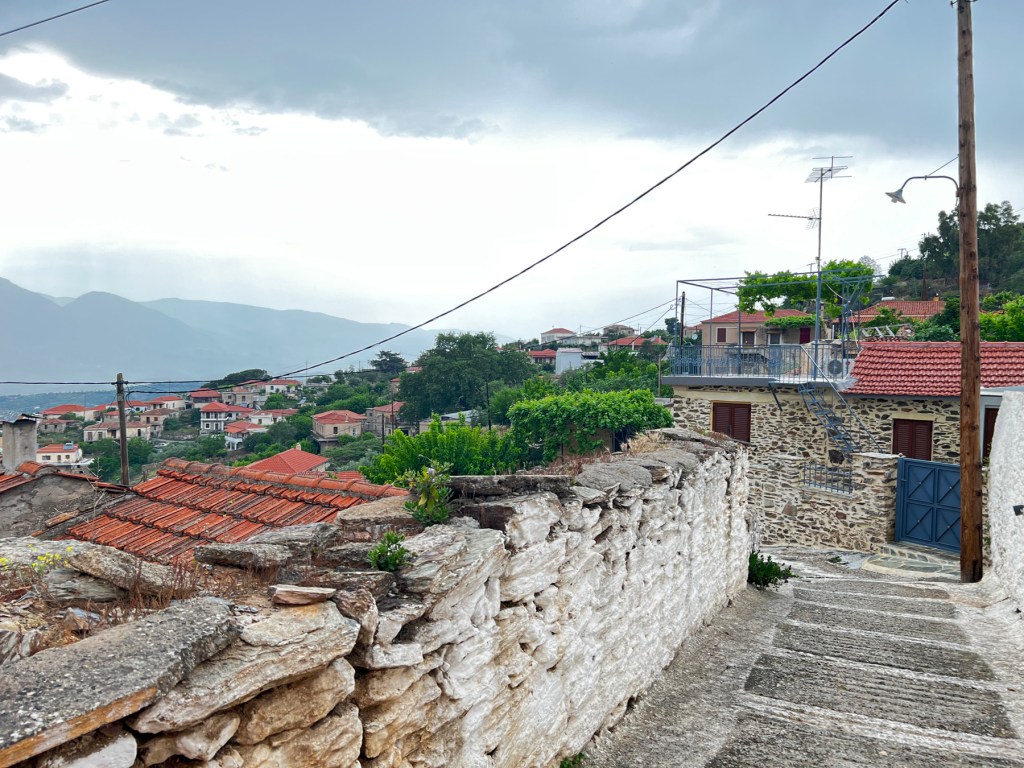
Steps leading to Georgia’s home

Village families were very close and considered themselves one unit. Because they knew each other well, marriages among their children did not present unexpected surprises such as alcoholism, illness or mistreatment of spouse or children. Marriages were arranged by a matchmaker (either male or female), who received money for their services. Georgia said, with a sparkle in her eyes, that although match with a man from Agios Ioannis, Sparta was being considered for her, she refused it — preferring a man from Theologos. She married Ioannis Dariotis in 1953.
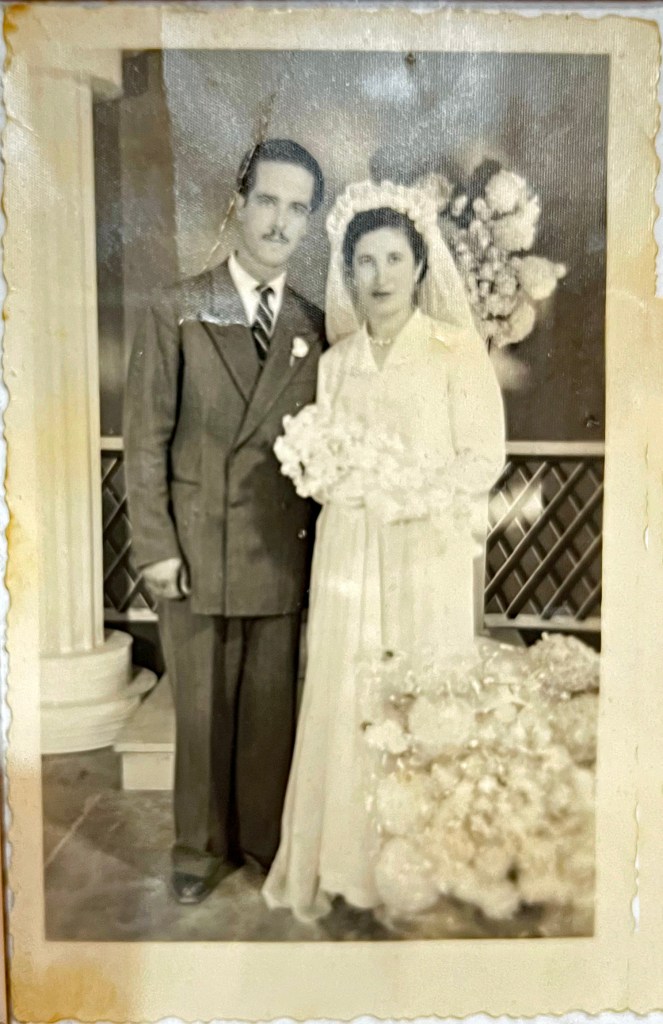
Ioannis and Georgia, June 28, 1953

Both men and women labored ceaselessly. The primary occupation was growing olives. For a time, only about ten families owned all the olive trees that fill the mountainside of Theologos. The rest of the men were laborers, working in the groves. As time passed, almost every family eventually owned at least one grove. Olive oil production was such a large business that two processing plants were built; currently, neither is operational. The villagers now bring their olives into Sparta for processing. Even today, the olive harvest season is long, lasting from October to April, because of the large amount of olives grown on the mountain.

One of two olive oil production facilities in Theologos

A few village men were woodworkers and carpenters or stone masons. Every building is constructed of stone, hewn from the mountain. Georgia’s father, Nikolaos, was a woodworker. Her husband, Ioannis, did not have an occupation when they married, and he worked with Nikolaos to learn the woodworking trade. Ioannis’ father was a farrier, making horseshoes and shoeing the animals in a courtyard at the front of Georgia and Ioannis’ house.

Courtyard where Ioannis Dariotis shoed horses

Children were born at home under the care of the village midwife, Chaido Synodinou (early-mid 1900s). A new mother was granted no reprieve from her tasks: cooking, cleaning, and childcare. Georgia’s mother, Amalia Bebetsos Zacharakis, boiled “bad” oil to make soap for washing clothes and bodies, and sold the product to earn a little money.

In addition to household chores, women harvested wheat and toiled in the fields. After the wheat was threshed, it was baked into bread in an outdoor oven.

Georgia opens the door to the oven, now housed indoors in a separate room

Seeing the hardships endured by village women, Georgia’s father encouraged her to make a better life. With his blessing and support, Georgia studied dressmaking in Sparta and became an outstanding seamstress. She made clothing for men, women and children. She also constructed clothing and vestments for priests, which are both ornate and meticulously embroidered. Georgia’s love of sewing has not subsided, and she took great joy in showing us her two sewing machines.
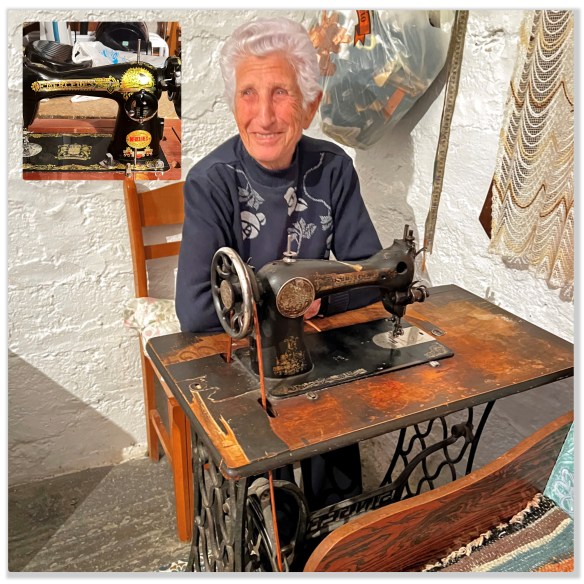
Georgia in her sewing room. She is sitting at the treadle machine which is operated by her feet; the electric machine is inserted upper left.

Georgia’s brother, Pavlos, and her nephew, Nikolaos, shared memories of growing up in Theologos. People were very poor. When their fathers worked in the fields, they took only bread to eat, leaving the cheese at home for the children. Everyone — children and adults — went barefoot.

Nikolaos, Pavlos, Georgia Zacharakis

Children had handmade toys. Balls were made from old clothing tightly stuffed into socks. Stones were lined up, and the homemade balls were rolled to move them. Sticks of varying sizes were placed on a ledge with half of the stick extended over the edge. The stick was hit hard, and the one whose broken half flew the farthest won the game. Children played leap frog and “heads or tails” with a stone or small coin. Primary school was a one-room building in the village; secondary school was in Sparta.

In the mid-1900s, when children grew into young adults, they left the village to attend college in other areas of Greece. Some returned to the village; many did not. Around the time of the great emigration (early 1900s), men went overseas in search of new opportunities. They walked or took a horse and cart to the nearest port, Gytheion; from there, they boarded small ships to Piraeus and other ports for the journey across the Atlantic. After settling in a new land, they invited their siblings, cousins, and villagers to join them. They brought their sisters to be married, thus relieving parents of the burden of providing a dowry and finding husbands who could give their daughters a better life.

Today, the population of Theologos is about 200 people. Soon, our Zacharakis cousins will gather for a reunion and to enjoy being together. Many are waiting to see the updated family tree which I have compiled using civil and church records. As the plateia (town square) fills, I know our ancestors will rejoice when they see us, their descendants, uniting in remembrance of them.

1Dictionary of Standard Modern Greek

Missing a Male? He May Have Been a Sogamvros

It happens in many families. A husband and wife welcome one daughter, then two, then maybe several more into their home. When the childbearing years have passed and no sons are born, the descriptive genealogy term is that the family is “daughtered-out.”

In pre-modern Greece, this situation posed problems for the husband and wife. With several daughters to be married, several dowries were needed — a most difficult situation for poor, rural village families. The surname may or may not disappear: if it is prevalent in the village, and if others with the surname are not daughtered-out, the surname will survive; if that is the only family with the surname, it will end.

But perhaps the biggest concern of the parents is: who will succeed the father as patriarch in the home? Who will be the head of the household, and assume the responsibilities of providing for and protecting the family? The patriarch provides financial support by earning a living and managing the money. He is the decision-maker in the home and provides his family emotional support and guidance. He preserves the family’s traditions and cultural heritage and serves as the primary role model for his children and grandchildren. He is revered–or sometimes feared–but always respected.

One solution to this dilemma is the introduction of a sogamvros, a man who marries one of the daughters. He leaves his father’s home and family to live in his wife’s household, thus assuming the role of patriarch in her family after her father dies.

Here is an example found in a search of the 1844 Voter Lists for the village of Agios Ioannis, Sparta, on GreekAncestry. Notice the suffix, –gamvros, in each name:

Thirty years later, the 1872 Voter Lists of the village reveals these names:

  • Στρατηγόγαμβρος, Χρ. (Stratigogamvros, Chr.) age 28
  • Τρακόγαμβρος η Σαχάμ, Π. (Trakogamvros or Sacham, P.) age 32
  • Τρατόγαμβρος Μιχ. (Tratogamvros, Mich.), age 35

Remember, surnames were “fluid” (changeable) or even non-existent before the 20th century, thus; the sogamvros may or may not change his name upon marriage. We cannot determine if the prefix is the original surname of the man, a nickname, or the name of the family he married into: Kontogeorgo-, Stratigo-, Trato-, Trako-. (As an aside, N. Stratigogamvros and Mich. Tratogamvros are found in both the 1844 and 1872 Voter Lists, which demonstrates the importance of examining all extant records for your surname.)

The irony of a sogamvros is that after he joins his wife’s family, he becomes “lost” in his own. He has left his home, resides in his wife’s house, and has a change in his name. If we find that a sogamvros has married in our family, how can we determine which family and village he was from?

Gregory Kontos of Greek Ancestry explained: “We may never know the man’s original name unless we find a document or notary record (contract, will, etc.) that states his father’s name or which village he was originally from. Or, if there is a family story that provides that information.”

In my recent interview with researcher Tom Frangoulis, he related that the only way he knew a male relative became a sogamvros in another village was because a family member mentioned that fact in a written family history.

Alternately, if we are “missing” a male in our family, could he have become a sogamvros in another village?

My branch of the Kostakos family is now daughtered-out. My father was the only son; my brother was the only son, and he has two daughters. If we lived in our village of Agios Ioannis a couple of generations ago, someone who married one of my nieces would become a sogamvros. To reflect his new role as patriarch, perhaps he would have chosen to take Kostakos surname, thus becoming a “Kostagamvros.” By leaving his family and joining ours, his identity would change. If no one documents this fact, his origins may be forever lost.

Let’s be sure we write something about the history of our family. How sad it would be if people “disappeared” because we did not take the time to document what we have learned about our ancestral lines.

ADDENDUM: My sincere appreciation to Achilleas Gazis, who wrote the following corrections to this post: “Two points to notice: the prefix is always the name of the family he married into; Your sogamvros would be Kostogamvros, not Kostagamvros.”

Family Tree of Agios Ioannis, Sparta

by Carol Kostakos Petranek

With three of my four grandparents born in Agios Ioannis (Aridas, Kostakos, Papagiannakos), I am related to almost every family in our village. My desire to understand our family connections both intrigues and entices me to document how we all interconnect.

I have spent several summers at the Archives of Sparta, the Lixarcheion office and the Municipal Office (KEP), researching our families. I have gathered information from primary sources: the Dimotologion Koinotitos, Mitroon Arrenon, School Archives, Church Books, Election Registers of 1844 and 1872, and Marriage Records from the Metropolis of Sparta. To complete the project, I must extract additional names from marriage, church and school records, but the basic family structure of the village is now documented.

This data has now been compiled into a website, Spartan Roots Family Trees, which can be accessed here. As I continue to add information, the website will automatically update.

Important: Only people who are deceased are in this website!

To use the site, click on the home page, then on the left menu, click on “name index“. Using the alphabetical letters at the top of the page, click on the letter of a surname. A list of surnames will appear and the number next to each name indicates how many people with that spelling are in the database. Click on the letter of interest. Name spellings vary a lot and some begin with two-letter consonants (see Notes below). Alternately, type a surname in the search box. If a name does not appear, then click on the first letter of the name and scroll until you find it.

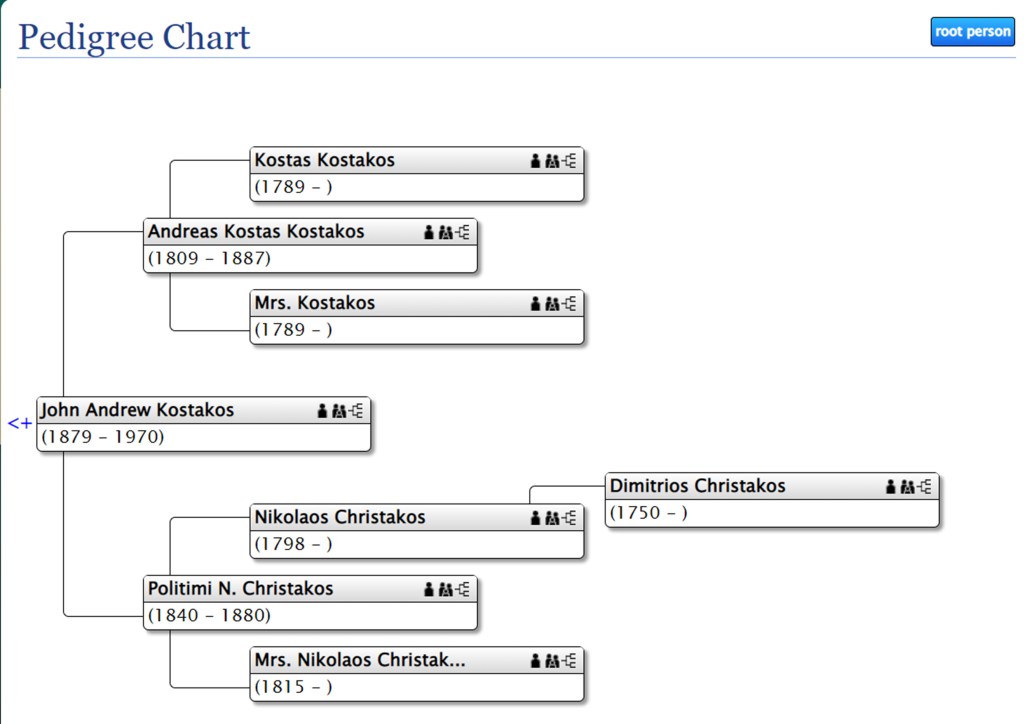
For example, I am looking for my grandfather, John Andrew Kostakos.

When you find a name of interest, you will see three icons on the right. Each takes you to a page with additional information about that person.

Number 1 is the Individual Page, with vital statistics, facts and notes about that person.

Number 2 is a Family Group Sheet. You can choose whether to view that person as a parent with his/her spouse and children; or as a child in the household of his/her parents.

Number 3 shows the person in a Pedigree view. He is the first person on the left, with his ancestors on the right.

Notes:

(1) to navigate, use the left and right arrows at the top of your browser to go one page back or forward.

(2) Be alert for names which begin with two-letter consonants. These are: μπ = b or mb; ντ = d or nd; γκ = g or ng; γγ = g or ng; τσ = ts; τζ = dz.

These two-letter consonants could be translated more than one way; e.g., Bolovitsiotis in English is spelled Μπολοβιτσιώτης in Greek, so it could begin with either a B or an Mp.

(3) If you know of a name that is not on the site, please contact me so we can determine why it is missing.

It is my deepest hope that this website will help you to trace your family back through time. Some men in the Election Register of 1844 were born in the late 1700’s! Our families have a deep and proud heritage, and I am so honored to have roots in our beautiful village!

I am so pleased that this initiative has been accepted into the Greek Ancestry Village History Project Initiative, which is explained here.

It Started with a Forgotten Name

by Carol Kostakos Petranek: Interview with Tom Frangoulis

How does a village history project evolve? In Egklouvi, Lefkada, it began with the name, “Polito.” When neither Tom Frangoulis nor his brothers could remember their grandmother’s given name, Tom embarked on a quest. He knew there had to be a record somewhere. “I was born in Egklouvi,” he explained, “and everyone in my father’s family was born, married and died there.”

Examining books at the archives and churches, Tom discovered that his grandmother’s given name was Polito. He also noticed that the Frangoulis name was written on page after page, year after year, going back in time. Way back– to 1760! “When I started building the family tree, all the branches were other families that also lived in Egklouvi,” Tom said. “The village didn’t have that many people, so everyone is related.” As Tom expanded his research into his mother’s family from another village, he concluded that “all of Lefkas is related to me!”

Tom’s passion for documenting his family’s history meant that his summertime visits to Egklouvi became research trips. “Starting in 2010, I would go to the archives for three to four hours a day, five days a week, for several weeks,” he stated. “I told the people there that I was interested only in my family research. I was not interested in making money or publishing a book – only my family history. After three years, they realized that I was not lying and they began to trust me.”

Tom Frangoulis

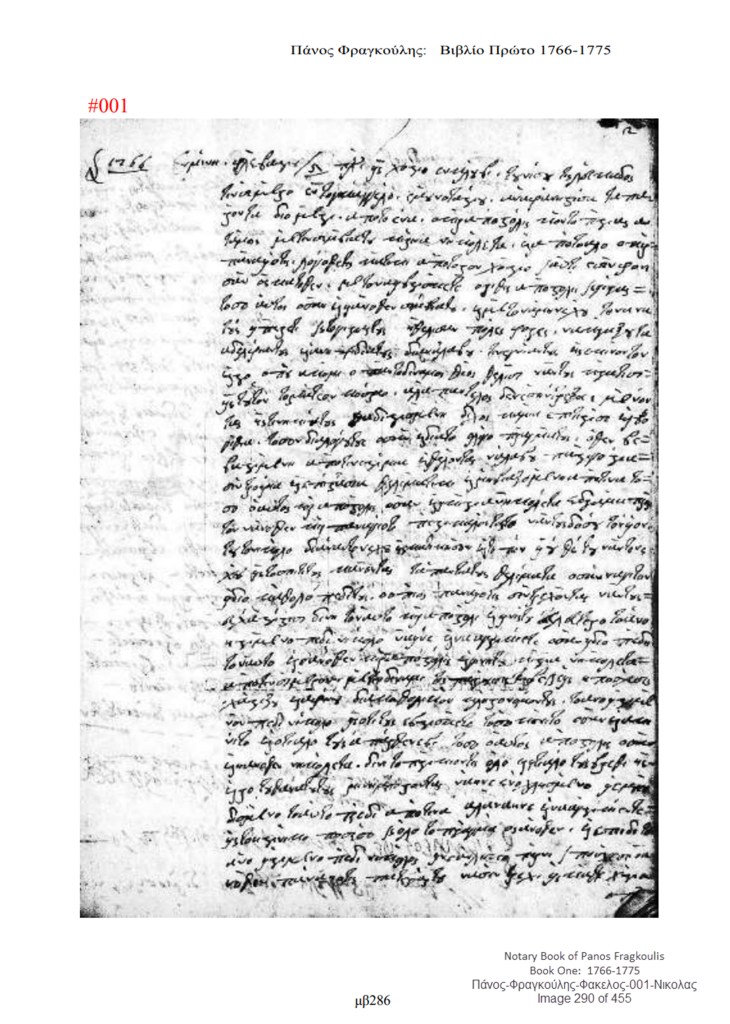
That trust, built carefully and honestly over the ensuing years, has enabled Tom to access records and documents not only at the archives, but also in municipal offices and city halls. Notary books on the island of Lefkada go back to 1760 and church records to 1770. At one point, the Greek government required priests to turn their church books over to the archive offices where they remain to this day. There are hundreds of books – civil and church – dating from 1750 to the early 1800s, and the late 1800s to early 1900s; however, there is little in between. “From 1840-1890, books are difficult to find or they don’t exist,” Tom observed. “The bridge for information in this timeframe is the Male Registers and Election Registers.”

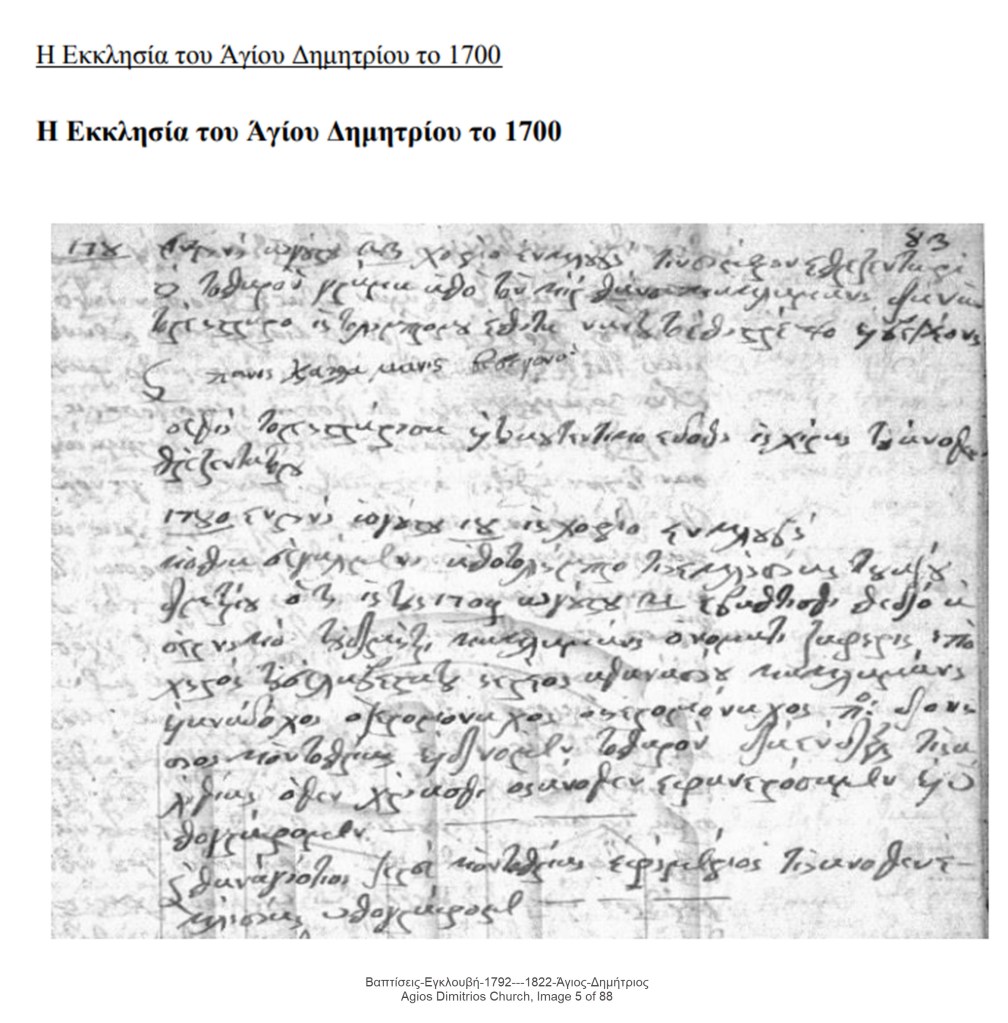
Another dilemma arose. “The books are fragile, and the ink has eaten the paper. I want the information, but I don’t want to destroy the books,” Tom remarked. He developed a two-part method to both preserve the records and extract the vital data.

First, he uses a camera to take digital copies of the original books. He then uses Photoshop to crop and straighten every photo, and to play with the brightness and contrast to ensure the image is the best quality possible.

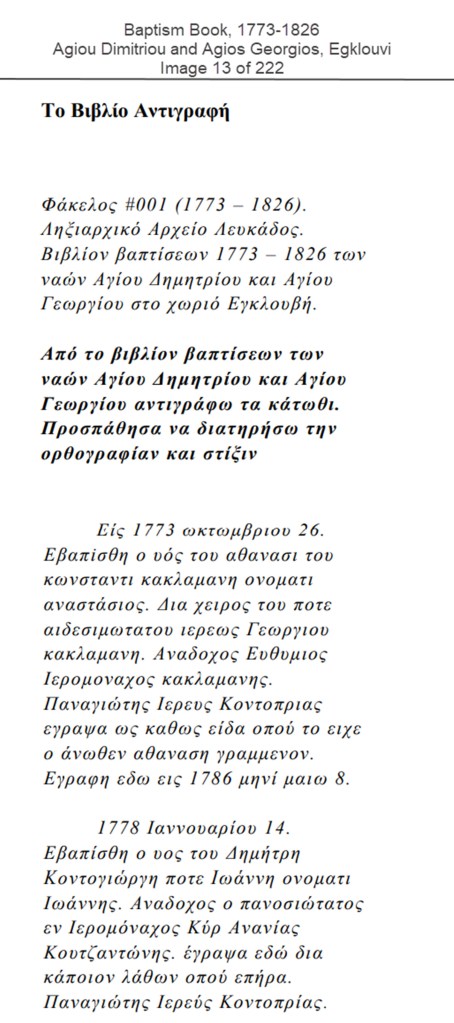
Second, he transcribes notary documents word for word. He reviews the pages and enters every name into an Excel spreadsheet. With church books that are names only, he types every name for every entry into a spreadsheet. He described his process: “I read the baptism book and create a line for the child — the date he was born and baptized; his name; the godparent; the father and the grandfather, and the mother (in later records). The forms are in alphabetical order. I analyze the records. Some books I analyze a little more to put together families.”

Tom transcribes the records into Greek, not English, because the villagers are then able to read his works, ask questions, and provide additional information. In turn, Tom helps them. “All I need is someone’s name, and I can take their family back to the 1700s,” he says with modest pride.

Reading the old, handwritten records—especially those from the 1700s—did not come easily. Tom explained, “In the 1700s there were very few people who could read and write, and that included the priests who were illiterate. When you read these books, you see that there were no rules in writing: one page is written as one long paragraph; there is no separation of words, no punctuation, no paragraphs, no periods, no capitalization. You must learn to decipher the handwriting of the person and then separate the words into sentences and paragraphs, so they make sense.”


Church records in the mid-1700s were written differently than today. In baptismal records, the name of the mother was generally omitted. Why? “Back then, people knew who the mother was because everyone knew all the families in the village,” Tom answered. “Sometimes not even a last name was written.” Also, priests recorded the names by which people were known. Since villagers used nicknames (paratsoukli) interchangeably with surnames, the priest could use either name in the record. Thus, correctly identifying families was a challenge. Tom learned that by comparing the given names of family members and parents, he could identify the family whether it used a nickname or a baptismal surname.

“After 1820, priests began writing both fathers’ and mothers’ names because there were several families with the exact surname in the village,” Tom commented. “Then, when there became too many with the name, paratsoukli were given as a way to differentiate the various families. My great-grandfather’s uncle got the paratsoukli, “PentEkotis (Πεντεκότης)” because he owned five chickens!”


Notary records—rich in facts about families and customs of the times—are an incredibly important resource for both historians and genealogists. Wills, dowries, real estate transactions, business agreements and sales of animals are written in exact detail, providing an intimate glimpse into the personal lives of villagers. “When you read them, you cannot separate yourself from the life that people lived. There were surprising things they did,” Tom said as he described a couple of examples:

1) “The general belief is that a dowry belongs to a man. Not correct. The dowry agreement is between the father and the mother of the bride and their son-in-law (the wife is not involved). There are three parts to a dowry agreement. First, the three parties go to the notary and the father and mother present a list of dowry items which could include trees, animals, land, household goods. All three agree on the list. Second, before the wedding, the son-in-law writes down everything he received so far – maybe three cows were promised but he only received two, and his father in law owes him one more. Third, the dowry belongs to the wife. If the husband mishandles one of the items from his wife’s dowry, he has to replace it.

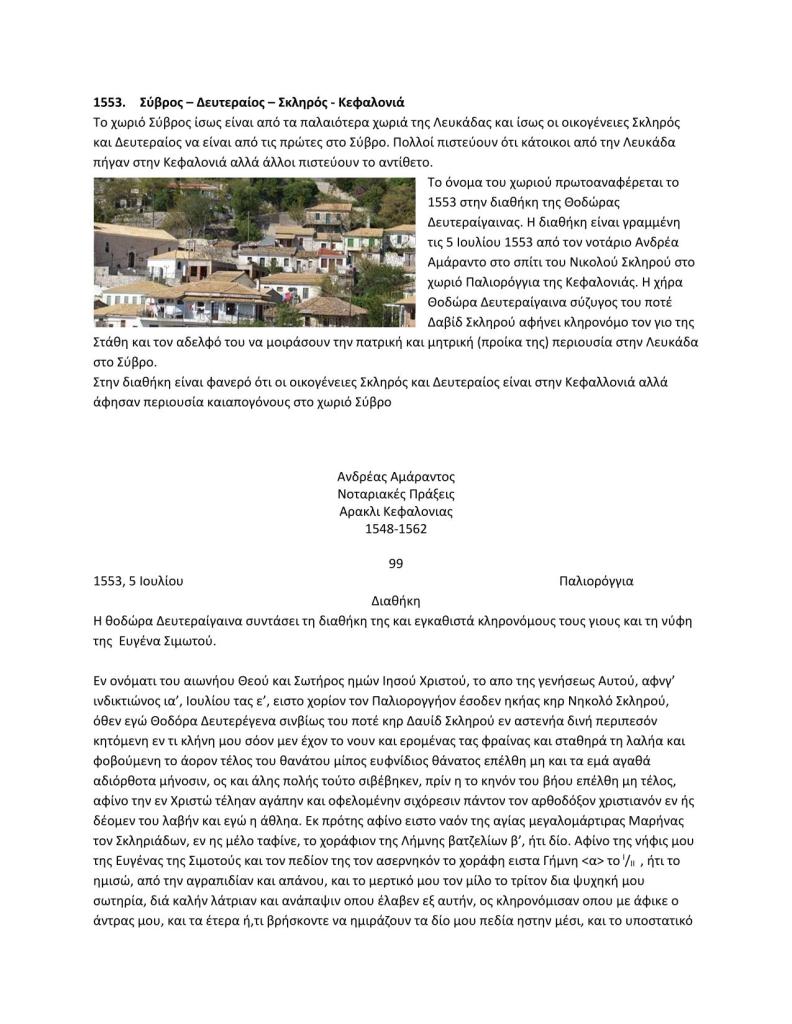
2) “A husband and wife can write separate wills. A will written in 1550 in Kefalonia proves this point. Both the husband and wife were from Lefkada but ended up in Kefalonia. The husband wrote one will, and his wife wrote her own will, leaving her property in Lefkada to her children.” At the end of this post is an article that Tom wrote which proves this point, and verifies that the families Deftereos and Skliros lived in the village of Sibros in Lefkada in 1550!

3) “If I was selling a house and you wanted to buy it, how would we agree on a fair price? There were no appraisers back then and no one wanted to be cheated. The notary books explain how this is done. Both the buyer and the seller choose three people from the village whom they trust. One person from the buyer and one from the seller go to the house together, look at it, and decide on a price. Then, the next couple do the same thing, and then the third. When all three couples have decided on their prices (which could be very different), the sums are averaged and that becomes the sale price. Thus, there are no allegations of cheating after people from both sides agreed on a price.”

4) “You can feel the pain of the people in those records. In a will written in 1789, two brothers inherited their father’s property. The father had only one donkey and one cow. In the will, he leaves half of the cow and half of the donkey to each brother. The boys now have to decide how to split these assets. Both need the cow to plow, and both need the donkey for transportation. They find a way to share the animals equitably.

5) “These people were very religious. There is no will where they do not write where they want to be buried, and what they leave to the church. They would write that a specific property or item is to be sold “for the good of my soul” and the proceeds used to pay for the burial and as a donation to the church. In 1770 Egklouvi had seven churches and eleven priests. The churches were started by small groups of families, maybe three or four, with a congregation of 100-150 people. Then several families would start another church. If families could not maintain the church, they gave it to the metropolis.”


When Tom began researching his own family, he had no conception that it would eventually expand to a village (and possibly now, an island) history project. He started as each of us does—one person at a time. He emphasizes the importance of doing something, anything, no matter how seemingly small it may be: “Start with yourself. Get a folder and in it put your birth certificate, diploma, marriage certificate and important documents. It doesn’t take long to write a few lines; on one page, you can write the main events of your life. Then start a folder for your father with his documents, and one for your mother. When you get married start a folder for your spouse and children.

“People don’t realize how much information we have in our own hands. I used to talk to my mother all the time but I was not smart enough to write down at least the main stories she told. My parents were not educated and if someone doesn’t know how to write and read, they develop the skill of storytelling. My mother would present a story in a way that was better than any in a written document, but I didn’t write it down.”

Tom’s years of preserving, cataloging, and creating family histories are culminating into several written books. When the President of the village of Egklouvi learned of Tom’s work, he was very impressed and was instrumental in getting the books published on the official government website of Lefkada. Currently, four of Tom’s books are online and the government is waiting for additional volumes. Tom is now working on 30 additional books. “What is on the website is just a small portion of what I have,” Tom said. “If I can get a couple of people to help me, much more work can be done.”

Tom’s books can be found at https://lefkada.gov.gr/books/ebooks/. The books are in pdf format and free to download.

In summary, although Tom’s work is extensive, his philosophy is simple: “What is important is what you leave behind. We are living here for just a few years. Maybe our children are not interested in their past, but someday, someone will want to know ‘where did I come from? How did they live in the villages of my grandfather, my great-grandfather?’ You don’t have to go as far as me, but we all need to write something about our family.”

Below is the article about wills in the year 1550, referenced above: