Author: Theofanis G. Kalkanis
published in The Faris Newsletter, Issue 78, July 2023, page 32
Barter economy (or labor) was a common practice in the past in our region and elsewhere. More common was the exchange of labor in olive picking and other agricultural and livestock tasks among families. Usually, barter labor occurred between families, but also between professionals, involving building houses or other activities or even household production of cheese, soap, pasta, etc. However, there were also notable and characteristic cases and stories of barter economy between communities or even between ecclesiastical authorities and the residents or professionals of the villages.
A first case/story is the one that has come down to us and concerns the painting of some of the icons of the altarpiece (iconostasis) of the Holy Trinity of Xirokambi. These are the 14 small icons in a row at the top of the iconostasis. As the old resident of the village, Dim. Men. Xanthakos, narrated before his death, an iconographer, Pan. Lazaris, lived in our area during the time of the Italian-German occupation. He painted icons for churches in exchange for olive oil. Each icon of the iconostasis that he painted (in one day, as remembered by D. M. X.) was “exchanged” for a can of oil!
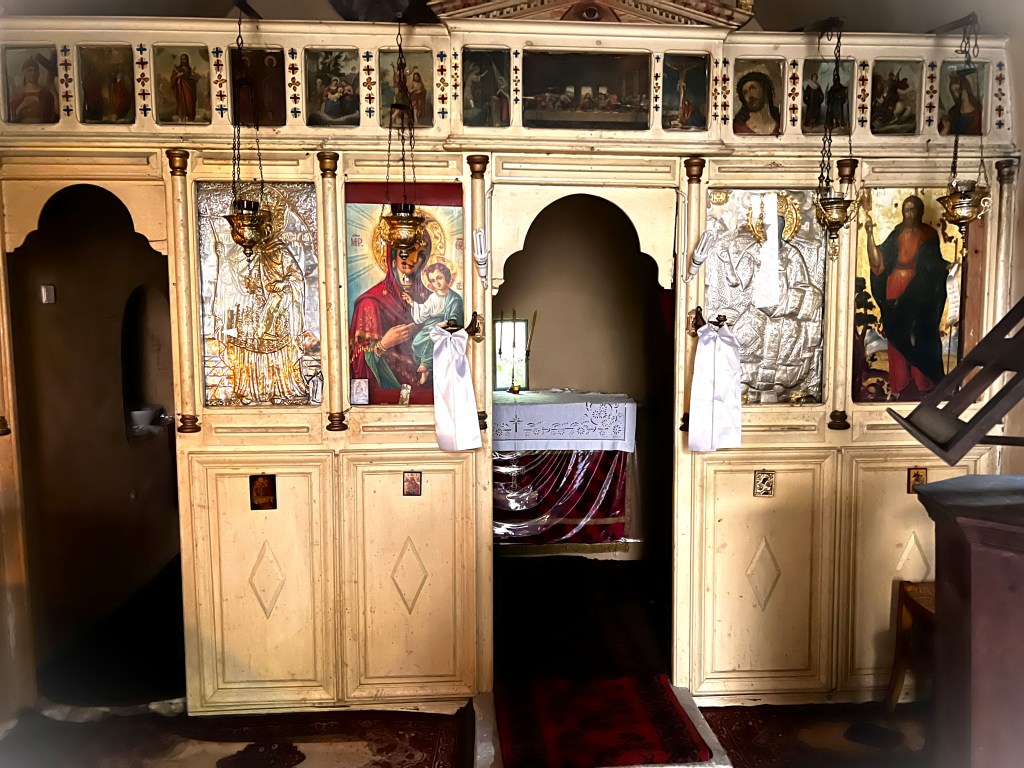
Photo by Carol Kostakos Petranek, June 2023
Another story that is characteristic of barter labor (and on a large scale) is the following: In Xirokambi until the early 1960s, long queues of residents lined up in front of the communal faucets at a few points in the village. Everyone waited to fill containers or pitchers, wooden barrels, or metal jugs with drinking water for all uses. At that time, the community council with presidents Georgios and Nikolaos Koumoustiotis successively, commissioned contractors for a large project for the village and its residents. Water was to be supplied to all houses with underground metal pipes from the tank that had been built in Anakolo. The “contract” with all the residents entailed their mandatory personal labor, “exchanging it” for the provision of water to each house. Instead of personal labor, some residents exchanged with the community a worker or an animal for transportation or a skilled craftsman with money or oil. The project was completed in the early 1970s and changed life in our village and elsewhere.

Photo by Carol Kostakos Petranek
The third case concerns the operation (in the mid-1960s) in Xirokambi of a Branch of the Gymnasium [high school] of Sparta for the students of our area until an independent Gymnasium was established. At that time, many students used to stop their studies after Primary School or continue their studies in Sparta by renting rooms and receiving baskets of food every day… With the initiative of some residents, pharmacist Theof. G. Kalkanis and merchants Elias Chr. Kapetanakos and Ilias N. Liakakos, the establishment and operation of the branch became possible (after persistent efforts). The original and remarkable thing is that the teachers who were transferred from the Gymnasium of Sparta were “bartered” with the oil collected by the parents from the committee (…)
I (Carol Kostakos Petranek) am honored to receive permission from the Katsoulakos family to translate and share articles from The Faris. Translation verification and corrections have been made by GreekAncestry.net. This is the fourteenth article of the ongoing series. Previous articles can be viewed here.

 Spartan Roots (Σπαρτιατικές Ρίζες)