By Socrates P. Vafakos
published in The Faris Newsletter, Issue 33, January 2003, pages 19-21
In today’s world, a pair of shoes is a simple matter in terms of manufacturing. They are made in factories on mass production lines with the latest technology and sold en masse to the world. In the early decades of the 20th century, however, when technology and modern machinery were non-existent, there were a few cobblers, who at the bench and in their workshops, made custom-made leather shoes and repaired worn and punctured shoes. Due to poverty, making a new pair of shoes was a rare phenomenon. It was considered a luxury to have a second pair of shoes. For this reason, the craftsmen, the so-called shoemakers, made new shoes on demand only. They would usually set up their bench in the shoe shop and with the help of workers and apprentices, they would repair damaged shoes. How many times didn’t the cobblers return to the surrounding villages to repair people’s shoes?
Every region of Greece had shoemakers and of course Xirokampi was not an exception. In Xirokampi, Ioannis Panageas had a shoemaker’s shop across the street from where Mr. Mandrapilia’s paint shop is today. The brothers Nikos and Argyris Kalianiotis had a shoemaker’s shop in the building that belonged to Panagiotis Kyriakakos. Later in the same place was the shoemaker’s shop of Yannis Alexakis, who had married the daughter of Argyris Kalianiotis. Panagiotis Christopoulos had a shoemaker’s shop in the building that belonged to Napoleon Andreakos. In Katsouleika was the shoemaker’s shop of Evangelos Kritikos, while Panagiotis Kalianiotis, who lives today in Sparta, had his shoemaker’s shop opposite the bakery of Nikolakakos. Finally, there is Georgios Starogiannis who is 96 years old today and lives in Xirokampi. His first shoemaker’s shop was in the house of Arachovitis. In 1933, having already been 10 years in the cobbler’s art, he went to the square and opened a shop next to Vangelis Liakakos’ house.
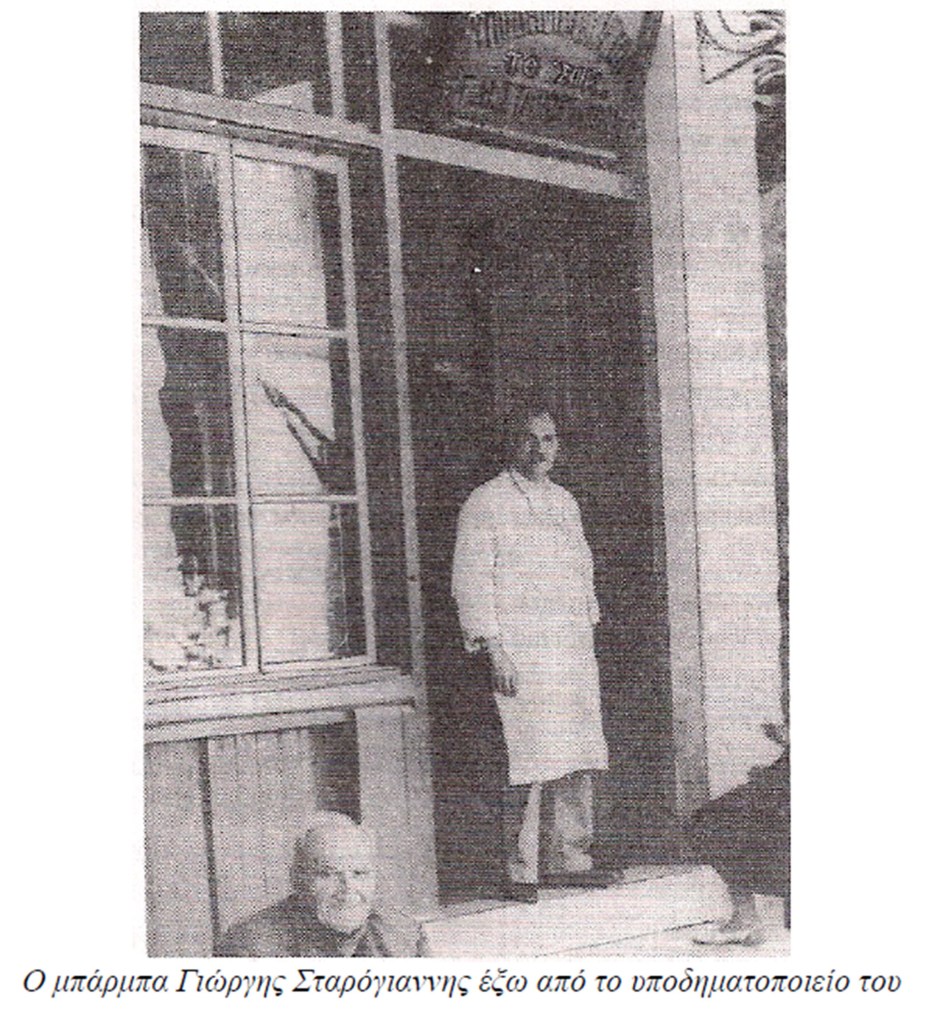
“Barba” Georgios Starogiannis retired when he completed 45 years of love for his craft. He is the only shoemaker along with “barba” Pantelis Skliros who now lives in Katsouleika. Like all shoemakers, he had several workers in his shop, around 20. He mentioned a few to me: Pantelis Skliros, Pantelis Frangis, Iraklis Komnenos, Konstantinos Chrysikos, Lias Chios, Yannis Filosofos who was also a good shoemaker, just like the aforementioned. There were of course many other cobblers who worked with diligence and craftsmanship in the shoe shops of Xirokampi. “Barba” Giorgis Starogiannis, during the occupation period, was the only one in Xirokampi who could manufacture the so-called German boots or vaketes (βακέτες).
The shoemakers made shoes on demand. They were made to fit the feet of the person who ordered them. At first, the cobblers took measurements with a tape measure. To give the shape of the shoe to the treated leathers and sole, they fitted them with a special shoe mold called kalapodi (καλαπόδι). Previously, of course, they had cut the leathers with a sharp blade, or if the skins were thin, with a cutter [similar to a wire cutter]. These two tools were sharpened with a special tool, called matsaki (ματσάκι). The pieces of leather were placed in the kalapodi and underneath was the vardoulo (βάρδουλο) [a strip of leather on the bottom of a shoe to which the sole is nailed or sewn]. Using small nails called spragges (σπράγγες), they nailed the sole to the skin.
After the whole construction took the shape of the shoe and the leather was repaired, they removed the nails and threw them away and where the nails had been, they sewed the skin with an awl. Then, to fasten the heels to the shoes, a hole was drilled to insert the wooden spike which was made from a piece of board. The tool which was used to drill the hole was called katsaproki (κατσαπρόκι). After affixing the heel with the wooden spike, they secured it with nails called telakia (τελάκια), which varied in size. To prevent the shoes and especially the boots from wearing out easily, two metal taps (or clips) were nailed, one on the toe and one on the back of the shoe. All around the shoe, where the leather meets the sole, the cobblers made various decorative stitches and engravings. The construction of the shoe was completed by polishing the sole, the heel and the bottom of the shoe with three smooth surface tools, the machineta (μακινέτα), the camareto (καμαρέτο) and the lampougio (λαμπούγιο). In particular, for polishing the heel, the cobbler would first heat the polishing tool over a fire in a small tin can. Such a pair of leather shoes needed a day to be made by an experienced craftsman.
Making a pair of shoes required great craftsmanship and artistry. An incident proves this: a customer from Potamia haggled with “barba” Giorgis Starogiannis for a pair. “Barba” Georgios, to show him the quality of the shoes he would buy, put the shoes on scales which balanced perfectly. The shoes were of equal weight, something difficult to do because they were handmade.
Of course, as we have already pointed out, the main work was repair. They patched full of holes and repaired damaged, worn out shoes. Every time there was a market, people from the surrounding villages and the mountains would come and have their shoes repaired by the shoemakers who set up their stalls in the square of Xirokampi. Often, the cobblers would go to villages and mend shoes on the spot. When the sole was punctured, they would patch it with a piece of leather. When the leather was punctured, they would put the shoe in the kalapodi and patch it with a piece of leather, called fola (φόλα).
At the beginning of the century, in the first decades, when there was no eight-hour work day, the shoemakers worked many hours a day (10 – 15) and sometimes stayed overnight at their work, without being paid extra wages and overtime by their bosses. The working conditions in the shoemaker’s shops were difficult, but they became more humane when the right to an eight-hour work week was secured, for which there had been many struggles all over the world.
Today, no one in Xirokampi follows the art of shoemaking. The old ones have either died or have now retired (G. Starogiannis, P. Skliros, P. Kalianiotis), while the younger ones do not have the passion to continue this profession. After all, there are now shoe industries that manufacture many pairs of shoes at low cost. Very soon, unfortunately, the shoemaker’s trade will be completely eliminated in all of Greece, as the last cobblers will also retire.
___
I am honored to receive permission from the Katsoulakos family to translate and share articles from The Faris. Translation verification and corrections have been made by GreekAncestry.net. This is the seventh article of the ongoing series. Previous articles can be viewed here.

 Spartan Roots (Σπαρτιατικές Ρίζες)
My grandfather came to Canton, Ohio in the very early 1900s, from Skopi. In Canton he opened a shoe making and repair shop. I still have many of the tools he used, and endless memories of his shop…. and the aroma leather, and shoe polish. I miss my Papou Foti Thanopoulos so much. Thanks for your article about the shoemakers in beloved Greece. ❤️
Thank you for sharing this about your grandfather! May his memory be eternal
Great read, very interesting and thank you for providing this to the now generations. We must never forget life of our family roots. It tells me who I am.
Thank you, Christina, for your kind comment and for reading Spartan Roots!
I was thrilled to see this article, in English, on the “Spartan Roots” website. I read it many years ago in January 2003 of The Faris (Η Φαρις), in Greek. My father, Panagiotis Christopoulos, is mentioned in this article! He operated his shop for a short period in Xirokampi, until he immigrated to Toronto, Canada in 1957. My mother, Martha, my brother George and myself joined him in Toronto in 1960. My father had many entertaining stories of the time he spent operating his shop, especially of the interactions between his fellow villagers! Through the translation of this article to English I am able to pass a little of my family’s history to my children and grandchildren. Keep up the good work! And, let’s ensure we, “Spartans” keep connected, through the internet (social media, etc.). I have been involved for many years with our compatriots from Xirokampi and Lakonia, here in Toronto, the U.S. and in our homeland. In fact, I am presently the president of both the Society Xirokabiton of Toronto, and the Pan-Lakonian Federation of Ontario. Both organizations have Facebook sites and I will be linking this article and Spartan Roots website accordingly.
My grandfather, Arthur M Karaberis, I was told, by my father, Christos, worked in a shoe factory, when he came to American, so did my father with him. They also were fishermen. Arthur was born in Larissa, Christos born in New Hampshire
How wonderful to read this! Thank you!