by: Georgia Stryker Keilman and Carol Kostakos Petranek
Greeks, like most ethnic groups, engaged in “chain migration” upon leaving their homelands. A man or a family would follow others who left their village and settle near—or even with—them in their new country. By associating at church, work, or in Greek organizations, immigrant families would form tightly knit groups, celebrating namedays, holidays and other traditions together. An important component of these immigrant communities was to bring young couples together to form new families. Whether by formal matchmaking or simple introductions, it was ensured that the next generation was able to meet and marry compatriots.
Georgia Stryker Keilman’s immigrant grandmother, Georgia Bebetsos and her three brothers, Sam, James and Tom were all living at 355 Chicago Avenue (Source: 1920 Census). This address was located just outside of the old “Greek Delta” area of Chicago where thousands of Greek immigrants settled. While recently reviewing the record again Georgia realized that she knew of marriages between members of some of the families living in the buildings at 353 and 355 Chicago Avenue.

Was there a previous connection between these families?
The families were from various villages in the Sparta area and one from the Arcadia Region.
Bebetsos – Theologos
Magoulias – Loggastra
Dounias – Soustiani
Pleotis – Arcadia Region

Georgia noticed that the 1920 Census documented that all the men in these families were working in the restaurant business; 1 assistant manager of a restaurant, 4 waiters, and 1 cook.
Could that be the connection?
Georgia researched the World War I Draft Registration forms or Naturalization applications to identify where they worked in 1917.
| Name | Home Address | Employer |
| George P. Dounias | ? | Charles Pappas, 344 W. Chicago Ave |
| John Magoulias | 344 W. Chicago Ave | n/a – assume same as above |
| James Bebetsos | 744 W. Division St | Chas. Papas, 744 W. Division St |
| Thomas Bebetsos | 2510 Blue Island Ave | Charles Pappas, 2510 Blue Island Ave |
| George Magoulias | 161 Hill Street | Mitchell Bros, 316 W. Division St |
| Angelo Pleotis | 859 Sedgwick Ct | Hotel Green Mills Garden, Broadway & Lawrence |
Notice that the first 4 people shown in the chart are associated with an employer named Charles Pappas. Also, they list their residence as the same address as their employment. We are assuming that they lived in rooms above the restaurant.
For example, in the 1920 Census, Charles Pappas was living at 744 W. Division Street. His occupation was proprietor of a restaurant. He was living with his wife and son, two brothers who were working as waiters and two roomers who were working as a waiter and a dishwasher. It is most likely that the restaurant was on the ground floor with apartments above.
Also note that the 344 W. Chicago Avenue address referenced in the above chart is about 1 block from the apartments at 353 and 355 W. Chicago Avenue. If the men referenced in the 1920 Census at this address were working for Charles Pappas at the 344 W. Chicago Avenue address, they could have walked to work.
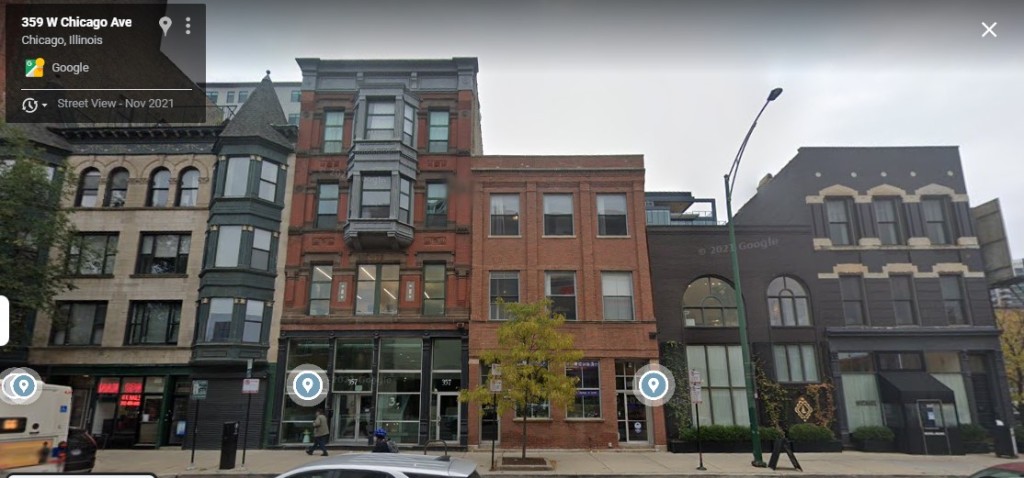
Although the 353-355 W. Chicago Ave. apartments were demolished, some buildings from that era are still standing across the street. Below is a photo which shows that many of the buildings in this area had a “store front” on the bottom floor and apartments above. The idea that the waiters, etc. could be living above the restaurant is a reasonable conclusion.
Naturally, questions arose:
• How did these people from neighboring villages end up in the same building?
• What are the connections? Or, who instigated the connections?
• The men who lived in the same buildings worked in restaurants. How did they know each other? What was Charles Pappas’ connection to them?
• How did these couples, living in the same building, become introduced and get married?
• How did so many apartments become available at the same time to provide housing for all these people?
We can hypothesize answers based on our understanding of the Greek immigrant community: chain migration; connections through the church and associations; matchmaking; business owners hiring fellow compatriots. But the details, which add to the richness of the human story, remain unknown. How important it is to get our family stories documented by those who know the specific facts!
In our 21st century society, it may seem like an anomaly to have this level of intertwining among unrelated people. But as we study the village records of our families, it is readily apparent that such connections were not only common, but were the very fabric of village life. Our ancestors were simply duplicating these intricate, woven relationships in their new lands.

 Spartan Roots (Σπαρτιατικές Ρίζες)
FAN club research reveals closer connections! Enjoyed this case study.
Thank you!
What a fun way to dig deeper into family stories. Yes, always go back to records to make sure you picked up on every detail the first time. 😉 Have you checked Sanborn Maps for the restaurant yet, to check out the layout?
Excellent idea! That went right past me, but I will definitely look into it and let Georgia know as well. Thank you!
Clarke St and Halsted Ave. Chicago. Not sure of spellings but many Greeks from same Spartan villages on these two streets. Thanks for all your research.
Thank you for your comment! Yes, that was definitely a hub for Spartans 🙂