Listen to the locals! Wise counsel, which is leading me down new roads (literally). When I had lunch with friends in Barsinikos, I mentioned to Christos (a native of the area) that I was trying to determine where my great-grandfather, Andreas Kostakos, may have lived before he was in Agios Ioannis in 1844. With waving arms and rapid Greek, he said, Anavryti and Perganteika (these are two villages on top of the Taygetos mountains). I was a bit stunned; my cousins had said Anavryti, but there was never a mention of Perganteika. So I replied in a nice manner, “But how do you know that?” Christos looked at me incredulously (how could I possibly doubt him?) and went into a long and animated explanation about how a man would settle in a certain area, have children, and then those children would populate the area; and, that a small settlement (not a village) would be formed by a couple of families. Therefore, the origin of specific families is known.
During the Ottoman occupation, families fled to the high mountains where they lived in ways that are unimaginable to me. After the Revolution of 1821, they began to descend into the valleys where the land was fertile and flat. When I told Christos that Andreas Kostakos was listed in the 1844 Election Rolls as living in Agios Ioannis (in the valley), he said that by that time, he had already come down from the mountain.

1844 Election Rolls, LADA Collection; Line 1205: Andreas Kostakos age 35, indigenous; owns property; village Agios Ioannis
Location of Perganteika: it is above and over the mountain from Anavryti; Agios Ioannis is in the valley. Seeing it on a topographical map, it is easier to understand how Andreas followed the pattern of descending from the highest to the lowest location after the Revolution.
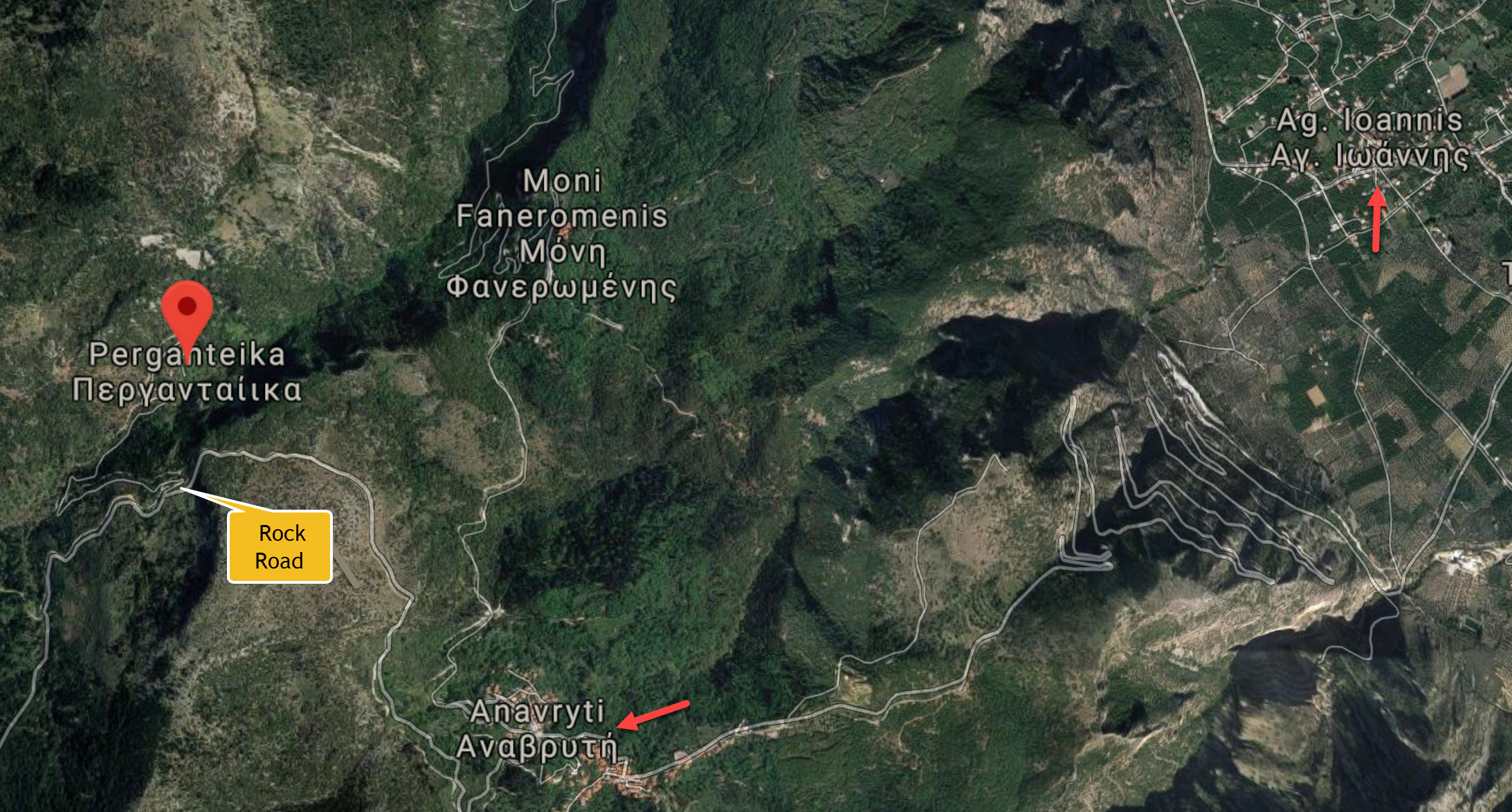
Perganteika, in relation to Anavryti and Agios Ioannis
Christos’ words have been weighing on me for two weeks, and I resolved to go to the now deserted settlement of Perganteika. How could I not go if my great-grandfather could have been from there? So this afternoon, I left the flat terrain of Agios Ioannis and headed up the mountain.
Anavryti is an historic village situated near the top of one of the Taygetos mountains. Prior to a road constructed in 1980, it could be reached only by foot or donkey. The white spaghetti-looking lines on the map above are the switchback roads, with hairpin turns providing magnificent views of the valley below.

Leaving the valley on the road to Anavryti
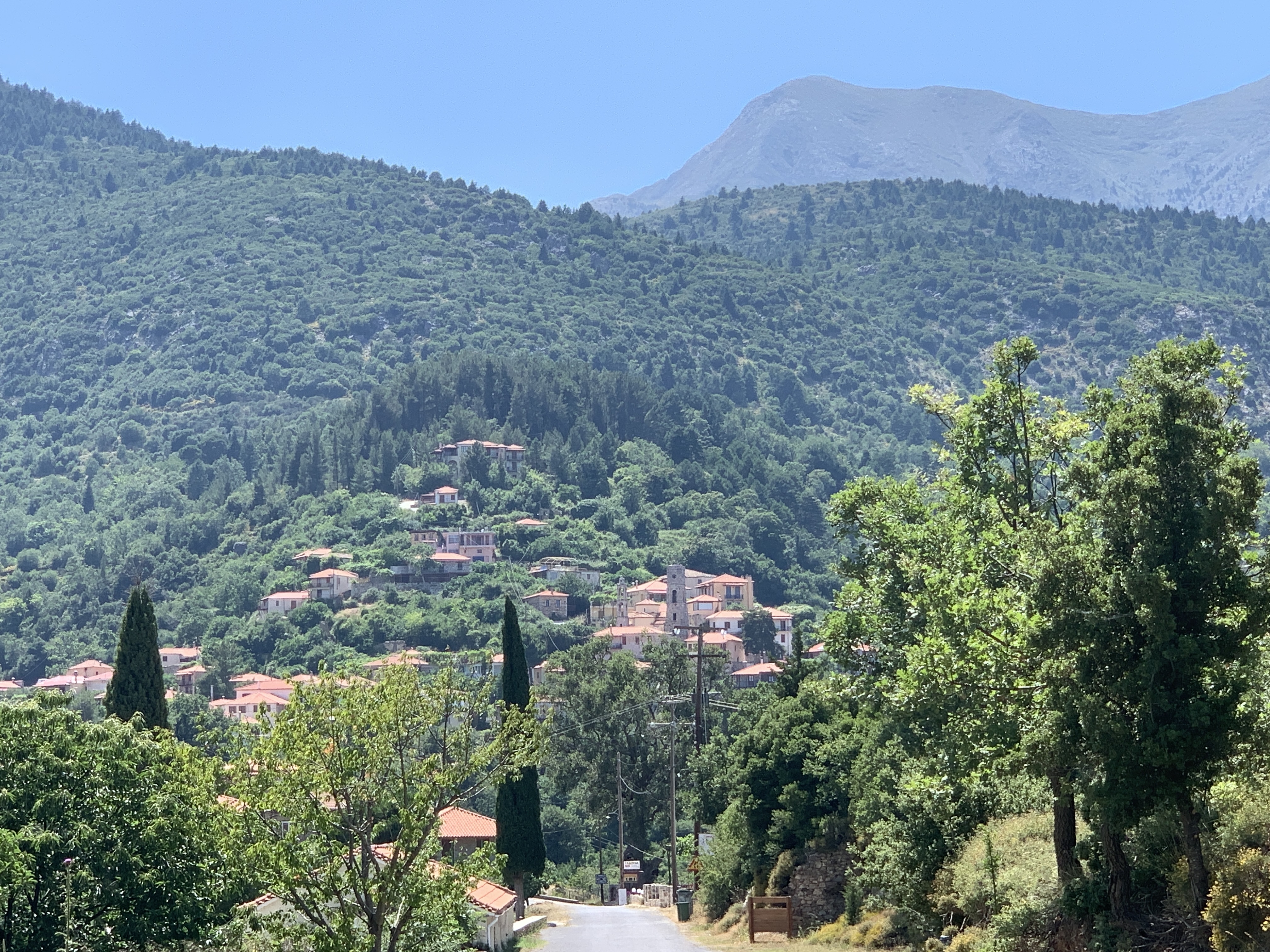
Almost to Anavryti; almost to the mountain top
When I entered the village, I stopped to take photos. The owner of a taverna which overlooked the valley came to say hello, and I asked him where I could find the road to Perganteika. He said to go through town and when the road dead ended to turn left, and when I reached a fork in the road with a steep turn, to go right. Then he looked at my Honda Civic, shook his head and said, “not in that car. With a Jeep, maybe.” I had heard that there was a church service in Perganteika the previous Sunday so I completely disregarded his caution, thanked him, and kept going. The road through Anavryti is paved stone; very narrow; with homes so close you can almost touch them from your car window.

The road in the village
Every mountain village has fountains where cold, pure mountain water flows continuously. Villagers and hikers fill their water bottles. This fountain was donated by the Katsichtis family and is at the edge of town.

Fountain of Anavryti.
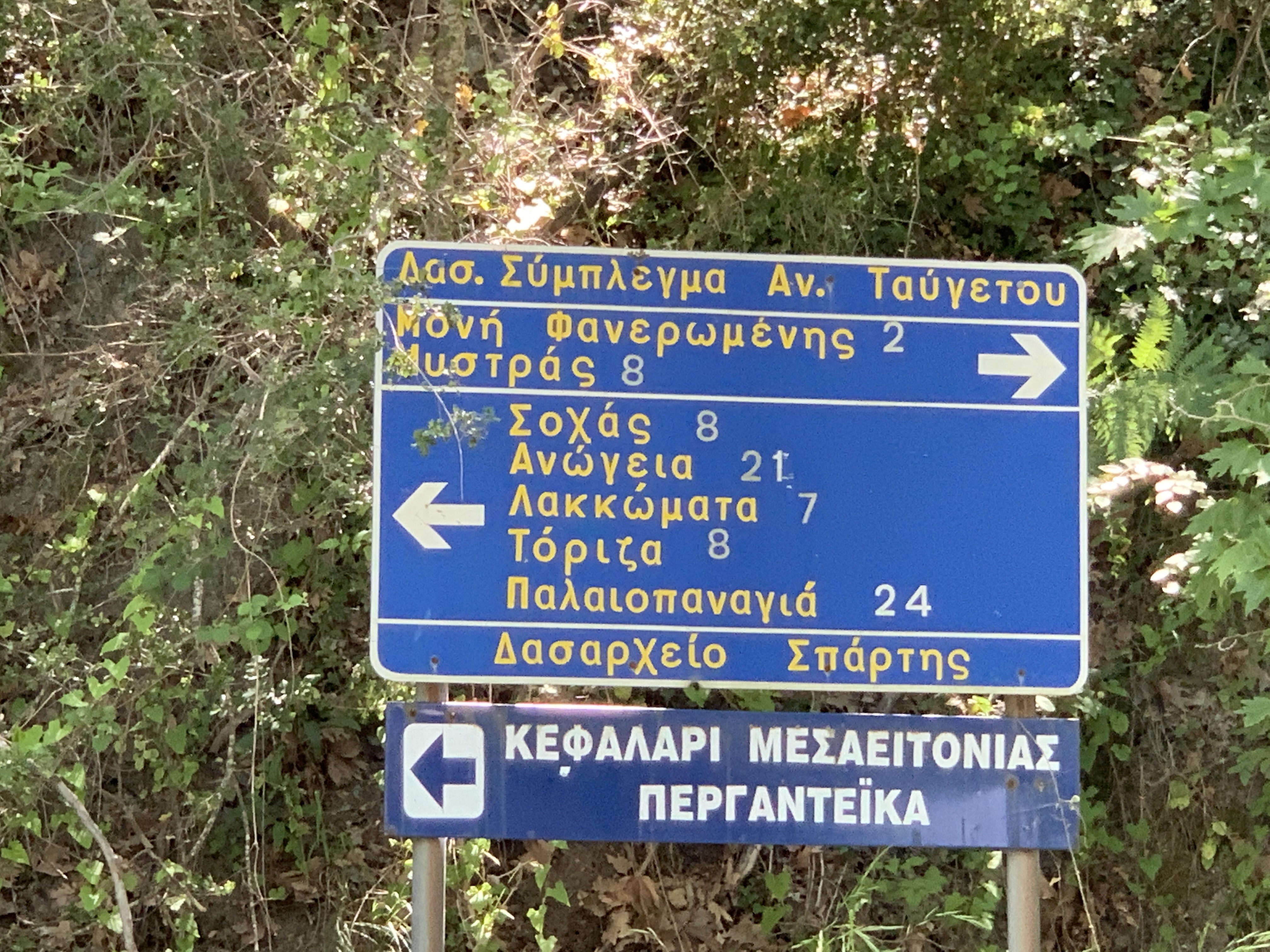
Towards the end of the village, the road changed from stone to asphalt, still narrow, still winding, but easily driveable. It wasn’t long before the road dead-ended and I came to a sign. The dark blue addendum with the left-pointing arrow proved the taverna owner was correct and that I was going the right way.
Immediately, the road changed. It became narrower. The asphalt became rougher and big ruts appeared randomly. There was a steep drop-off so I had to stay far from the edge. Donkey droppings were everywhere; they are still part of life in the high mountains. Here, in the middle of nowhere, a truck appeared. I stopped and asked the men where they were going. I thought that if they were headed to Perganteika I could follow them, but they waved me off and muttered something in Greek which I could not understand.


Drop off
I was doing great! The road was not bad and I was feeling a bit smug about ignoring the taverna owner and forging ahead. Until I got to the fork in the road where I was to turn right. I started on the hairpin turn and stopped. No way could I go any farther in a Honda Civic. The pavement ended and ahead there was nothing but rock.

The rock road to Perganteika
I considered leaving the car and walking, but the map showed Perganteika was 4.2 km and I was wearing sandals. I ventured a bit by foot but the road worsened as it continued. It wasn’t going to happen today. Disappointed, I headed back towards Anavryti. I decided to go to the Faneromenis Monastery, just 2 km from the road into Anavryti. Although there are thousands of churches in remote and uninhabited places, I continue to be amazed whenever I find one. Despite their lonely habitat and disuse, they are decorated with beautiful icons.
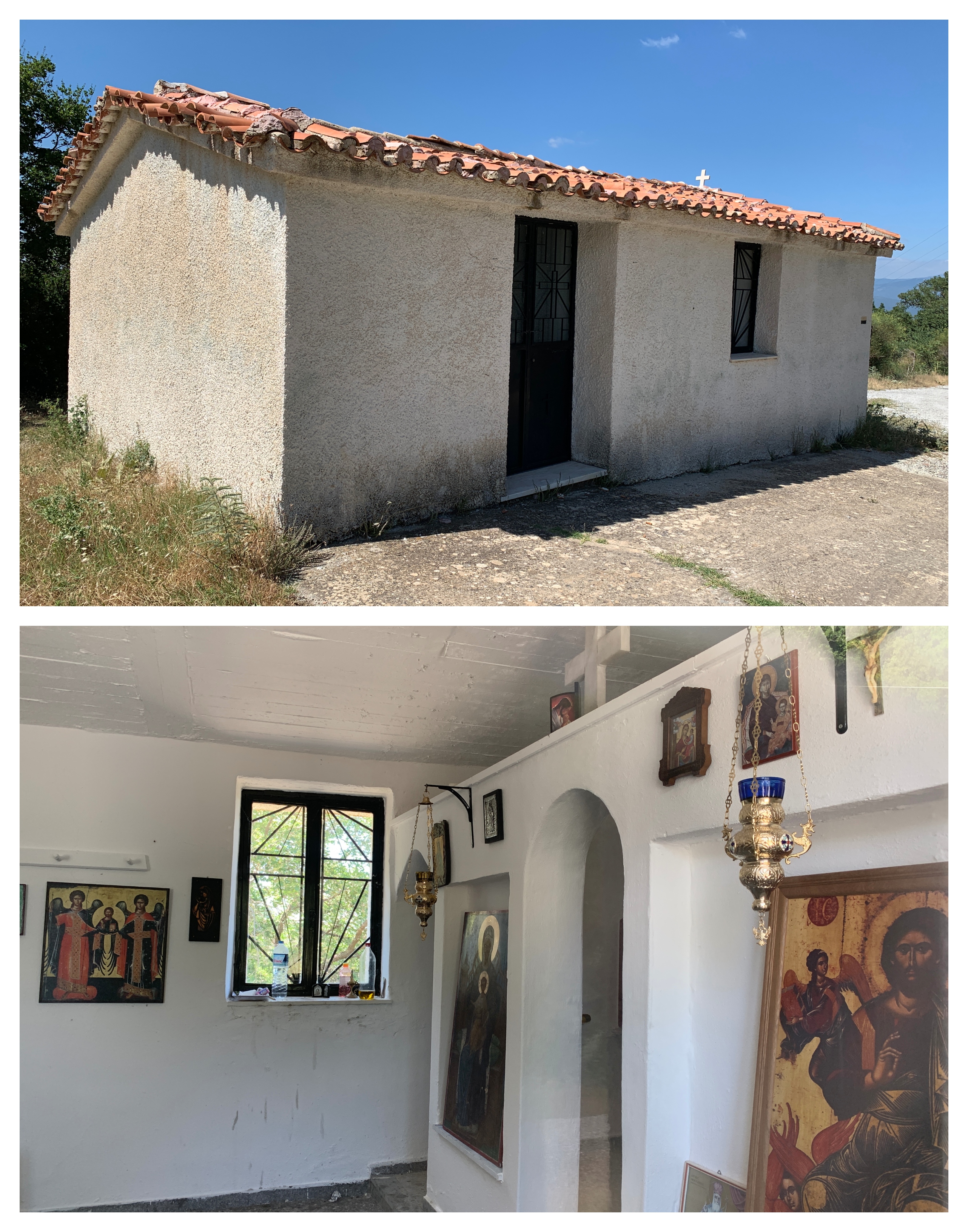
Agios Stratigos
Once again, the passable road ended at the monastery. I would have liked to continue towards Mystras, but the road became a steep gravel path descending precipitously down the mountain. Not in a Honda Civic! That’s when I realized that the road was maintained for the monastery. I turned around again and drove back to Anavryti.
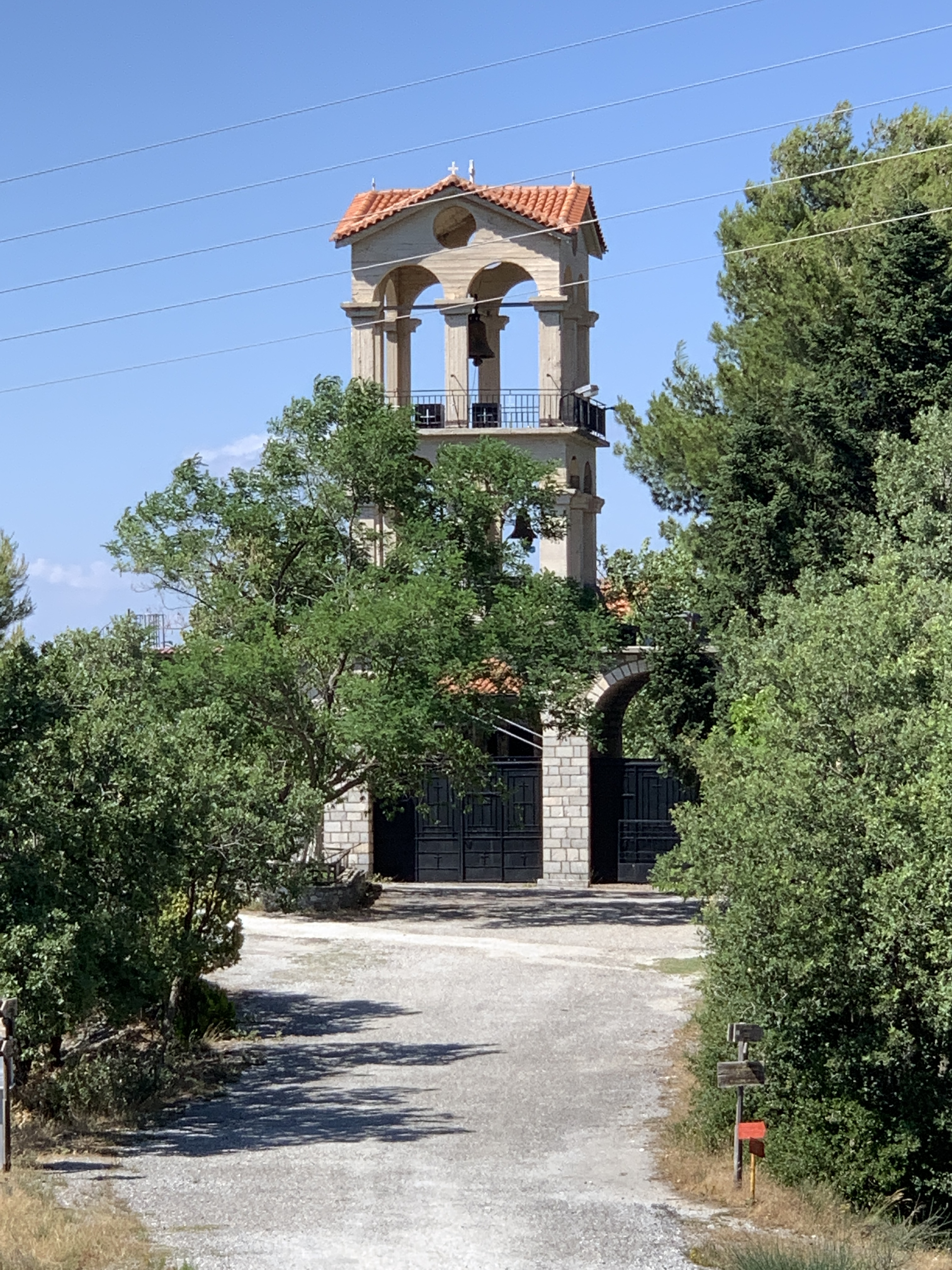
Faneromenis Monastery; a lovely but lonely edifice in the wilderness
No village stopover is complete without a visit to the cemetery. Cemeteries in Laconia are lovely memorials to loved ones. White marble crypts are decorated with flowers and photos. With the mountains as backdrop, they are peaceful and spiritual resting places.

Cemetery in Anavryti
Next summer, I am renting a Jeep and bringing walking shoes. I will get to Perganteika. How can I not go?

 Spartan Roots (Σπαρτιατικές Ρίζες)
Pingback: Perganteika: Reprise | Spartan Roots (Σπαρτιατικές Ρίζες)
Hi Carol,
Thank you so much for your fascinating articles, they are full of interesting information. My parents were from the areas you write about (Tripi not so much but Katsarou a few articles) and so it makes reading them doubly interesting. Thank you for all the hard work you put into this project of love.
Mary Michalakakos
Pingback: Kosta’s Map | Spartan Roots (Σπαρτιατικές Ρίζες)
Great story Carol! Sorry that you couldn’t make it all the way up the mountain. I had a similar experience when in Kyparissia in 2016. I wanted to go to Lentekada, where my Papouli lived before emigrating. Just by chance (more likely Divine Providence), I met a woman in a shop who introduced me to her husband who was from there. He went there every Saturday. He had a large Mercedes truck. He agreed to take me there. We needed every bit of power that that truck had to offer but we made it. I pray that you will have a similar encounter.
You DID get lucky! Thank you for sharing your experience, as it makes me doubly glad that I stopped when I did. Between the big rocks and steep incline, I knew I would be in trouble. Looking for a Jeep for next year 🙂
Carol, I enjoy all your articles, but this one definitely hit home for me! For one reason, I’m a half breed, paternal greek side with roots in Anavriti, of which I am dying to see. Second because Katsichtis is a line on my paternal grandmother’s side that I was able to obtain records and DNA matched cousins to build this branch out. Let us know when you plan on completing your trip up the mountain, if there is anyway I can meet you there, I would volunteer any and all the help I could offer you while taking all of into my spirit! All my best….Dawn
Such a wonderful account, Carol. I have one more week before I get home & am anxious to record my findings on Hellenic Genealogy Geek. I am basically still reeling from my discoveries in Kastorio.
How exciting! I look forward to reading your posts. And I am very happy for you!
What a marvelous story, Carol. I wonder if my G-G-grandfather in my mother’s paternal line lived similarly in the hills above ορεινη μελιγου, Arkadia. He is listed in a census as Ioannis Pagionis with his occupation as shepherd.
Correction: Ioannis Pagonis
Is he in a census or an Election List? My understanding is that fleeing to the hills during Ottoman rule was the norm in the Peloponnese so yes, he most likely would have follow the same pattern of going as high as possible, then coming down to the lower areas. What surprised me was to find a village above Anavryti. I can’t even begin to imagine the life our ancestors lived up there, but at least they were free from oppression. Thank you so much for your message
I received this unsolicited research from Achilleas Gazis: (The) 1871 electoral list for Thirea Municipality, where Astros belonged; no Pagonis shown for Astros proper, but in the Platanos village section, there is one Kyriakos Pagonis, son of Ioannis, aged 24, sheperd -see no 720 [a copy of the electoral list was included as a photo]. I think, now, I have misinterpreted who was the shepherd. My greandfather was George Kyriakos Pagonis, born 1884 in Astros.